
Aaaages ago, Susan asked me for more information about the buttonhole loop used in this top, and I totally forgot! I’m so sorry! right up until yesterday when Pencil Girl asked the same thing about Cassie’s top. Ladies, thank you so much for asking! I hopped to and wrote up my method… and if you dislike sewing tutorials then please skip over this… we’ll just pretend that this isn’t even here and we can still be friends, yeah? winkwink ;D
The buttonhole loop is a quick, easy and very unobtrusive button closure, made using thread alone. It is most often used for a short slit opening at the top centre back of a dress, blouse or a top, where two finished edges abut each other with no overlap; it is practically invisible as well as a quicker alternative to a rouleau loop. My grandmother used it aaallll the time, and taught me how to make one…
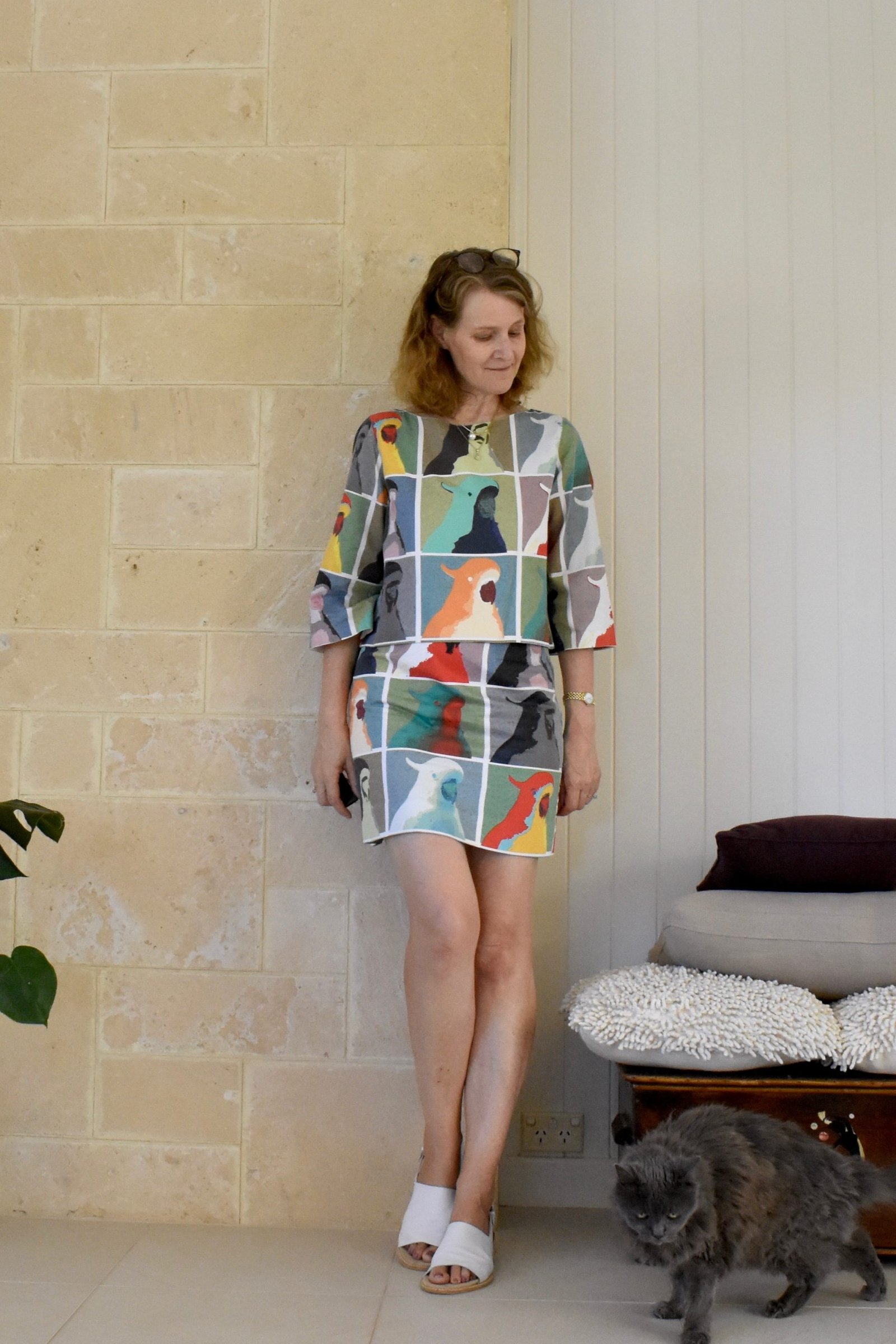
also, please let’s just pretend that this is the back of a divine little blouse made of Liberty lawn or something, and not what it is. Which is two measly scraps of leftover upholstery fabric from my recently made duffle bags… #notliberty #notsilk #ohtheshame
Stitch the button in place. Which side is up to your personal preference… although to have the button on the right hand side is conventional

Cut about 30cm (12″) of the thread you’re going to use. Buttonhole twist is traditional and the best if you are lucky enough to get hold of it, I am using upholstery thread here which is an excellent substitute. You can also just use regular, all-purpose thread or even embroidery thread if you like, it will probably be just fine if a little more difficult to work with. Reason being, regular thread is thinner and twists and tangles more easily, so is more likely to develop knots, and also results in a flimsier loop, naturally; and embroidery thread, being stranded, is more difficult to pull firmly into the knots you are forming with each stitch. But either would work out ok, in a pinch. There are no rules in sewing!

Secure the thread at the top of the left hand side of the opening. This should be at a level with the top of the button.

Lay it over the button so the thread lies around the button shank/stitching, and pull firmly until thread and two garment sides are sitting in the desired position. It’s more neat to have the sides abutting each other closely, although if you want a bit of a gap between the sides make the loop longer.

Stitch the thread once in the left hand side, level with the bottom of the button.
Lay the thread back around the button again, and stitch back in the top edge.
Being careful not to pull the loop out any looser or tighter, undo the button… now you’re going to work buttonhole stitch to totally cover up that two-stranded loop…

Bring the needle over the loop, insert it back under the loop and over the working thread on the other side… this is the buttonhole stitch. It’s basically the same as blanket stitch, but instead of doing it into the edge of fabric, you’re doing it over a thread in mid air, so to speak.

please excuse my dodgy drawing skills…

Pull it down firmly, and repeat; just keep going, going, going; pulling each stitch firm and trying to keep it all flat and even and straight; and not to rotate around the loop as you’re going along.

When you get to the end, secure the thread into the bottom of the loop by sewing three tiny stitches into the same spot three times.
aaand; done!































His is exactly how I would do it, too! 🙂
Thanks, Carolyn! I love your tutorials.
This was fabulous Caroline – you are too modest honestly. Your diagrams and descriptions were every bit as easy and plain to follow as any sewing book I’ve ever seen. I can see where there are times when you especially just want the simplicity of this loop so the button is more cleverly showcased. It’s subtle and dainty.
Thank you sooooo much!!! 🙂
I wish your tutorials were printer friendly. Would love to print and keep in binder for future reference.
I have been doing the buttonhole loop for years but the size of the loop was always hit and miss…..your tutorial is an aha!! moment for me…..thank you Carolyn.
Sorry if I’m missing this in your instructions but I’m wondering about knots. Did you make a knot in the very beginning and if so, where do you hide it? Did you make a knot at the end or just end with three tiny stitches and that’s sufficient to hold it all together without coming apart?
Thank you! beautiful loop!
Hi Karen; you start off by just stitching 3-4 tiny stitches into the one spot, over each other; the same as how you finish off. This is a pretty stable and secure way to start off stitching, and is the way I always start off a bit of hand stitching, with almost no exceptions. I think it’s more secure than a knot 🙂
Thank you! Just in time for the back closure on my newly made Farrow dress. How lovely to think how you’ve spread your grandmother’s knowledge to help other sewers around the world. Pretty amazing, actually!
This is MAGIC. I like this kind of closure and may even attempt it myself. Your instructions are encouraging.
Thank you! I’ve never known how to do this properly.
My grandmother taught me how to do this too! Your tutorial is the next best thing to a personal instructor 🙂
I am delighted to see this tutorial (with my name in it, too!). Thank you for spending the time to explain your method so clearly. I always struggle with the thickness of a self fabric loop. Plus, it is either too loose or too tight for the button. But now I see how you add the loop after the button is in place aligning everything in place with thread. Genius!
This is the method I use too although I’ve only ever used regular sewing thread. My mother taught me a similar method where you attach one end of the thread then work the buttonhole stitch with your hand until you get the desired length then attach the other end which was much easier but I can’t remember exactly how to do it this way so I have to use the method you described. ☹️
This is great! Very timely as I have a top whose loop constantly comes undone and annoys my husband as he has to constantly put it back on then lectures me! A job for today I think!
I think I could do this even though my sewing skills are almost non-existant
This is how I do it as well, and if I want to use a regular thread, I wax it so it strengthens the thread and also stops it from twisting and creating knots.
Thank you !!!
I wish you a beautiful year.
Such a pretty detail! I’ll have to keep this in mind 🙂
Thank you for demystifying this gorgeous finish, which I prefer to a fabric rouleau loop.
Pingback: Wednesday Weekly #66 – Helen's Closet
Lovely! Thank you for sharing your grandmother’s teachings! Wishing you a good and creative year.
I followed your tutorial this evening, and my loop turned out beautifully. Thank you so much for the excellent directions, photos and drawing. I needed all of them to understand what to do, but got it right on the first try. You are the best!