
So, I’ve been making some more soap, trying to develop a few new recipes of my own. Ever since my first go at soap-making, I’ve perused the oil selection at Coles with a lot more interest… and came home with a few new goodies to experiment with. Specifically; macadamia oil and avocado oil. Following the good advice a few kind commenters on my previous soap-making post, this time I used a soap calculator to help formulate my quantities, thank you Becky and Barb! for letting me know there was even such a thing! My recipes also contain different proportions of the other oils I already had, olive oil and coconut oil. I’ve been seeking out the paler yellow olive oil now too, because I wanted the natural colours of the new oils to be predominant …
And since I’m providing recipes here that include the highly toxic and corrosive compound sodium hydroxide, here are a few very important safety tips…
WHEN HANDLING NaOH, ALWAYS WEAR RUBBER GLOVES, PROTECTIVE EYEWEAR AND CLOTHING THAT COMPLETELY COVERS YOUR ARMS.
- Never let it get into contact with your skin. When mixing into water, work outside as much as possible so as to avoid inhaling the fumes. Never under any circumstances put your face over or near the container you are mixing it in.
- Ensure you are not going to be disturbed for the time you are working with it. Keep all pets and children well away.
- If you must take your lye solution inside, keep all windows open and work underneath a range hood with the fan on full blast.
- In the case of spills, clean up with copious amounts of water… i.e. a garden hose if outside. If you do happen to splash some on your skin, IMMEDIATELY put the affected area underneath a tap, and flush with water running fully over the area for several minutes at least. If you can see a visible burn or the area continues to sting and burn after copious flushing then seek medical attention immediately. NaOH is not to be trifled with!
Making your lye solution; FOR ALL RECIPES: When mixing NaOH into water, put the full volume of your cool or cold water into a clean, thick sided, glass container that has no cracks, and can hold at least twice the volume of the water you are working with. Add the NaOH to the water, a little at a time, stirring with a metal spoon. You can stir with a wooden spoon, but you may find the solution gets a little discoloured with tannins from the wood. NEVER add water to NaOH, ALWAYS ADD NaOH TO WATER. This is because as NaOH dissolves in water it generates heat and fumes, and is potentially explosive. If you have trouble remembering which is the correct way to mix the two: when I was at school we learnt this little ditty… and the exact same principle applies to working with a strong alkali like NaOH.
(Picture of a gravestone)
“May her rest be long and placid,
she added water to the acid;
The other girl did as she ought-er,
and added acid to the water”
Substitute alkali for acid, it’s the same situbar. After the solution mixes clear, it will be quite hot. Do not seal the container. Supervise it until it cools before using.
Moving on…. here are my recipes:

Macadamia Soap (7/10)
I absolutely love the dreamy cafe-au-lait colour I got with this mixture! whether it’s horrible to use or not I do not know yet, but will definitely update here and write a little review when it’s cured and I use it.
200g coconut oil
500g macadamia oil
300g olive oil
300mL water
137g NaOH
See the above safety note for handling and mixing NaOH.
Gently heat the coconut oil until it is liquid, then add the other oils.
Outside, carefully add NaOH to the water, a little at a time and stirring. Let it sit for a few minutes, uncovered and under constant supervision, until jar feels lukewarm and no longer hot, and fumes are no longer visibly emanating from the surface before mixing it into the oil.
Pour NaOH solution all at once into the oil, and commence stirring with a stick mixer not running. After a few minutes of this, turn the stick mixer on and keep “pulsing” and mixing for about 10 minutes or until the mixture becomes visibly “gelatinous” in appearance.
This mixture took a lot longer to set than my previous batches… at least 48 hours before it was hard enough to remove from the moulds without distorting them at all. I’m hoping this means it will be a really nice, moisturising soap 
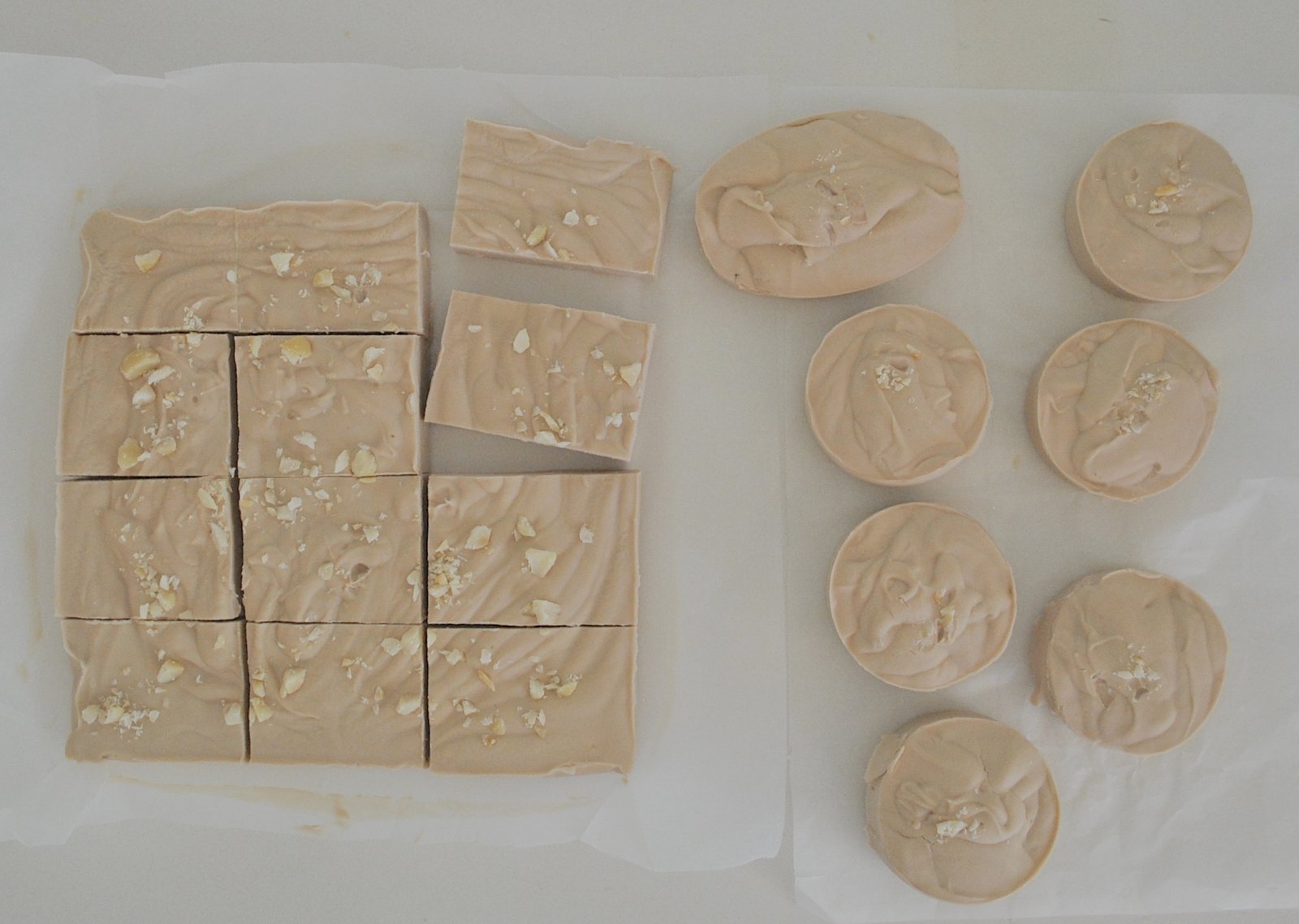
This recipe has larger quantities and so obviously produced a lot more soap than my previous recipes, I had an old Brie container and used this to mould the excess into a nicely oval-shaped bar of soap, but it was still overflowing and these bars are each quite a bit bigger and thicker. I chopped up some macadamias and sprinkled them on top for both decoration and as an identifier down the track, seemed like a good idea at the time! but then I decided I don’t like how it looks on top of the soap and will think of something different in the future…


Avocado Soap (5/10)
250mL avocado oil
400mL olive oil
110g coconut oil
200mL water
90g NaOH
See the above safety note for handling and mixing NaOH.
Exact same procedure as for the previous recipe…
This mixture got to the gel stage a lot more rapidly than the macadamia soap. The avocado oil was quite a strong natural “grass” green in colour, which gives this soap its creamy yellow-y green colour. This is the entire batch from this recipe: avocado oil is quite expensive and the bottle a small one, thus the smaller quantities.
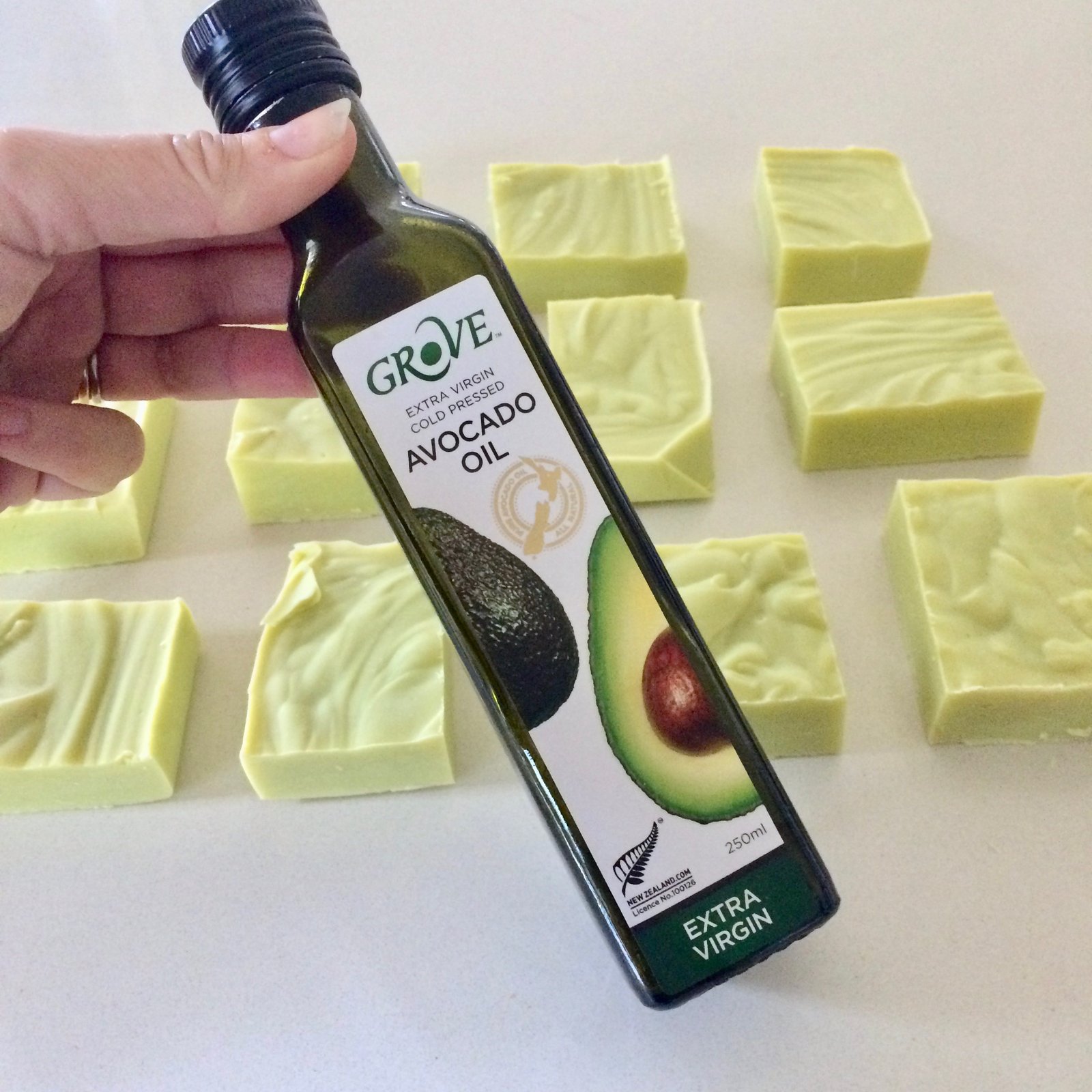
I just used my 24x24cm cake pan lined with baking paper, there wasn’t enough mixture for the silicone moulds too. The bars are quite deep though.
Just a note on how I’m choosing these quantities, it’s pretty easy to let the olive oil just take over your recipe since it’s so cheap compared to other oils, however I wanted to keep the “special” oil up there as a major-ish component and not just a token one! While for sure, costs are something you always want to consider, I still want to experiment with the more interesting oils, like macadamia and avocado and am quite excited to use both these ones once they cure too!
this is the full quantity of soap produced from this recipe… yes, the avocados are there for pretty, illustrative purposes only and are not required for the recipe!
Update:
I’m rating the Macadamia Soap a good solid 7/10; it’s nice soap to use and I probably will make it again. The macadamia oil makes it a little more expensive to make than some of the others which I why I’m rating it down just a little.
The Avocado soap is getting a slightly low 5/10… I mostly likely won’t make this again. The avocado oil was quite expensive, that pretty green colour faded as the soap dried, leaving it a regular old pale yellow colour, and also I just wasn’t keen on the, albeit subtle, fragrance of this soap. It just smelt a little on the…. “foody” side, is the only way I can think of putting it!
































Wonderful looking soaps…remember to let us know how they work out. So far I have made a dozen or so different recipes, including shaving soap and a shampoo bar (that one has not been tested so far, but the shaving soap was a huge hit). The most favorite by far is the lemon poppyseed scrubbing soap that I use for cleaning up after gardening, and I give it to all my gardening friends and relatives. I love the soap calculator because it lets me use up any bits and bobs of oils and every thing will work out in the end. It is a very enjoyable and useful hobby to have. My latest creation- little gingerbread soaps that I coloured with a little paprika, that will be embedded into a lighter soap for the kids. Have fun.
Barb from Canada
Carolyn, I’m reading your soap making adventures with great interest. Every recipe I read has tons of oils that I don’t have or can’t easily find. I have coconut oil and olive oil and even castor oil but couldn’t find any recipe that uses these. So thank you for sharing your simple easy recipes of small batch soap making.
The avocado oil soap has such a lovely hue!
Kay, try googling soap calculator. You can plug in the types of oils that are available to you. Olive oil is easy on the skin, coconut oil gives great lathering and a harder bar, but can be a bit drying in too large a quantity. Together they make a great soap.
Barb from Canada
Thanks Barb! I just could never figure out how to use the soap calculator.
On second thoughts, Maybe there’s a youtube video that shows how to use the soap calculator.
They look like candy! So beautiful.
When I used to make soap, for molds I often used hand-lotion bottles. I’d slice off the tops at the widest part of the bottle so that the soap could be easily pushed out, after slicing off the bottom when the soap was solid. These are nice hefty, oval, easy-to-grasp bars of soap.
I would encourage you to read a basic soap making book to give you a boost in decision making about oils and recipes. The first book I read about soap making was the short and concise Smart Soapmaking by Anne Watson, and it is excellent for outlining the actual science of making soap, and she also gives you a few good recipes. There are a lot of wild ideas about oils and soap additives on the internet that can lead you astray. I have learned over the years after lots of experimentation that my favorite soaps are not complicated and are made from mostly cheaper oils. My favorite soap is made from lard (creamy lather), tallow (hard bar), rice bran oil or avocado oil (great for dry skin), coconut milk (gentle and nourishing), a little canola oil (big bubbles), and sugar for increased lather. Milks soaps are really moisturizing and kind to my dry skin, but adding milk to soap can lead to disaster if not done correctly. I also encourage you to read the soapmakingforum.com on the internet. There are lots of expert soapmakers on that forum, and you will learn tips from them that are invaluable. I believe Anne’s book also has an oil chart that will guide you in choosing oils that will result in a hard bar that will not melt in the shower. It is fun when you start making soap to create your own exotic recipes, but it really is helpful to learn from others to avoid the pitfalls. If you are going to continue to make soap, I also encourage you to buy a good loaf mold at some point and learn how to line it. I predict you will have lots of fun with this hobby, Carolyn, and it results in lovely gifts for others as well. I have not bought any soap for years, and making my own soaps has improved my skin immensely.
Oooh. I keep looking for the magic cedar wood and bergamot soap. Maybe I should make my own! Lovely.
I’m so excited to see how these turn out. The suspense!
Love reading about your new ‘making’ adventures! Thank you for taking us along with you. 🙂