So, I actually bought a book called how to make your own soap about a year ago, took it home all full of enthusiasm, only to fizzle out once I realised that a lot of the recipes were full of rather hard-to-locate ingredients *sad trombone* I did enjoy looking at the pretty pictures though and dreaming a bit, not much else, kept on buying soap from the supermarket, blah blah blah… Fast forward to a few days ago, and I saw on ig a simply beautiful picture of castile soap Marilla had just made, and she mentioned how simple it was, only olive oil, water and sodium hydroxide! well that, I could manage!! I was inspired! Enthusiasm reignited! Immediately dove straight in; googled the youtube video she recommended, picked up the NaOH next time I went out. NaOH, aka caustic soda, aka lye, can be found in Bunnings in the heavy duty cleaner section.
Watching that youtube video, of course there were links to about a million other, soap-making videos, so I watched another, and another, fell down a bit of a rabbit-hole… who knew there were so many soap-making you-tubers??? Several of them prone to snarking on each other in the comments section, haha… but that’s another story! I did a bit of googling, and found some more simple recipes that also called for ingredients I could easily buy. By the way, I’m linking to the videos and recipes that gave me the proportions but I’m writing my own recipes here too… why? Several reasons: it’s a little annoying to have to sit through a whole video just to catch that moment when they mention the ingredients and quantities they’re using; secondly because I had to convert everything to metric, which is actually a pain in the neck and I don’t want to have to do it again the next time I want to make soap; and thirdly; I’ve altered some of the quantities to better fit in with a. the quantities of things I can buy here and b. for next time what I think is going to make a decent and manageable quantity of soap.
I made three types of soaps, pictured above from left: Castile, or pure olive oil soap, pure coconut soap, and buttermilk soap. I bought all the ingredients from the supermarket apart from the NaOH, which I got from Bunnings. It was lots of fun making soap… and far easier than I thought! 🙂
Since I’m writing recipes here : a few very important safety notes on working with NaOH, or caustic soda… long term readers may know that I’m an analytical chemist, and I spent years working with chemicals day in day out, and when you do that you can get a little lackadaisical with the handling of very dangerous chemicals. But never ever with stuff like NaOH! it is a very strong alkali; highly corrosive and potentially explosive if not handled correctly around, say, water, which you are doing when you’re making soap. So!

WHEN HANDLING NaOH, ALWAYS WEAR RUBBER GLOVES, PROTECTIVE EYEWEAR AND CLOTHING THAT COMPLETELY COVERS YOUR ARMS.
- Never let it get into contact with your skin. When mixing into water, work outside as much as possible so as to avoid inhaling the fumes. Never under any circumstances put your face over or near the container you are mixing it in.
- Ensure you are not going to be disturbed for the time you are working with it. Keep all pets and children well away.
- If you must take your lye solution inside, keep all windows open and work underneath a range hood with the fan on full blast.
- In the case of spills, clean up with copious amounts of water… i.e. a garden hose if outside. If you do happen to splash some on your skin, IMMEDIATELY put the affected area underneath a tap, and flush with water running fully over the area for several minutes at least. If you can see a visible burn or the area continues to sting and burn after copious flushing then seek medical attention immediately. NaOH is not to be trifled with!
Making your lye solution; FOR ALL RECIPES: When mixing NaOH into water, put the full volume of your cool or cold water into a clean, thick sided, glass container that has no cracks, and can hold at least twice the volume of the water you are working with. Add the NaOH to the water, a little at a time, stirring with a metal spoon. You can stir with a wooden spoon, but you may find the solution gets a little discoloured with tannins from the wood. NEVER add water to NaOH, ALWAYS ADD NaOH TO WATER. This is because as NaOH dissolves in water it generates heat and fumes, and is potentially explosive. If you have trouble remembering which is the correct way to mix the two: when I was at school we learnt this little ditty… and the exact same principle applies to working with a strong alkali like NaOH.
(Picture of a gravestone)
“May her rest be long and placid,
she added water to the acid;
The other girl did as she ought-er,
and added acid to the water”
Substitute alkali for acid, it’s the same situbar. After the solution mixes clear, it will be quite hot. Do not seal the container. Supervise it until it cools before using.
Having said all that, I hope I haven’t unnecessarily scared anyone off! as long as one is careful, knows what is going on with it and has a healthy respect for the dangers, and follows all the above simple and common sense safety rules, you should be fine. On with the soap-making!
Each recipe should make 18 bars of soap approximately the size pictured, give or take a little

Castile, or pure olive oil soap… (rating 4/10)
Based on this recipe…
1kg olive oil… I used an extra virgin olive oil… do not know if this makes any difference
280mL water
130g NaOH
See the above safety note for handling and mixing lye. Outside, carefully add NaOH to the water, a little at a time and stirring. Let it sit for a few minutes, uncovered and under constant supervision, until jar feels lukewarm and no longer hot, and fumes are no longer visibly emanating from the surface before mixing it into the oil.
Pour NaOH solution all at once into the oil, and commence mixing with the stick mixer not running. After a few minutes of this, turn the stick mixer on and keep mixing for about 10 minutes or until the mixture becomes visibly “gelatinous” in appearance.
this was my first effort, and got me hooked, it was so easy and quick! My olive oil was quite a strong green colour, and the mixture looked pretty swampy while I was mixing it, so I was pleasantly surprised at how the colour mellowed and softened into this beautifully soft and creamy, greeny-yellow. MUCH nicer!! We have an olive tree, so I snipped a few leaves to decorate my soap bars.

My second effort was this rather dreamy Coconut Soap ( 7/10)
based on this recipe
900mL coconut oil
340mL water
125g NaOH
See the above safety note for handling and mixing NaOH. Leave the solid coconut oil out in the sun, or even sitting in your car or something until it’s completely liquified. Procedure is otherwise exactly the same as for the castile soap, above.
 So, I’ve had a large jar of coconut oil sitting in my pantry for the last ten years or so; we’d bought it for Cassie to make a “beachy waves” hair product that required about 1 tablespoon of the stuff. The hair product was horrible, made your hair revoltingly greasy, and so the jar has sat untouched in our pantry ever since. Well guess what?! *throws a party* finally found a use for it!!!!
Note: I found this mixture gelled more quickly by comparison to the previous mixture, and was a noticeably more solid gel too. LOVE the heavenly pure white colour… like meringue! and I sprinkled some shredded coconut flakes over the top, just for decoration. Afterwards I thought I should have stirred some coconut through the mixture before pouring into moulds, it might make a nice exfoliant in the soap. Next time maybe!

Buttermilk soap (9/10!)
based on this recipe, though I didn’t watch the video… I’d watched enough videos by this time that I was like… got it!!
240mL buttermilk
800mL regular olive oil.. this one was a much paler yellow in colour, not as green as the variety I used for my castile soap
145g coconut oil
125g NaOH
Pour the buttermilk into ice-cube moulds and freeze. Once frozen, tip into a glass jar with a capacity of at least 500mL. Add the NaOH –see the above safety notes – and stir until dissolved. As the two mix, the heat given off will cause the buttermilk to melt quite quickly. I guess this is why you freeze it in the first place, so the heat of this reaction doesn’t burn the milk, or cause it to curdle.


In a large separate bowl, mix the oils, and add the buttermilk/NaOH mixture, and proceed just as previously described.
 Compare the mixture’s rather strong yellow colour above with the much paler colour it takes on as it sets and dries, below.
Note: I found this mixture took quite a lot longer to reach the “jelly” stage than the previous two recipes.

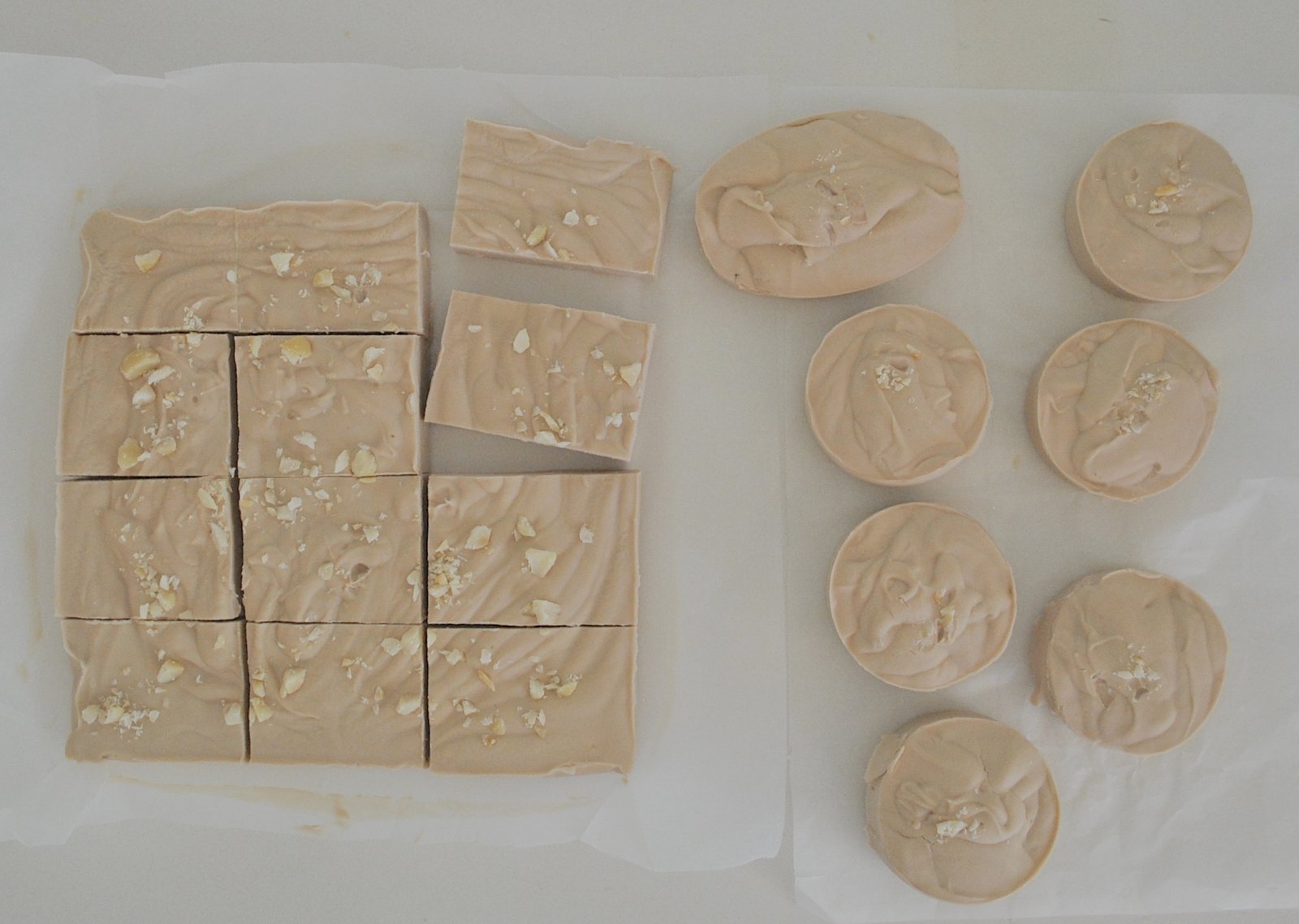
So that’s it! For moulding the soaps, I used a silicon, 6 capacity muffin tin and a 20cm x 20cm metal cake tin lined fully with baking paper, and let them sit for 24 hours before removing from moulds and cutting.
the buttermilk mix…

The muffin “tins” were great because the soaps just popped out ready formed and don’t need any further shaping… but I like the more conventionally shaped bars I cut from the slabs of soap too. The soaps need to cure for at least 6 weeks in a non-airtight container before using; I used old cardboard cereal boxes and have stored them up high on my overhead kitchen cabinets so they’re out of the way.
buttermilk soaps
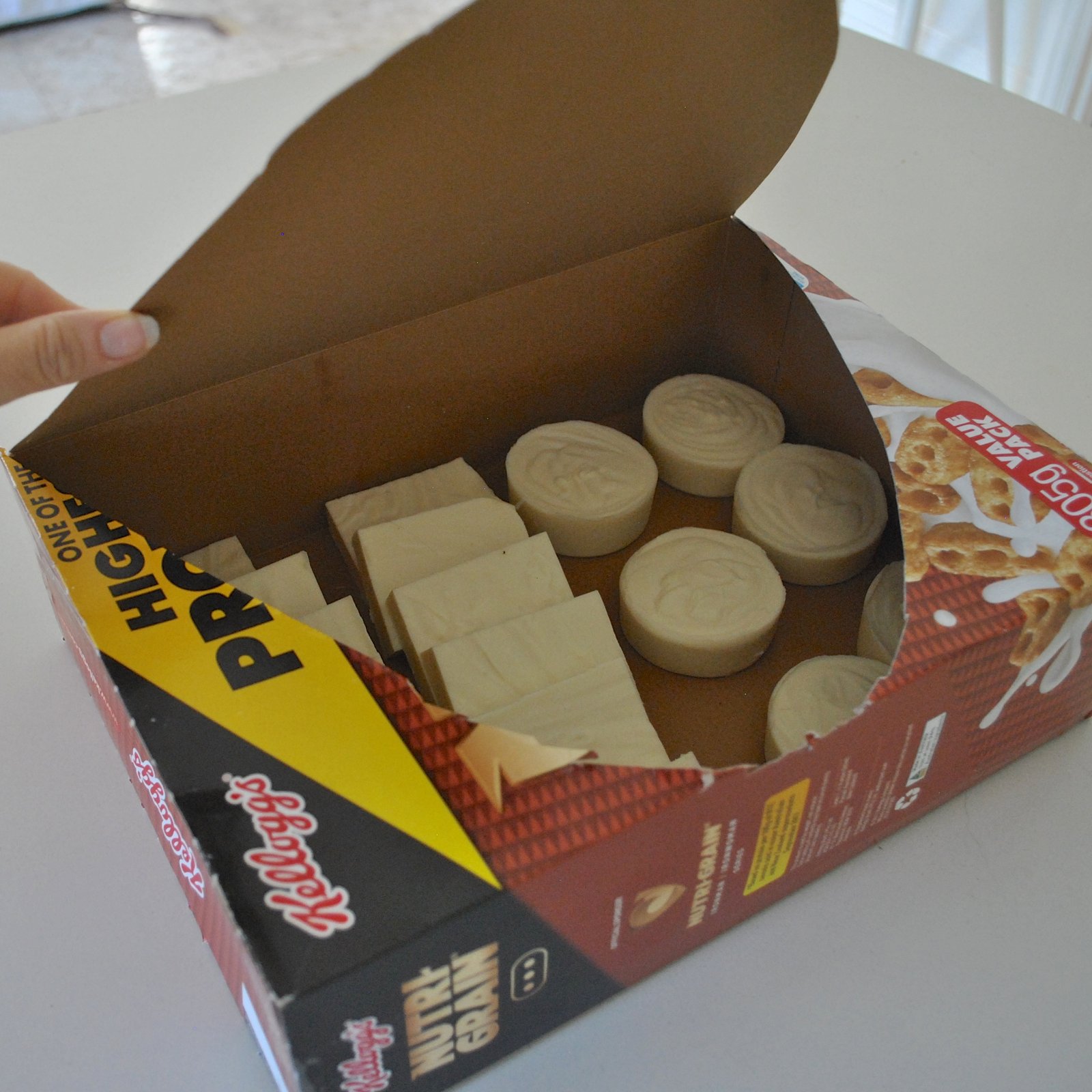
I can hardly wait until they’re ready! My pouring skills drastically improved with each batch, so my castile soap bars started out a bit messy with blobs of soap slopped up on the sides, a little rough and ready, the coconut soap is still kinda choppy but more attractively so, and my buttermilk soap bars are smooth and silky things of beauty to my eyes! I’m reeeeally looking forward to when they’ve all finished curing so we can try them out. According to my reading, if you start using them too early before they’re fully cured, homemade soaps will wash away faster and be used up too quickly, which would be a waste… we don’t want that!

the whole lot…I’m roughly estimating that this might be… maybe, a year’s? supply? though I’ve never really kept tabs on “how much” soap we use so that’s a pretty wild guess and I’ll have to wait and see.,.
I read that olive oil soaps apparently don’t give as much lather as other oil soaps, again we shall wait and see!
When I’ve tested them all out I’ll come back here and write an update! Stay tuned!
Update: so I’ve rated the soaps up there…. clearly my favourite is the Buttermilk soap, with a rating of 9/10… I love this soap! silky smooth and beautiful to use, and a lovely very soft, unobnoxious fragrance.
The Coconut soap I’m giving a good solid 7/10; although it has quite a hard texture I don’t mind this too much in a soap, but I am deducting a few points just for that. It has a nice, very subtle fragrance, and coconut is one of my favourite fragrances.
The Castile, or pure Olive Soap is sadly my least favourite of the bunch, it turned sloppy in the soap dish quite quickly and actually dissolved very quickly too. I’m not ruling out that I made some boo-boo while making it, it was my first go at soap-making after all! but all the same, I think I just prefer the others… 4/10
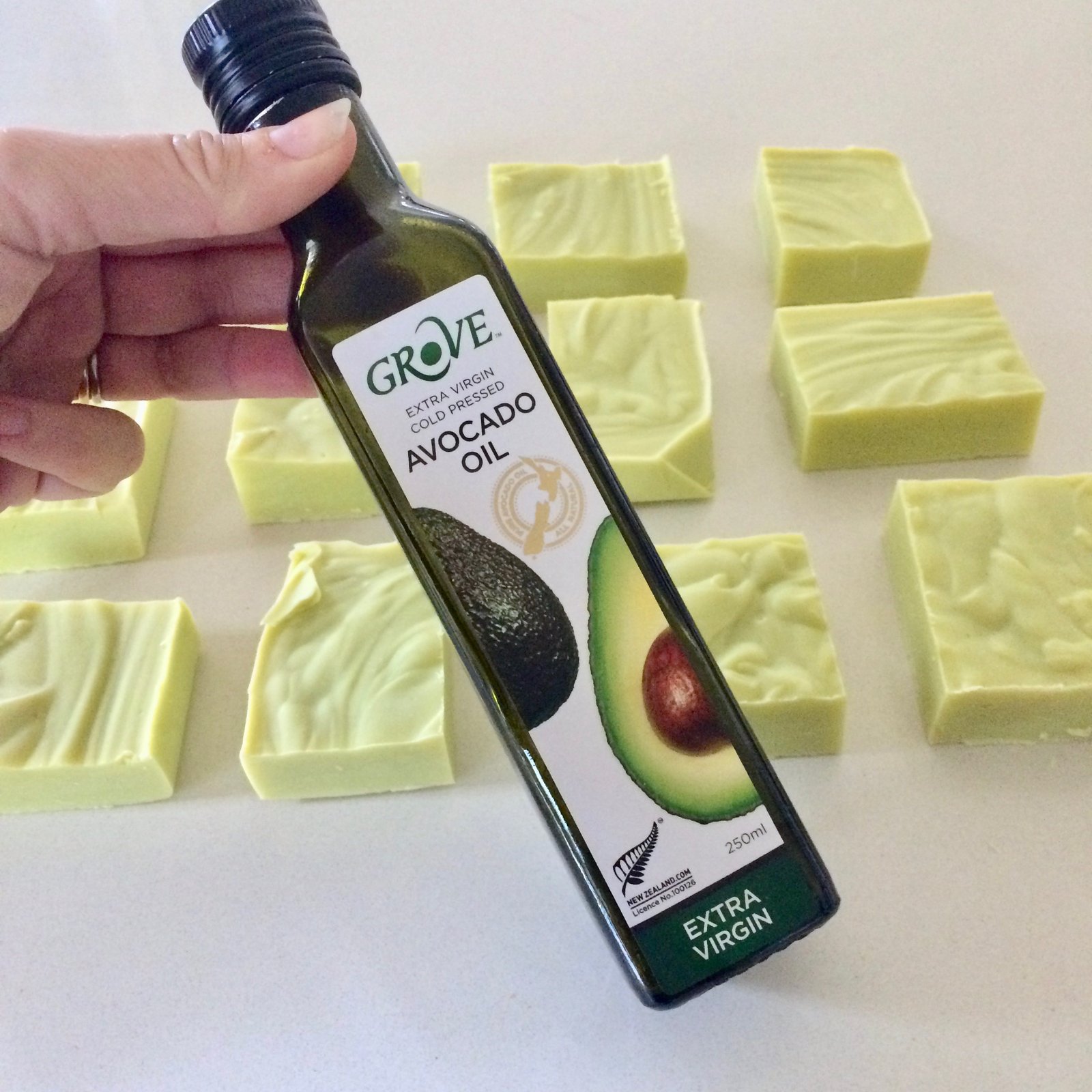
The other soaps I’ve made, Macadamia (7/10) and Avocado (5/10) are blogged here.

SaveSave
SaveSave
SaveSave
SaveSave
SaveSave
SaveSave
SaveSave