Tag Archives: Pattern Review

Snowy-white Nougat

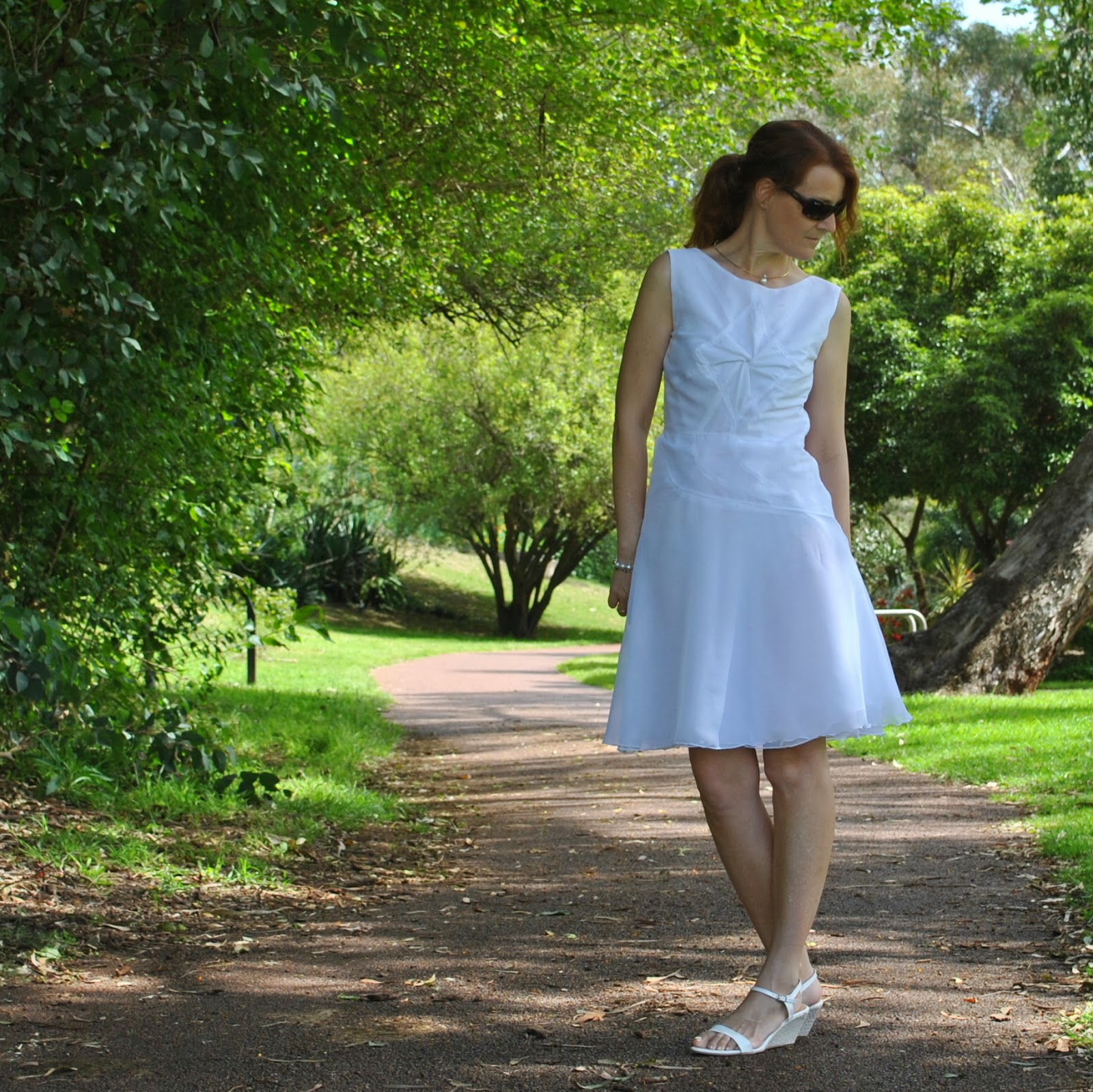
The clever AnaJan of Stepalica is designing patterns now!  and I was honoured when she very kindly sent to me her debut design, the Nougat dress to try out.  Thank you so much Ana!
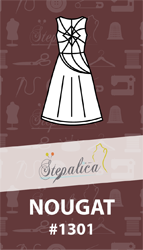
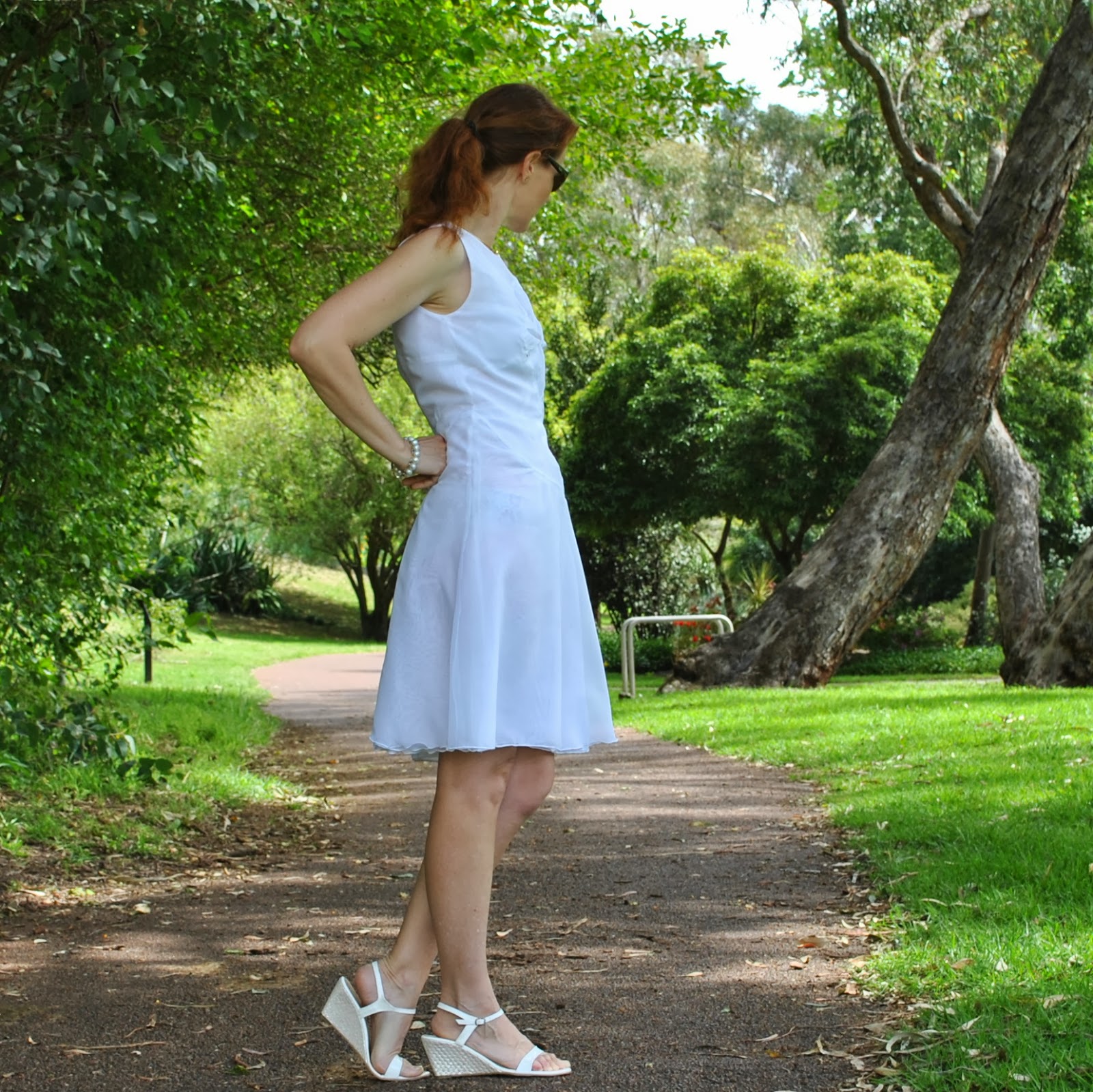
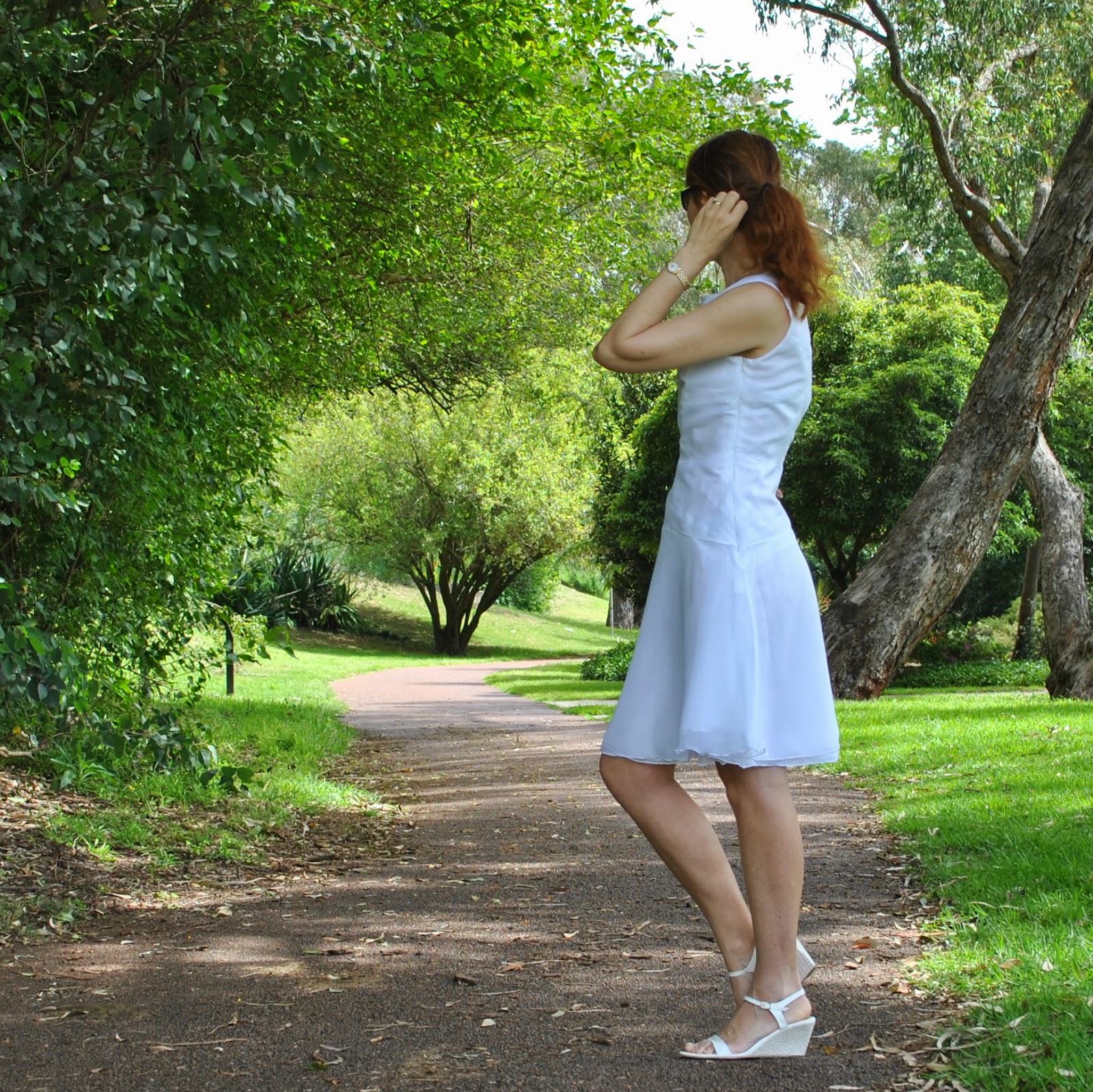
The Nougat is a classic, waisted, sleeveless A-line dress with a pretty swirly-skirted silhouette and closure by invisible zip in the left side seam.  Where the pattern is extremely clever however, is that it includes three variations of various degrees of difficulty, meaning there is a something for all skill levels.  If you want a challenge then version A with its multiple curved seams will give you a good one; if you want a pretty, A-line dress then version C delivers this too.  I went for the trickiest version A for my first go, but the one pattern includes all pattern pieces and instructions for the two progressively more simplified versions B and C, and there are comprehensive instructions to walk you through constructing the more fiddly bits of the more advanced version A.  I was a bit late for the Nougat sewalong, but I consulted Ana’s posts when I did get around to making my own version, and I found all her sewalong instructions to be detailed, thorough and very helpful.

Ana suggested for the bodice and skirt yoke pieces to be cut from different colours of fabric, to enhance and showcase the swirl effect of the piecing.  The seaming can be seen far better on Ana’s very impressive blue version of the dress here with absolutely perfect seam joining!  However, I really just wanted a lovely fresh plain white dress to ring in summer, so used a small portion of an embarrassingly ginormous quantity of white fabric that I have stuffed in bags in the cupboard under the stairs  (mwahaha)  This fabric originally spent a few years as pictured below.  Until I decided that big white swags of fabric decoratively framing a bedhead were a haven for spiders as well as pretty passe.  I took it down many years ago, but obviously I kept all that wonderful fabric!  It is actually very nice fabric; a mixture of synthetic organza and chiffon which means of course that the dress can be just tossed in the washing machine, will drip dry, and will never ever need ironing.  Yeesssss!
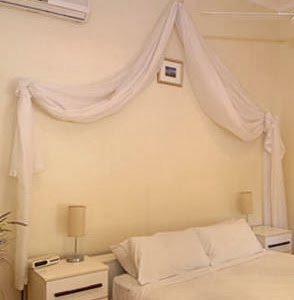
before…

 The bodice and skirt yokes are made of double layered organza, with the inner/lining layer a plainer version of the pattern, relatively un-pieced apart from a few basic shaping seams and darts.  Because all my fabrics are pretty fray-tastic plus see-through, I put quite lot of thought into how I could stabilise all those raw edges.  There are so many of them in this multi-pieced design!  I didn’t want to overlock because the stitching would show through and be super obvious on the outside of the dress.  So for the organza bodice and skirt yokes I sewed the seams, pressed open, trimmed the seam allowances quite narrow with my cutting wheel, and then double top-stitched each side of each seamline.  I posted a close-up picture of the seam detail on photo maisonette last week. 
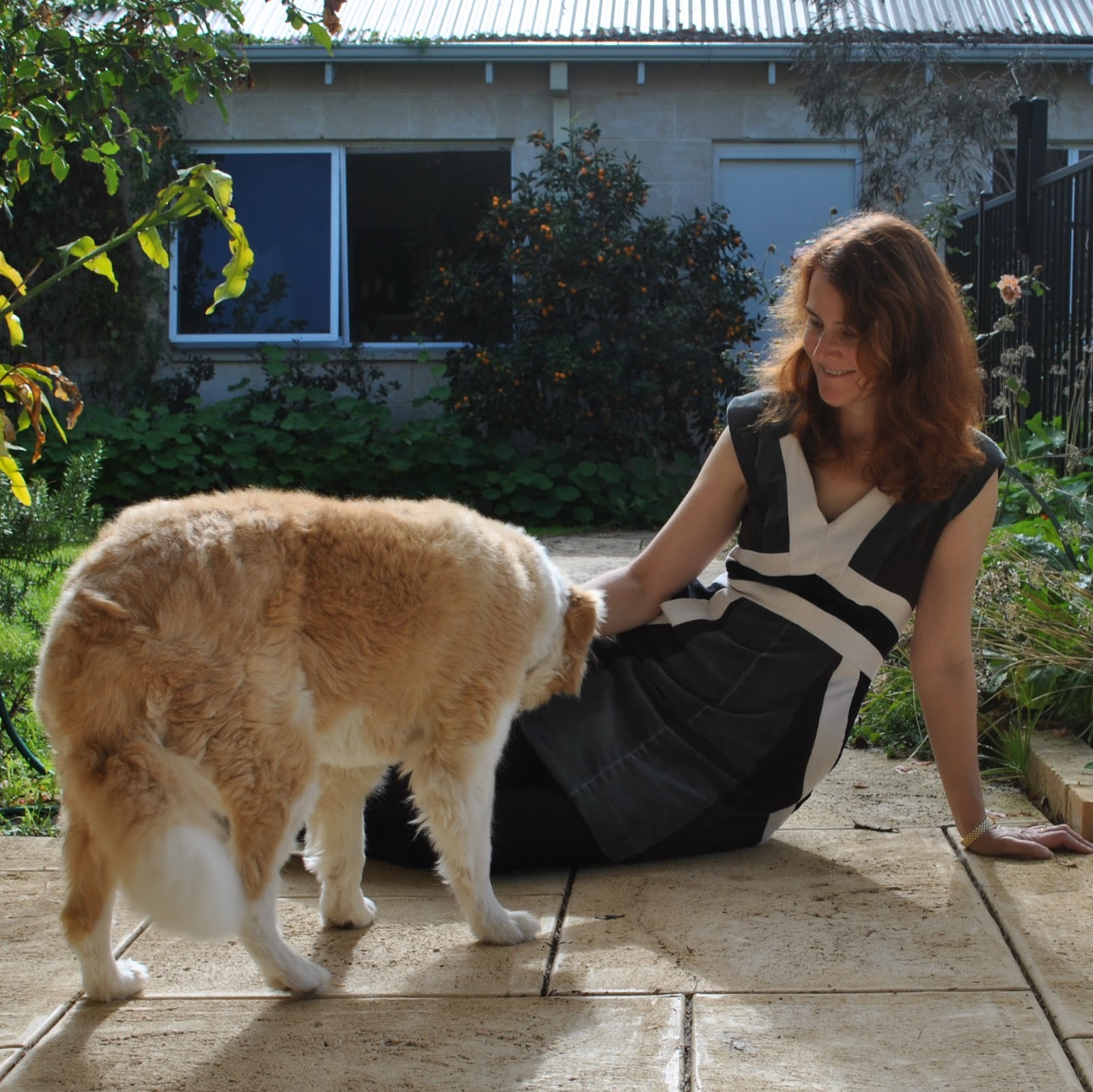
The skirt is actually three separate identical chiffon skirts, layered.  One is attached to the shell of the dress, the other two sandwich the lower edge of the lining.  Each side seam is sewn in French seams, and I finished the lower edges of each skirt using the rolled hem stitch on my overlocker.  I do really love the romantic ripply look of the layered skirts.  The design is a very lovely shape.  Very twirl-tastic, yes?  I did a twirl photo, just because.  Hehe, one of my pictures revealed that I am a fairly grim-faced twirler.  I am so impressed by people that can twirl and have a happy, carefree facial expression at the same time.  Me, I need to concentrate on not falling over!
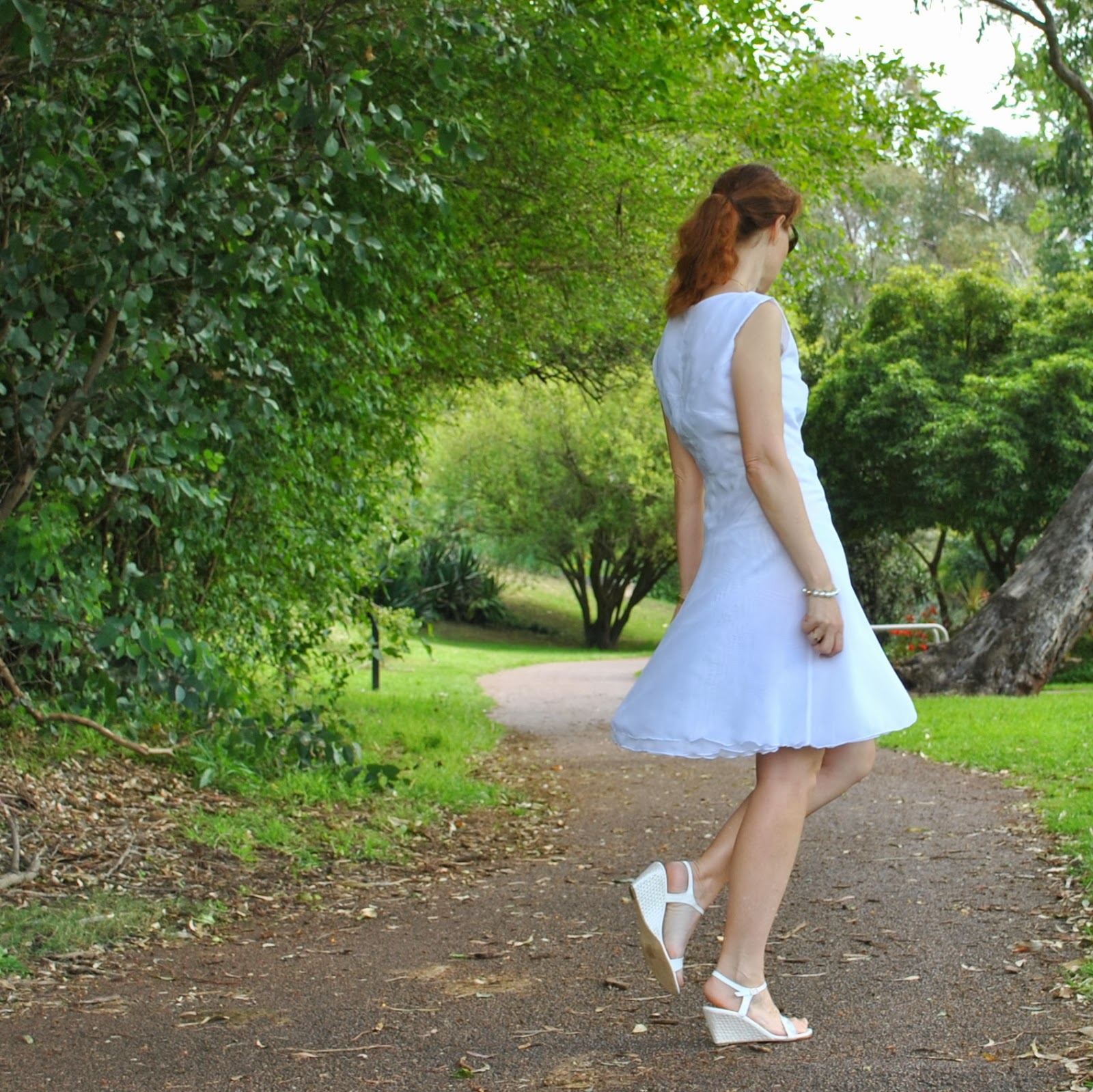
I am wearing my new ivory summer sandals too.  Aren’t they lovely? Obviously ivory is one of my favourite colours anyway, no matter what the season, and I really like the woven wedge heel too.  These will be appearing in lots more summer piccies to come!
Making my dress was not all plain sailing.  There are boo-boos.  I didn’t notice at first that the two halves of the back bodice were different to each other and so mistakenly constructed it as a mirror image of one side; therefore three of my seam lines on the right side of the dress do not join up.  One on the shoulder, one on the bodice and one on the skirt/bodice seam.  Rats.  But since I did use just one colour you can’t really tell without super up-close inspection, hehe.  My other seams all mostly join up  😉
Details:
Dress; the Nougat dress by Stepalica patterns, white organza and chiffon
Sandals; c/o Misano shoes
it’s hard to know what to do with your arms when taking side view piccies… 

Pattern
Description:
The Nougat is a classic, waisted, sleeveless A-line dress with a pretty swirly-skirted silhouette and closure by invisible zip in the left side seam.  The pattern includes three variations of various degrees of difficulty, the most advanced option has a complex swirled twisted diamond motif in the front bodice, with sunburst seamlines radiating out and then back in again to join together at the left hip. 
Pattern
Sizing:
European size
32-44. I cut a size 34 in the bodice, grading out from the waist to a size 38 at the hip level.  Because of these personal sizing changes I also cut the skirt pieces to be a bit more flared going down to the hemline than the pattern to give a better look proportionally.
Did
it look like the photo/drawing on the pattern envelope once you had finished
sewing it?
Yes.
Were
the instructions easy to follow?
The instructions are very clear and well written, and very helpful.  I definitely needed them for that complex diamond motif! but I did use some of my own preferred sewing construction techniques for some of the basics.
What
did you particularly like or dislike about the pattern?
The silhouette is not one I would normally go for, and I quite thrilled with how much I like it.  I really love the line of the skirt.
I really enjoyed the challenge of sewing the diamond motif and in spite of a few boo-boos I am pleased with how it all came together.
Fabric
Used:
Synthetic organza for the bodice and skirt yoke and chiffon for the skirt 
Pattern
alterations or any design changes you made:
I stuck pretty closely with the original design, and just cut the skirt a bit more flared for my version.  I sewed double rows of topstitching flanking each seamline on the bodice and skirt yokes, both to visually define them better and to anchor and stabilise the seam allowances and guard against fraying.
Would
you sew it again? Would you recommend it to others?

I think I only need one of version A in my wardrobe since it is quite a distinctive design, but I would definitely sew either of versions B or C again.  I recommend version A to the advanced seamster looking for a challenge.
Conclusion:
I am very pleased with it!  I really wanted a white dress for summer which is why I went for a solid colour version of the pattern, and now it reminds me of an old-fashioned tennis dress.  There is something quaint and ladylike and yet still sporty about the silhouette that I really like.  The seaming is really interesting, and I am in love with the swishiness of the skirt.
pinterestmail

Libra

… the sign of the scales.
So at first sight there may appear to be absolutely nothing scales-y or balanced or anything at all even vaguely Libran about my ensemble.  So what on earth is the Libran element here… ?  Well ME!  Yes, it is my birthday today.  And I have made for myself a birthday dress, especially for socialising like the flirty sociable little butterfly that Librans are supposed to be.  Hehe, I can’t help but laugh at that description since I am the complete opposite of a social butterfly, seriously!  It’s a miracle that I’m not still tucked in the corner of the laboratory hunched over the HPLC, but actually do have friends, and a husband!  Although maybe I just swapped the HPLC for the sewing machine?  Yeah.  I think I totally did.  You just can’t escape your true nature…
However, socialising has been had.  Monday I had a delightful morning tea with friends, who gave me a Fabulous Fabrics voucher…. aah they know me so well!  And I intend to make a nice dinner and cake to have with my fambly tonight.
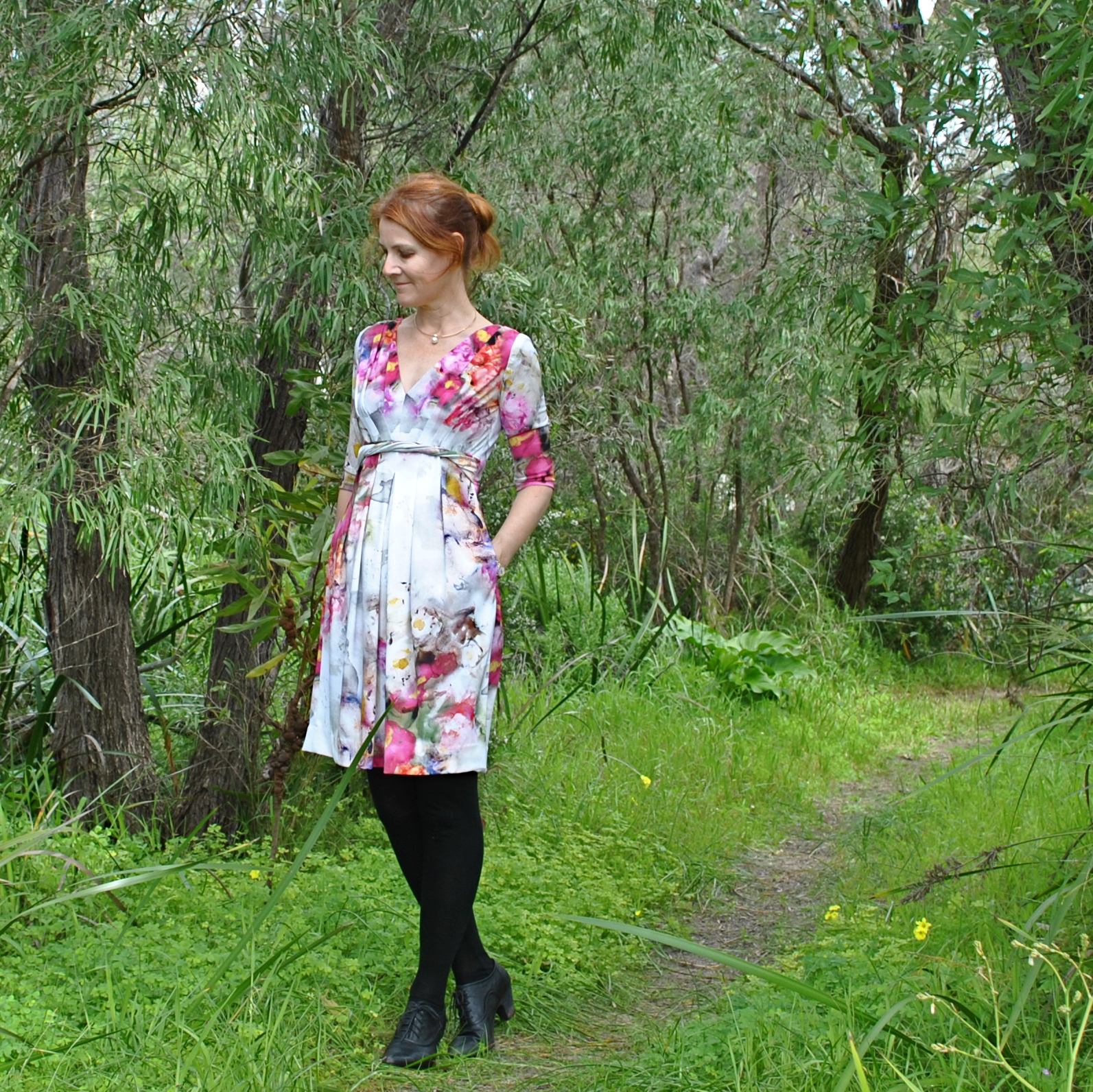
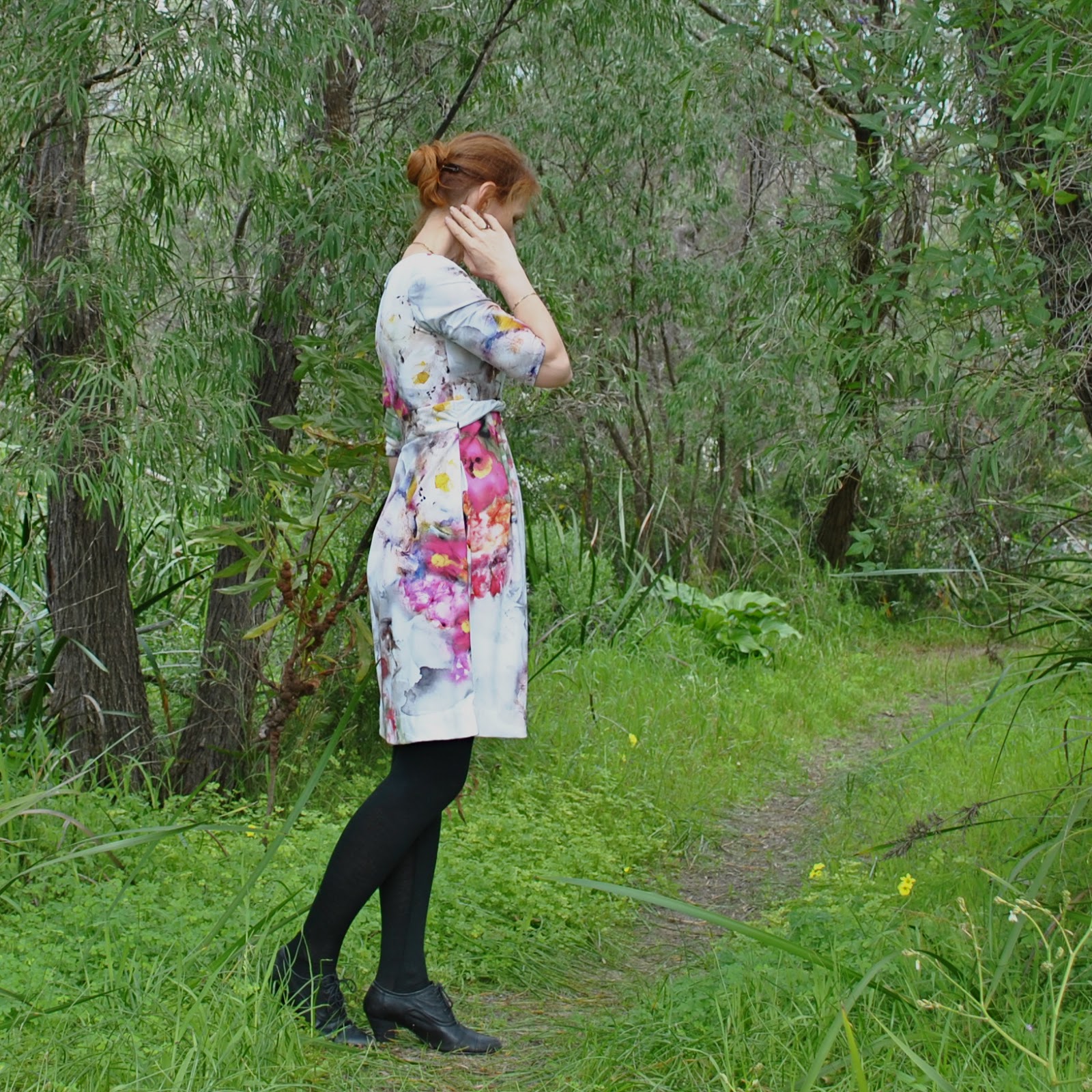
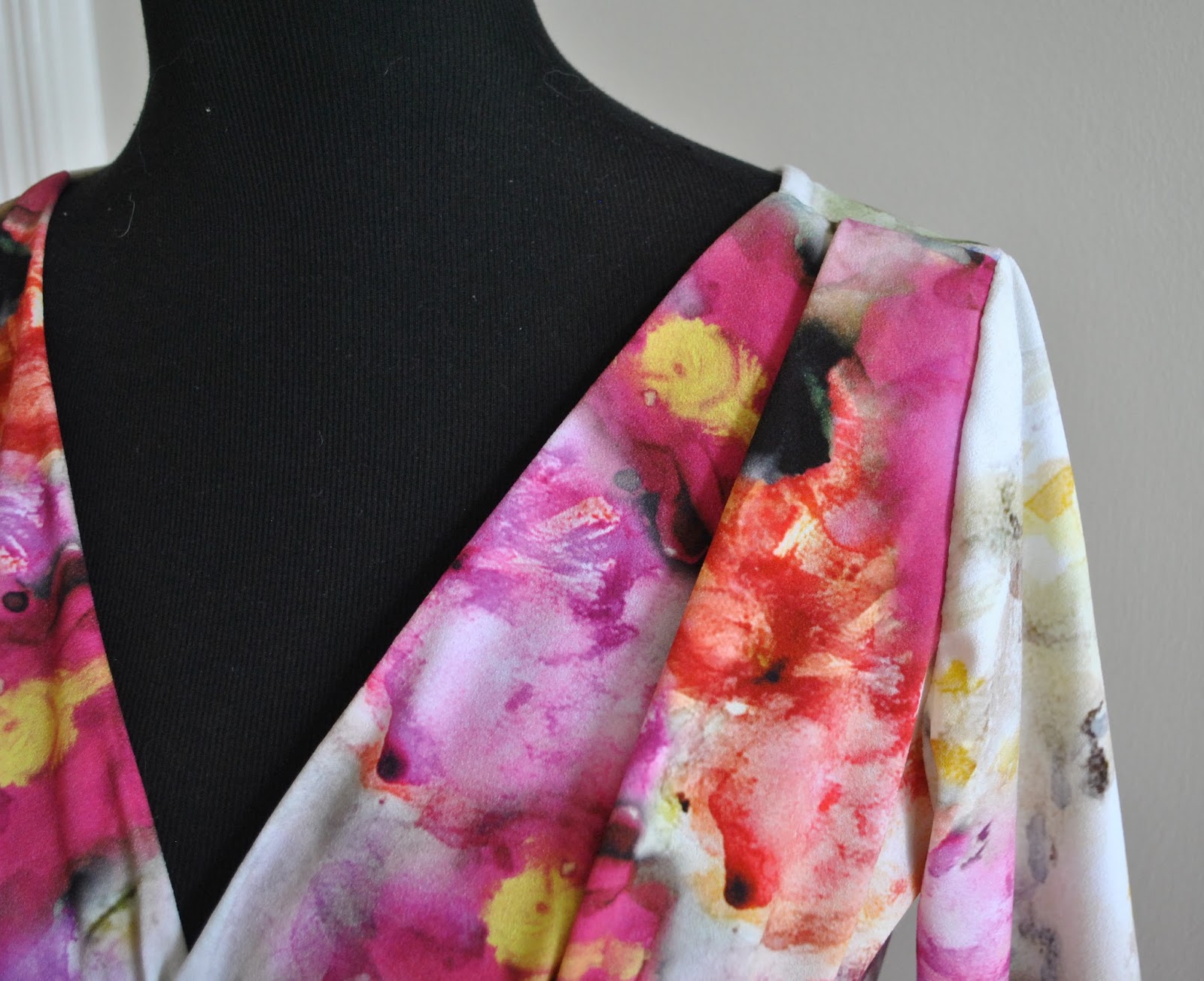
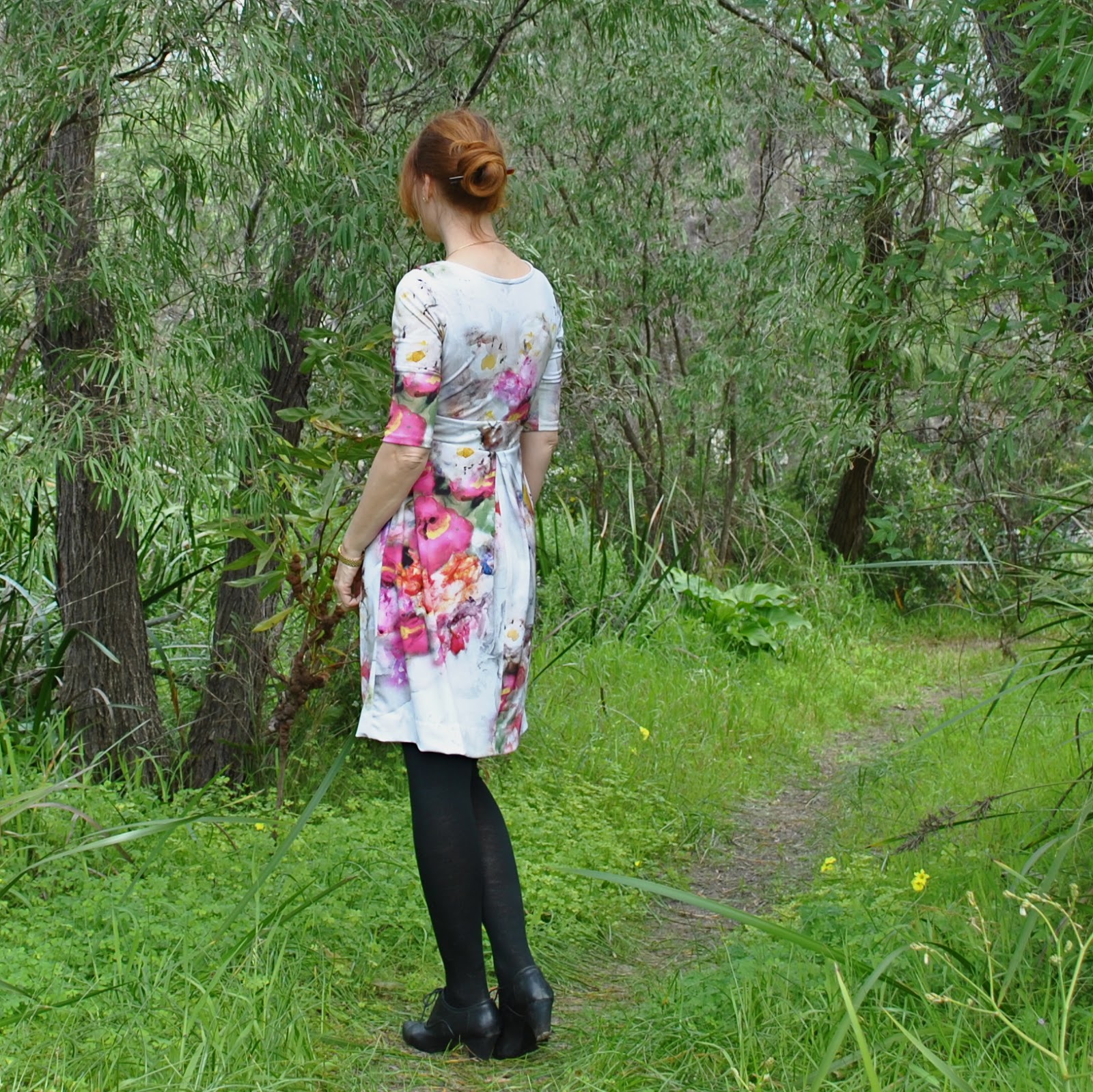
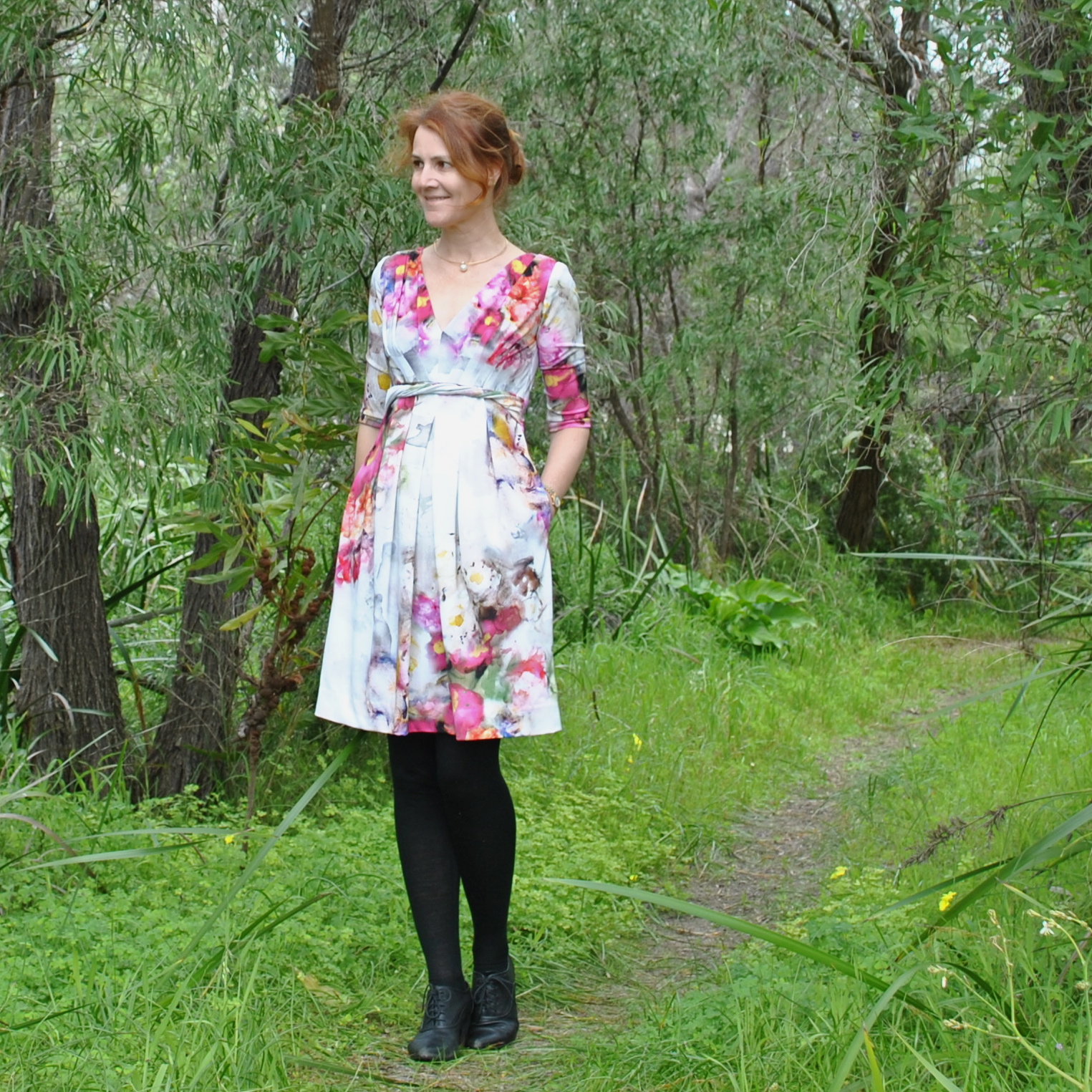
But, enough blahdy-blah… my new dress.  Florals, for spring.  I know right?  soooo innovative!  😀  But everyone loves to have a pretty new dress for the new season, yes?
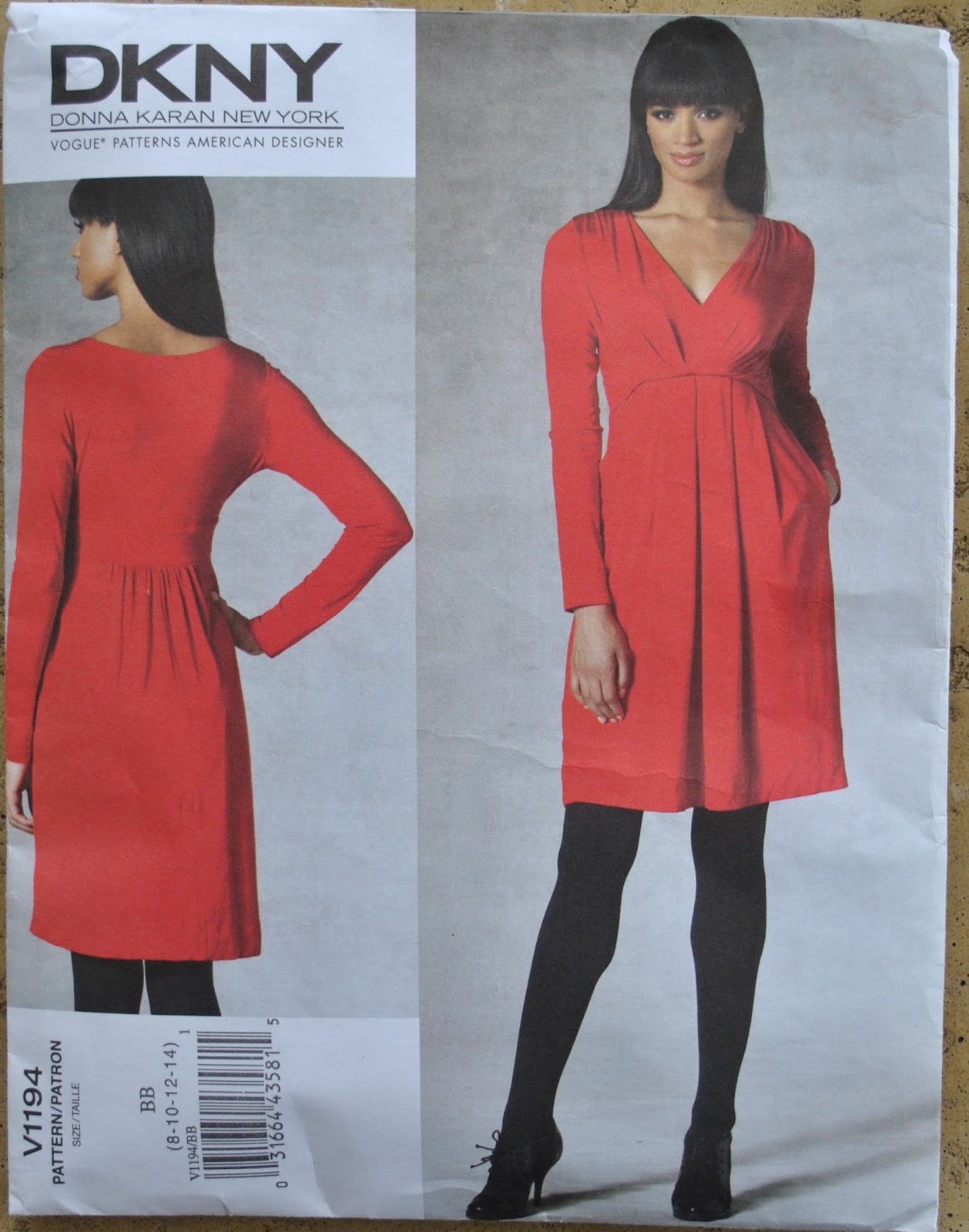
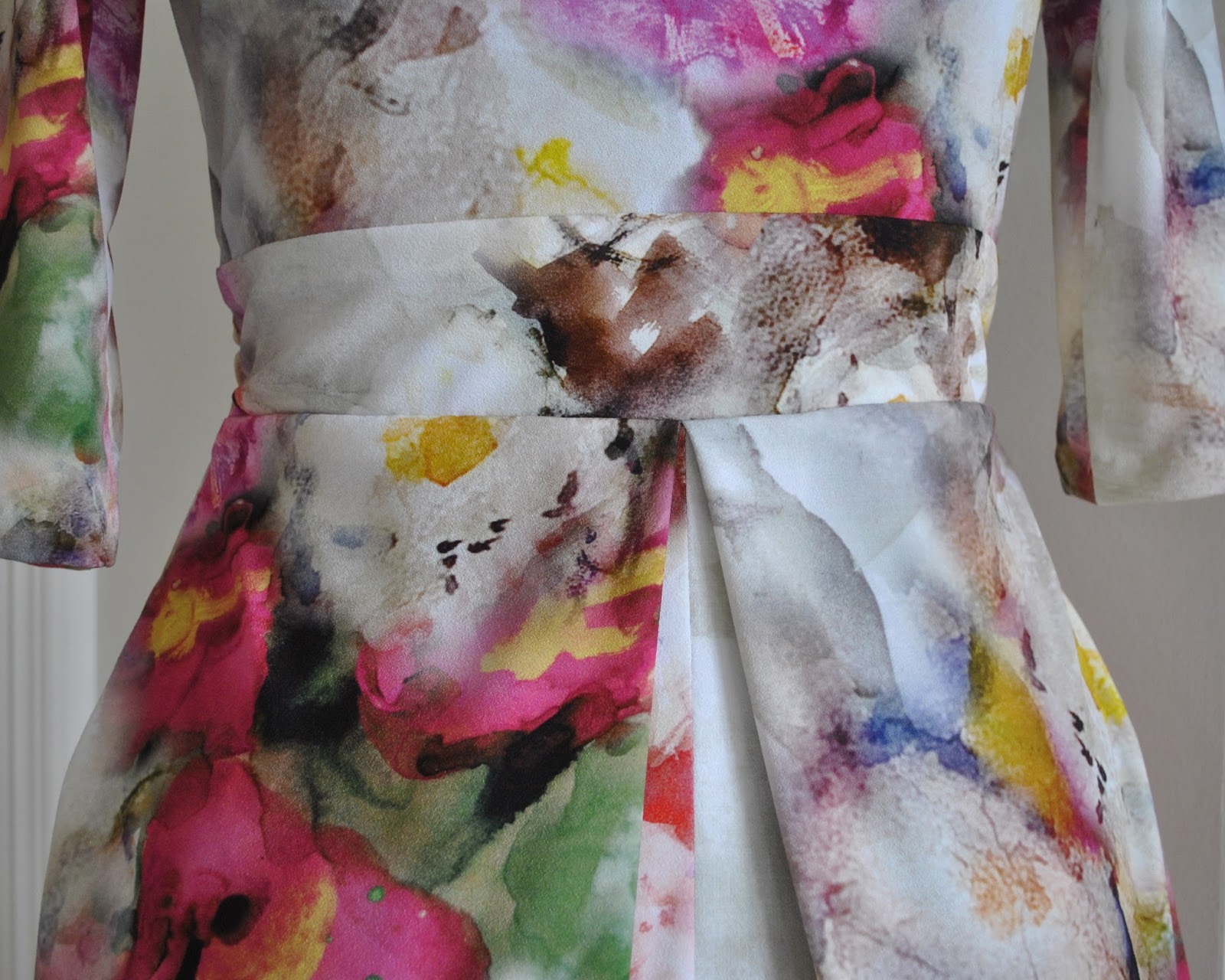
This is Vogue 1194, a pattern I bought not long after it first came out and have just never got around to it.  I made it pretty much to the pattern except with just a few minor variations… I folded the excess fabric at both shoulders and also at the centre of the skirt back into pleats, pictured below, rather than have gathers as per the pattern.  I’m afraid I just do not like gathers very much, poor things.  And I have shortened the sleeves to elbow length, more suitable for our warm weather.
The fabric is a gorgeous watercolour-y printed stretch knit from Fabulous Fabrics.  So, actually I originally wanted to make this fabric into a lingerie set, and the day I bought it I was meeting my friend J for lunch and showed it to her.  She seemed slightly horrified that its loveliness was never going to see the light of day and urged me to make a dress instead.  I went away a little thoughtful, a little dampened, but still fairly determined to make lingerie.  I showed the fabric to my mother, and to Cassie next, both of whom vehemently agreed with J that to make it into lingerie was the silliest idea they had every heard.  Well, they put it more tactfully than that but that was the gist of it.
I felt even less certain about my lingerie plan.
The final kicker though was when I laid down my fabric and pattern pieces and discovered that the Vogue 1194 skirt pieces plus a few others pretty much fitted perfectly and I only needed to buy a bit more to get out the remainder of the pieces.
The universe was telling me something and I was finally getting it.
So I cut out the dress instead natch… and ended up making my lingerie set from my poppies print instead, so all’s well that ends well, no?
After all my talk about slips and linings the other day, maybe I should mention that the dress is unlined, but that I am wearing my beige satin petticoat underneath.  Hope that’s not tmi.  Or course the petticoat cannot be seen, which is just the way things should be, yes?

Details:
Dress; Vogue 1194, floral stretch fabric
Petticoat (not seen): Burda 8071, beige satin, details here
Tights; self-drafted, of black merino wool, details here
Shoes; Django and Juliette, from Zomp shoes

Pattern Description:
Pullover, mid-knee length dress has loose-fitting front pleated and gathered bodice, bands (twisted front), raised waist, A-line, front pleated and back gathered skirt, side pockets, stitched hems and long sleeves.
Pattern Sizing:
Size 8-14. Other reviewers noted that the pattern runs a little big so I went down a size from my usual and cut a size 8.  This was a good decision.
Did it look like the photo/drawing on the pattern envelope once you had finished sewing it?
In essence, although I wanted a springy dress so cut my sleeves to three quarter length.
Were the instructions easy to follow?
Very! and also it is rated an Easy pattern by Vogue
What did you particularly like or dislike about the pattern?
I have always liked the simple softly draping pleats on this one, and the flattering V-neckline.  The skirt is full enough to allow deep side pockets and yet still appears slimline and not pouffy or bulky.
The look of the gathering on the skirt back on the pattern envelope caught my eye in a not-good way, fortunately it is easy to instead fold the excess fabric into a sleeker-looking box pleat.
For my size the pattern stipulates that 1.9m of fabric is needed.  Cutting the sleeves to elbow length, I found 1.3m of fabric to be sufficient.
Fabric Used:
Printed stretchy fabric 
Pattern alterations or any design changes you made:
I pleated the excess fabric in the front shoulders, and also I folded a symmetrical box pleat centred on the skirt back joining seam, thus eliminating all gathering in my version of this pattern.
I hand-stitched the sleeve and lower hems.
Would you sew it again? Would you recommend it to others?
OK, so I always say yes I will sew it again and then only occasionally do I follow through, but this is such a basic and classic silhouette and so easy to run up very quickly, so I am absolutely certain that I will, soon  🙂 
And yes, highly  🙂
Conclusion:
Easy, stylish and flattering, this basic yet prettily feminine design is very lovely in my opinion.   I’m very happy with my new dress!
pinterestmail

the Panellist

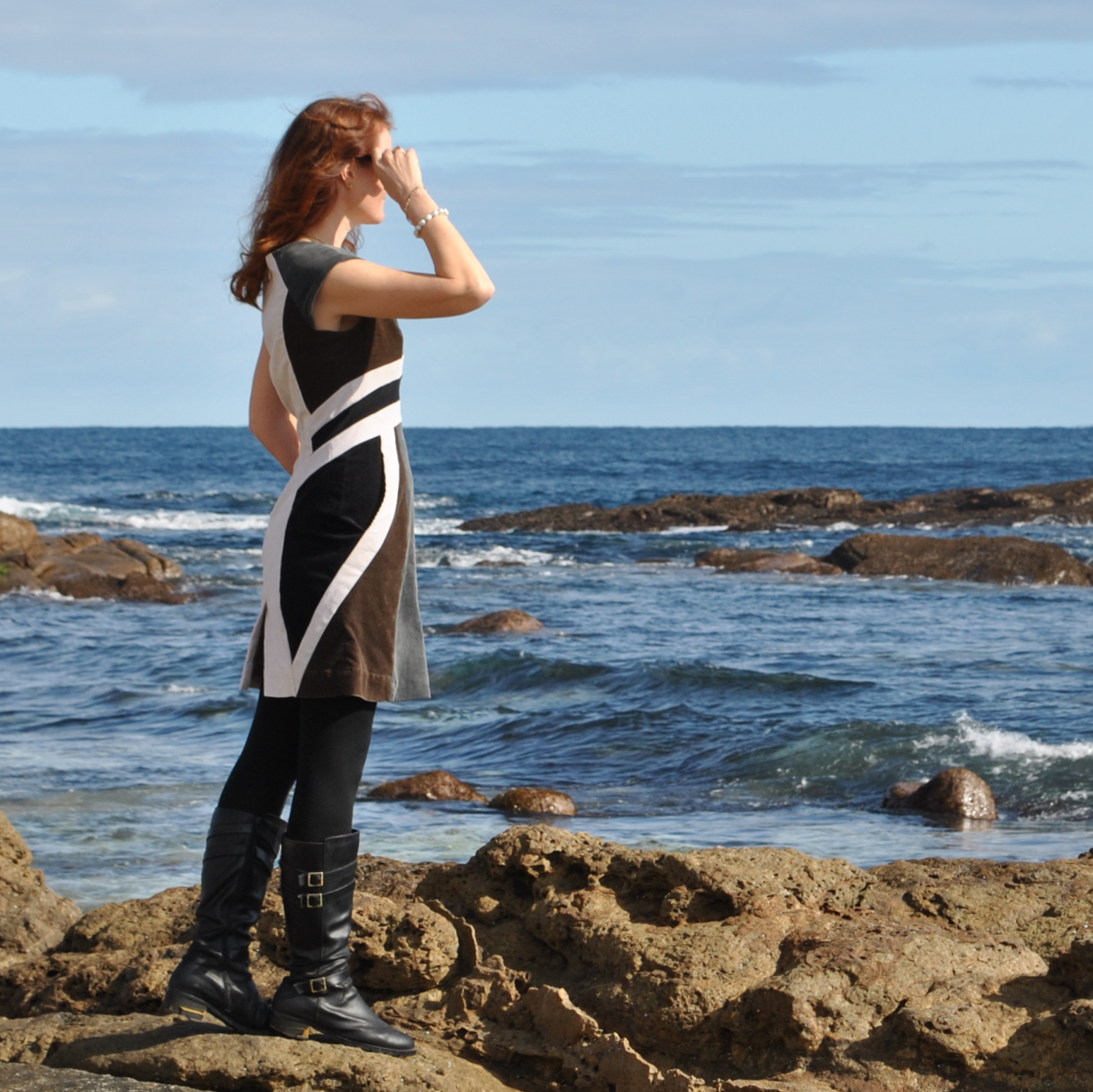
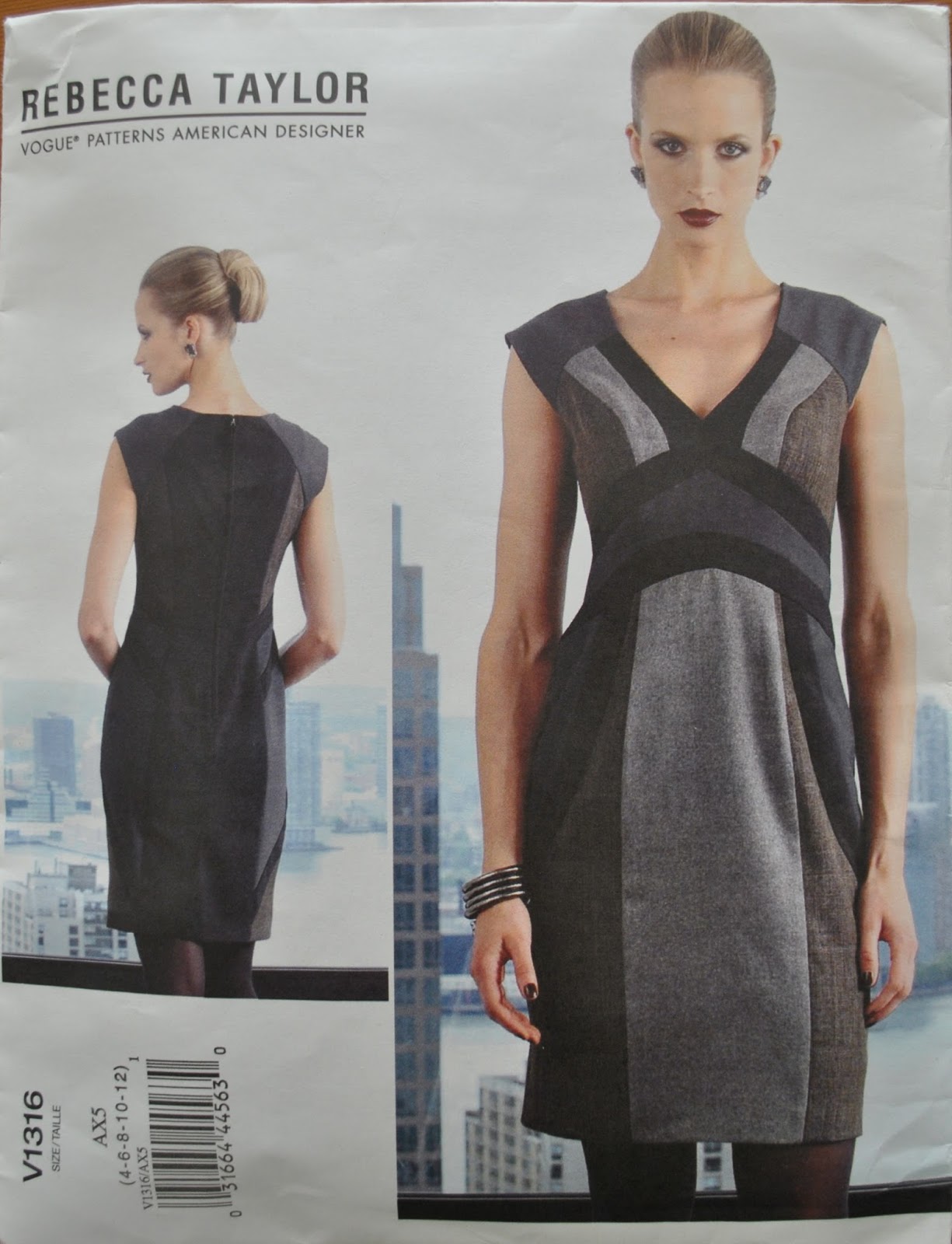
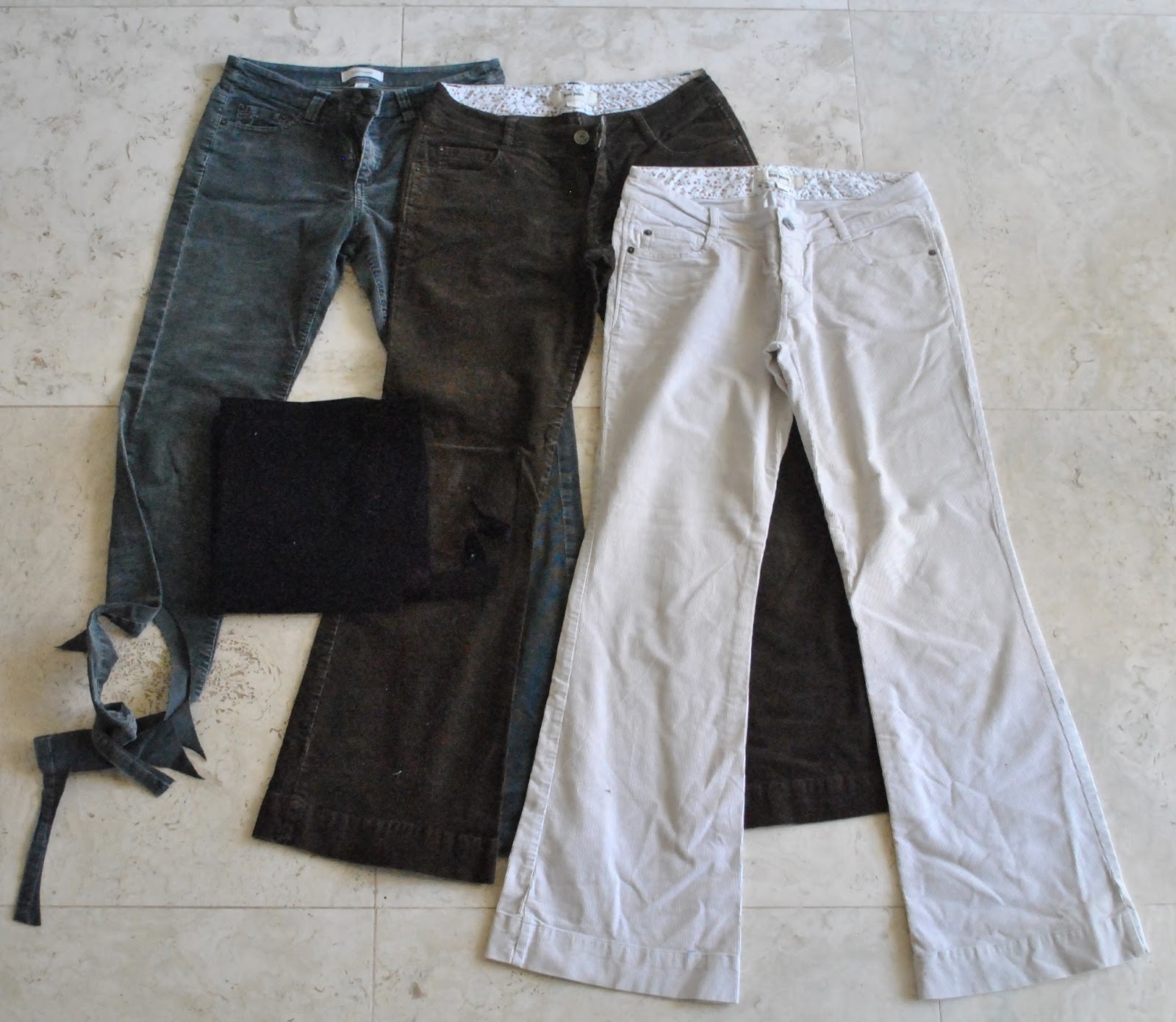
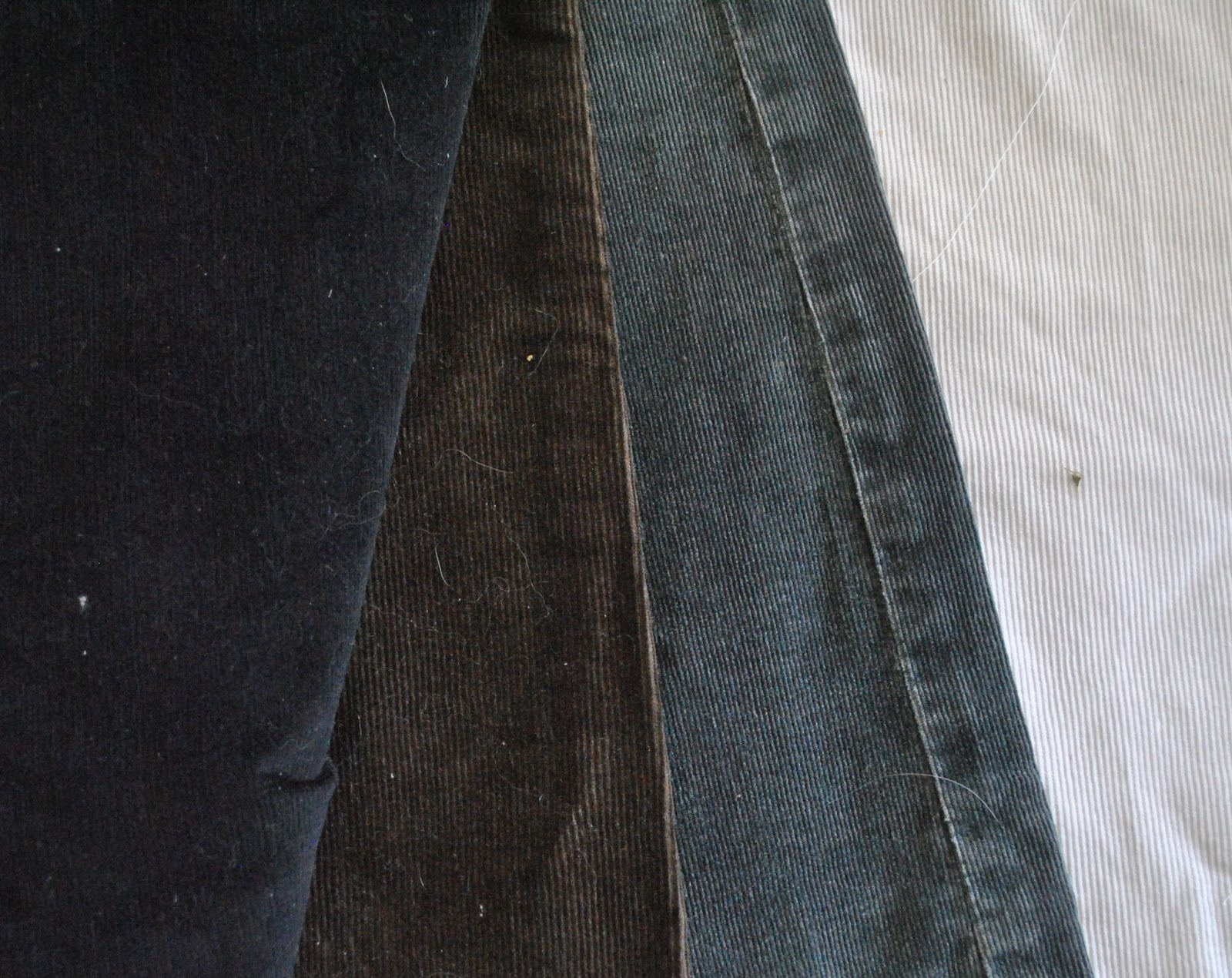
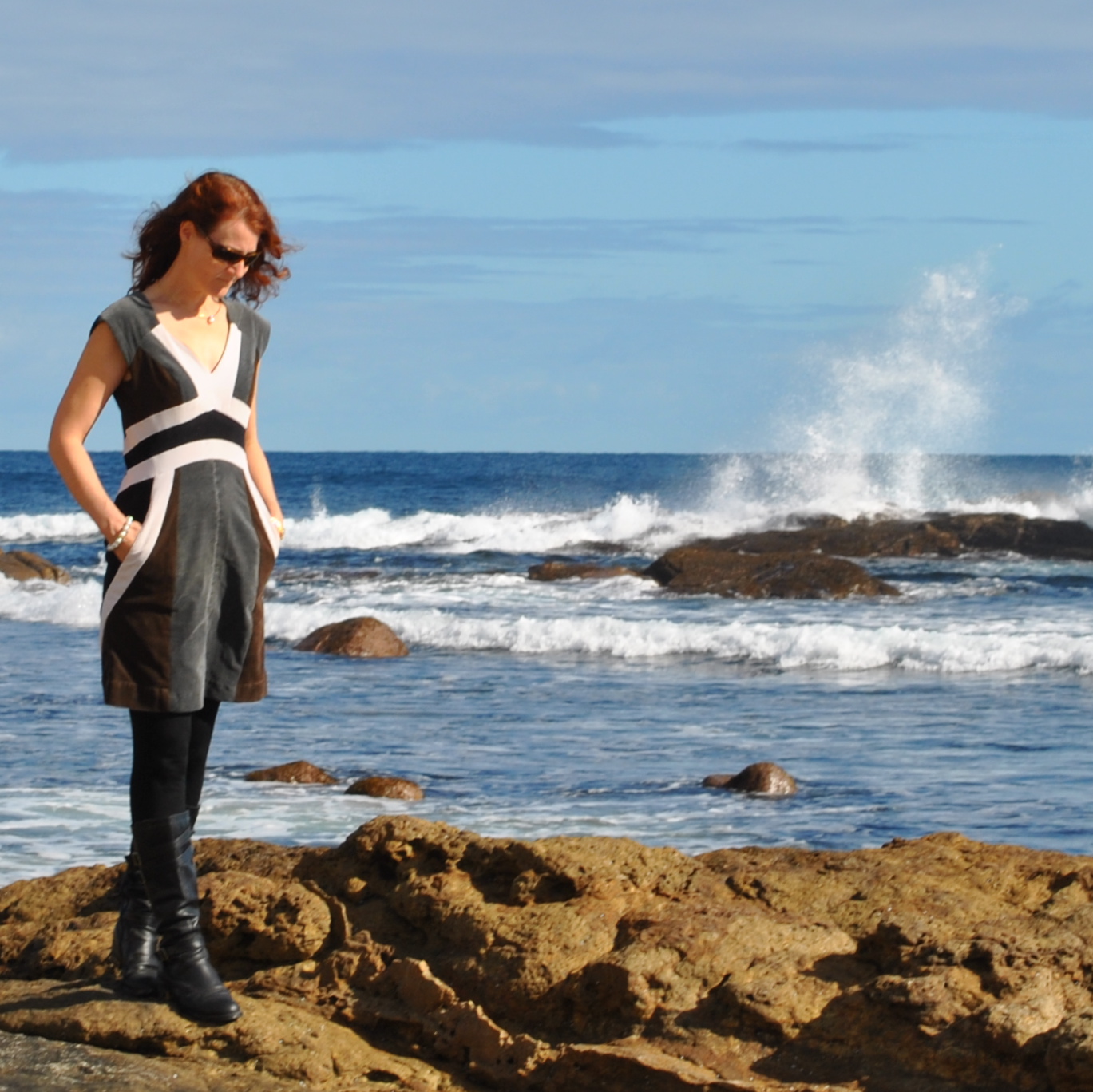
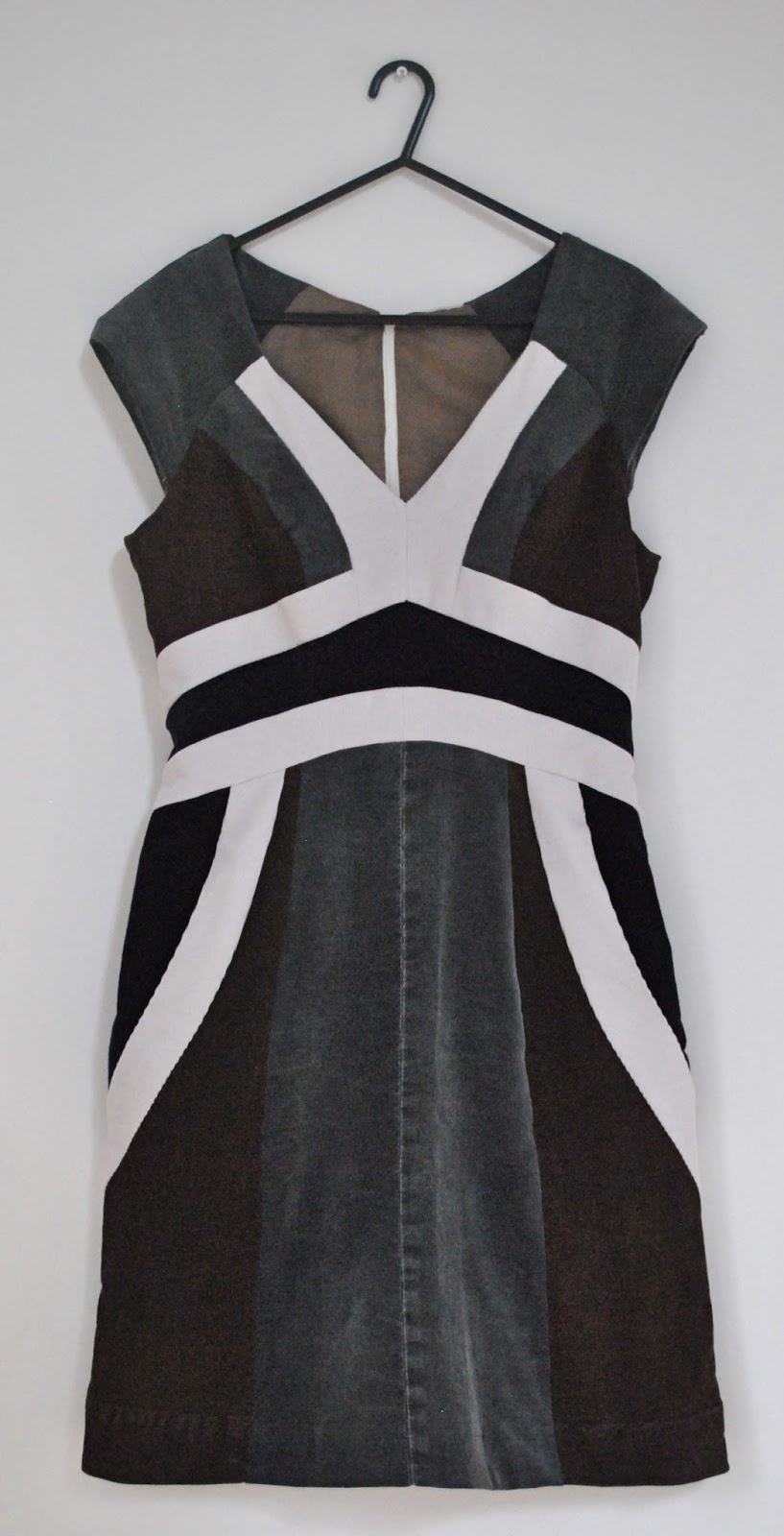
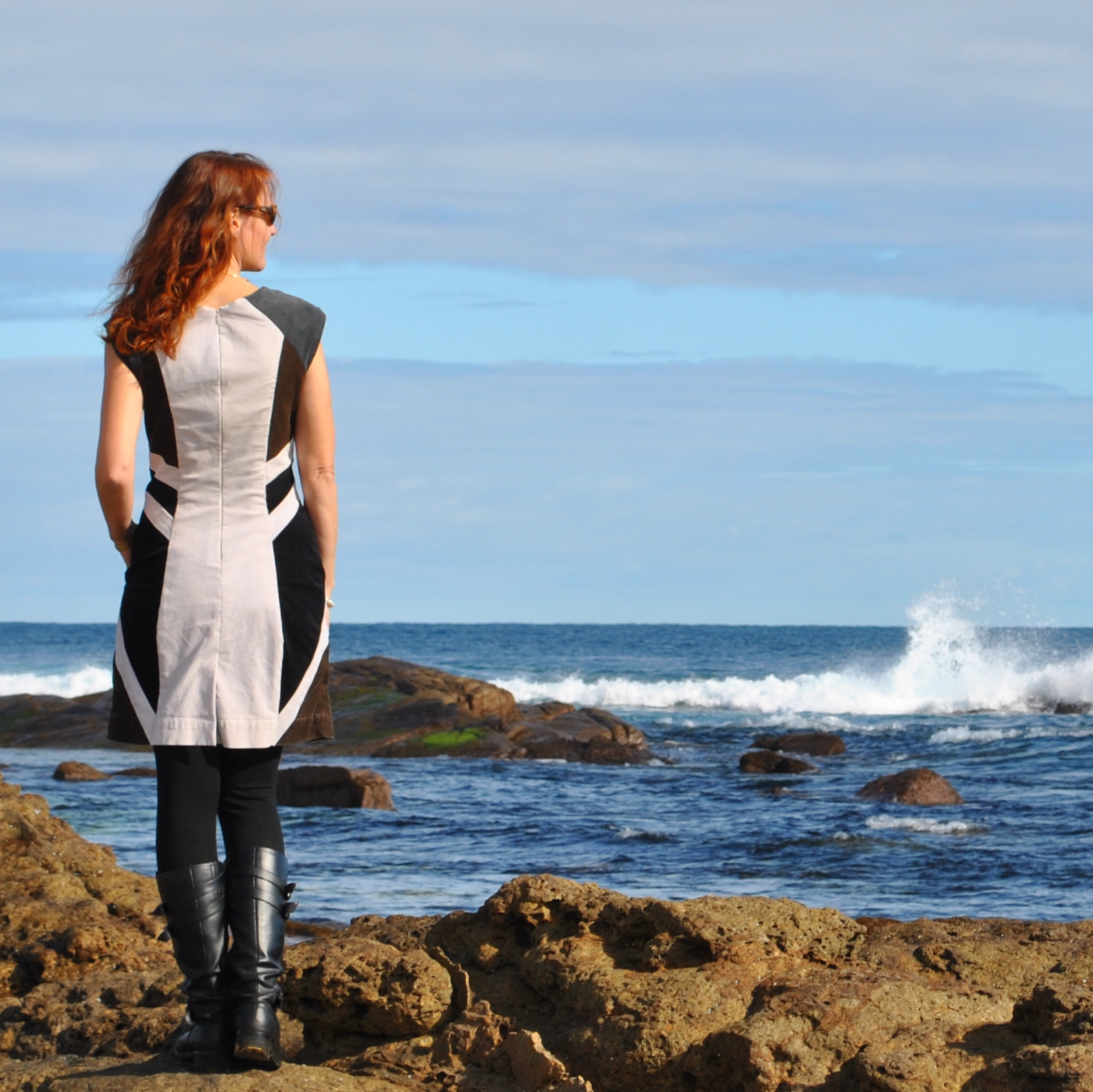
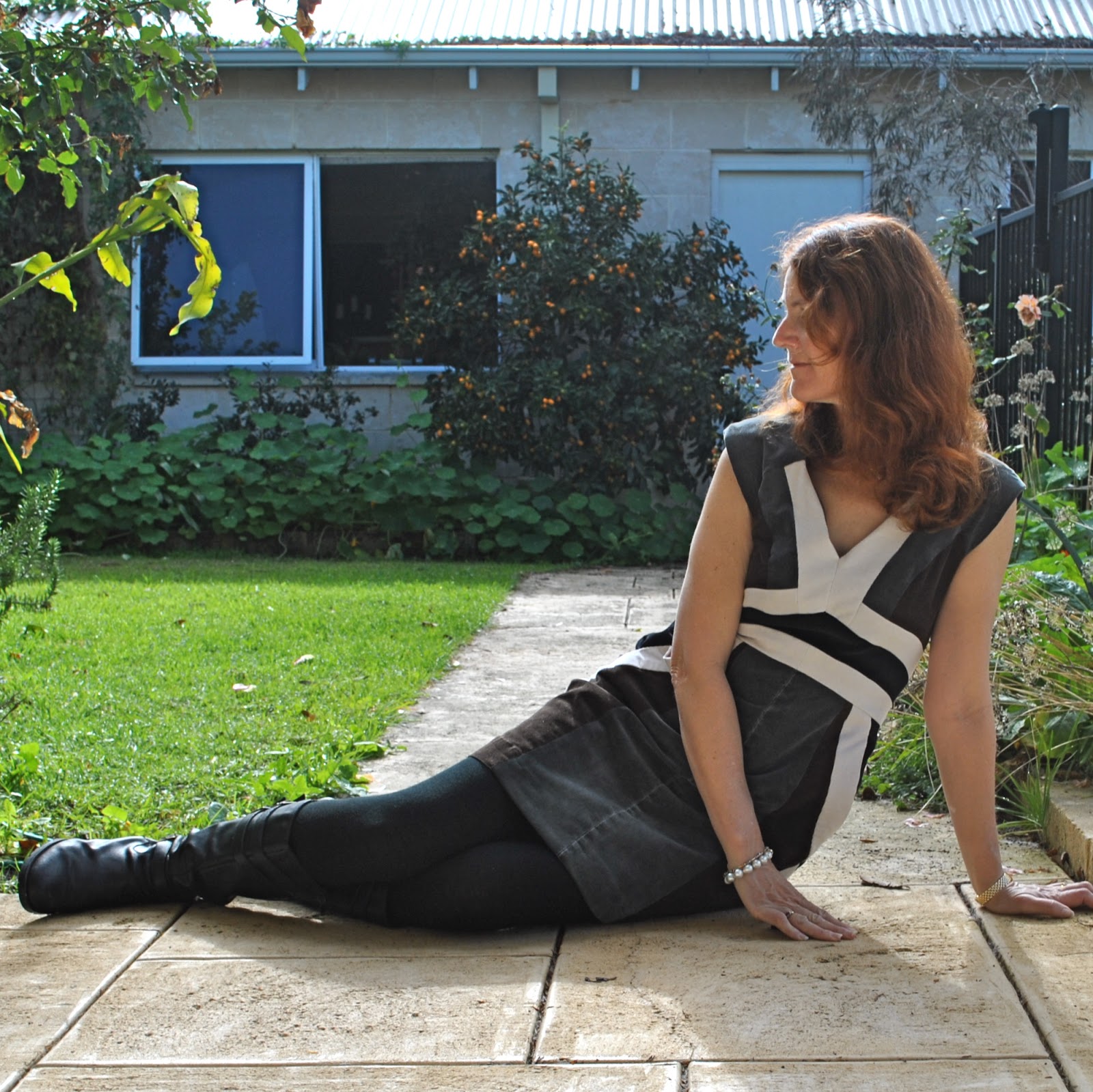
I’ve made a new dress! a dress comprised of panels and bands.  This is Vogue 1316  and I made it using three pairs of old corduroy jeans, ivory, chocolate and a faded black; plus a piece of new black corduroy, itself a leftover from my black corduroy flares-now-bootlegs.  Ha! hanging on to those old jeans and leftover scraps payed off… eventually.  It can be seen by the mangled leg of the jeans on the left that these have been partially harvested previously, when I made the Black parliament…

I managed to get the pieces for the dress, following the grain AND the nap (no small feat) from these jeans, with only a few piecings necessary.  The original hem has been retained and incorporated into the lower hem of the skirt in each of the ivory and chocolate brown lower skirt panels.  The widest panels I cut from the leftover piece of black corduroy, because that piece was the widest… the bonus is that this is the hip area and the darkest fabric situated here gives a slimming effect.
The lower band of the dress is a very wiiide piece, and since jeans legs are not wide, this required joining three pieces together.  But hey, I don’t think the joins scream “hey lookee here, seam!” very much, so I think I get away with it.

Also the lower front is cut over the side seam from a jeans leg, with the old side seam in the new centre front.

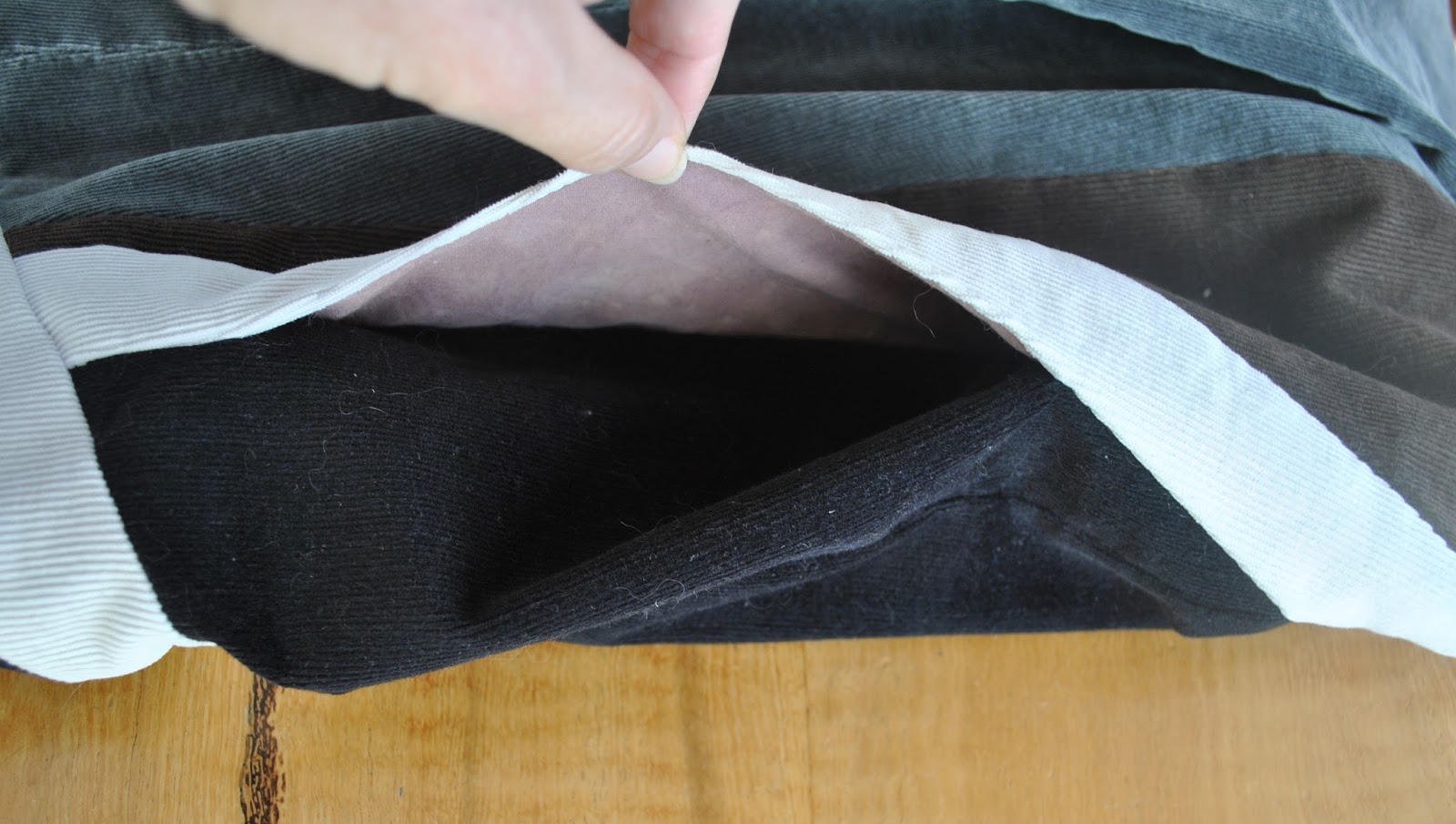
So, it can be seen above that my dress has luvverly deep pockets.  The pattern does not provide for pockets.  When I first saw the picture on the pattern envelope I thought that it did.  That side band curving down from the waist and around to the back was situated in perfect hip pocket position, so it was a reasonable assumption to make.  Perusal of the fine print revealed that I was sadly mistaken.    Early elation (and it has pockets!) turned to disappointment (oh it doesn’t have pockets), turned to a dawning realisation (hey, it could so easily have pockets) turned to a firm resolve put those missing pockets back into the design where they were so inexplicably lacking (dammit, that dress really should have pockets!)

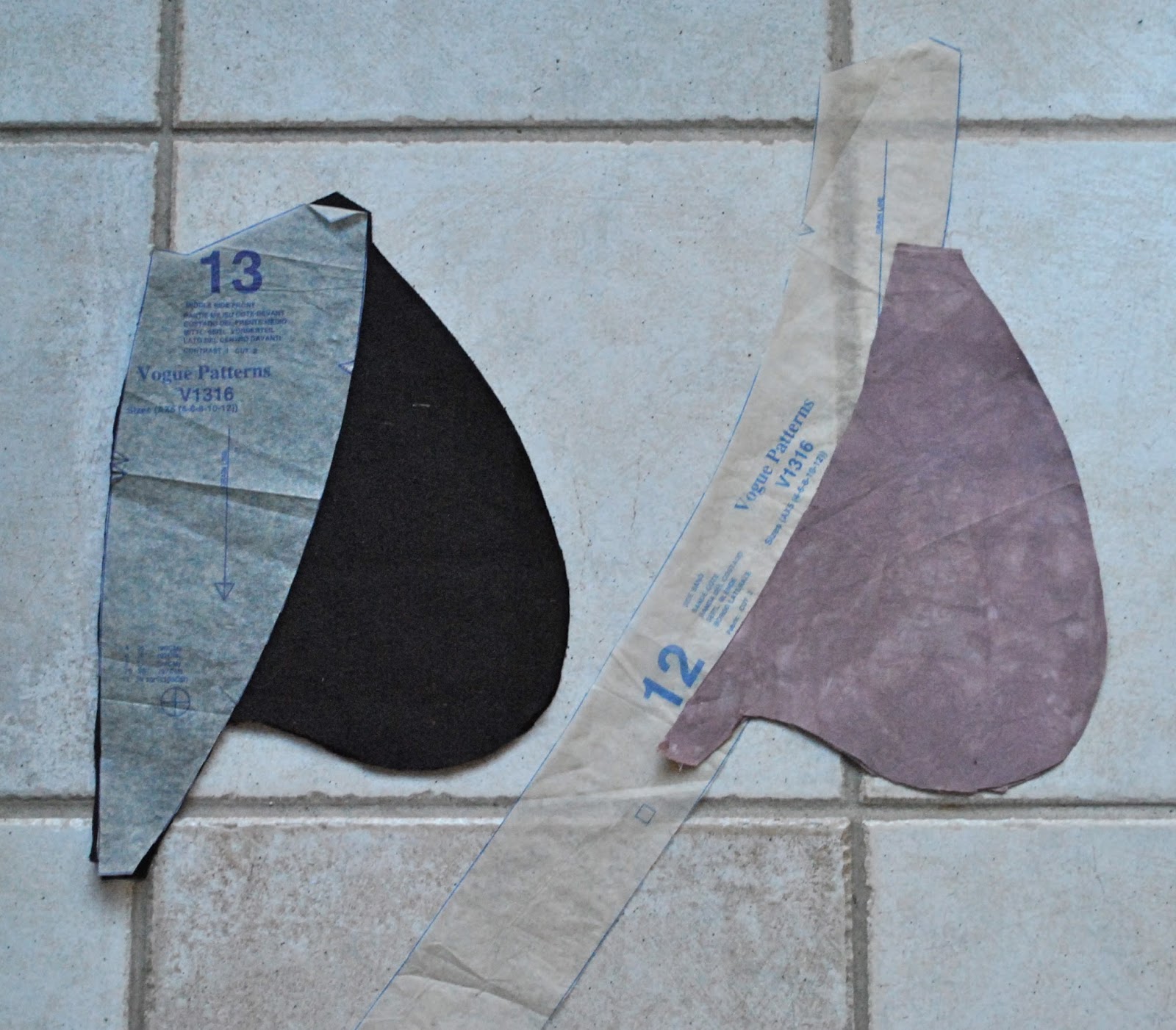
Adding them was not very difficult.  I cut the skirt pieces to be bigger, grading from my usual waist size out to between one and two sizes bigger than my usual choice at the hips to accommodate having hands in the pockets.  Then drew a rough, my-hand shaped piece onto paper, added this to the inner edge of pattern piece 13, the middle side front, and cut this composite new piece from the fashion fabric for the pocket.  I cut the hand-piece from woven cotton for the pocket lining.  I interfaced the corresponding section of the full-sized fashion fabric side band piece with iron-on interfacing, as this was to be the pocket opening and so needed stabilising, and joined all the pieces in the normal pocket way, the pocket lining to side band with a narrow seam allowance so the fashion fabric continues over and into the pocket within the fold.  Additionally the pocket opening is under-stitched, to prevent the lining from rolling out.  

I am unreservedly thrilled with how the pockets turned out, they really are in the perfect position, and I cannot understand why they were not there in the first place.  Vogue would do well to include pockets, or at least the possibility of pockets, in all their casual designs imo , since they are clearly high on the list of Most Desirable Features in a Design, wouldn’t you agree?  It’s certainly something I always look for in a casual pattern, or at the very least, the potential for finagling pockets if at all possible.  I reckon this dress is only, like, a hundred times better for having pockets?  Rough guesstimate, there.

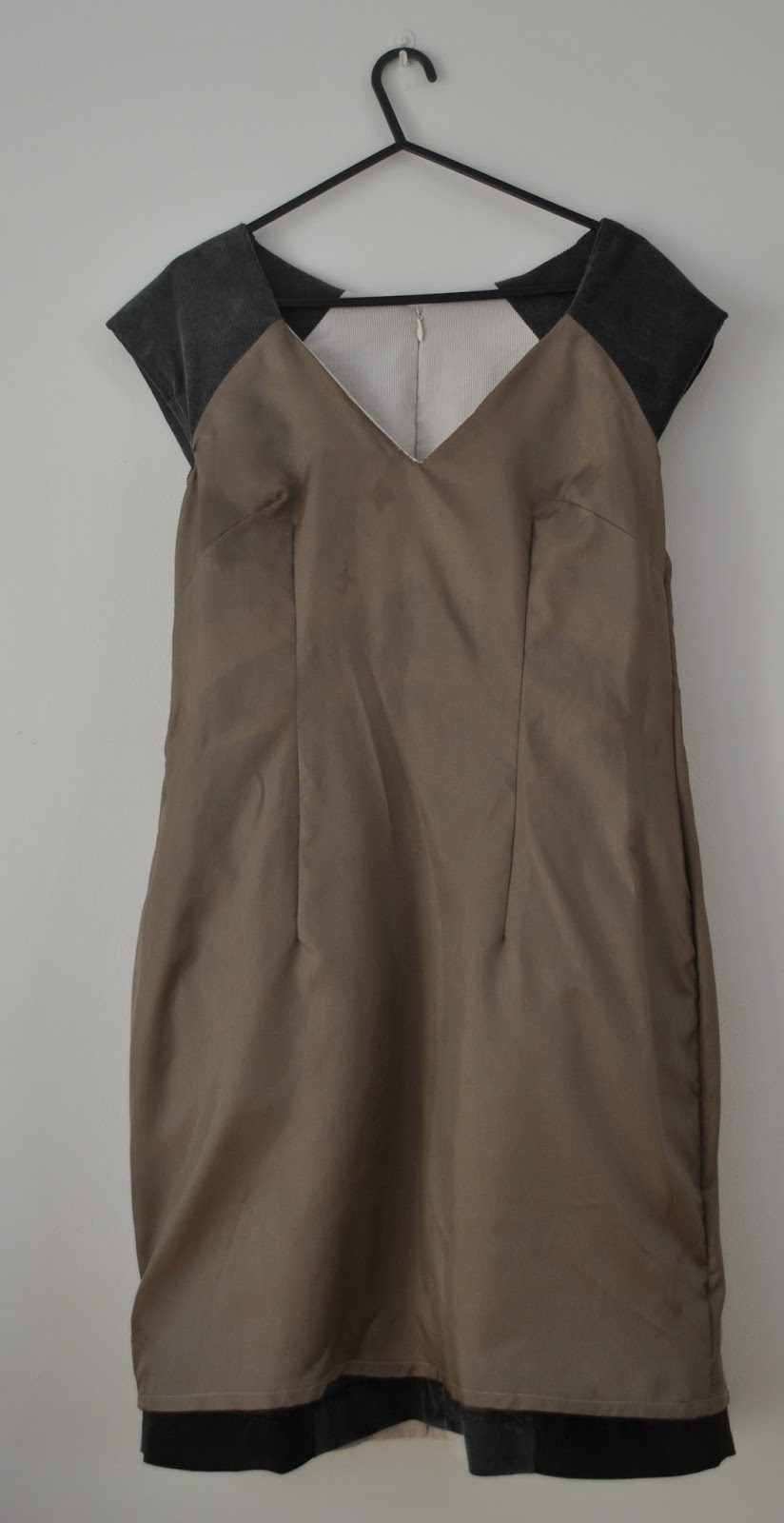
The dress is fully lined; and even in a casual, toss-it-on-for-whatever, day dress like this I prefer the clean and streamlined minimalism of an invisible zip, so used one.
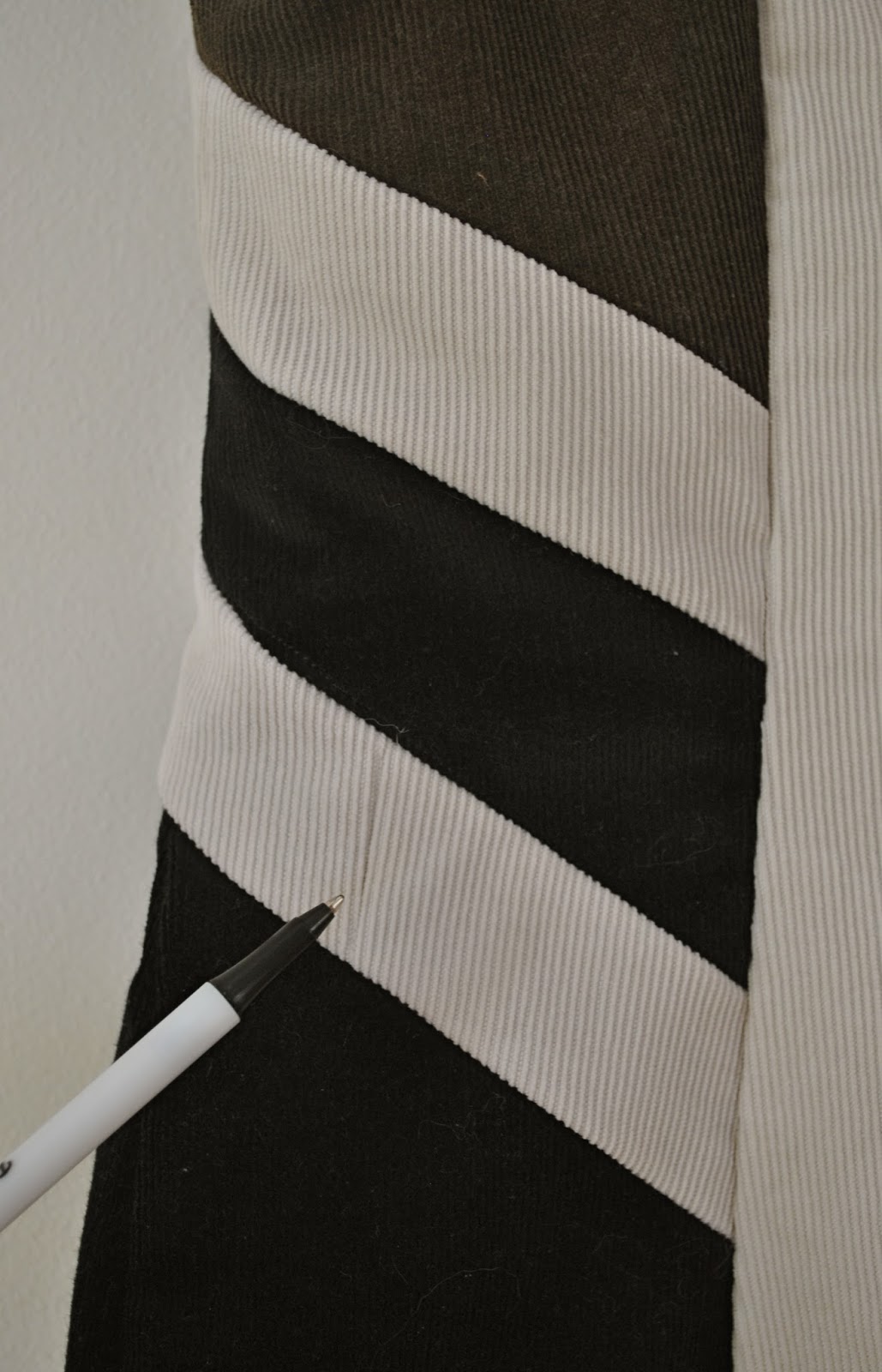
The fit… there were minor issues.  For a “fitted” pattern I reckon it runs quite big and boxy throughout.  But this was easily fixed, mostly through that handy back/side section seam, pictured below.
I am super happy with the dress, it was an enjoyable puzzle to put together and is very comfy and easy to wear.  I love washed and worn corduroy, such a beautifully soft and warm texture in a winter dress.  And it always makes me feel good to re-use old textiles constructively like this.  🙂

More inane drivel thoughts about this pattern can be found in my pattern review below if anyone is interested.

Details:
Dress; Vogue 1316, fashioned from 3 old pairs of cotton corduroy jeans plus another piece of cotton corduroy in another colour.
Tights; self-drafted, black merino, details here and my tutorial for drafting your own custom-fit tights pattern here
Boots; Andrea and Joen, bought from the now re-branded Uggies in Dunsborough

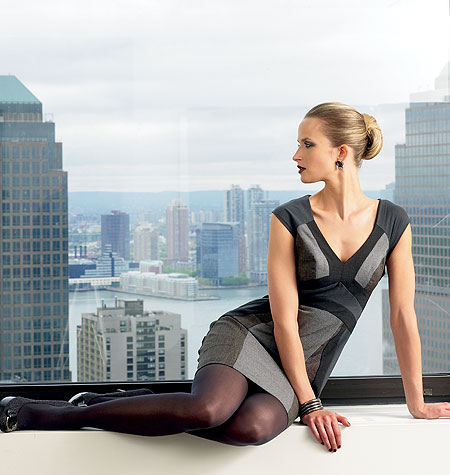
and merely because I find these pretty amusing… the Vogue pose

Pattern
Description:
Fitted
lined dress has several shaping bands and multiple panels, a central back zip
and walking vent
Pattern
Sizing:
Size
4-12. I cut my usual size 10 in the bodice tapering out to between a 12-14 at
the hips.  This hip is larger than
my usual size, but I wanted to incorporate pockets into the design, which
requires a bit more room in the skirt. 
In my opinion the pattern runs a little big, since I had to take in the
bodice quite a bit, and might go down to a size 8 in the bodice next
time.
Did
it look like the photo/drawing on the pattern envelope once you had finished
sewing it?
Yes.
Were
the instructions easy to follow?
Yes
What
did you particularly like or dislike about the pattern?
I was
attracted to the complex banding and panels design, lending themselves to
pattern through the use of tonal solid colours.
I was
disappointed that it did not have pockets, considering that the side
band is perfectly positioned to have a pocket tucked under it. But I knew the
design would be very easy to adapt so that I could have my beloved
pockets.  And it was, and so I have them  🙂
The
lining is not done in the best way, in my opinion.  I don’t really love lining being sewed straight to the shell
of the dress like this.  It is
under-stitched to help keep it all inside; but if I was going to make this
again I would instead make self-fabric facings for the neckline and underarm
and attach these to accordingly modified lining pieces.
For the lining, the pattern stipulates 1.8m. In my size, I found 1m is sufficient.
Fabric
Used:
Cotton corduroy in four different colours 
Pattern
alterations or any design changes you made:
Pockets!  I was
determined to incorporate pockets into the dress, so modified pattern piece 13
to be a pocket piece, and also drafted another piece to be a partial facing for
piece 12 with an integrated pocket lining.  To accommodate hands-in-pockets wearing
ease, I drafted the skirt pieces to taper from my usual size 10 at the waist, out
to between 12-14 at the hips.
I
raised the height of the centre front by about 1cm, and am glad I did.  Next time I might raise it even higher!
Step
19-23: I prefer an invisible zip in my dresses, and I always install an
invisible zip before stitching the remainder of the seam below.  I reckon this gives you a much better
and smoother finish.
Sizing;  I find the bust of Vogue fitted patterns to be drafted too big for
me generally, so I pre-emptively shaved about 1cm width off the bust curve of both pattern pieces 3.  Even so, at Step 24: sewing the back to side section seam; I found the fit still quite boxy and not
close-fitting enough for my tastes around the waist, so took out several inches in
width from the underbust and waist, graduating out again to the bust and hips.
Ultimately these alterations left me with a distinctly more A-line skirt than the pattern intended, and I am happy with that.
Would
you sew it again? Would you recommend it to others?
Oh my
gosh, I always say yes I will sew it again, and then I’m immediately distracted
by new patterns like a toddler with a shiny new toy!  But I certainly would not rule out sewing this one again.  This one is just going to be casual, everyday, winter’s dress.  I’ve been thinking about the idea of using several bright clear colours demarcated by black bands, like a licorice
allsort.  Wouldn’t that look cool? 
And
yes  🙂
Conclusion:
I
really love how it turned out! The interesting and unusual seaming pits the chosen colours against each other to dramatic effect.  I can picture a multitude of
possibilities for colour-blocking here. 
I am especially pleased with how my pocket alteration turned out, to be honest I
probably would not enjoy wearing a dress without pockets so much as one with,
so to be able to incorporate them so easily into the design was a very happy
bonus.
Without
any fitting modifications I would not describe this as a fitted dress.  I had to take
my usual size in quite a bit. 
However it is quite easy to do a lot of final fitting through the back
to side section seams.

….photo-bomb!…

pinterestmail

Future Grrrrl!

Whoa!  who is that babe?
It’s FUTURE GRRL!
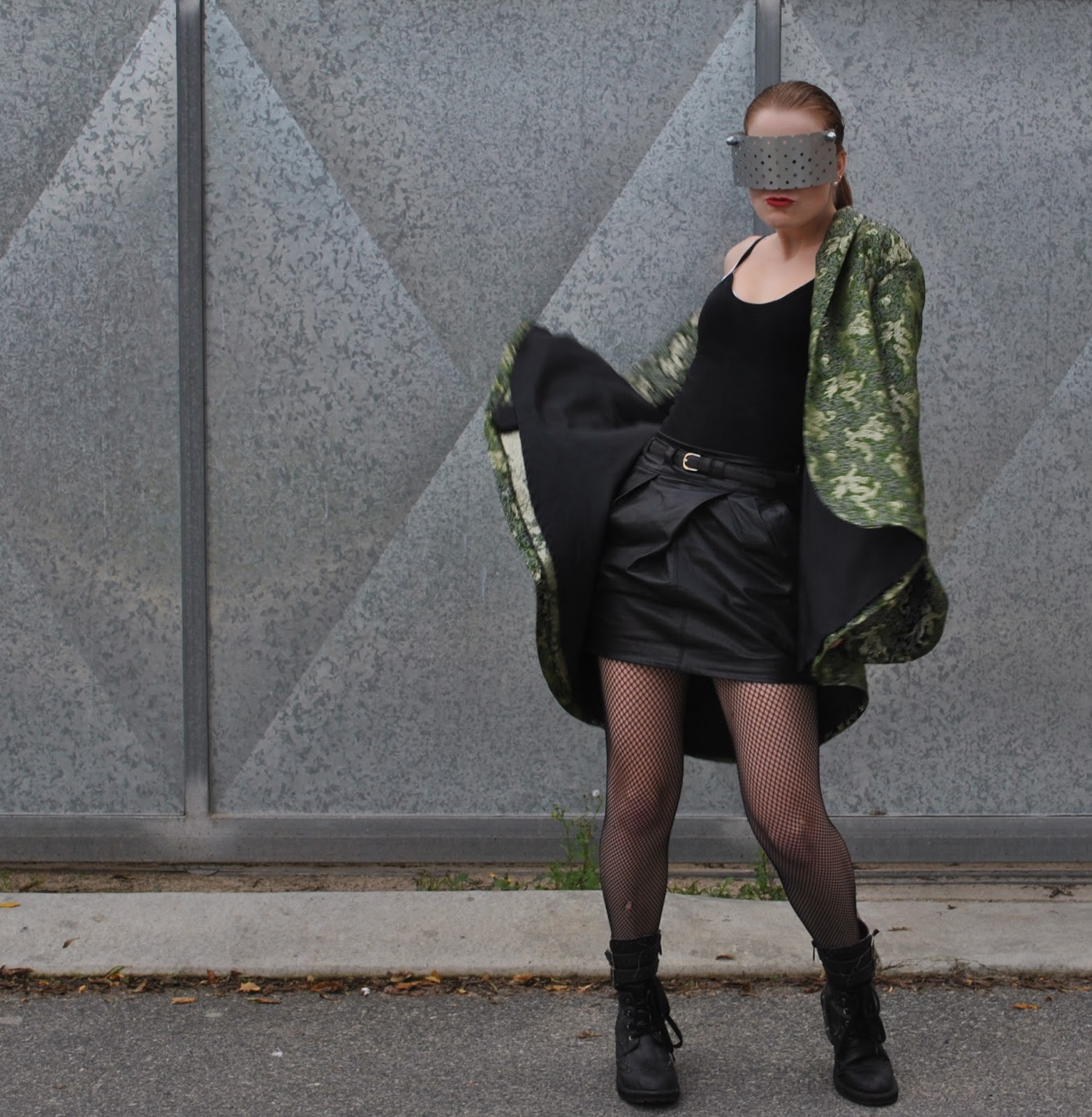
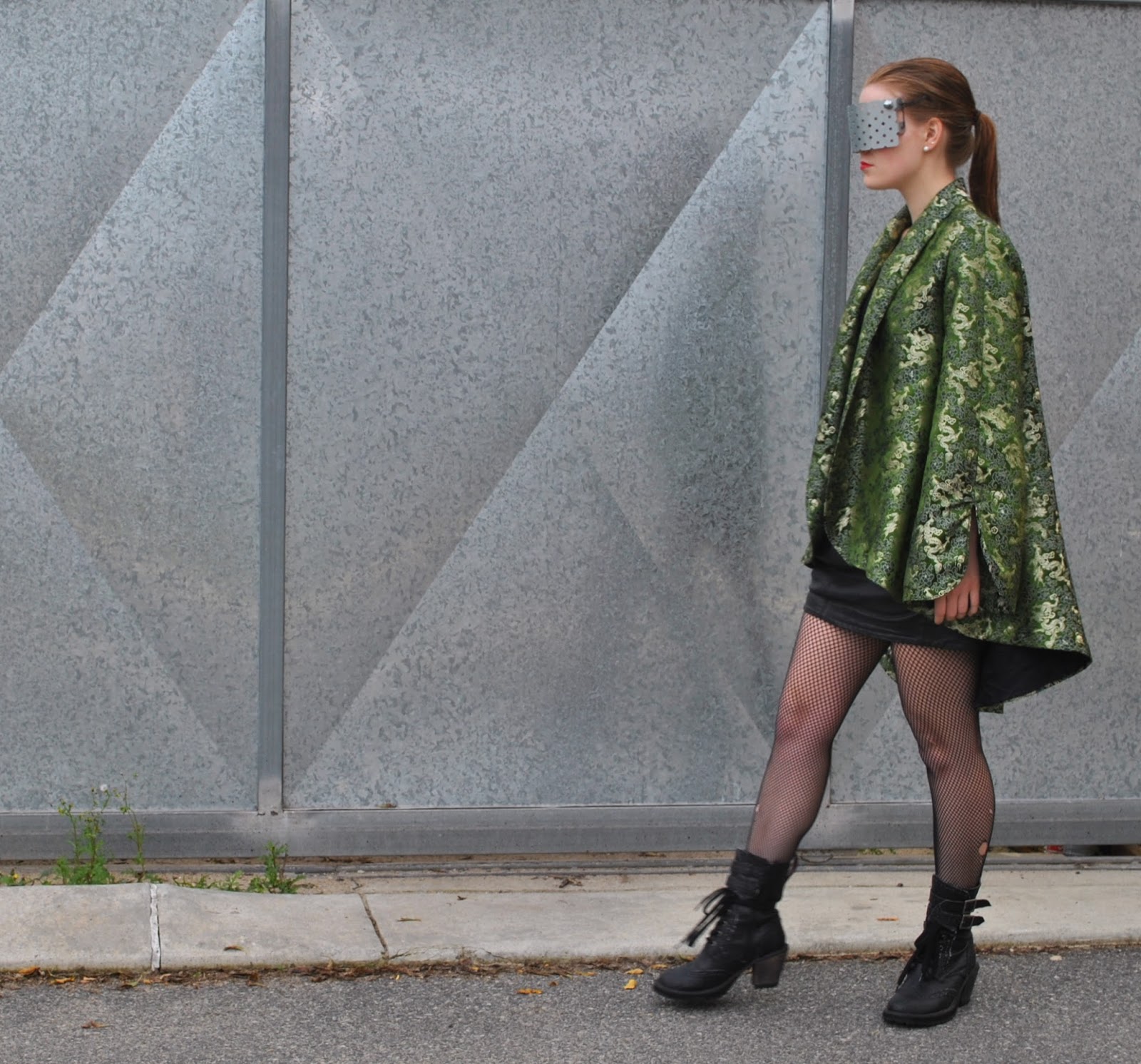
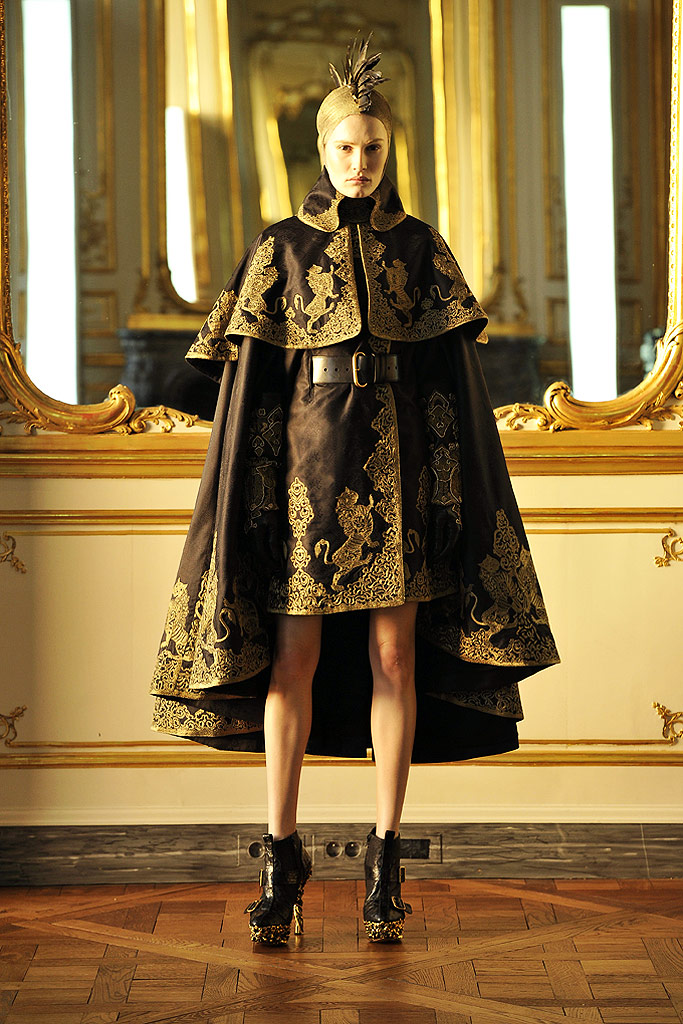
So; Cassie was going to a Futuristic party… and had a firm idea of how she wanted to look.  To make this sartorial vision a reality she wanted a flamboyant and luxuriously textured coat.   
Mission accomplished!
She took her inspiration from an Alexander McQueen outfit, and looks kinda Blade Runner I reckon.  We bought the fabric and pattern together. Wait, wait what am I saying? I bought the fabric and pattern.  She buys her own clothes now, but I do pay for her fabric when we’re out together… I’m hoping to encourage that creativity and DIY spirit.  Well, that’s the theory, anyway!

below: Alexander McQueen Fall 2010 RTW

Fast forward a coupla weeks and Cassie having spent hours and hours and hours of her free time on meticulously hand-sewing another friend’s costume for him to wear to the same party (he looked very cool too, btw) suddenly realises the night before the party that she has to work the next day, and so there is absolutely NO WAY she can get her own costume finished on time.  Daughterly pleading with promises of chocolate followed.  *sigh*  Mum to the rescue.  I did not want that fabric and pattern to just sit there and not even get to the party!

Hehe, I’m joking of course, I was very happy to step in and take over the making of this ultra glamorous jacket.  Isn’t it rather gorgeous??  And, she did construct most of the shell herself.  Probably we each did about half the work involved.
btw, this is NOT the fab, self-indulgent, frivolous thing for myself I mentioned in my previous post… I had to abandon that for a while to make this!  That is yet to come!
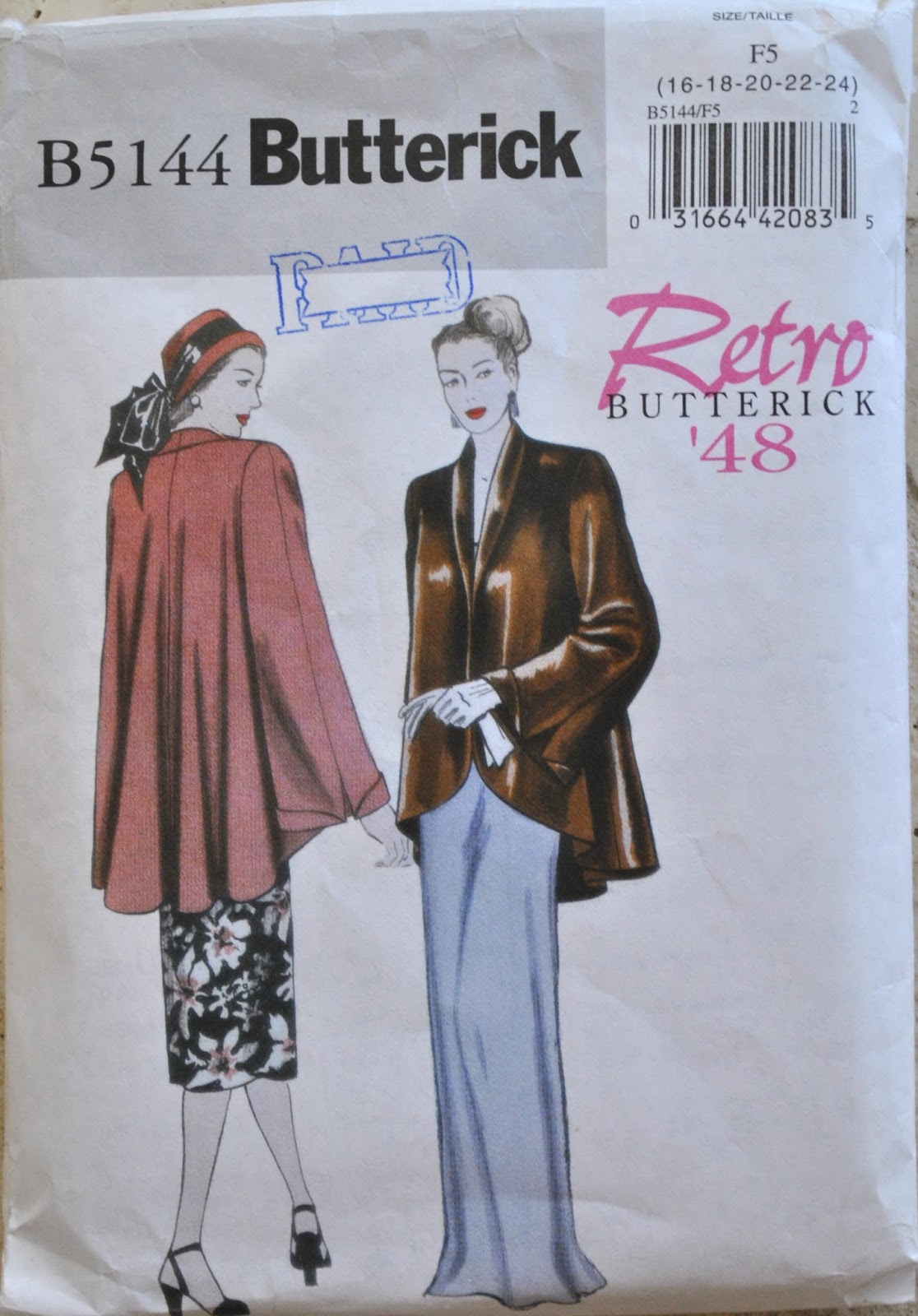
The pattern is Butterick 5144, a reproduction 1948 pattern.  My, but this is a wonderful silhouette, isn’t it?  Fortunately I’m allowed to wear it too if I want  😉
The fabric is a heavy Chinese brocade from Spotlight; emerald green and gold and black, with dragons writhing all over, and lined with black polyacetate lining fabric.

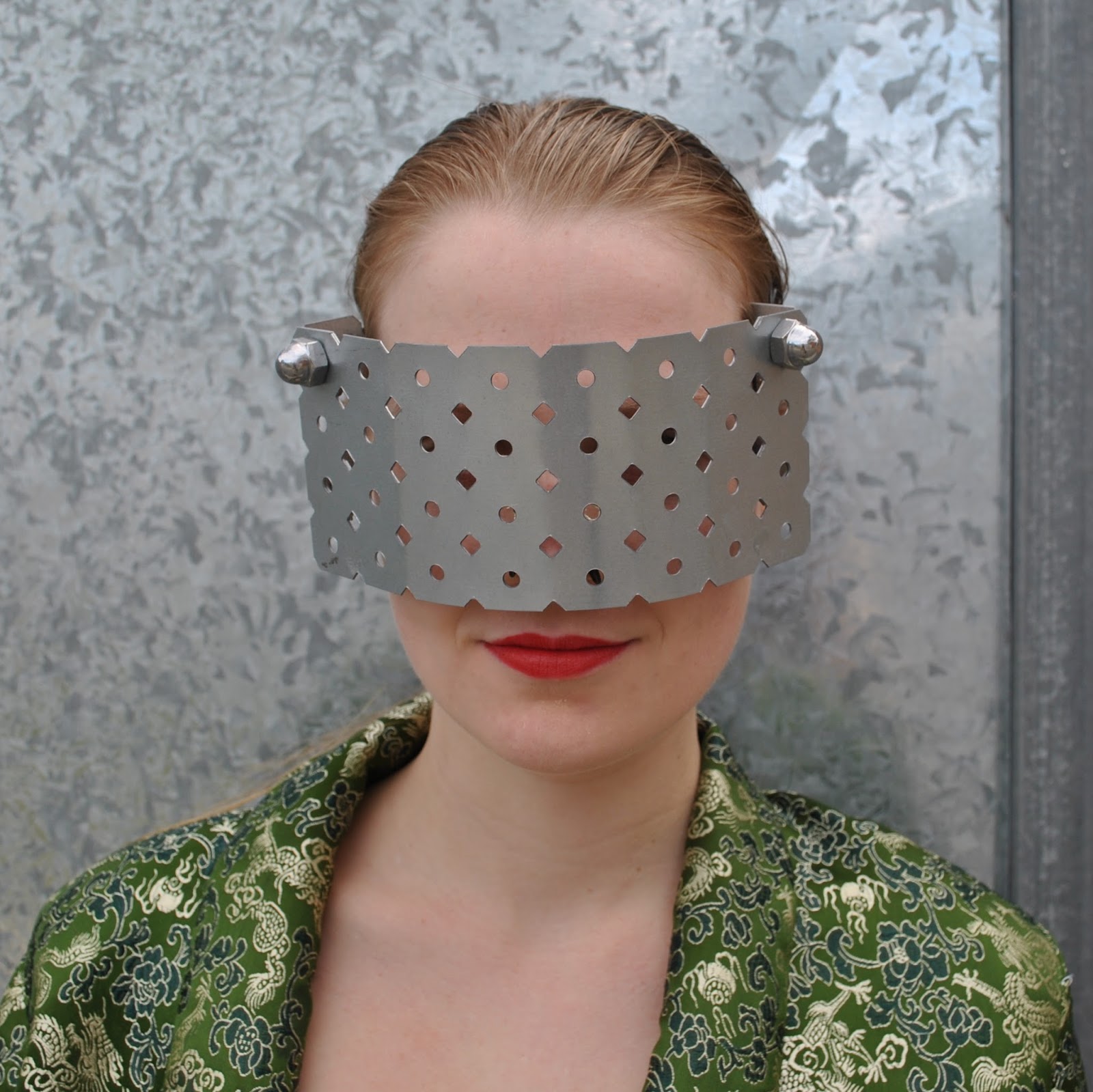
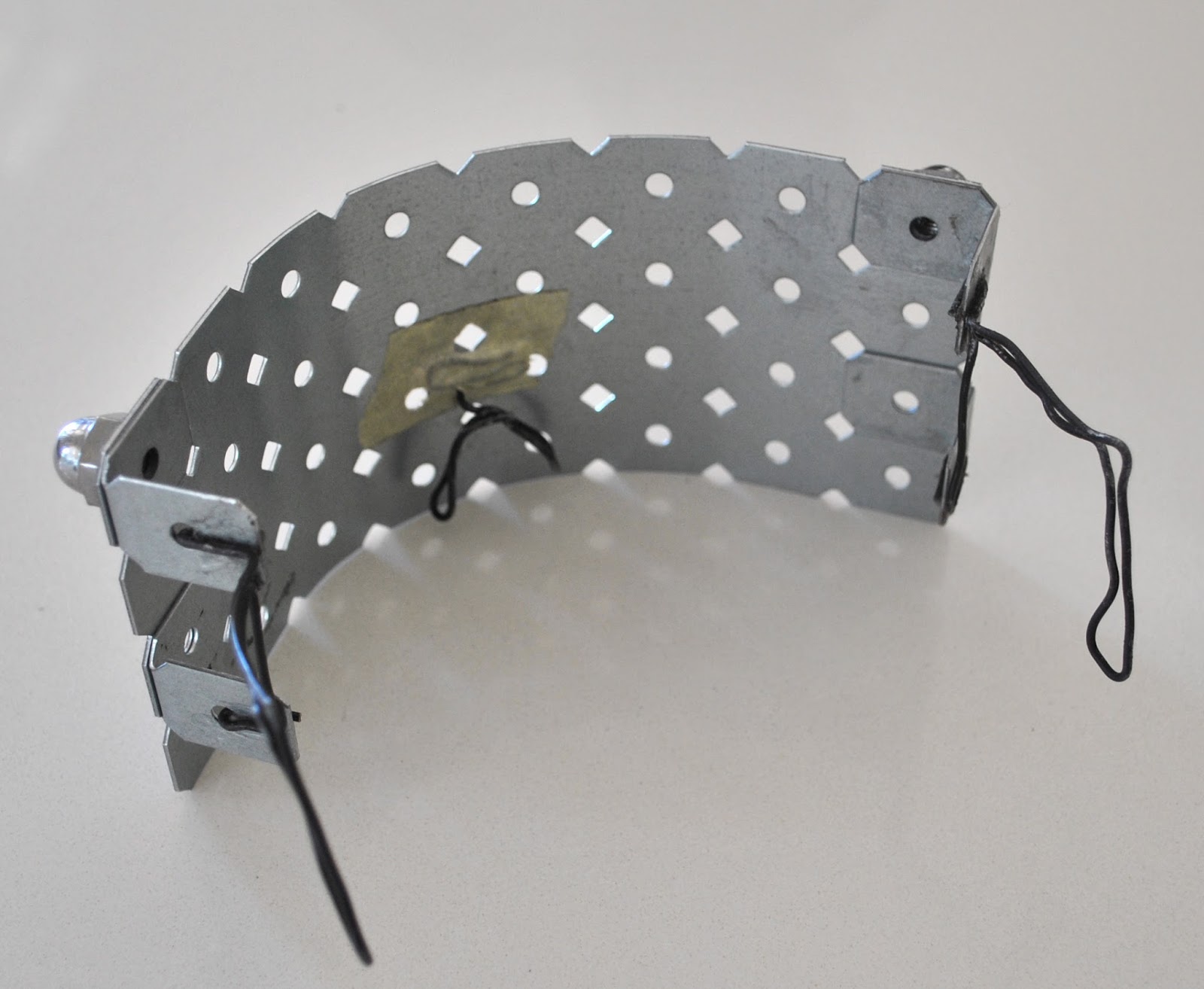
Cassie made her own “sunnies” too.  Aren’t they amazing?  She tells me there was another girl at the party with homemade mesh sunnies on.  They met up and were like: 
Hey cool sunnies!  
Hey, yours too!  
Can you see anything?  
Nup!  Can you? 
No!
cue massive rofl…. in that way that girls at a party have…

Details:
Jacket; Butterick 5144, Chinese … silk? (can’t remember for sure) brocade
Sunnies; made by Cassie
Cami; Country Road
Skirt; Manning Cartell
Stompin’ boots; bought in Japan  

Pattern
Description:
Very loose-fitting lined jacket has shaped front and flared back, shawl collar, side seam pockets, two piece sleeves with turn-back cuffs and shoulder pads
Pattern
Sizing:
16-24, unfortunately the only size the shop had.  I graded it down to a 10.
Did
it look like the photo/drawing on the pattern envelope once you had finished
sewing it?
Yes.
Were
the instructions easy to follow?
Very!  This is rated easy, and it is!
What
did you particularly like or dislike about the pattern?

Oh My Gosh, you guys. I was doubtful at first when my daughter chose it, but now I could not possibly love it more. It could be the most glamorous thing in the house! The shaped hemline is chic and looks quite high-end, the draped back is elegant, the long and very wide sleeves look lovely. It has pockets! and is overall a surprisingly simple make. 
I have no dislikes.
Fabric Used:
Chinese brocade (I think silk? but am not 100% sure of that)
Pattern alterations or any design changes you made:
Unfortunately the only size in the store was a 16-24, and my daughter had her heart set on it. However I did not find it difficult to grade it down to a 10; there are 11 pattern pieces which are quite basic and the instructions are simplistic and straightforward. No fiddly or difficult bits at all.
Would you sew it again? Would you recommend it to others?
My daughter and I made this one together for her, and I think I would like to make one for me now! And, yes!
Conclusion: 
Very very cool. This is a 1948 reproduction pattern, so at first glance it might appear a bit costume-y but in this unexpected fabric it manages to fit beautifully into a funky modern wardrobe. I absolutely LOVE how it turned out. This one is for my daughter, and me? I’m dreaming of one in lightweight camel wool… or maybe in black or chocolate coloured velvet… (sigh)
pinterestmail

Cancer, the sign of the crab

I have made a new dress.
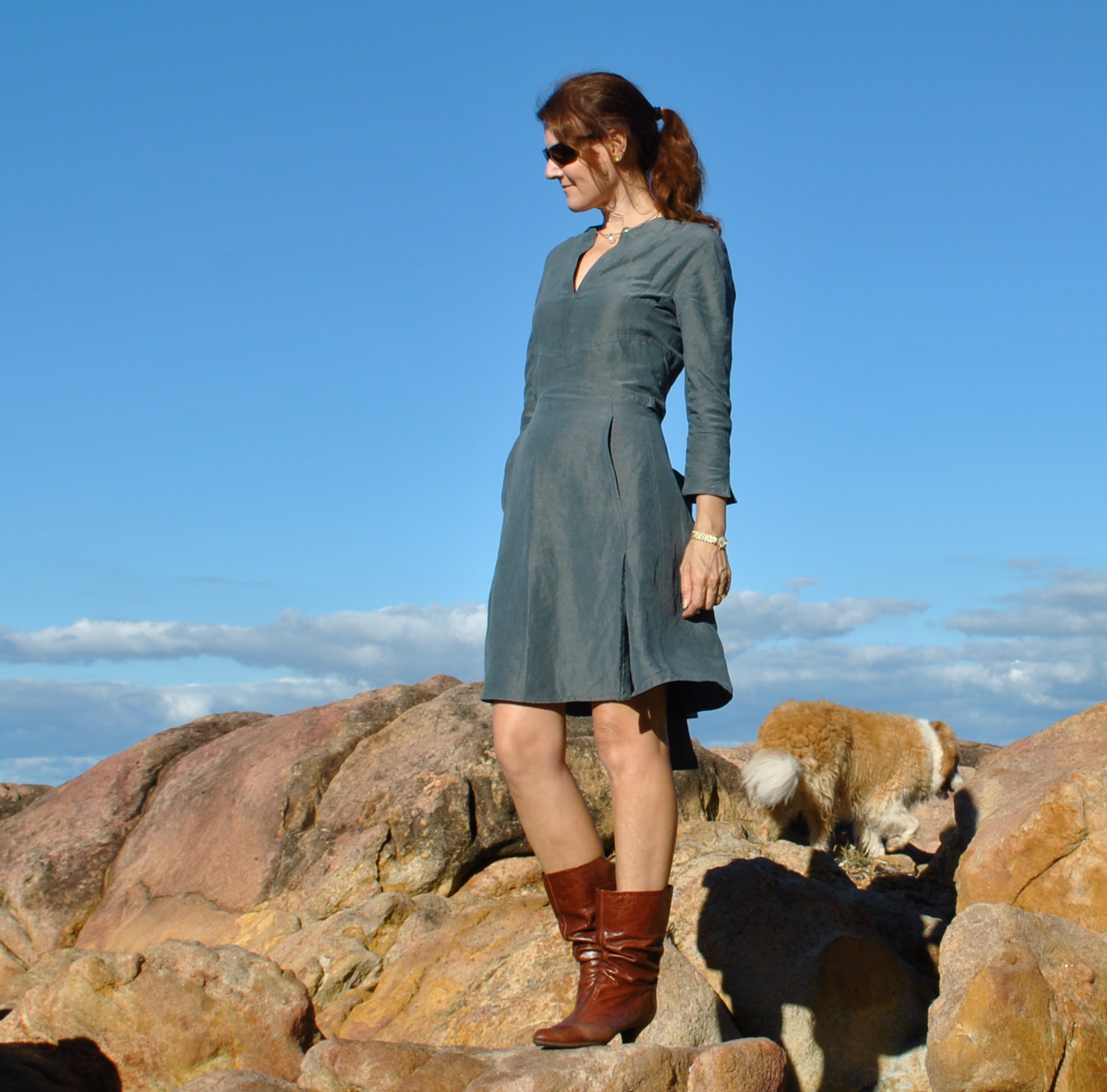
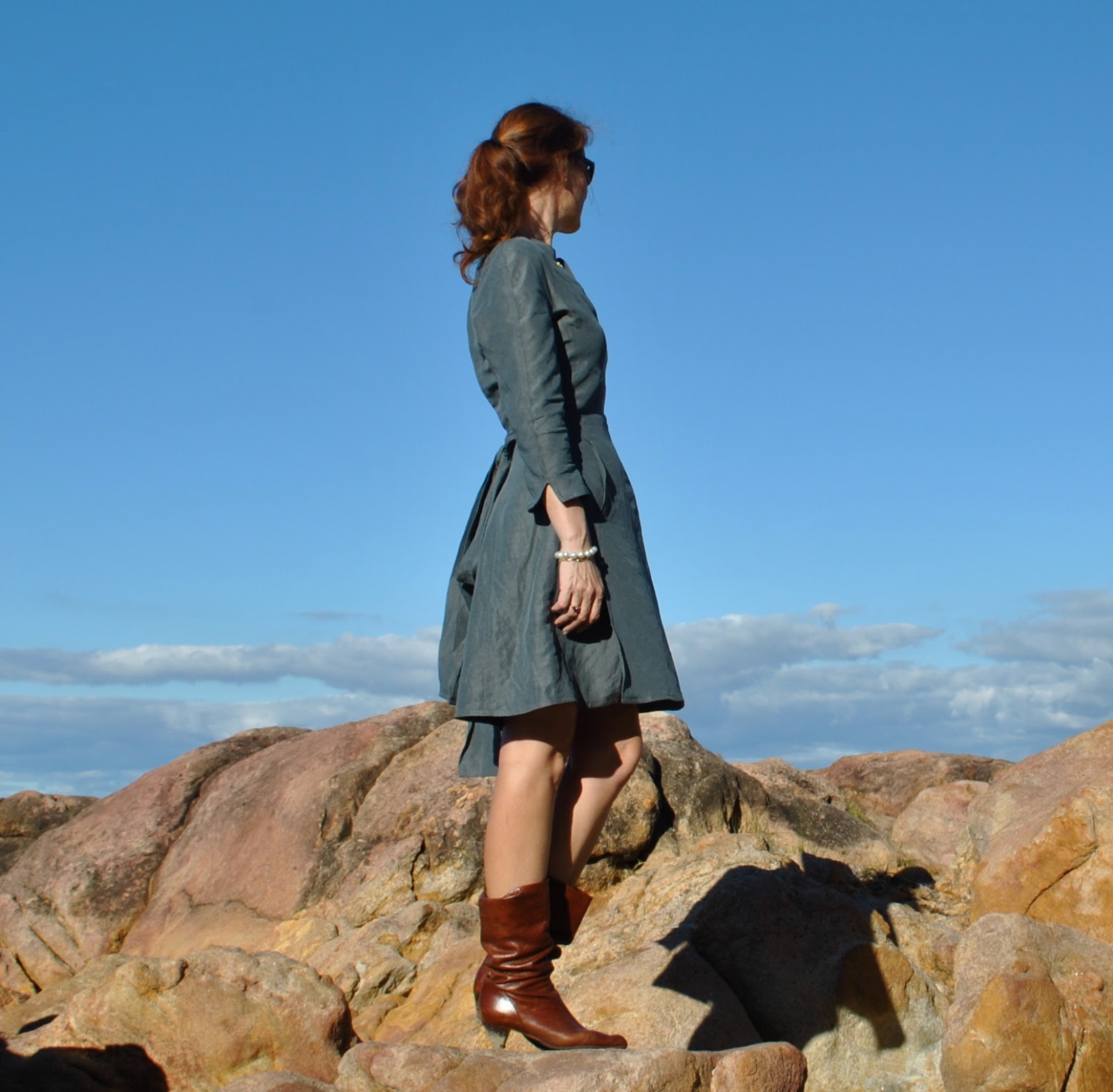
And here I am wearing it to scramble about on the rocks, just like a, er, crab….?
…..?
well, it’s a tenuous little link!!
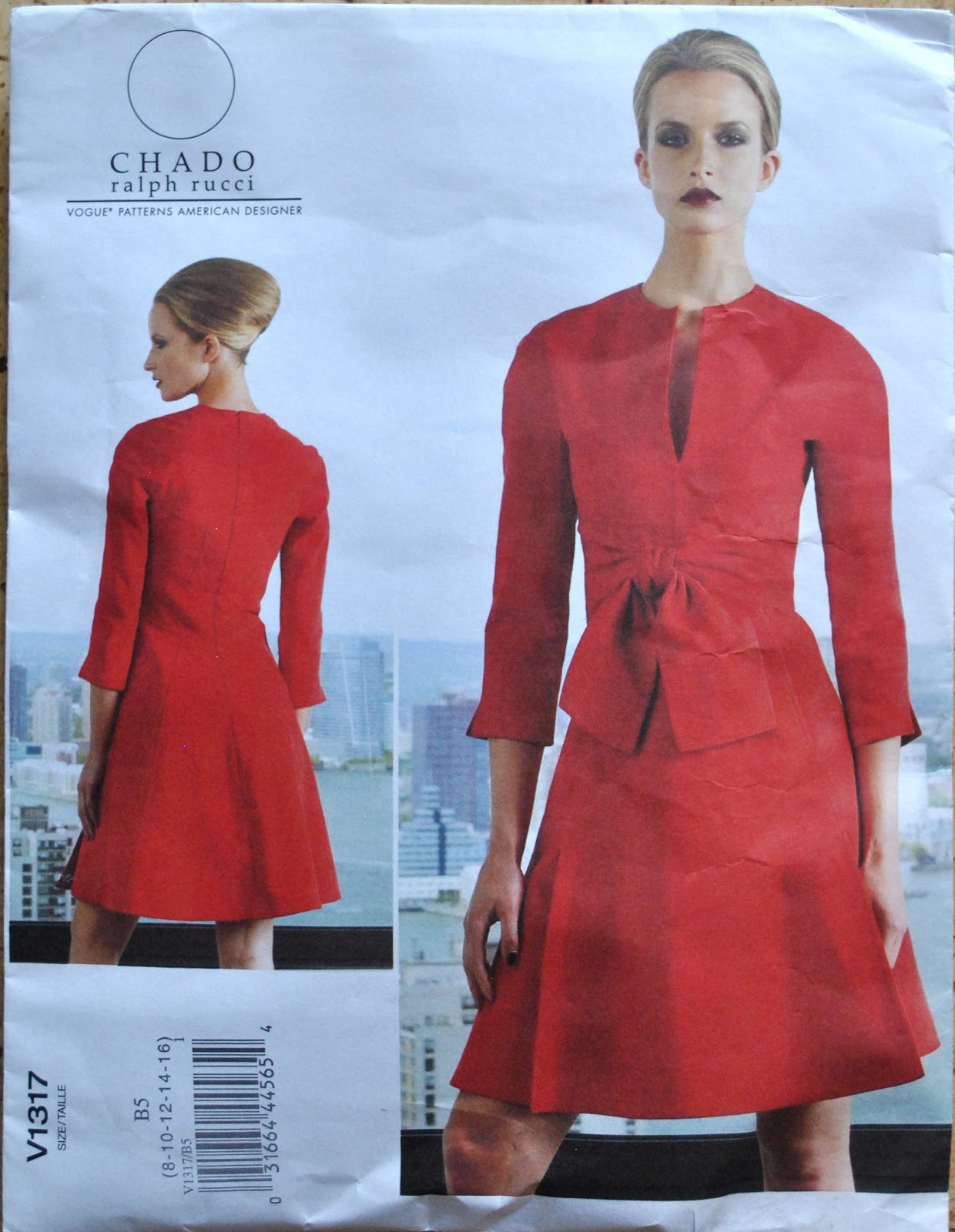
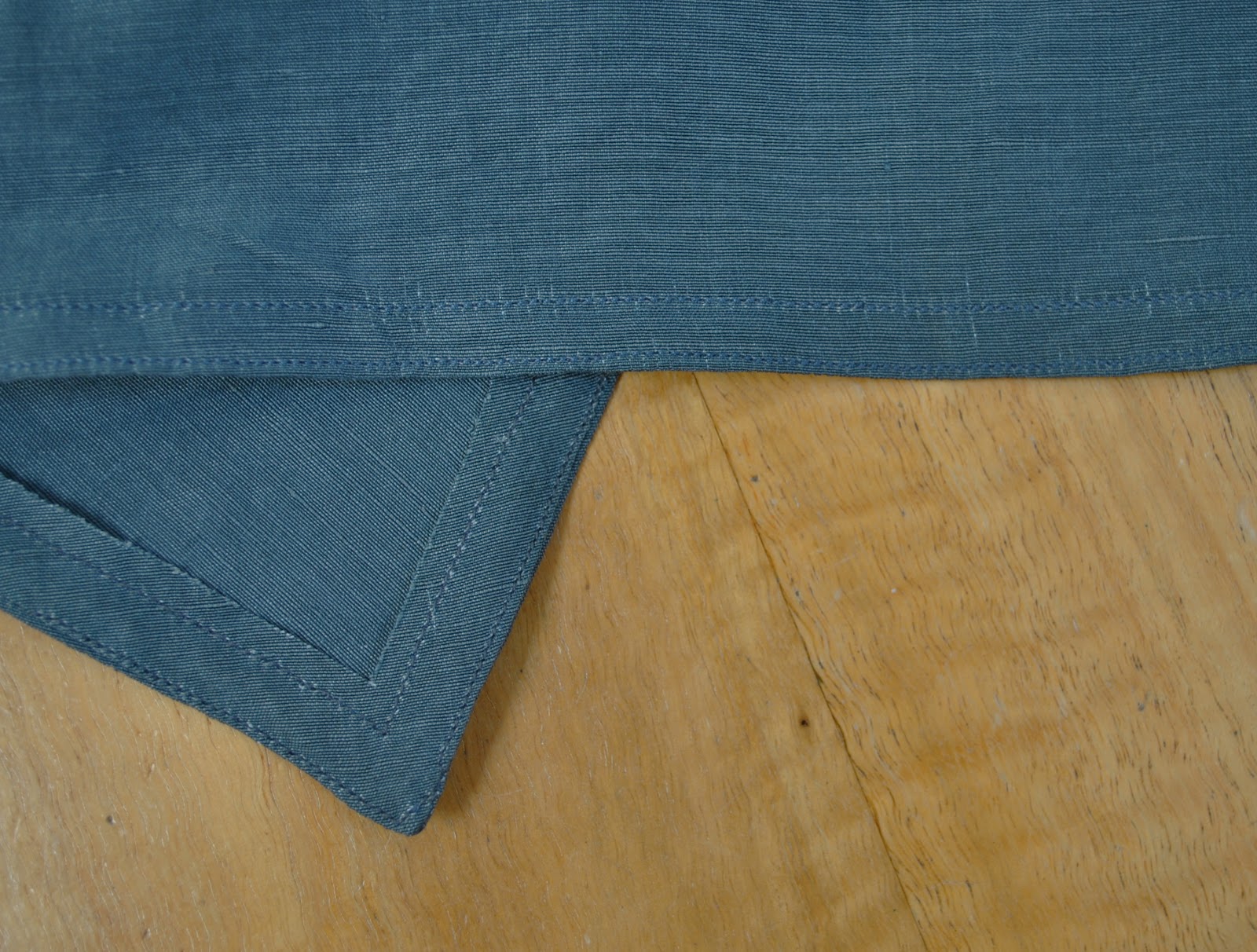
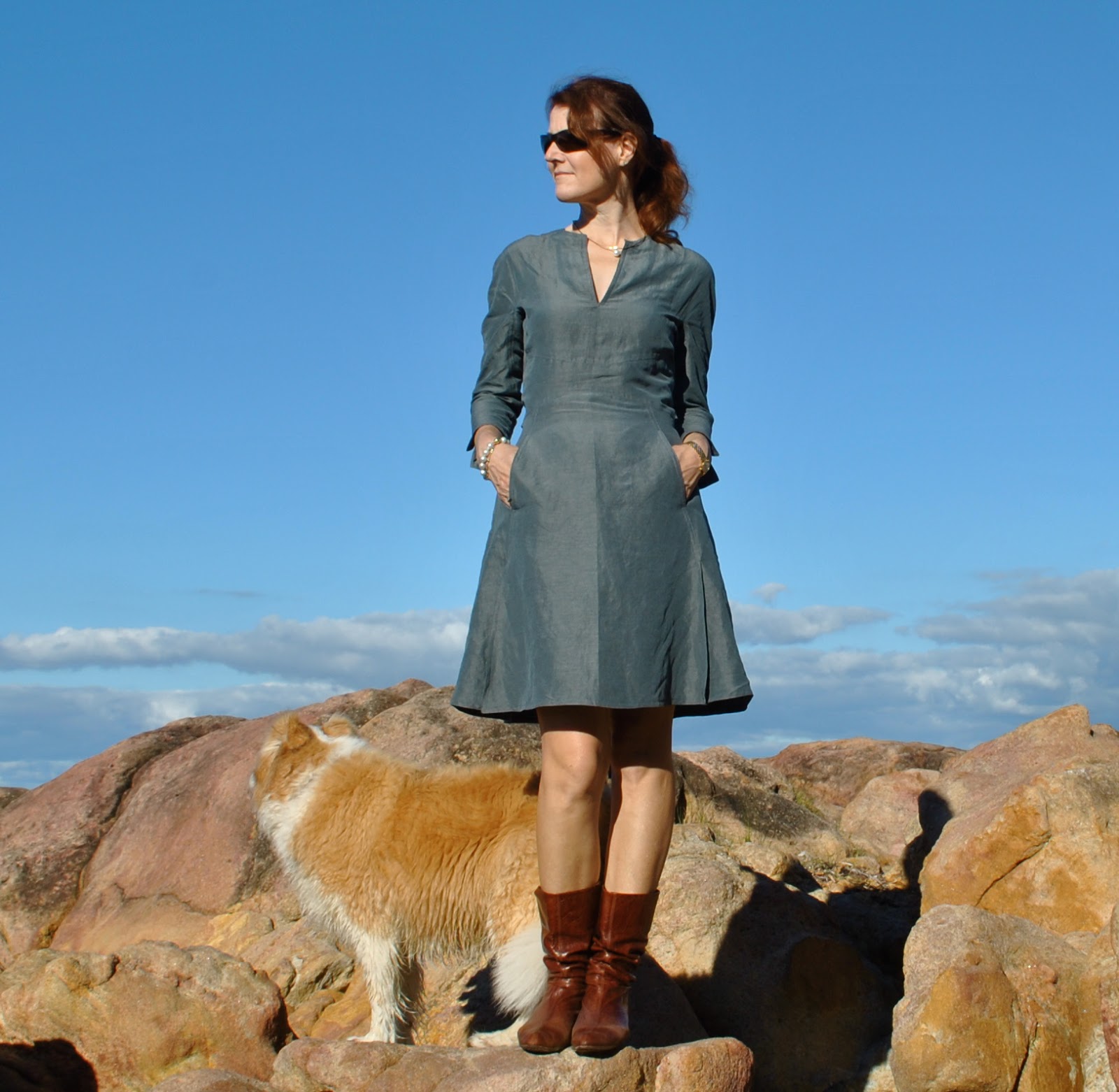
I made it using a new-to-me pattern Vogue 1317.  I have admired previous versions of this dress on shams and more recently Catherine, and my own version has been cut out for months and getting worked on in miserable dribs and drabs for waaaaaay too long!  But it is finally finished.  Like a lot of Chado Ralph Rucci designs, this is not a make-it-up-in-one-day garment  🙂
The fabric I used is a lovely silk/linen mix from Fabulous Fabrics, bought for me as a Christmas present by Mum and Dad.  The shade is a gorgeous deep, grey-y, green-y blue, like gunmetal, or the colour of the ocean under a thundery sky.  It’s lovely stuff.  I’m kinda tempted to go into Fabulous Fabrics and buy up every colour…. must resist….
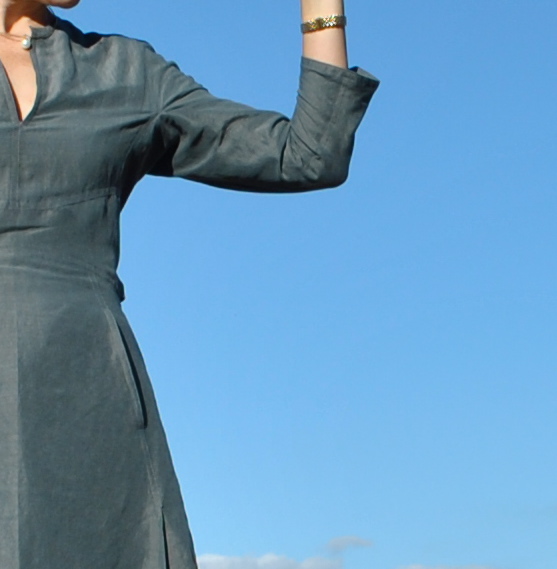
I must say I really love this silhouette and this style; the bodice is flatteringly streamlined, the sleeves are a nice shape and length, and the skirt is flippily cute and figure flattering.  I’m happy with how it turned out,  I love the (modified) pockets!
I did make a few tiny alterations to the pattern when I made it up; and when I use this pattern again I will make even more changes.
The changes I did make:
Even just looking at that front skirt piece I thought that the pockets are situated too close to the centre front, which would lend a sort of hands-over-the-crotch appearance to when you put your hands in the pockets.  So I widened the skirt front piece by about 2.5cm (1″) on each side.  This alteration also enabled me to make the pockets slightly bigger, mine are about 1cm wider and 1.5cm deeper each.  Now they are situated over my upper leg and I think they are perfectly big enough to be usable  🙂

The front centre front bodice slit looked a tad low-cut for my taste, so I sewed up the bodice front and the corresponding facing pieces by an extra 4cm.  Now the opening hits at a more flattering and modest point.
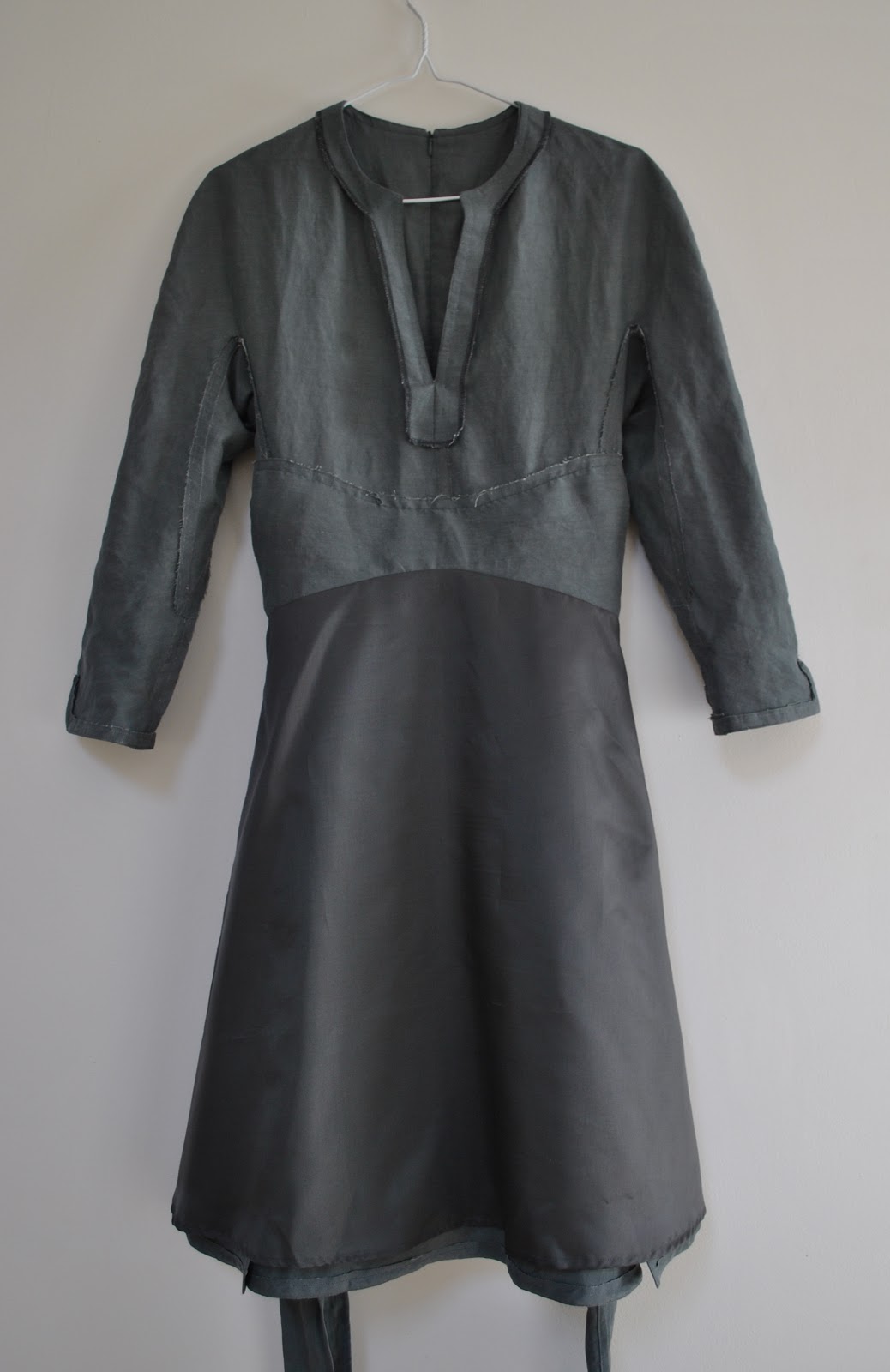
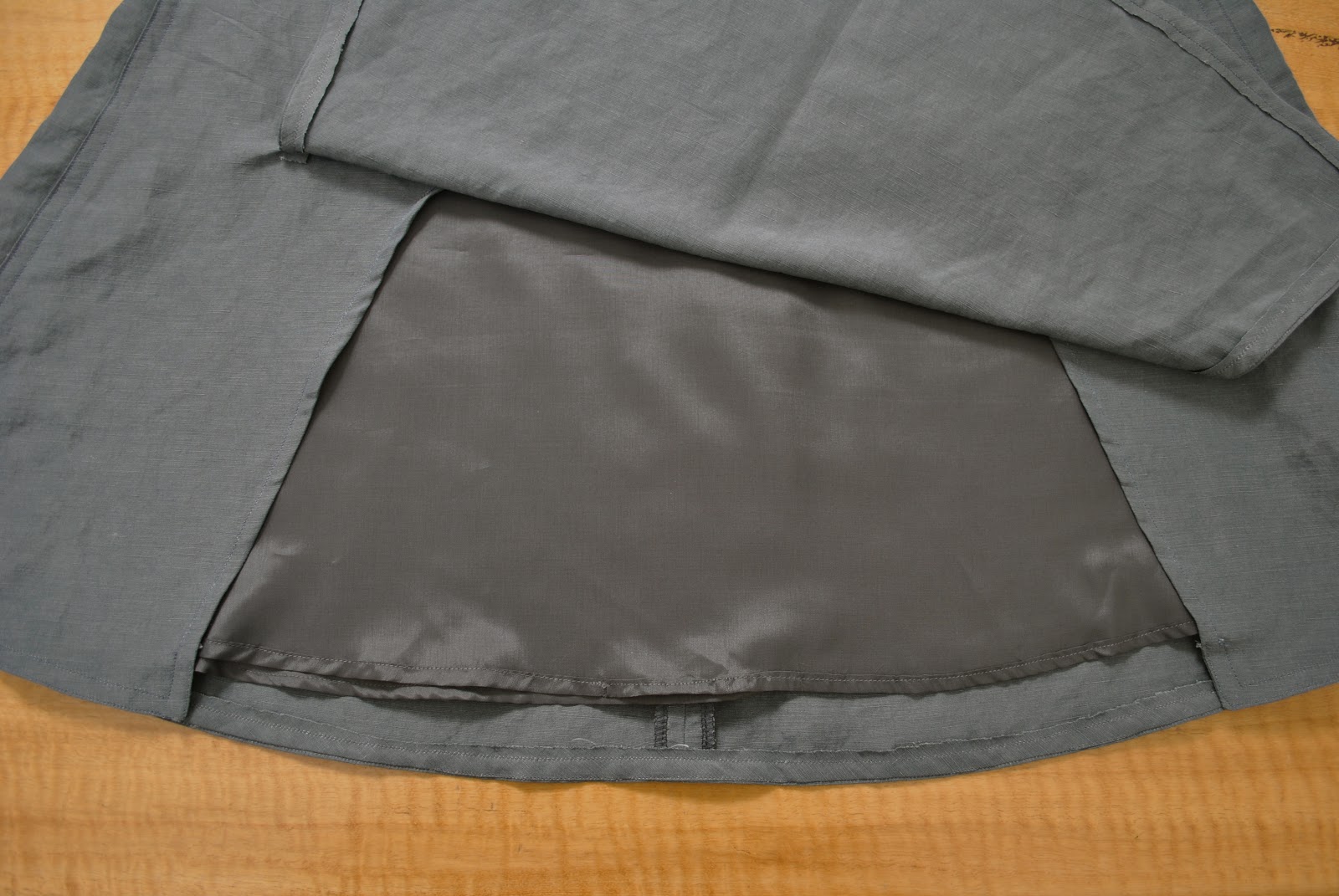
I spliced the skirt pieces together to cut a three piece skirt lining (one front, two back pieces with a CB seam), using dark grey polyacetate lining fabric.  The pattern doesn’t call for a lining, but if there was not one then in a windy situation…. see?
I think a skirt lining is imperative  🙂

I cut the waist ties to be much much longer, because I like the idea of wrapping them around my waist and tying them at the back.  I prefer a back-tie, over a front-tie sitting in a big bow right in the middle of my tummy!

I also added about 2.5cm to the skirt length, and reinforced the zip stitching lines with narrow strips of self fabric cut on the grain for stability.

Changes I did not make, but would if I was making this up again:
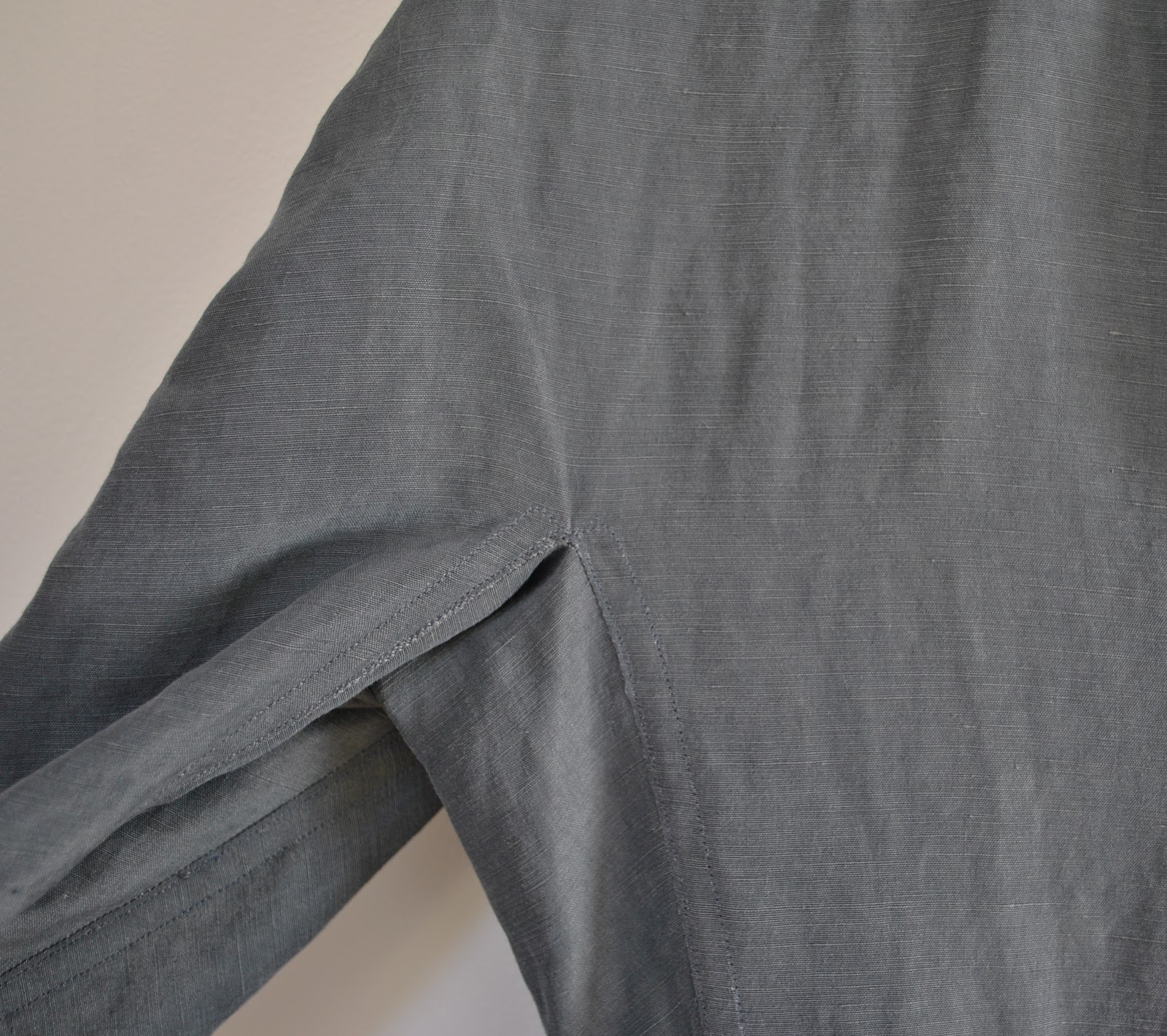
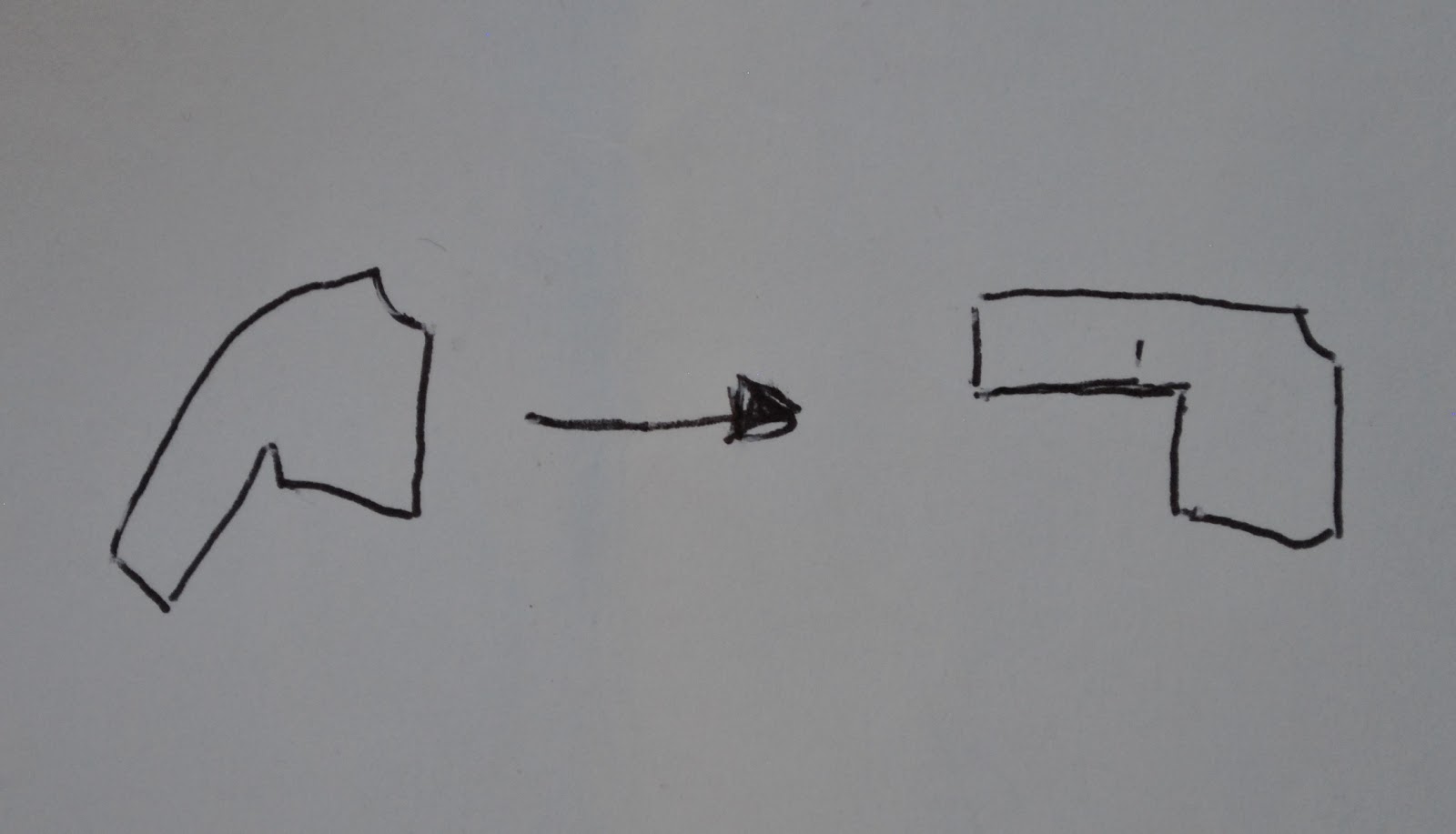
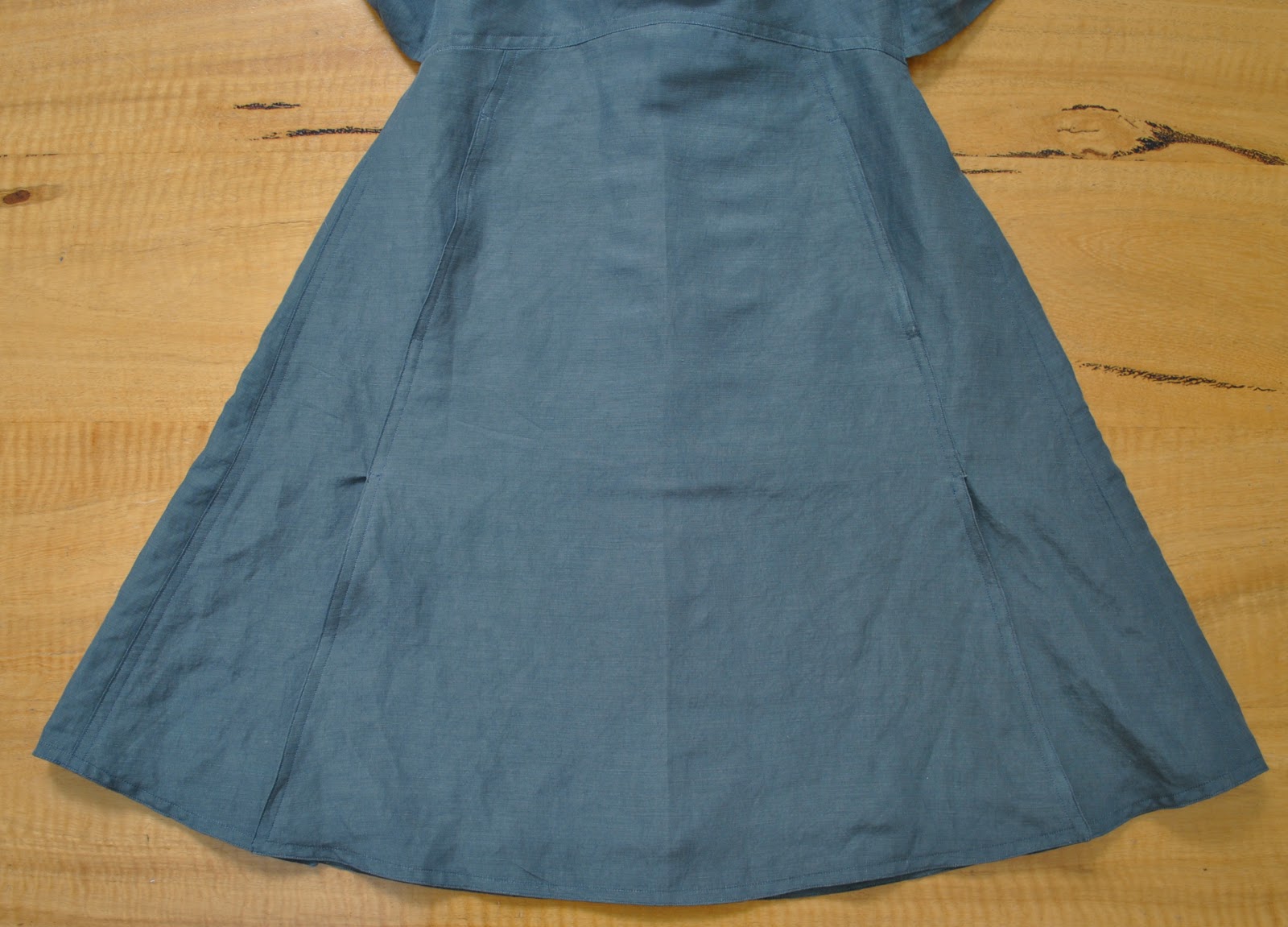
The inner corner of the bodice front, at the small circle point, is, I hate to say it, badly designed, there’s just no other way of putting it.  The dress as it is is fine for sitting at a desk, working on a computer all day, or say, going to a concert, a movie or the ballet.  However I want to wear my dress all day, for the kind of activities I do everyday, including hanging the washing on the line, putting groceries in the fridge and pantry; in short, activities that require me to raise my arms above my head!  Lifting my arms over my head does not work as smoothly as it should.  

The next time I make this pattern up, I will re-draft both the front and back bodice pieces to be roughly more like this illustration… opening up the underarm at the inner corner to let the sleeve sit out horizontally at the cutting stage.  This will help eliminate that unnecessary strain on the fabric at that turning point.

The hems are finished with an interfaced facing, which is turned in, double top-stitched and trimmed close to the stitching.  This is quite nice, the double top-stitching matches up visually with the copious quantities of double top-stitching that is all over the rest of the garment; but I don’t know if I love it.  I might brainstorm something different for next time.

But these are mere petty quibbles.  I do like my new dress! 

min 11C, max 21C, fine and sunny

Details:
Dress; Vogue 1317, dark blue/grey silk/linen mix
(not seen): handknit socks
Boots; Enrico Antinori, from Zomp shoes

Pattern
Description:
Dress has low neckline slit, close-fitting bodice cut-in-one with sleeves (slit), side back bodice extending into underarm gusset, lined midriff, single-layer tie ends (wrongside shows), skirt with side front/side back seams, side front pockets/vents, invisible back zipper, stitched hems, and self-bias binding. Topstitching and edgestitching.
Pattern
Sizing:
8-16; I made my usual size 10 and needed no alterations for size
Did
it look like the photo/drawing on the pattern envelope once you had finished
sewing it?
Yes.
Were
the instructions easy to follow?
as is usual for Chado Ralph Rucci patterns, yes the instructions are easy to understand, but not necessarily easy to follow!
What
did you particularly like or dislike about the pattern?
I fell in love with this dress style from very first sight of the envelope.  Who ever said there was no such thing as love at first sight?  Poppycock!!
The style is very chic; a funky modern interpretation of a vintage silhouette.
There are quite a few things I do not like; that I intend to change on future iterations of this pattern; and yes, there will be more!
The shape of the bodice front and back, at the small circle point, is, I hate to say it, but badly designed, there’s just no other way of putting it.  The shape of the pieces here means that lifting your arms above your head while wearing the dress does not work as comfortably as it should here.
Fabric
Used:
Silk/linen mix
Pattern
alterations or any design changes you made:
I thought from looking at the pattern piece that the pockets were situated too close to the centre front; ie, meaning that when your hands are in the pockets, they are hovering right over the crotch region… neither a ladylike or comfortable position.  I widened the skirt front piece so that the pockets are more to the side, so my hands are resting on the front of my hips while they are in the pockets.  Widening the skirt front also enable me to cut my pockets bigger and deeper, a bonus side effect  🙂
I stitched the front bodice and corresponding facing pieces seam to be 4cm longer; the opening now hits at a more flattering and modest point on me.

I cut the waist tie piece to be much much longer, so that I can wrap it right around my waist and tie at the back.  I prefer this to having a bow or knot sitting at my front.
I cut the skirt pieces about 2.5cm longer each, and lined the skirt with a lining that does not have that wide open flap at the front; for reasons that become obvious when you sit down and cross your knees in this dress.
Would
you sew it again? Would you recommend it to others?
Probably!  I recommend this pattern to an advanced seamster, who likes an updated “vintage” silhouette, and who lurves topstitching with a  passion.
Conclusion:
Well, I love it! and with just those few minor adjustments I am looking forward to making this pattern up again  🙂

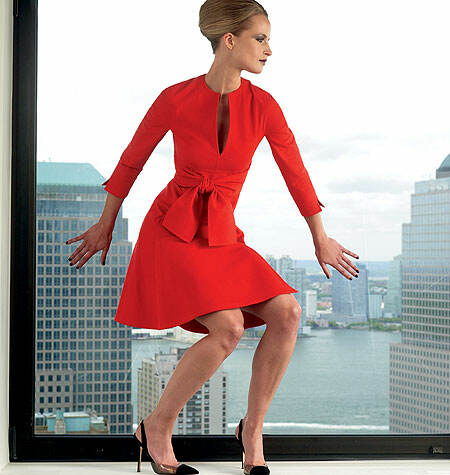
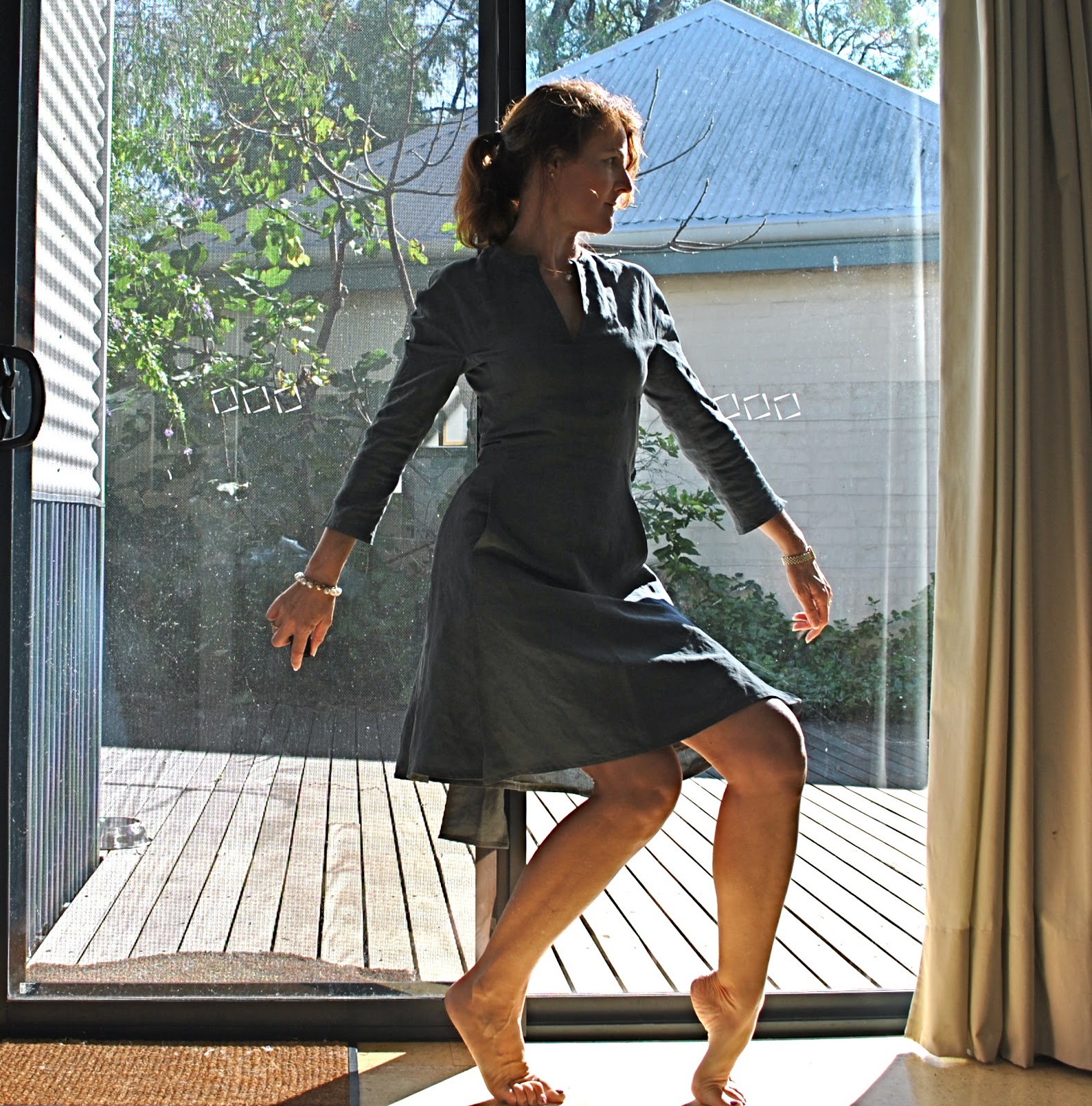
Now, just because it always gives me a big laugh when other sewing bloggers do this, like Jilly Be and chenille; I give you… the simple casual elegance of the Vogue pose!  Now this I think can claim to be crab-like!
source

pinterestmail

Taurus

 
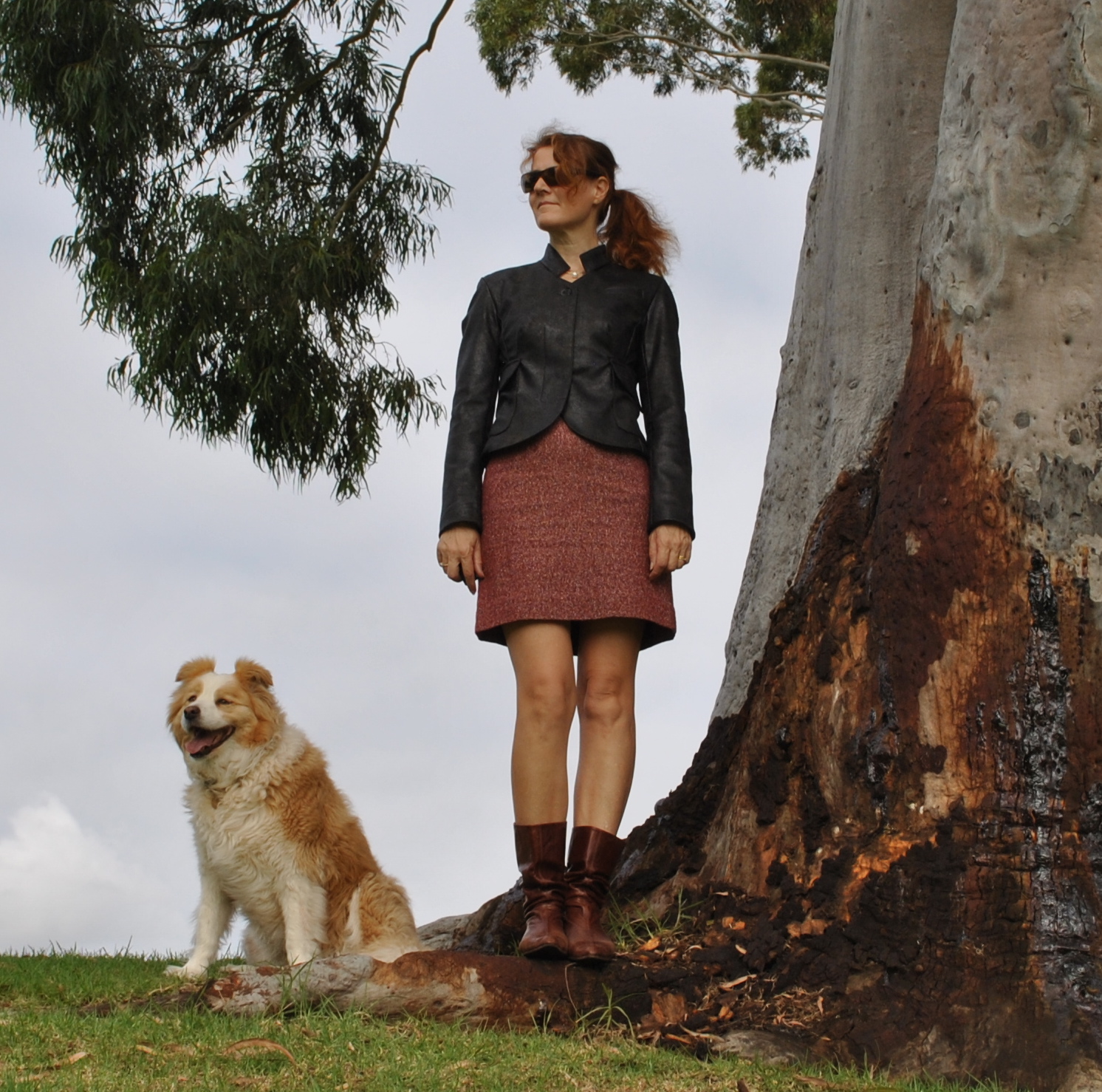
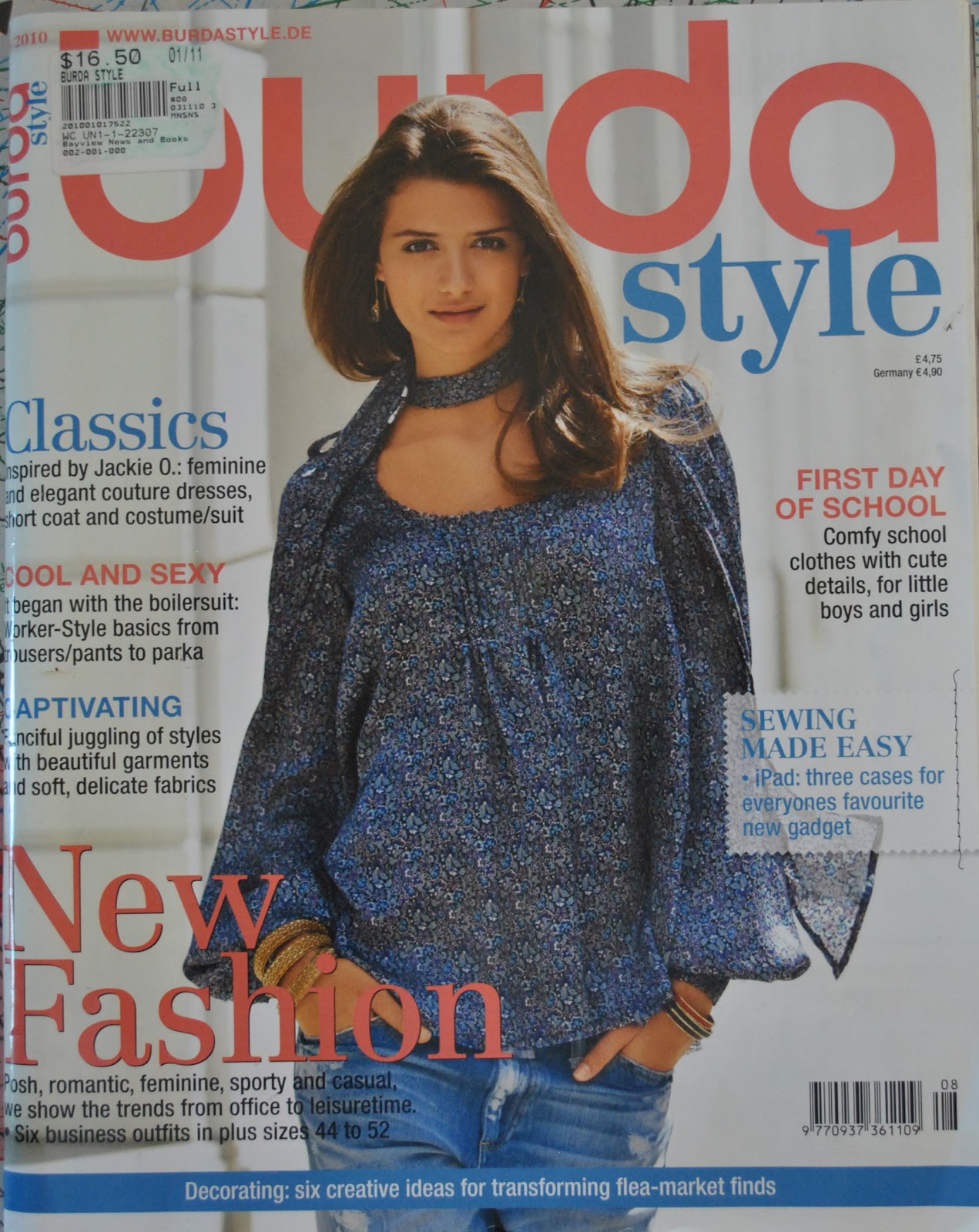
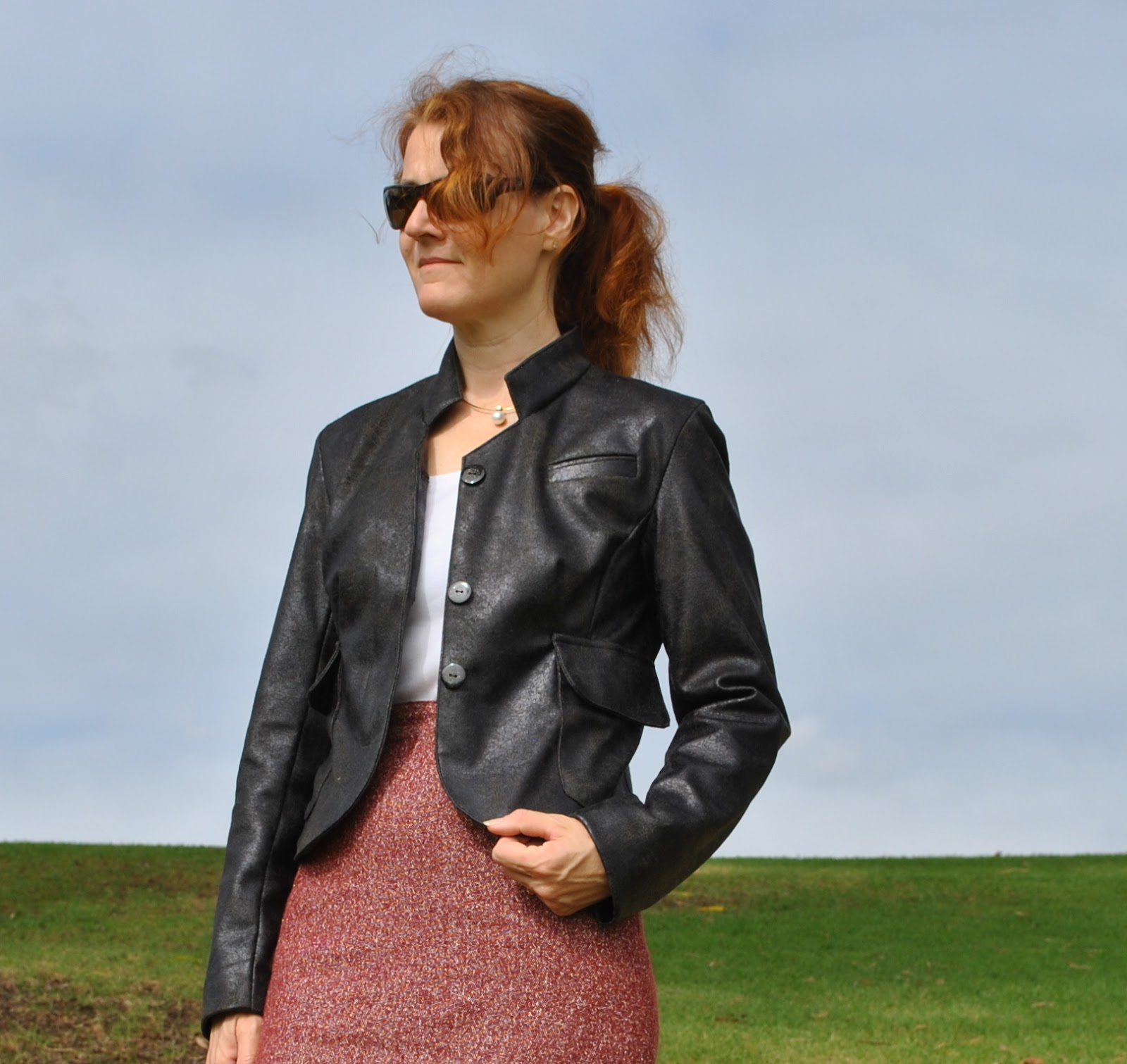
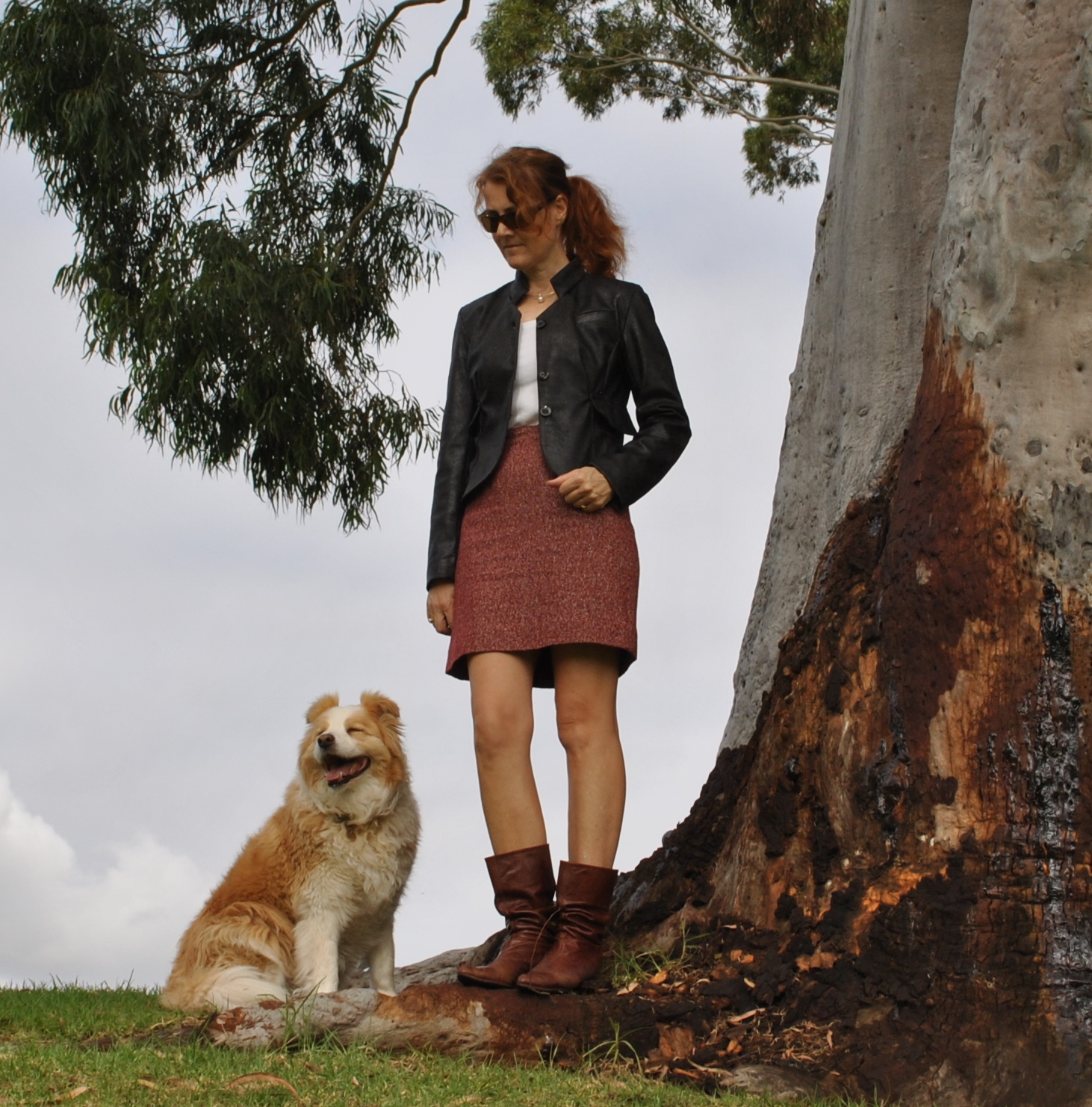
I have made a new leather jacket.  Well…  it’s “pleather” really.  A faux leather jacket; or maybe we can call it a fleather jacket… ha!   I’m going to go with that.  I’m pretty happy with how it turned out!  I’ve been thinking wistfully about a leather jacket for years, and I was super impressed with kbenco‘s gorgeous leather jacket.  So, while I was staying at my parents’ place over Easter I noticed this pattern, designed for leather in one of Mum’s old Burda style magazines. I found this very nice chocolate brown and black-splodged PU laminate in Fabulous Fabrics; the texture is very realistic, semi-matte and soft and very faintly “crazed” like very well-loved, well-worn old leather.  I bought up and got cracking.
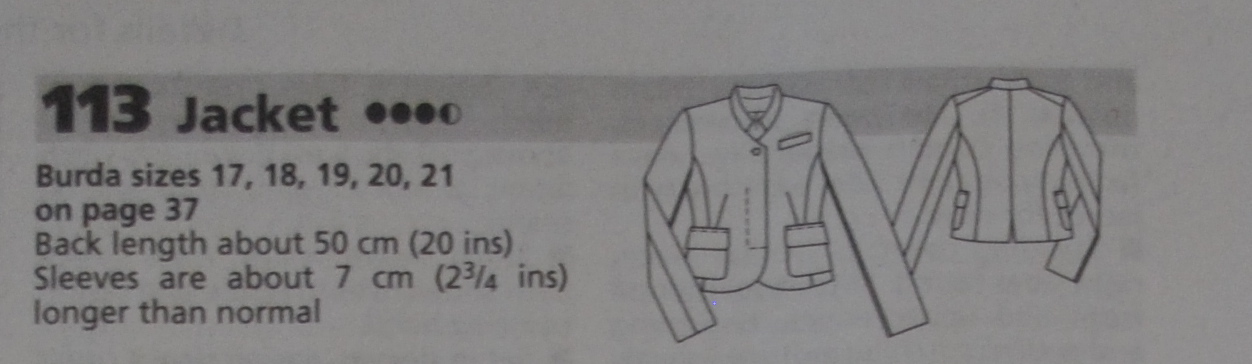
The jacket is pattern number 113 from Burda style magazine, 08/2010.  I made no modifications, excepting multiple teeny modifications to get a good fit.  There were plenty of these, but I’m only listing them in my review below if you feel like plodding through the nitty gritty, since reading about personal fitting modifications is the most boring thing on the planet.  The only one really worth mentioning is that the sleeve cap to this pattern is rather high and leather is not a fabric that lends itself well to easing.  So I shaved off quite some height off the top of the sleeve cap, just over 1cm tapering off to the gathering start and end points.

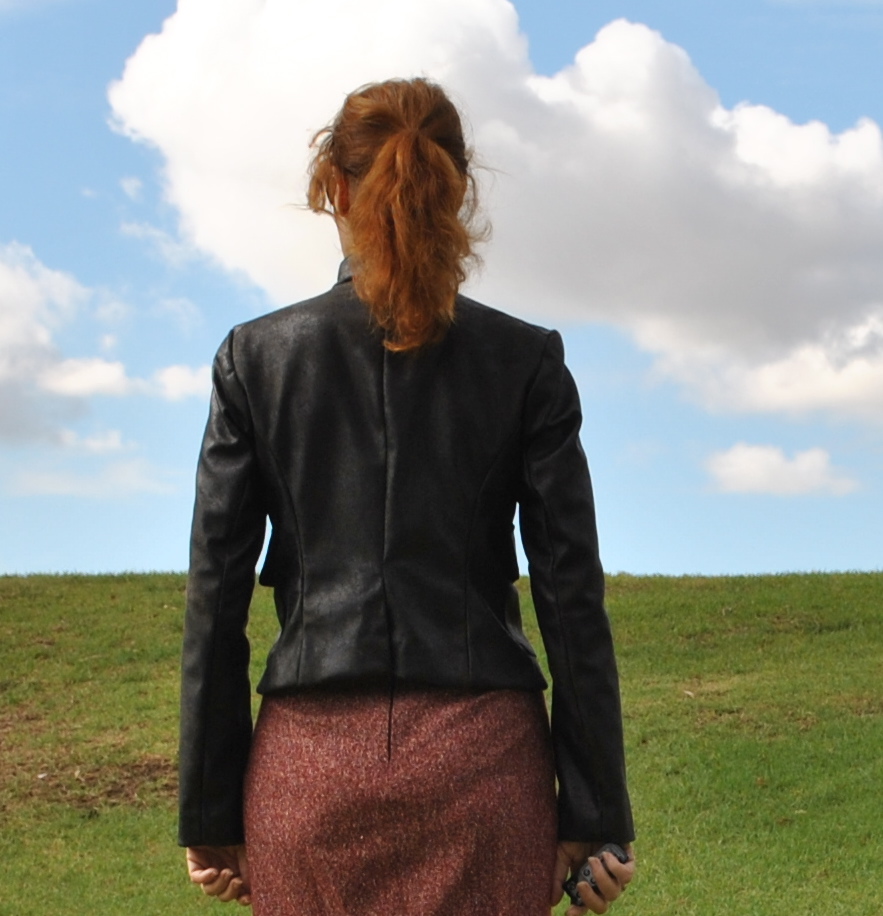
I’m not completely sure about that slit at the lower edge of the centre back seam.  I don’t really see the point of it.  I’m giving it a fair go though.  It’s on trial.  I might decide to sew it up sometime down the track…
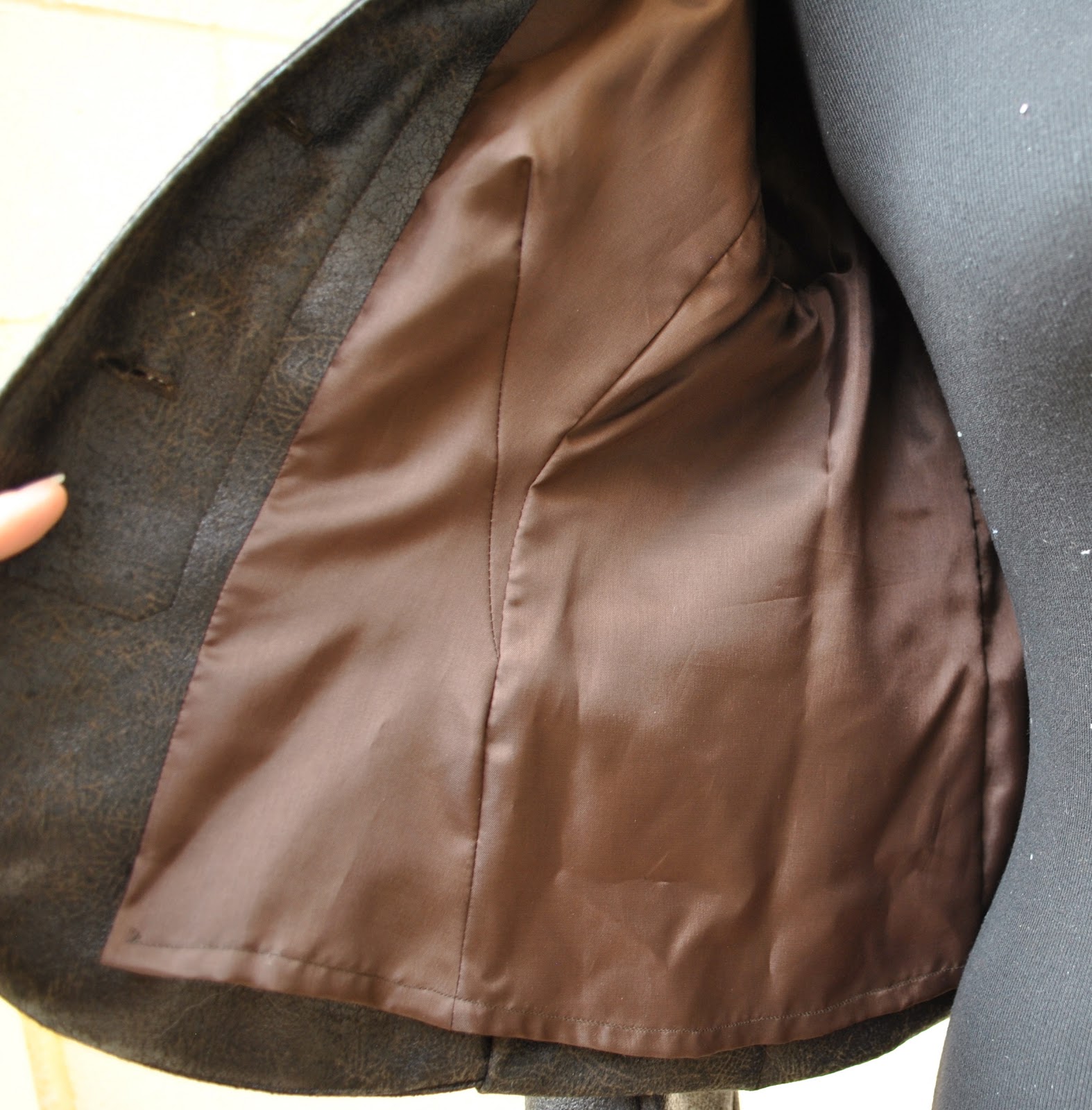
The jacket is fully lined with chocolate brown polyacetate lining fabric.  

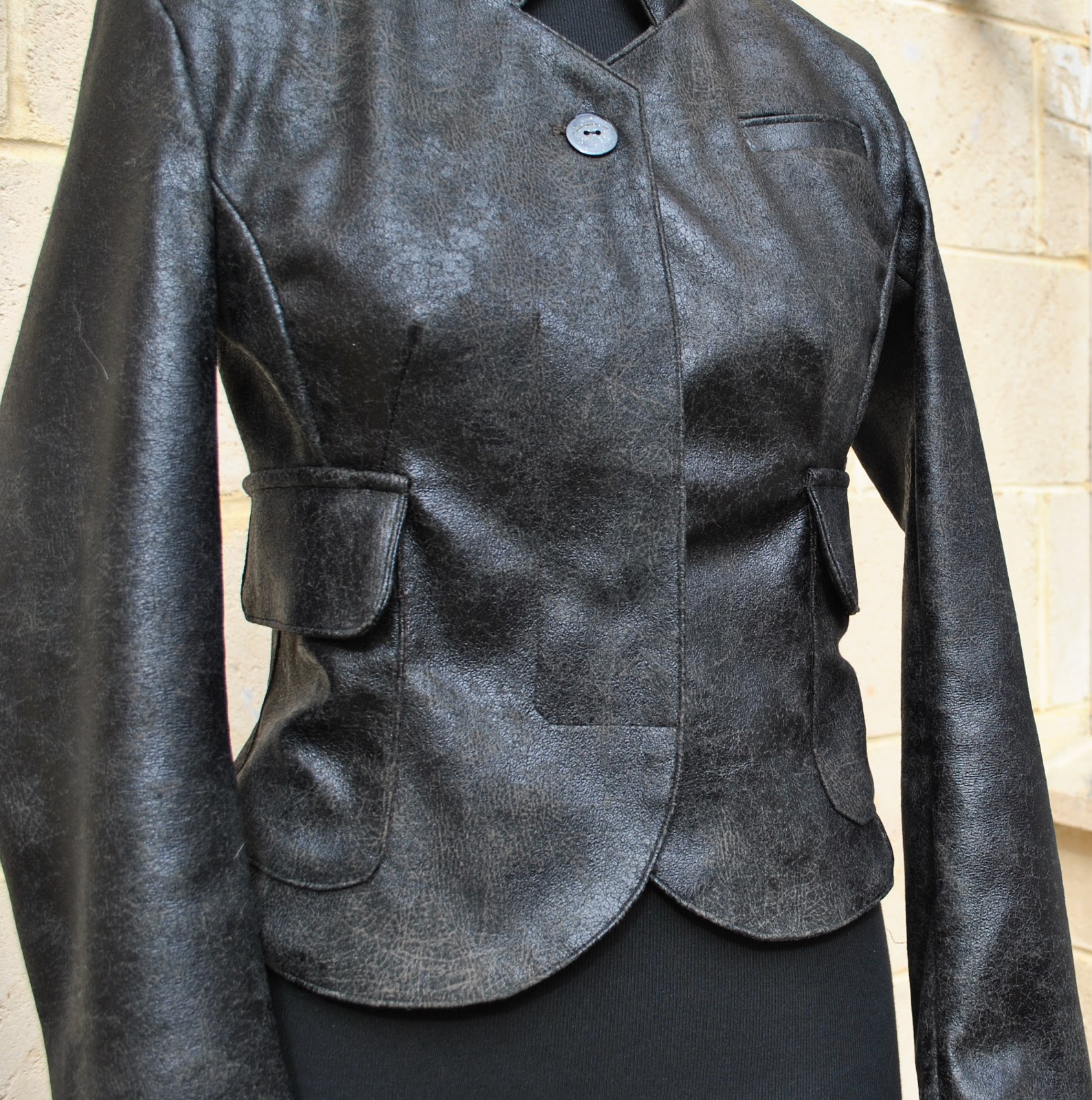
It has a hidden button placket for two hidden buttons, and two large, lined, flapped patch pockets at the hips, which are unfortunately not situated very conveniently for actually putting your hands in (sad face)  But you can still put things in them, and they do look pretty cool.  I like leather jackets to have lots of things and detailing and stuff on the outside.  In my opinion details really up the cool quotient on a casual jacket and lend it a young, urban aesthetic.

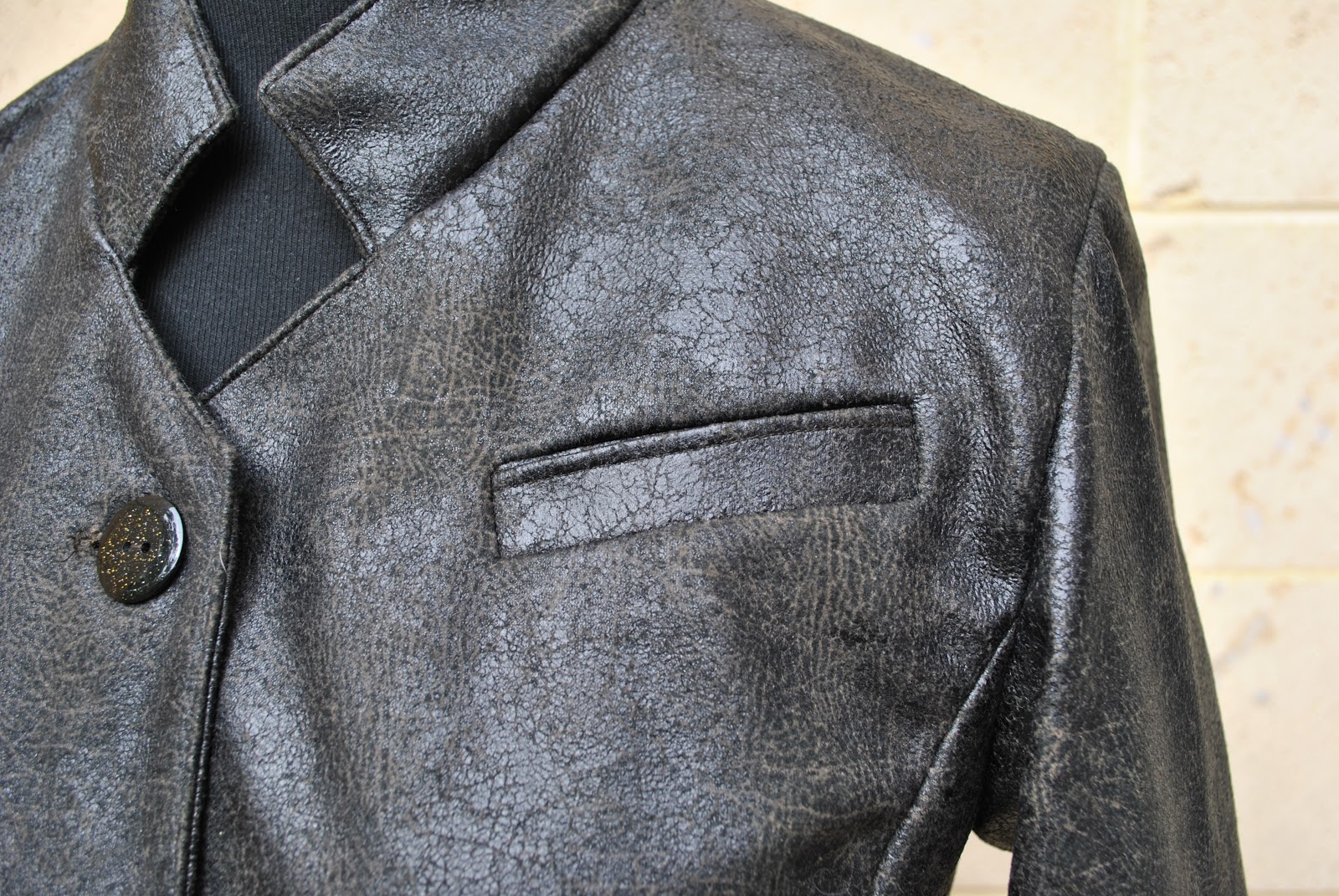
The jacket also has one small welted pocket on the upper left.  My fabric tended to “bounce” out of a fold, so I edge-stitched the welt, as well as the collar and front opening edges, to give them a flat sharp edge.  
The pattern called for the pocket bag under the welt to be inserted in line with and perpendicular to the pocket, which would have meant it would sit stuck out at a slight angle.  Whaaaa?  So I changed it so it hangs down vertically from the welt.  It’s hidden in between the lining and the jacket, so you can’t actually see the pocket bag at all, but I just didn’t like the idea of it sitting out all skewiff, defying gravity like that; it seemed an oddly imperfect and unbalanced way of doing the pocket, and it would have flopped in on itself a bit.  I think Burda probably did it this way to make the pattern piece and the instructions easier; but I just had to alter it to have a straight-hanging pocket.
Apparently the sleeves are 7cm longer than normal so that the wearer can roll or fold them back.  Well, I love this longer length.  This is great for winter.  I always get really cold wrists in winter, and so I won’t be rolling or folding them up at all!

Details:
Jacket; Burda style magazine 08/2010, 113, pleather
Skirt; Vogue 8363 with modifications, rusty red wool/silk mix, details and my review of this pattern here
Tshirt; self-drafted, white cotton, details here
Boots; Enrico Antinori

By the way, I often state that whatever I am wearing in my picture is what I am wearing that day, that I keep it real and never ever “dress up” just for the camera.  Well obviously, everyone in Perth will know straight away that it is a bit too warm for a winter-y get-up like this today! so in this case I am “dressing up”  (blush)  Sorry, but I just couldn’t wait for winter to show off my new jacket!

Pattern
Description:

Fitted
jacket with a short V-neckline, narrow standing collar, single welted breast pocket and two flapped patch
pockets.  Long two piece sleeves,
front has two darts for shaping, the back features a short lower hem vent and
the front closes by partially hidden button placket
Pattern
Sizing:
Petite/half
sizes 17-21; I made the size 19
Did
it look like the photo/drawing on the pattern envelope once you had finished
sewing it?
Yes.
Were
the instructions easy to follow?
Yes
What
did you particularly like or dislike about the pattern?
Well; I think the styling is great; a mixture of classic blazer and motorcycle jacket with a neat and nifty, waist-defining shape, and cute detailing.  I really like the pockets and I think they look really great in leather.  The sleeves are 7cm longer than normal.  I love this, they will keep my wrists nice and warm this winter.
I’m not completely sold on that centre back slit at the hem.  I don’t really see the point of it.  This may or may not get sewn up in the future, if it lets too much cold air in.
Fabric
Used:
Faux
leather, with polyacetate lining fabric for the lining
Pattern
alterations or any design changes you made:
I didn’t make any design changes, but I made tonnes of small modifications for fit.  Considering leather is not a fabric that eases at all, I think the sleeve cap is drafted too high and would have been too difficult to ease into the armhole.  I shaved off about 1cm in height off the top, and also took about 1cm off the edge of each shoulder seam, the latter a fit modification.  I took in all the seam allowances at the waist to bring the jacket in to hug my waist; the shaping as it was a tad boxy for what I wanted.  The faux leather fabric I used didn’t take creases at all, so I edge-stitched all around the front edges of the jacket and collar, as well as the fold of the welt, to give a nice sharp edge.
Would
you sew it again? Would you recommend it to others?
Maybe….
so many patterns, so little time! 
But yes, of course I recommend this classic yet cool pattern to others.
Conclusion:
Well
I now have a cool new (f)leather jacket. 
I’m totally happy with it.  ‘Nuff
said  🙂

pinterestmail

Blue-bell sleeves

Hello  🙂
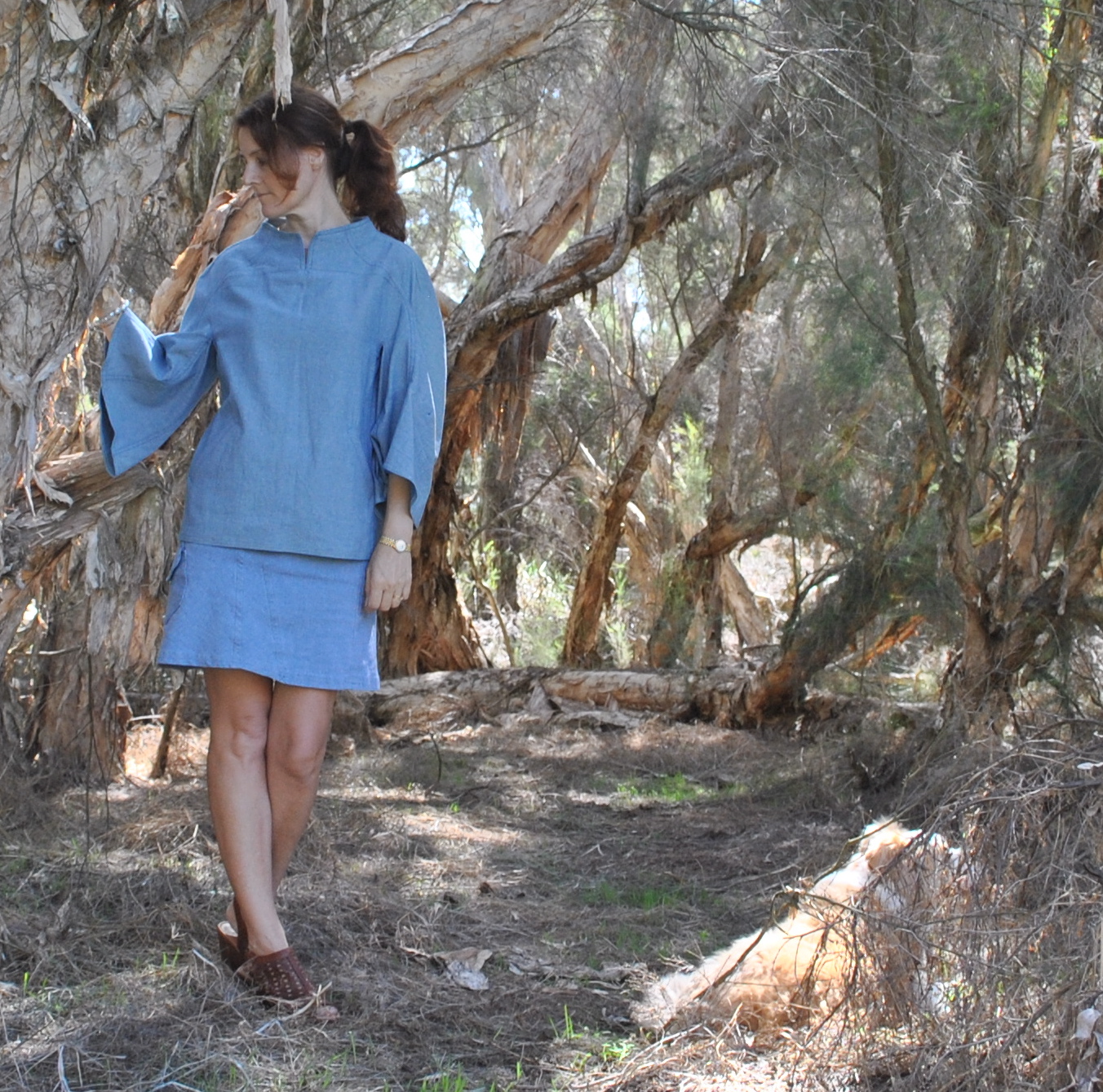
I’ve made a new top.  Actually I made this a little while ago, and I’ve suddenly came to the glorious realisation that hey! the autumnal weather is here and it’s actually beautiful enough to wear it.  I love this time of the year!
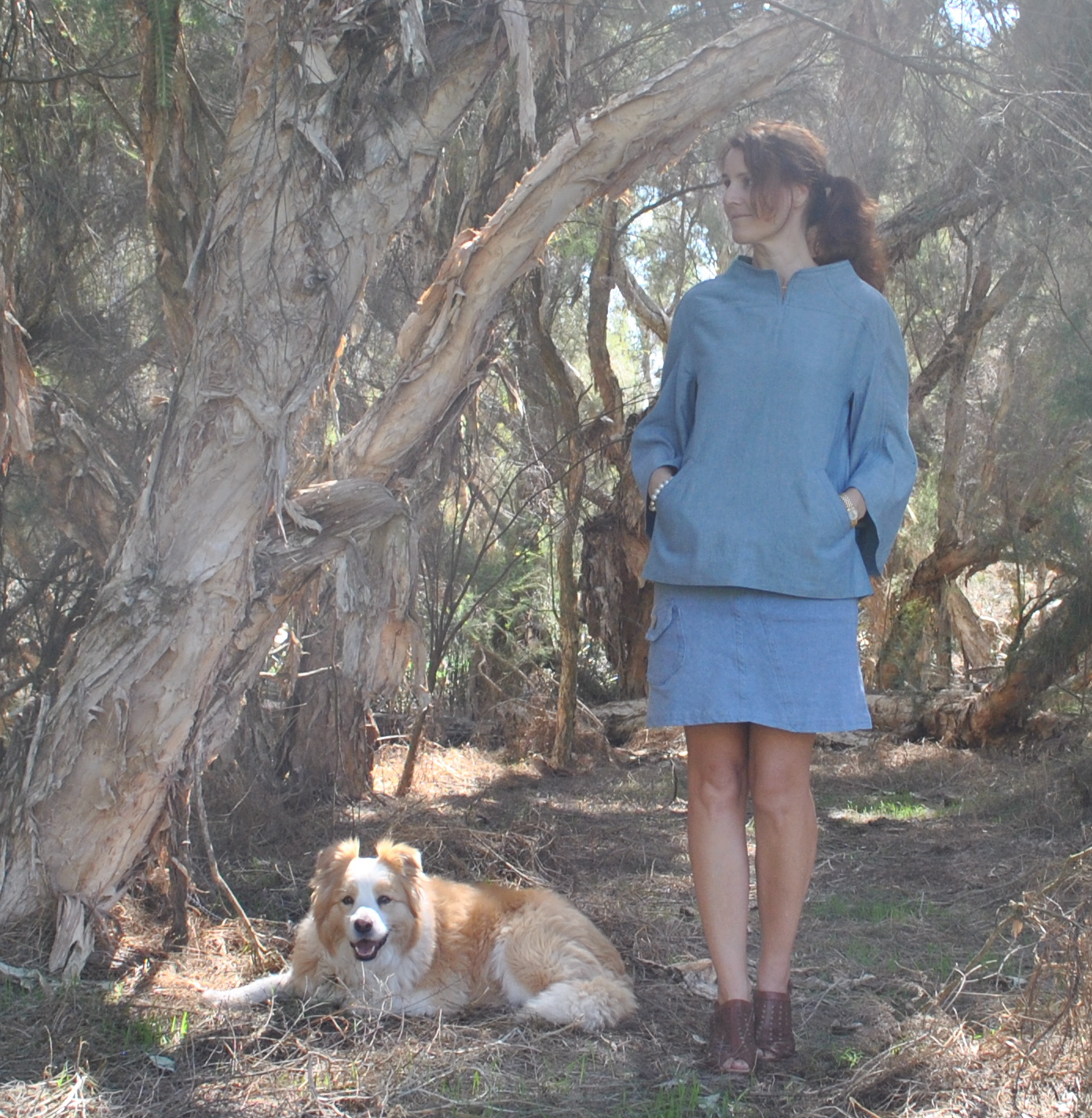
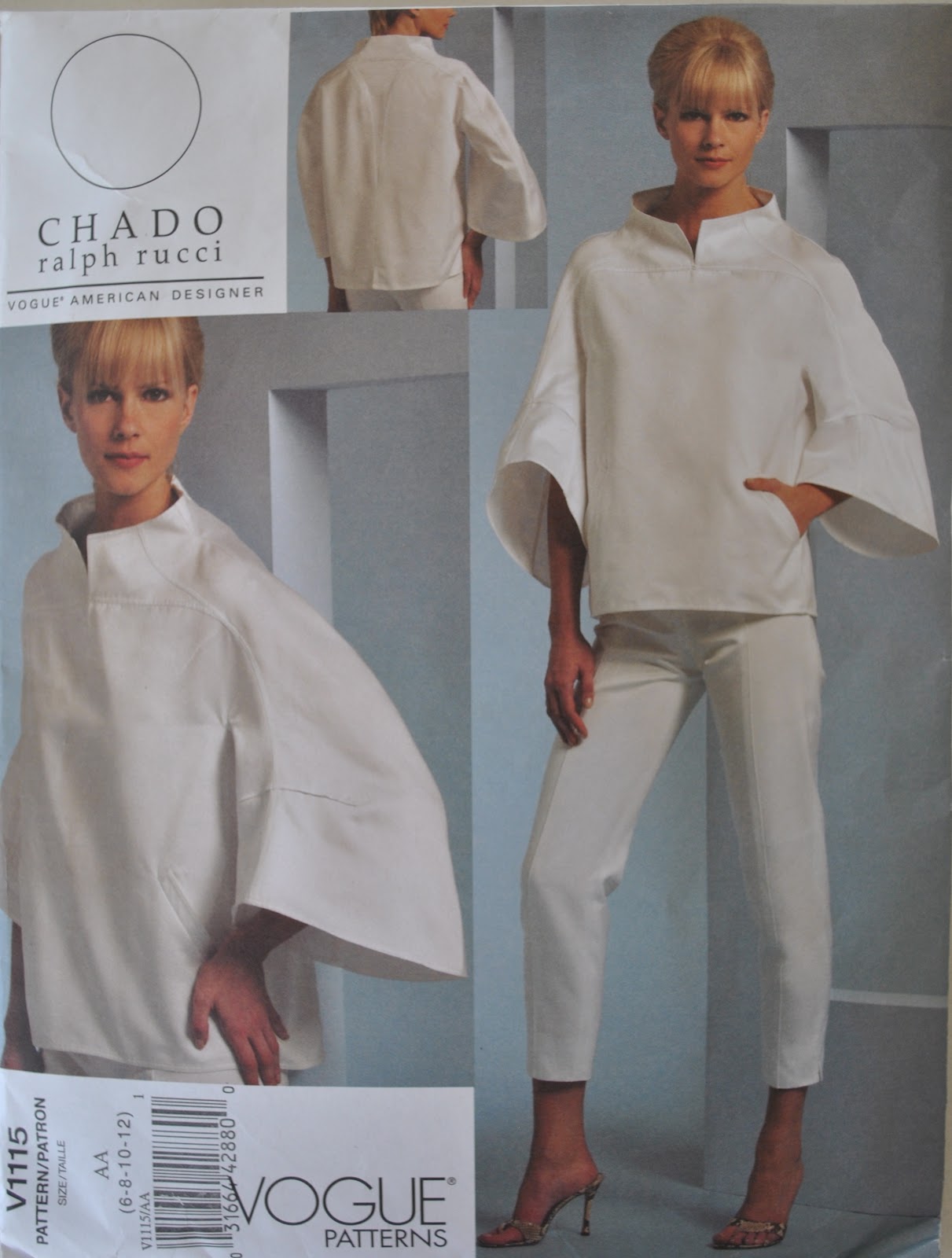
This is made using Vogue 1115 with the body lengthened by about 2.5cm, and used a piece of thin blue woven cotton denim-y stuff.  I chose to use the fabric wrong side out, since I preferred the muted, slightly undefined, yellow-y tone of the blue of the wrong side.  The right side is a stronger blue, which I didn’t think did wonders for my complexion.
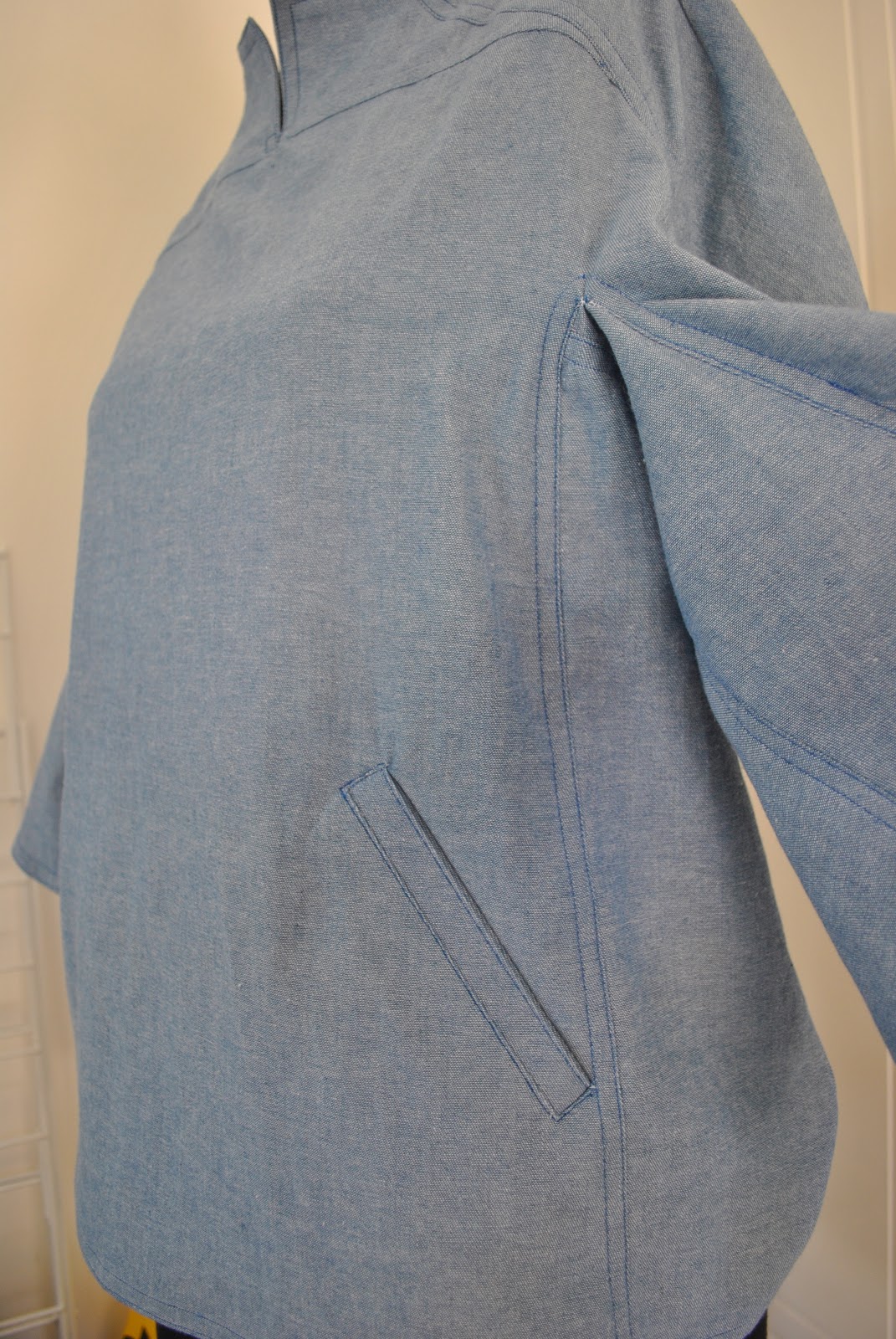
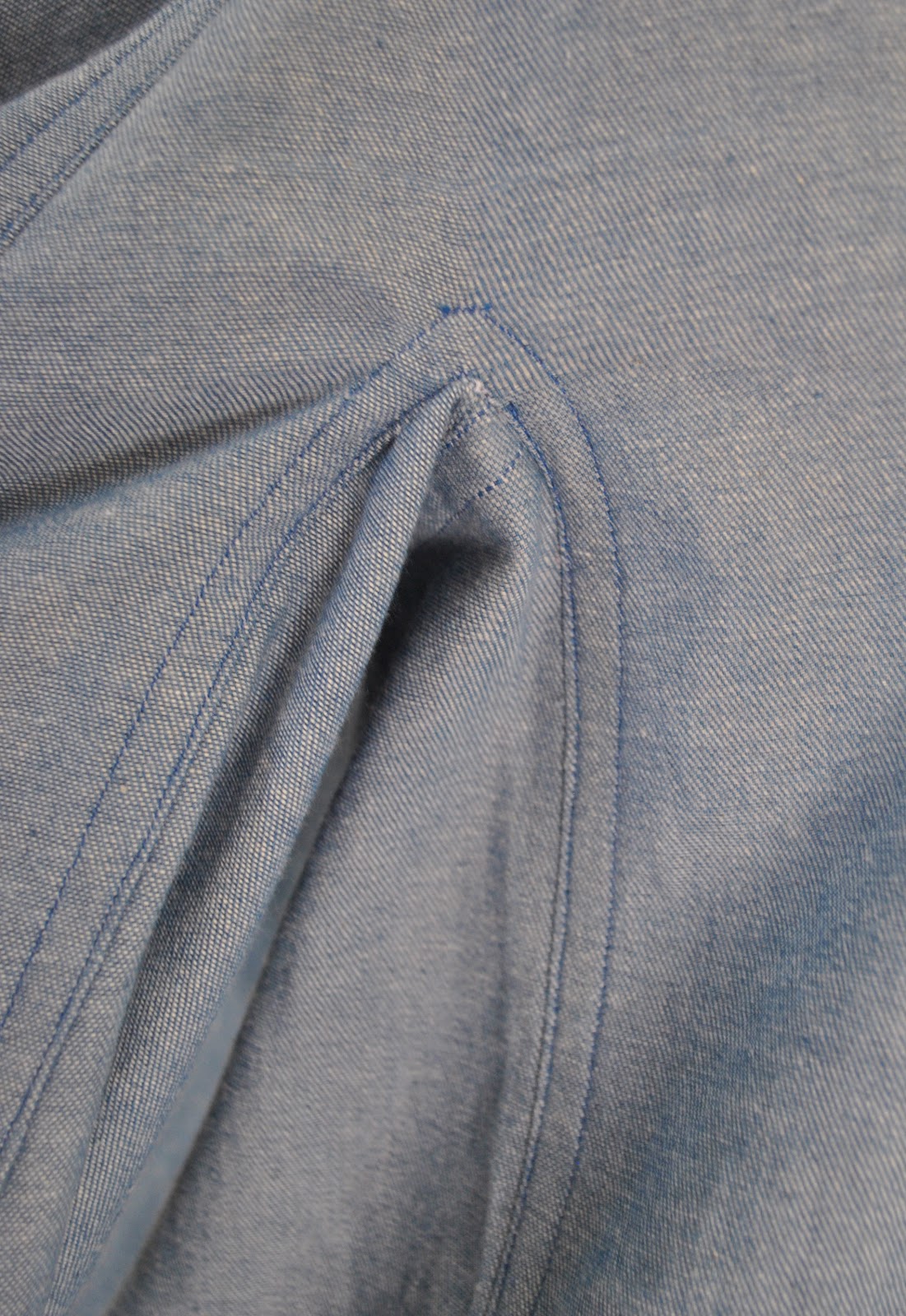
I’ve written a pattern review below for anyone interested, but there really is one important thing to know about this pattern, it is rated Advanced/Plus Difficile, and yes, that is a well deserved rating.  The undersleeve/side piece when joined together is pretty tricky to insert neatly; and sewing down the seam allowances of said sleeve gusset with a double row of topstitching? … seriously tricky.

Most of the topstitching I used a deeper blue thread which was painstakingly colour matched to the blue in the fabric weave.  Haha, kidding; actually it is just leftover thread that I already had in my stash  🙂 the fact that it matched is fortuitous!  I used a lighter shade of blue for the bar tacks.

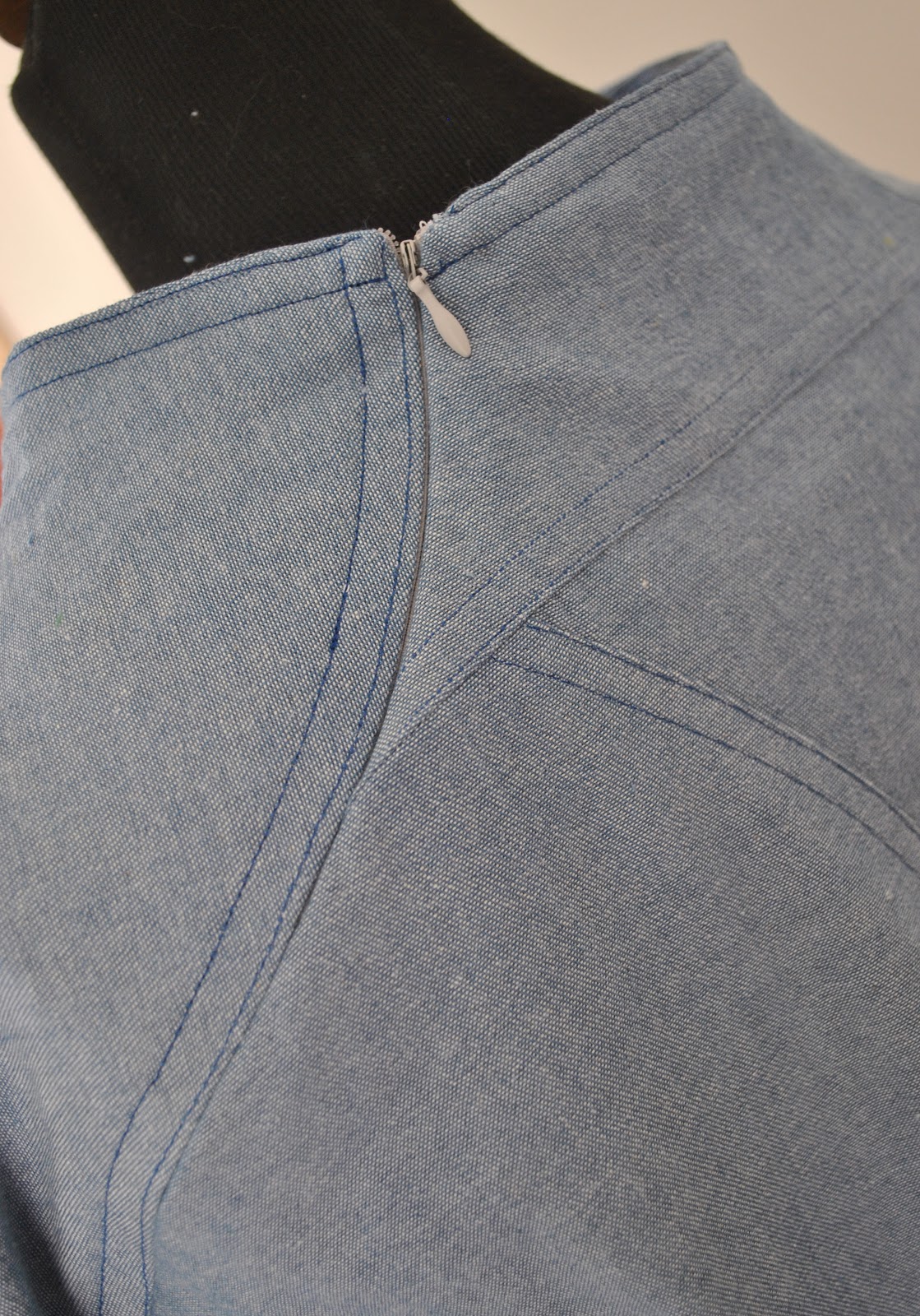
Installing that invisible zip, another seriously tricky procedure.. since I prefer to insert the zip before sewing up the seam below it; and since the seam allowance has to be finished with a double row of top-stitching to stylistically match all the other seams on the garment; this is an area that needed a bit of nutting out.  I’m pretty pleased with the nice even finish I got in the end  🙂

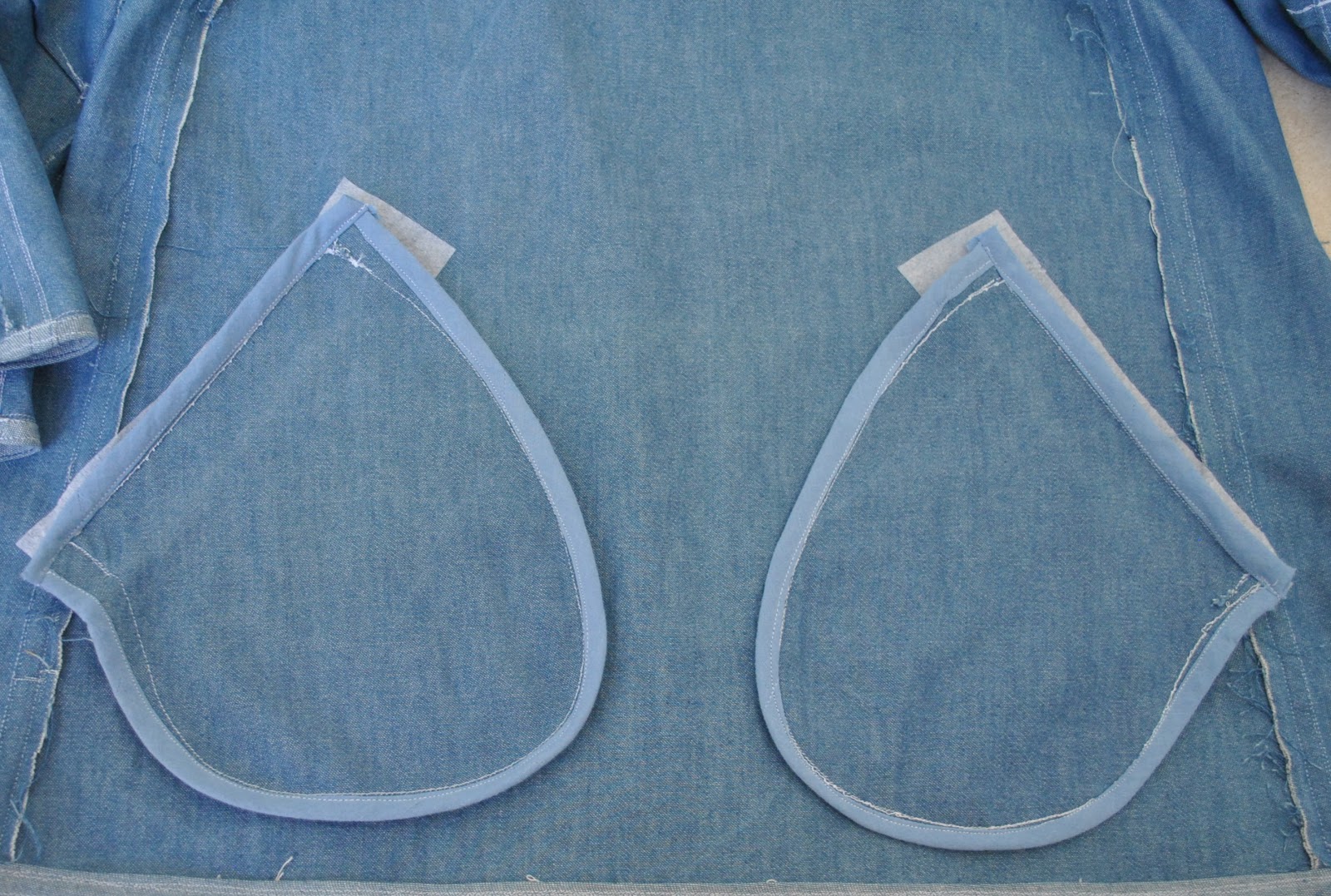
Look at those blissfully deep, welted inner pockets (satisfied sigh)  I made them a smidge deeper and bigger, and the edges are finished with HongKong seaming.

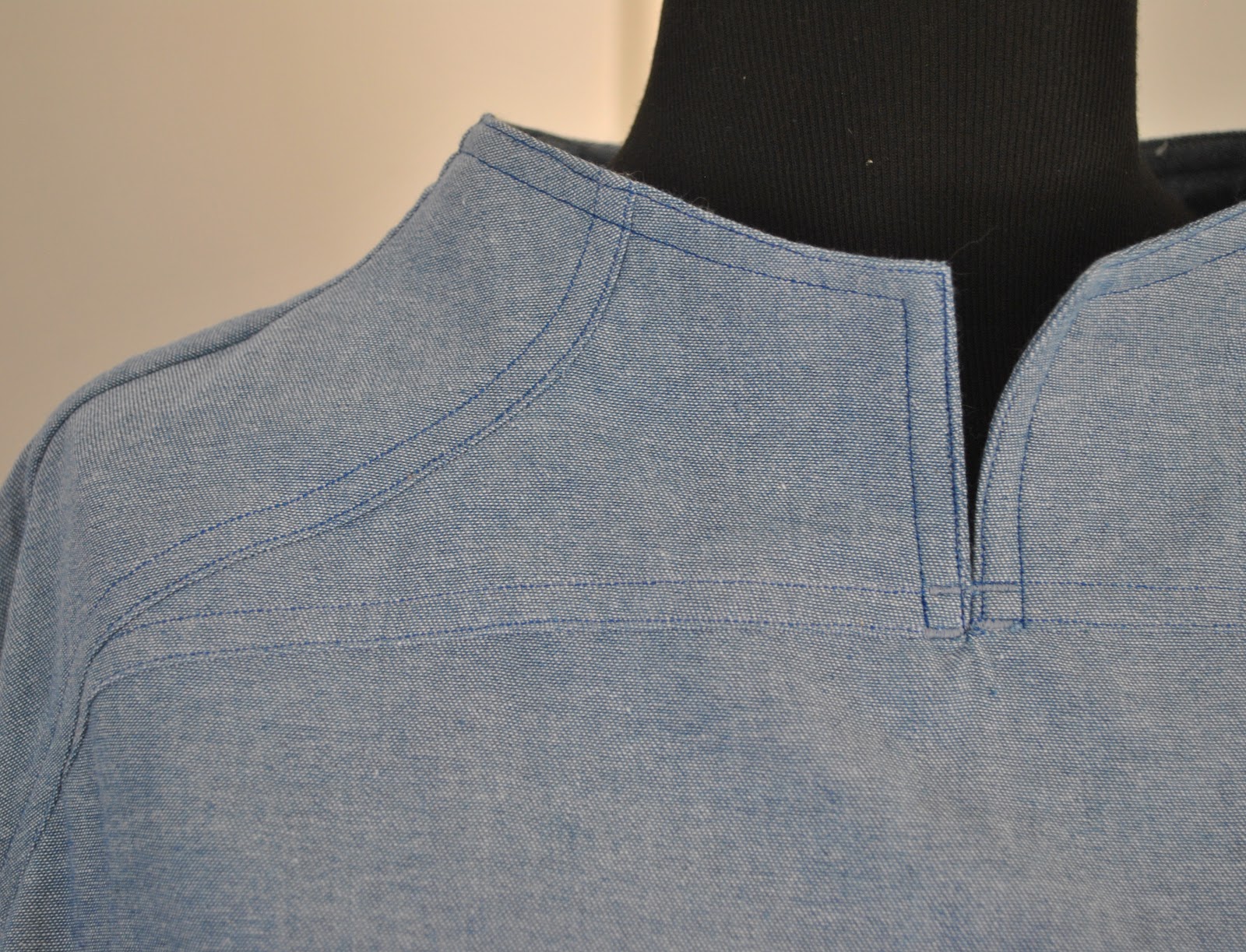
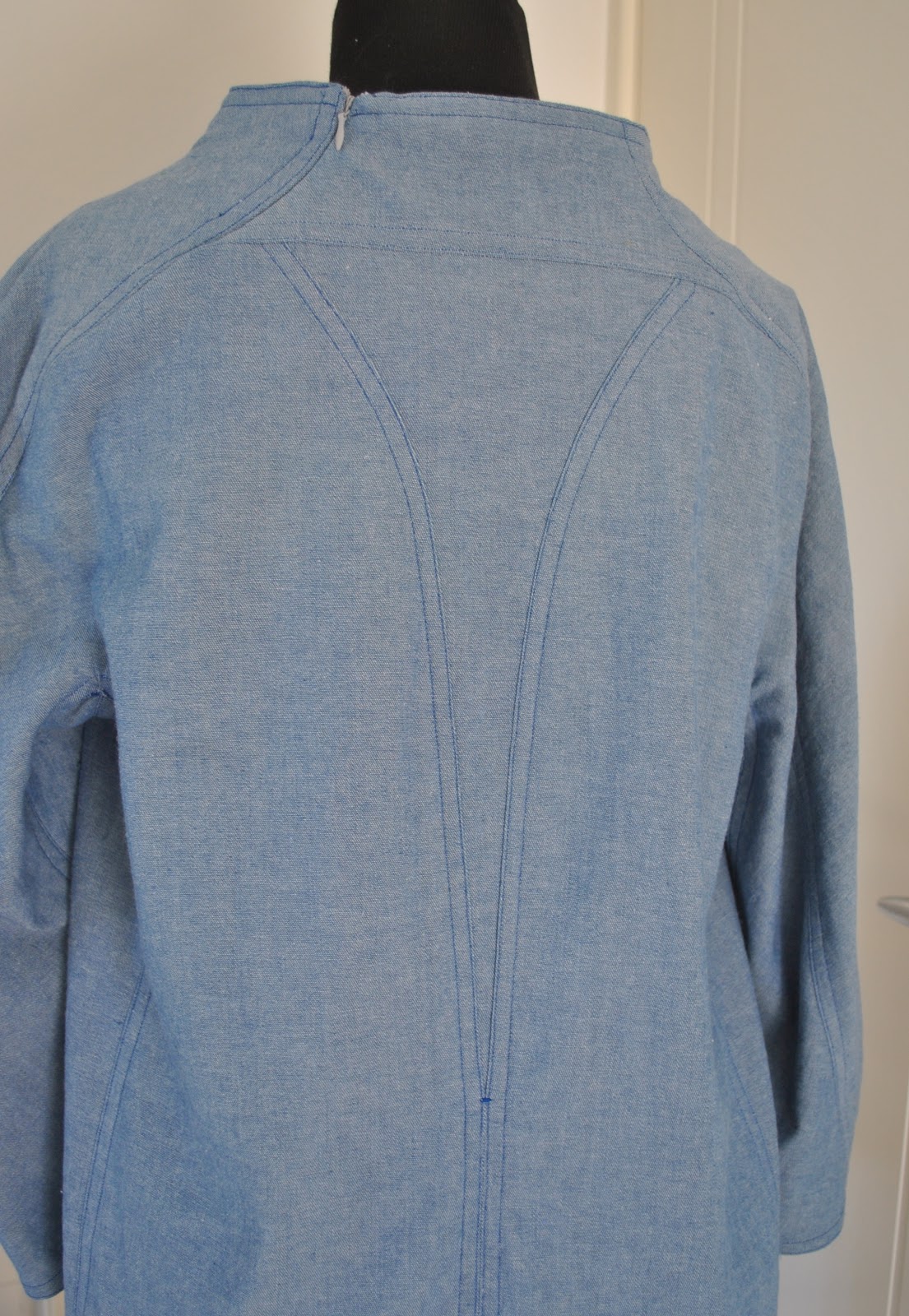
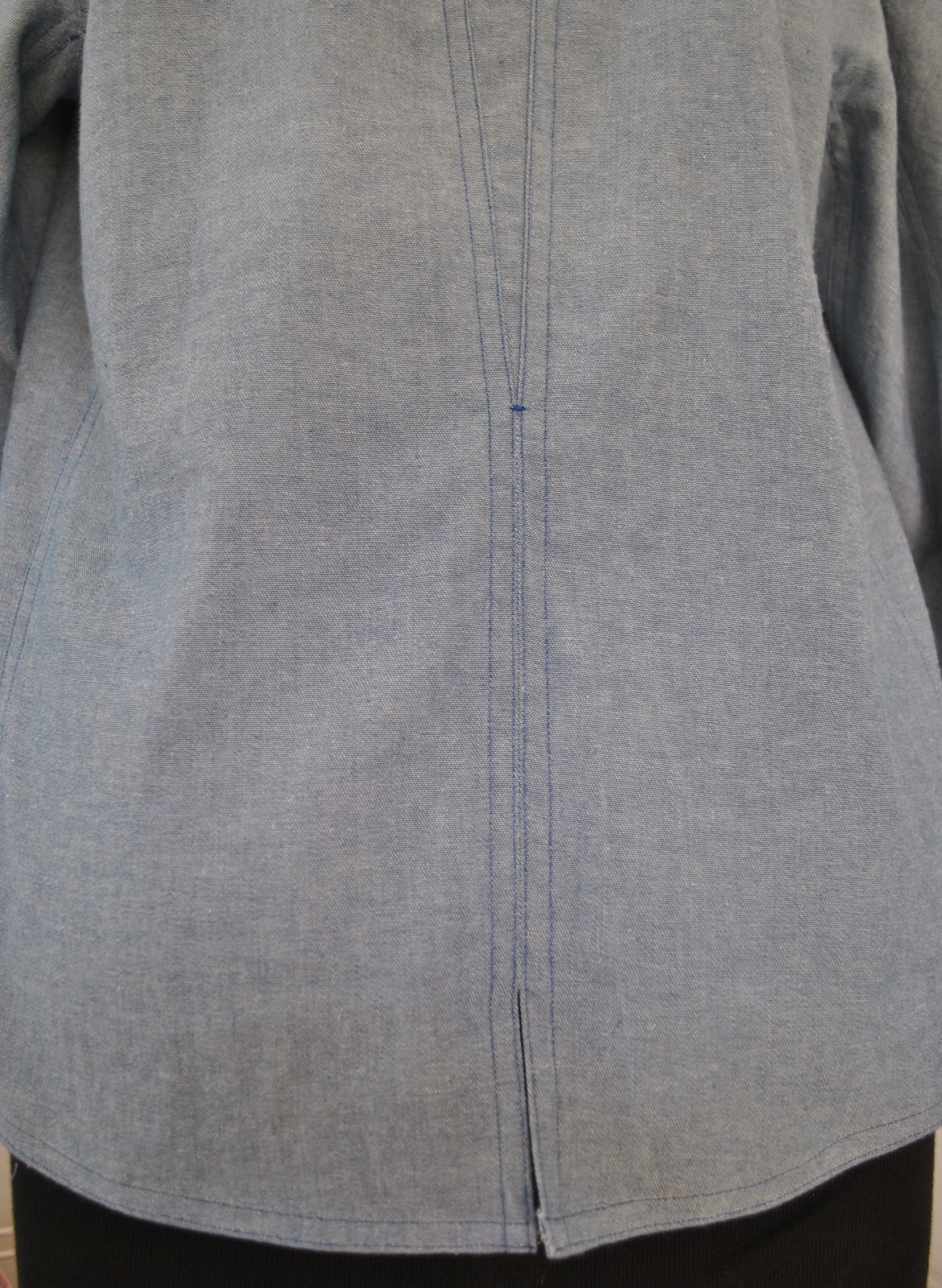
The graceful curve of those pieces in the back is so elegant and stylish.  I just love the seaming lines here!  I also like how the slit at the lower back stylistically matches the slit at the upper front neckline.  imo, it’s the little details like this that set the designer patterns apart from the others.

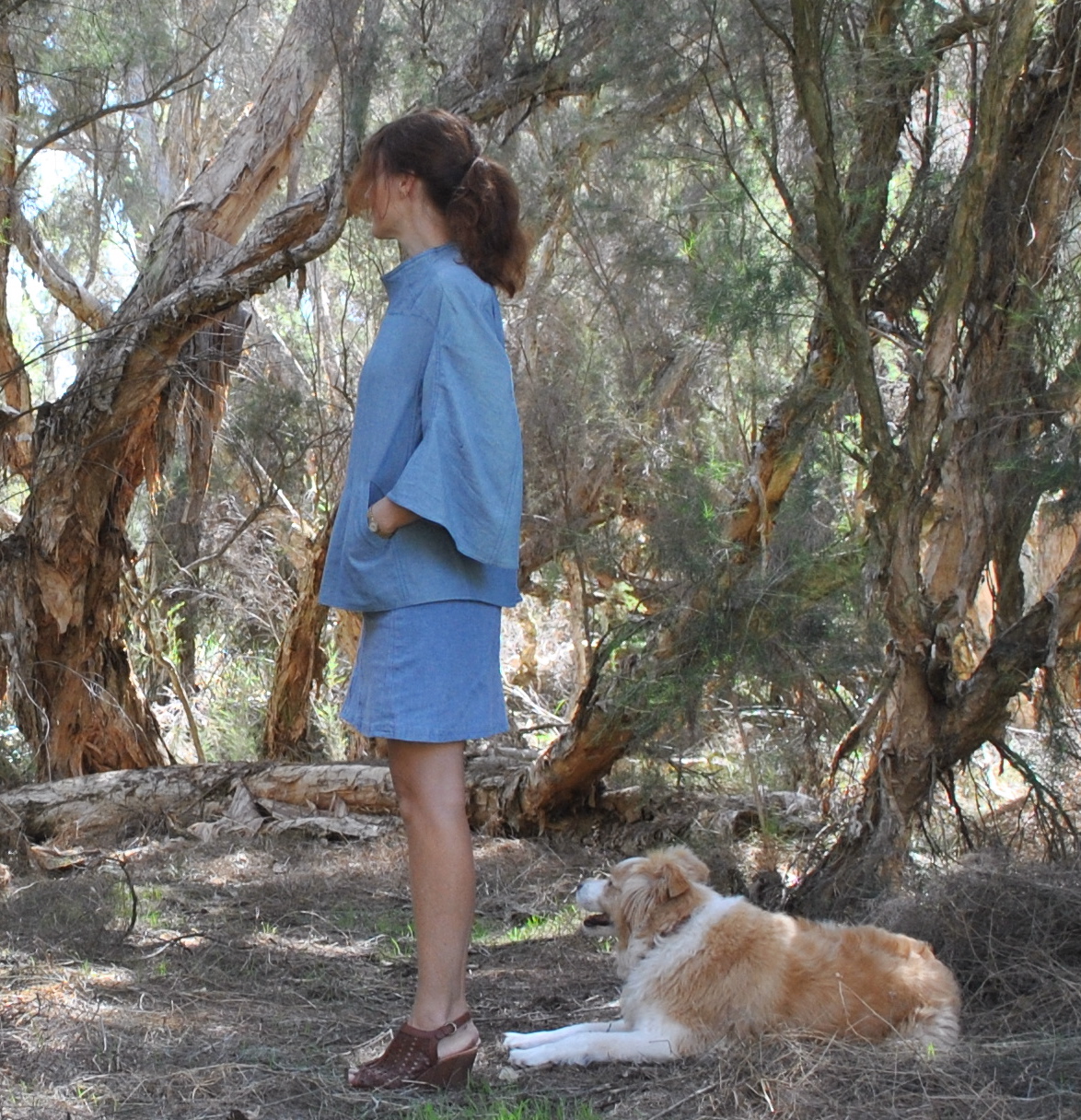
Those wide bell sleeves… I wasn’t absolutely certain that I would adore these, but they’ve grown on me.  They are certainly comfortable and feel nice to wear, no constrictions whatsoever! and I think they look quite designer-y and interesting.  I worried that the size of them would make them annoying, that they would get in the way of my daily activities, but I’ve worn my new top all day and barely noticed the sleeves.  No worries there!


Details:
Top; Vogue 1115, blue cotton denim
Skirt; based on Vogue 1247, refashioned from another skirt, originally Vogue 8561, details here
Sandals; c/o Misano

Pattern
Description:
Loose-fitting,
hip length, pull-over top has wide funnel neckline with slit, front and back
armhole gusset seaming, bell sleeves, welt pockets, back  inset, slit, side back zip and flat
fell seams.
Pattern
Sizing:
American
sizes 6-12; I cut the size 10
Did
it look like the photo/drawing on the pattern envelope once you had finished
sewing it?
Yes.
Were
the instructions easy to follow?
In my
opinion the instructions are straightforward but this pattern is rated
Advanced/Plus Difficile for a reason!
What
did you particularly like or dislike about the pattern?
Well
I do so love a sewing challenge, and there are a few in this pattern… this is
not a top that can be whipped up in one day, no sirreee!  I dug down deep into my reserves of
patience and only allowed myself to work on the tricky bits when I was feeling
fresh and not tired!  For example:
stitching those double rows of topstitching to the undersleeve and side / front
and back seams was tricky, and also attaching
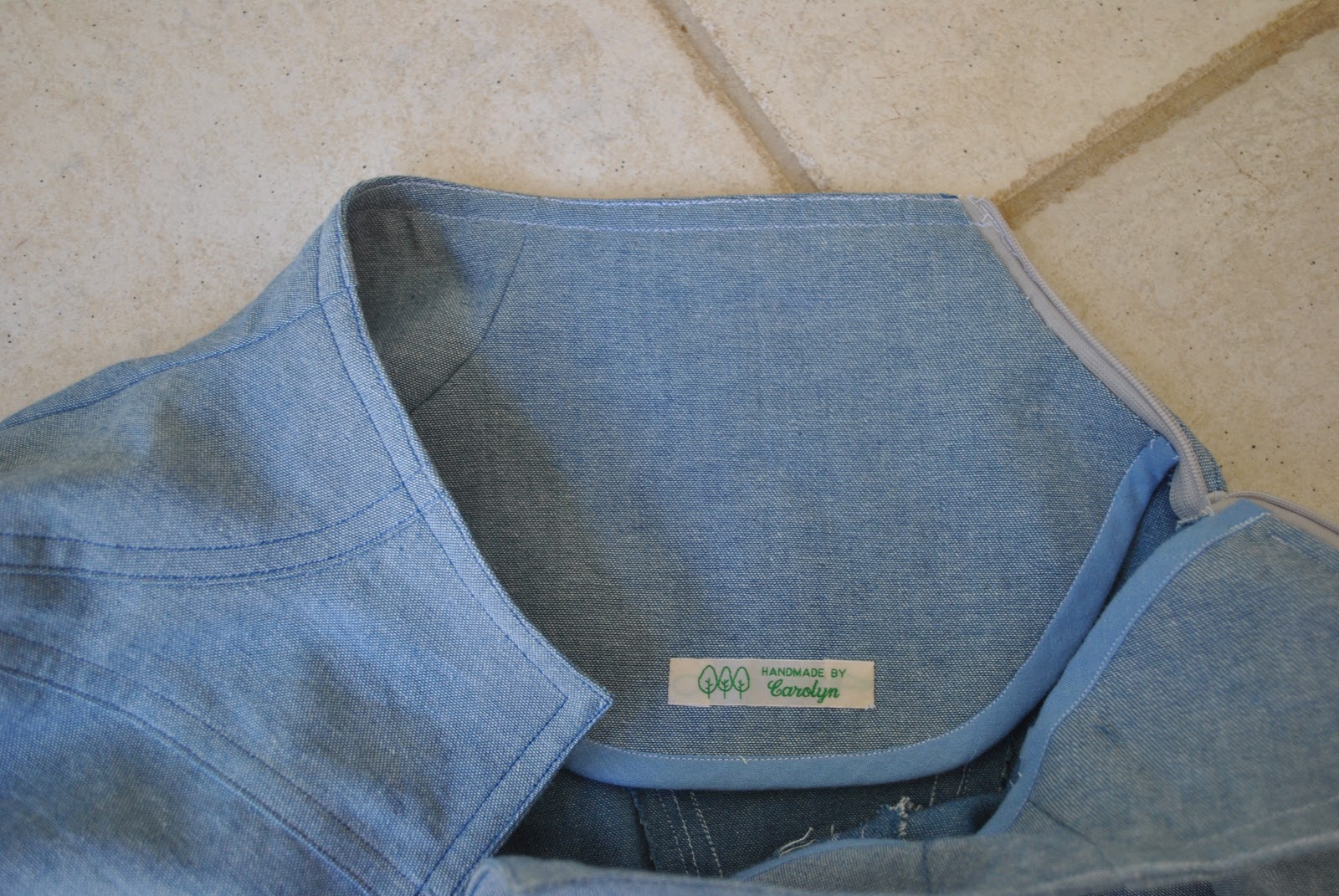
the neckline facing neatly to the top curved edges of the zip tape quite
tricky.
Fortunately,
I really love the final product!
Fabric
Used:
Lightweight cotton
denim
Pattern
alterations or any design changes you made:
I
lengthened the body pieces by 2.5cm at the hem, and cut the pockets to be 1.5cm
deeper…
Step
16, I chose to reinforce underneath the single layer of fabric with a small
bias cut square of interfaced cloth before stitching the bar-tacks.
Step
35; I prefer to insert the invisible zip before
sewing together the seam underneath, I think you can get a much neater finish
Step
49; I think it is supposed to read “with right sides together” but in any case
I didn’t stitch the welt together like this, just folded it wrong sides
together and continued with step 51 with the edges raw and unstitched, and then
in step 56, slipped them between the pocket and triangular ends, stitching them
in place in the pocket seam, a more elegant and less bulky way of finishing the
welt considering the raw edges are bound with HongKong seaming in step 57.
I didn’t do the following, but if I was
making this again I would…!
Step
3 and step 20 have you slash the underarm/sleeve between stay-stitching… I
recommend instead that you leave the actual slashing until just before step 45, when you pin
and attach the undersleeve and side. 
There’s no need to make the cuts so early, and if your fabric is subject
to fraying then I think it’s best to leave it until the last minute,
particularly since you are cutting so close to the stay-stitching and into the
armhole corner.
Would
you sew it again? Would you recommend it to others?
I do
recommend this pattern to the advanced seamster, and I think I will sew this one up again.  And,
ahem, I can get the top on and off without having to even use that
difficult-to-insert zip as long as I don’t mind my hair getting a bit
messy.  Which I don’t.  So, maybe I have a tiny head but
looking at the pattern envelope I think the model probably could do the
same.  The next time I might not
even bother with that zip. 
Conclusion:
I’m very happy with my new top, and I think it is a great
designer take on comfortable and
chic.  I was a bit worried about
those wide bell-sleeves before I started, that they would get in the way of daily activities, and/or look awkward and
stand out stiffly in a difficult-to-wear way but I needn’t have been; the sleeves feel great and look quite cool, and are very comfy in this loose floppy fabric.

pinterestmail

You can leave your hat on…

I’ve made a hat.
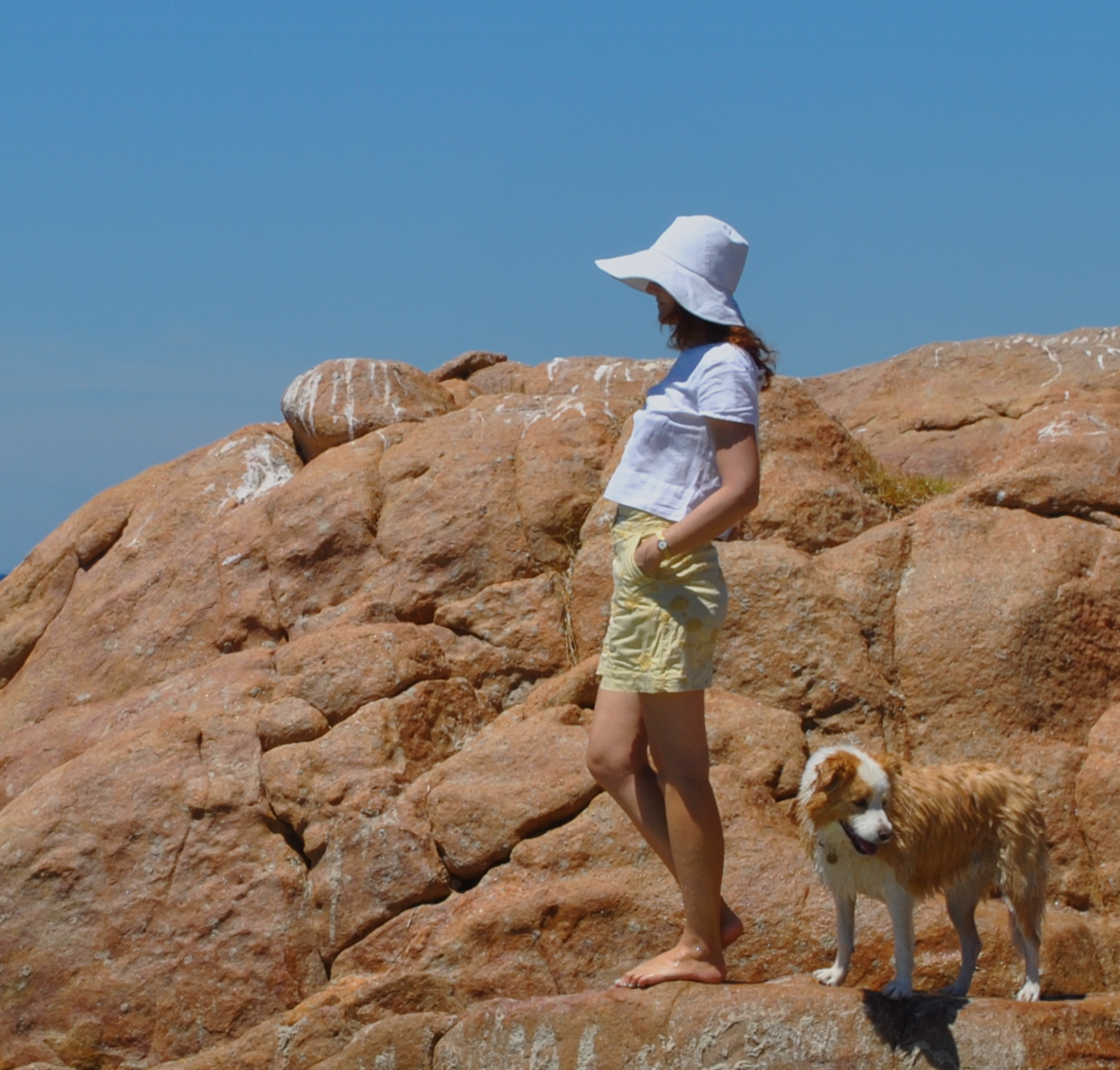
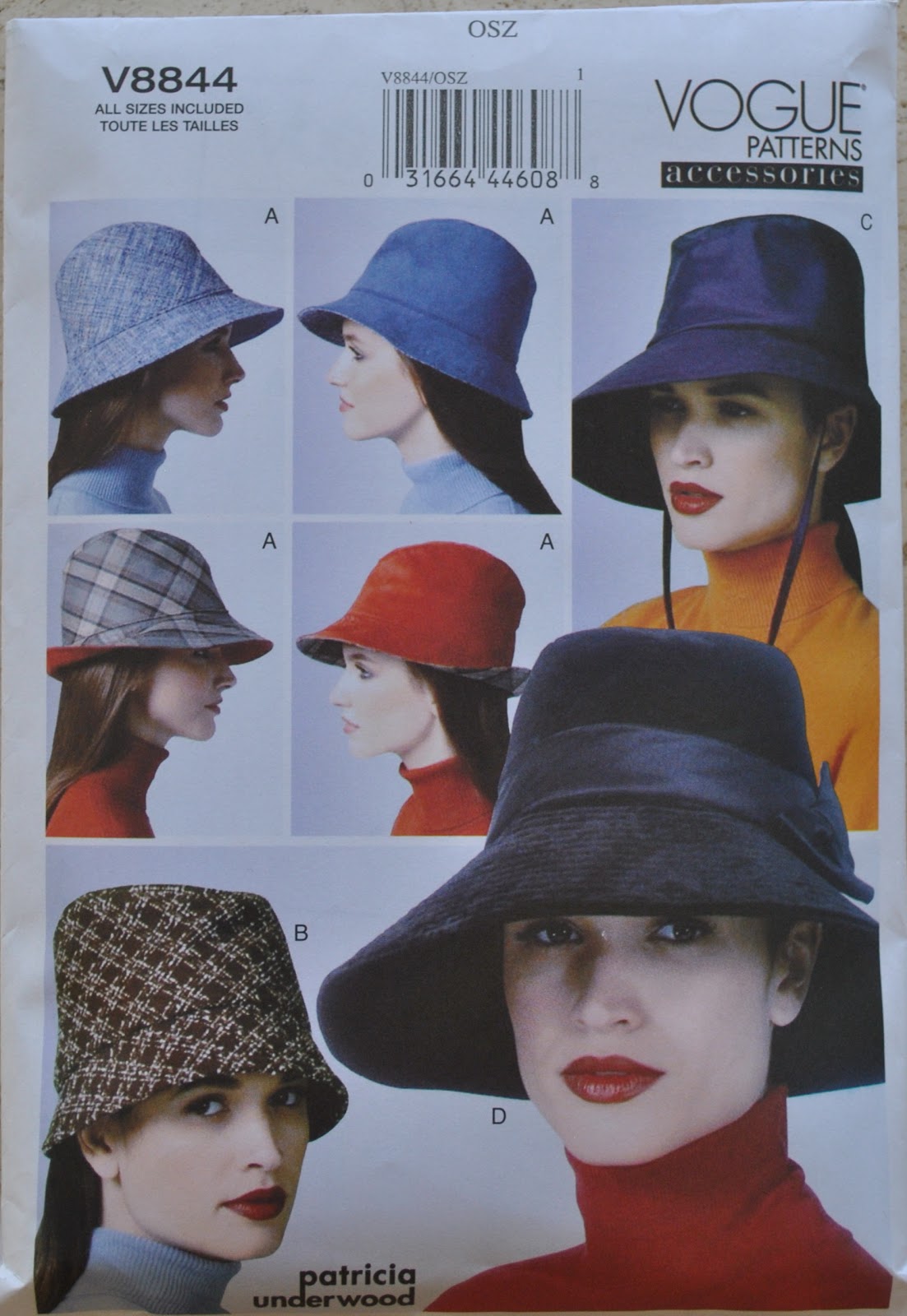
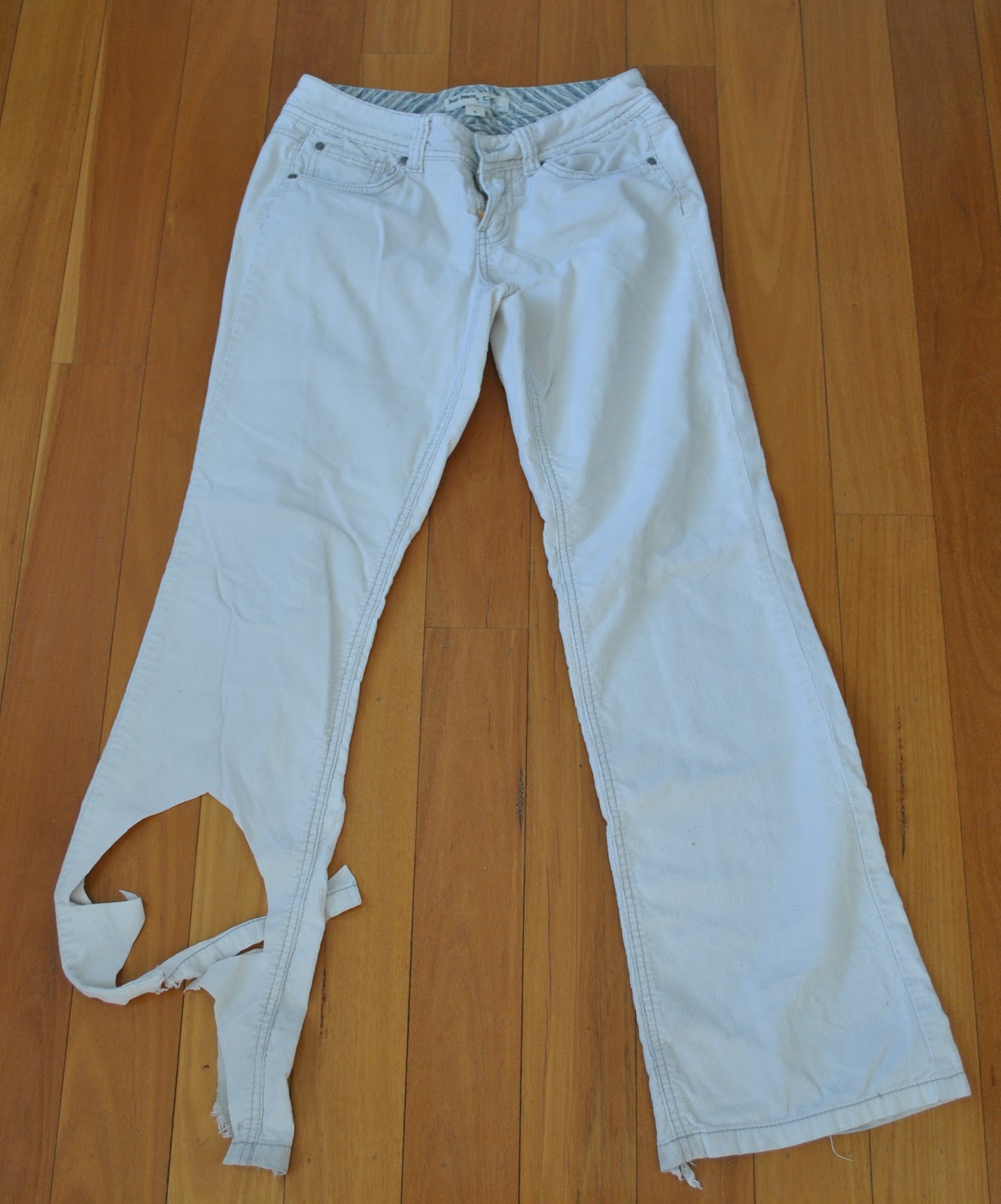
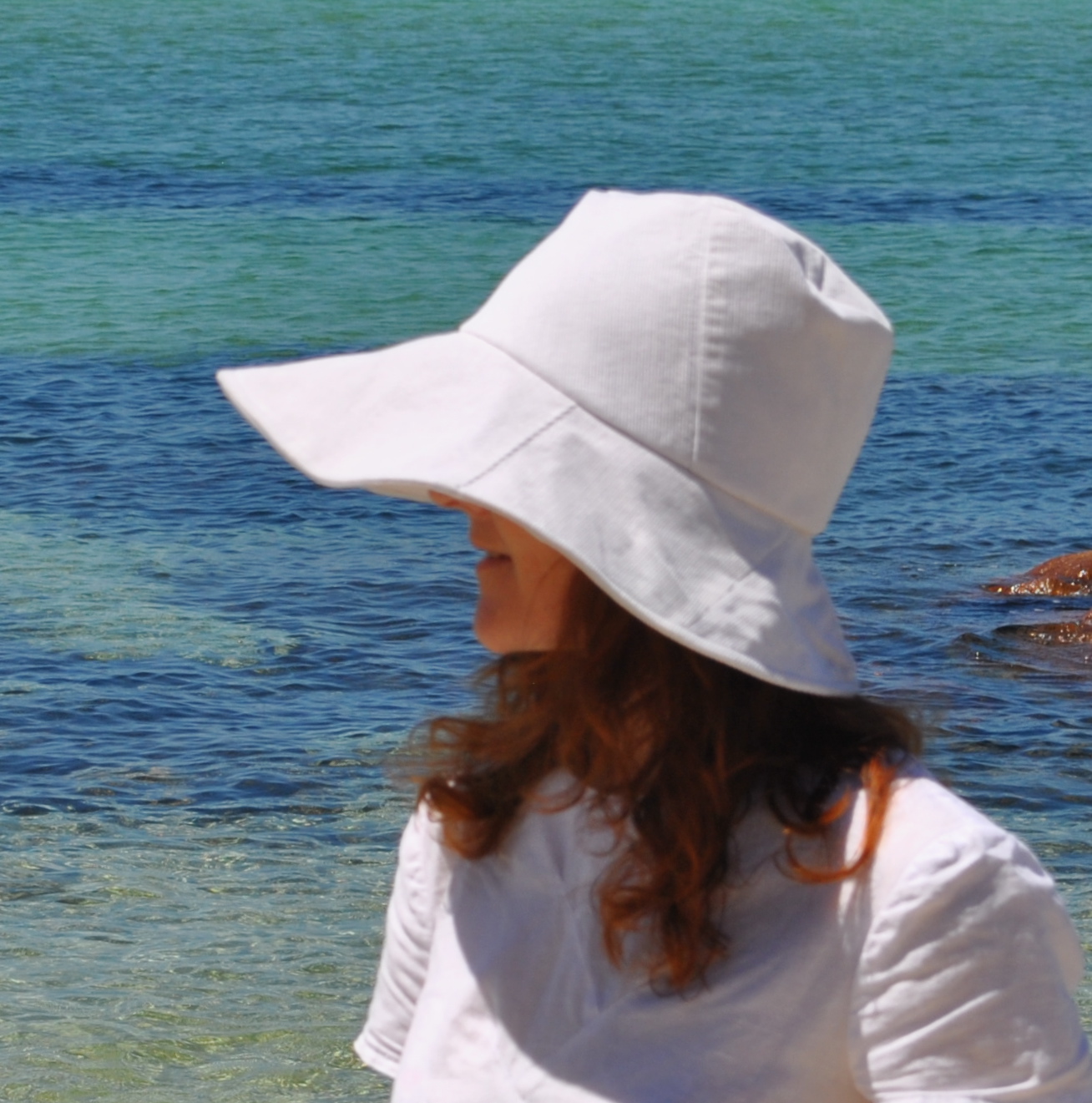
I used Vogue 8844, and the fabric is a soft ivory
corduroy, harvested from a pair of Cassie’s old worn-out jeans that has been
living in my good sammies pile for the past four or five years.   As evidenced by that half gone
leg there, these jeans were also the source of the White parliament, pictured here…
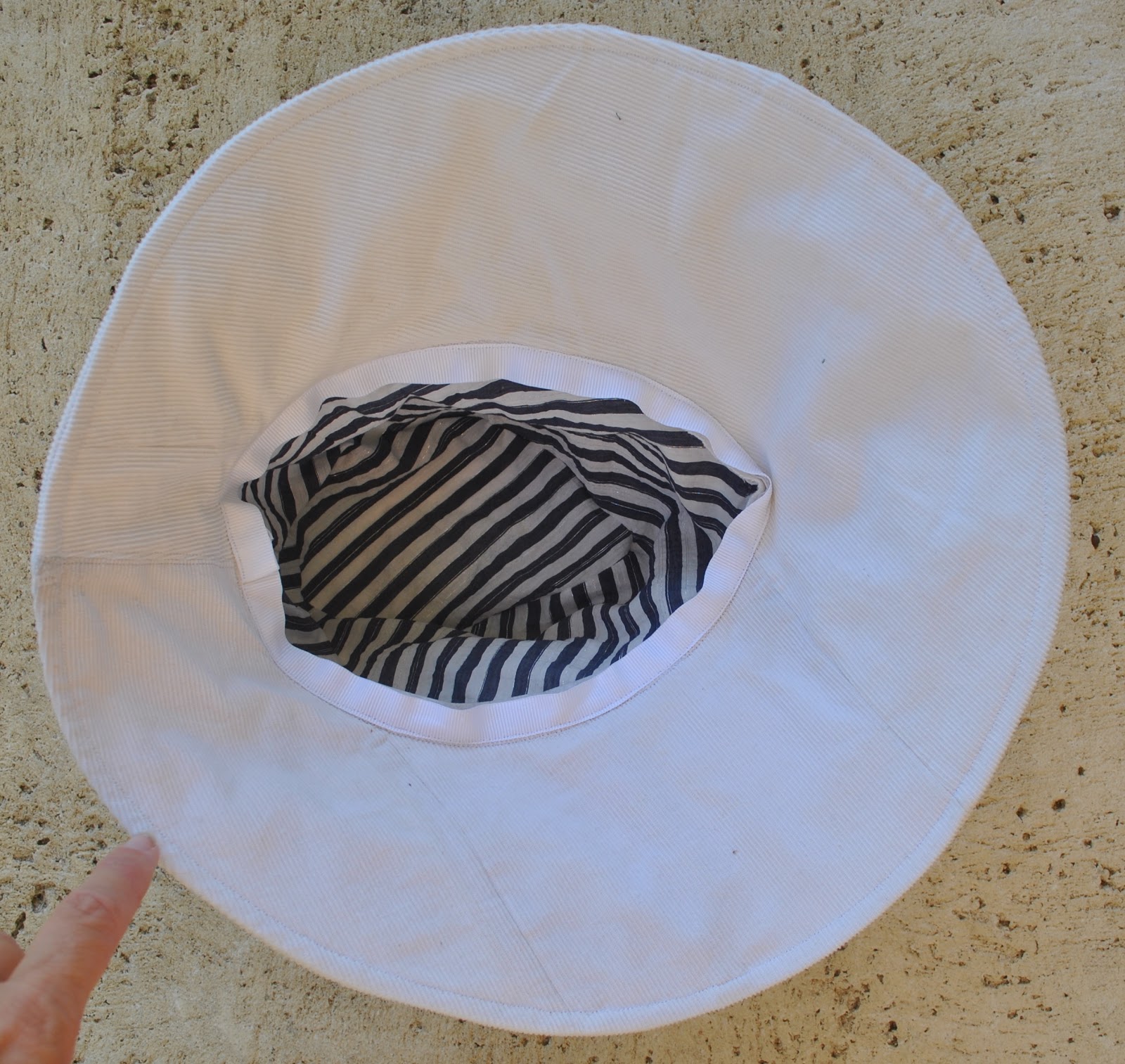
The hat is lined with blue and ivory striped stuff
leftover from Sam’s stripe-y shirt, and the inner seam finished with white grosgrain
ribbon.  

You know that very stiff, heavyweight,
iron-on interfacing? that is useful about once in a blue moon?  I’ve had a huge length sitting
untouched in my stash for many many years.  Well, I guess we must have had a blue moon since I managed
to use a bit in this project.  The
hat pieces are all interfaced with this stuff.

I felt pretty good about getting all of the hat
pieces cut out from the jeans. 
Most of the pattern pieces were too big to cut out in one piece, on the
grain and with the nap of the corduroy (they all are, btw… self pat on the
back)  So I had to do a bit of
piecing.  You can see some of the
seams in this picture, but I’m OK with those seams.  I feel too smugly virtuous about re-using old textiles to
feel bad about a few extra seams in a thing!  Eco-smugness; don’t you just hate that biz  😉
I
wondered about the sizes, which is partially
why I decided to use a re-cycled textile for my first time making this pattern…
not the main reason, I am firmly
committed to mindfully re-using old textiles when I can.  But anyway, about the sizing;
My
head measurement almost exactly corresponded to the S, so I made this
size.  And I couldn’t be more
thrilled with the fit, it cups my scone snugly and is neither tight nor
loose.  There was a brisk-ish breeze
on the beach the day I wore my hat for the first time and photographed it here,
and it stayed firmly and comfortably in place.  I never felt it was in danger of flying away!
The sizing
in this pattern works, y’all!!!

incidentally there is a just-there dog in the below picture  😉
Some advice for those wishing to re-purpose those
long skinny jeans leg pieces into a new sewing project requiring wider pieces?  I recommend doing all the piecing for
each component, using your pattern piece as a rough guide as to where and how
much to add on, and leaving at least
a few centimetres leeway around all the edges.  Stick religiously to cutting the joining edges and sewing
seams along the grainline of the fabric AND ensure fabric nap is consistent.   After sewing pieces together, lay the patchworked piece down flat
and only then accurately cut out the
pattern piece.  This way is much
easier than accurately cutting out little part-pieces and then trying to join
them together to fit the pattern piece. 
J
Details:
Hat; Vogue 8844, ivory corduroy
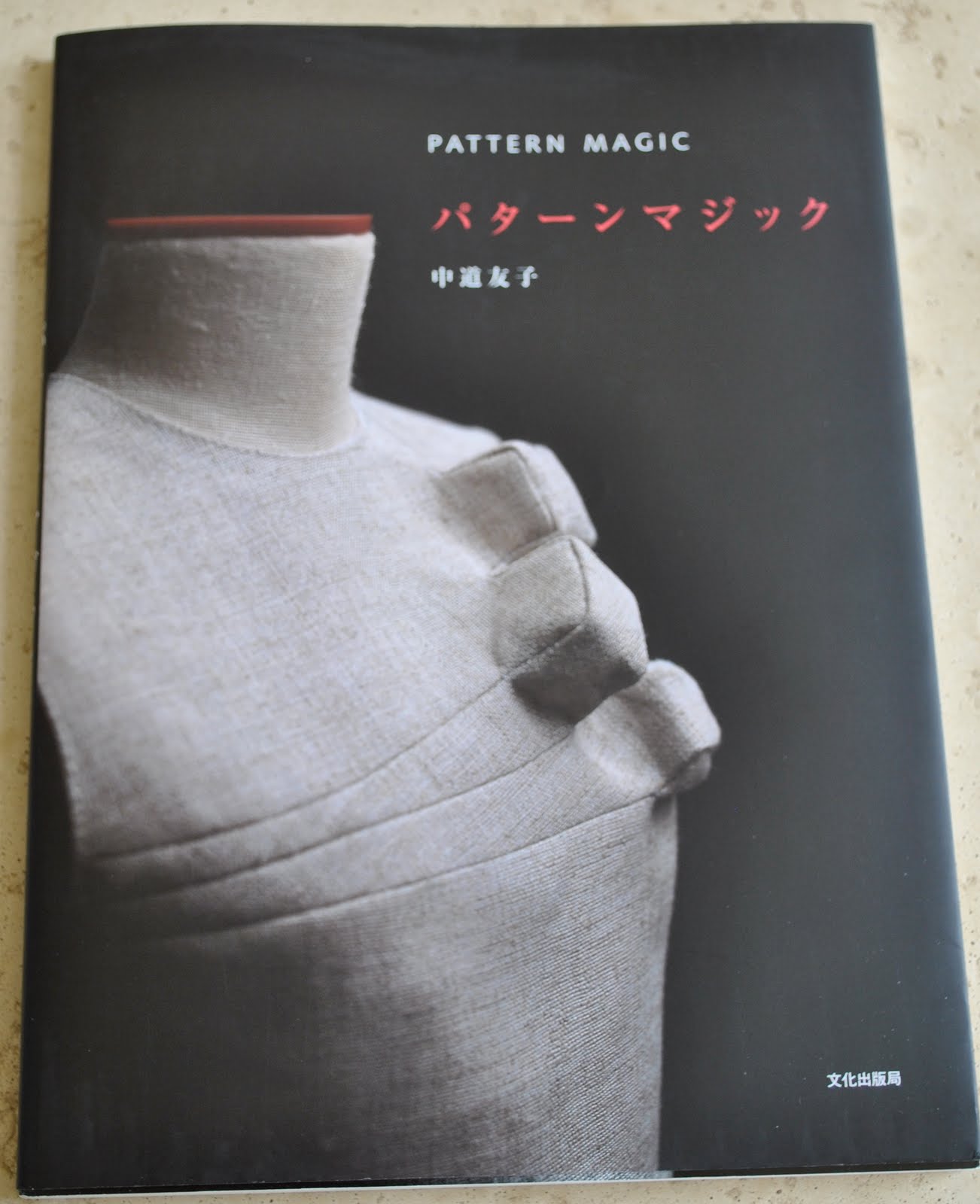
Top; the bamboo shoot top, Pattern Magic by Tomoko
Nakamichi, white linen, details here
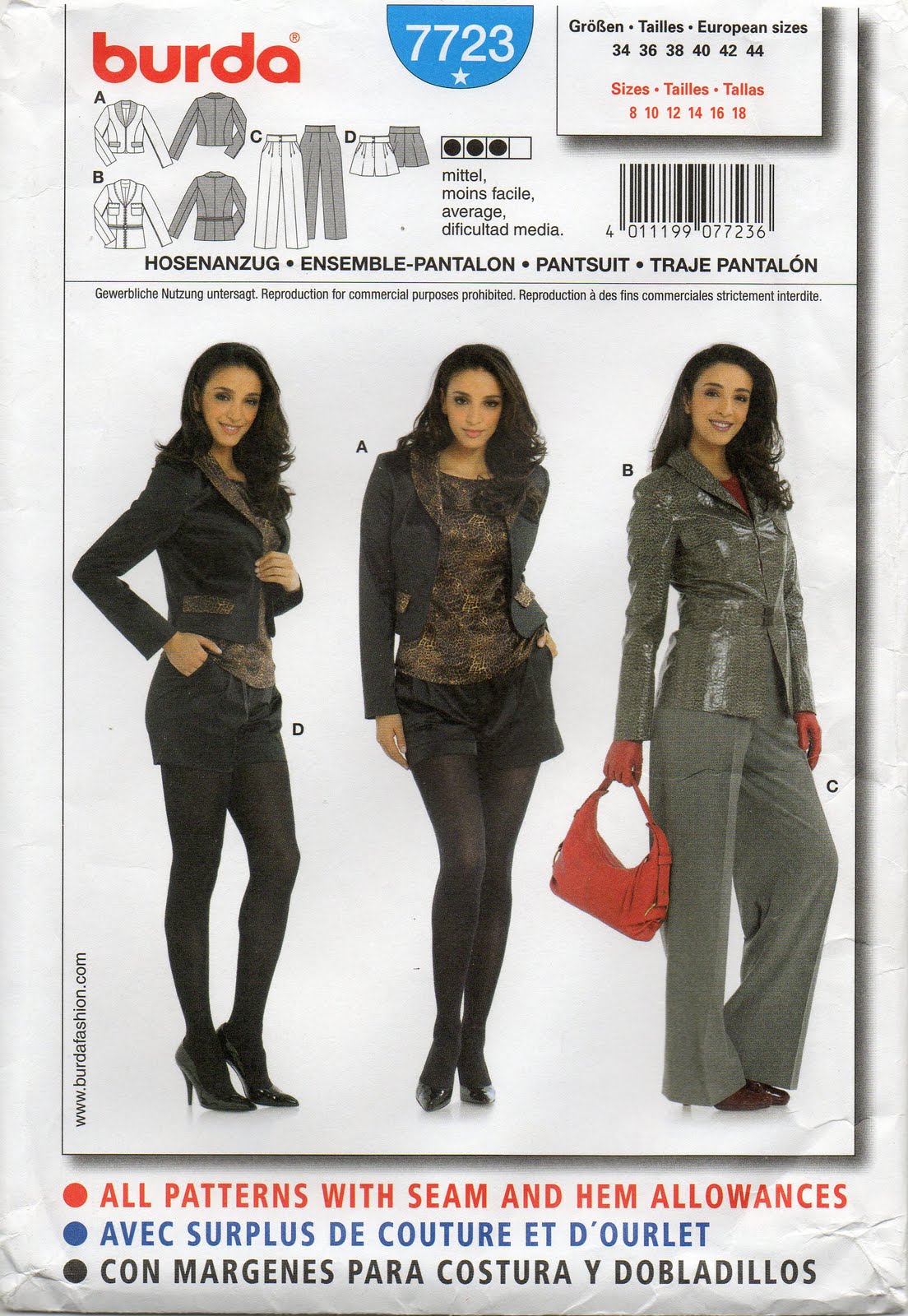
Shorts; Burda 7723 slightly modified, embroidered
yellow cotton, details here
Pattern
Description:
Four
lined hats, each offered in XS, S, M and L.  A; contrast lining, D; contrast band and bow.
Pattern
Sizing:
XS 52cm
(20.5 in), S 55cm (21.5 in); M 57cm (22.5 in); L 60cm (23.5 in)  I made the S.
Did
it look like the photo/drawing on the pattern envelope once you had finished
sewing it?
Yes. I
made view C, leaving off the chin straps.
Were
the instructions easy to follow?
Yes
What
did you particularly like or dislike about the pattern?
It is
a nice stylish hat, easy to make.  The
slightly shaped top and crown lend a chic, vaguely Indiana Jones-ish air to the
hat.
Really,
there is absolutely nothing to dislike about this pattern; it’s a hat, and it
works!
Fabric
Used:
Cotton
corduroy
Pattern
alterations or any design changes you made:
None.  But if a wider brimmed hat was desired;
it would be a cinch to just add a few centimeters on to the outer edge of the
brim curve to achieve this.
Would
you sew it again? Would you recommend it to others?
I
expect so, and yes  🙂
Conclusion:
This
is a great basic pattern which I think will be very useful. I made mine in
ivory corduroy for a summery-looking, wide-brimmed sunhat, but as illustrated
on the pattern envelope it would work equally well made up in tweed or a richly coloured
velvet or some other winter appropriate fabric to make a smart version for
winter.  
let’s play spot the dog again
pinterestmail
Switch to mobile version
↓