Tag Archives: Pattern Tutorial

how to make a tulle petticoat

… so, I mentioned Cassie’s engagement? and of course I’m completely thrilled to be asked to make her wedding dress!  Thrilled, maybe tempered with a little nervousness, shall we say? but still nonetheless thrilled.  I might even have been anticipating this very thing every since she was born!

Anyway, I’ve made a start… with a coupla petticoats.   Yes, petticoats, plural.  I shall now proceed to explain…

First of all; a stiff, tulle petticoat, to give plenty of volume and oomph to her bridal ensemble.

I’d read a blog post YEARS ago about making a petticoat but couldn’t find it, and so I just plowed ahead and made the above petticoat with what I could remember.  But I do hate not giving credit, so after hunting and following links for what seemed like ages I finally found it!! this post here by Sugardale.  I remember being very impressed with Sugardale’s post when I first read it, but I still somehow neglected to bookmark it or save any useful details that would enable me to find it again upon the occasion that I would need to use it.  But eventually I did find it.  And straight away realised that I had failed dismally to follow any of her instructions when making my own petticoat, so hmmm, there’s that! For example; Sugardale recommended an odd number of tiers, I made mine with an even number; Sugardale recommended working from the bottom up, I, in fact, worked from the top down.  Honestly? I don’t think these issues are a big deal, I think either, or even any way is probably going to work out just fine…

After making a muslin for Cassie’s dress – two actually – we determined the length of the skirt would be 87 cm.  I decided upon 4 tiers, with the following finished heights:  from top down; 20cm, 21cm, 22cm, 24cm… staggered heights just because I believe it looks better and more balanced to have the lower tiers wider than the upper tiers.

I did remember enough of Sugardale’s instructions to know that the tiers started at 2yds from and top and needed to double in circumference with with each tier down; and the tulle I scoped out in Spotlight had a width of 126cm (49.6inches)  So I calculated the following dimensions for my pieces:

Please note:  tier 4 only has 1 single 1cm seam allowance added to the height, since the bottom edge is the lower edge of the petticoat and doesn’t need a seam allowance.

You can see by my calculations and measurements of the tulle I bought, that one and a half cut lengths measures 189cm which I decided didn’t need trimming down.  Yes, my tiers were going to end up with a wider circumference overall than recommended, but I decided that a bit of extra volume was definitely not a bad thing.  It is in fact a very good thing!

How much tulle to buy?

So, according to my calculations; I was going to need:

(2 x 22cm) + (3 x 23cm) + (6 x 24cm) + (12 x 25cm) = 6.6m of tulle  Allowing for errors, I bought 8m of ivory tulle.

I used my rotary cutter and mat to cut the pieces as cleanly and as neatly as possible, and I cut and finished all gathering and stitching of each tier completely at a time before proceeding to the next tier, so as to not mix up the pieces.  I can tell you, by the time  you get to the bottom tier of 12 pieces, you do NOT want to get them mixed up!!

For the top tier, (circumference 189cm); I stitched it not fully closed, but leaving an opening of about 15cm from the top edge, so that Cassie can step into the petticoat.   The seam allowance either side of the split opening I simply folded down and topstitched it down on either side of the split.  I then ran a gathering stitch around the entire top edge and pulled it up to roughly fit Cassie’s waist measurement.  I cut a bias-cut strip of white cotton poplin, measured off Cassie’s waist measurement of 63cm and pinned to mark, and gathered the top tier (189cm) into this length.

After stitching each tier, I topstitched the upper seam allowance of each tier to the skirt above, approx 7mm from the stitching line.  I think this gives it a bit of strength, and lends a bit of pretty visual structure to this ethereal thing too.  Not that it’s meant to be seen, but well, you know…

Sophie checks out a weird THING

To finish the waist tie, I pressed the raw edges of the waistband strip into the centreline, then pressed the strip in half, and topstitched in place, about 2mm from the opening edge.

When putting the petticoat on, Cassie steps into the skirt, then the long ends of the waistband are pulled across from each other, wrapped around her waist and tied in a simple knot or bow.


It stands up by itself!

I stuck it up on the kitchen bench for a while, while I had to do something else, and I dunno, the sight of it gave me such a laugh!  Like a little tulle volcano, or something.  Mt Petticoat!!


Because bare legs against a scratchy tulle petticoat will probably become very uncomfortable very quickly, I also made a simple full circle petticoat to be worn underneath, using ivory cotton voile from Spotlight.


This is also 87cm in length, and for this I bought 4m and used every single bit!  I cut this length in half, and then cut the half circles for the two halves the skirt by the “fold into halves, then quarters, then eighths, then again” and cut across the lower edge to get a rough, but good enough curve; method.

The waist opening is made by cutting off the top, just 8cm from the tip.  When stitching together the two half circles of the skirt, I again made sure to leave an opening of at least 15cm so she can step into the skirt!!  and same as for the tulle petticoat, to finish the slit edges I simply pressed down the seam allowances either side of this slit and topstitched them into place.

To finish the waistband and for closure, I again made a bias cut strip of the same fabric, and stitched it to the waistline, leaving long tails either side, pressed the raw edges to the middle of the strip and stitched it closed, same as for the tulle petticoat.  By the way; I usually stitch this; right side of strip, to wrong side of skirt; this means when you fold the raw edges of the strip over you’re actually topstitching from the right side of the skirt, which of course ends up looking much neater from the right side. Which is just what you want.

For the lower edge of the fabric petticoat, I overlocked the raw edge to provide a stable and even width guide for hemming; then folded the overlocked edge under twice and topstitched it down.

The two petticoats!  I think they look so pretty together!

LATER EDIT:

I made a second, voile petticoat!  It’s exactly the same as the first cream coloured one, except it’s white; because I think I cleaned Spotlight right out of the cream, whoops!  This will be worn over the tulle petticoat and be like the lining to the dress.  So the layers Cassie will be wearing, from the inside out are:  voile petticoat, tulle petticoat, voile petticoat, DRESS!

petticoat… junction…

pinterestmail

mustard pietra shorts

Hack attack!

Despite initial appearances, my new shorts are actually based upon the Pietra shorts/pants pattern by Closet Case patterns… I loved this pattern immediately, loved the high waisted flat front with no waistband, and those cool side panels with pockets.  However, I was not quite so much in love with the elasticated back … or perhaps I should specify I was not quite so much in love with my own rear view in the aforementioned elastic waist version of the pattern?!

Yes, I did make up a test version with the elastic waist first … for version number one, I cut up an old linen dress given to me by Mum.  Unfortunately I decided I’m tragically allergic to elastic waistbands, with the one and only exception of pyjama bottoms.  Although looking at these pictures now my rear view is not as offensive to me as it was when I first looked at them!  at the same time, I am still much happier with the rear view of my second, non-elasticated and more streamlined version.

side view…

I was pretty sure I would be able to alter, modify, wrangle a de-elasticised waist with a bit of finagling… putting an invisible zip in the centre back seam and removing a whole lot of real estate from the back waist area, retaining that lovely flat front and pockets completely.

the front view looks exactly the same as the original, unsurprisingly since this is basically unaltered…

I shall now proceed to explain my butchery… and please note that these measurements laid out here are tailored to my own personal waist measurements and will obviously be different for other people.  Specific measurements for each of these modifications can best be determined from your own waist and hip measurements.

I removed 6cm from the waist of the back piece; and actually swung the side edge out towards the hem edge at the same time, adding a bit of flare to the back view of the shorts…

I also removed 2cm from the top/back edge of the side pieces, tapering off to nothing at the top edge of the pocket.  This wedge was also removed “mirror-image” from the front facing, shown already stitched on at the left…

I put a dart in the back piece… while my picture illustrates it to be 10.5cm, I actually stitched it a bit longer, closer to 11.5cm at its end point

… the dart is situated 10cm in from the centre back raw edge and is 3cm in width at its top edge

… I used the existing back waistband piece to cut my two new back waistbands to fit the new size…

… inserted an invisible zip into the centre back seam.  Note, the centre back seam is essentially unaltered, except that the back waistband now has a vertical centre back seam too.

Because I whimsically fancied something a bit different for the back of my waistband, specifically a V-shaped cut-out effect at the centre back … I put in the zip a bit lower and stitched the top edge in an angle like so…  Yes, I’m very much oversimplifying here, because making my two sides exactly identical actually took aaaaages and some super precise measuring.  I even unpicked one side completely and re-did it because it’s amazing how even 1 or 2mm difference will show up as a glaring inconsistency.  Hint; making a little paper template made it a lot easier to get everything perfectly mirror image; which yes, seems super obvious in retrospect!

corners trimmed and turned out…

I hand stitched the waistband self-facing down with tiny fell-stitches…

To finish; the side seams were pinned, and the already-understitched front facing was wrapped around over the top and over the back waistband piece.

Side seams were then stitched, corners trimmed and seam allowances finished etc. before pulling the whole thing right sides out.  And that’s it!


Oh! of course, the ever important fabric notes… this is actually just a super cheap cotton drill from Spotlight… I LOVE the orange-y mustard colour of course, SO MEEEEE! and the random vertical dashes.  The pattern sorta reminds me a lot of this felted wall hanging I made, many moons ago; my vision was of a sort of poem carved by an artistic cave man, in a language or alphabet wrought in colours and strokes of differing lengths and groupings.  This is still hanging up in our front room! and you can read more about it here

Details:

Shorts; both the Pietra shorts/pants pattern by Closet Case patterns
Drapey white top; based on the loose drape top no.1 in the Japanese pattern book “drape drape”, by Hisako Sato
Hat; Vogue 8844, in khaki drill
Plain white tee; Nettie tee by Closet Case patterns, white jersey

pinterestmail

a knitting project bag

It’s sometimes quite difficult to think of gifts for Mum because she will say, without fail; please DON’T GET ME ANYTHING FOR MY BIRTHDAY.  But… I have to think of something!!!  Besides the fact that she’d probably be little bit upset if I actually did give her nothing, haha  😉

Mum is always knitting, and she’s still particularly keen on knitting socks… whenever she comes up to stay she brings her knitting, usually stuffed in some flimsy plastic shopping bag; and works on it pretty solidly, at all hours of the day or night.  And inevitably, she will ask to borrow my scissors and a wool needle… btw, I don’t mind at all hunting these things out for her, but really it would be so much better if she had them with her and at hand already.

Lightbulb moment… Mum was in urgent need of a knitting project bag!!

It’s only recently I even became aware that knitting project bags were a thing, after I discovered a few knitting podcasts on youtube… where knitting project bags are an absolute must have!  I’m a bit embarrassed to admit that my own knitting bag is just a daggy old, small shop tote thing, that shops put your purchases into… it can be seen in this post here.  It’s not very good, and Mum’s isn’t any better.

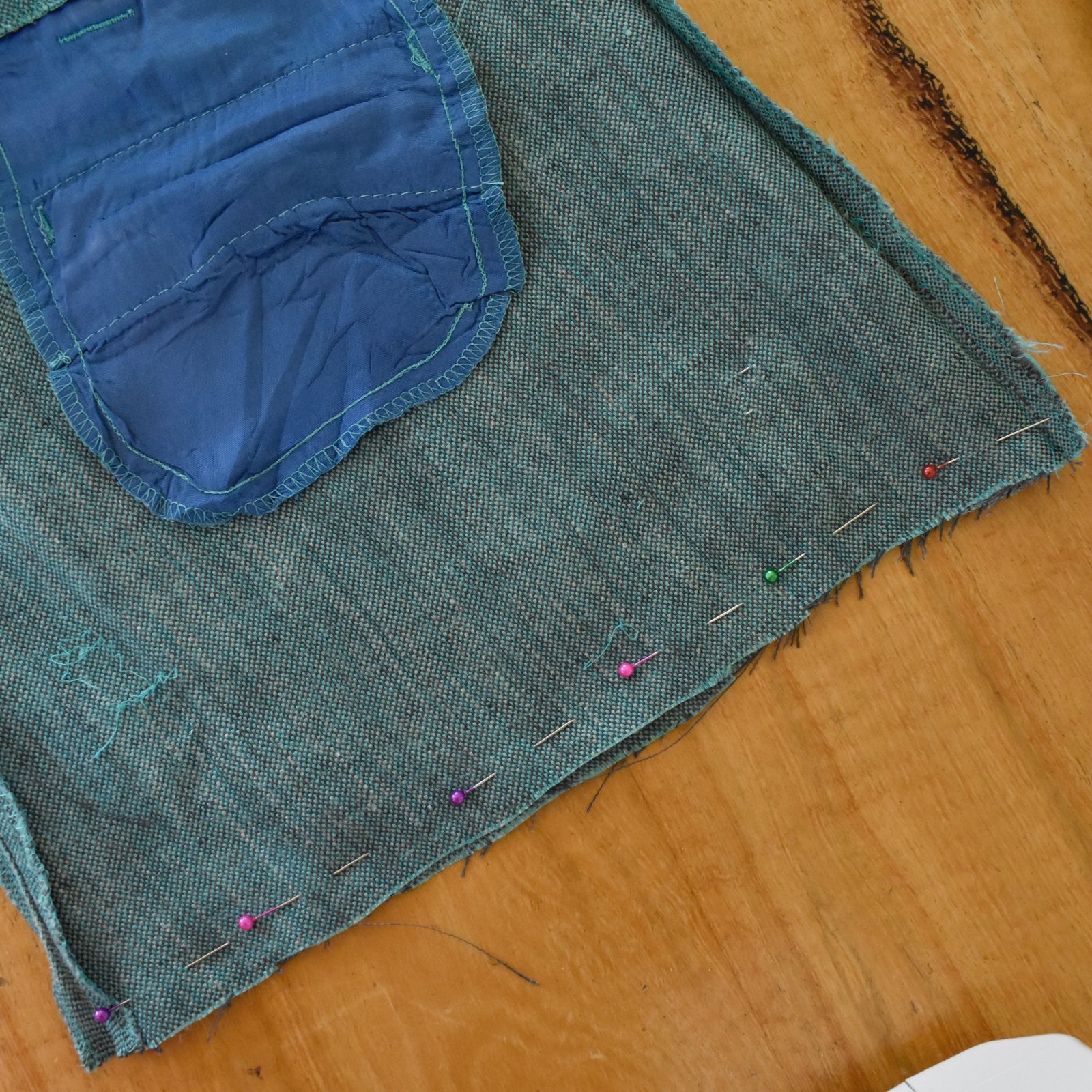
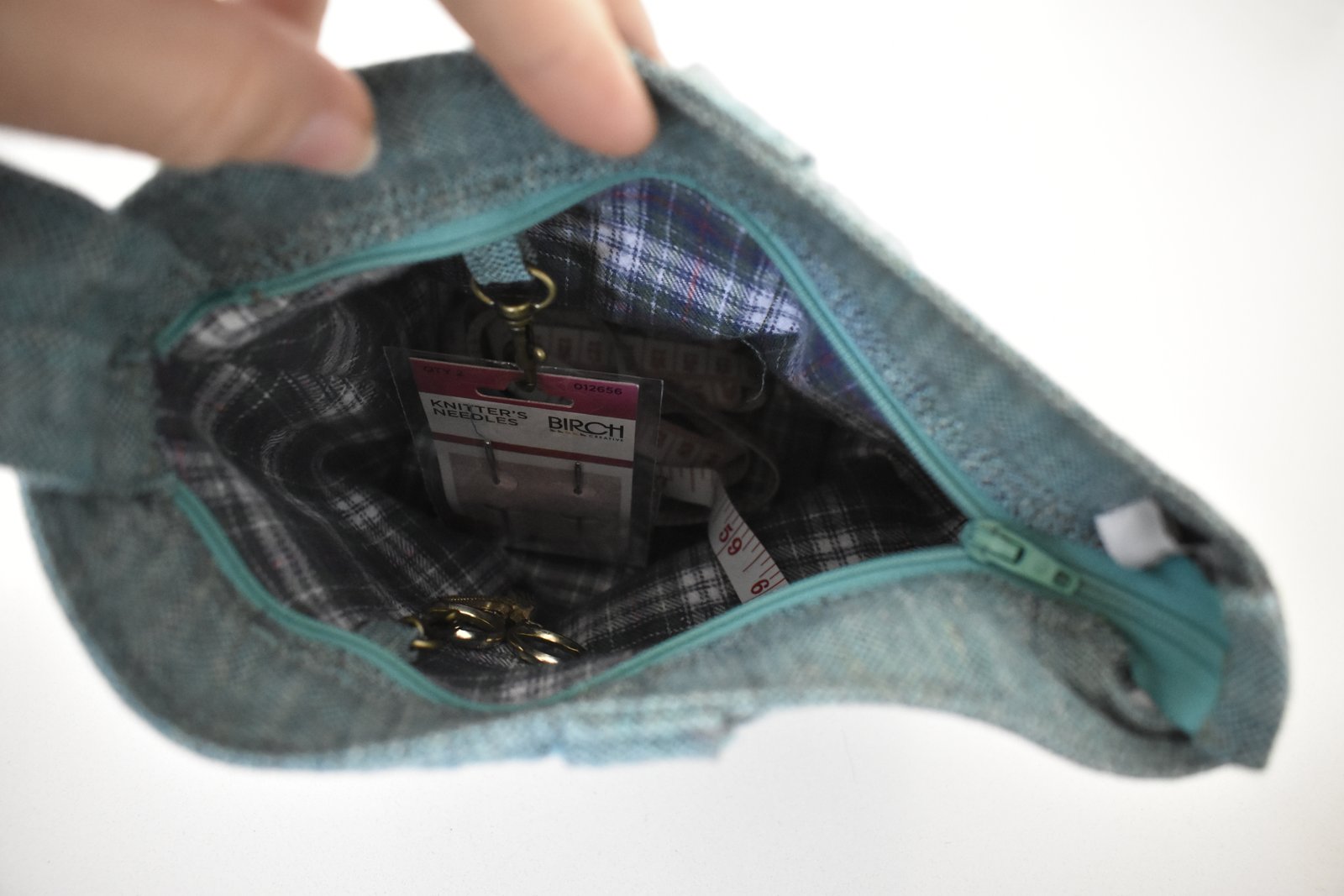
I perused Le Stash, and my hand fell on some lovely garden-green raw silk, mainly because I knew I had a matching zip in my zip stash already too.  The green silk turned out to be a pair of trousers, that Mum herself had originally give to me to use for fabric sometime.  She’d originally bought them in Italy, while on holiday, and got many years of good use out of them.  It occurred to me I could make a really good little project bag, utilising the trousers’ existing welt pockets and waistband…  bonus that this lovely fabric is boomeranging its way back to Mum in a new, and newly useful form.  Full circle! I selected some brushed tartan cotton for the bags’s lining, and inserted a new zip underneath the waistband facing inside, along with a wrist strap, so she can have the bag hanging from her wrist and still knit from it.  I think the really interesting thing about the bag though is the accessories; I added three little tabs inside, two with swivel clips, to which I attached a pair of scissors, and a pack of wool needles, and the third has a D-ring to which I’ve sewn a tape measure.  I left the original back welt pockets intact on the outside (above), so she can tuck small extra things into those pockets, things she might not want to go rattling around the inside of the bag.

I think she will have everything she needs!

I wrote a little tutorial, in case anyone reading this wishes to have a go at a similar refashion for themselves.  It’s a very useful thing for a knitter, whether for yourself or a gift for someone else, it’s easy and kinda fun to make, and I think it turned out quite cute too! In fact I would really like one for myself!

I used:

a pair of trousers with a waistband,
piece of brushed cotton for lining (around 52cm x 25cm),
stiff interfacing (52cm x 25cm)
30cm zip
2x 13mm swivel clips
1x 20mm D-ring

Extra accessories to finish; a tape measure, pair of scissors, pack of wool needles

To start with, unpick the side seams of your trousers, and cut out the seat.  Cut the waistband off at the side seams too, allowing the same seam allowance as the side seams.  Note; I then trimmed down my piece to about 52cm x 25cm (inc waistband) which made a bag with a finished measurement of approximately 20x20cm, and with a base of 20cmx8cm.

If your trousers have welt, or other pockets, that’s a bonus!  Cut a piece of lining fabric the same size and shape, using the trouser piece as a template.  If the fabric is on the floppy side, apply stiff fusible interfacing to the lining, and if your interfacing is anything like as unreliable as mine, it’s a good idea to stitch/quilt the interfacing and lining together to be sure they stay together as one layer.

Unpick and open out the lower edge of the waistband facing, and stitch up the side seams, including the waistband and waistband facing, in one continuous seam.  Stitch the lower bottom seam.  Likewise, stitch the side seam/s and bottom seam of the lining.

Determine the desired width of the bag bottom… this should be at least equivalent to, or even a bit wider than the bag opening.  I made mine 20cm.  Measure this length along the bottom edge of the bag, centred so that the excess on each side is the same.   Bring the side seam and bottom edge seam to meet, right sides together, and pin.  Determine the side edges of the base of the bag, by marking two straight lines at the end points of the bag base, perpendicular to the bottom seam.  (shown on the bag lining, below) Measure each carefully to ensure they are going to be the same length, if there are differences then adjust and re-mark until they  are equivalent.  Mine are 8cm long from pin to pin.

Stitch.  Construct the lining bag to be exactly the same.  Trim off the corners.  Pin the bag and bag lining together along the bottom side edges, wrong sides together, and stitch together along the previous stitching, ie. the short side edges of the base of the bag.

Turn the bag right sides out, so the lining bag sits inside the outer bag, attached at the base but not yet attached at the top.  You can optionally stitch the bag and bag lining together along the long bottom seam as well, however I found this to be quite fiddly…

Make the wrist strap and tabs for the bag’s accessories to hang off…  my
dimensions are:

strip 1: 8cm x 37cm
strip 2: 4cm x 10cm

Construct each as follows: fold strips in half lengthwise and press, open out and fold both raw edges in to meet the pressed centre line, press.  Fold the strip in half along the first fold line and press, topstitch close to each long edge of the strip.

Cut the narrower strip in half, giving two 5cm strips. Thread each through the closed top of a swivel clip, and baste raw edges together.   Cut 5cm off one end of the first, wider strip for the tape measure tab, thread this piece through a D-ring, baste.  Stitch the tape measure onto the D-clip.  The remainder of the wider strip will be used for the wrist strap.

Bag: open up the remainder of the waistband facing away from the waistband.  Pin the ends of the wrist strap to the waist band facing adjacent to either side of one side seam, baste in position close to the raw edge.  Take the zip, and pin each side of the zip to the waistband facing, aligning the top and bottom ends of the zip with the side seams of the bag, and ensuring the opening end of the zip is adjacent to the wrist strap, and with wrist straps folded back against the waistband facing; topstitch zips in place, stitching over the wrist straps.  Leave a gap of 1.5cm each side at the bottom end of the zip to enable the end to sit on the outside.  Trim the zip, leaving a 2-3cm tail.  Cut a small square of fabric and use it to wrap and enclose the trimmed bottom edge of the zip; fold, pin, and stitch it in place.

Open the zip; take the three previously made tabs with swivel clips and D-ring attached and pin them around the top of the lining bag, raw edges even, right sides together, and with the swivel clips/D-ring hanging down inside the lining bag.  Fold down the waistband facing enclosing the raw edge of the lining bag and top edges of the accessories tabs inside the old waistband.  Pin waistband facing back to its old position on the original waistband of the trousers.  Ensure the upper ends of the zip tape are tucked up inside the waistband, also check you are happy with the position of the tabs with swivel clips/D-ring before stitching the old waistband facing back in place.  This can be a little fiddly around the top and lower edge of the zip, but just take care and stitch as far as possible.

The final step is to clip a small packet of wool needles and pair of scissors to the swivel clips.

Aaaand, done!!!  Now, I really really want to make one for myself too!


pinterestmail

some tops, and a collar pattern

ivory nettie 2 I’ve been busy making a few tops…

nettieSO!  Exhibits A and B; two Nettie tops,both made in a really gorgeous, pale cream knit from Fabulous Fabrics, given to me by Mum.  Now, I know I’ve said a gazillion times before that I have SO MANY white tops I should never ever need to make another one, but you see; a full-sleeve-length ivory Tshirt was one of my most worn wardrobe items last year.   So, I’m pretty confident that these two boring things are probably going to be two of the most worn things in my winter wardrobe this year too! #ivorytopaddict.  I managed to squeeze two tops from out of my piece of fabric, yes! *air fist punch*

I’ve fine tuned my Nettie pattern now for my own figure, but I still have to sorta “start from scratch” with fitting when I’m cutting out a fabric with a different stretch factor than those I’ve used previously with this pattern; and this fabric has quite a low stretch.  So to be cautious I upsized quite a bit, cutting approximately and roughly a size 20, and then pinned the sides in to fit me.  Also; my fabric was just big enough for the two Netties, but only-just-and-not-quite-perfectly-enough!! you know how it is… you MAKE IT WORK.  They both have long sleeves coming right down to my wrists, but I had to cut Nettie B (below) just a little shorter at the hemline, so that I could get the two tops from my one piece of fabric.  It sits at my high hip; Nettie A (above) is longer, plainer, with a high crew neck, finished with a grainline-cut band, applied as for this method here.

DSC_0007DSC_0002Along the back edge only, I topstitched the seam allowance down to the top, just inside the seam line.  In both cases, the raw edges of sleeve and lower edge are finished with the overlocker, than turned under once and invisibly hand-slipstitched in place.

Nettie B, below, is slightly cropped and has a wide, boatneck collar.

ivory nettie 2

I had some interest for this collar/neckline on instagram, so I’ve drawn up a pattern for it… it’s kinda rough-looking and I do plan to improve the presentation but just wanted to get it up here for now.  It does however, work! and so I hope it does prove useful for someone!

neckline:collar

ivory nettie 1 collarThe method is as follows:

This is a collar/neckline designed for a close-fitting Tshirt in stretch knit fabric; the collar is a standup folded collar, and the neckline is wide and shallow. The idea is that you use your tried and true Tshirt pattern just ignoring the given neckline and substituting this neckline/collar for the one in your pattern.  I used the Nettie pattern by Closet Case patterns, although any Tshirt pattern would do.  Align the pattern pieces so the line of the shoulder seams and the centre front/back lines of this pattern are correctly aligned with the shoulder seams and front and back centre folds of your Tshirt pattern, and cut the neckline accordingly.  Seam allowances are 1cm (3/8″), so if the Tshirt pattern you are using has a different seam allowance, align shoulder stitching lines (dotted lines) lines of the shoulder seam, rather than the cutting lines.

Cut the neckband/collar, with the short edges on the grain line.  Sew the collar short edges together, right sides together.  Fold the resulting “ring”of fabric in half lengthwise, wrong sides together, aligning raw edges… pin to the Tshirt neckline right sides together; distributing the length of the collar evenly around the neckline.  Stitch using a 1cm seam allowance, and finish the raw edges with overlocking or zig-zag, as desired.

If you use this pattern, then please do leave me a comment and let me know how it goes.  I’m always thrilled to get feedback  🙂

Now for some more tops, hoodies…!  Smug self back-patting for unselfish sewing commences right here, since neither of these are for me

sams hoodie

Exhibit C; I made a grey hoodie for Sam, to fulfil his birthday request… this is the same self-drafted pattern I’ve used previously for hooodies for each of my boys; and the seventh and eighth time I’ve used the pattern.  The best thing about these hoodies in my opinion is the rather nice combined collar/hood, and I’ve previously written a tutorial on how to make this collar, here.  Sam wanted grey, and the addition of a bit of red was my idea.  I just liked the idea of some little contrast and the red seemed cheerful and fun for winter, and a bit more interesting than if it had just been plain grey.  The rather gorgeous warm, grey terry fleece is from Spotlight, and the red is cut from an old Tshirt from my refashioning bag.

sam hoodie pocketsam hoodie

rayman

aaaaand Exhibit D; a Rayman Hoodie for Sam to wear to ComicCon.  The same pattern, and again to fulfil his specific request!  I bought some warm purple Tshirt ribbing from Spotlight, simply because it was the perfect colour.  The white circle and the red hoodie bit were both cut from two old Tshirts from my refashioning bag.

And that’s it!… well; for now, mwahahahahahahaaaaaaa. *she twirls her cape and dramatically sweeps off to the sewing lair, maniacal laughter radiating in her wake*

Details of all clothing in this post:

1)

nettievogue1247josharp garter jacket

Top; modified Nettie by Closet Case patterns
Skirt; Vogue 1247, yellow corduroy dyed caramel, details here
Tights; self drafted, details here and my tutorial for making your own tights pattern is here
Boots; made by me, details here
Cardigan; hand-knitted by me in Jo Sharp yarn, details here,
Cowl; my own design, mustard yarn, details and pattern here

2)

nettiepaprika jade skirt

Top; modified Nettie by Closet Case patterns
Skirt; Jade by Paprika patterns, details here

3) and 4)

Hoodie; self drafted pattern, my tutorial for making the combined collar/hood is here

pinterestmail
Switch to mobile version
↓