Tag Archives: One Year One Outfit

totally local, totally natural, from head to toe

A person could be forgiven for thinking that I had abandoned my totally local, 1 year 1 outfit project, since there has been no mention of it here for months!… *blush* however, it has been plodding along, slowly but surely, and is now FINISHED!!!!  Hurrah!  At last!

The concept: last year Nicki from this is moonlight conceived the very interesting 1 year 1 outfit project and invited me to take part with her… the idea was that you make an outfit using ONLY local materials and primary supplies grown and/or sourced in your own area.  Well you know how weak at the knees I go for a dressmaking challenge! and the more difficult the better!  Several of us here in Perth took part last year; Nicki, Sue, Megan and me.  Sue, Megan and I met up for a hilarious photoshoot in our outfits one day last February; it was so much fun! and we all had plans for this year too.

from left: Megan, Sue, and me… the links in this post go to everyone’s individual posts about their outfits

So yes, I was all enthusiastic… however!  It really is a difficult challenge, far more difficult than you might think! and though I made a good start with dyeing some yarn early, my other challenge, my Year of Handmade, has consequently swept me away with its even higher degree of difficulty … I’m not whinging, ’cause I really do like challenges honestly! however I’ve struggled with everything this year a bit and it’s taken a while for me to get my groove on.  Fortunately Nicki announced a March deadline recently, which lit a fire under me.  I got cracking, and got finished!!!!

Thoughts going in: I loved my first 1 year 1 outfit project from last year; although I confess I’ve barely worn it at all!  Reason being that while I think my embroidered felt is ethereally beautiful, at the same time it is fairly fragile and can only stand up to light wearing on special occasions.  So my major priority for this year’s outfit was casual wearability; something that I could toss on and wear on a daily basis without fear of ruining it.  I also wanted it to try out some natural dyeing techniques.

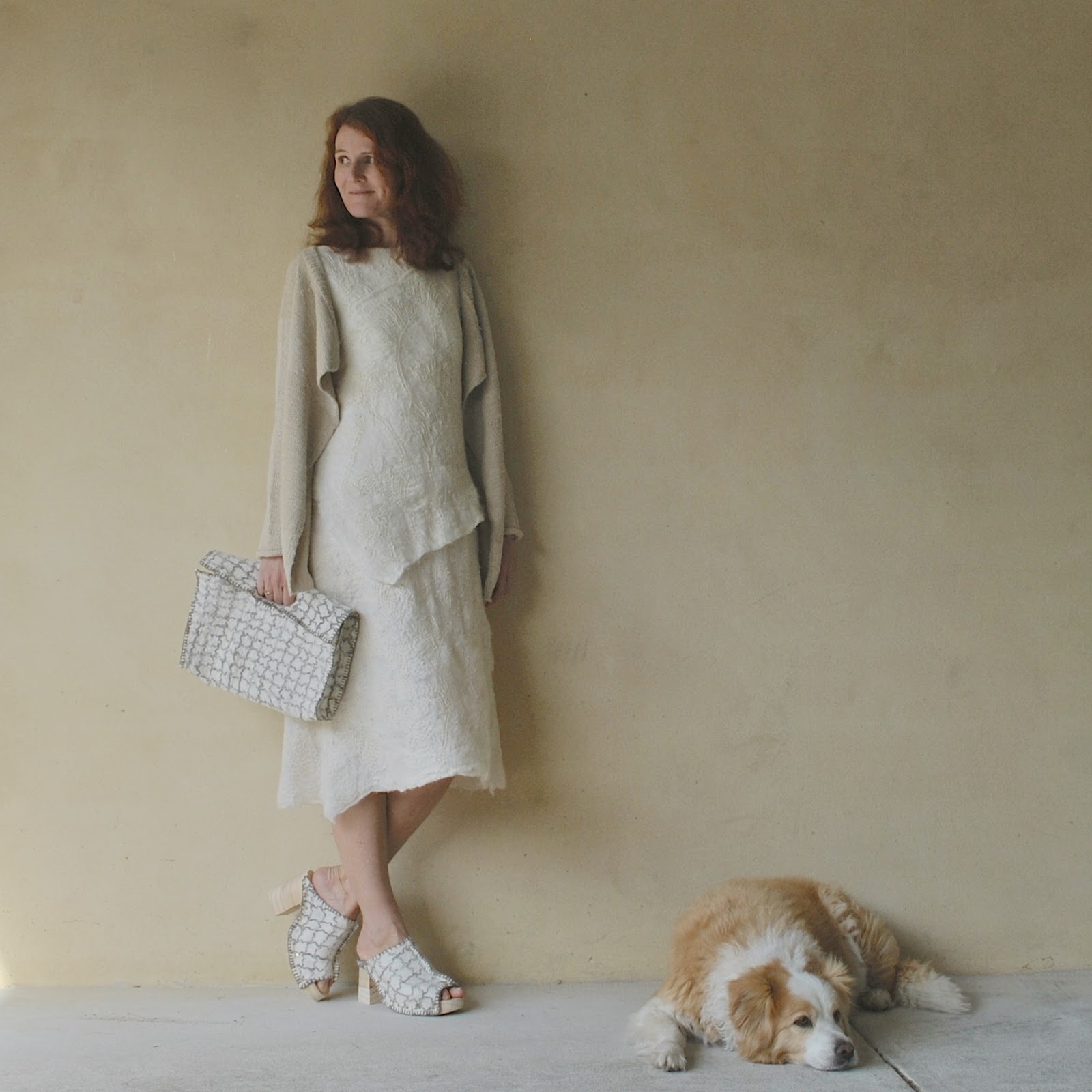
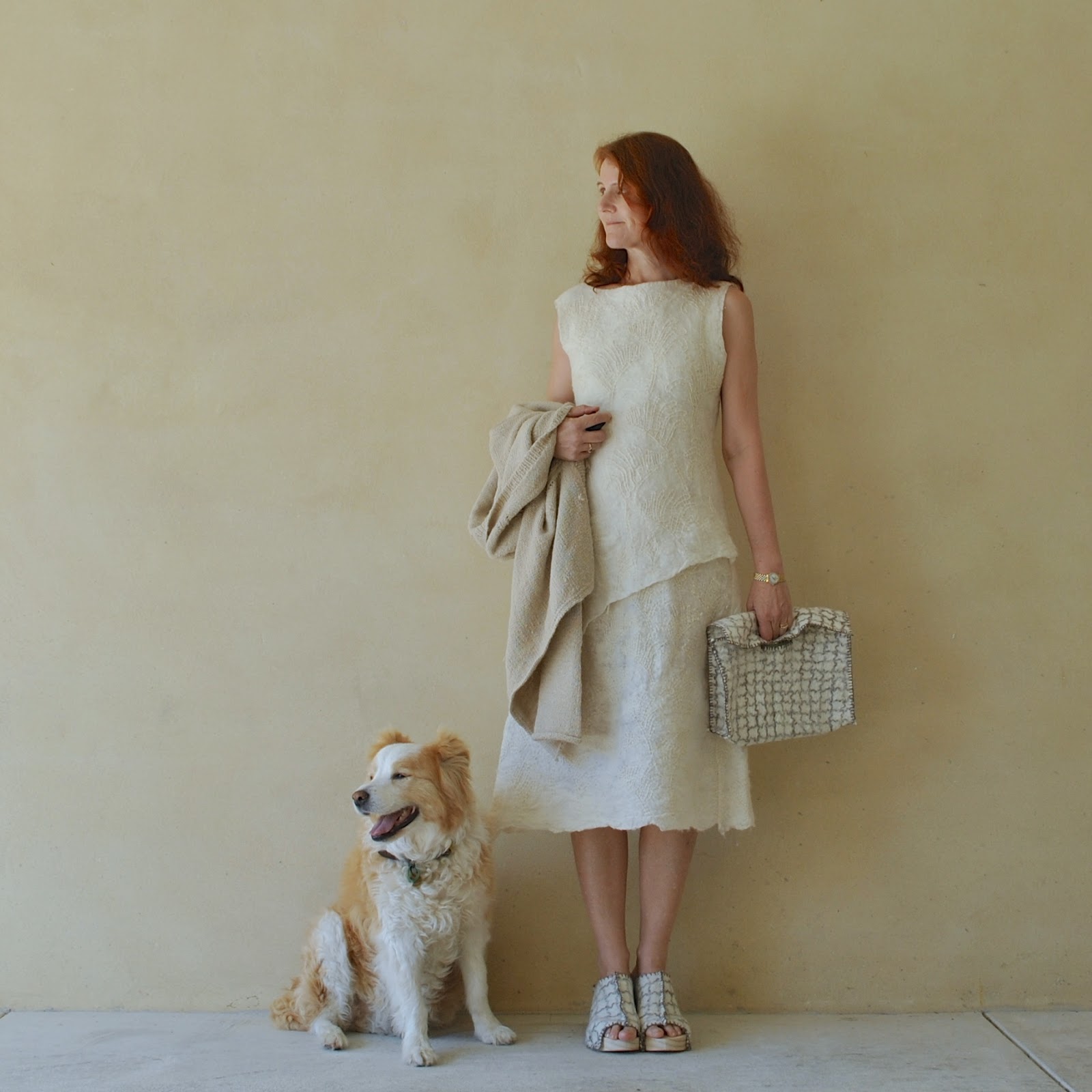
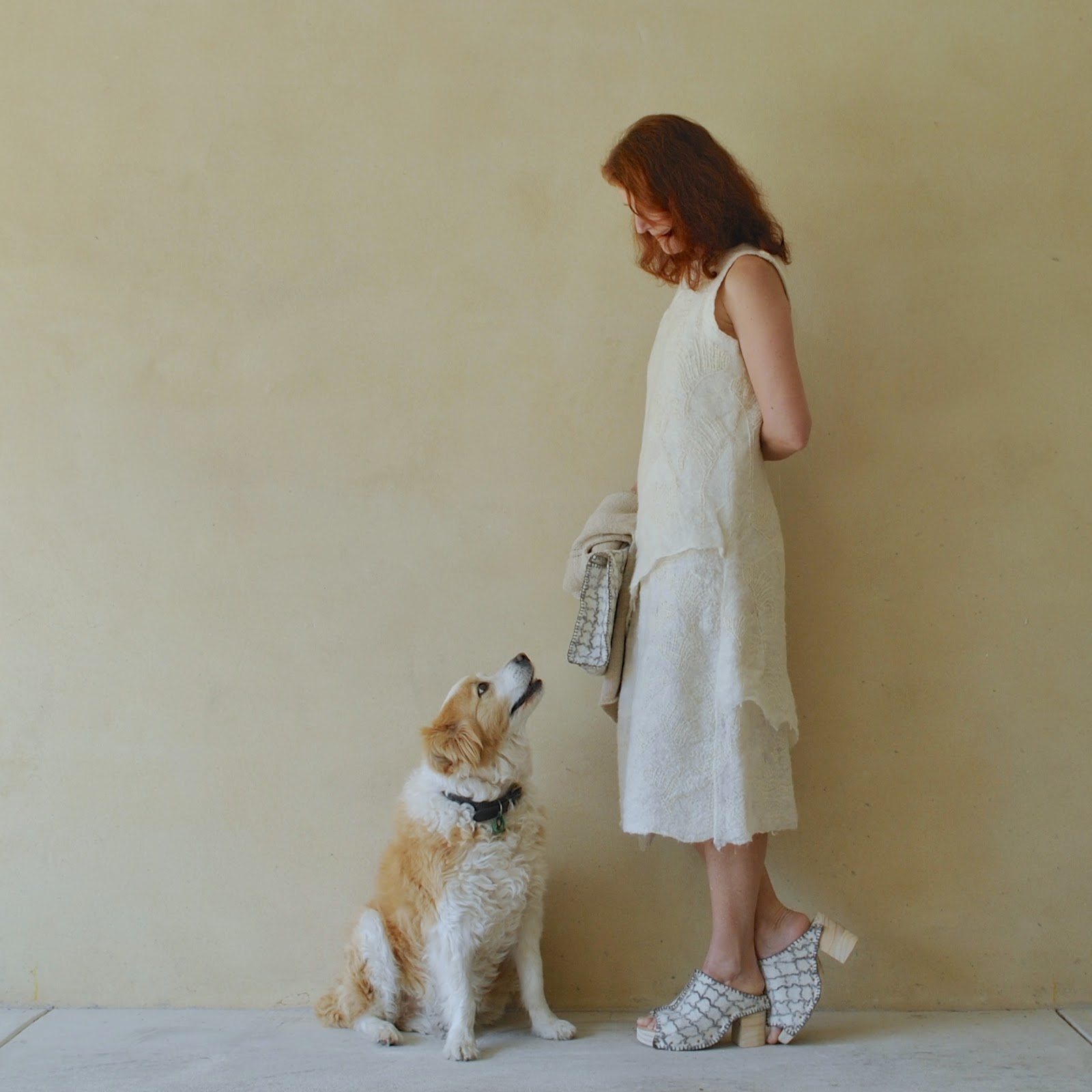
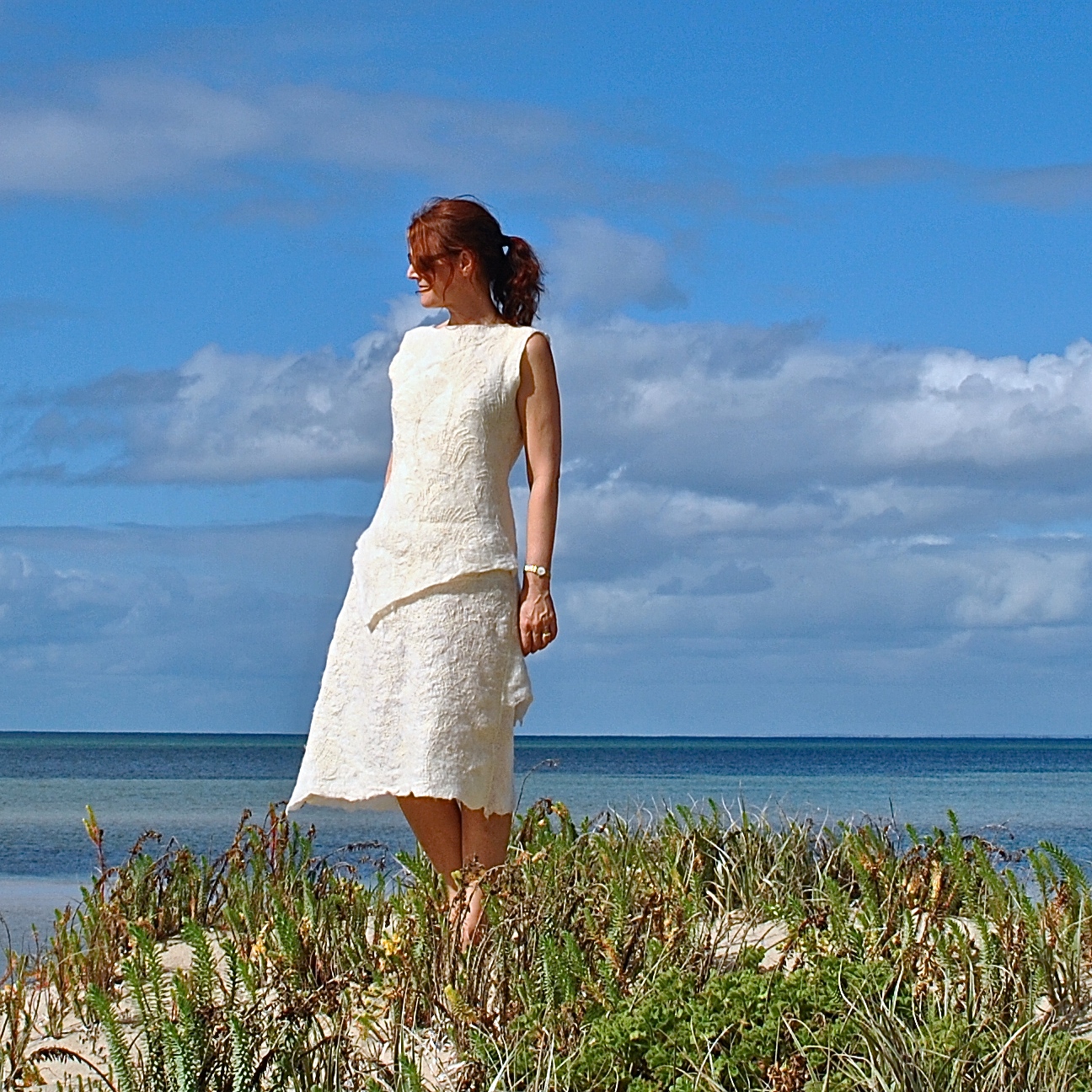
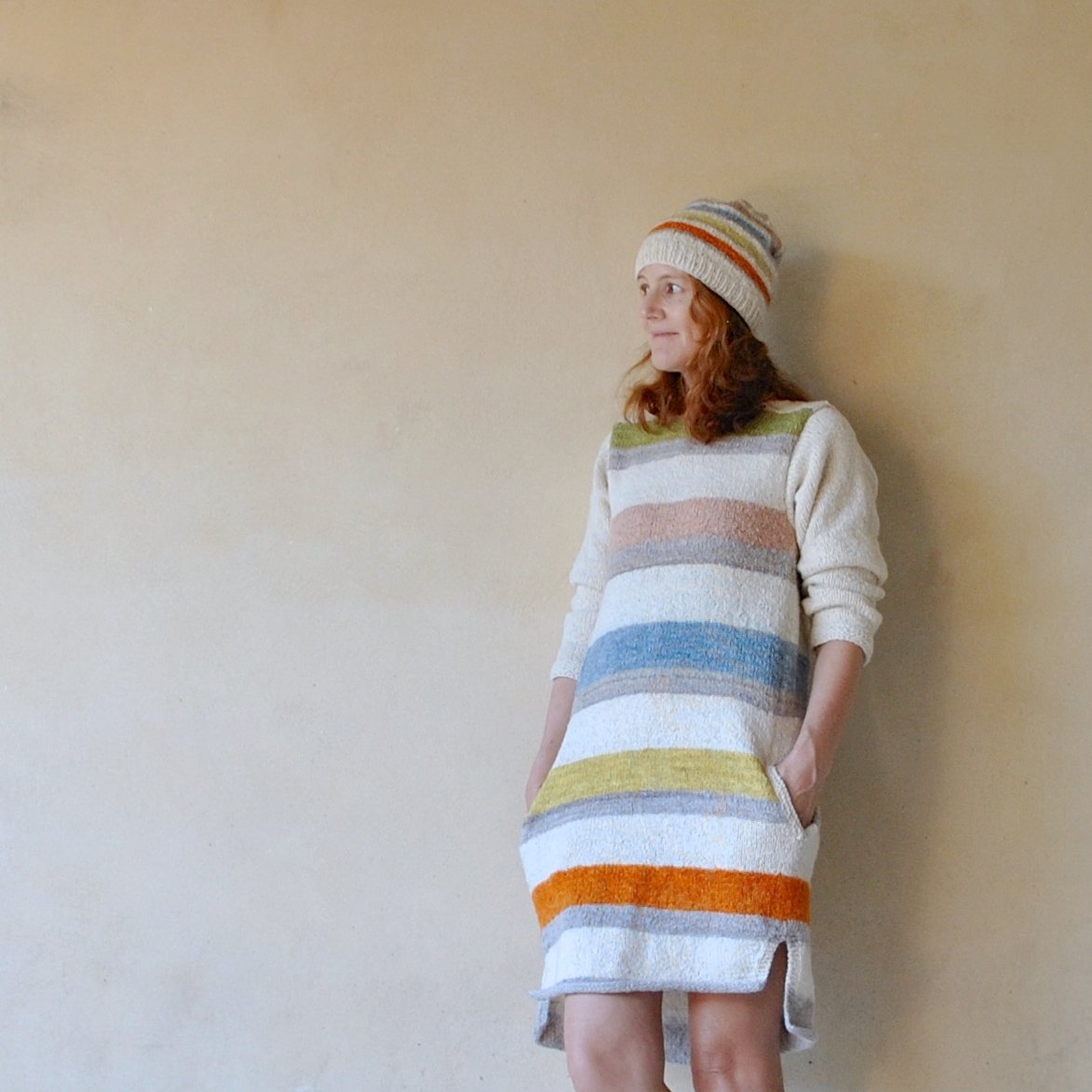
What did I make: a simple knitted dress and a matching beanie, showcasing my dyeing experiments in stripes.  I just wanted my hard-won colours to shine on their own merits equally without competing with each other, and individual stripes separated by the blankness of the natural undyed ivory just seemed a good way to accomplish this.

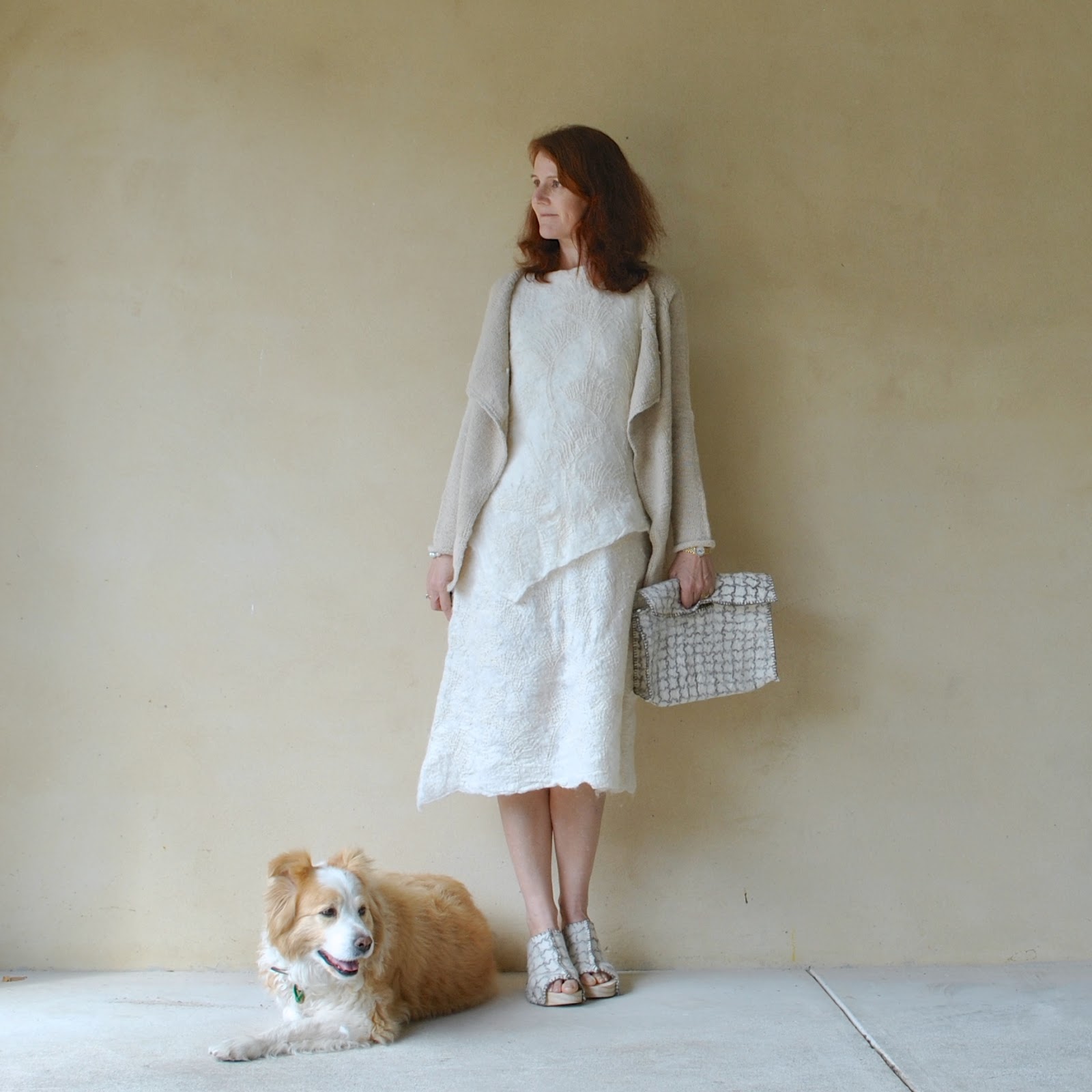
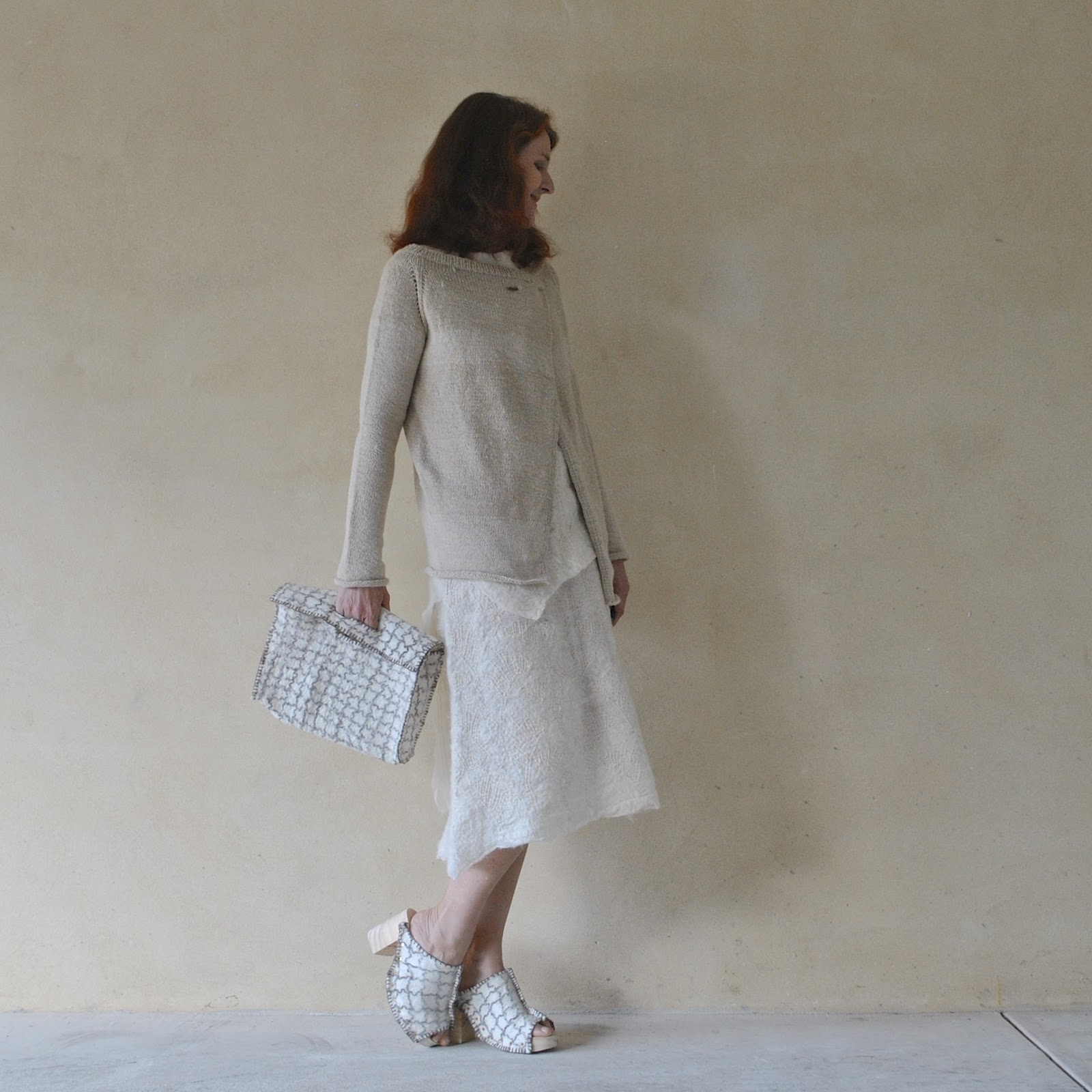
My shoes, bag and underwear were all made for last year, and also comply with the rules of the challenge.

Sources; I obtained all my handspun merino yarn from Bilby Yarns, which is an absolute treasure trove for West Australians interested in local wool products and supplies.  My yarn is from Western Australian Merino sheep; born, grown and shorn right here in the south-west of WA.  The raw fleece is transported to Bilby Yarns in Willagee, where local spinning enthusiasts can purchase it, spin it in their own homes, and sell it to people like me back through Bilby Yarns.  It’s such a great scheme!!  All my yarn was spun by the talented Beverley L. whose yarn I also used last year!  Some of my yarn this year was leftover from last year, and I managed to buy some more of her’s this year…. I’m so pleased I was able to purchase so much of her gloriously lovely handspun!  I bought mostly undyed natural white, and some natural grey.  The grey is quite rare, and I was lucky to get hold of this!  I used the grey to highlight each colour; I like how the grey stripe adds a bit of trompe l’oeil 3D-ness to the coloured stripes, like a shadow underneath each one.

So! I had my natural ivory and grey yarn, now for the colours!  All my dyeing experiments are outlined in this post here.  I didn’t end up using all the colours I produced… leaving something for the next 1year1outfit maybe??  The colours I chose from my experiments are, from the hemline going up, are:

Orange, from Coreopsis flowers;

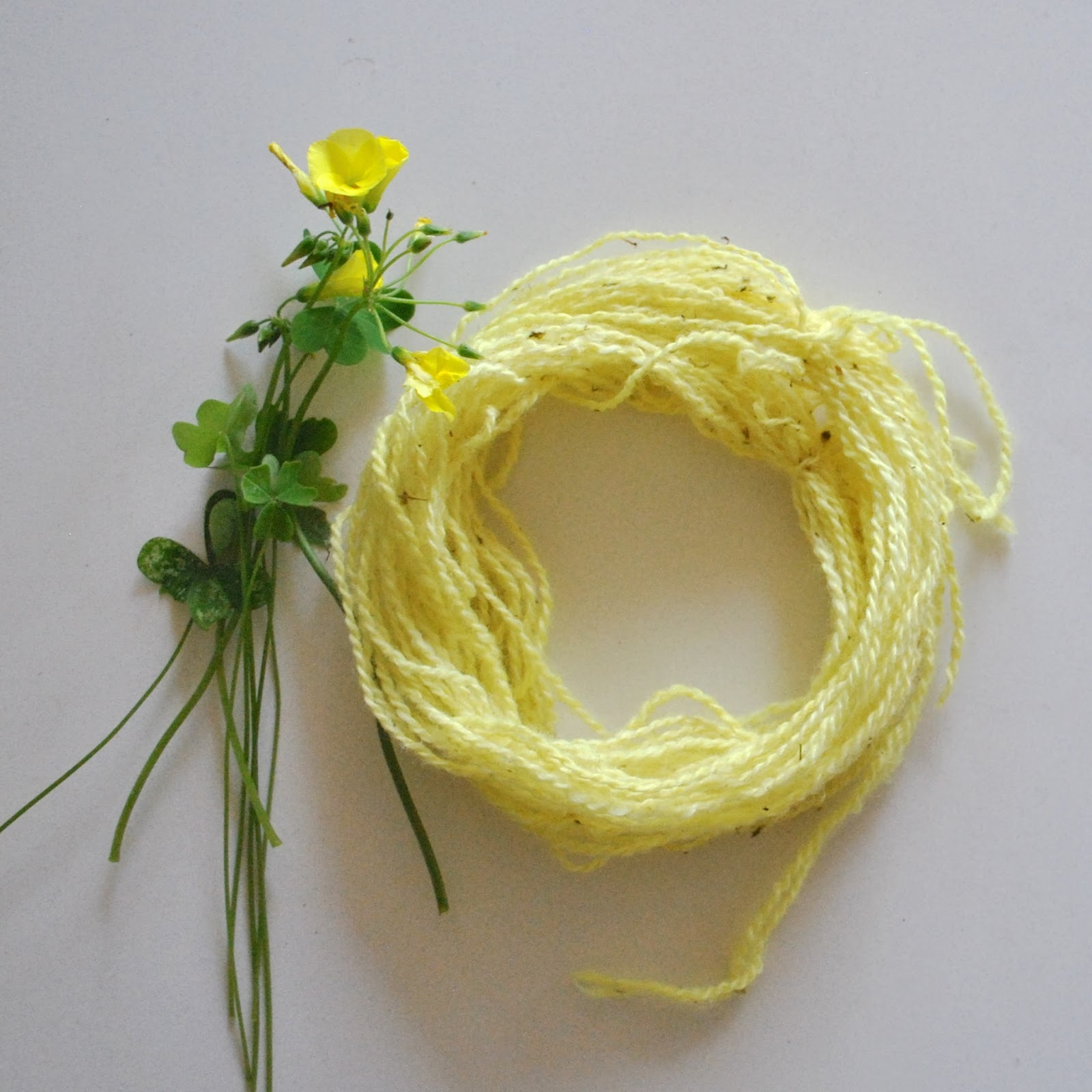
Acid yellow; from sour grass stems and flowers,

Blue, from Japanese indigo, and I’m so grateful to Nicki for the use of her dye vat,

Pink, from avocado pits,

and that lime-y green colour at the neckline, and seen in closeup a few pictures down, was the result of over-dyeing, soaking some of my spare indigo yarn in a sour grass (oxalis) dye bath and then with just a single coreopsis flower (orange) tossed in to give it a bit more oomph when I realised the yellow was a bit weak.

The design: is my own!!  I did about a million calculations first but even then there was plenty of unravelling and re-doing bits until I was satisfied with it!   I wrote down my final pattern below, just in case I ever want to revisit this pattern, or if anyone is interested in knitting an entire dress for themselves!  It’s ok, I wouldn’t blame anyone who didn’t but still…  The only thing is that it’s only got the one size.  That lower hemline with slightly forward slits?  yes, it’s pretty obvious that my hemline is totally inspired by the Named patterns Inari tee dress, a pattern I have made five times now and unequivocally LOVE.   I just really like the way the Inari dress slits do the job of a walking vent, but is visually more interesting and obvious than your regular, garden variety, centre-back walking vent … and I really like the terraced high-low look of that longer back and shorter front.

The dress is mostly stocking stitch, with the lower edges, the sleeve edges, and pocket opening welts highlighted with various width rows of garter stitch.  Those sleeves!  OK, I’ll confess these almost did me in  … initially I had other ideas, resulting four false starts on the sleeves before the final design decision.  Four!! It was a bit gut-wrenching, each time I would be chooffing merrily along with a sleeve, before the dawning realisation that my previously thought-to-be cool idea was actually going to look really really stupid.  Gut-wrenching!  SO MUCH UNRAVELLING!!  But I refused to give up, I kept reminding myself that this HAD to work, I’d put so much into it already and I just could not abandon it in its hour of need.  Finally I hit upon this sleeve, a very simple, and plain, , unadorned long-sleeved style , which worked out just right, I think.

Pockets; of course it has pockets!!  the dress is knitted in the round, so there are no side seams, but I left openings at the front hip to knit in the pockets later.  There are little extension “flaps” at the pocket openings, for a continuous look when you’ve got your hands in the pockets and may catch glimpses of the pocket insides; and the pockets are just little “bags” made by picking up stitches along this edge, knitting a simple rectangular strip and folding it in on itself.  The garter stitch “welt” was knitted on before stitching the pocket piece closed.

The neckline; just wanted something really simple and streamlined, so I did one single row of chain stitch embroidery around the neckline edge.

The beanie: is a slightly loose and slouchy beanie, as I love this look and have decided this style of beanie suits me quite well, I think… hope!  The arrangement of the stripes is the same as the dress, just on a smaller scale.  This got unravelled and re-knitted only once before I worked out just exactly how I wanted it to look.

Le Whole Shebang, with accessories and all:


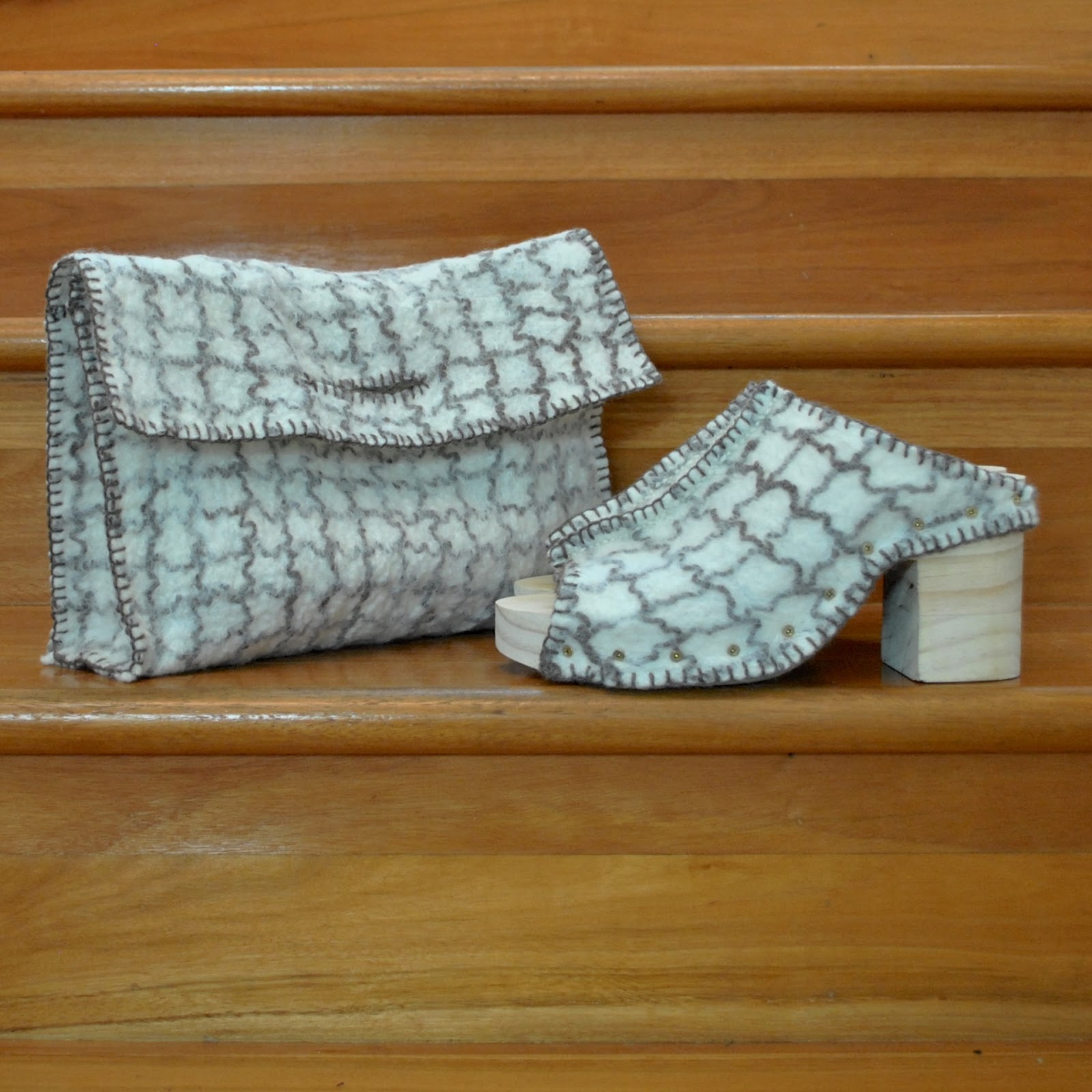
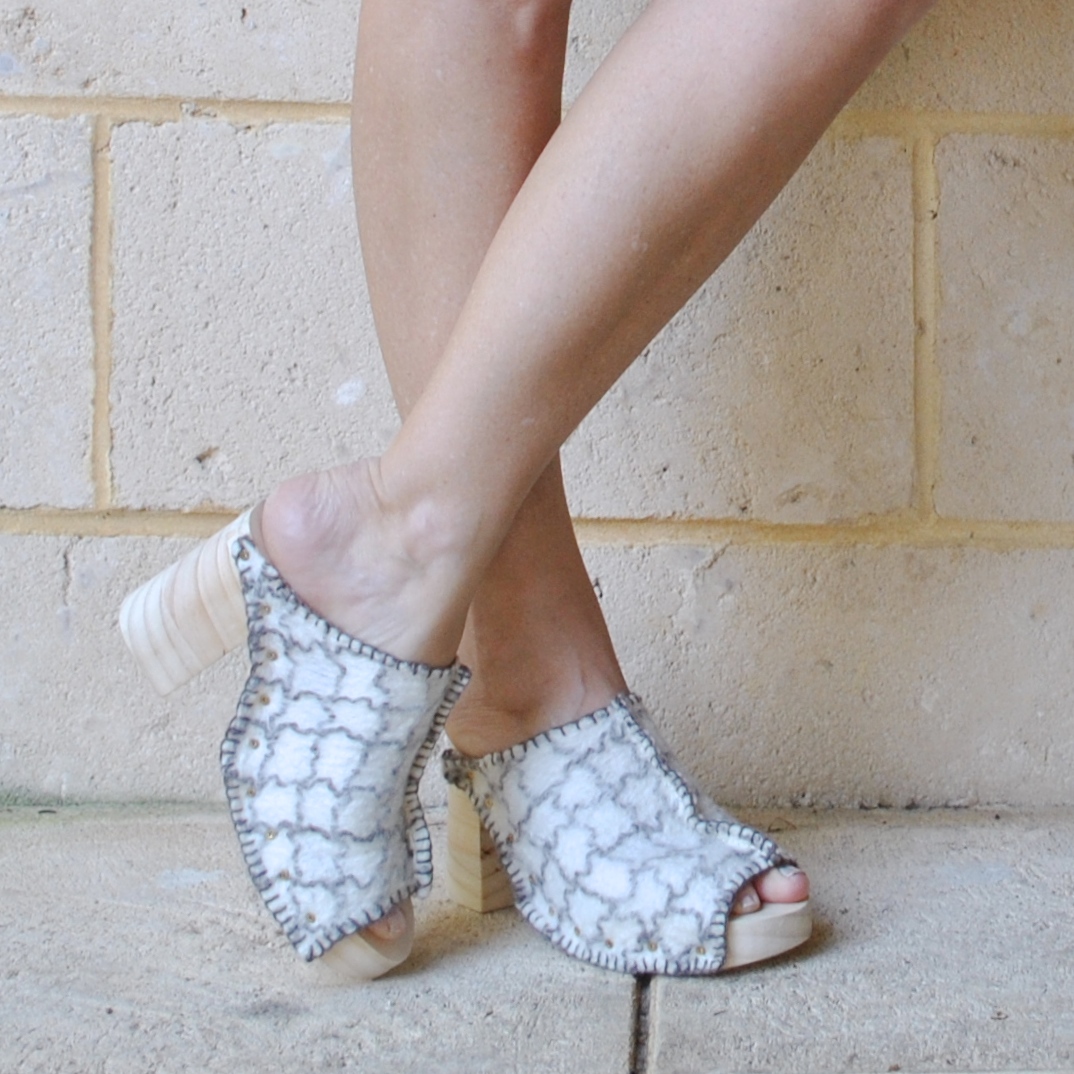
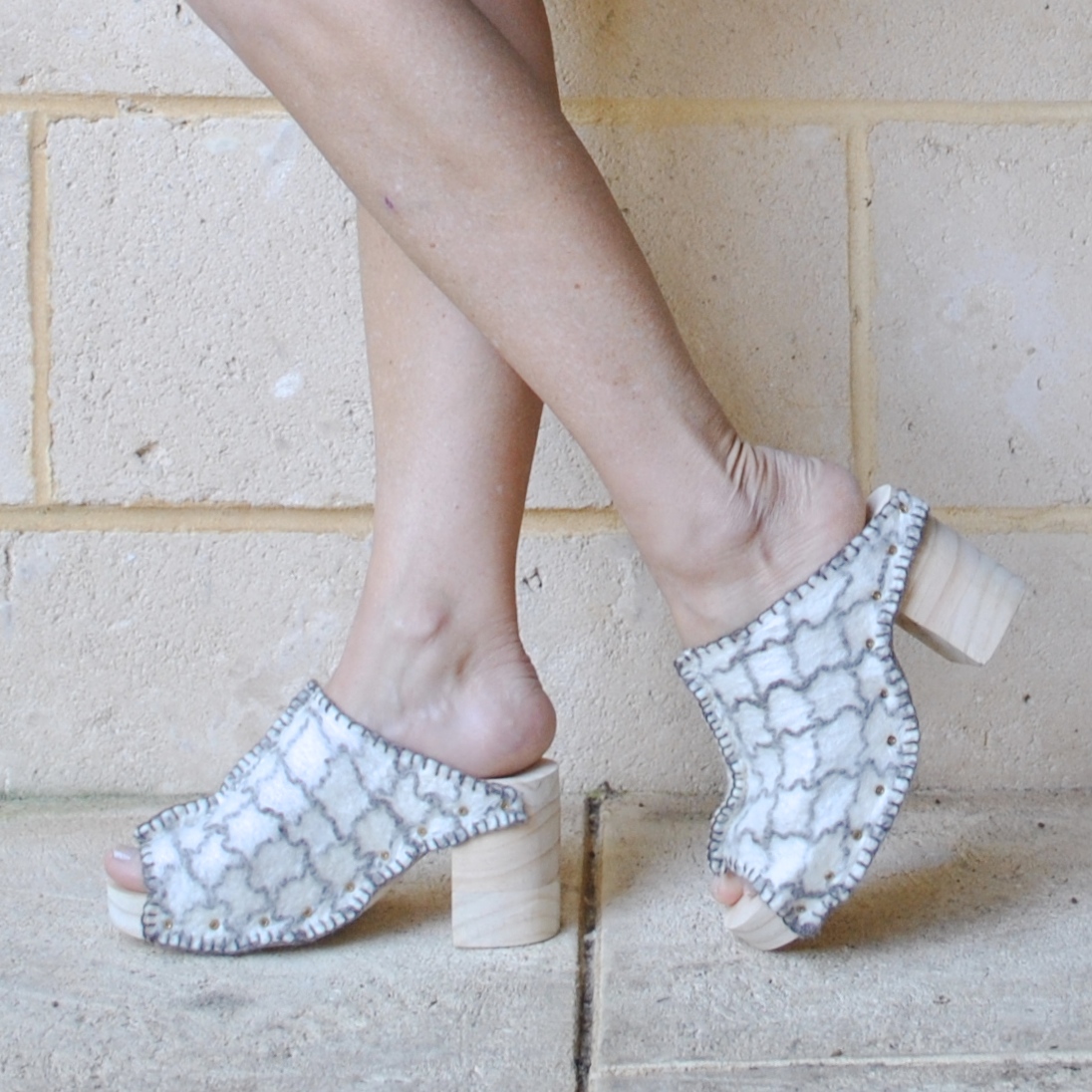
Shoes and bag; I’m wearing the same shoes and bag I made for last year’s project.  At first I worried that they wouldn’t “go” but well; I reckon they go just fine.  I carved my shoe bases from Manjimup pine and made the felted tops in natural white and black merino fleece and handspun, as described here.  The matching bag is of the same felt.

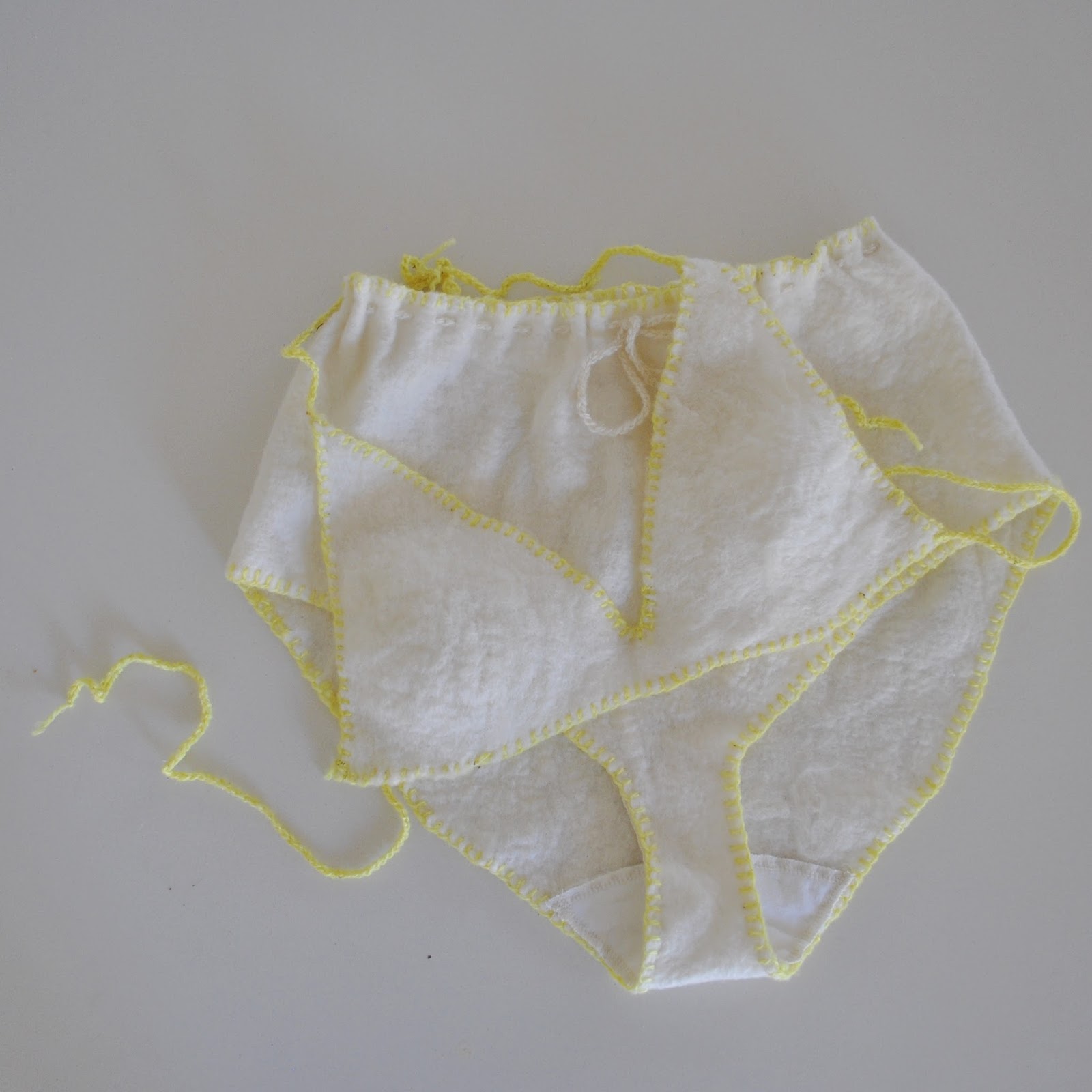
Underwear: yep, same as last year.  Well, I’m not going to make a new pair when I never wear this set at all!  However, it is totally 100% local so I’m counting it as part of my totally local outfit again for this year, hehe.

So that’s it!!  Am I going to take part in the “1 year 1 outfit” project again next year? well I do have ideas, but confess I’m a little exhausted, by, well…  everything, at this point.  Maybe, maybe not.  The truth is that I actually do have enough totally local materials still, to produce something… so maybe…  yes?! We’ll see!

fun fact; the small tree with bright green leaves behind and to the right of me in the picture, is called a Snottygobble.  Yes, really!! #weirdAussienames

Following is my free pattern for this knitted, slightly A-line dress with inset, welted pockets, split hem, long sleeves.  Includes pattern for optional beanie also.  Please link back to me and credit me if you use this pattern, thank you so much  🙂
Knitted dress + beanie

Location;  Leeuwin National Park, in the south-west of Western Australia… although the picture immediately below is actually taken in our own garden, since I forgot to take my bag with me when I went to the park, doh!!
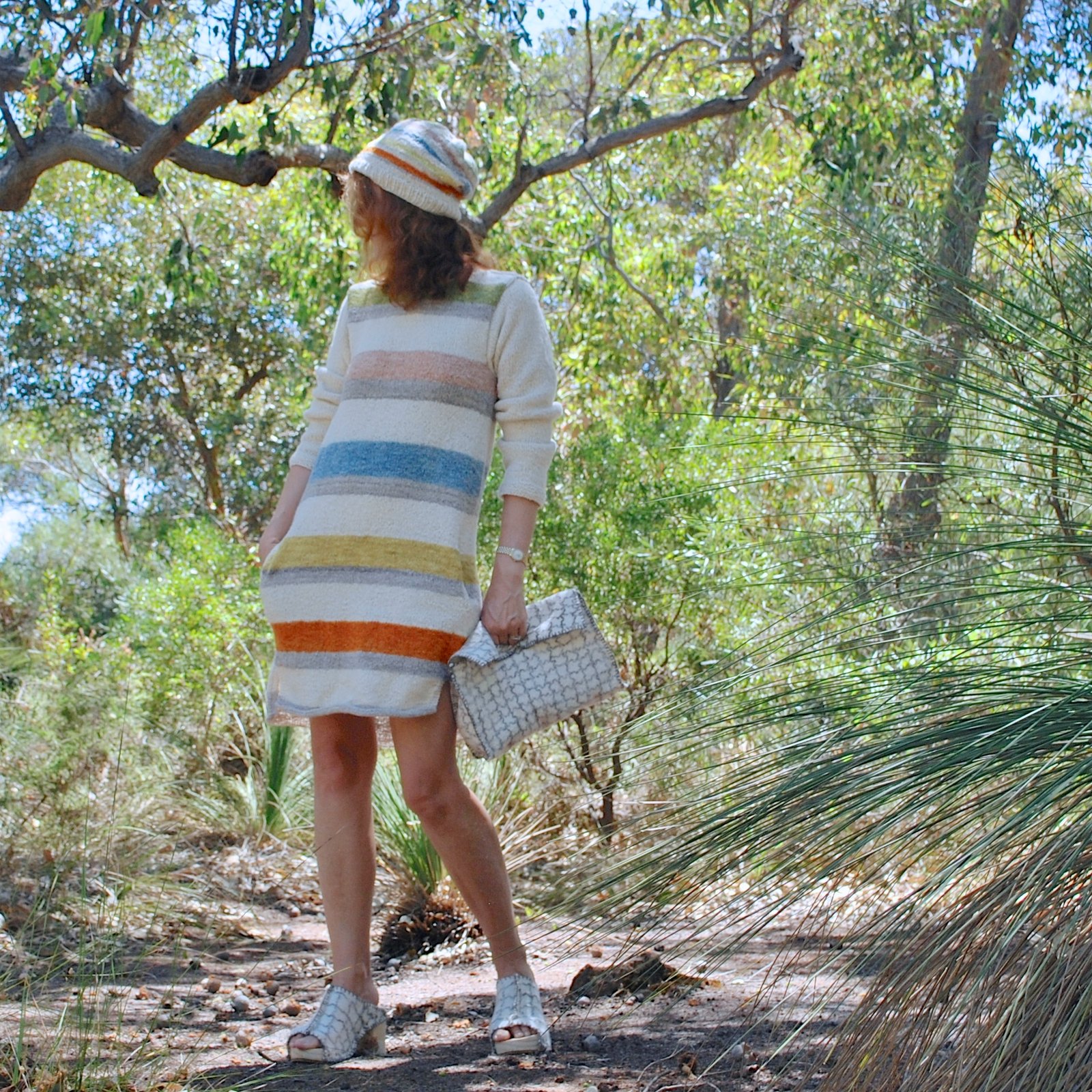
Now, you may be wondering… Carolyn, isn’t it the height of summer?  Aren’t you absolutely roasting alive like a broiled lobster in that warm and ultra-cosy-looking woollen ensemble??  The short answer to those questions is; yes, and again, yes.  Ahem.   The maestro of Seasonally Inappropriate Sewing strikes yet again.

pinterestmail

totally local, natural dyeing

naturallydyed wool

Above: top row L to R; indigo, avocado skin, bracken, lower row L to R; coreopsis, chopped avocado pits, whole avocado pits

Progress report.  I’ve been fiddling about with natural dyeing for my Totally Local outfit… this is the new name for the challenge known last year as 1 year 1 outfit; where we make an outfit for ourselves using ONLY locally sourced materials and absolutely nothing NOT!!!  Yep, for us that rules out zips, thread, and even fabric!  making it quite a challenge. That’s ok, I love a challenge.  The “totally local” is the brainchild of Nicki, of this is moonlight.  I enjoyed myself so much last year I wanted to do it again, and have been brainstorming ideas and hatching plans for my outfit for this year, mwahahahaha.

My outfit from last year is here… and it’s all very…  colourless?  isn’t it?  That’s because I opted to use just the natural undyed merino and alpaca wool for my outfit, which is all white or off-white by default.  The only one shot of colour in my ensemble is the brilliant chartreuse sour-grass dyed crochet border on my underwear, which is hidden away!  Yeah that was a bit silly, wasn’t it?!  Anyway, this year I am aiming for a bit more colour in my ensemble, and so have been gathering lots of materials and bits and bobs to make some pretty COLOURS!

So here’s the run-down…

I’ve been buying skeins of handspun, naturally white merino wool from Bilby Yarns.  This merino is 100% Western Australian, grown, sheared and, well, everything locally.  The fleece was spun by two lovely local ladies, Beverley and Gwen.  Literally, nothing about this wool has ever stepped foot outside of the south west of Western Australia, so it qualifies for the challenge perfectly!

You might remember that last year I used naturally white merino yarn that had been handspun by Beverley, for the kangaroo paw embroidery and sewing-together of my felted dress.  I still had some of that yarn left over and simply bought some more, as Beverley spun more.  In some cases, I bought  it still wet from its wash!

Now on to les couleurs…

indigo

Blue:  I owe this beautiful shade of indigo blue to Nicki from this is moonlight, thank you, Nicki! Nicki sourced and nurtured a pot of local indigo… I think it was with the assistance of Trudi Pollard? (not sure, maybe Nicki can correct me if she reads this!) and then, when she learnt she would be going over to the eastern states and would not be taking her indigo pot with her, generously offered to share it with a few others of us local girls who are doing the project, .  Thank you so much, Nicki!  we had a great fun day, dyeing with various locally sourced dyes that Nicki had built up.  I personally only had eyes for that enormously difficult to obtain BLUE.  I soaked a few of my skeins, gently wrung them out and bought them home unwashed and still full of the dye, to “steep”.  Those skeins turned out intensely blue… practically navy!  So, at home, after a few weeks of sitting, I soaked those skeins with some fresh, new, white merino, and the washings gave me this lighter shade of mid-blue above.  I’m planning to keep and use those deeper blue skeins, probably next year, because for this year, I really wanted these more washed-out shades.

My blue wool above is pictured here with some of my own indigo plants, that I am careful nurturing and trying real hard not to kill.  I do hope to use these for dyeing… one day.  Obviously that is not about to happen anytime soon, though.

IMG_1590

Pink; from avocado pits, merino pre-mordanted with alum.  My avocados were grown on a market garden in Wanneroo, and I bought them from Scutti’s, my local greengrocer.  Basically, I bought them while in season and have been hoarding and freezing the pits and skins all summer!  Once I had enough pits to play with, I gently brought my wool to the boil with some unbroken pits as described in this method here, and left it to cool in the dye and then to soak for a further four days, as the colour of the pot deepened.  I was seriously blown away by how beautiful the colour turned out! so I’ve been collecting more avocado pits and will probably do some more wool this exact same shade.  I LOVE IT.

IMG_1595

Apricot; this is the result of dyeing with chopped up avocado pits, plus skins; merino pre-mordanted with alum.  Again, boiled gently for half and hour or so, topping up with boiling water as needed, then left to cool and then soak in the solution for four more days.  I quite like this colour, and may do some more of it.

IMG_2040

Light sage green;  this is the result of dyeing with avocado skins with some avocado flesh left on them… same method as above.  This colour is alright, quite soft, a barely there grey/green.  Green seems to be another one of those elusive shades that is quite difficult to obtain from our local resources.  I may or may not overdye this one  a touch… just waiting and seeing for a bit …

IMG_2042

Yellow-y apricot; just a few coreopsis flowers, on merino pre-mordanted with alum. The coreopsis flowers are grown in a garden in Willagee, harvested and dried by the owner, and are available through Bilby Yarns.  To get this soft colour, you really do only need just a few flowers.  For my first experiments, I used lots.  Haha, the joke’s on me, because that first batch turned out brilliant, BRIGHT orange.  For this shade I kept a close eye on it; taking it out to check and rinsing a few times, dipping for just a bit longer until I reached this nice soft shade.

IMG_2047

Pale, rusty pink; this is bracken, on merino pre-mordanted in alum.  I gathered the bracken from my parents’ place.  Hehe, funny, story, I half-jokingly asked Mum… “would it be alright if I picked some bracken for a dyeing project?”  After a short incredulous pause Mum says, “Carolyn, pick as much as you like!!!”  To explain, Mum and Dad have a large property, with loads and LOADS of bracken, and Mum HATES it with a deep fiery passion.  It is a native plant so she lets it be for the most part; but when we first got the block it was overgrowing the paddock quite severely and Mum wanted to put in an orchard.  I have memories of my Dad driving all around the paddock with a log chained to the back of his land rover, dragging it across the bracken, trying to clear it away.  It’s such tenacious stuff, it grew back over and over and over again!  Year after year it kept popping up all over the place.  Mum eventually got enough cleared for her orchard… but it was a massive effort.

That frond in the picture above is dead and brown… obviously, since I’d just boiled the living daylights out of it for dyeing!!  I did pick and use quite a big bunch but forgot to keep just one little frond aside for a demonstrative picture with my wool… but if you can imagine, it is actually quite a strong, bright green in colour, so this beautiful, port-wine/pink shade it gave was a lovely surprise to me.

I love all those beautifully soft pastelly shades, and am so happy how they blend together so tonally and gently.  In the process of dyeing I did get a few other stronger shades, that while I like them very well in their own right I’m still undecided as to whether to use them for this particular project… as follows:

From left:

dyeing

Bright orange: from a large number of coreopsis flowers.  It’s lovely, but maybe not a good match with all my pastels…

Moss green; a result of one dip in indigo, plus a dip in the coreopsis bath.  I really love this colour, but again, quite strong and vivid …

and deep navy blue, from Nicki’s dye-pot.  I’m not sure how I managed to get such a deep shade from the pot!  I’m wondering if it got caught up in some indigo sludge at the bottom or something… but this is a very strong colour for a single dip in natural indigo!

mustard

Mustard: I seriously adore this mustard, the result of one dip in coreopsis and then a further dip in avocado skin dye.  It does go so nicely with all the other colours! but is one of the “strong” ones, so I’m still um-ing and ah-ing over this one too…

So that’s it!  to summarise; I’m pretty excited about all the lovely colours you can get dyeing with local plants.  The only one that I would describe as difficult to obtain locally is the indigo, of course… if we did not know someone who had nurtured and cultivated a special dye-pot then blue would not have happened for me this time, so I am so glad and grateful that Nicki got one!  Blue is the hardest of colours to come by naturally.  The other plant sources; the coreopsis, avocado and bracken; are all plants that are grown right here in Western Australia for some reason or another.    Also, of course don’t forget sour grass! this is a rampant weed around these parts, and last year I picked some from my own garden and got this bright acidic yellow colour, as described here.  I’m currently carefully nurturing some more weeds precious sour grass, with a view to getting some more wool in this colour too…

sourgrass

Look at this divine array of colours!!  I’ve got some colour decisions to make, designs to design  😉  in short, I’m getting pretty hyped to continue on with the next stage of my totally local outfit!

from top to bottom: coreopsis (light), chopped avocado pits, bracken, whole avocado pits, avocado skins, indigo (light), indigo (dark), indigo + coreopsis, coreopsis (dark), coreopsis + avocado skins, sour grass

IMG_2097

pinterestmail

all Aussie adventures

MY OUTFIT IS FINISHED!!!
And I am showing it all together here for the first time.  Can I just say right here; wooooohooooot!
The challenge, as laid out by Nicki of this is moonlight, should you choose to accept it, and I did! was to make for yourself an entire outfit using ONLY locally sourced materials.  Sounds simple, right?  It has been anything but!
I’m very grateful to Nicki for conceiving this brilliant and very thought-provoking challenge, and for inviting me to take part.  This has been one exceedingly amazing ride, has blown my mind more than any other dressmaking challenge I’ve ever done, and really pushed my creativity to the limit.  At the beginning of the year I seriously did not think I would be taking my outfit to the levels I did…. I thought for sure I would be giving myself a pass on some things, for example;  thread, and allowing myself to use regular Gutermann’s thread.  As time went on though I toughened up, embraced the idea of going the whole hog; and I’m very pleased that I did manage to rise to the challenge and make the maximum possible from locally sourced products!
In fact, I’m quite proud and extremely happy! :))
For the challenge, I made:
a knitted alpaca cardigan/jacket
a merino felt dress
merino felt and pine shoes
a merino fleece bag
merino fleece undies and bra
In a nutshell, every single blinking thing I have on here is made by myself, using pretty close to 100% south-west Australian sourced materials

Those of us in Western Australia; SueMegan, Nicki and myself, have had to be quite innovative in our approach, I think.  I mean, forget zips, thread, elastic… there is not even any freaking fabric made in WA!  This was our single biggest hurdle, I think!
However, we are extremely fortunate in that we have wool available to us; lots and lots of wool!   Australia has the world’s biggest wool economy… did you know that 80% of the world’s apparel wool is from Australia? and Australian merino is the world’s best quality woollen fibre.  22% of the country’s wool production is here in Western Australia (source)

Hardly surprising then that all four of us have used wool as the majority component in our outfits.
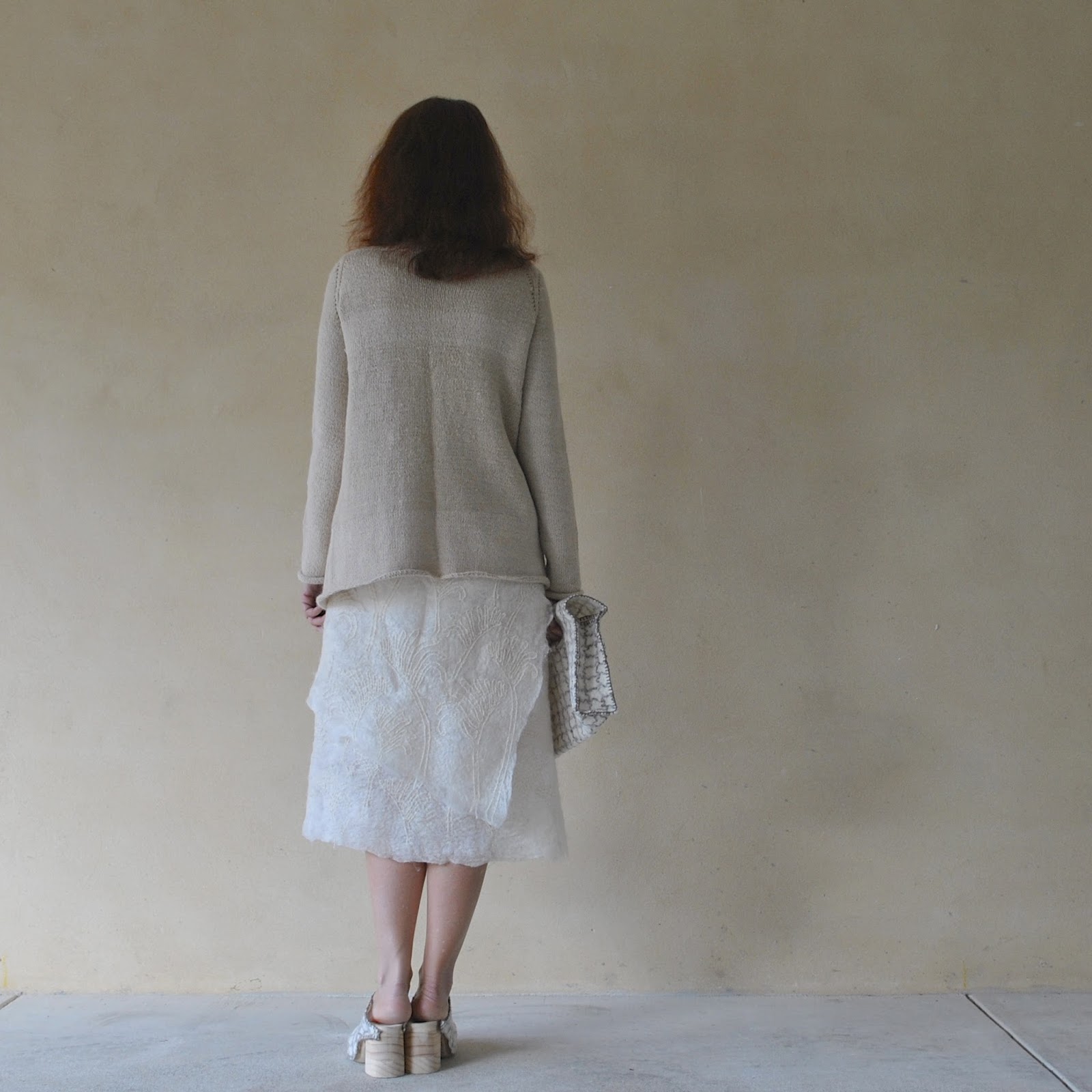
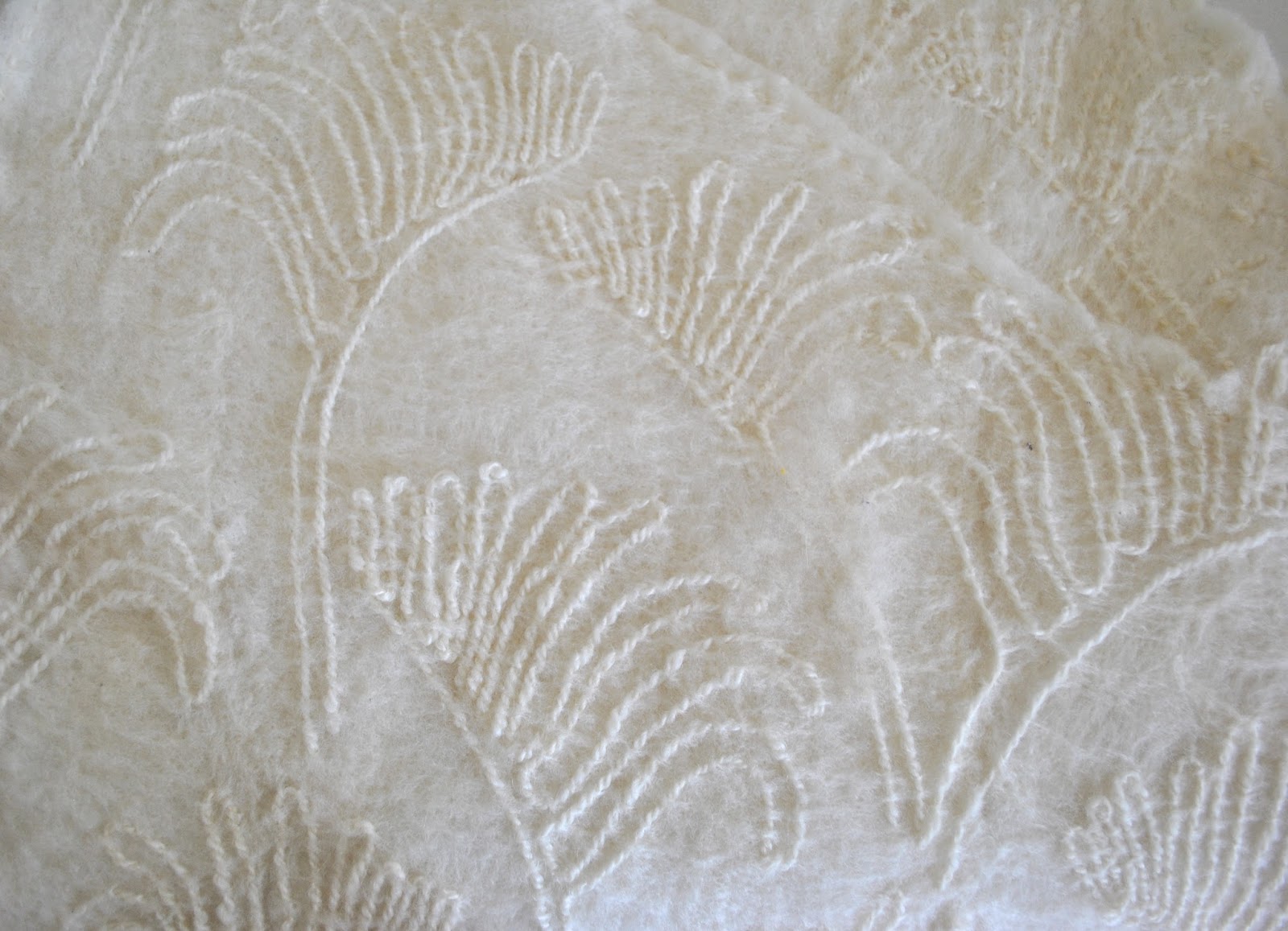
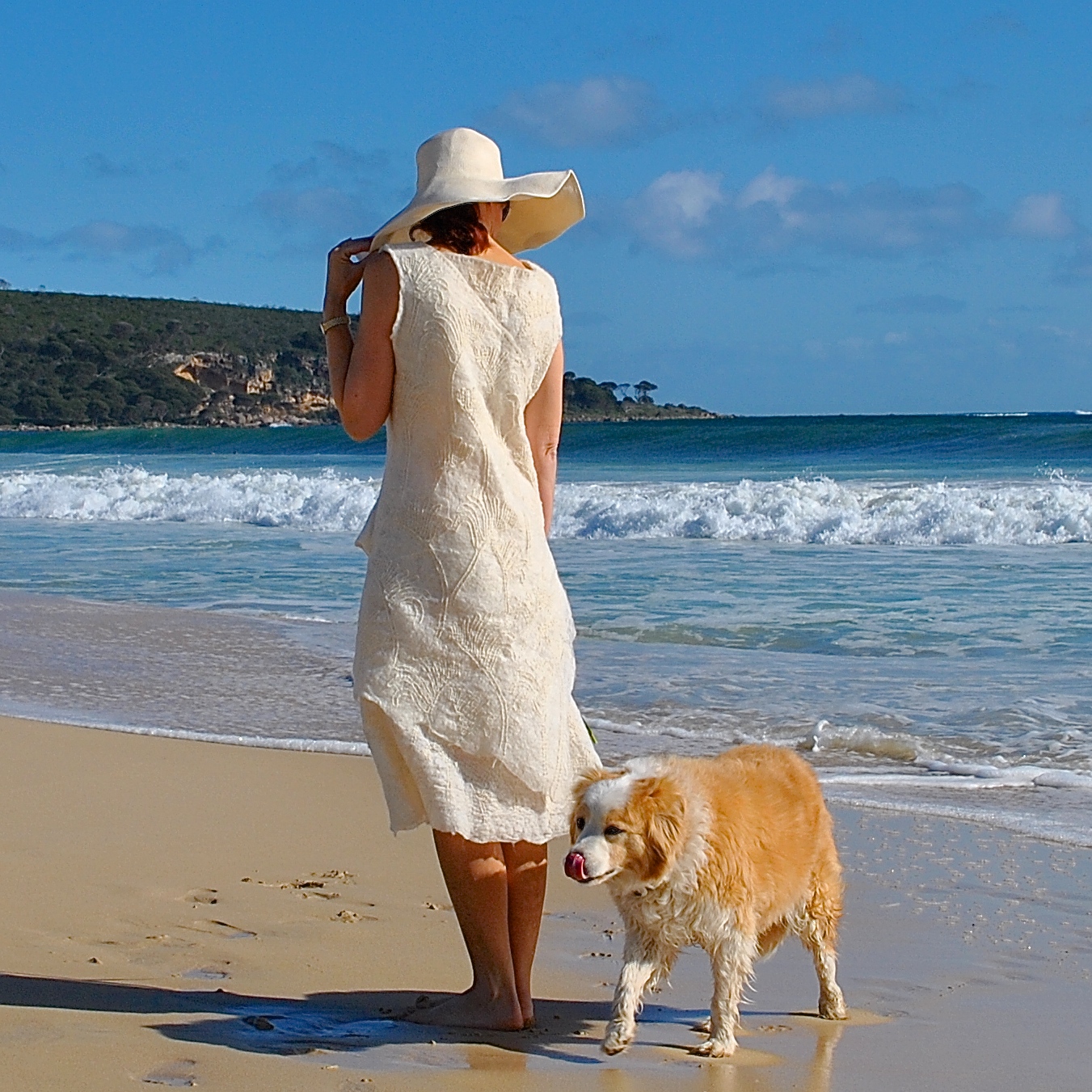
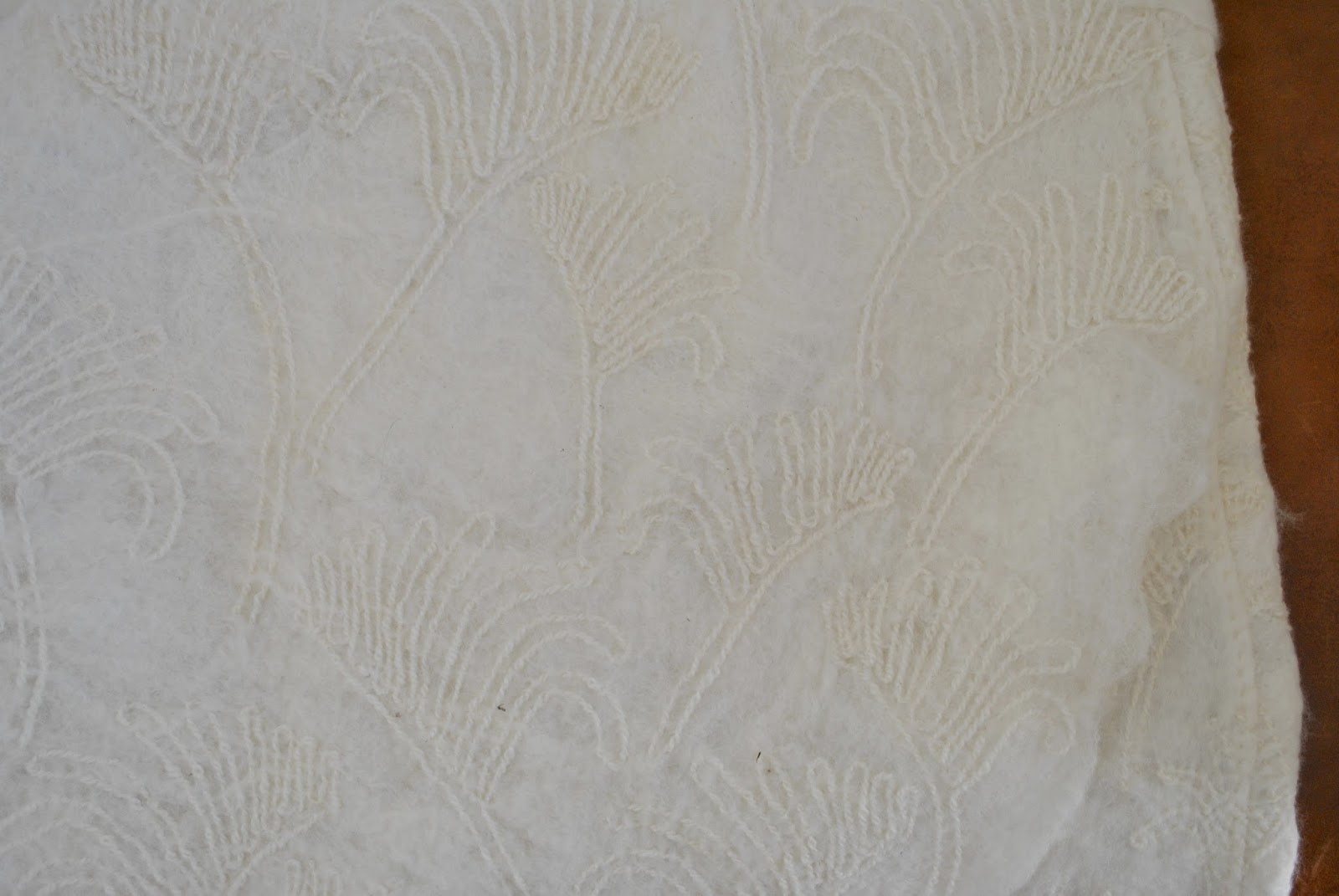
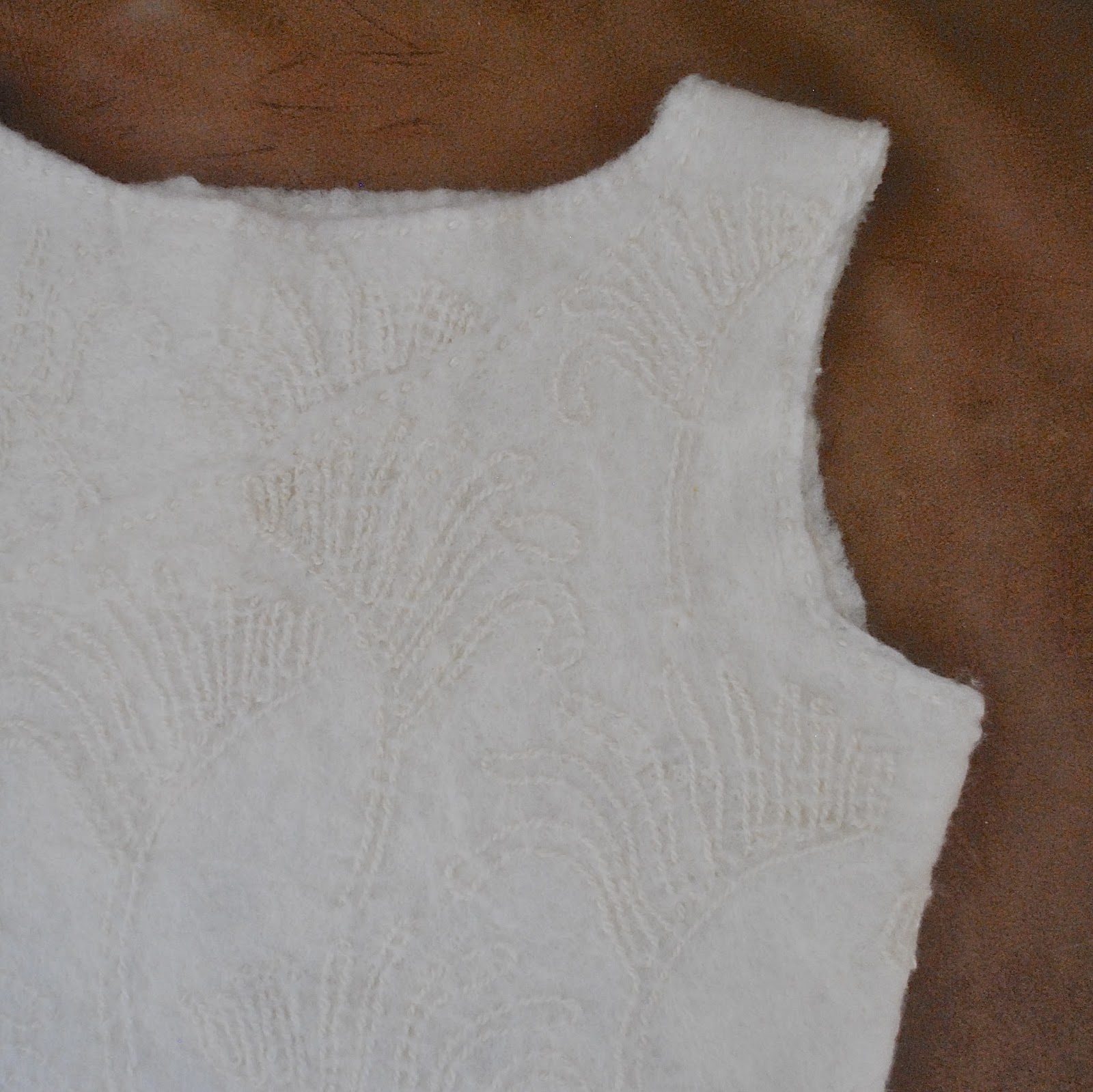
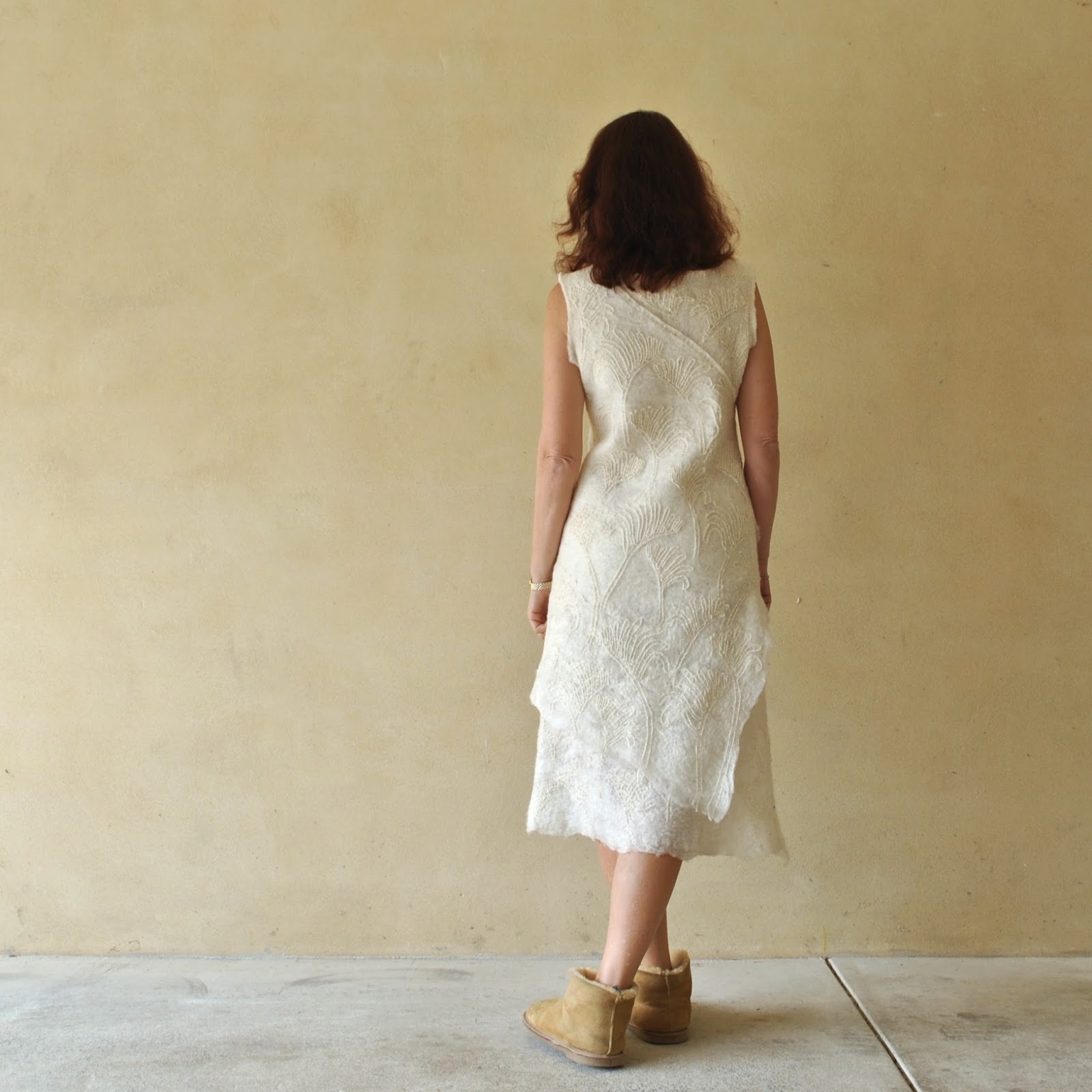
My dress, bag, underwear and shoe tops are made from Western Australian merino fleece.  I made my wool felt fabric from the fleece as outlined in this post.  My dress is made from natural undyed merino fleece felt, and I hand-embroidered the fleece all over with locally handspun, undyed merino yarn.

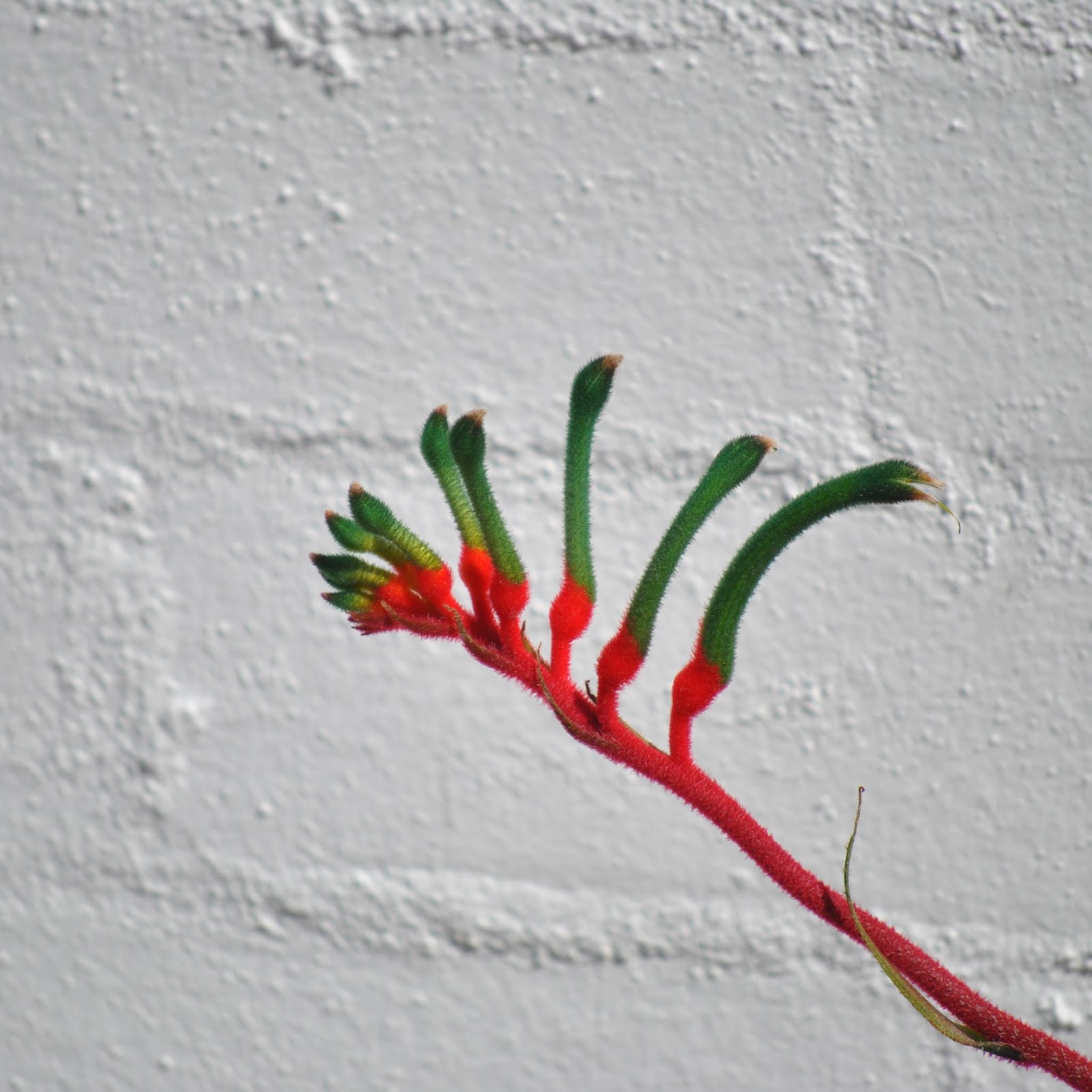
Anigozanthos manglesii

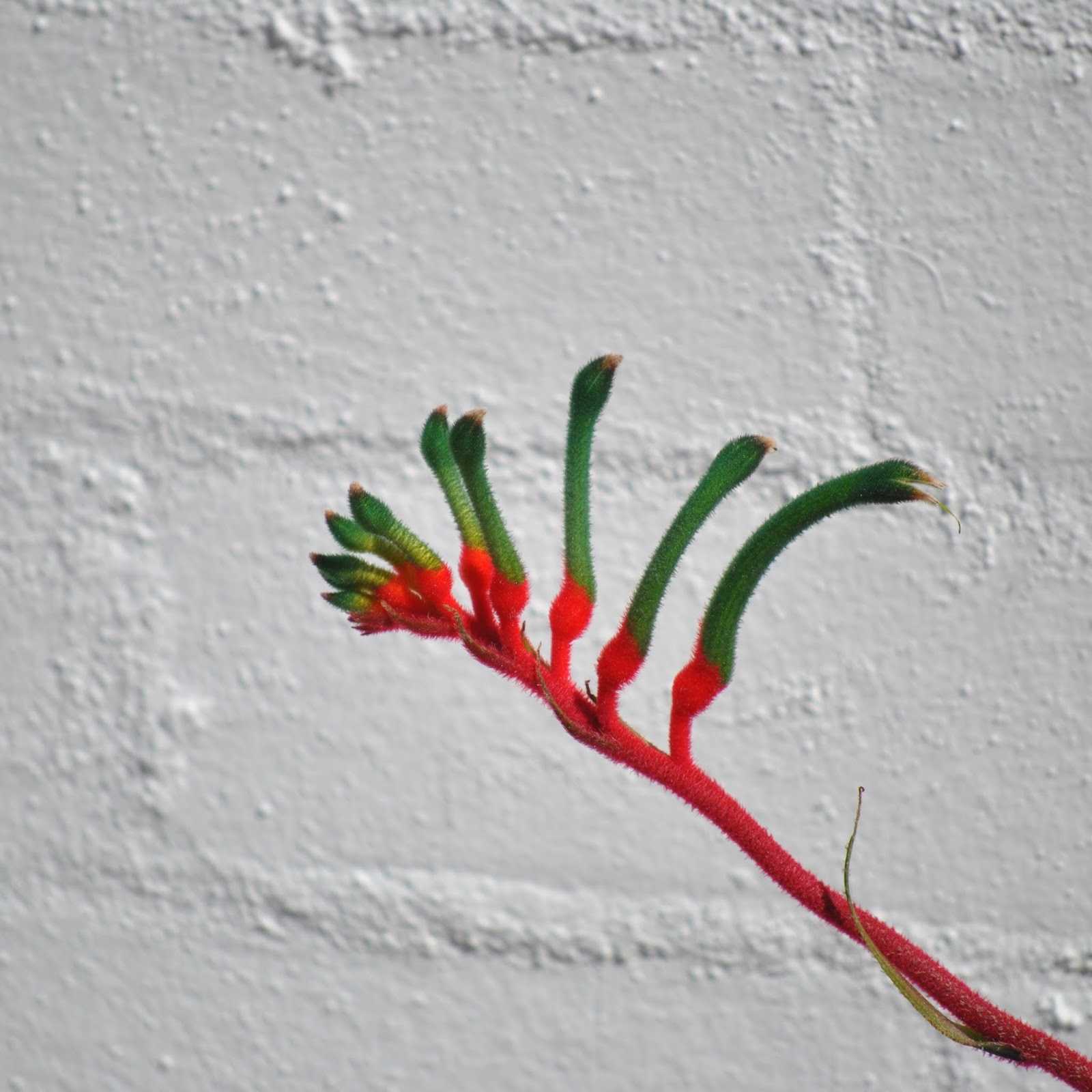
The embroidery design is my own; a random arrangement of of kangaroo paw motif, for our Western Australian state floral emblem.

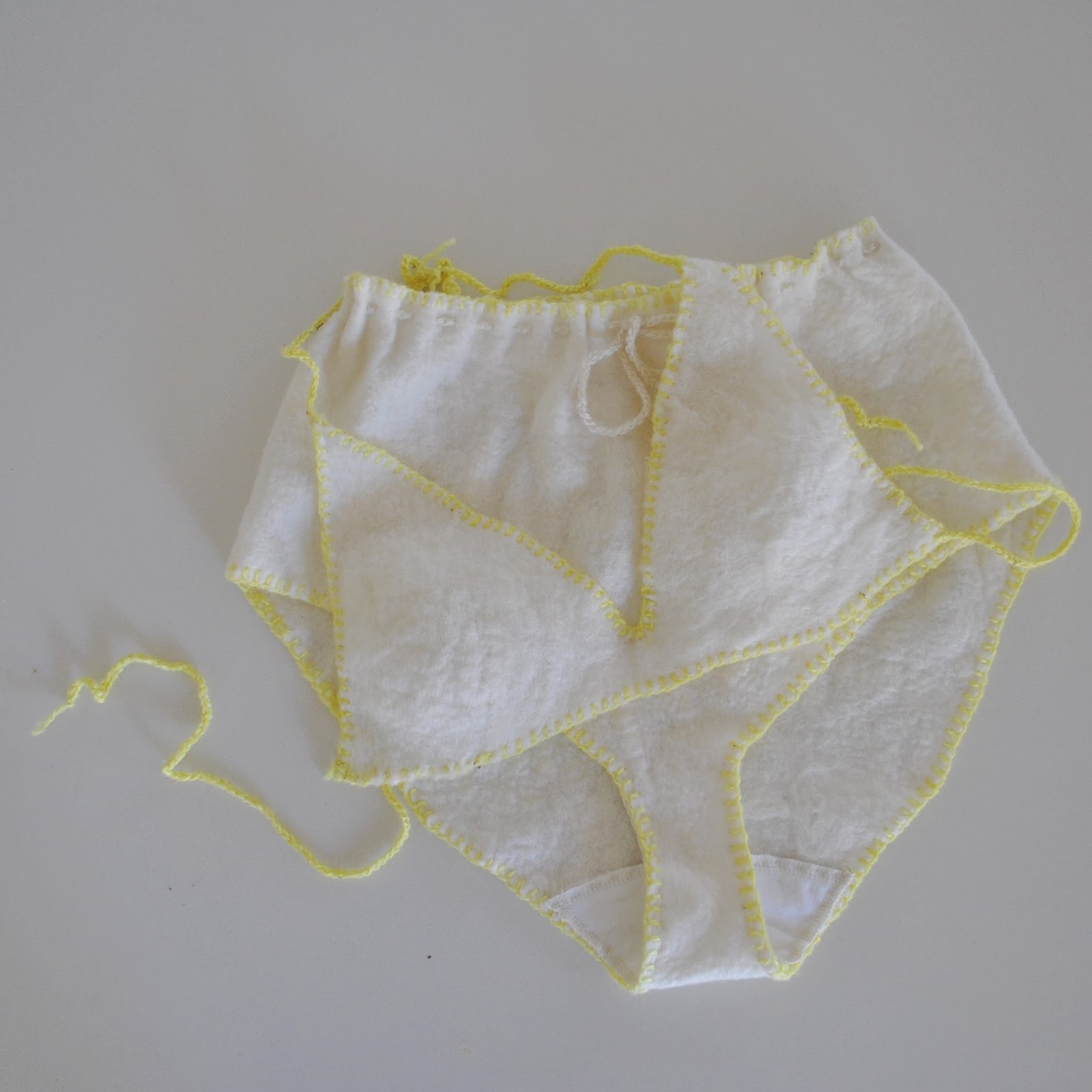
My underwear features the only “colour” in my entire outfit; I dyed the decorative yellow edging and ties using sour grass picked from my own garden, as posted here.
All the other fleece, yarn and wood in my outfit I left in its naturally coloured state.

My cardigan is alpaca yarn, from the Fibre of the Gods, a tiny mill operating on a farm in Toodyay.  This establishment produces alpaca yarn on their own property, from the fleece of their very own alpaca herd.  I bought some of their yarn directly from off the farm and knitted my cardigan, as posted here.

My wooden shoe soles are hand carved by me, using Western Australian pine.  The pine is grown by Bunnings on their own pine plantations down south and milled by Bunnings in Manjimup.  I made my shoes and my bag from my merino fleece as outlined here My bag and shoe tops are also merino fleece, with a grid pattern made of naturally black sheep yarn.

And that’s it, in a nutshell!
Well, typing it all out like this has kinda brought it home to me for the first time; I am wearing a pretty-close-to 100% homegrown outfit, top to toe, for maybe the first time in my life!  I’m kinda amazed, even at myself.  It’s a little mind-blowing to me.
Final thoughts: I’ve learnt a tonne doing this challenge.  Firstly, our local industries are precious and need our support.  That goes for everywhere, not just here in WA!  I personally am going to put more effort into supporting our local products regularly.  I mean, I’m definitely not giving up my more “regular” sewing, but I am going to do this challenge again.
Secondly, that if you really put your mind towards doing something, keep yourself focused on getting a project done, to overcoming obstacles, then you probably can do it.  Sometimes you need to sleep on it, think outside the box a bit.  I learnt a lot as I was going along, and several times had to improvise a solution to a problem.  There were moments when I questioned my sanity in doing this, when I wondered if my ideas were even going to work… a felt dress? unlined? felt underwear? sounds like the vision of a lunatic, or at least a recipe for disaster, for sure… well OK even I can admit that felt underwear is not really a practical nor a workable thing!  … do NOT recommend.  😉
Also, I had lots of fun!! I LOVE a challenge and this challenge really stretched my capabilities; which is the very best sort of challenge, in my opinion!   I thought hard and long about each aspect of my outfut and tried very hard to honour the materials, to minimise my waste and to make something truly Western Australian in feel and flavour as well as provenance.
There were also moments when I realised I had to accept a small defeat; in the case of this outfit; the glue holding pieces of wood together in my shoes (from NSW, Australia), the nails holding the felt to the soles of my shoes (China) and the cotton jersey liner for my undies (China).  They are very tiny elements so I’m not going to beat myself up over them too much.
I guess the important thing is that I gave everything careful consideration,  and really thought about provenance and the possibility of substituting local products in as many instances as I was able.  As well, I wanted to produce something stylish and lovely, that I knew I would love wearing and feel proud and happy in.  I genuinely love my outfit, and feel pretty pleased with my efforts!
Lastly; maybe I’m on a bit of a post-challenge high, but I’m quite excited about attempting this again next year… in fact I already have ideas and plans!
Mad? maybe, but quite happy to be so!

Details:
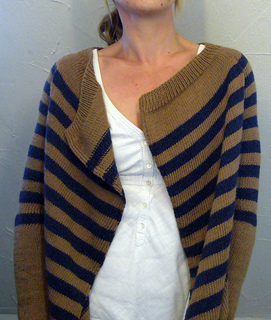
Cardigan; the Caramel cardigan, in Fibre of the Gods natural alpaca, grown, shorn, washed, carded and spun in Toodyay, Western Australia and hand-knitted by me, details here
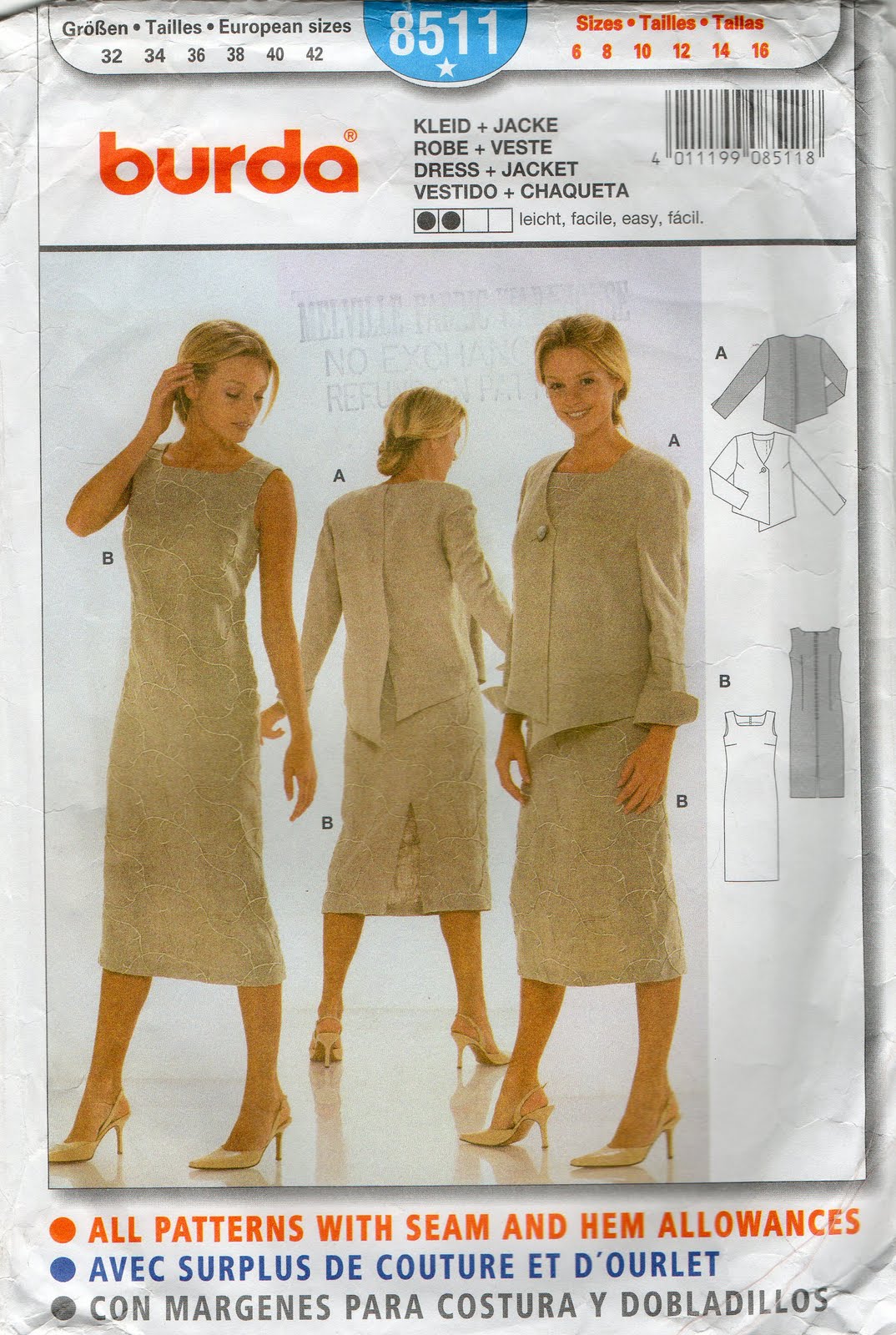
Dress; my own design based upon Burda 8511, made from merino felt made by me and hand embroidered with locally handspun merino yarn from Bilby Yarns, details here
Shoes; my own design, pine soles from Bunnings hand carved by me, felt tops made by me from merino fleece bought at Bilby Yarns, details here
Bag; my own design, in felt made by me from merino fleece bought at Bilby Yarns, details here
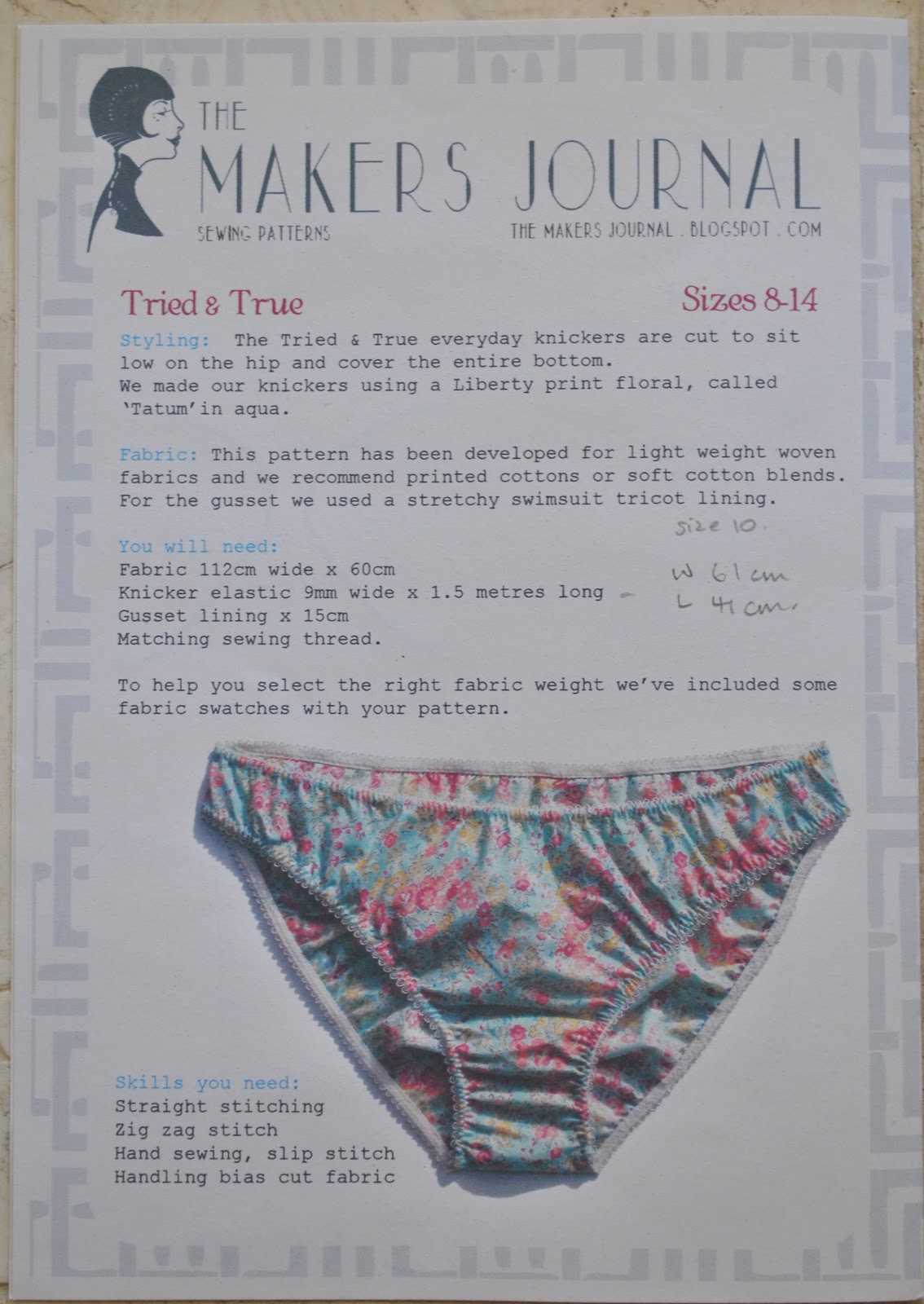
Underwear; my own design, knickers derived from the Tried & True knickers pattern by the Makers Journal, in felt made from merino fleece bought at Bilby Yarns, details here

pinterestmail

a strange lingerie set

I fully admit it; this could very well be the weirdest, most bizarre thing I’ve ever made! I had toyed with the idea of making a lingerie set to complete my one year one outfit… er… outfit; but rejected the idea as being impractical and unwearable; then re-embraced the idea, then rejected it again. And found myself pondering it again… and then dismissed it again.  Finally I just decided to have a go, although this part of my project was in danger of never ever getting blogged!
So; lingerie, made using ONLY locally sourced materials; quite a challenge, quite a challenge.  My set is very very simple; a string bikini top and high waisted knickers cinched in at the top with a drawstring.  
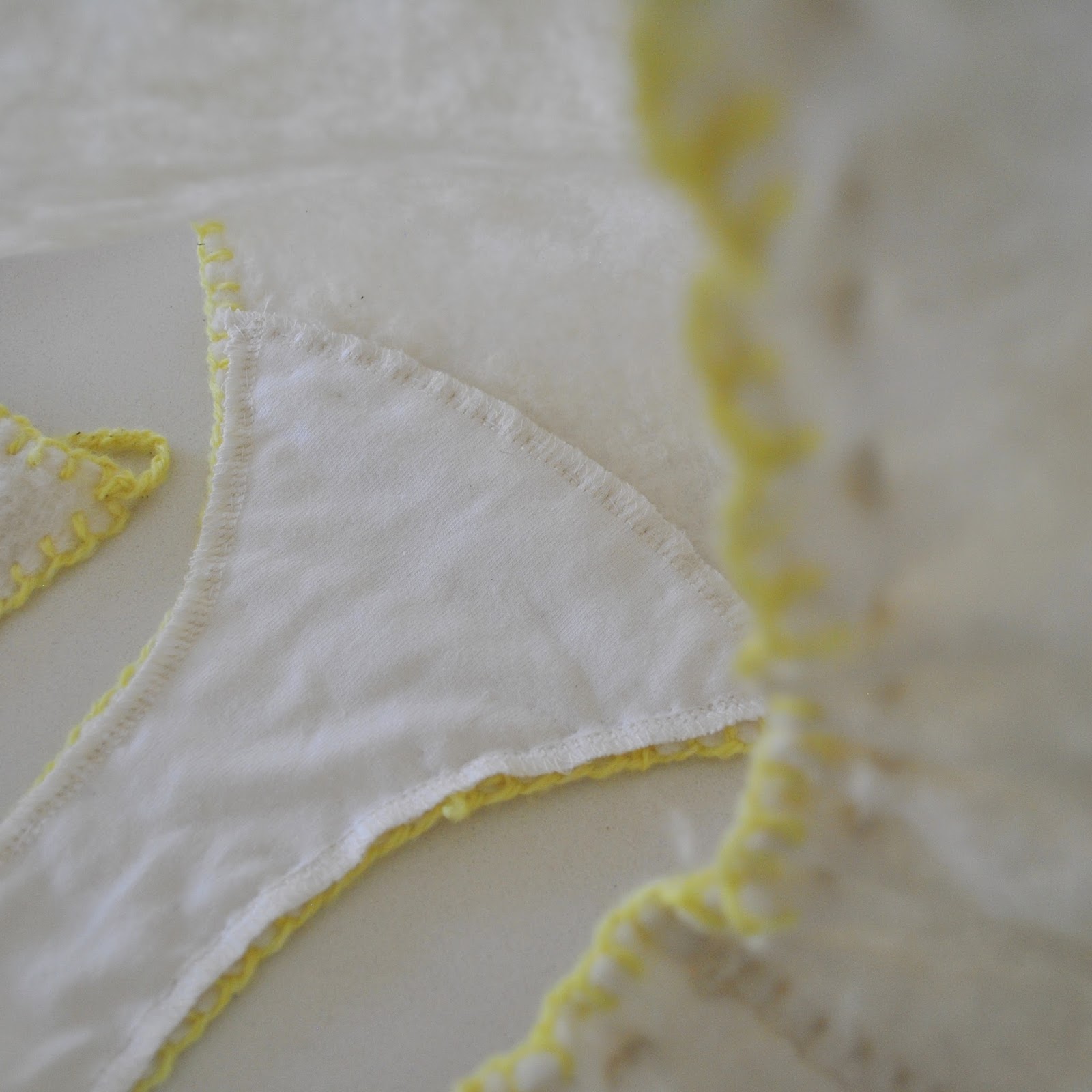
As per the criteria of the challenge, I could not use anything not made here in Western Australia … which ruled out elastic, findings, thread and even FABRIC!  Hmmm, yes, quite a challenge…   Like every other part of my outfit for this challenge, I had to make my own fabric.  Fortunately I had some pieces of merino felt leftover from my dress, and I made another small piece to complete the knickers, so my set is mostly made from scraps, yay!  The yellow blanket stitch edging is in locally handspun merino yarn from Bilby Yarns, that I dyed myself using sour grass from our garden; here.  The bikini strings and the drawstring are a single crochet chain. 
In my early planning stages, I had contemplated knitting some knickers and bra from my handspun Western Australian merino yarn, and actually found a free pattern for a knitted bra too! but rejected that idea… why? well to be perfectly honest, this set is probably not going to get a hekkuvva lot of wear! if any! and so I really wanted to minimise the use of my beautiful handspun yarn.  I felt OK about using my leftover felt though, since that was made from my own labour.
The bra is self-drafted, if you can call two, felted-together, darted triangles a self-drafted pattern, ahem.  I gave them a gentle cupped shape by cutting darts from the lower edge and felting them closed with my felting needle, just like I did the darts in my dress, so the darts are seamless; and felted them together at centre front the same way.
The knickers are loosely based on the Tried & True knickers pattern, by the Makers Journal, an undies pattern designed for non-stretch wovens.  This design is a little on the low-rise side which I modified slightly by making it a higher rise design with a drawstring to pull them in at high hip level, also the crotch and leg holes have also been cut away significantly with a deeper curve to the crotch and straighter front leg-line; I did this because the fabric was a tad on the bunchy side around this area otherwise.  When they’re on the knickers look like tap pants, flaring out a little from the waist and away from the hips, and are actually quite cute, believe it or not!

I made a little cotton jersey lining for the knickers, and have loosely tacked it in with running stitch  This small piece of fabric is the only part of the set that does not fit the criteria of my one year one outfit challenge; but I’m sorry, I just consider a liner to be an absolutely essential thing to have in a pair of knickers.  I’ve done my absolute best to eliminate non-local elements in all of the components in my one year one outfit, but you can only go so far for this challenge! and I’m drawing a line at unlined knickers.
While making them I was reminded of Sheldon fashioning historically accurate undergarments from linen just to wear to the Renaissance fair… so funny!… meaning, yes; I’m fully aware that this is just about the silliest set of lingerie ever, but I made them mostly from my leftovers and using my “experimentally” dyed yarn so I don’t consider making them to be too much of a waste of resources.  I think I made them just for fun, really!  Think of it as wearable art!

pinterestmail

Natural dyeing; sour grass on merino wool

Inspired by Nicki of this is moonlight, I’ve been having a go at solar dyeing.  What is solar dyeing…?  well, it’s basically just chucking fabric and chopped up organic material into a glass jar and leaving it outside for a while until your fabric has changed colour.
Boom yeah: blog post done!
Hmmm, well maybe just one or two more details would be helpful…
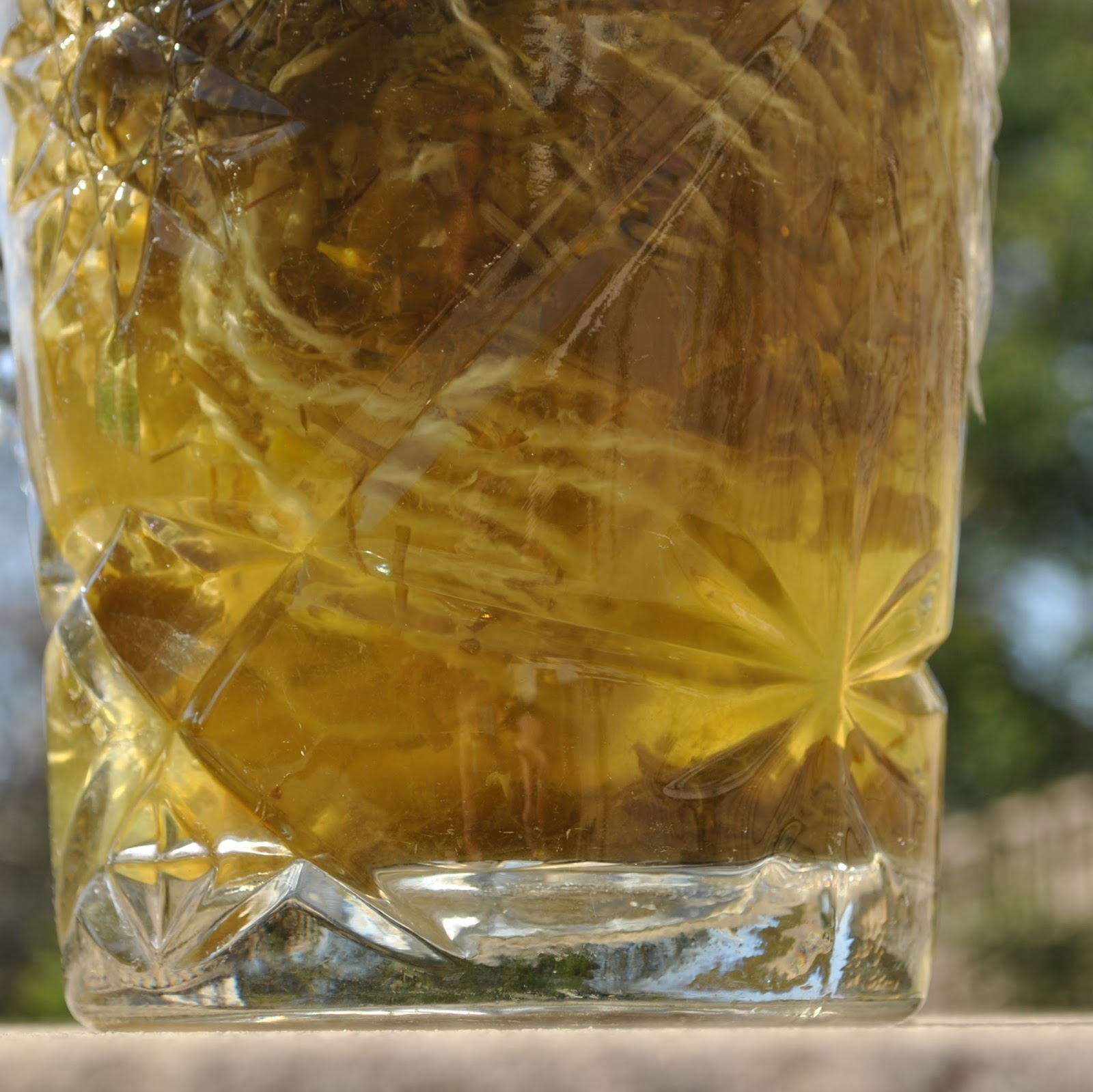
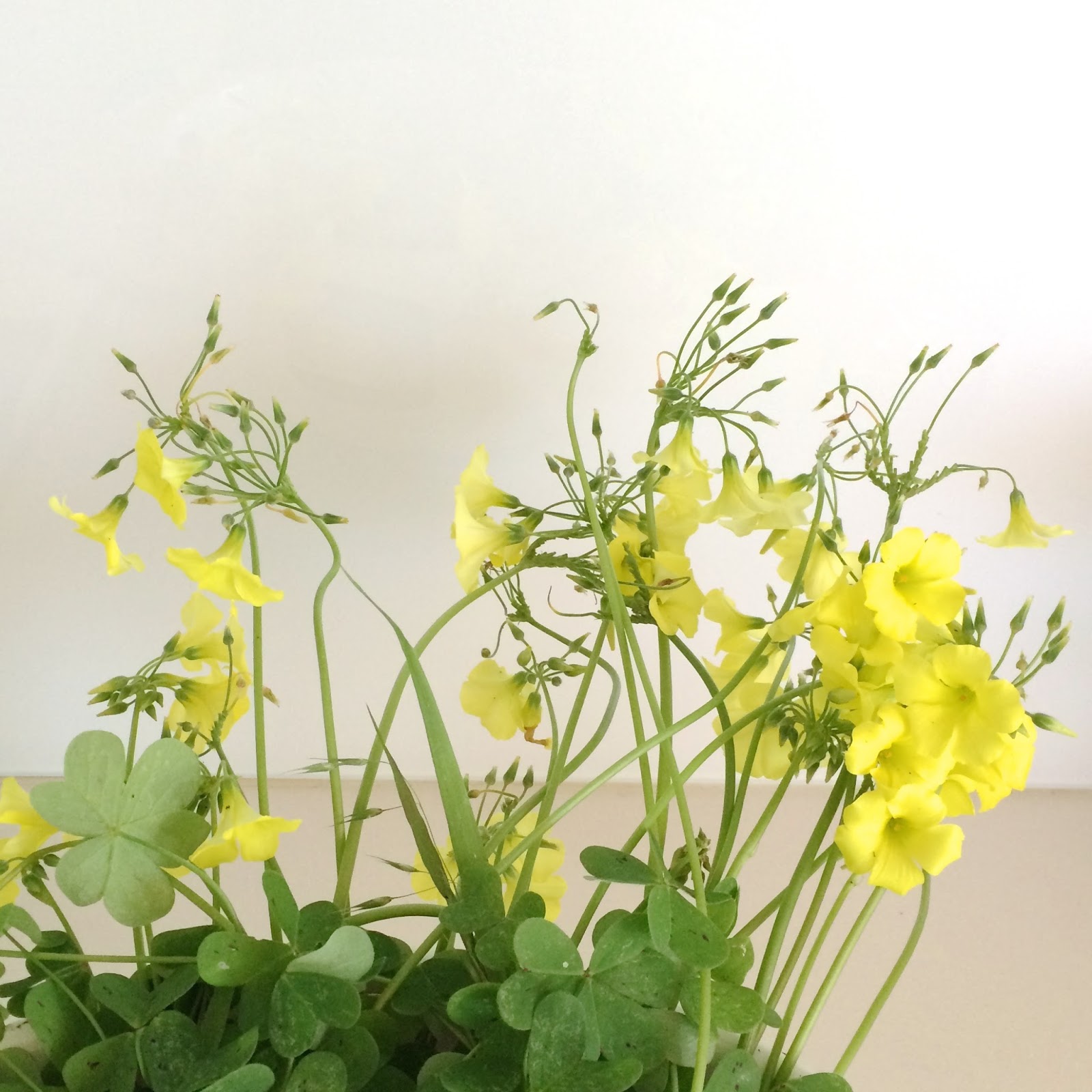
So I was just weeding my garden, I mean; harvesting my carefully nurtured dye-plant crop! of course! and spontaneously decided to experiment.  This plant is Oxalis stricta or common yellow wood sorrel; more commonly known around here as sour grass.  I have fond memories of sitting with my fellow primary school friends on the school oval at lunchtime, munching on this stuff … ah, memories!  It grows like mad around these parts, you can find it everywhere and it’s considered a weed.  But a useful weed!

This was just a little play to see if I like the effect; so I used about a dozen flowering plants, and 20g natural merino wool.  My wool happens to be 100% Western Australian merino, handspun locally and bought in Bilby yarns.
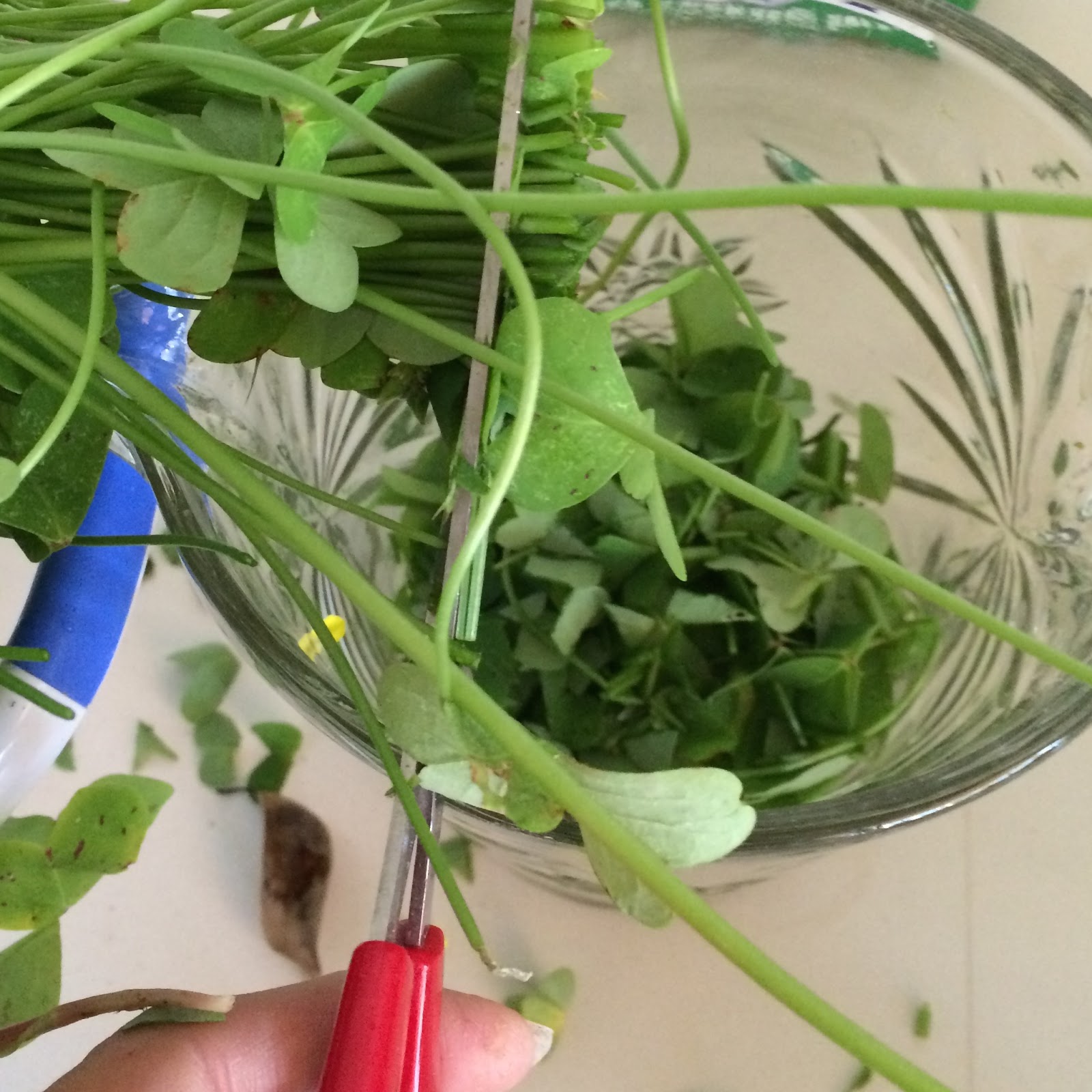
I snipped the whole plant minus the bottom third of the stalks, roots and root ball into small pieces, straight into a large glass pitcher along with 1/2 cup salt, half filled the pitcher with water, and stirred it around pretty vigorously to dissolve the salt.  Then added my yarn, which I’d loosely tied in a skein to guard against knots.

Once the yarn was in, I swooshed it around very gently to immerse it in the plant material, covered the pitcher with glad wrap, then popped it outside in the sun.  I left it for five days; moving the whole kit’n’caboodle around during the day, following the sun, and would always bring it in each night.  Basically, did not stir again.
After five days, the wool seemed to have picked up a nice amount of colour, so I gave it a very thorough rinse in cold water and picked off as much organic material as possible.
And, ta da!

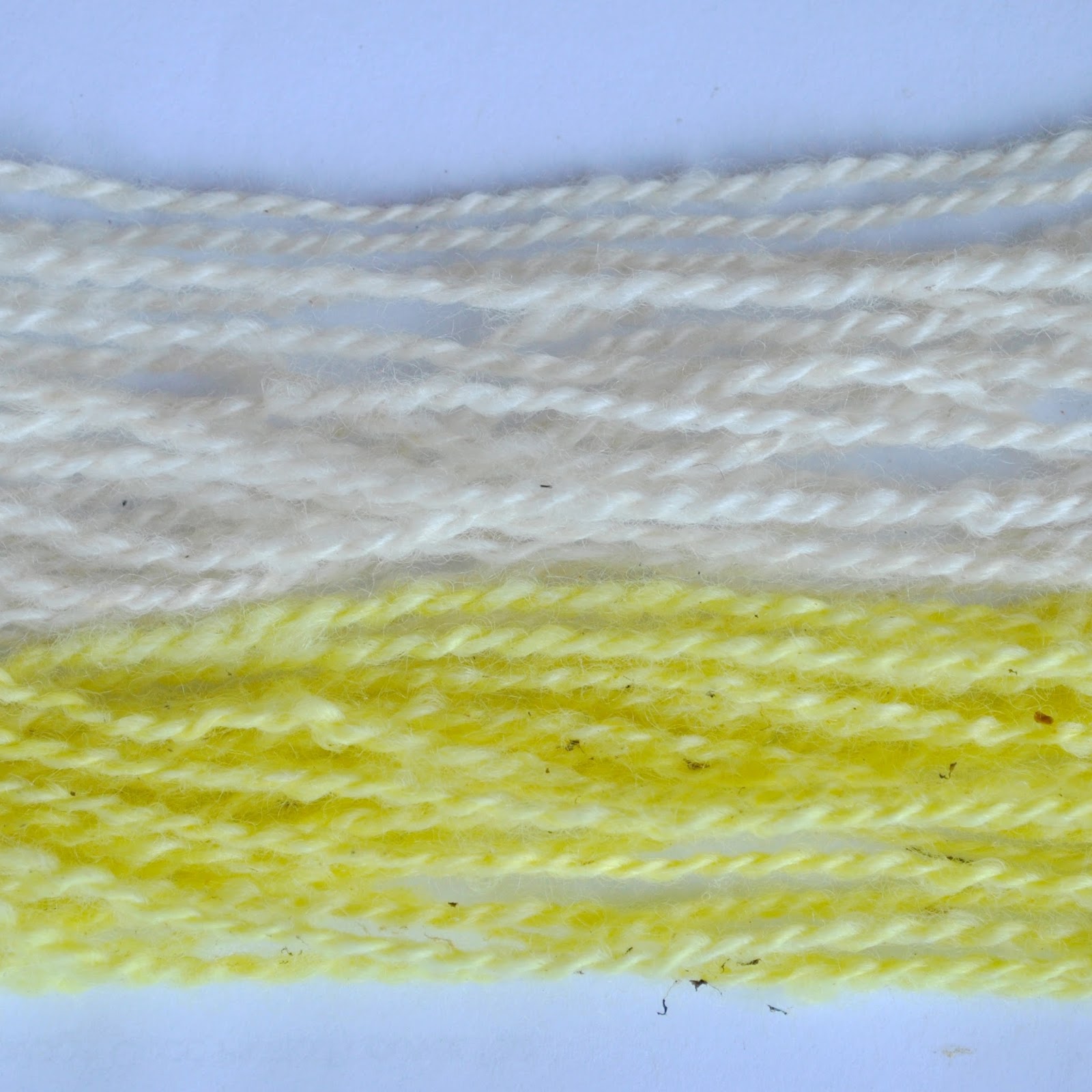
This could not have been any easier! and I’m very happy with that bright yet delicate chartreuse shade of my wool.  Not to mention the non-toxicity of the whole process too.  I will definitely be doing this again;on a bigger scale with more yarn and more plants and leaving it for longer next time  🙂
Notes for next time; picking out the organic material takes ages and is a bit of a pain.  I’m toying with how to keep the plant matter and fibre separate next time, so as to avoid a gazzilion squishy rotting bits of plant muck stuck tight to my wool everywhere.  Maybe with a very loose-weave synthetic gauze “bag” for the plant matter.  I’m not sure if this would reduce the effectiveness of the dye though… but will give it some thought and a shot.
This is not going to be my only experiment with natural dyeing either; I’ve bought some indigo seeds and am raring to see that experiment come to fruition as well…

pinterestmail

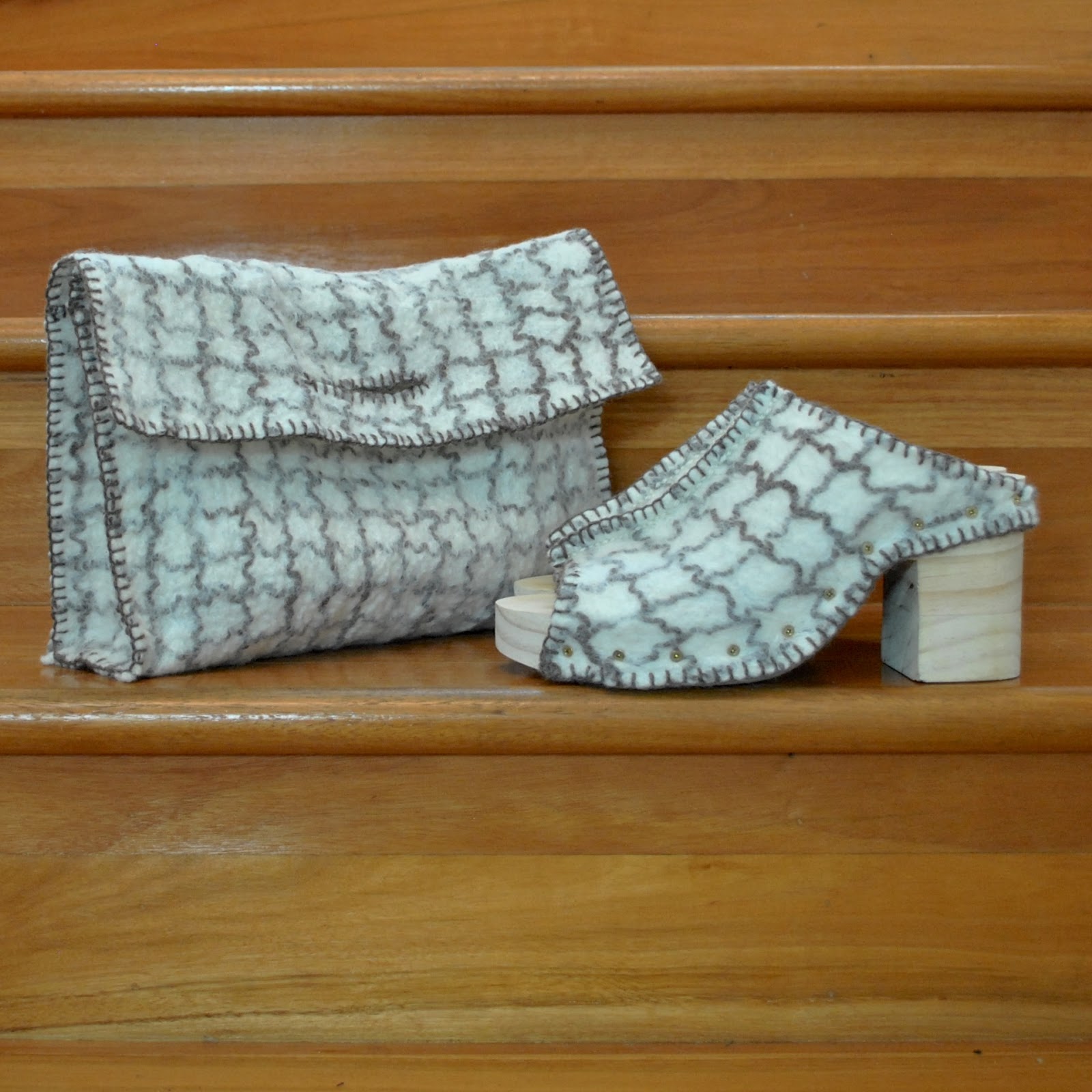
I made matching shoes and bag

I’ve finished the next coupla components in my 1 year 1 outfit project!
First up; shoes!
Following the same formula that I used for my previous two pairs of shoes; these have a carved wooden base and a fabric top.  For the soles I used Western Australian pine from Bunnings.
I actually had several pieces of wood from which to choose for this project; my Dad had given me some marri from their block; and I also, albeit briefly, considered jarrah as another truly Western Australian product.   Also, my brother had given me some jacaranda logs from when he had to lop a branch from the tree in their back yard.  But I eventually decided to go with pine … why?  Well it’s the softest, lightest and easiest to work with! and our ancient old bandsaw has finally given out, meaning it was going to be a ginormous struggle to cut the marri or jacaranda or jarrah either on any of our other equipment. These are all pretty rock hard woods, also both marri and jarrah weigh a tonne and you’d only want very thin soles of it for a shoe.  Pine was the path of least resistance.  I have definitely not ruled out using the other wood that I have for future pairs of shoes though.  I just need to get better at woodworking first  🙂

personalised soles  🙂

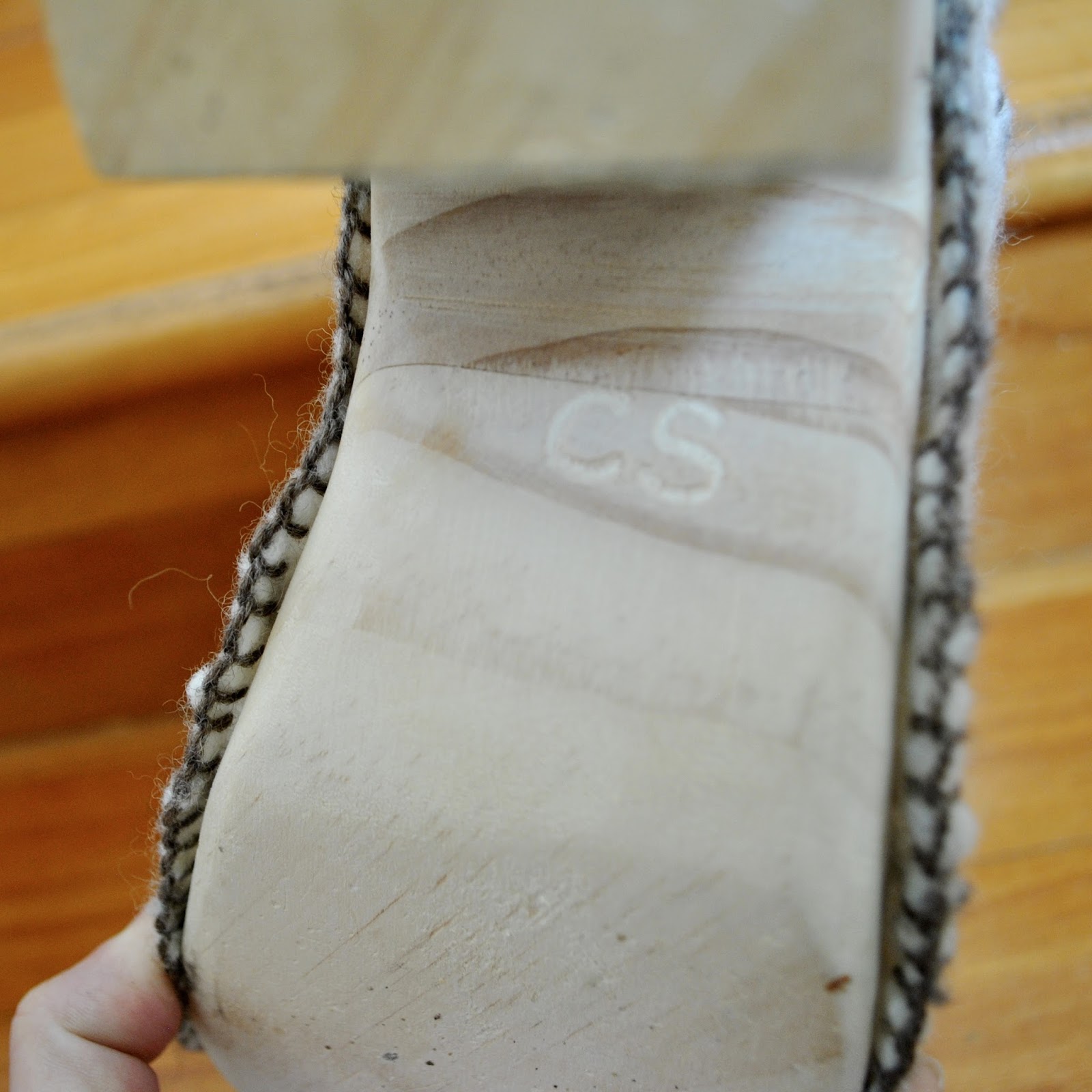
Craig helped me with the big cutting and I did the finer shaping using the belt sander, and hand-sanding out the heel groove and some grooves for the ball of my feet.  I also carved my initials, just for fun  🙂
The upper is 100% Western Australian Merino wool felt; made from natural, undyed, white fleece and natural, undyed, handspun black sheep’s wool as outlined in this post.  By the way; I incorrectly stated in my previous post on my dress that the wool I used for the felt was Corriedale, and I have since discovered that it was pure Merino wool, sorry!  I’ve corrected the error in that post now.  And am actually rather thrilled to be wrong, to be honest!
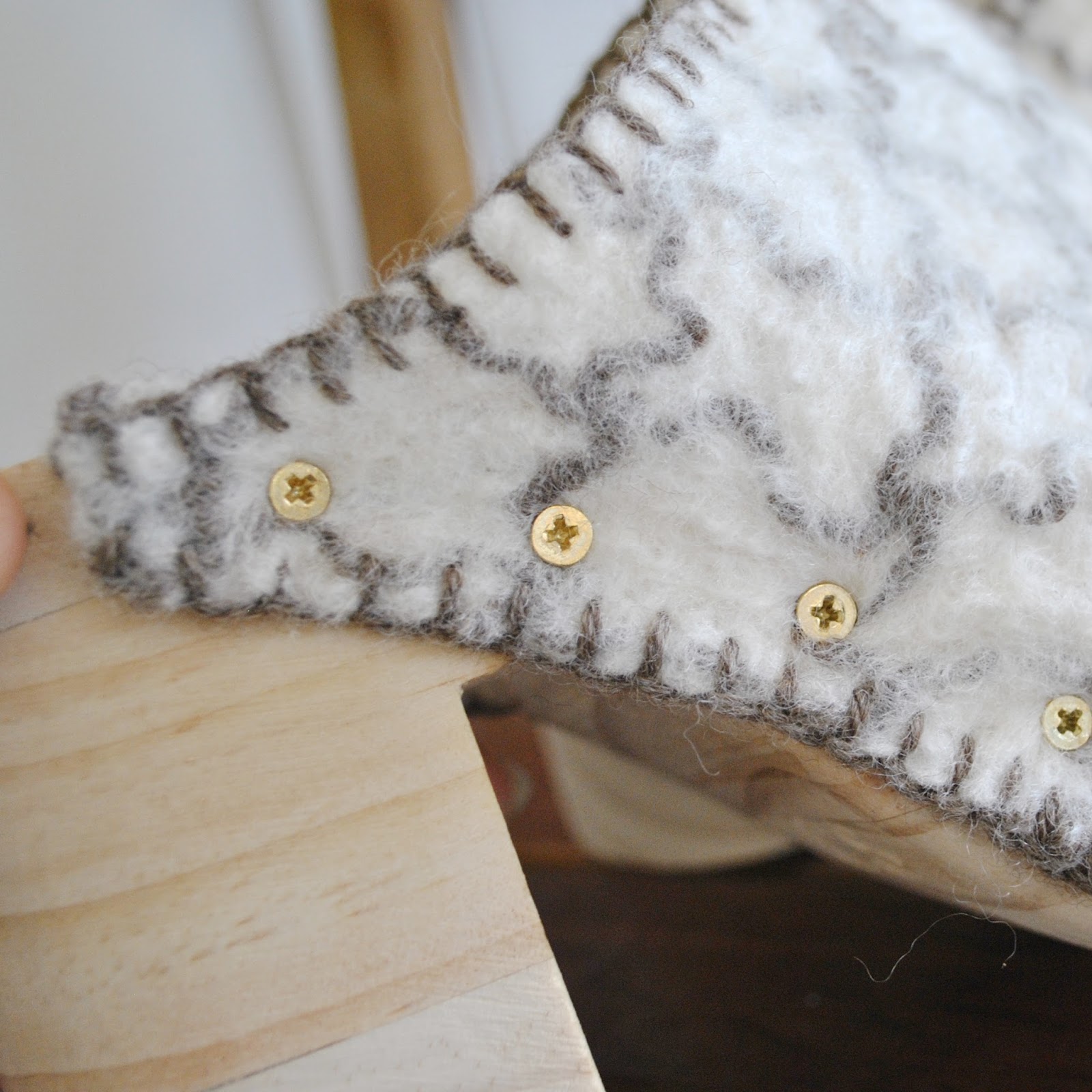
Anyway my black and white “plaid” was the thickest and strongest of the felts that I made, so I kept it for these more demanding of my outfit components.  Sadly, I realised that it’s still not particularly sturdy and is probably going to stretch out pretty quickly  :((  But I’ve devised a devious plan to cope with the inevitability of The Stretch, mwahahahaha… see that central seam running right down the top/middle? well as it stretches out I can just unpick it, cinch in the top seam a bit, trim and re-stitch.  Simple!  And when it has stretched out past the point of saving, which it will; then I can easily unscrew the screws from the sides, remove the whole felt top and substitute something sturdier like leather.  Hopefully I can somehow find a nice piece of thick WA leather, so that my shoes will still be eligible as a 1 year 1 outfit piece!

OK: confession time… I did have to cheat on a few minor parts of this project; the glue holding the pine layers together is made in NSW, and the screws holding the felt upper to the wooden soles are made in *embarrassed whisper* China.  I did investigate making these; and concluded that to make my own local glue and “nails” is both possible and achievable.  You can make your own glue using boiled animal bones, sap, or milk and vinegar; and I could have made wooden “nails” using jarrah or pine dowel.  And originally I was seriously gung-ho about doing just that; until my Dad and my husband advised me to get real.

You see, the wooden soles are honestly such a hugely time-consuming and difficult component for me to make that I really really wanted them to hold together firm and fast and be perfectly secure; and NOT EVER fall apart.  A rank woodworking beginner like me could all-too-easily destroy my carefully hand carved soles trying to ram wooden dowel “nails”, with hot homemade glue dripping everywhere; and even then if I was miraculously successful; they could later on just fall out or snap at a moment’s notice.  Which, according to my experienced father and my husband; is pretty darn likely.
And I would, um, yeah; be sad.  Understatement of the year, right there.
Anyway, I went the route of properly manufactured wood glue and steel screws…  but I just want to say, for the record, that I did investigate the 100% hardcore approach, and gave it serious and careful thought.
And I do not regret not going there either, not one little bit, sorry!  You can only do so much!
What is more! I will also be gluing some thick rubber to the soles to protect them from damage.  I haven’t done that yet, I plan to “show” them first in this virginal state.  But I will.

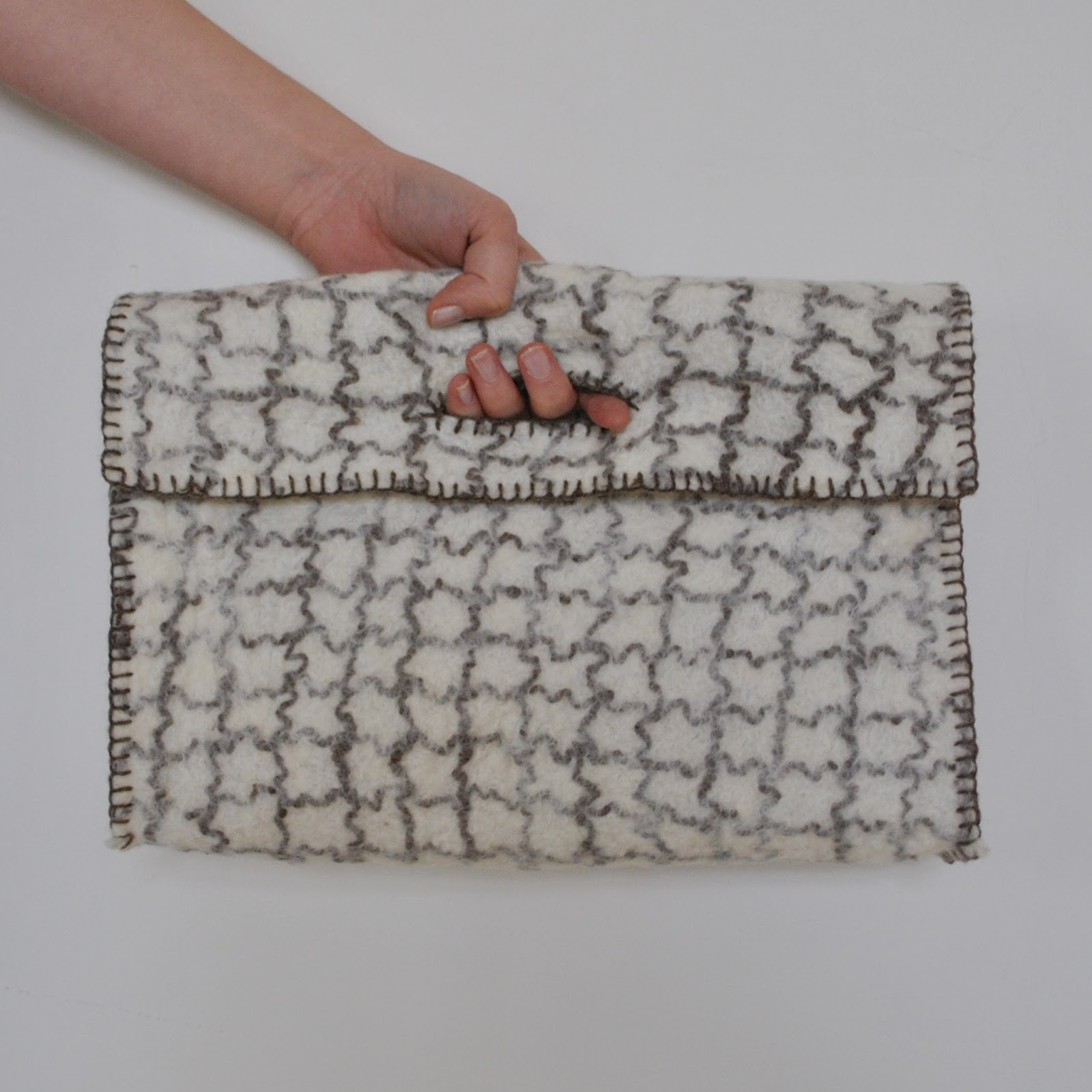
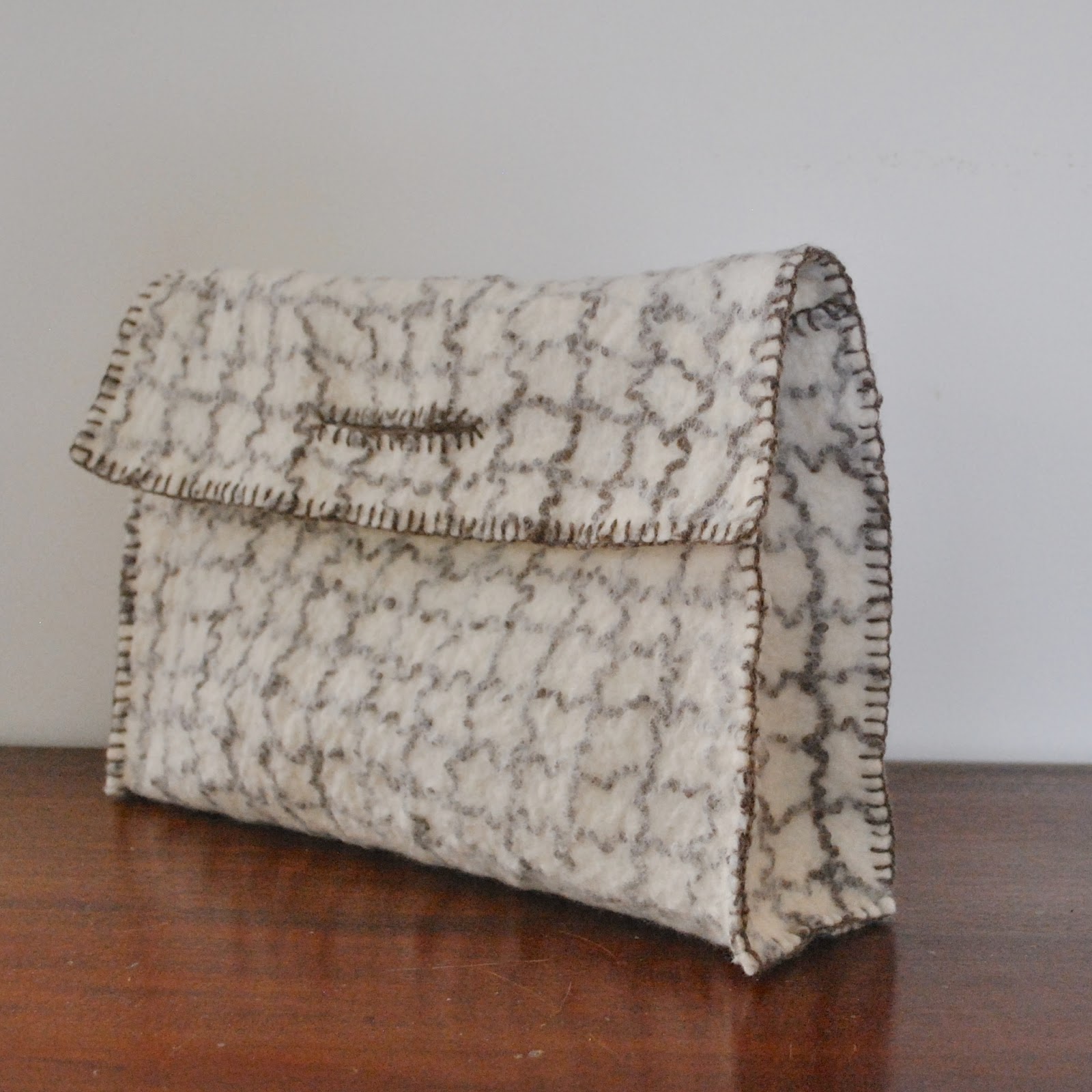
Exhibit two; a bag!

And it perfectly matches my shoes, hehe.  Isn’t that the old fashion must-do advice for a lady from the 50’s or something? I seem to remember reading somewhere that a lady would never dream of sashaying out with non-matching shoes and bag.  Ancient stuff, I know; we definitely do not adhere to such a strict dress code anymore!  But I had enough felt for it so here I am, totally regressing to the standards of a previous era.
ooo yea.
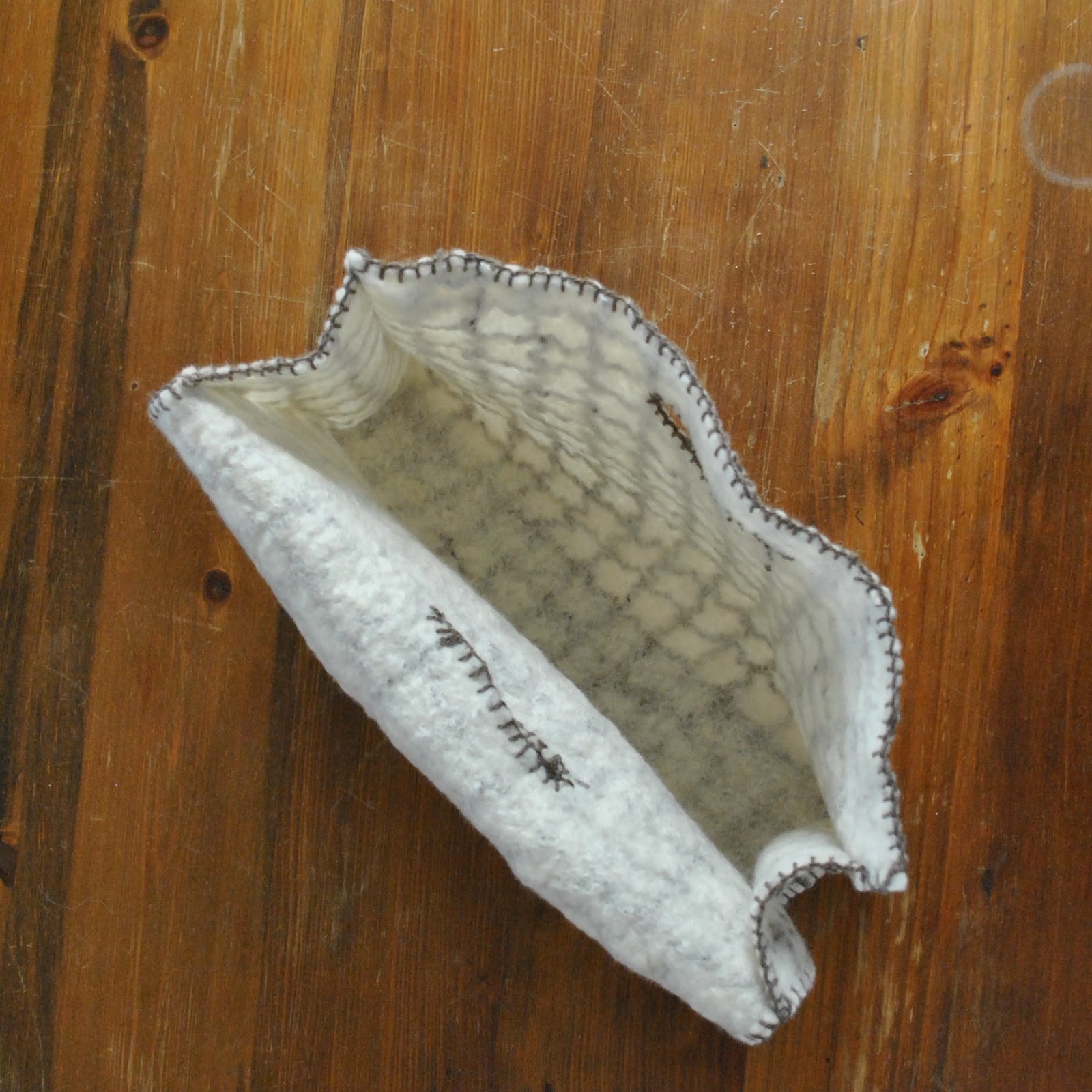
It’s just a simple, um, something-bag?   A sort of rustic briefcase?  I don’t know the correct term to describe this kind of bag.  A fold-over, almost-envelope, with rectangular side gusset thingies to make it box-like.  It’s all held together and decorated with blanket stitch.  For the handhold; I cut and blanket-stitch edged three slits that line up with each other through all layers.  Ta da!  Simple, but it does the trick.

I like the way the felt is thick enough that it can stand up by itself… just.
I am toying with a few extra components for my 1year1outfit project, but minor things that may or may not come to anything.  However, they may; fingers crossed.  If all else fails, at least I do have a complete outfit now!

pinterestmail

an all Western Australian dress

OK; it’s done, the second and arguably the most time consuming component of my one year one outfit project!  
Can I just interject right here… WOOOOHOOOOO!

Phew!  so, just saying, but I’m tentatively predicting that this one piece could well be my piece de resistance for the year.  I made the dress, and not only did I make the dress but I made the fabric too!  previously post about making my fabric from Western Australian Merino fleece here.  
And I hand-embroidered it, with a motif of my own design.  Also the dress is of my own design.  Is this a little insane? probably.  
Ok, YES.

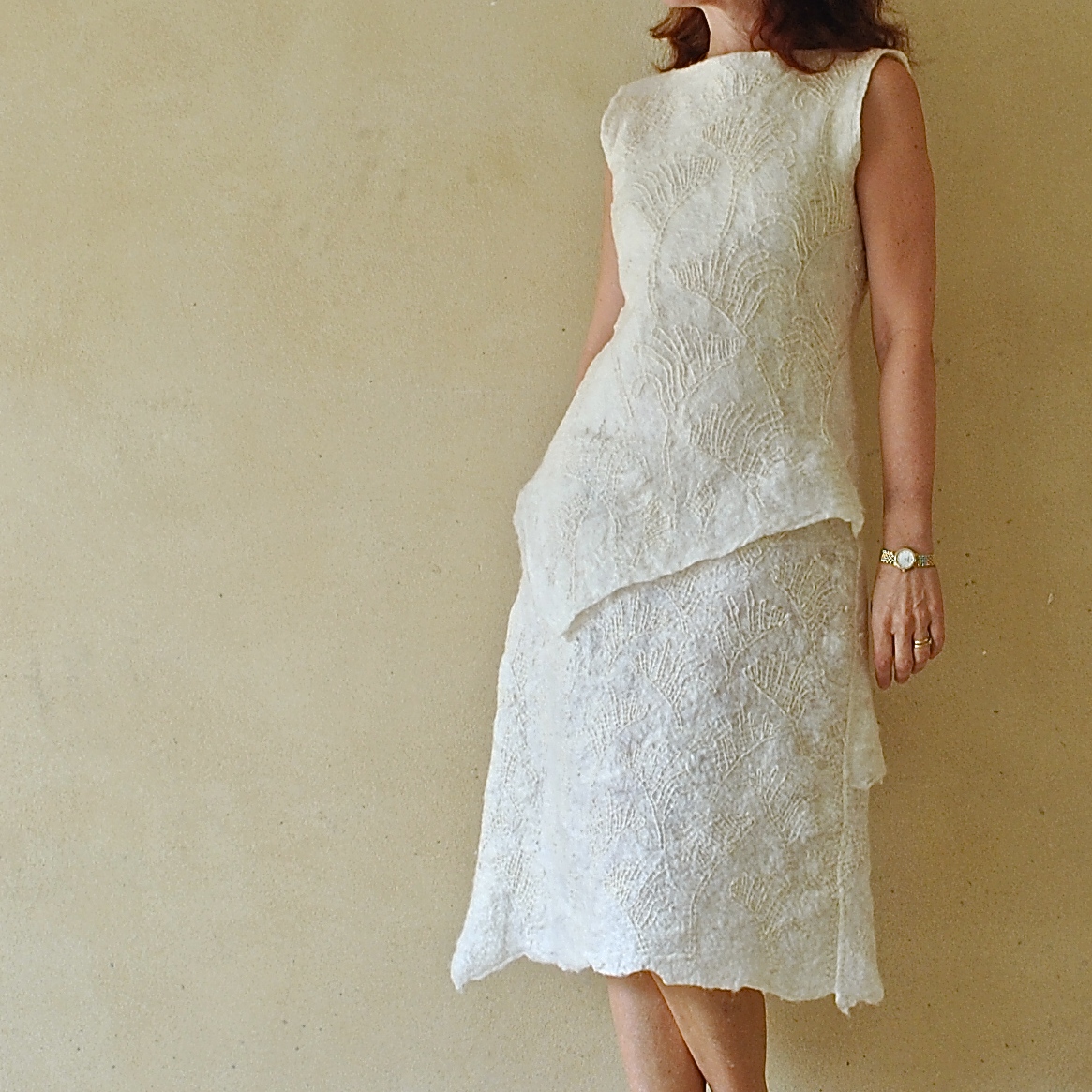
So, the dress.  As mentioned, it is fully embroidered with kangaroo paws.  Why kangaroo paws, you may ask?  Well, the kangaroo paw is our state floral emblem and my project is an all-Western Australian deal, so it seemed like a pretty appropriate choice.  I sketched a stylised kangaroo paw design based upon one from one of my own photographs.  I drew a few in different sizes and then for each section of the dress drew up separate, big all-over patterns.  Some of the paws wrap around the side seams from front to back, which was planned since I wanted to kinda tie the design together as well as I could.

my muse; Anigozanthos manglesii

This style of all-over embroidery is obviously inspired by the Alabama Chanin style, but the design is all mine.  I chose to incorporate embroidery for a few reasons; firstly to give some added strength to my felt, since the felt seemed just a touch fragile on its own.  
Secondly, for decorative impact too, of course!  My felt is quite textured already, but I really liked the idea of something more, and a white-on-white design.   I embroidered the under-dress, below, in a regularly spaced and repeating pattern of identical kangaroo paws, while the overdress, above, has a more random appearance, with different sized kangaroo paws, placed non-regularly and more artfully; as if someone had taken a bouquet of kangaroo paws and scattered it across the piece.
For the embroidery: I used natural, undyed Western Australian Merino yarn, handspun here in Perth by a lady named Beverly.  I bought this from Bilby Yarns.
The side seams are hand-stitched and hand-fellstitched in a thinner version of the same yarn.  I left the lower edge of the dress with its naturally wobbly self-edge, just as how it came out from the felting.

As per the one year one outfit strict criteria, I could not use anything in my dress that was not locally sourced; meaning no thread or zips.  So, I could have used buttons, since I still have some lovely ones made by my Dad using wood from my parent’s block… but I decided to go with a dress that I could just pull on over my head and with no closure required.  I used my standby plainy-plain dress pattern, Burda 8511 and drew up a wide, midi-length, loose, A-line dress pattern; two layered and with slanting asymmetrical hemlines.  The under layer is a full length dress; and the over layer is a shorter and briefer one, one-shouldered with a diagonal top edge disappearing into the side edge/armpit.   I cut out “facings” for the top edge, and these are fused/felted to the inside of the dress, underneath the single layer part of the under-dress.  Meaning, the dress has two layers of fabric all over, which I fused together by felting nearly all over after embroidering.  The front has felted-together layers to waist level, while the back has the layers felted together to below bum level.  The remaining lower portion of the overdress float free, and the only parts that are a completely single layer are the lower portion of the underdress.
Clear as mud?  Yep, I thought so!

Also: it may superficially look like the dress has not a skerrick of shaping, with no visible darts or piecing, but actually that is not the case! It is shaped… with invisible darts!!! yes, really invisible  🙂 The shaping is not drastic since I needed some looseness to enable me to get the thing over my shoulders ok…  but the shaping is there.  I cut out the bust darts and back waist shaping darts, and closed them together by hand-felting the layers together with a felting needle.  This is a clever little needle, long and with tiny serrated point.  You jab it in through the layers of your felt and its serrations enable the wool fibres to meld and mesh together thanks to their own naturally barbed nature, albeit microscopic.  This is how felting is even possible, of course!  Thanks to this wonderful property exclusive to wool, my dress has a nice subtle shape but with no visible evidence of such shaping, such as darts or seams.  It’s also how I felted together the two layers of the dress, all over.
It’s like magic, I’m telling you.

running stitch edging, and invisible bust dart

Once I had completed all my wool embroidery, I went over and painstakingly hand-felted those upper and underdresses together as described above.  Then the very final step was to run a simple running stitch around the neckline and armholes.  I wanted a nice subtle edging to these areas, not only for some strength, as the running stitch is almost like stay-stitching if you like, and stabilises these vulnerable areas that might otherwise get stretched out every time I pull the dress over my head and push my arms through those armholes.  The edging also provide a nice visual border that that does not compete with my embroidery… and obviously I want my embroidery to have the biggest visual impact. 

So!  This is merely part two of my one year one outfit project, part numero uno was my knitted alpaca jacket/cardigan, posted here, and I have a couple more components still going in the works.  What will they be? we shall see, we shall see…  🙂
I may have a few surprises still up my sleeve, mwahaha! 

Details:
Dress; my own design based upon Burda 8511, of self-made wool felt with wool embroidery of my own design
Ugg boots; from some ugg boot shop, forgotten which one

Ahhh, the uggies.  I know they’re pretty awful but I just could not resist!  Seemed only fitting.  I’m gahn the full Strine here, mate.  🙂

pinterestmail

making felt from fleece

Hello!
So furthering onward with my one year one outfit adventures, I thought I would put together a post on my other efforts so far… I have also been making my fabric for the other components of my outfit.  Yes, making freakin’ fabric!!!! transforming Western Australian sheep fleece into felt, with which I shall make…. something.    Still ruminating on exactly what...  
Along with my fellow one year one outfitters Sue, Nicki and Megan, I visited Bilby Yarns; a small but treasure-packed little shop in Willagee that supports local wool producers and enthusiasts and stocks supplies for anything and everything wool-related you could possibly think of! spinning, weaving, felting, needle felting, knitting and crochet and probably some other endeavours that I haven’t taken in yet, too.  It also stocks dyes, both natural and chemical and, most fabulously; yarn from Western Australian sheep, hand processed and hand spun by local ladies.  It’s a truly fantastic local resource! and I can see myself paying the shop many more visits in the future.  The lovely chatty June kindly demonstrated spinning and also felting to us; and we all came away with supplies of fleece, greatly enthused to make us some felt…

I have made some decorative felt panels a few times before, small and therefore easy things; blogged here and here and a couple of others that I’ve given away and never blogged.  However, this project would have to fit in with Nicki’s strict criteria; to be a TOTALLY home grown product.  Normally if I was considering making felt for a garment to wear; I would felt onto a piece of silk chiffon to give strength to the fabric. 

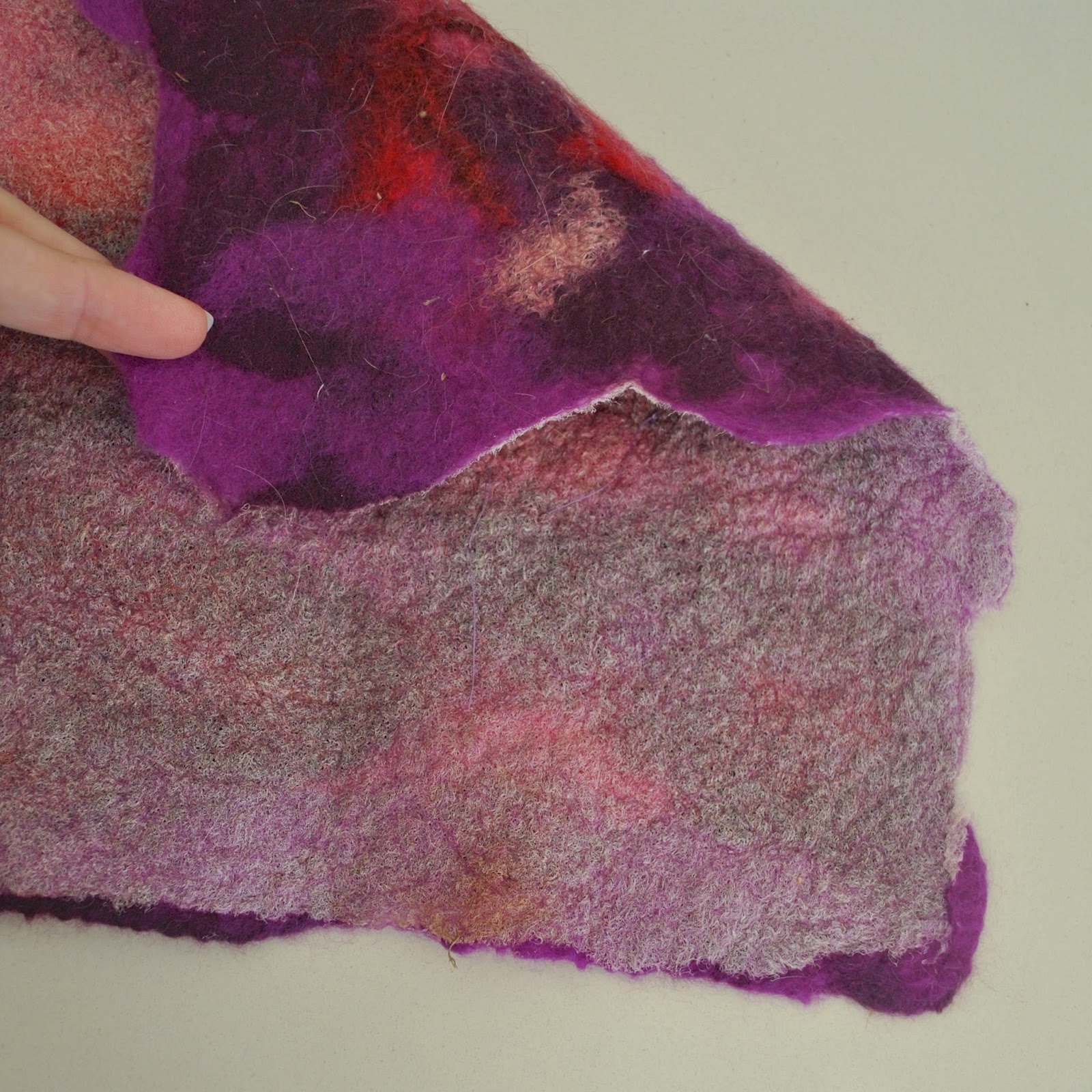
felt with silk chiffon backing

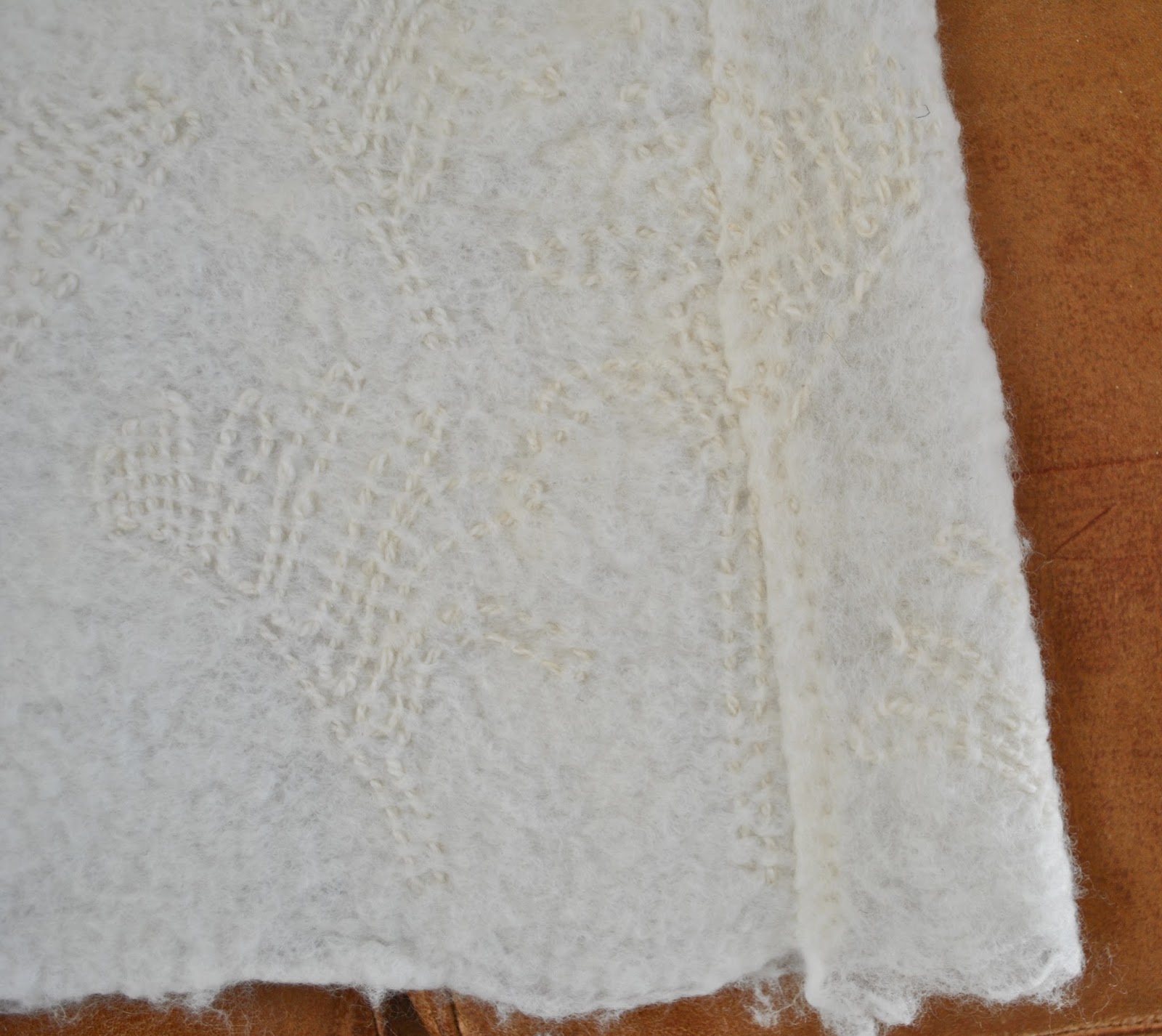
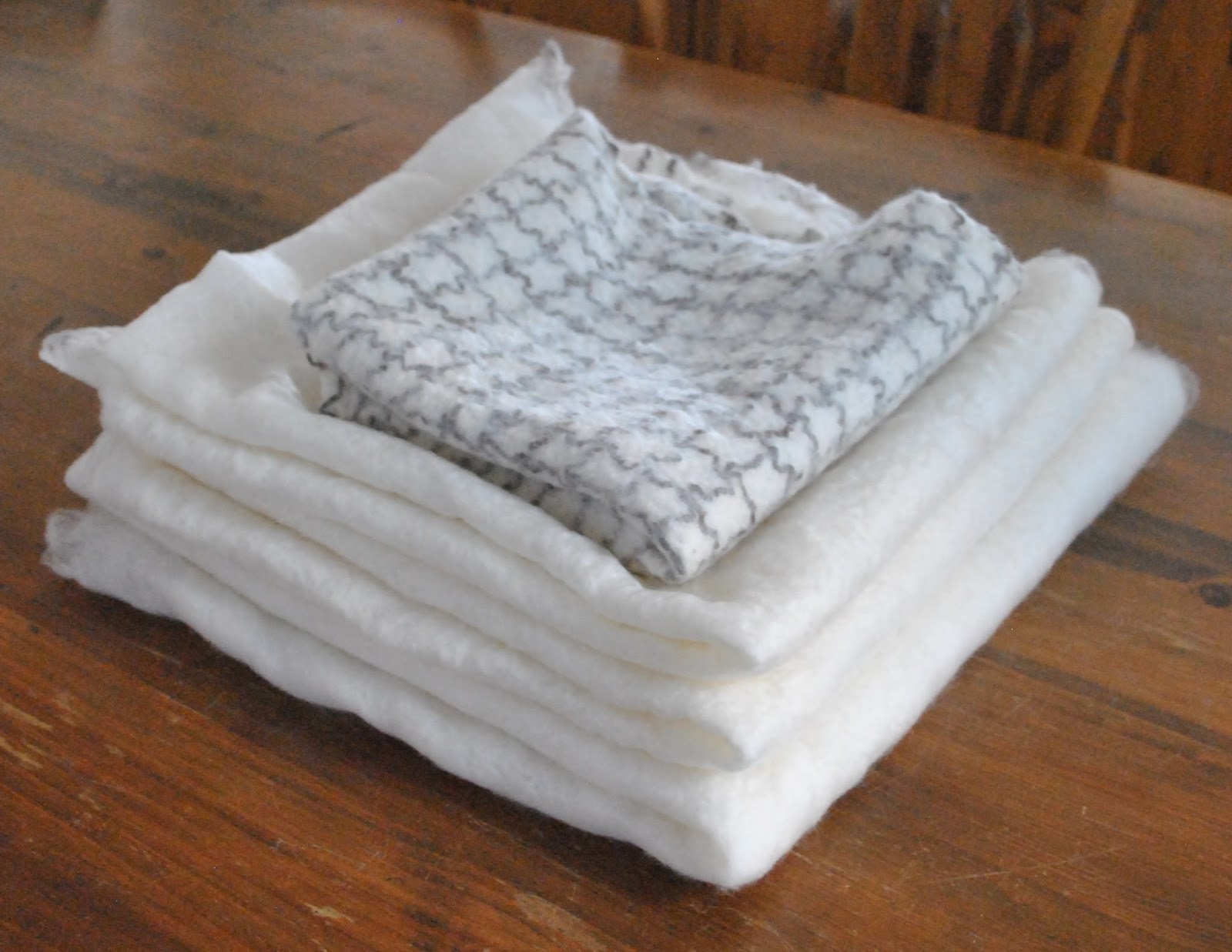
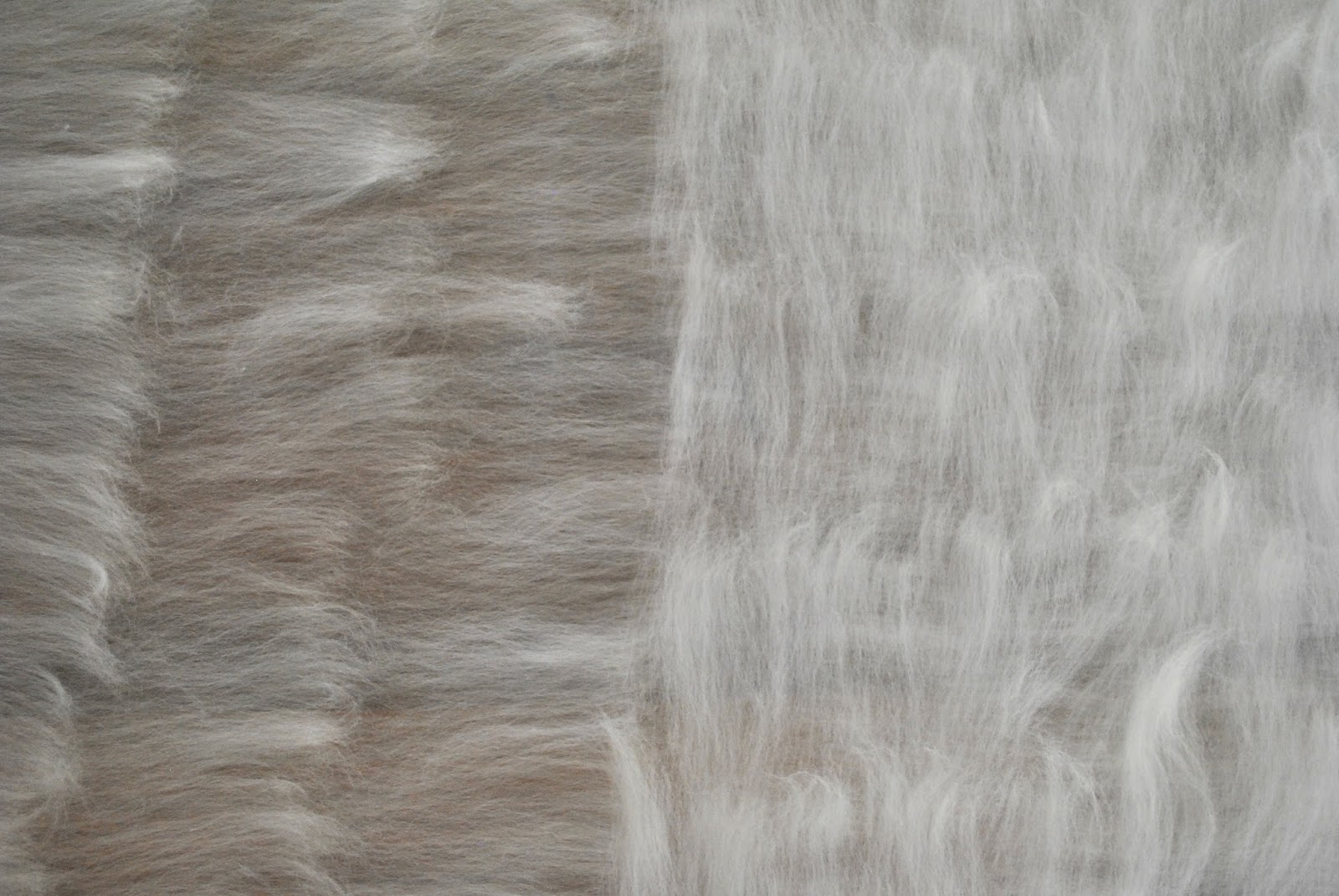
However; obviously silk chiffon is not a thing ever produced here in Western Australia! so in terms of our challenge it was a no-no.  I had to think of some other way of building some toughness into my felt…  I noticed a small sample in the shop with a yarn grid felted into it, and thought this would be a brilliant way of solving the strength problem.  I incorporated a yarn grid feature into one piece of my felt and I will be using another method of building strength into the remaining pieces.
I bought some washed and combed, naturally white Corriedale sheep fleece, and also two balls of locally hand-spun, West Australian wool yarn; one naturally black the other naturally white; and 3 large, thin, plastic, painting drop-sheets from Bunnings.

Modus Operandi:
First of all.. key words:  GENTLE!  EVEN!  Those two words were to be my mantra throughout this entire procedure.  OK.
Now: you need a fair amount of uninterrupted time, and for large pieces of felt big enough for an actual garment, a large table; preferably indoors in a wind-less, breeze-free environment.  I used my dining room table.  When laying out the fleece, bear in mind the fleece will shrink to roughly 75% of its former size in the process of becoming felt, so if you’re after a specific size you’ll need to allow at least an extra third in size dimensions each way.
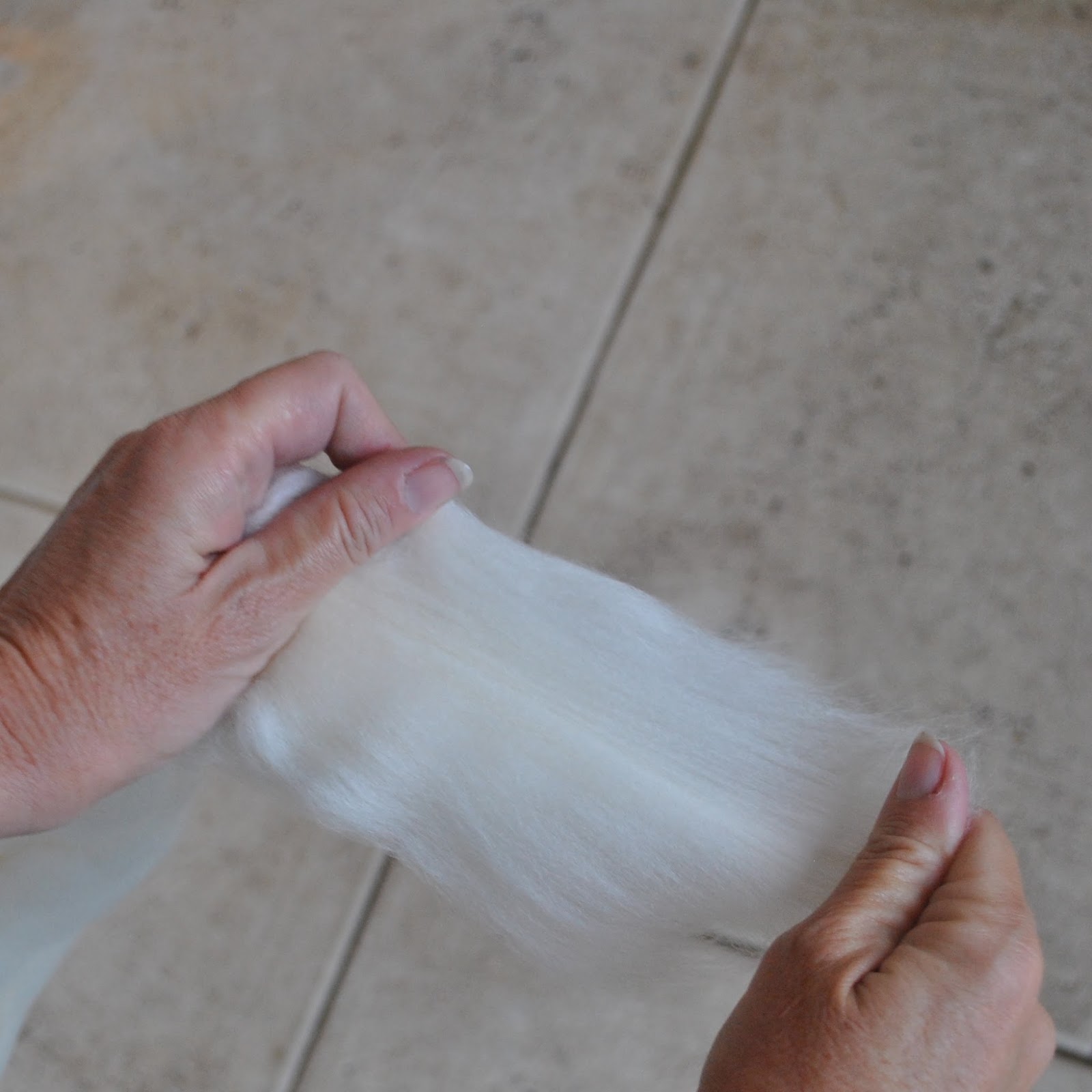
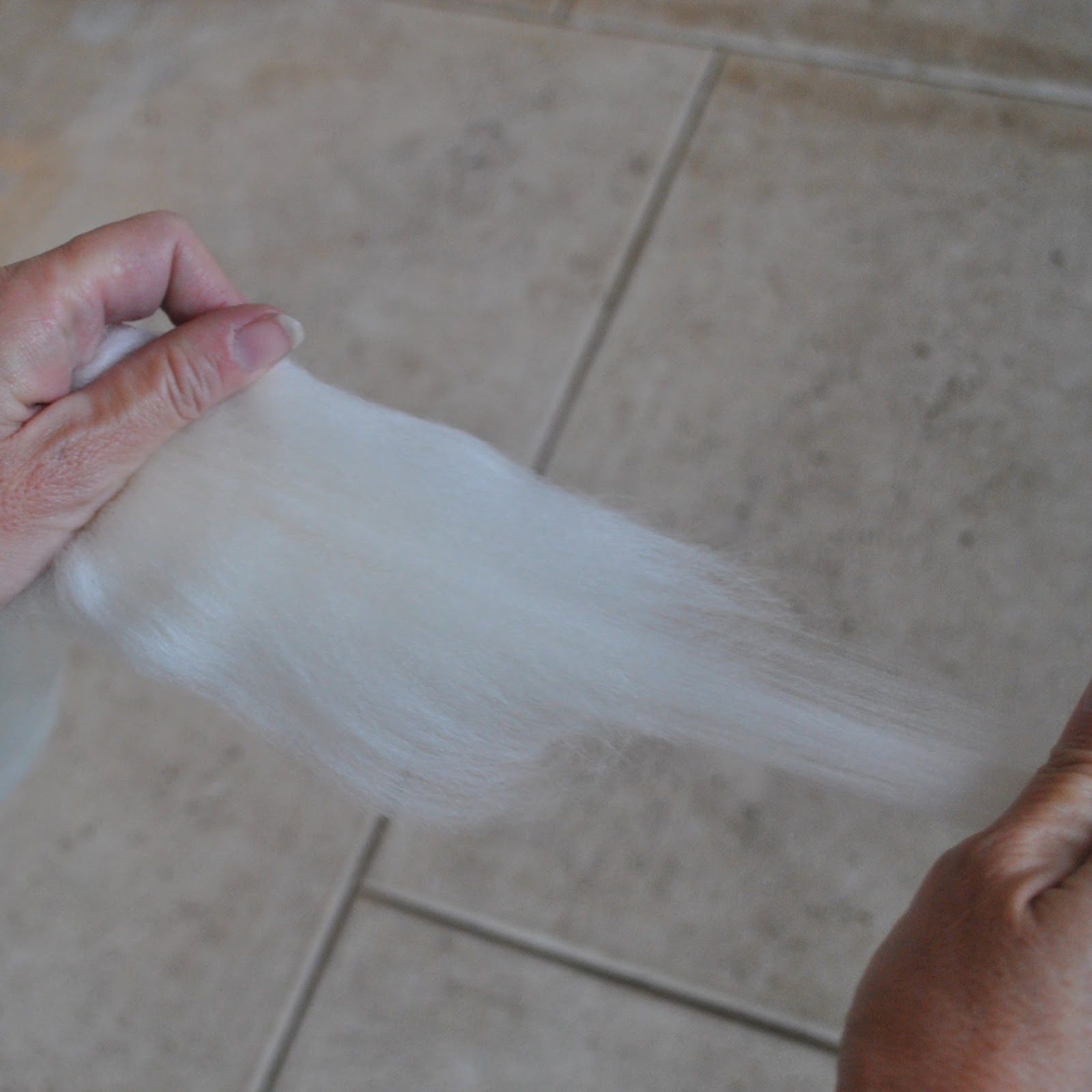
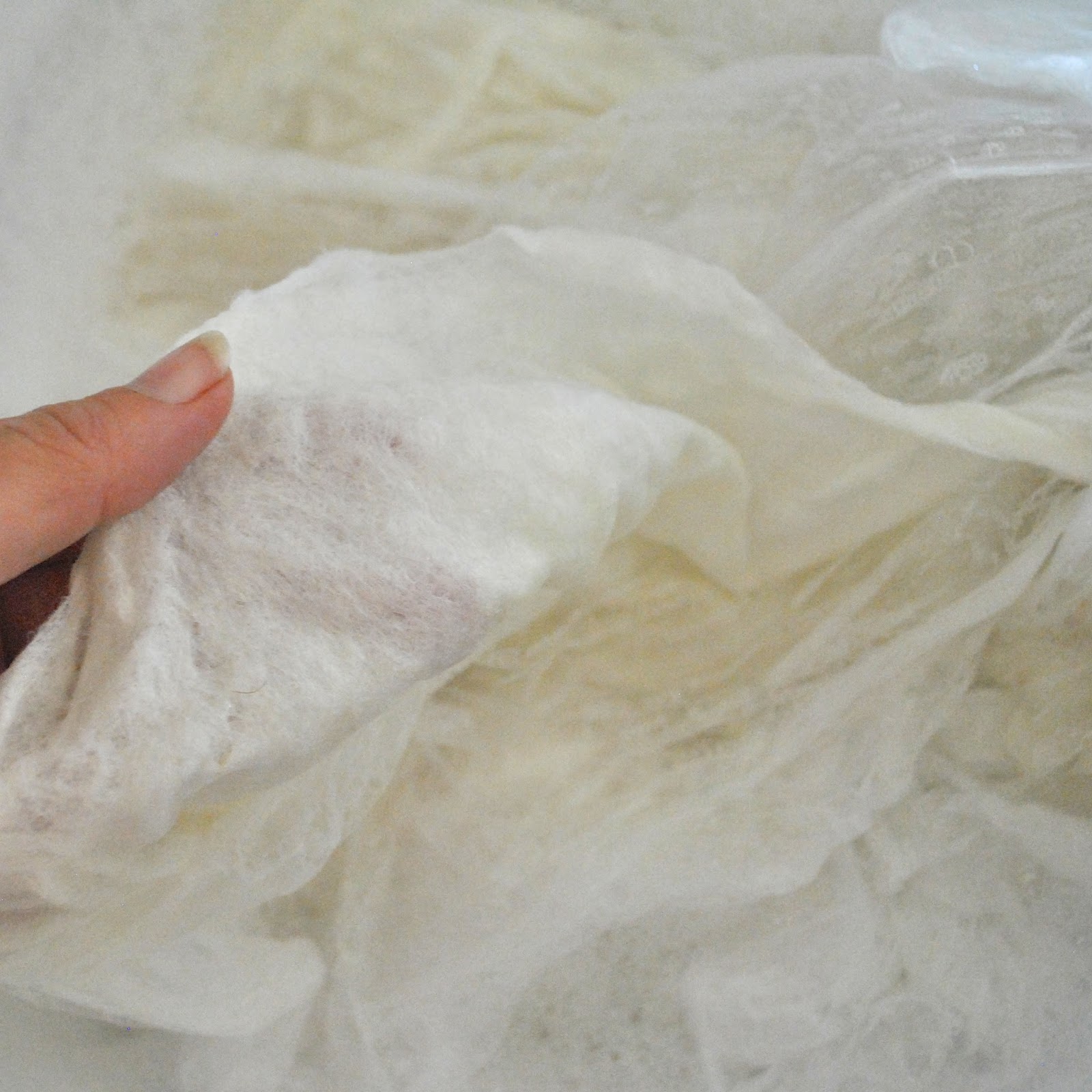
I laid my cut-to-fit plastic drop sheet on the table and start laying out small hanks of fleece onto it.  You hold the combed fleece loosely in your left hand, not too tight and not applying any pressure, and then with your right hand you grab and just pull away a small flat wodge.  Aim to keep the sections you’re pulling out of reasonably even spread and thickness; i.e., with no thick bits in the middle.  

Then, you’re simply laying them all in an even layer as possible, in one direction onto the plastic sheet.  I used my whole 2m x 1m table space.  This is why you need a good wedge of time, since your family’s not going to be able to eat dinner on the table during this process! and you can’t exactly pack it up out of the way since the wool fleece is so light and floaty that at all times it’s in danger of wafting about, blowing onto itself, or onto the floor if a door opens and a breeze comes through.  Plus in my three cat household there’s the very real danger that a curious little helper is suddenly going to jump up onto the table to check out what you’re doing and keep you company while you’re doing it.  Eeeeeeeek!  The potential for disaster is HUGE! 

The top end that you “grabbed” is a little thicker than the tail end, so overlap these by a little bit in each row.  Once you’ve covered the area, go over again, this time laying the hanks of fleece crosswise to the previous layer.
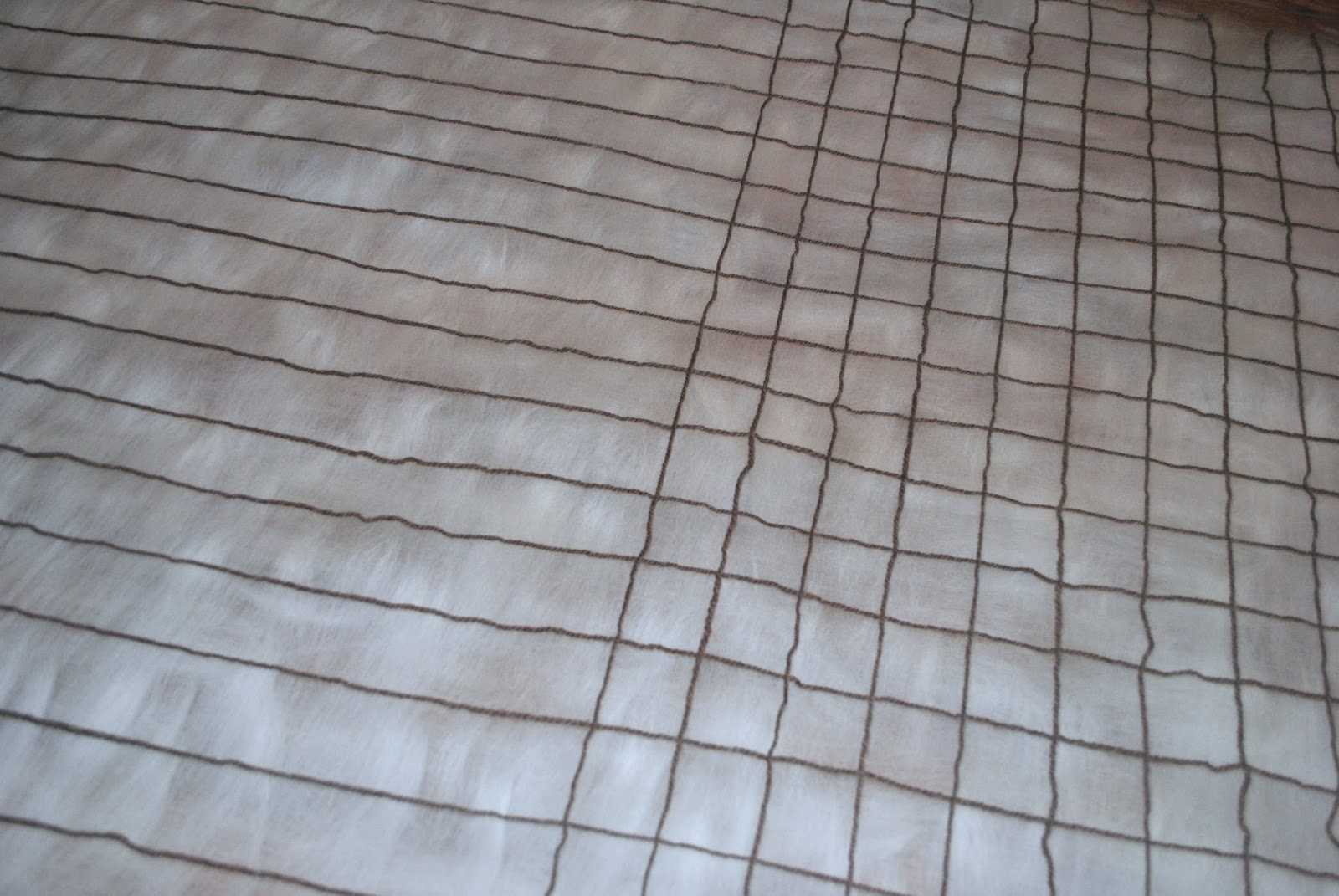
For my gridded felt I cut lengths of the homespun wool and laid it out over the fleece in an even grid.  Then I laid a very light and thin third layer of fleece over this one.  btw, some of the following pictures in this tutorial are of the grid felt and some are just the plain, un-gridded felt… because I was a little erratic in my picture taking; sorry!  But the felting process is just exactly the same in each case  🙂
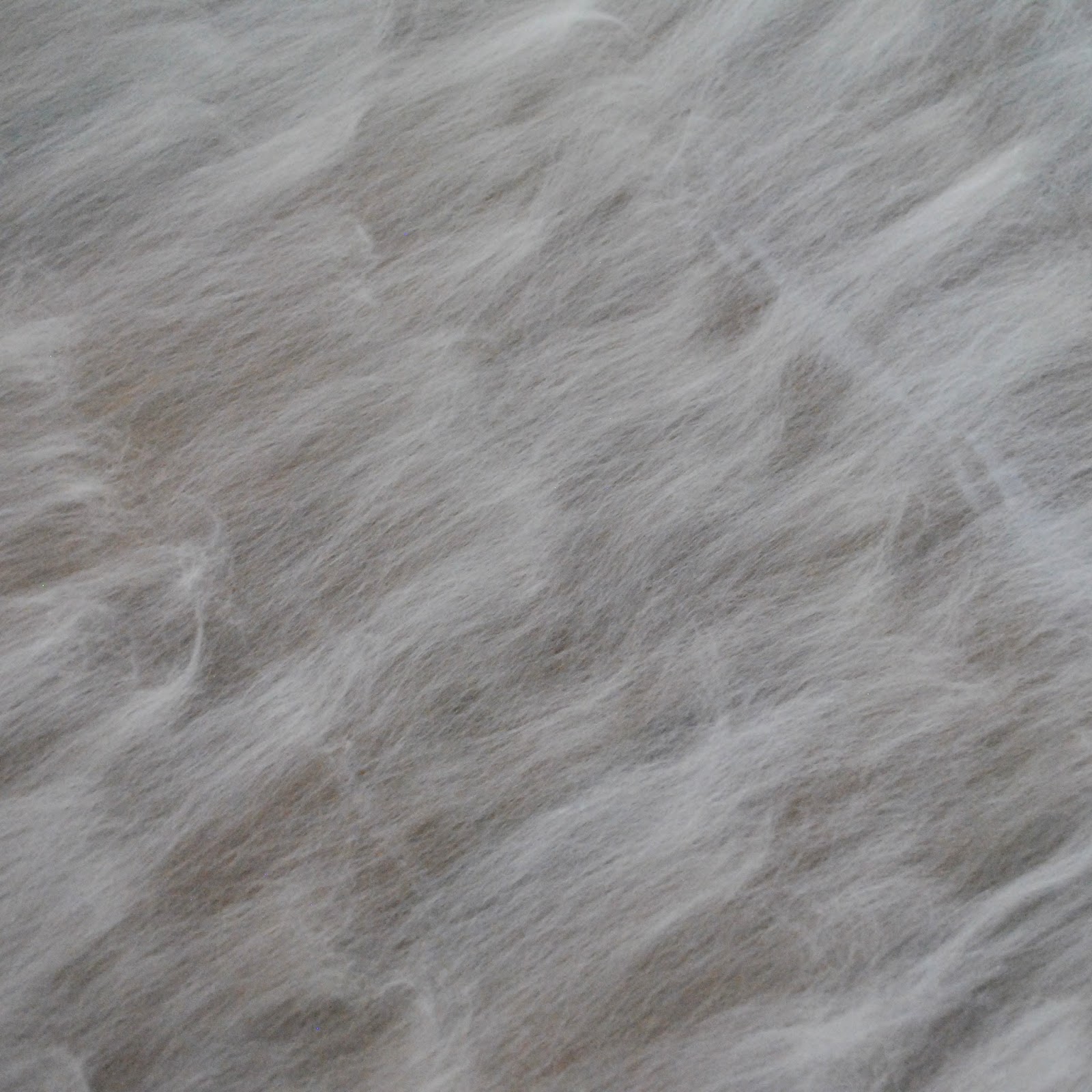
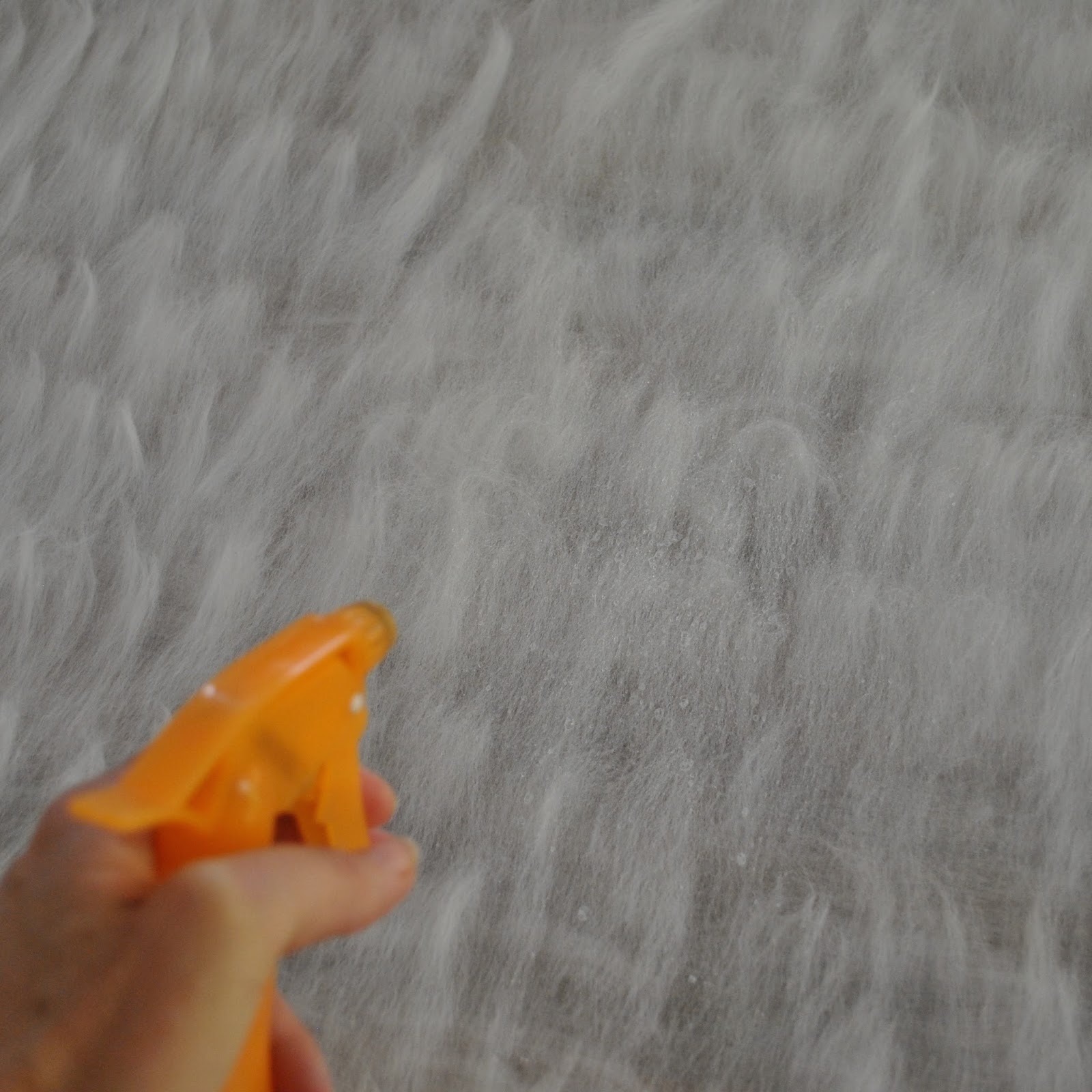
Fill a spray bottle with hot soapy* water and with the nozzle set to a fine mist lightly and carefully start spraying the fleece evenly all over.  Take great care to not blow the fleece about with an inadvertently strong spray or jet of water here! which could destroy all that carefully even laying-out… you’re aiming to very gently dampen down the fleece with a light misty spray.  Once the fleece has an allover layer of misty dew-like droplets all over, you can spray with slightly more vigour, pausing occasionally to gently flatten down the fleece with your hand, patting it down and allowing the water to seep through the layers of fleece.
*  Soap: the ladies in Bilby Yarns recommend the use of a gentle olive oil soap, and I agree this would be a wonderful option.  However, inadequate preparation and an impatience to just do it!!! meant that I just used a dash of regular dishwashing liquid for mine.  *horrified gasp*
Sorry to the purists out there!   I know, I’m a philistine  *hangs head in shame*  Please don’t boot me out of the felting club!
Eventually the fleece layers will be wet enough that they are no longer in danger of blowing about, and at this stage I allowed myself to add water just a bit more freely, but still lightly! sprinkling the fleece carefully using a small, plastic hand-watering can.

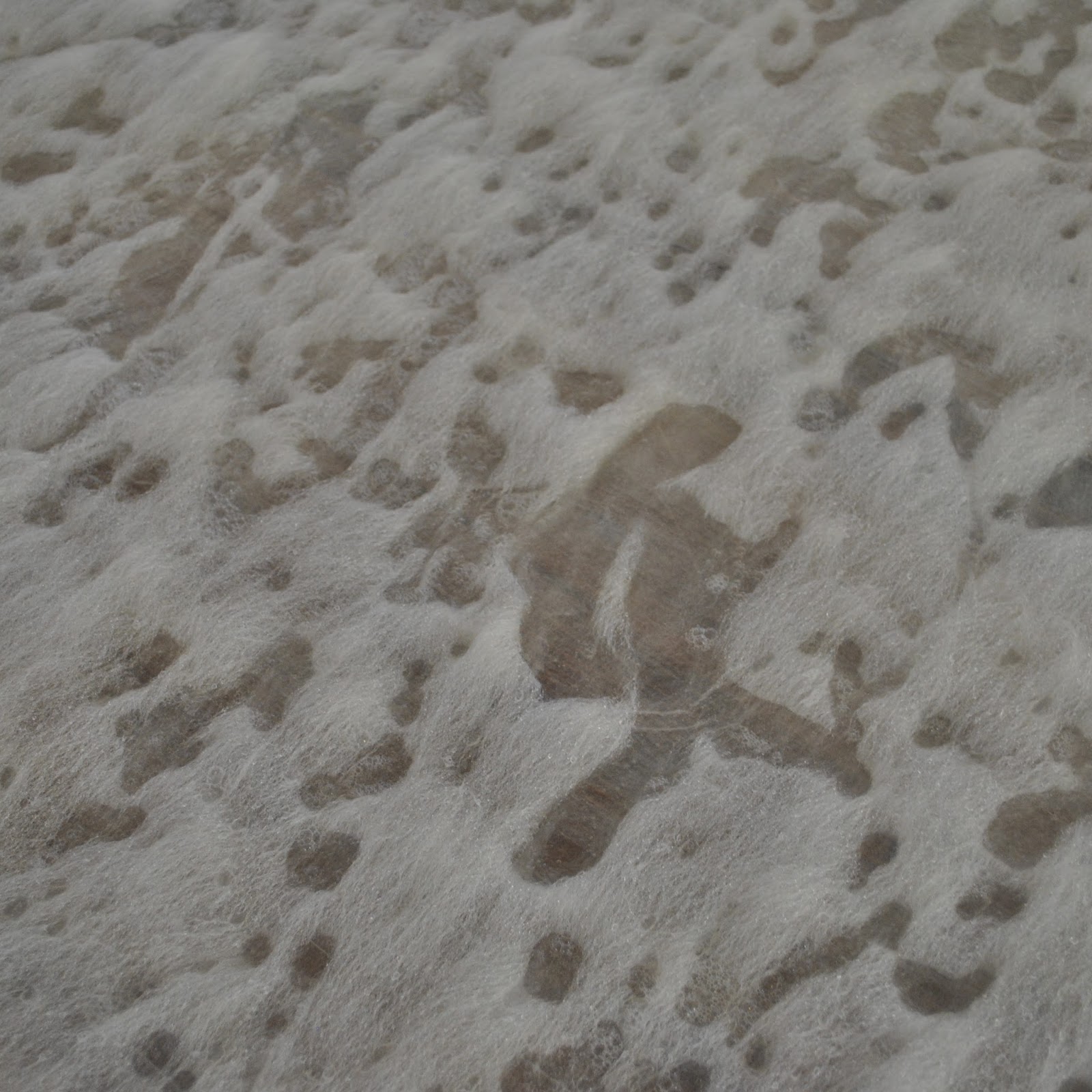
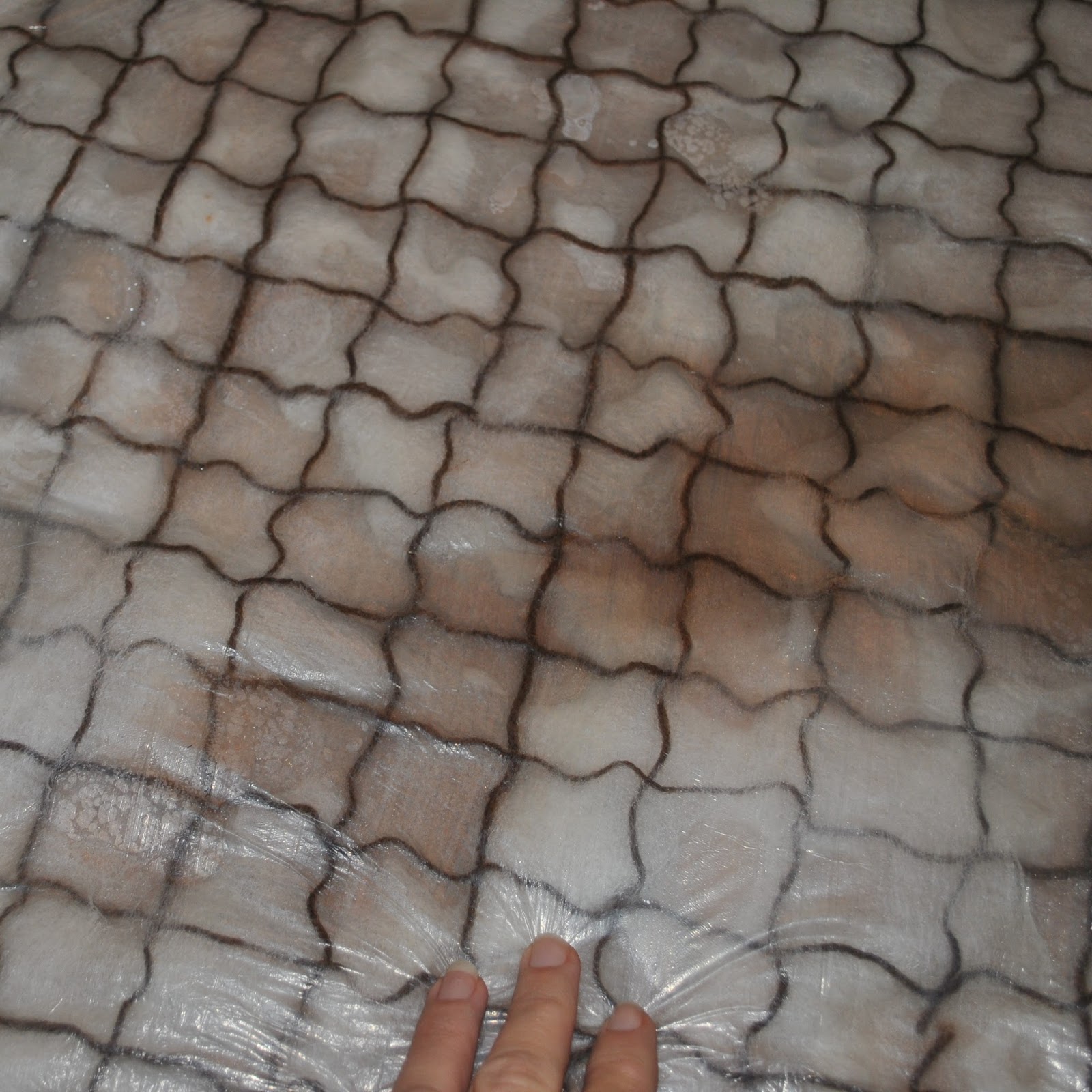
Check all over to make sure there are no dry bits; and once the fleece is wet through lay another cut-to-fit plastic dropsheet over the fleece, smoothing out any air bubbles, and start gently massaging to felt the fleece together.  Be light but firm, use small circular movements,  and cover the whole area evenly.  Every now and again peel back a corner to check that it’s felting together.

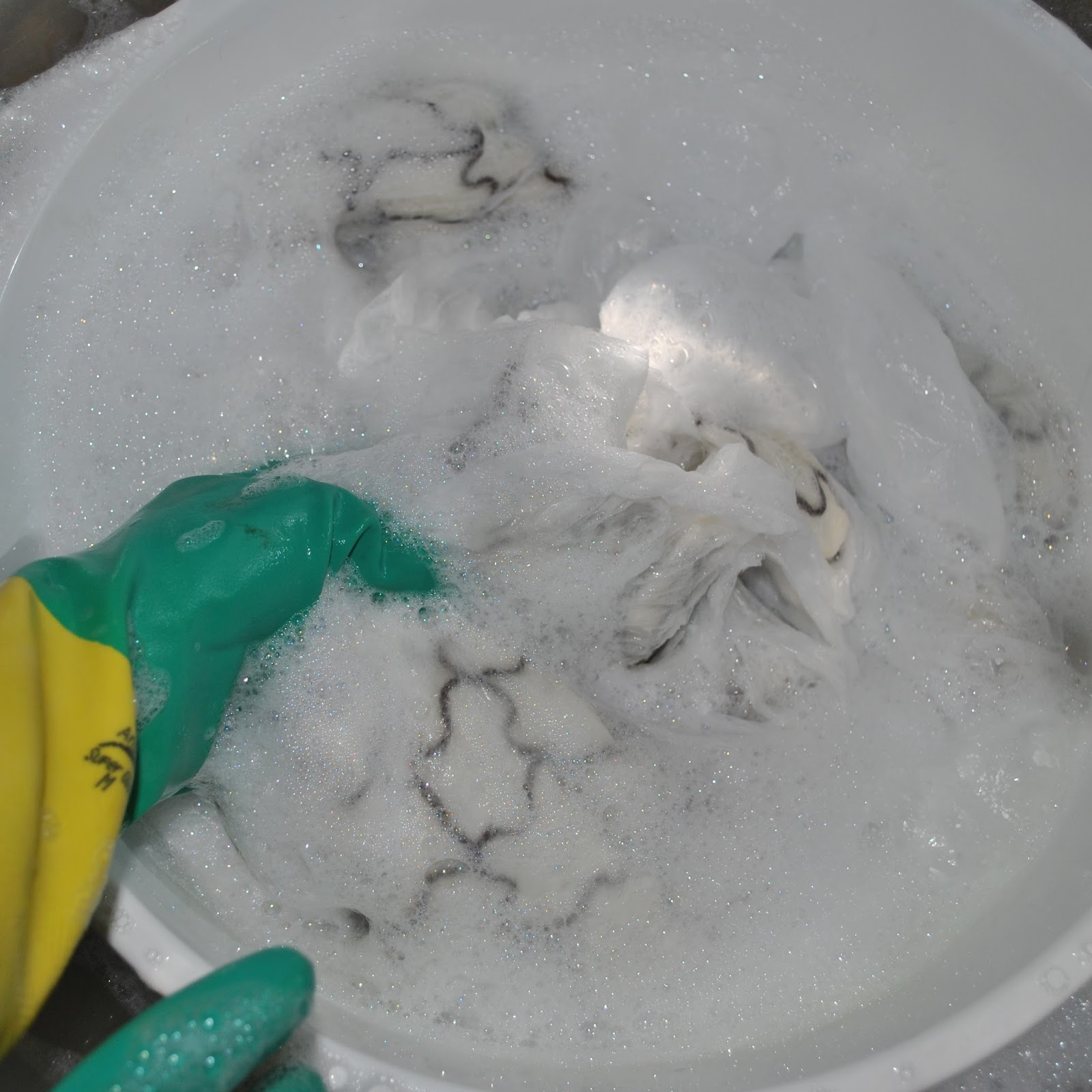
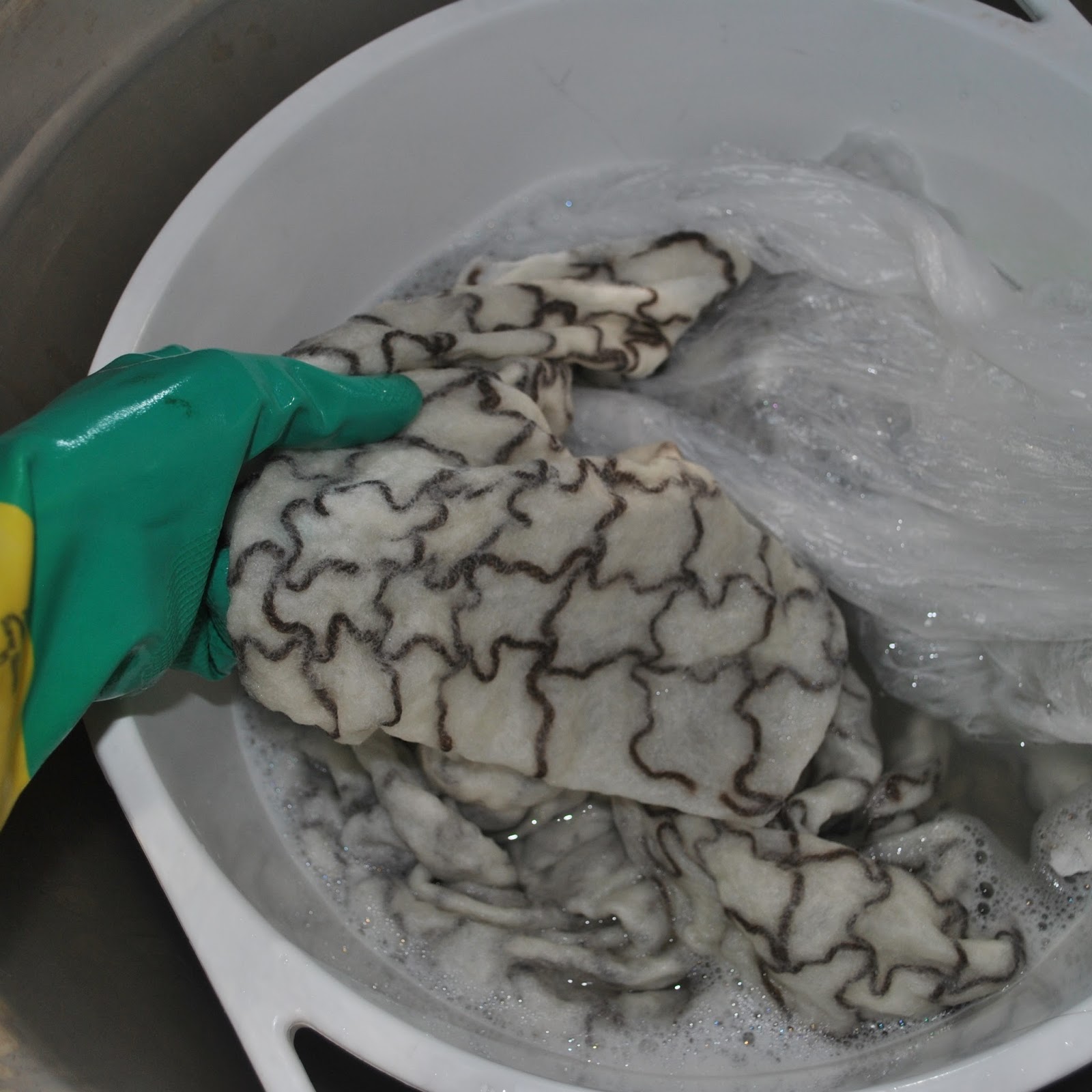
Once it seems to be melded and matted together enough that you can peel a corner away from the plastic and it seems to hold together in a sodden sheet of wool; replace that corner back between the plastic layers, and roll or fold the whole shebang up.  Fill a bucket with quite warm, but not hot! soapy water, plonk it in and start to gently agitate the plastic-wrapped fleece in the water.  Use the same sort of movements you would if you were hand-washing a precious cashmere jumper.  So, a bit of smooth slow swooshing, but no rubbing and nothing very vigorous.  Just some nice gentle easy swirling.

After a few minutes, say 5-10 minutes of this; check to see how the felting is going.  Once it has achieved a more stable, fabric-like texture you can peel away the plastic and remove that from the bucket.  
Gently rinse out all the soap, using cool water.  Still absolutely NO wringing or twisting the felt during this delicate procedure!!

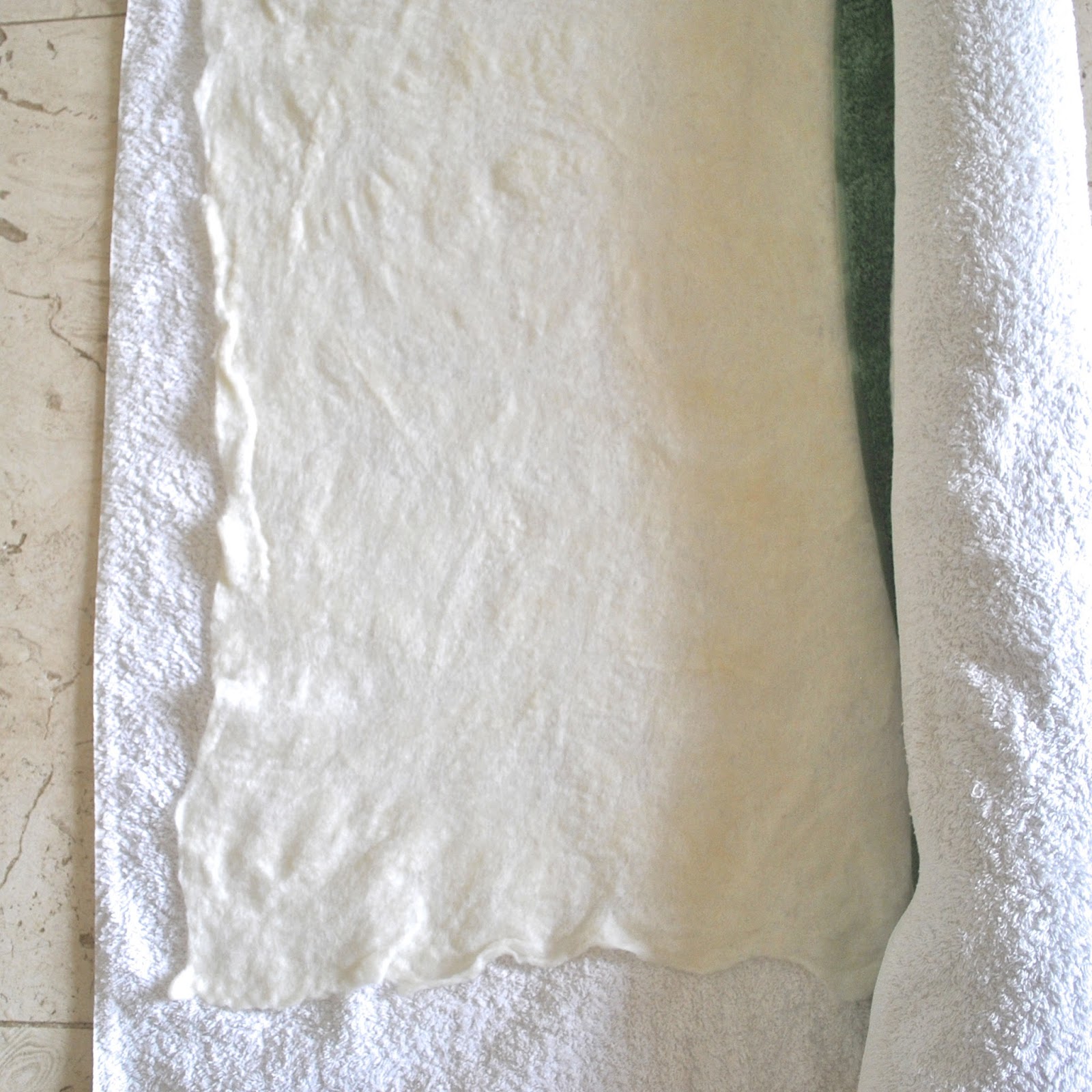
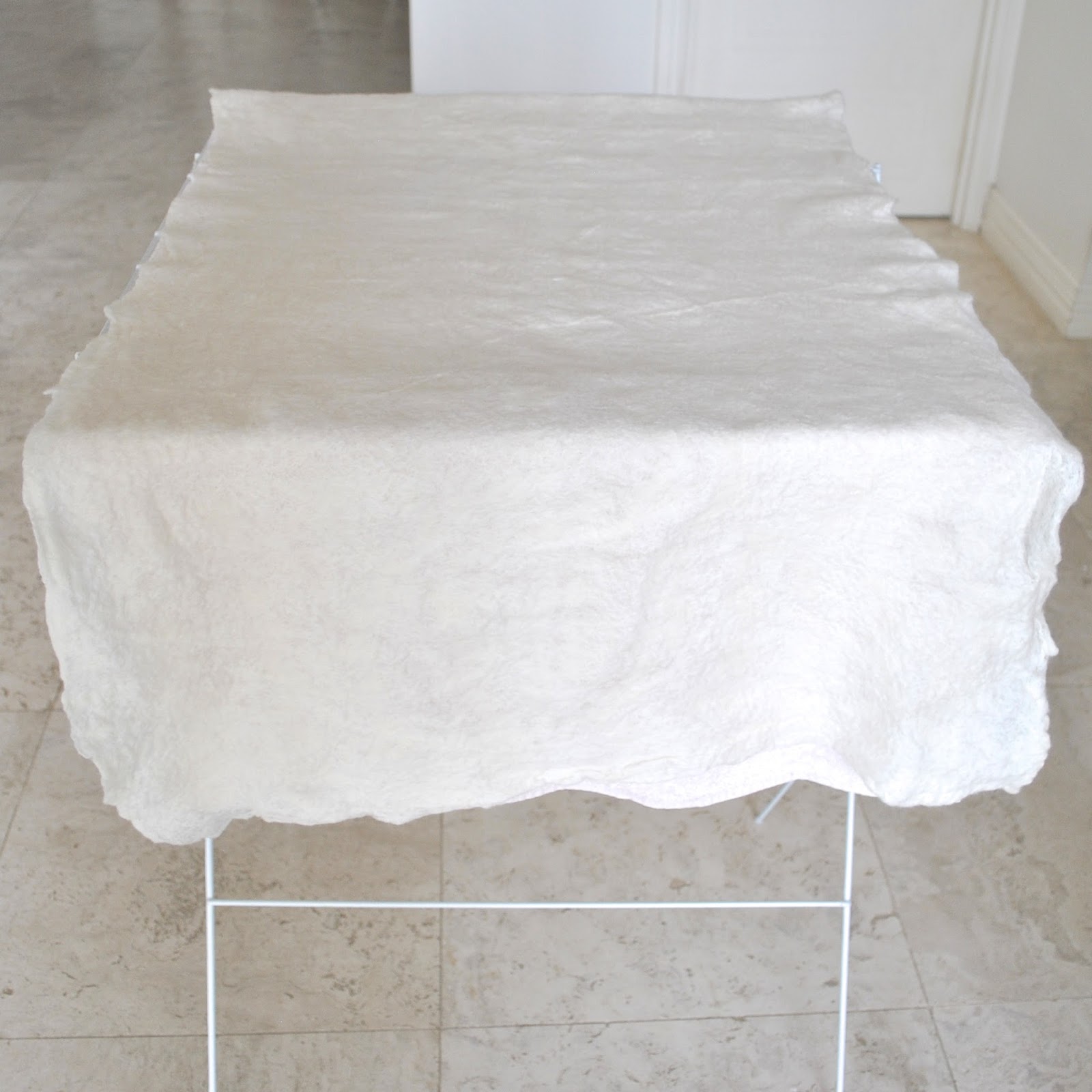
Just like you would that precious cashmere jumper; gently squeeze some excess water out, then lay the felt out on old towels and smooth it out as flat and smooth and even as possible.  Gently pull it into shape, tease out the crumply edges, smooth out any creases or little folds.  It will have shrunk somewhat during the felting process.  For the record; I initially laid out my fleece in a 90cm x 180cm rectangle.  After felting; my pieces had shrunk to roughly  67cm x 133cm; ie. approx. 75% of the previous size in both dimensions.  

When satisfied it is pulled flat and smooth and into a more or less rectangular  shape, roll it up in the towel, smoothing out any little creases that may form as you’re going along.  Squeeze excess water out by kneeling on and pressing down on the towel roll.  
Unroll, lay the wet felt onto fresh dry towels, and let it dry flat.

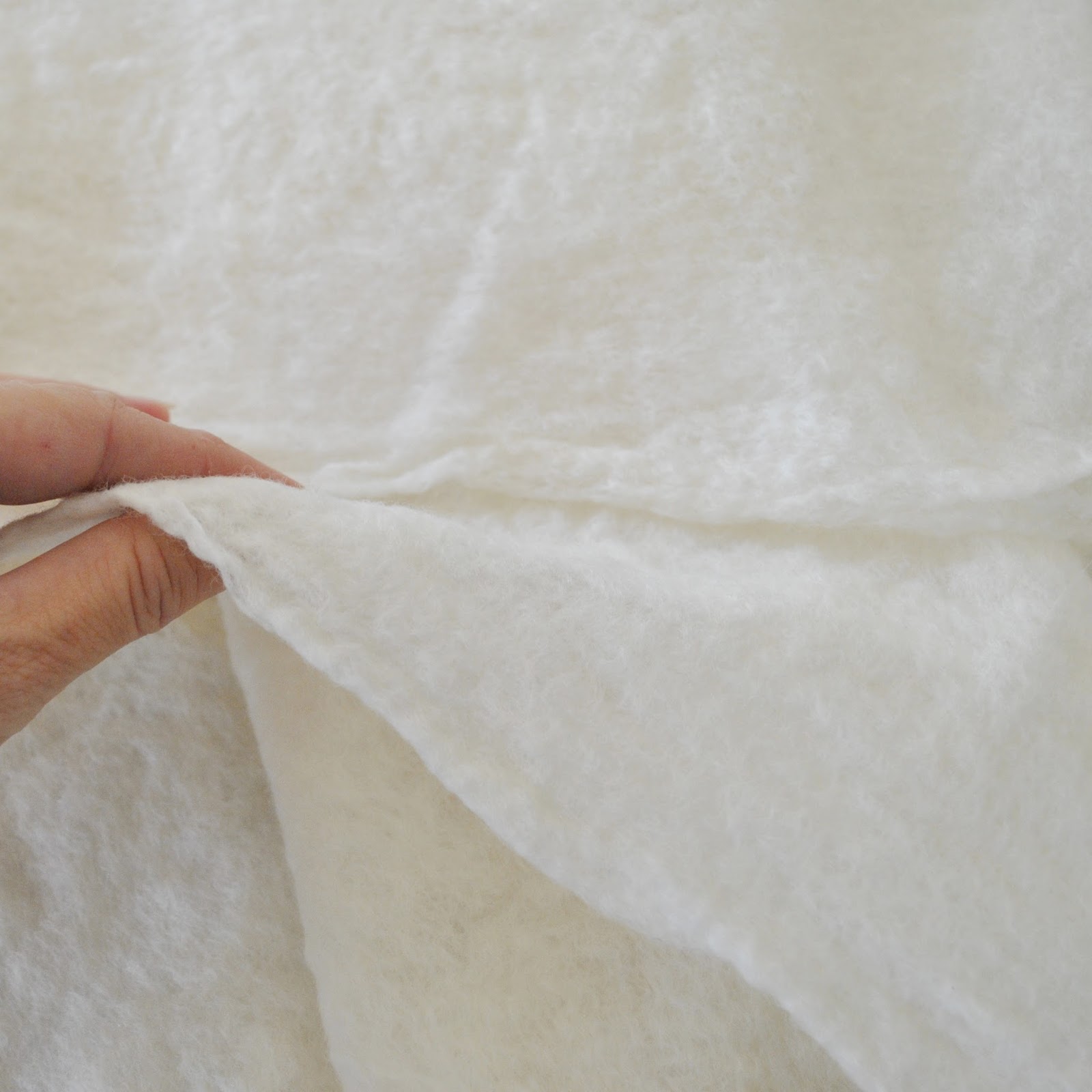
Et voila! felt!
The gridded felt is quite tough, sturdy enough to use on its own; and I plan to add extra strength to my plain cream pieces by adding some wool embroidery of some sort, which I am in the process of designing right now.
The most difficult part of all will be to cut into this precious stuff…  eeep!  must not ruin..!

pinterestmail
Switch to mobile version
↓