Tag Archives: Tip

more liberty lingerie… and why do I make my own?

On the “news” * the other night they had a little segment where Kmart introduced their new range of $5 bras, which is insanely cheap… and all over again I got to thinking about why I make my own in the face of the ever plummeting prices of rtw clothing.    See, a lot of people I know think I’m completely bonkers (source; they tell me)  for making my own when it’s so cheap to buy a perfectly pretty and well-made bra, and without the angst of sourcing all your own bits and pieces and spending the few hours it takes to put it all together.

* “News” in inverted commas… because some of our local news programmes go for a full hour here while at the same time this is a city where basically nothing ever happens.  The world news, or REAL news, is raced through in about ten minutes; local news might be another one or two minutes, tops, and usually is something like “the Mayor in hot water because she tried to claim her wardrobe as a work expense!”; the twenty minute sports section is always lengthily and disproportionately weighted towards Aussie rules football and stats and is highly detailed, let’s not even go there! ; the weather is a brief high point; and the rest of it is thinly disguised ads.  The Kmart bra story definitely fell into the category of thinly disguised ad.

So, summarising into a neat and tidy little list of pros and cons…

CONS

  •  it’s relatively expensive to make your own.  During my year where I added up how much I spent on my totally handmade wardrobe, I discovered that bras and undies were amongst the priciest of things to make yourself.  Sure, you’re only using teeny pieces of fabric and/or lace, but once you include elastics, hook and eyes, rings and sliders, and even the optional underwires, underwire casing and foam paddings… well it adds up pretty quick!
  • it’s fiddly
  • if you buying a rtw bra, you can reject any one that is not completely perfect and just keep trying on different ones until you find The One… when you’re making your own it takes time and maybe even a few less-than-satisfactory bras before you work out the perfect fit for you with any given pattern.
  • it can be difficult if not impossible to find colour-matching bits and pieces.  You can dye your own (more fiddle) or settle for good old boring black, white or beige.  Kind people may give you their old colourful bras from which you can harvest the colourful bits.. however in my experience the hooks and eyes closure at the back which is the very hardest bit to source in different colours is usually the very first bit to look hideously wrenched and worn out, and is not worth saving.

PROS

  • you can be creative… express yoself!!
  •  I feel a lot better about myself and my wardrobe if it is my own labour being poured into it, rather than someone else who is being grossly underpaid for doing so.  Many years ago when I took my Lifetime Pledge in Wardrobe Refashion, I thought long and hard at the time about doing so… and my reason has remained unchanged… I love fashion, I love the artistry and creativity and self-expressiveness of it, but I can only live with myself by taking that ethical stance
  • it’s actually kinda fun
  • it’s fiddly.  Yes, I also claimed this as a “con” but I’m the kinda loon who actually thoroughly enjoys doing detailed and fiddly things.
  • I like that my free time is spent doing something productive and useful… and there’s not much more productive and useful than making your own consumables.  Plus, last but certainly not least:
  • I LOVE sewing with a weird and totally unreasonable passion.  Perhaps that should have been number one on the list.

Well, anyway, there it is, annoyingly inconclusive.  I suppose what I’m saying is that as long as I’m able, I’ll probably continue to make my own, while questioning my own sanity at the same time.  Definitely bonkers.

Oh, and yes, I made a new lingerie set… ta da!


Fabric; Liberty cotton Clifton jersey Josephine’s Garden in the Pink colourway …  this is the other piece of liberty cotton jersey that I bought from the Fabric Store in Melbourne during my weekend away there with Mum, Cassie and Tiffany… and now I’ve made up all my Liberty and have NONE LEFT! (sob)  Knicker elastic, and the white cotton jersey used for lining from Spotlight.   The pink ribbon that I used to make the little decorative bows, white rings and sliders, and the bra hook and eye thingie were all from Homecraft Textiles.

Pattern; both bra and the two identical pairs of matching knickers are the Watson by Cloth Habit… with a few variations of my own, namely:

1) the front crotch seam has been eliminated from the knickers, as per usual.

2)  I really like the shape of the Watson bra pattern, however the raw edges showing inside has always been a problem for me… anyway I made this one so the bra cups + front band are fully lined and with NO raw edges showing on the inside.  My method is outlined below.

Stitch the side seams…

then stitch the cup into the cradle curve… taking care to leave free the narrow upper seam allowance of the cup at the centre front

Wrong sides together, stitch the cup lining to the cup/cradle seam allowance, cradle side up so you are stitching along the previous stitching line.  After this, fold out and twist the shell and lining cup pieces so they are right sides together and stitch the upper, inner-front cup seam with a narrow seam allowance. (no picture of this, sorry!)

Pin cradle lining right side to the seam allowance of the existing cup/cradle seam allowance, and stitch together with the shell pieces uppermost, so you are stitching over the previous stitching. Trim and grade seam allowances…

Now, take the cradle lining and twist it round so you can pin the side seam edge to the outside of the bra side seam… i.e. the right side of the cradle lining is up against the wrong side of the bra back piece.  Holding the pinned seam with the shell fabric uppermost, and taking care not to catch any other bits of fabric in with the stitching, stitch along the previous side seam stitching.

Trim and grade seam allowances…

Looking pretty neat and tidy already!

Attach the upper and lower elastics as per usual, and it’s all perfectly clean and neat in there with absolutely no exposed raw edges…  *satisfied sigh*


SaveSave

SaveSave

SaveSave

SaveSave

SaveSave

SaveSave

SaveSave

SaveSave

pinterestmail

little floral dress; donna karan for vogue

I’ve made this new dress! every year my dear friends give me a Fabulous Fabrics voucher for my birthday… it’s taken me a little while but I finally got around to spending it and making my birthday dress!

Pattern; Vogue 1351, this is my third version of this pattern, my first one is here and my second here.  This time I cut the skirt a bit more flared and actually it was going to be a lot longer to start with too, it was going to be a midi-ankle length dress, but when I tried it on for hemming I decided this particular small-scale floral was not right for a midi-length.  It felt like a big walking cliche, to be honest, as if it was the “before” dress in an op-shop refashion challenge, and I was about to lop a foot off the bottom and go “TA DA!!” LOOK HOW AMAZING IS THIS REFASHION GUYS!!! FRUMP TO FAB IN JUST FIVE MINUTES!!!

Actually, I think the longer the length of a dress, the bigger the scale and more overblown the print needs to be… and a smaller scale print really looks best in a shorter dress.  Also Craig gave a big thumbs up to the shorter length, although that is pretty much ALWAYS his response, so much so that I don’t know why I bother asking…  Anyway, I preferred the shorter length too, which I should say is of course the “right” length!

Fabric; floral chiffon, lined with a warm, peachy/pale-pink crepe, both from Fabulous Fabrics.  I’d tried a few different colours underneath the floral – because it is completely sheer the colour of the lining made a huge difference; white, ivory, and even cream were all too “cold”… I almost went for pale yellow which was quite warm and nice but in the end I settled on this lovely pale peachy-pink.  Pink gave an rosy warm glowing light to it;  just exactly what I want for winter  🙂  I know a chiffon dress seems a strange thing to make for winter, but this dark rich floral just seemed to my mind to be very right for the season, and is what I want to wear right now.

I stitched French seams on all areas of the chiffon, and the seam allowances of the pink crepe lining are overlocked to finish…

 triple-stitched baby-hems for both the shell and the lining…  as described in my tutorial here

… the only difficult bit I had was putting the pale pink invisible zip into the chiffon.  It is tissue thin, and so wouldn’t be able to provide any support for the zip, so I applied thin strips of iron-on interfacing along the stitching lines of the zip, extending it by about an inch either end and was super careful when stitching.

I thought I’d show my lining slip-stitched to the zip tape inside… I always stay-stitch a three-sided “box” at the lower edge of the seam where it will be sewn to the lower edge of the zip, snip into the corners, press the seam allowances under, and stitch along the stitches… this is something the patterns NEVER tell you, but I think they really should, because it’s so much better.  The lining sits a lot flatter and smoother, the stay-stitching gives a little bit of reinforcement to the area, and the squared-off slit really does make a visible difference to how invisibly the zip seam appears in the finished garment, especially in a very thin fabric like this.  Haha, I know that “visible difference to how invisibly etc” sounds like an oxymoron, but you know what I mean!

I wore it for the first time today!   along with my scarlet Miette cardigan, to show it to my lovely girlfriends who had given me the voucher… 🙂

Details:

Dress; Vogue 1351, floral chiffon, crepe lining
Cardigan; the free Miette pattern by Andi Satterlund, all details on my yarn and alterations to the pattern here
Tights; voodoo
Shoes; Vitullimoda, bought in Melbourne during my holiday over there with Mum and Cassie 🙂

location; Kings Park, Perth, Western Australia

SaveSave

SaveSave

pinterestmail

deep teal, suedette dove blouse

Hey!

I’ve made a new blouse.  It’s the Dove blouse by Megan Nielsen patterns, in an lightweight but warm, faux suede from Spotlight.  So, the recommended fabrics for this pattern are shirt-weight stuff like voile and crepe de chine and chambray and linen… not a wintery fabric like this.  However, when have I ever taken any notice of fabric recommendations? Pretty much NEVER, haha.

And I love it.  Very very happy.  Look at those sleeves.  Oooo yeah.

this is a blouse that demands at least one dramatic arm pose

Now, remember how I mentioned pretty recently that I was looking out for this pattern??  Well, Evie, of Indie Stitches very kindly emailed me to let me know that she had one in stock… and offered to send it to me… thank you so much, Evie!  Indie Stitches is an online pattern store with a very nice range of both paper and digital patterns, obviously as the name suggests specialising in small and independent pattern makers like Closet Case Files, Grainline, Sewaholic, Jennifer Lauren Vintage, Papercut, By Hand London, Tilly and the Buttons, Waffle patterns, Megan Nielsen and would you believe this is just a selection?! There are many many more!  If you love supporting small independent pattern companies then I highly recommend heading over to the Indie Stitches pattern store and having a browse, at least.

Please note; I did receive this pattern gratis, however there are no affiliate links in this post.  I will always notify my readers if there is an affiliate link in my posts.  Also on a tangential yet related note, I read somewhere that people think bloggers are raking in the money through affiliate links, well! that may be true for some types of bloggers, like maybe fashion bloggers?  but sewing bloggers…  NO.

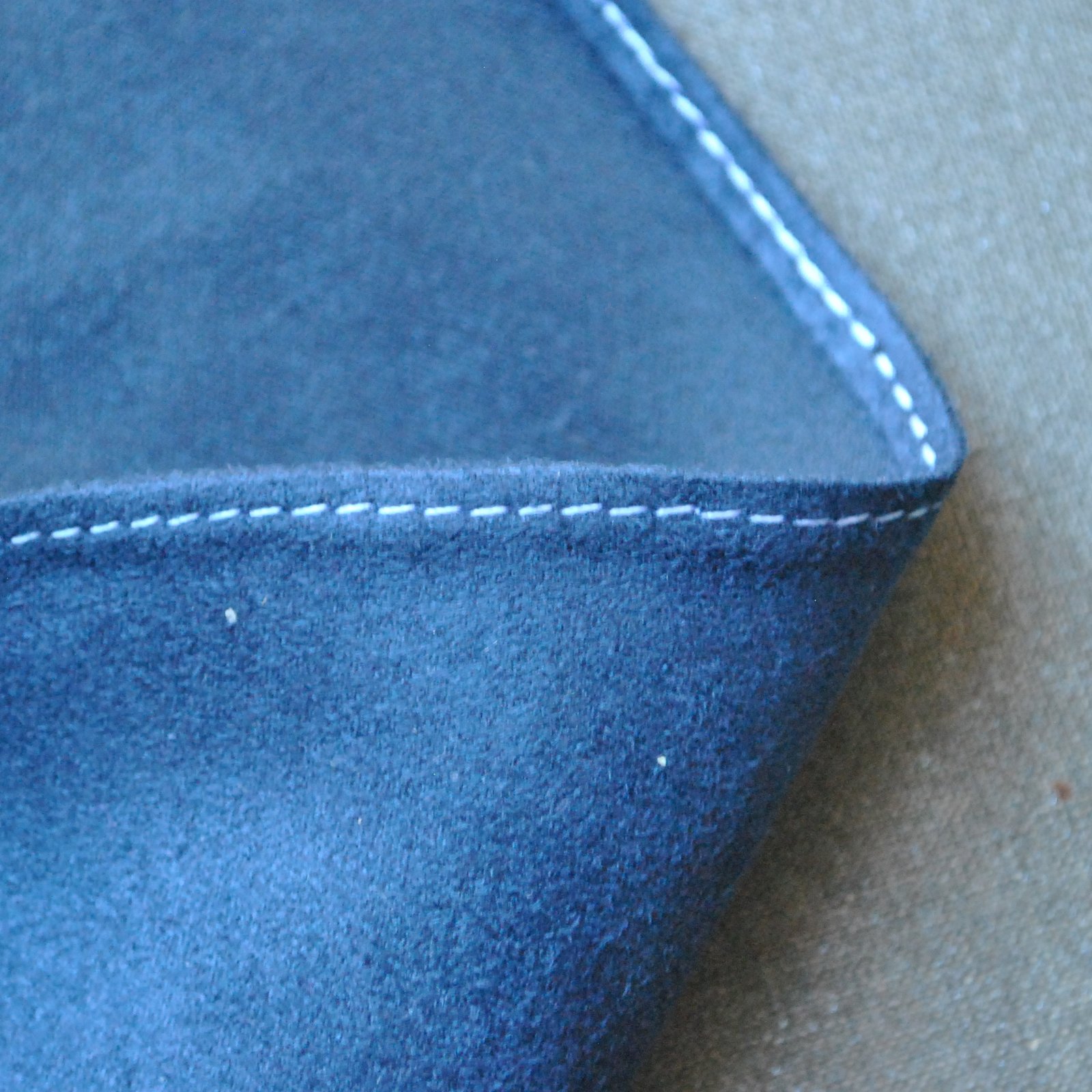
For the sleeves you do a triple-stitched skinny hem… it’s a hem finish I have used a few times before that gives a neat little baby hem but with no rippling or “lettuce-leaf” curling that you usually get with a single-stitched or machine-rolled hem… I think I read about it first years ago in an issue of Threads.  I wasn’t sure how it would work out with the slightly thickish suedette, but it did beautifully! and I had a request from my daughter and also from sewnewbee in IG as to how exactly is it done so I did a little sample and took a few pictures for a short tute…

I used a contrasting white thread here because I found you could barely make out a single thing in my pictures with the matching thread!  anyway:

First; stay-stitch at a distance of 6mm (1/4″) inside the raw edge, being super careful NOT to stretch out the edge while doing so.  This is the 1st row of stitching.

Turn the raw edge to the underside just outside the previous stitching, so the stitching sits just inside the pressed edge, and press.

Stitch again (the 2nd stitching) at a distance of 2-3mm  (1/8″) inside the pressed edge, and give it another quick press…

Trim away the raw edge as close to the 2nd stitching as you can.

Turn under this now extremely skinny, double stitched edge and stitch again (3rd stitching) right over the visible (2nd) row of stitching.  The first two lines of stitching help keep the hem from stretching out as you sew, so your edge will be nice and flat and with minimal “lettuce-leaf” curl along the edge.

Inside: looks almost like one row of stitching, but it is actually two; one over the top of the other

Right side has only one row of stitching… plus a very skinny, nicely non-curly edge achieved in a difficult to hem fabric  🙂

excuse me ma’am, your remote is showing

Details:

Blouse; Megan Nielsen Dove blouse MN2105, version 2, in petrol blue suedette
Skirt; Vogue 1247, yellow corduroy dyed brown, details here and my review of this pattern here
Tights; self-drafted, black polyester stretch, details here and my tutorial for making your own custom-fit tights pattern is here
Boots; made by me, and my own design, details here

location: South Perth foreshore, Western Australia

pinterestmail

golden brown


hello!  I’ve made this new blouse…  I was having trouble thinking of a way to describe the colour, since the only thing coming to my mind was those white puffball fungi that upon “puffing” send forth a little cloud of smelly spores that are just about exactly this colour.  Then Craig came to the rescue, suggesting “golden brown”  Oh, yes, that is SO much nicer!  Why is my brain sooo….? um, weird and mundane and lacking in poetic nuance?!


Fabric; a silk crepe from Tessuti fabrics in Melbourne, bought during a previous years’ trip over there with Mum and Cassie.  I’ve had it marinating in the stash all this time, awaiting the perfect blouse pattern.  I think this was happily, and accidentally, IT!

obligatory back view… 


Pattern; the Sudley by Megan Nielsen patterns. Tim and Sam gave it to me for Christmas, after I had requested the Dove blouse pattern.  Did I mention already that the Dove is perpetually sold out?? yes I believe I did.  Clearly my boys encountered the same issue that I have had …. timing, it seems, is everything!!  However, the Sudle is a nice little pattern, very simple, and I think I will use it a lot too.

This is actually the second Sudley I have made.  I also made a dress that has now been assigned to Cassie when I realised it was just going to be a little too, er, young for me.  I expect it’ll show up on ye olde blog here sometime…


Alterations:  The Sudley is a very young-at-heart style whereas I am more of a hoary-old-beast-at-heart; so I made a few minor design alterations to “old” it up a bit.   I opted for the plain neckline, and jazzed up the plain sleeves by running a loop of skinny elastic through the sleeve hems to gather them softly up, and made a separate bias rouleau loop “bow” which is purely decorative and just sewn on to the hem with a few firm stitches through all layers.

I also cut the lower hemline to have a curved “shirttail” line to it.  The hems and the neckline are all finished by hand, because I really wanted to have a smooth clean stitch-free expanse of fabric with absolutely no visible topstitching anywhere.  This is about as invisible as I could get.

Oh; one thing I did, which I would recommend for this type of neckline; you stay-stitch all around the neckline and the keyhole opening, obviously to stabilise it, however! to further help keep the neckline straight and true I kept a little bridge of fabric intact at the top front edges of the keyhole where the ties were to be attached, and maintained it throughout most of the blouse’s construction, and only cut through it at the very last minute, when turning and hand-stitching the bias binding down on the inside.  I think this simple precaution really helped to keep everything true.

All seams throughout are French seams, except for the armscye seams which I just ran through the overlocker to finish.  Picking my battles here!  This silk, while absolutely divine and a dream to wear, was actually not much fun to sew!  However!  The puffball spore, I mean, lovely golden-brown is a perfect colour for autumnal me, also I think this style of blouse suits me and I’m going to enjoy wearing it a lot.  It’s going to go with TONNES of my other clothes.


Details:

Top; MN2004 the Sudley blouse by Megan Nielsen patterns with minor modifications, silk crepe
Skirt; Vogue 1247, ivory curtaining fabric, details here and my review of this pattern here
Shoes; made by me, my own design, details here

Skirt below; Vogue 8363, canvas, details here

Location: Eagle Bay, Western Australia

Wearing it out to dinner recently, with my “bookshelf” skirt.  I think they go together quite nicely!

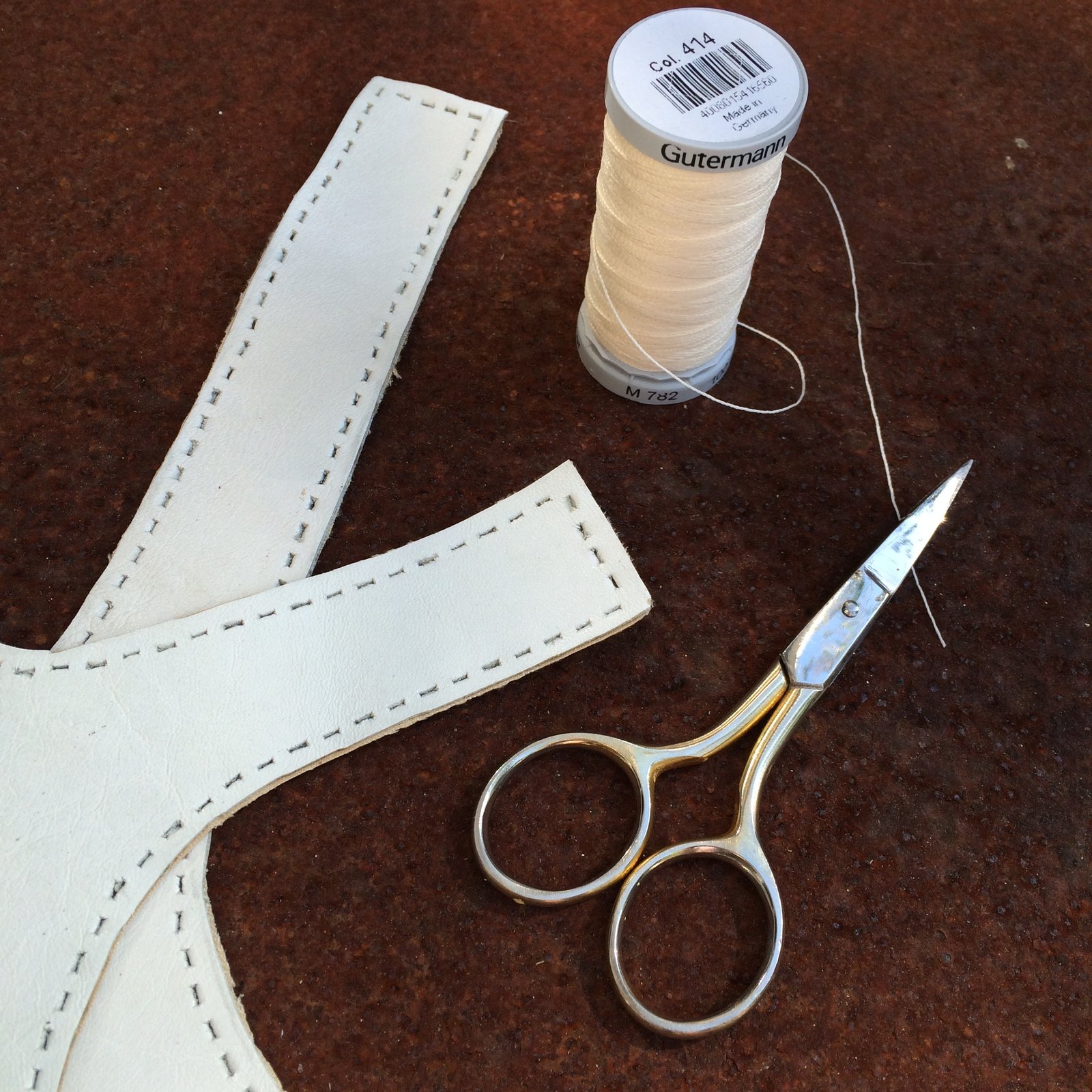
And my clogs have received a much-needed makeover!  The ivory pleather part of the upper has got so worn and was starting to pull badly around where it was nailed to the soles…. I’d already fixed it once but finally acknowledged that if I wanted them to last a lifetime, and I think they can! then it was time for action.  One thing I’ve learnt about making my own shoes is that if something needs a little mending or attention then it REALLY pays to get onto it very quickly.  Mum had given me an ivory leather clutch years ago “for shoes” and it was juuuuuust big enough so I could cut out new pieces.  I used my punch that I bought in Copenhagen, and upholstery thread in ivory to sew up and down all around, and hammered on the new uppers.

Now they’re as good as new!! in fact; I reckon BETTER!

pinterestmail

terracotta axel skirt

Hey!  I’ve made this new skirt.  Actually I’ve made lots of new things lately and just haven’t yet blogged them… oops!  Getting onto that, asap!  Hehe, actually a good thing about me-made May is that it kinda forces me to blog as yet unblogged things that I want to wear that day.  Well it means I have to, otherwise… what would I link to??  *horrified gasp*  O, the shame of having nothing to link to!
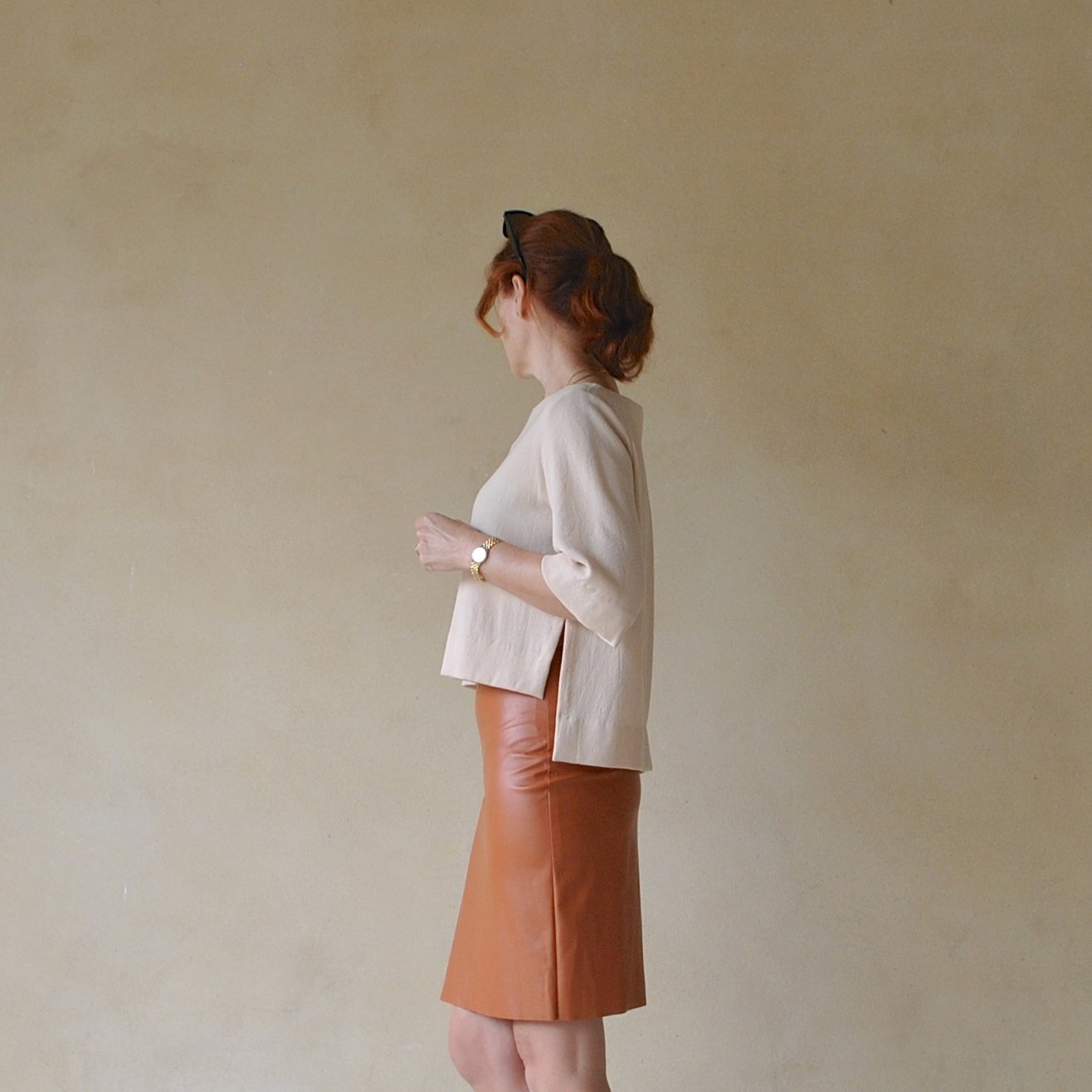
 

Pattern: the Megan Nielsen Axel skirt.  I bought this pattern a few months ago, on one of the several occasions I’ve wandered into Potters Textiles in fruitless search of the Dove blouse pattern.  The Dove seems to be a pattern that is perpetually sold out… yes, I could have bought a pdf but I kinda had my heart set on a paper pattern.  Mostly because I adore Megan’s illustrations that she does for the envelope.  Aren’t these adorable?   I also have another, different Megan Nielsen pattern that I have recently finished too… but that shall wait until another day and its own separate blog post…. 😉

I made the short, straight version 2 only without the waist ties because this one is actually just my trial version of the pattern…  I was toying with the idea of using it for one of my Melbourne fabrics and just wanted to test it out for fit first.  This is a pattern designed for firm fabrics with some stretch, because it is a tight, form-fitting pattern, but in quite a nice way I think.  The style actually reminds me a LOT of the figure-hugging little pencil skirts we used to wear to high school in the 80’s.  Btw, and going off on a random tangent… if you want to see a daggy homemade mockup of my old school uniform; I put this one together for a school reunion a few years ago…

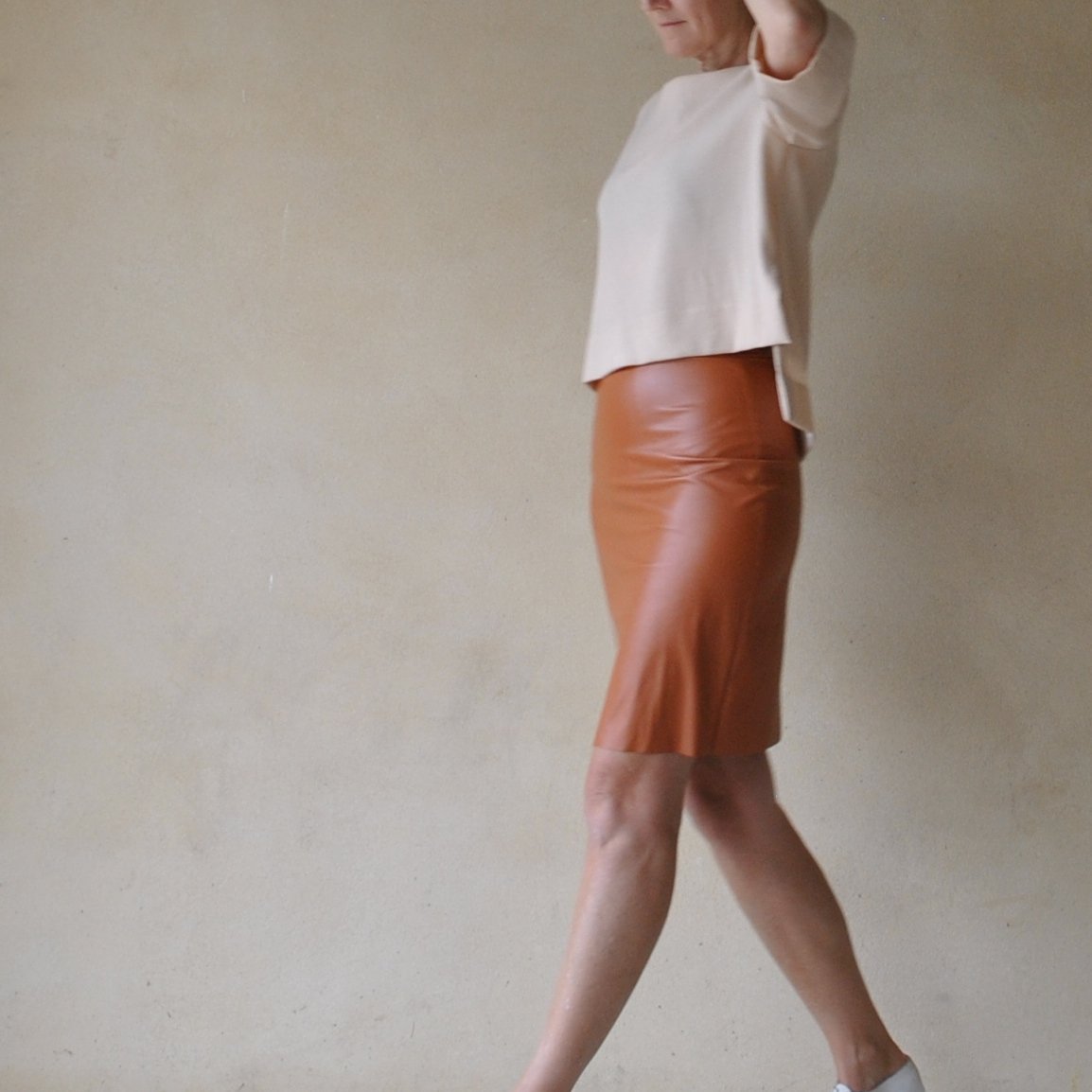
Fabric: a stretch polyurethane laminate “pleather” from Spotlight.  I’d originally bought several metres of this stuff on superDUPER special; I had the thought of making either shoes or a raincoat… then I went off it and shoved it away and out of sight.  As you do!  I’ve made quite a lot of things out of this stuff in the past, here, here, here, here and here!  Some have been more successful than others and so I have a bit of a love-hate relationship with the stuff  😉  When I was searching for something to run up a muslin/trial thing I thought “oh what the heck this’ll do”, made it up, and you know what?!  I’m actually liking how it turned out, like, A LOT!  It’s like an old-fashioned love story; fabric and pattern met, eyes locked across the room, hearts went a-pitter-pat, the stars aligned, fireworks exploded, champagne corks opped, they rode off into the sunset together and are bound to live happily ever after.


Some details: I cut the front on the fold so as to eliminate that unnecessary centre front seam; also, to accommodate my ahem, pear shape; I pro-actively graded out from an S waist out to an M at the hips.  And I’m pretty happy with the fit. See, this is why we sew!  Style-wise; it’s an extremely simple, no-fuss, zero-drama design, with absolutely no closures; just the simplest of bands for a waistband that you pull up over your hips.  Not even kidding, this took me like a few minutes to whip up, tops.

simple stretch waistband


I’ve learnt in the past that this pleather doesn’t hem well… so I just cut a sharp clean edge using my rotary cutter, and angled the seam allowances inside the skirt so there’s no danger of them peeping out under the lower edge.
Also, it’s tricky to press, but does look about a thousand times better if you do… it’s best to press on the underside and use scrap fabric when you’re going over the seams, the plastic right side of the fabric will soften and melt ever so slightly and I found I had to peeeeel off the pressing scrap after pressing.  So it’s best to be quick and not let the iron linger on for too long!  Some more of my tips for sewing with leatherette or pleather are here and here


Details:

Skirt; MN 2207 (Megan Nielsen Axel), terracotta polyurethane laminate “pleather”
Top; own design variations on the Epaulette cut & sewn from the Japanese pattern book “she has a mannish style”, also called “she wears the pants” by Yuko Takada, apricot crepe, details here
Shoes; designed and made by me, details here

Location: along the South Perth foreshore

pinterestmail

the year of handmade, 4

yoh4

gday howzit going, yeah good thanks.  (Aussie terms of great endearment)

So, I’ve been going for four months now wearing 100% made-by-myself clothing and shoes, yay! I’m a third of the way through!  Only eight months to go!!!  Oh dear, that’s slightly depressing.  I do not want to look at it in that way at all!  8 months, eeek!

Above is a selection of some favourite outfits for the past month, the entire shebang so far can be viewed in my Year of Handmade Flickr album here

Do I have anything new to report? well the making of my winter boots felt like a mini game changer, I just love those things so much and feel like they go really well with my preferred winter uniform of a little skirt or short dress with tights.  When wearing them my feet are perfectly warm, and I feel comfy and confident and dare I say it, awesomely shod!  Yes, I dare!  I love them THAT much.  So please excuse a bit of preen-y, prideful boastfulness, ahem.

Everything is chooffing along just fine.  My yellow tape shoes are wearable, but I’ve worn them in the country, in the rain, and in the dirt and so they’re embarrassingly dirty and a wee bit revolting now.  That’s ok, I don’t mind having a pair of hard-knock shoes! so I haven’t tossed them out or anything.  I’m also using my black taped derbies for walking Sienna in the mornings too.  At least the dirt doesn’t show up on the black!

Something (obvious) I have learnt: DIRT AND WATER ARE THE ROOT OF ALL EVIL  SHOE DAMAGE  Seriously.  Dirt is bad, water is bad, dirt and water combined? well good luck to your poor old shoes surviving that!!  Walking on the beach, or through fully wet and muddy grass is like the worst things you can do to the life of your shoes.  Yes, I did say it was obvious.

I’ve had to perform minor repairs to several pairs of shoes during the last month, however I’m pretty confident that they’re hanging in there alright and that each time I’m repairing something I’m learning more about how to improve them at the same time so the same little issues won’t happen again.

Also; I avoid mud and puddles like the plague now! or at least, immersing my shoes in those things… 😉

So, maybe this is a good time to talk specifics; my ongoing shoe issues are all bound up with identifying and then obtaining high quality glue and soling materials here.  It’s not so much that good gluing and soling materials are not out there, obviously good supplies are out there, since plenty of shoemakers are making awesome shoes.  Let’s just say, it’s more a case of; the information is in obscure and often out-of-date places, and even when someone is using a particular product and you can and do get hold of it for yourself; there is scant information on the correct application, and then almost nothing by way of review, telling you whether it actually worked for that person long-term, or not!  This has made it quite frustrating at times.  Those of us delving into making shoes have to play this game of trial and error and sort it out of ourselves.

Soling: I’m still using rubber sheeting from Bunnings, which is fine really, considering there’s nothing else in Perth.  Trust, me, I’ve looked!  However, after much umm-ing and aah-ing  I have taken the plunge and bought a sheet of crepe soling from the US, at heinous expense.  Fairly excited to see how it’s going to measure up, and perform.  Results to appear here, in due course.

Glue: I’m currently using Parfix Gel Bond Contact Adhesive.  Advice from a local shoe repairer was to get hold of Bostik Gel Contact Adhesive, which is apparently available in Bunnings.  However it has not been in stock in either of the three Bunnings stores I have visited which is why I bought this brand instead.  This has been pretty good, but I’ve learnt a few valuable lessons on getting the maximum performance from it.

boots8

Here for posterity are my current findings; and please note: I am far from an expert, and it could be that a proper trained shoemaker disagrees with the following and I am actually doing something else completely wrong that I just haven’t worked out yet.  However, adhering (hehe) to these guidelines has ensured me a pretty well problem-free experience since.

Better results are obtained in a slightly warm environment… say 20C and above.  If it’s a very cold day, I’ve found it’s better to warm up the rubber in front of a heater.  My experience is that rubber moulds to the bottom of the shoe far better when it’s a bit warm.

Thoroughly “rough up” all surfaces before use by giving them a good solid sanding down.  Use high grit sandpaper, or even start off with a rasp or metal file.

Wipe off surfaces with a dry cloth to remove all “bits”, and then follow manufacturer’s instructions for application and wait time.  When putting the two layers together I use a hammer to gently hammer all over; in the case of the shoe sole, I apply the hammer pretty liberally and firmly.

Can I just say, the hammering bit is enormously satisfying  *evil chuckle*

You can leave the tin of adhesive open for a while and even leave the brush perched on top and unwashed for up to, say, three quarters of an hour with no problems.  Any longer and it’s better to wash the brush; soak and swoosh and dab it around in turps, and then remove the adhesive pretty promptly.  It’s actually quite easy to pluck and roll the adhesive out from the bristles after a good “turps”-ing; it becomes quite rubber-y and not particularly sticky and can be pulled out without much fear of it gluing together your fingers.  If you want to do some more adhering, use a fresh brush, or wait until the first brush is fully and completely dry of turps.  Do not let the adhesive get turps in it, because it seems to slightly spoil it, and it becomes just a little bit less effective the next time you use it.

OK, my year of handmade report deviated somewhat into shoe-talk.. whoops, sorry about that!  Well, I guess it was inevitable that the “challenge” for me in my Year of Handmade was always going to be all about the shoes!

pinterestmail

winter boots

winter bootsI MADE THESE!!!

OK, maybe I’m a bit biased here, but to my eyes these are just about the most beautiful things in the world right now!!

So I finally did it! and I’m even extremely happy with them to boot (haha!) and after a month or so of mental anguish and metaphorical hair-pulling even I can find almost no fault with my (eventual) finish.  It’s true there were some struggles along the way yes; but I’m so happy now, and those dark moments have faded away in the happy, warm fuzzy pink glow in which surrounds me right now.  I even dressed today to match it  😉

winter boots1So, the process…

boot pattern

Pattern; self-drafted.  I did buy some long black zips, but eventually decided upon a design which I could just pull on, no zip required, and drafted a pattern to accommodate this…    Before starting, I padded my lasts with a couple of pairs of thick winter socks so as to give my foot a decent amount of wearing ease and allow enough room for my own feet to be well sock-ed too! and taped them down firmly with masking tape, to protect them from the boot-making process, and made my pattern to fit the padded last, obviously.

padded lasts

Materials; the upper is black vinyl, from Clark Rubber,  this comes in two types and I spent a bit extra and bought the UV resistant kind that is highly resistant to whatever the weather may throw at it; sun or rain.  Well, since I plan to be wearing them outside most of the time, and given the amount of work you put into making a pair of boots, the small extra cost is completely justified, in my opinion!

winter boots lining
The boots are fully lined in faux chocolate-brown suedette (above), bought originally in the Fabric Store in Melbourne, and which I have used to line nearly all my shoes so far.  It’s the same stuff I used for my chocolate suedette top, here.

For the soles and heels, I used rubber matting from Bunnings. I cut these to size, and sanded each surface well before glueing them together using contact gel adhesive, also from Bunnings. Inside the boot, I also glued an insole cut from cork matting, and then over that, is laid a foam inner sole (Coles) which I’ve covered with the chocolate brown suedette, to match the interior. Not that you can see it easily, down in the dark innards of the boot, but still

winter boots buckle

Decorative details: I had “finished” the boots, and they were kinda plain, and I decided they really desperately wanted some hardware, and maybe some straps.  I then planned on some “belts” around each boot with buckles… but unfortunately cool buckles are pretty much impossible to find around about here.  Everything I saw was either diamante or leopard print plastic and without exception totally hideous.  In the end, I compromised with these nickel finished swivel clips to close the “belts” and you know what? I love them SO MUCH and am actually super-happy I couldn’t find the buckles I originally wanted after all!  I bought these from Homecraft Textiles.  The three “belts” were all sewn on by hand, after the boots were finished.   And before you ask; yes, this was pretty difficult.  But I reckon it was worth it!  Also, I became acquainted at this stage with how very warm the boots were going to be, even before wearing them, since my hands just about broiled while shoved down in the boots, doing this sewing.

Making the boots…

winter boots half done
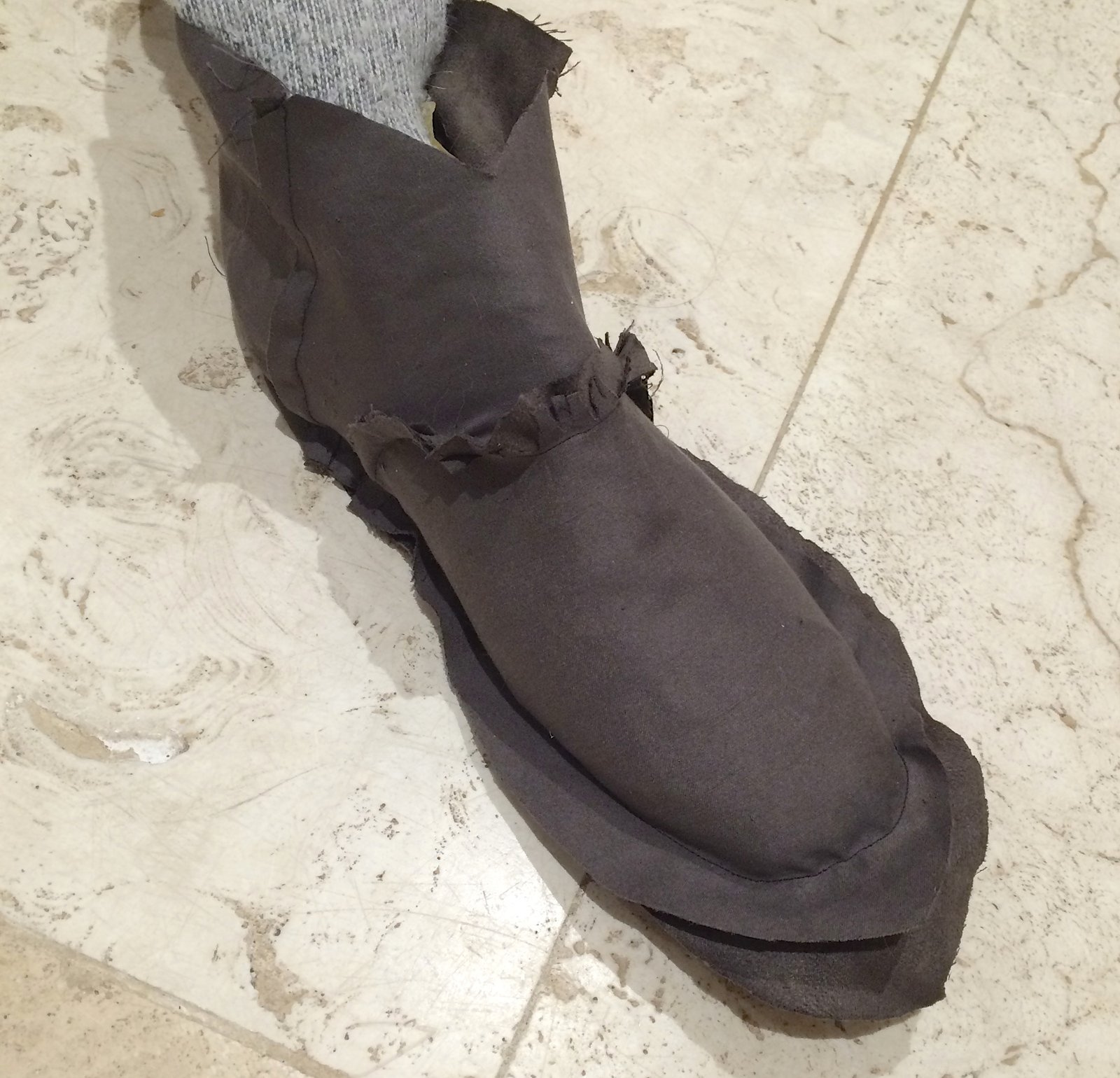
I made the lower part of the boots first, like sort of ankle boots, and did all the lasting and constructing the toe puffs and heels counters using stiff cotton denim with some stretch to it, and PVA glue, just exactly the same way as previously described in the making of my paprika desert boots here.

winter boots innards

My vintage wooden lasts are wonderful things, but because they have a metal plate on the bottom it means you can’t nail into them.  So, I pulled in the well-glued up (PVA glue) sides in under the shoe by stitching it all in, in like a cobweb of back and forward stitching, using thick strong Gutermann’s upholstery thread (above).  You have to do this reasonably quickly, before the glue hardens and dries too much, but it’s not actually difficult.  Then I left it all to dry thoroughly, before skiving and trimming much of the bulky folds away underneath.  After this, I glued the sole underneath with contact gel adhesive, and glued and nailed the heel into position, just as for all my previous shoes

Once this was finished, I had two completed ankle boots (above), and it was time to add the “calf-tubes”.  Yes, I expect there is some proper name for those, but that is how I thought of them!  I found it was impossible to machine stitch anything beyond this stage, with my little home sewing machine, and don’t have access to a shoe-maker’s sewing machine, so all the rest of the construction I sewed by hand.  I sewed the lining and outer tubes around the top of the “ankle boots” in a way as to enclose the seam within the two layers, then  hand stitched the tubes up the centre back seam using a leather needle and tough Gutermann’s upholstery thread.  I used back-stitch for the calf-tube to the ankle boot seam, and ladder stitch for up the centre back seam for this.

winter boots sewing

half sewn up…

winter boots sewing 1

Oh, I did manage to sew the upper “hem” by machine! although this was not particularly easy, what with the thick fabric and the boot and all.  I cut the lining to sit neatly underneath the hem, glued the layers together as best as I could, then glued the upper vinyl hem down, and stitched it.  It’s doesn’t look like it would be hard to sew the top hem by machine but just trust me, a boot is a far from manoeuvrable thing to sew.  The final sewing step was to add those three decorative “belts” per boot, as described above.

winter boots heel sandedwinter boots heel1

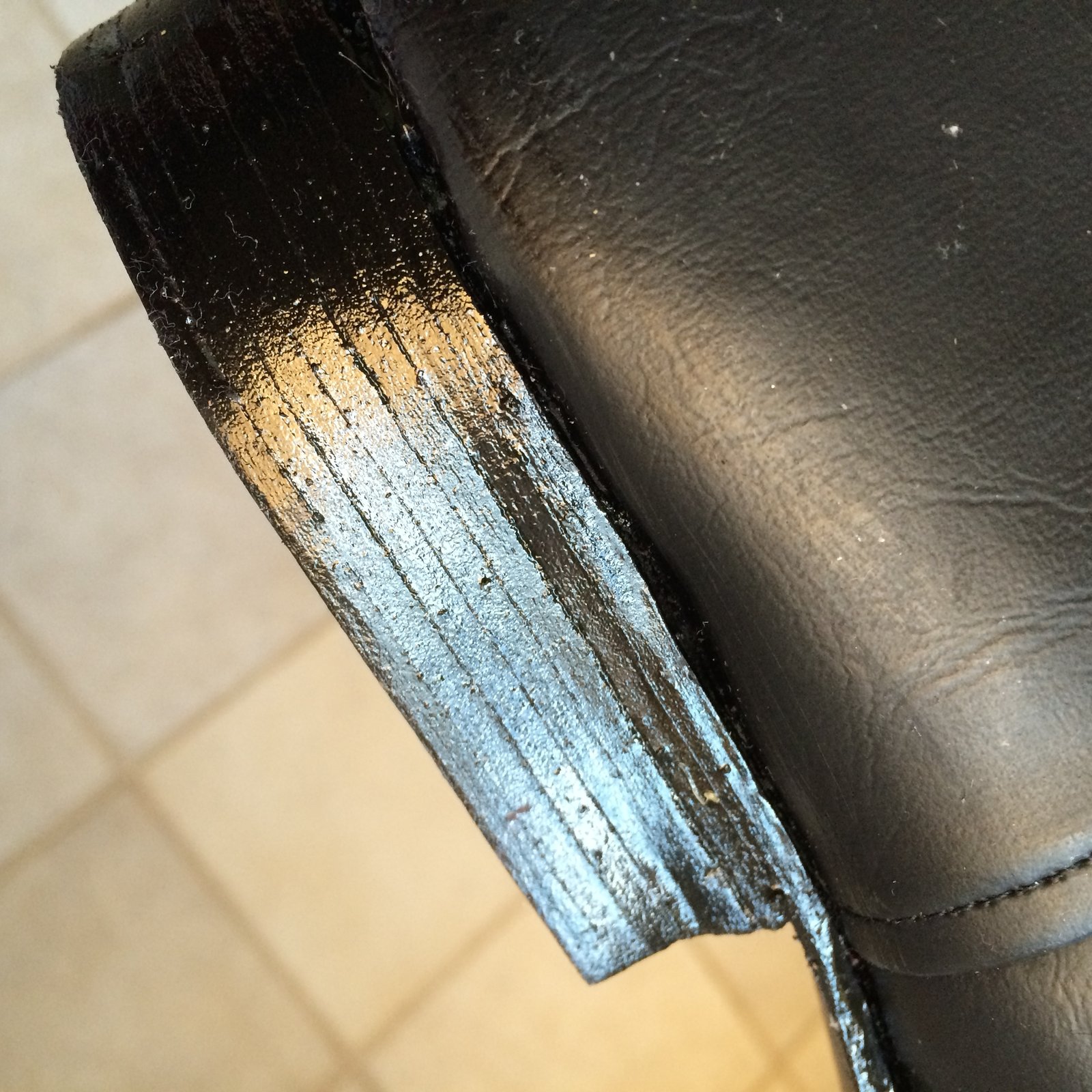
Then for the finishing off!  I’d cut my heels carefully, but they were still a bit uneven.  In previous pairs of shoes I’ve sometimes left the unevenness, because I kinda liked the randomness, but in this case I wanted a more smart finish… I sanded the heels till they were all beautifully smooth, and then “blacked” the heels and the sole edges (above).  This also camouflaged some stray small blobs of glue that were here and there, that I hadn’t managed to get off with turps.  The very final step was to varnish the heels and soles,  so they’re all nice and shiny and clean and, dare I say it? almost rtw looking?!

winter boots 4

And done!!

winter boots 2sorry for the picture overload, but honestly; I’m so proud of those boots I could burst!

winter boots 3

Details:

Boots; MADE BY ME!!!!!!!!
Jumper; Jo Sharp design and mohair, knitted by me, all details here
Skirt, Paprika patterns Jade skirt, in burgundy silk/cotton knit, details here
Tights; self-drafted, black poly stretch, details here, and my tutorial for making your own custom-fit tights pattern is here

Sienna is thrilled with my boots too; you can tell, yes?  😉

winter boots ootd

pinterestmail

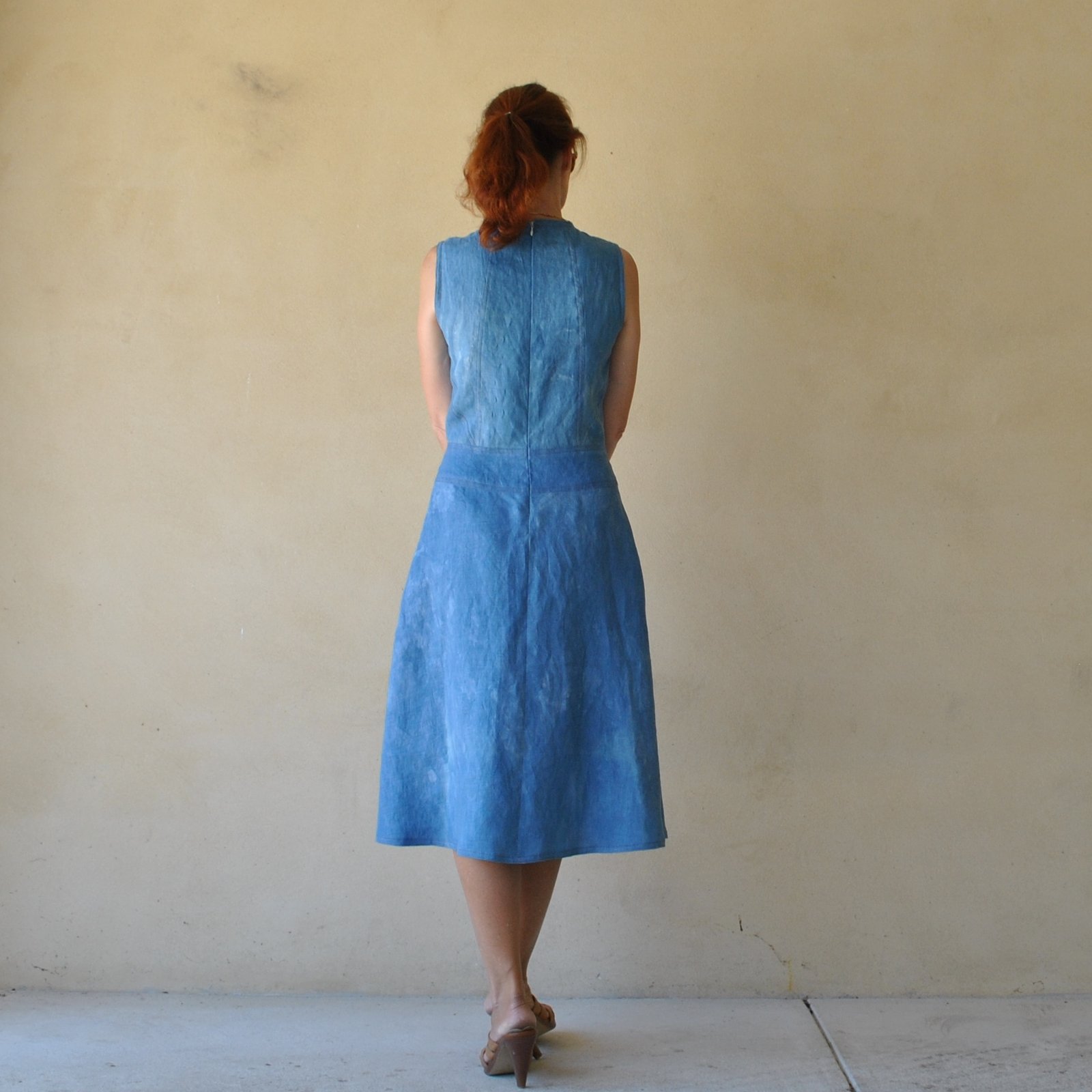
a Japanese indigo dress

DSC_2668
 I’ve made another Yoshimi dress  🙂
Pattern: Vogue 2900.  This pattern will always be in my head the
vogue2900“Yoshimi dress” since her versions are all very inspiring to me, and as well, the lovely Yoshimi herself personally recommended it for me, so there you go.

DSC_2670
Fabric; linen, which I bought as plain white from Potters Textiles and then dyed real indigo, by which I mean using a real live, actual Japanese indigo plant-based dye pot!  Yup, how awesome is that? I feel so very fortunate to have been given the chance to use Japanese indigo dye, since it’s quite a rare beast in WA.  Growing the plant itself is very difficult here, and yes, I have tried and experienced a personal fail myself in that area… *represses sob*

Anyway, a few months ago, Nicki got together a group of us Perth girlies to go on a fun day out… and what constitutes a fun day out for the likes of us self-dressmakers more that a sartorially related, hands-on, “doing” thing!  And what’s more hands-on than dyeing your own fabric in a real indigo dye vat?!  This dye-vat is the work of the ultra talented and creative Trudi Pollard of Pollard Design Studio.  Visiting Trudi’s studio in Bedfordale and viewing her many amazing creations is quite the inspiring and very humbling experience.  Some of her exquisite textile art can be viewed at the studio’s site here.
IMG_6372 IMG_3735
 I pre-washed my linen twice before the day but was hoping/aiming for just a touch-but-not-too-much blotchiness/unevenness; that lovely natural patina, you know.  It worked out just spot-on how I wanted!

Construction notes: the seam lines in this pattern are lovely and interesting to my eyes and I wanted to highlight them somehow… the first time I made it up I made black cotton edging strips and this time I wanted to do something a bit different, to differentiate it from that dress in my wardrobe.  Now, what does one think of when you think of indigo cotton? well for me Levi jeans are pretty high on the list.  And Levi jeans have that very distinctive double orange topstitching allover, so I went with that as inspiration.  It’s a lot more visually subtle than the black edging, but it’s there, and I really like it!
I had a look online to learn more about the origin of that orange topstitching, and interestingly enough, the reason for it was to go with the copper rivets that were used to strengthen jeans!  Hmmm no copper rivets on my dress, whoops.  Oh well!
I took great care to make sure those diagonal seam lines ended on the exact point and also put in a few little orange bar tacks on other random sewing junctions, for fun.  I know, you can barely see them on the far-away pictures, but up close and personal I think they add a bit of interest to the dress.
IMG_7310DSC_2626
The invisible zip saga… to sum it up, there was not a colour match even halfway acceptable!  I chose a light blue and after inserting, just very carefully touched up the more visible bits of the zip tape with a felt-tip pen.  This may or may not wash out over time, in which case I can always just touch it up again.
IMG_7421
Then the pale blue zip pull was still too glaringly pale for my liking too; so I painted it coppery-orange with nail varnish, custom mixed using a few different colours from the small army of nail varnish bottles that live in my bathroom drawer.  I knew all those funny colours would come in handy again some day!
DSC_2638DSC_2635
Insides; all raw edges were overlocked with white thread, and I used white thread in the bobbin too, for continuity.  I know; it’s not like anyone will ever see inside the dress, but to have it all looking cohesive is still a very satisfying sight to me.
indigofb
So, that’s it, done and dusted!  Now to continue with the small mountain of Christmas-related tasks I’ve lined up for myself and been busily and secretively working away on like a squirrel.  I feel like I’ve been racing around like a crazy scatterbrained whirlwind lately.  Crisis point not yet reached, but getting there…
Later dudes!
 DSC_2655
Details:
Dress; Vogue 2900, in indigo dyed linen, with orange top-stitching
Sandals; from the oppie, yonks ago
Sunnies; ma RayBan wayfarers
 in twirlerrific actionDSC_2672
pinterestmail
Switch to mobile version
↓