Tag Archives: Own Design

Another trip down memory lane…

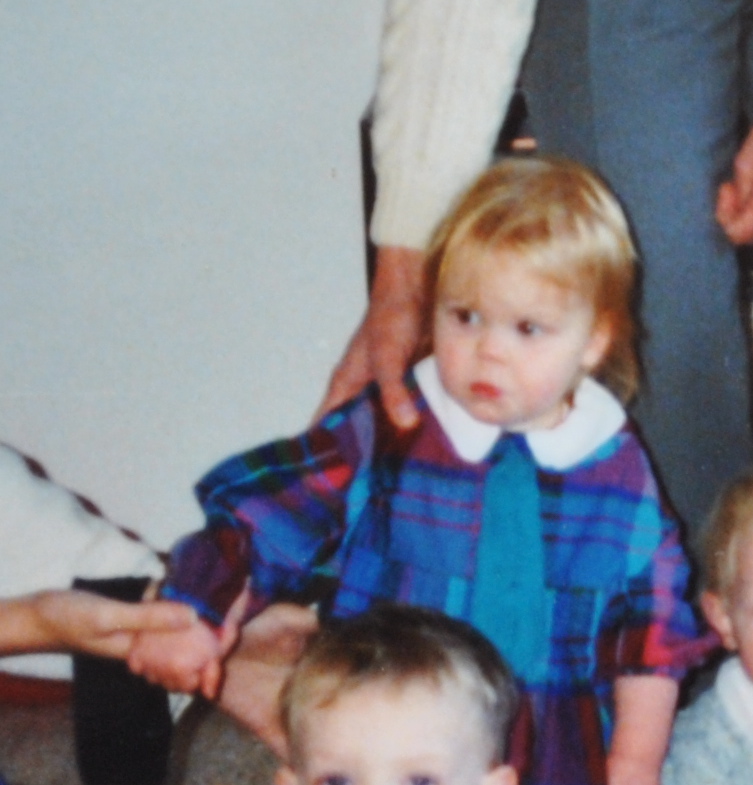
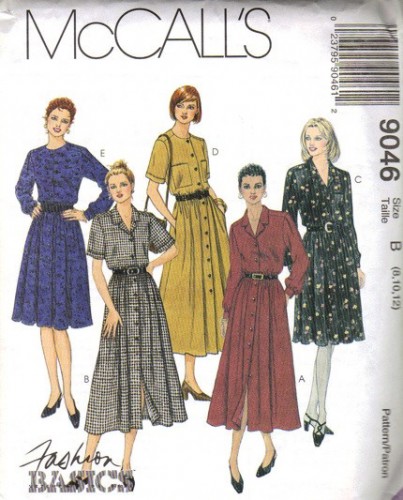
…  Remember when I said I had only once before made Cassie and myself matching clothes? Well this is Cassie’s dress, that was made from the leftover scraps of a dress I had made myself.  Her little dress, made using a TopKids pattern, has a white Peter Pan collar, and a miniature faux man’s tie in turquoise fabric, itself the leftovers from these shorts (so you can see how long I hang onto scraps…!)  I’m sorry it’s not a very good picture, and what’s more I have no pics of my own dress in this fabric; but imagine this maroon, deep turquoise and red large-scale plaid in one of those 90’s style shirt-dresses with a high small collar, long sleeves and a big full gathered skirt.  Something like the red version of this pattern at right… yes, very very very 90’s.  I hope I haven’t shattered any delusions of myself as a style maven now!  At least I never liked shoulder pads so never used them.
So I’ve got that going for me…    (Can anyone recognise that quote?)

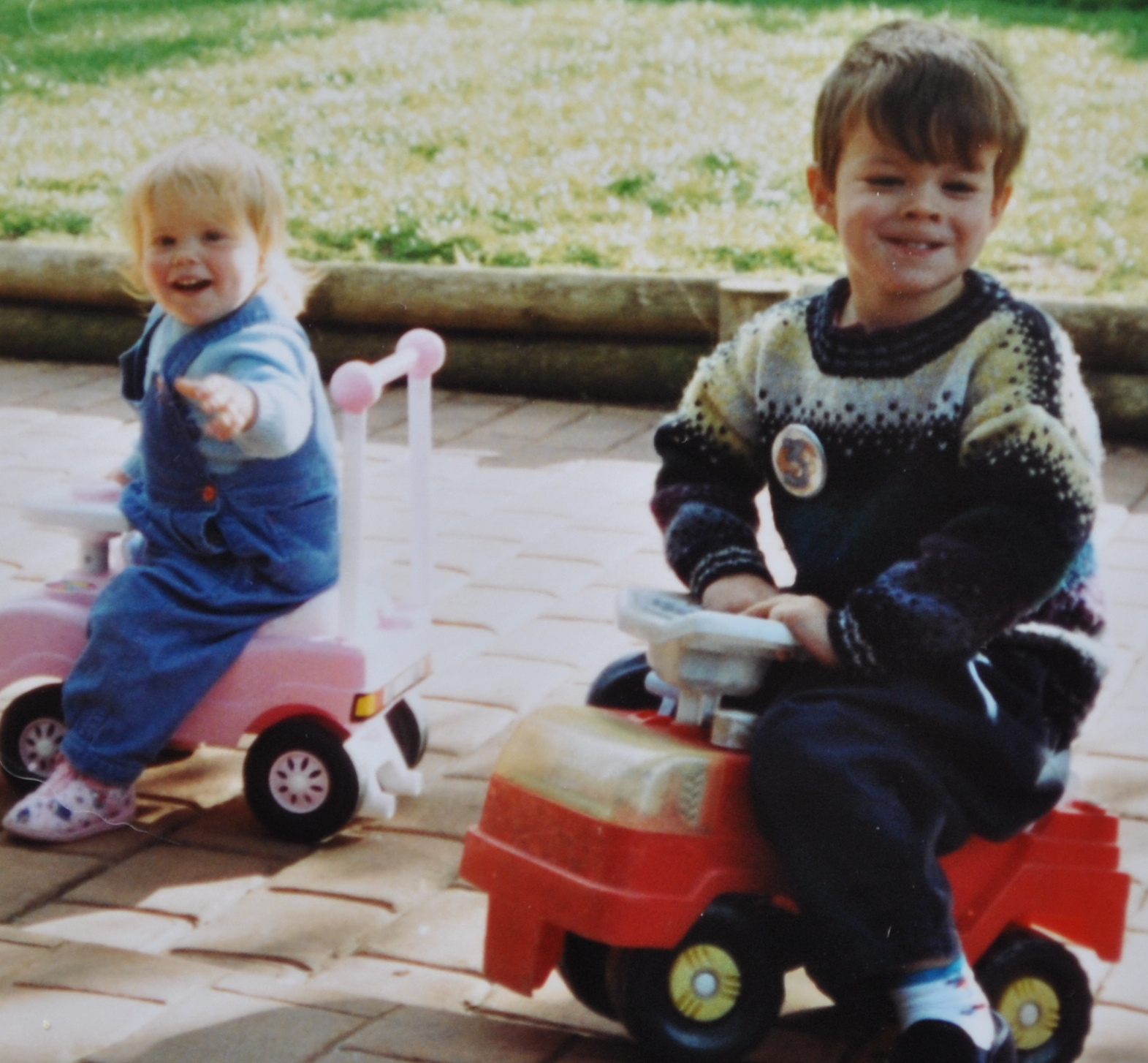
Tim is wearing here a little jumper here that I knitted for him using scraps of wool from other projects… rather cleverly eked out if I say so myself, so that the front, back and both sleeves had the same colours and in the same proportions!  Knitters will know this is not necessarily a simple thing to achieve when you are working with scraps…  It went from the dark shades of purple, blue and green at the bottom through grey, then pale blue then the palest yellow and back to navy blue at the top, and the colours were not in defined stripes but faded together in an ombre effect.  I did this by knitting two colours together per row in the fair-isle knitting method.

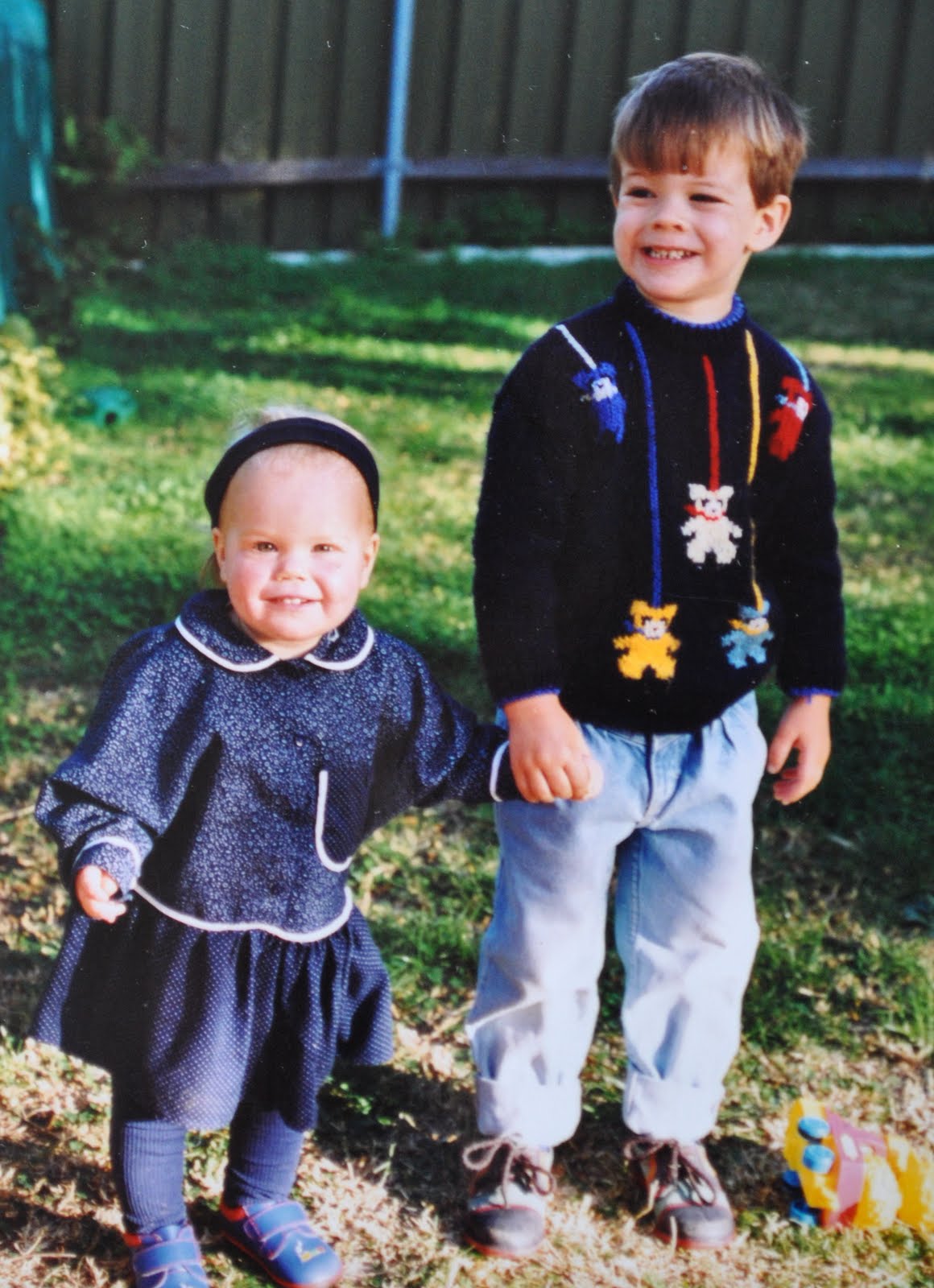
In this picture, Tim is wearing another jumper I knitted, and I can’t recall now if it was from a pattern or if I took the embroidered teddy bear design from a cross stitch and just transposed it to a knitwear graph… yup, memory not what it used to be!  Again using scraps for the teddies.  Cassie is wearing a little dress I made for her using a TopKids pattern.  It was in two different white and navy blue prints, one a polka dot and the other a floral.  The fabric was slightly fluffy, brushed cotton, and I sewed in white piping around the collar, sleeve cuffs, the single curved breast pocket and around the dropped waistline where the buttoned-up blouse joined the skirt part of the dress.  It was quite cute, no? and a nice and warm little number for winter!

And the quote?  From that great 90’s cinema classic, Caddyshack.

pinterestmail

Sam’s quilt

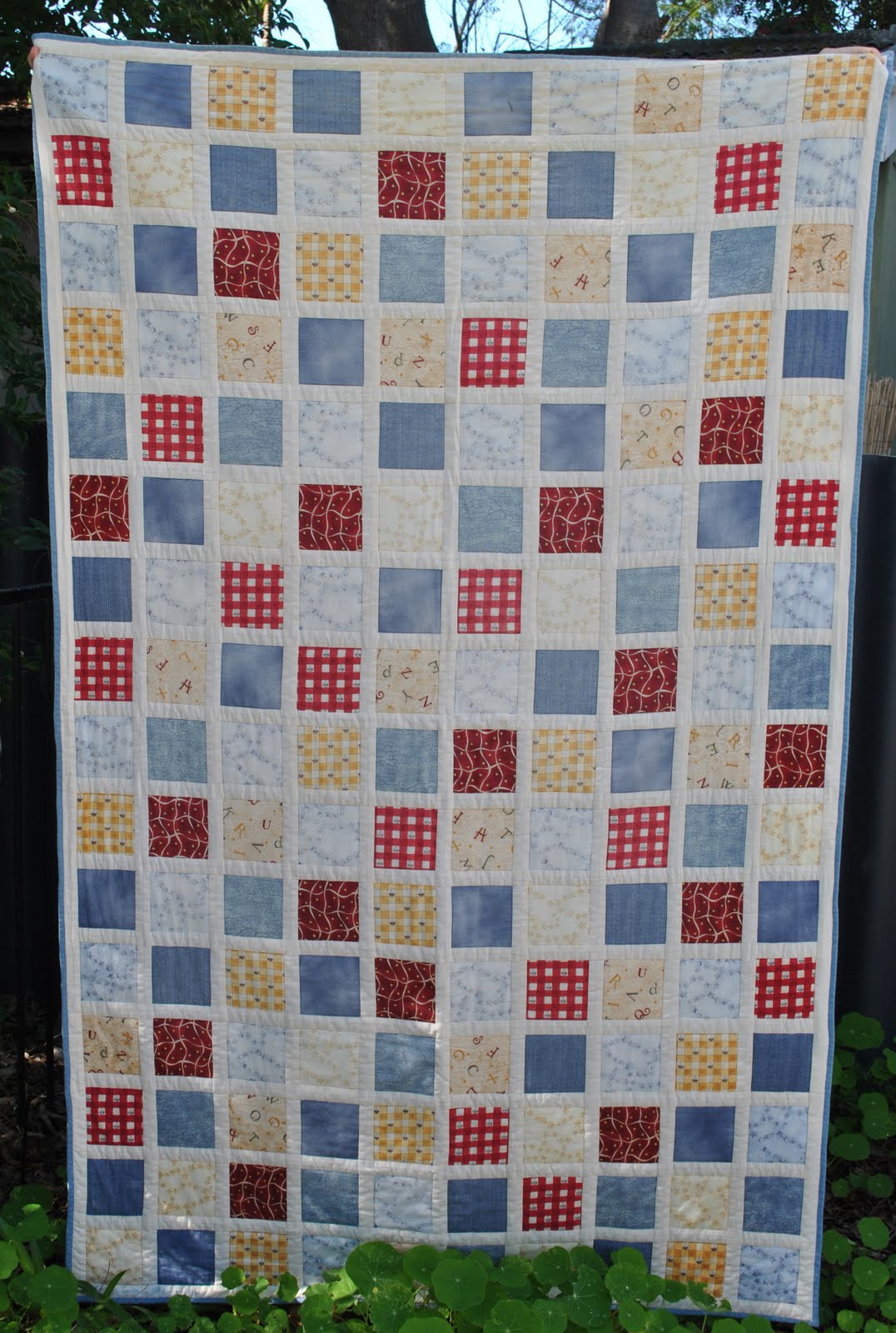
An ongoing part of this blog is the documentation of stuff I have handmade in the past, including the small collection of quilts I have made for my family.  I have shown here before Tim’s quilt and Cassie quilt, now here is Sam’s quilt.
Like the others his quilt still lives permanently on his bed, but unlike the others has never had to be repaired and, apart from some fading of the colours, is in very good nick.  This is probably due to three reasons; firstly probably because it is the newest of the three, but also possibly because Sam is not the sort of boy who played on his quilt like the other two did.  He liked to hang out with his older brother and sister so would go and play on their beds instead!  And lastly, because I had finally learned about finishing a quilt in the traditional way this one is actually finished off “properly”, if there is such a thing!
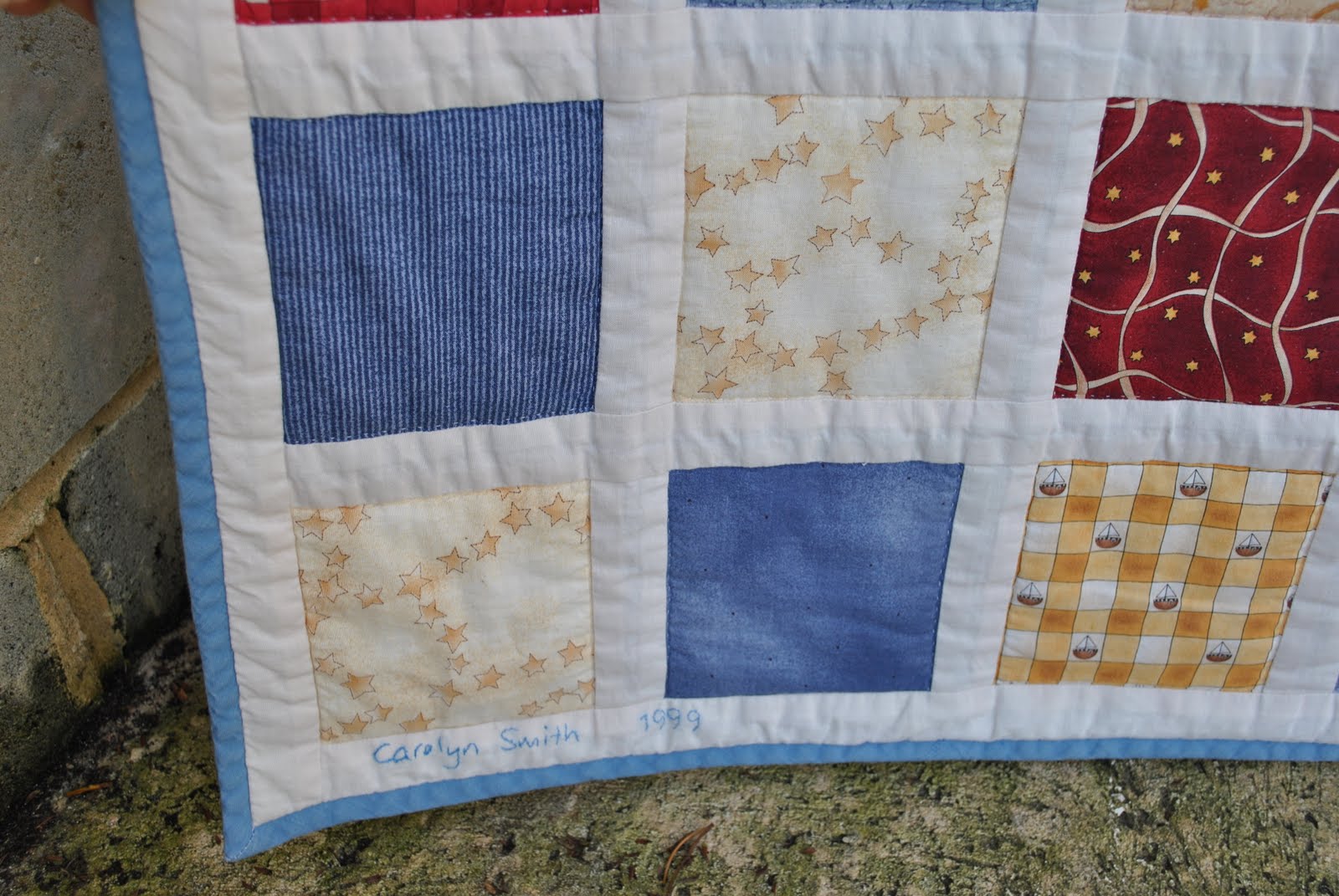
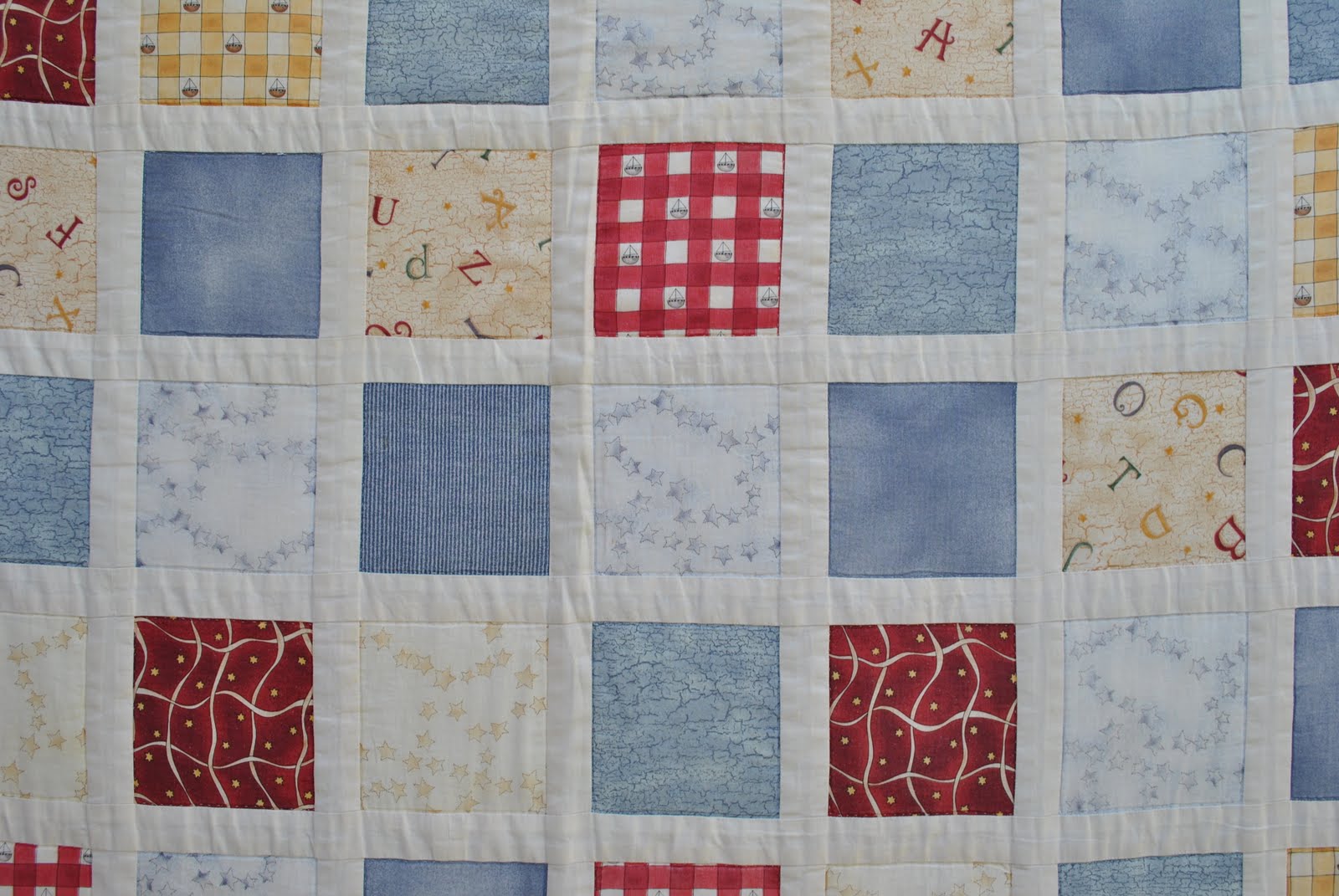
The design is a simple arrangement of squares of fabric that I chose because I liked them, and I thought the soft antique-y shades of yellow, red and blue suited Sam’s sunny but shy personality.  The squares are enclosed and showcased in a grid of pale yellow strips.  The quilt is bound in the traditional method with self-made bias binding.  Each of the squares is bordered by hand-quilting.  I embroidered my name in the bottom corner and the year in which I made it.
Every now and again I read on the internet about the “slow-sewing” movement; a trend that is about taking the time to appreciate the sewing process and work meticulously and carefully on getting a perfectly handcrafted result…  Of course, nearly always such references are about a garment of some sort; a project that would take a few months at the most, whereas to the quilting fraternity (sorority) that time-frame is hilarious!  
A handmade quilt is the very definition of slow sewing.  Making someone a quilt is a labour of love, not a project to be taken by someone after a quick-fix result.   Each of the quilts I have made has taken me a year to complete; no exaggeration.  I have usually machine pieced the top so this can be put together in a few days, but the hand-quilting process takes at least a year.  Anybody who has made a quilt will attest to this highly labour intensive hand-made craft, so I always have enormous respect for people who quilt.  I don’t think I personally have the patience for another quilt (although I have at least one more, I think, to show here.) so I am pretty proud of these that I have made!

pinterestmail

Horrible colour, begone

So, as I mentioned last post, colour

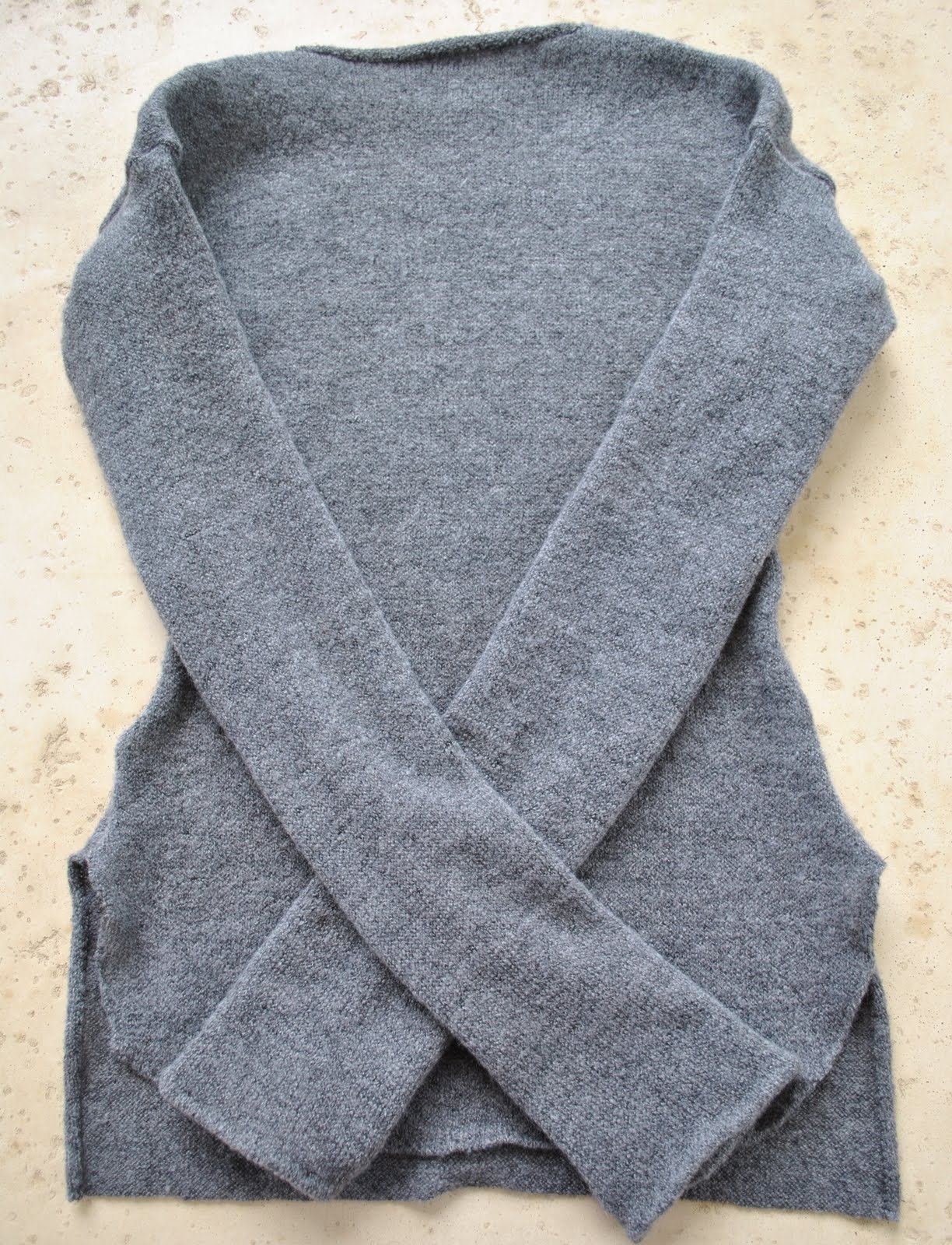
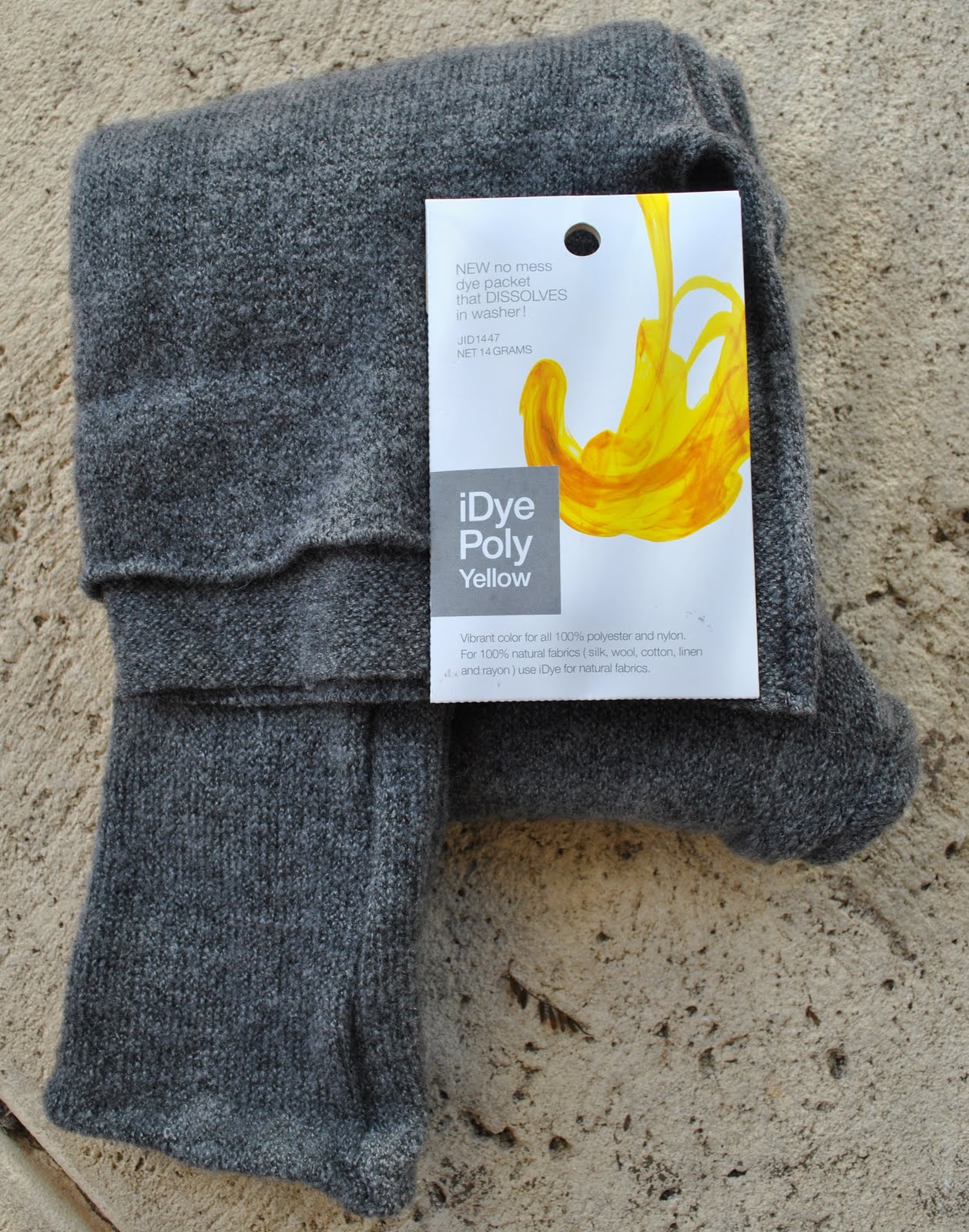
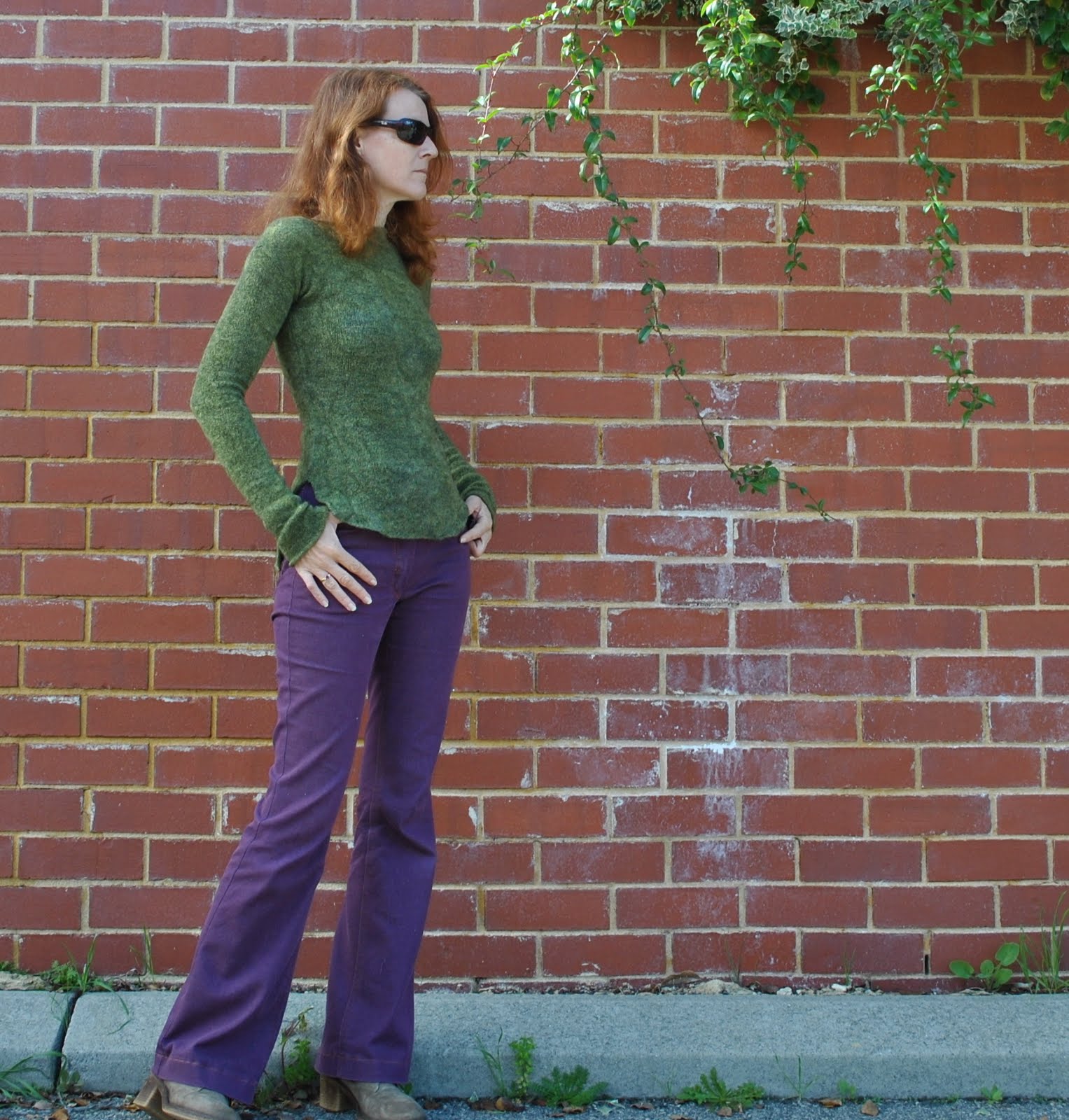
Exhibit one; some grey synthetic knit stuff from the remnant bin.  Remnant bins are a terrible trap really, aren’t they?, the fabrics within can be so tempting pricewise, and the truth is they might not be very “you” at all.  So in a moment of madness I was swayed by this mottle-y grey fluffy stuff and brought it home, and eventually got around to making up a top and donned it, and it looked more than a bit awful.  No I wouldn’t even take a picture of myself to show here on the blog; I looked pale, and ill, and … awful.  The shape of the top was OK and I liked the monastic roughness of the fabric combined with the simplicity of the silhouette, it was just the colour that was the problem here…  So it was off to check out the dye section.  I was pretty sure the fibre composition here was mostly synthetic, so I bought iDye Poly for synthetics, in Yellow.

Et voila!

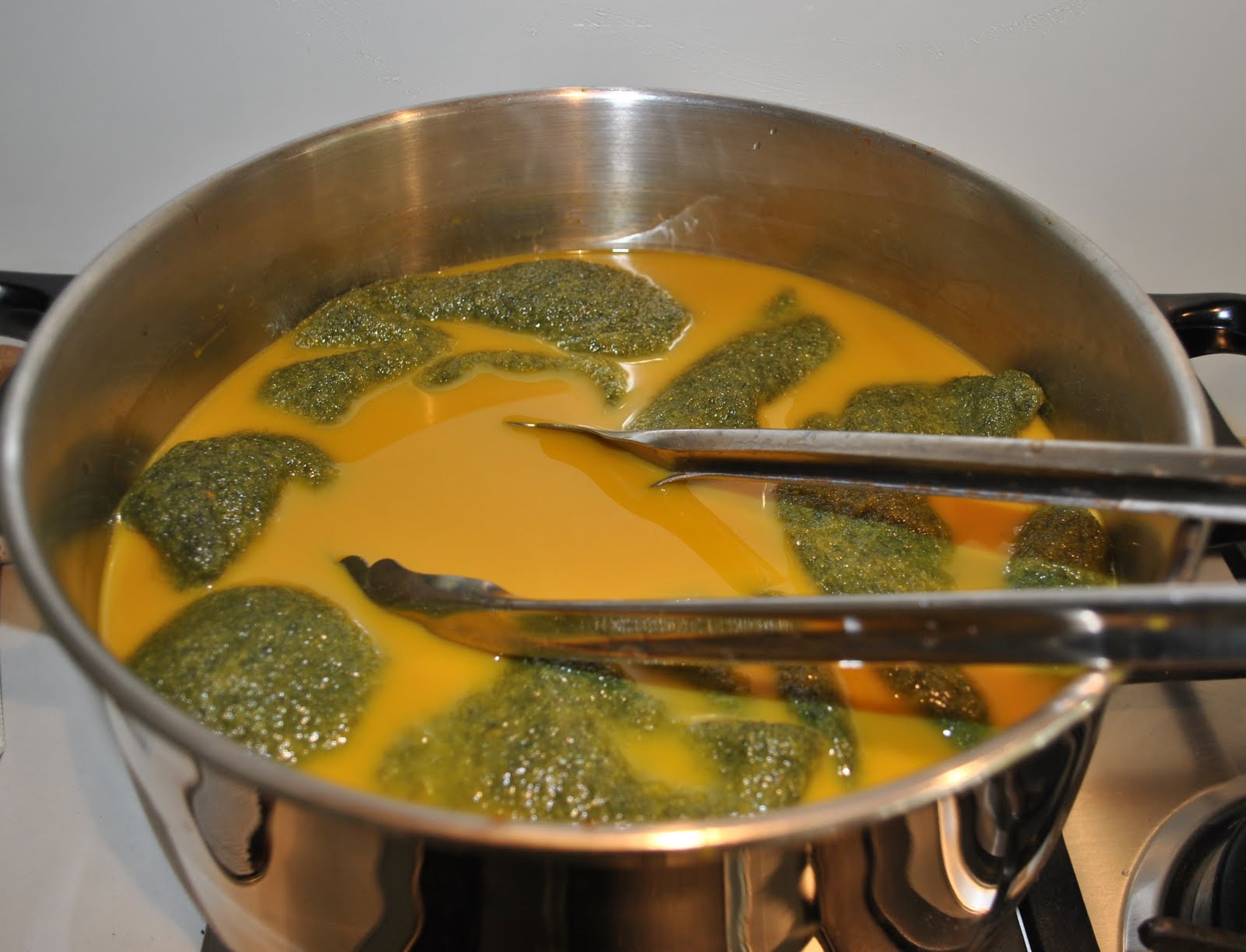
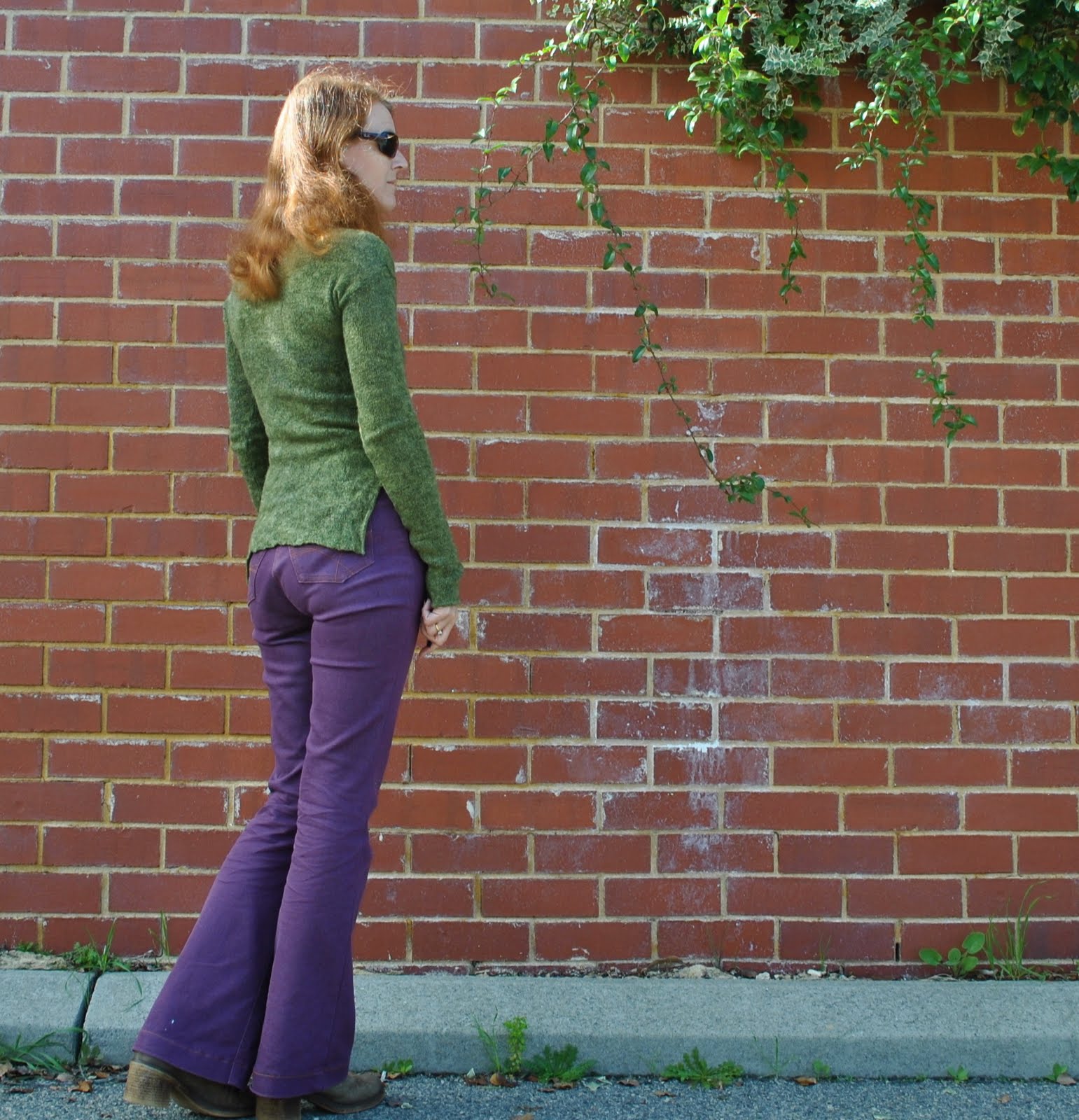
I was just hoping to just get a more yellow-y shade of grey out of this that would be more flattering to my complexion; but imagine my delight at this wonderful moss-y green that resulted!  Obviously the grey had far more blue in it than I realised, and I’m sure we all remember from our paint mixing days in art class at school that blue + yellow = green.  This is a prime (haha!) example right here…

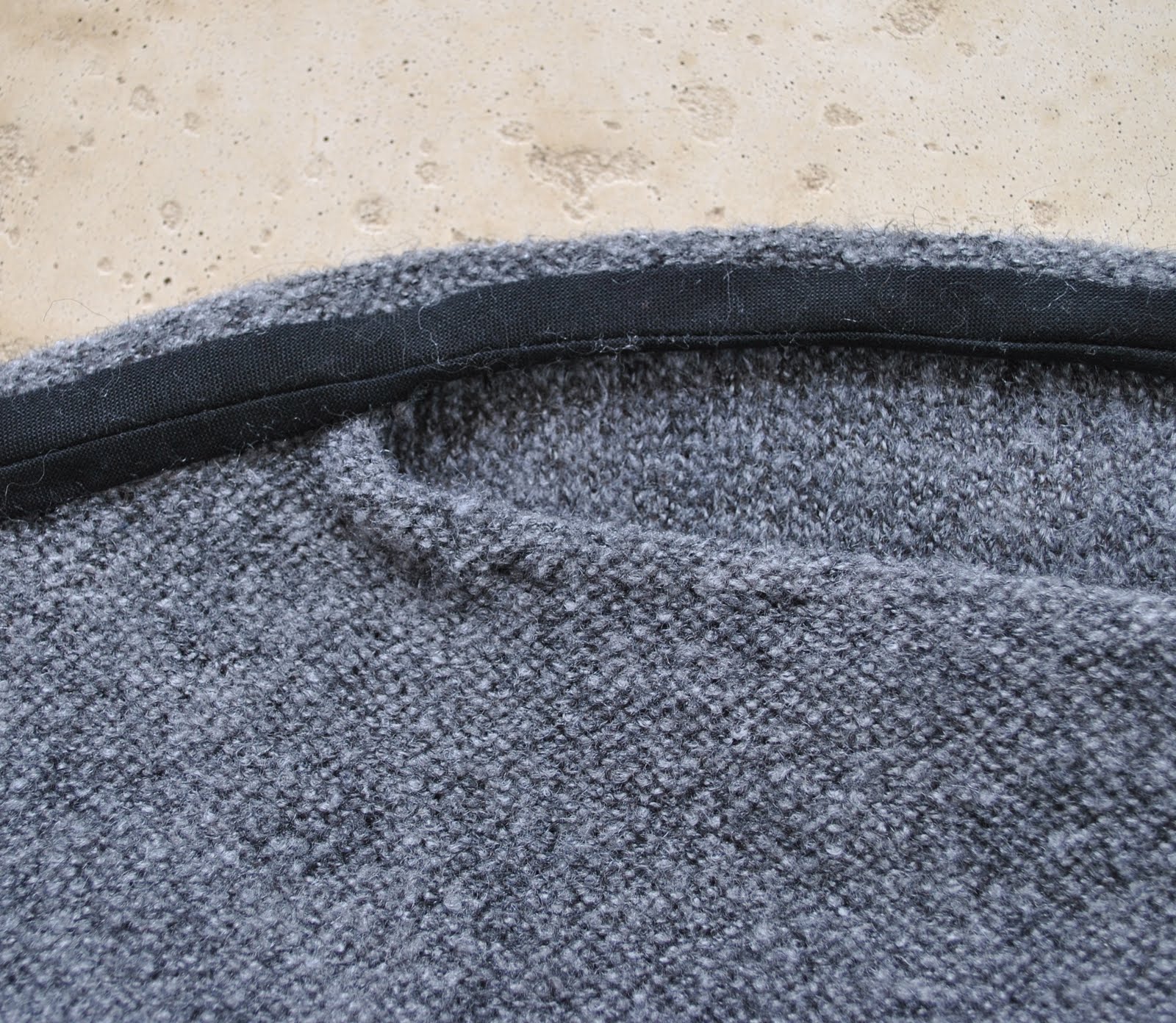
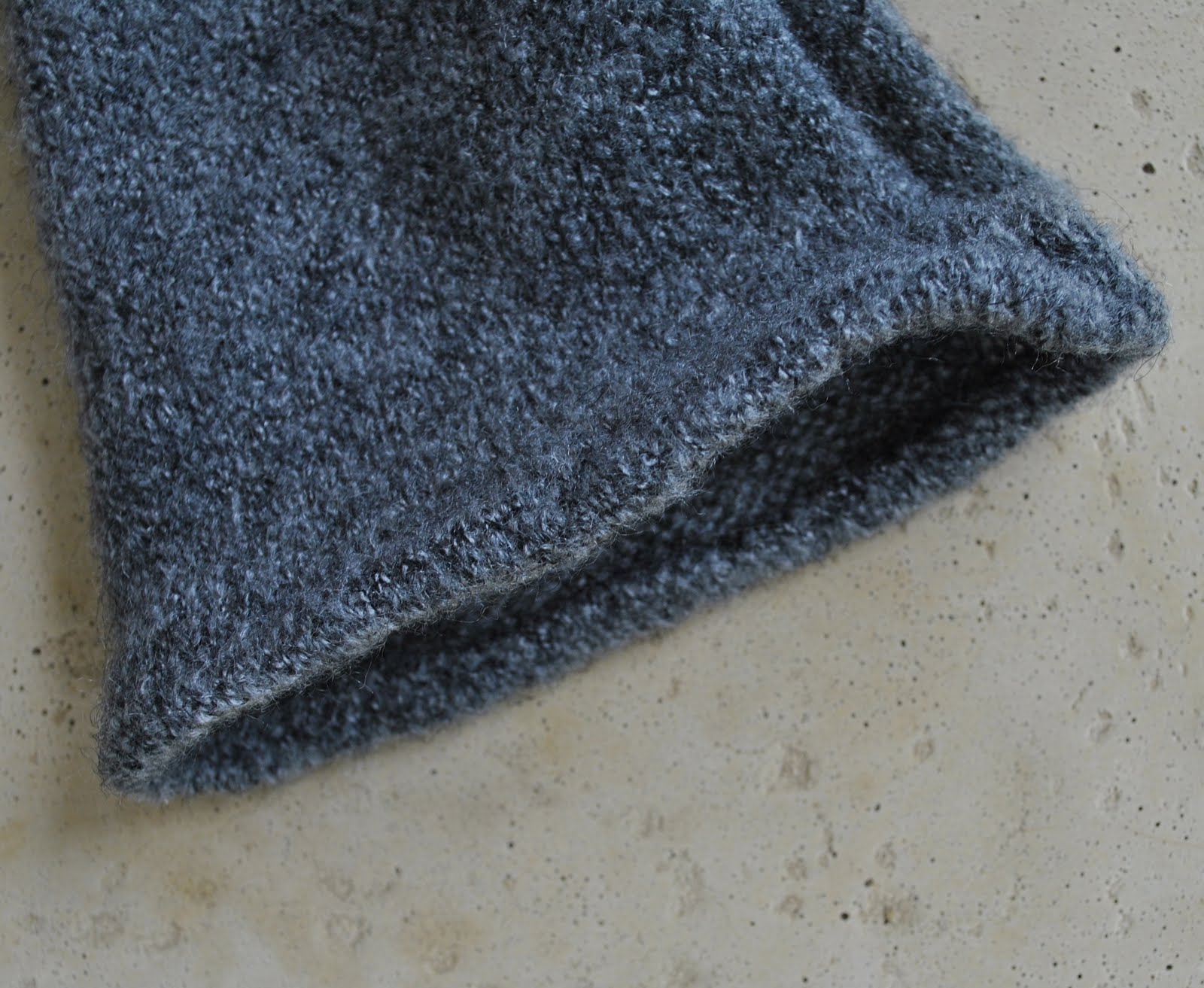
Construction details; I drafted the top using one of my other Tshirts as a guide.  The fabric remnant I had was cut off at a funny angle, necessitating the curved lower front hem. I matched this curve on the other side of the front, but I left the back pieces straight for a contrasting hemline.  Initially I meant to curve the back hem too, but I think I like that contrast now.  Both lower hems are unfinished, and after more than a few washings that the garment received during the dyeing process, I can report the happily un-fray/ravel-abe nature of the raw edges of this knit.  However I did handstitch the sleeve hems in a rolled edge.  The neckline, well I tried to be sort of clever here, and apply a bias binding that would both enclose and stabilise the shoulder seams inside, and as well as finishing the back neckline.  This turned out to be a trickier exercise than I thought to achieve my desired effect, but I think I pulled it off.  The front neckline is rolled to the outside in a tight little roll, and hand-stitched down.  (these pictures taken before dyeing, obviously!)

Final summary; well to think I started out with fabric that was, let’s face it, a bad purchase since I wouldn’t have bought this fabric at full price off the roll, and then finally managed to get something that I am actually happy with; ultimately a successful project.  I’m still not in complete love with the fabric, it is a tad cheap and scratchy but the new colour is so wonderful, and was a far more perfect-for-me colour than I was hoping for.
On that note, does anybody know of a good source of pure wool knit fabrics…?

Details:
top; my own design, from (originally) grey synthetic knit stuff dyed using iDye Poly in Yellow
Jeans; Burda 7863 with some modifications, purple stretch denim, details here
Shoes; Francesco Morichetti, from Zomp shoes
pinterestmail

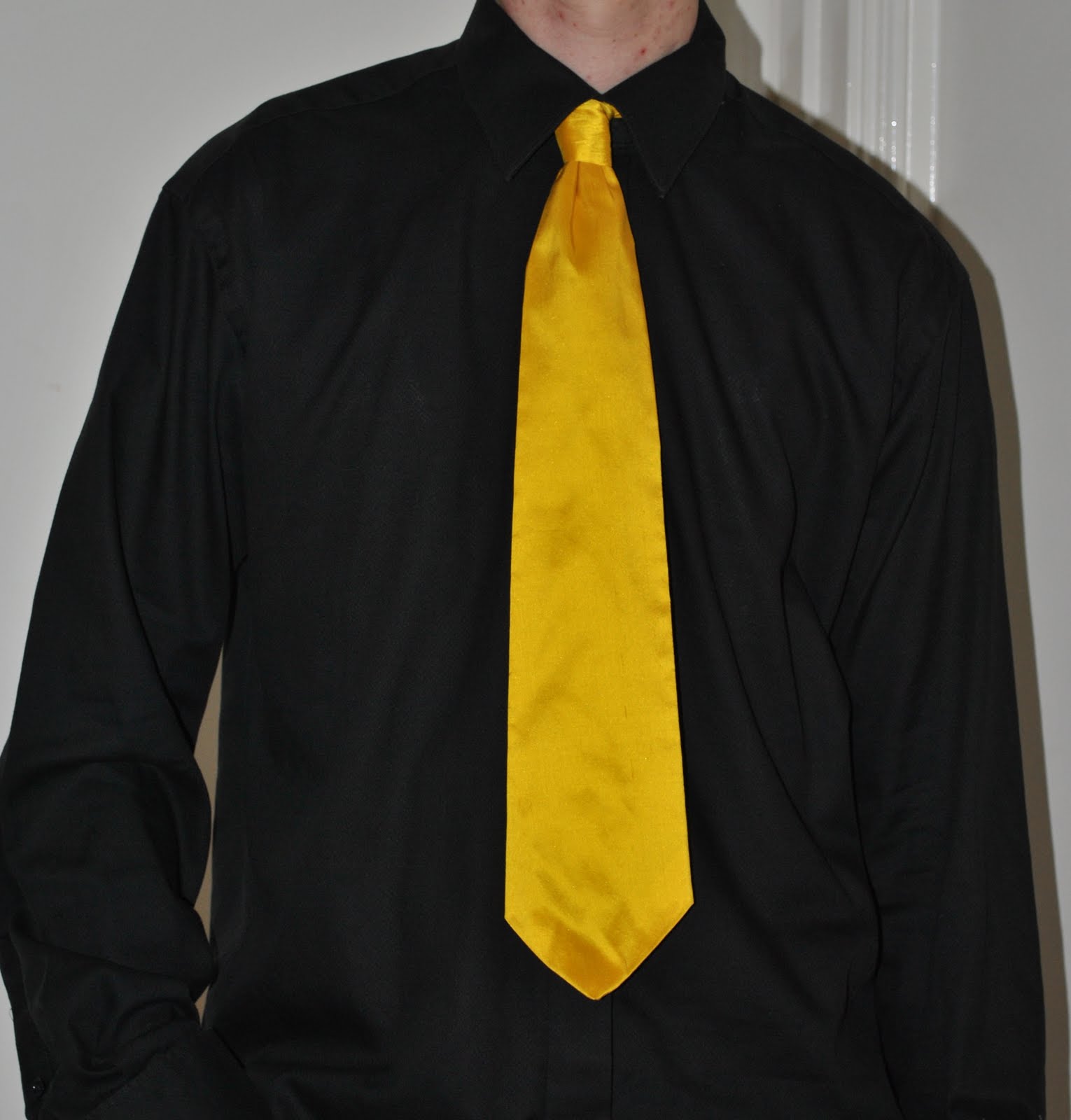
Yellow silk Tie

Oh boy.  I’m not sure if I have done it right, but I’ve just created my first pattern and put it onto Burdastyle as a free downloadable pattern!

If you want you can download the pattern here… you have to click on “print pattern at home” to get the instructions, which form part of the pdf…
So OK, it’s just for a tie (baby steps, here), but it still took me … er, hours.  Actually far far longer to draw and write up the darn pattern than to make up the tie…!
Obviously, please let me know if there are any problems with it and I will sort them out as best I can  🙂
Anyhoo…

So, during the month of June we had Tim’s birthday party, and he asked me if I could make him a tie to wear.  Tim has very firm ideas on his apparel, and always has to look sharp.  Hmmm, where did he get that one from, I wonder…

He had his heart set on a definite colour, and since I had mentioned oh-so casually once upon a time how a tie would be laughably easy to make, and a darn sight cheaper to make your own than the $60 odd you get charged for RTW, even polyester, he put in his request.
So, I have taken apart one or two ties in my time (the last time to make this), and they are pretty easy to make, but I took a few progress shots to show here, so if you haven’t made one before you don’t have to take apart your own tie natch, to find out…
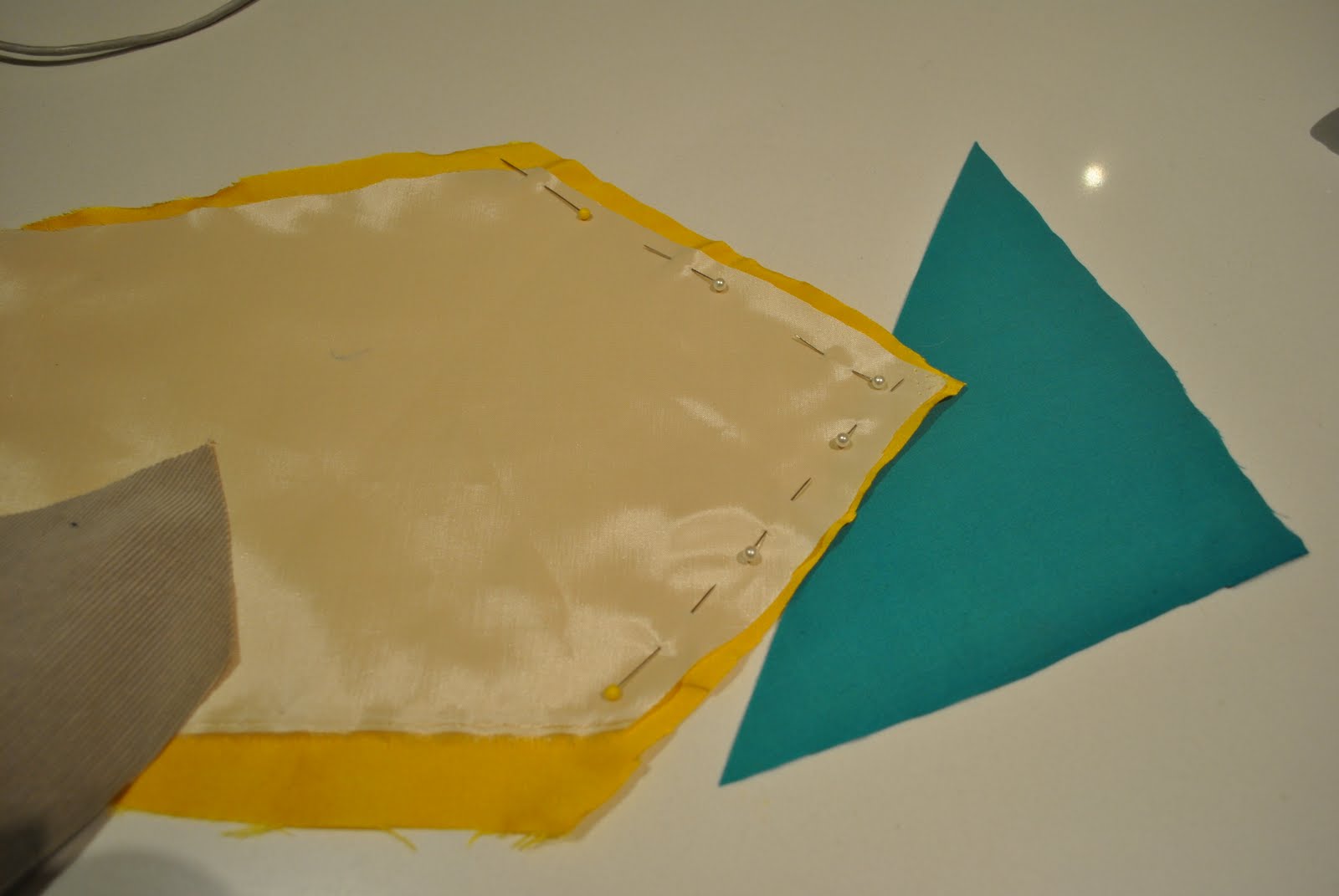
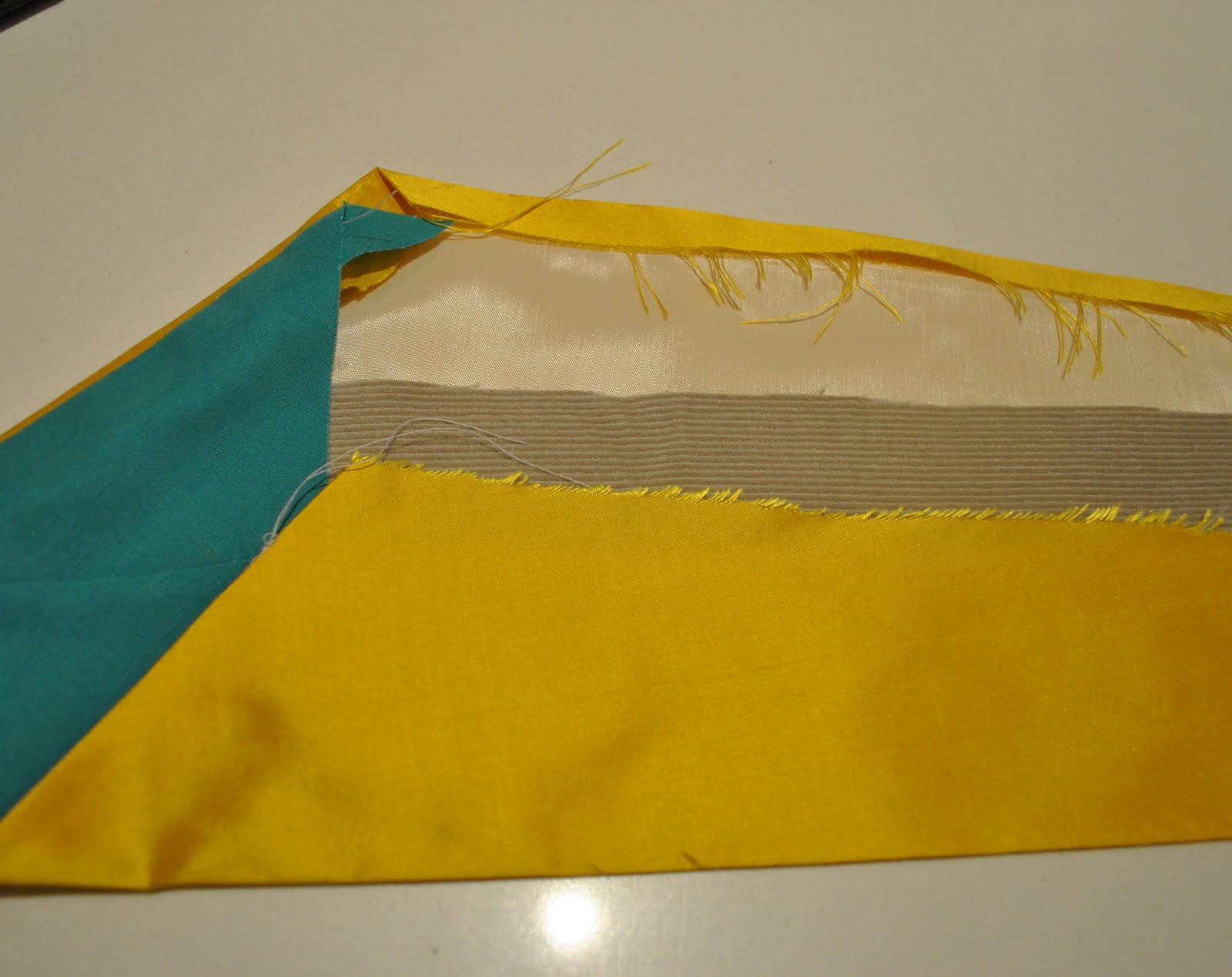
Firstly, a tie has four different fabric components, the outer fashion fabric, lining fabric, padding fabric, and a section of very lightweight underlining fabric.
I used:
For the fashion fabric the lovely rich egg-yolk yellow silk dupion Tim had chosen
scraps of lightweight turquoise cotton for the lining
A strip of corduroy for the padding
scrap of organza for the underlining
The underlining is pinned in place onto the wrong side of the tie, this is presumably to avoid stitching lines appearing on the outside of the tie.
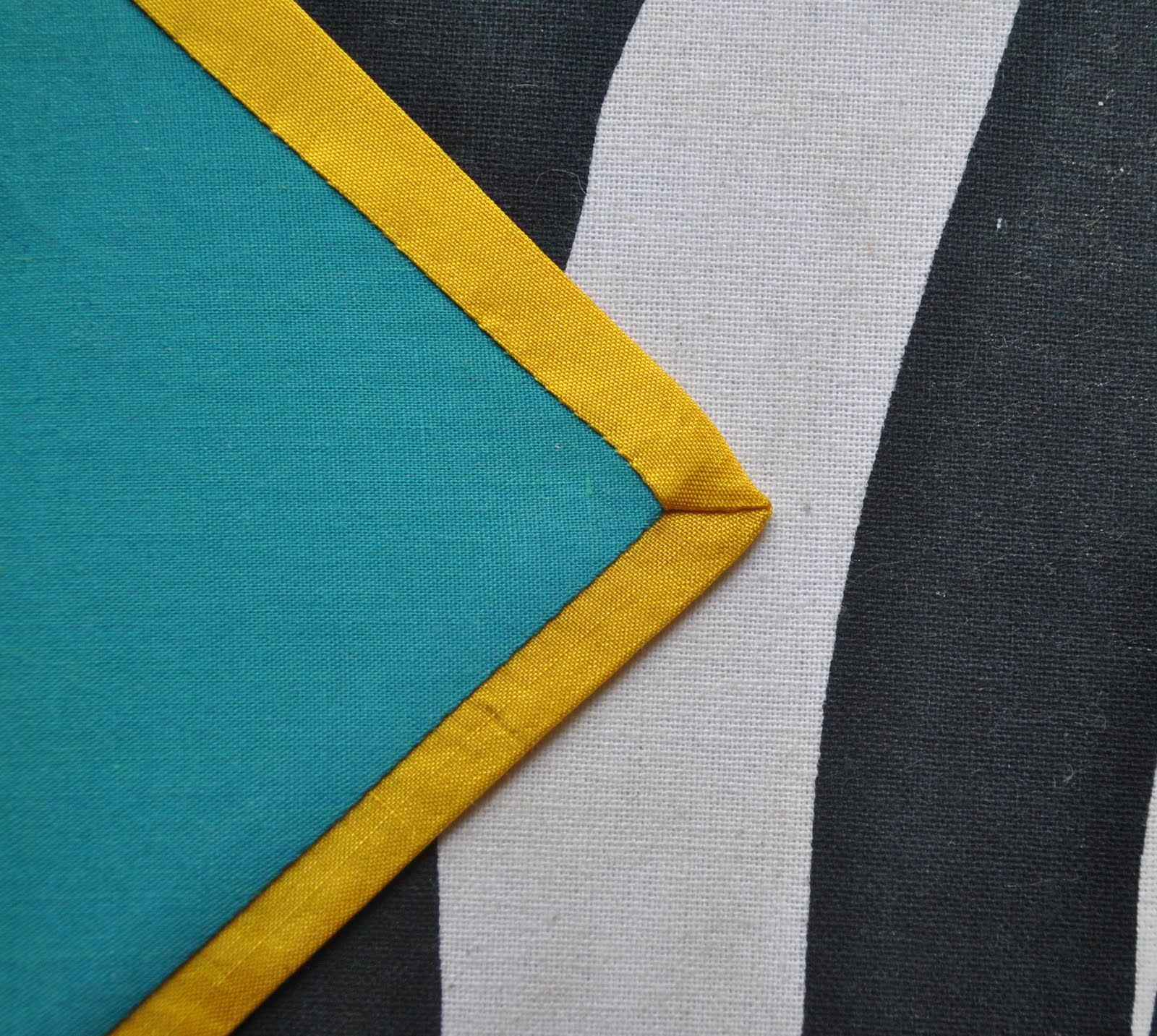
To get the nice mitred top and bottom edges of the tie, which is a nice finish ensuring that the lining fabric will not peep out from around the edges of your finished tie; I sewed the triangular lining pieces on as follows…
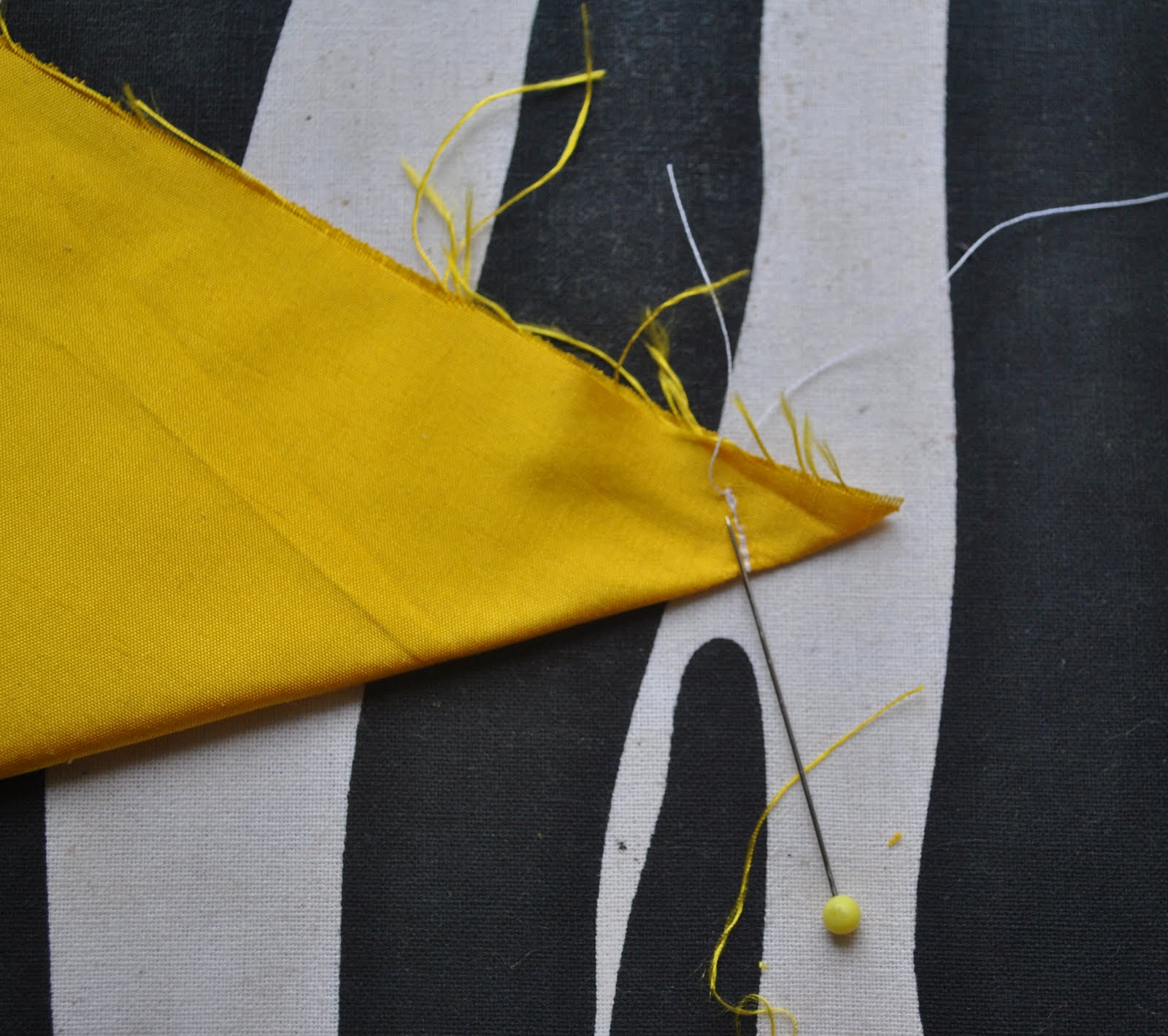
Firstly, fold the tie lengthwise in half, and sew a short line of stitching, perpendicular to the centre fold of the tie… starting at the centre fold and finishing at about 5mm from the raw edges.   The pin is laid in place alongside the white stitching line.
Note: this is a demo scrap that I sewed up later to show up that stitching line properly, really your underlining fabric should be in place wrapped around on the outside of this fold.  I did take a photo with the underlining in place, but my white thread didn’t show up very well against the white underlining fabric, so took these mock-up photos separately, without the underlining.
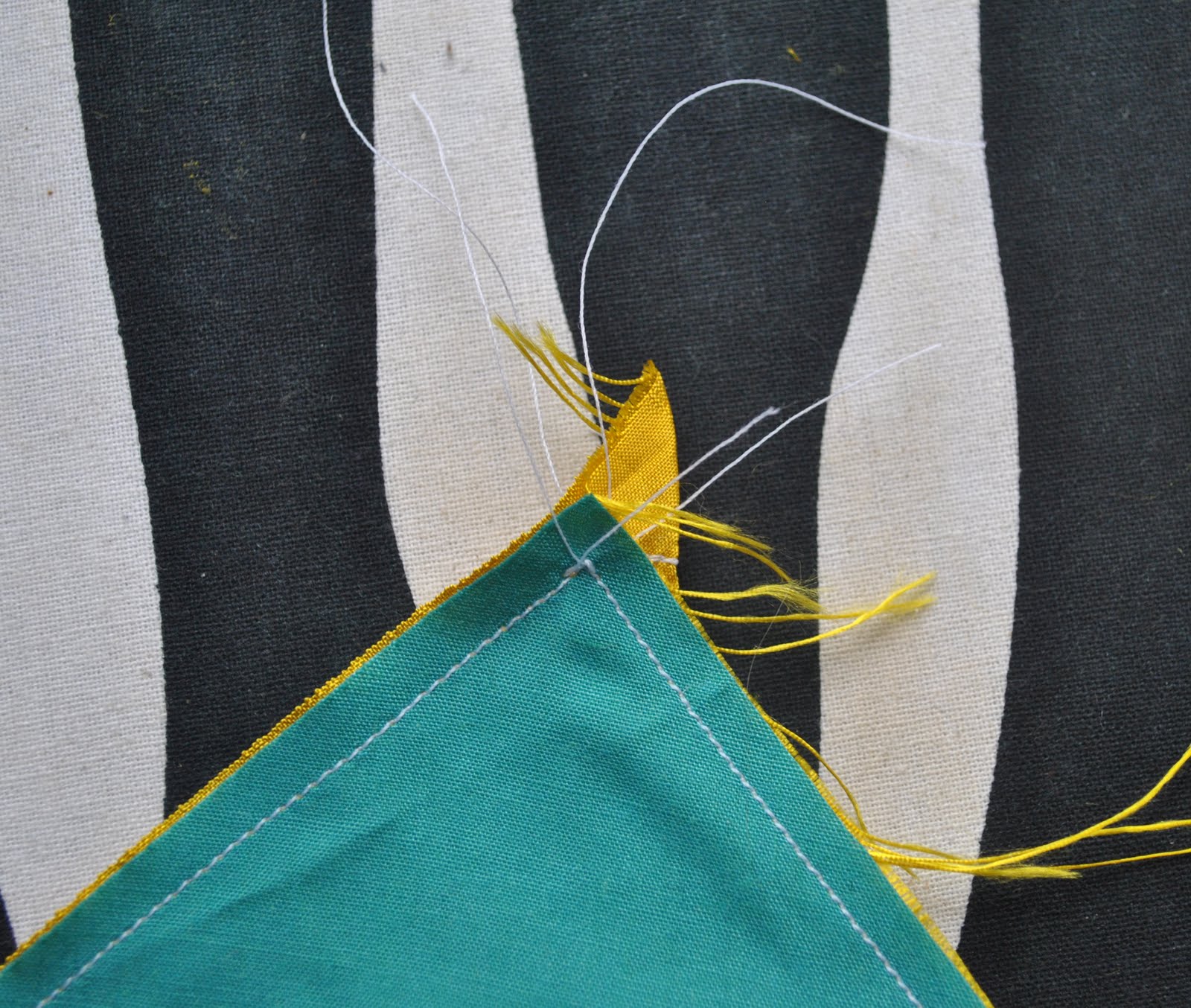
Lay the triangular lining piece over and stitch to the fashion fabric, each line of stitching ending right at the end of your short stitching line, that you did in the previous step.
Turn out, and you have a nice mitred corner.  Do both the top and bottom of the tie in the same way…
Now insert the padding into the points of the tie.  This requires some gentle stuffing and poking the padding point up cleanly and firmly into the corner; I know there are proper tools for this job that proper seamsters use but I usually use a slightly blunted pencil (hehe, oops!) I had cut my padding a tad long, just in case, and so there was some trimming required here to get it all sitting in nice and flat.
Then just fold one long edge in and press firmly in place the length of the tie.
The last open edge, fold in the seam allowance, then fold over the centre of the tie and press.
Slip stitch that long folded edge in place, and down those short slanted edges onto the lining.
Voila!
pinterestmail

Army style jacket, with detachable (faux) fur-lined hood

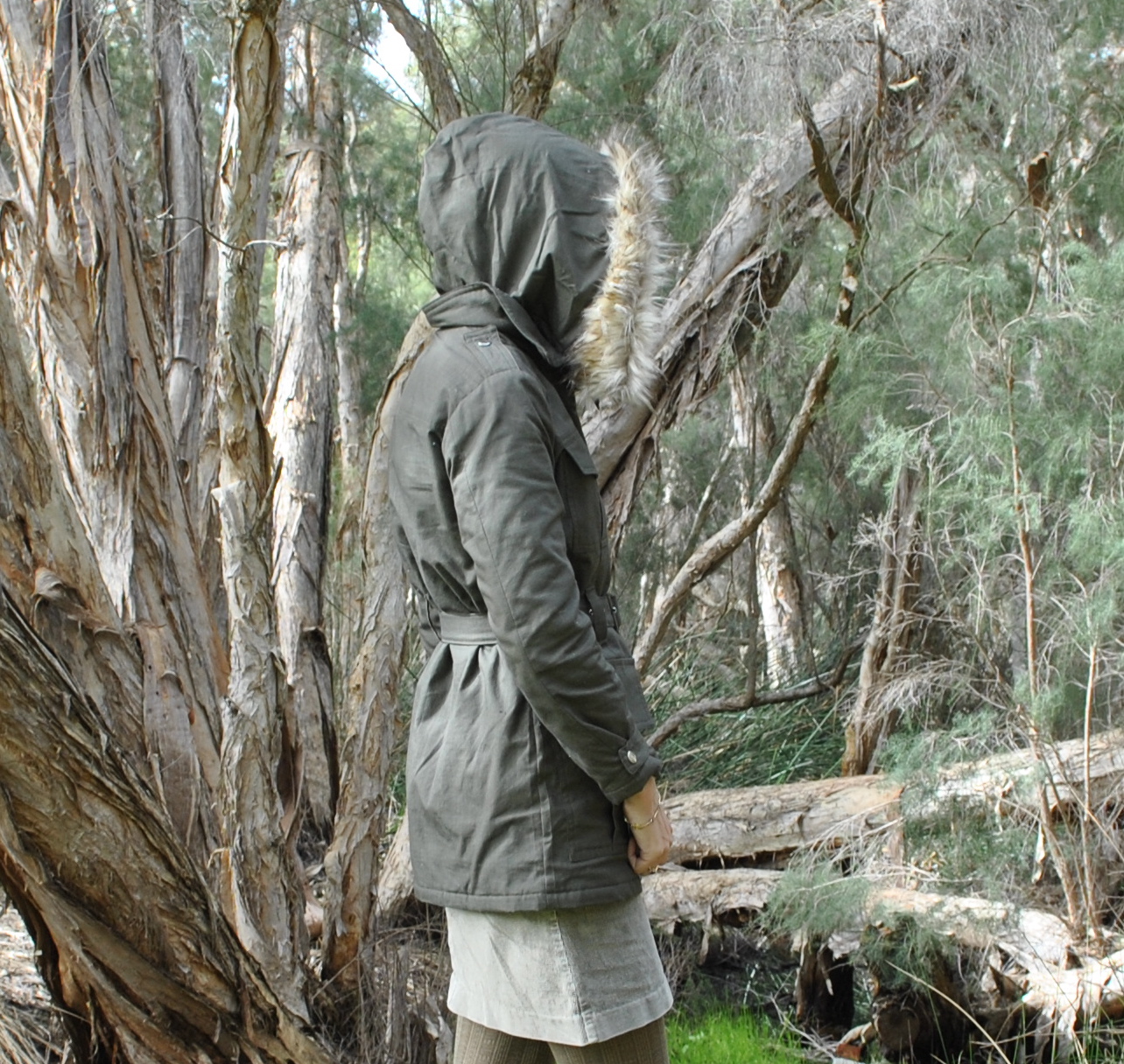
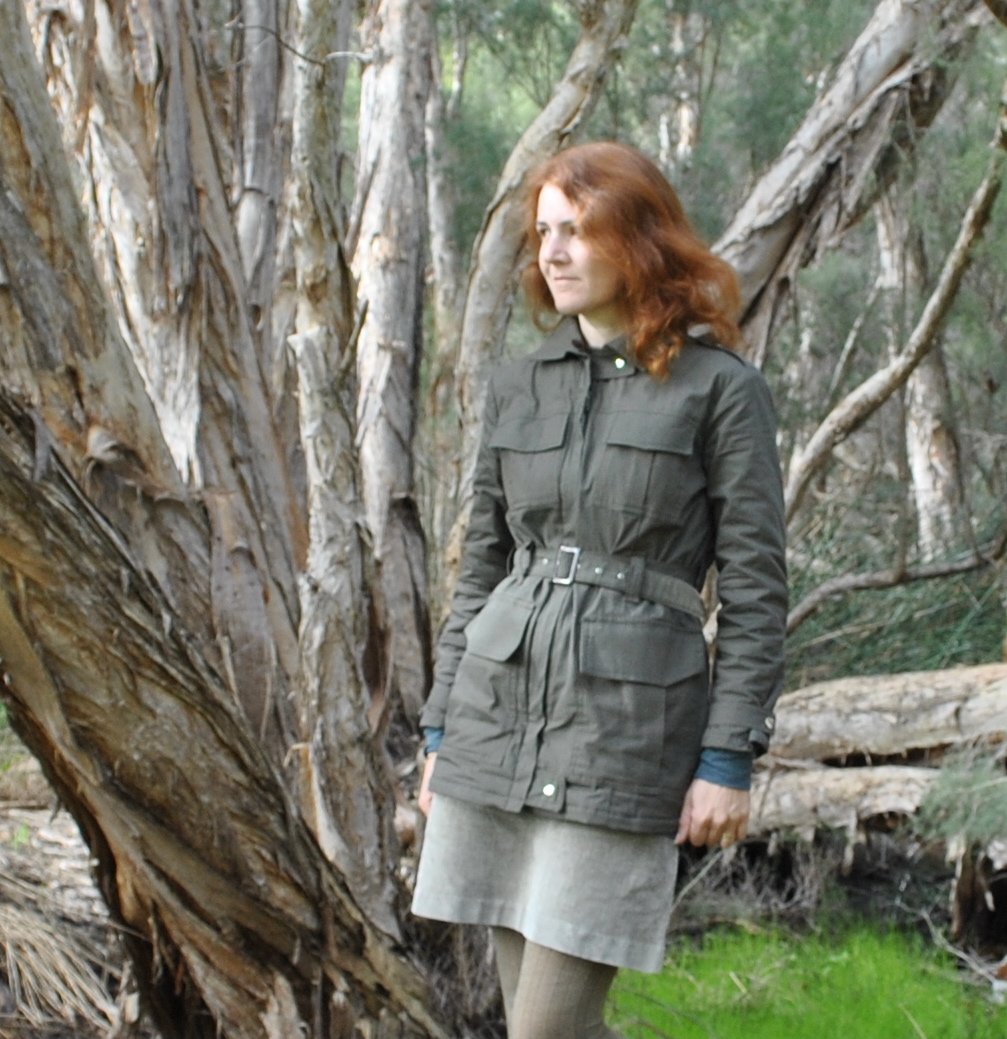
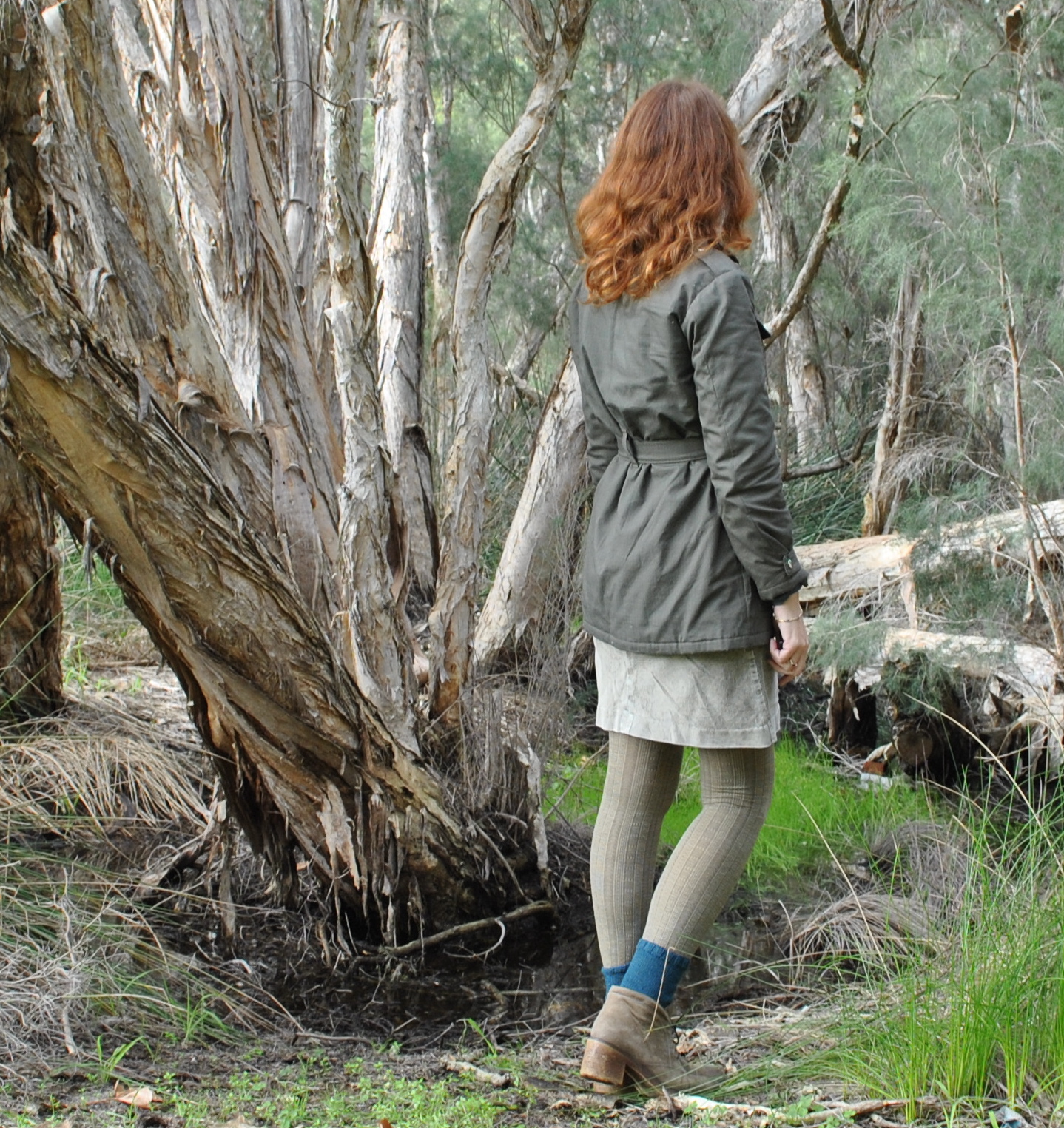
I mentioned some time ago my new army/military style jacket; finished way back in March, well, here it is!
When we were in Tokyo I saw all ages and both sexes, everywhere, sporting big khaki army type jackets.  All with military details, lots of pockets, cinched in waist belts and sometimes with fur-lined hoods, and I just fell in love with them and decided I just had to have my own.  They just looked so big and comfy and cosy looking, and the girls (and boys) wearing them looked so warm not to mention so so so too-cooool-for-school; casually and bulkily stylish…  I’m sure a lot of the ones I saw were real army jackets, possibly from army disposal stores or secondhand stores, but naturally with my DIY aesthetic I was always going to try to make my own… 😀
Of course what I wasn’t taking into account was that it doesn’t really get all that cold here and especially for the hoodie part of it!  I expect I will wear it without the hood for most of the time… but it was still fun to have a go at making a furry hood, and it just might come in handy for some mornings, and if we ever go down to the country.

Details:
Jacket; Burdastyle 05-2010-127 with my own modifications, khaki ripstop cotton and grey marle fleece lining
Skirt; Vogue 7303, olive green corduroy, to see this little skirt styled in 6 different ways go here
Top and tights; Metalicus
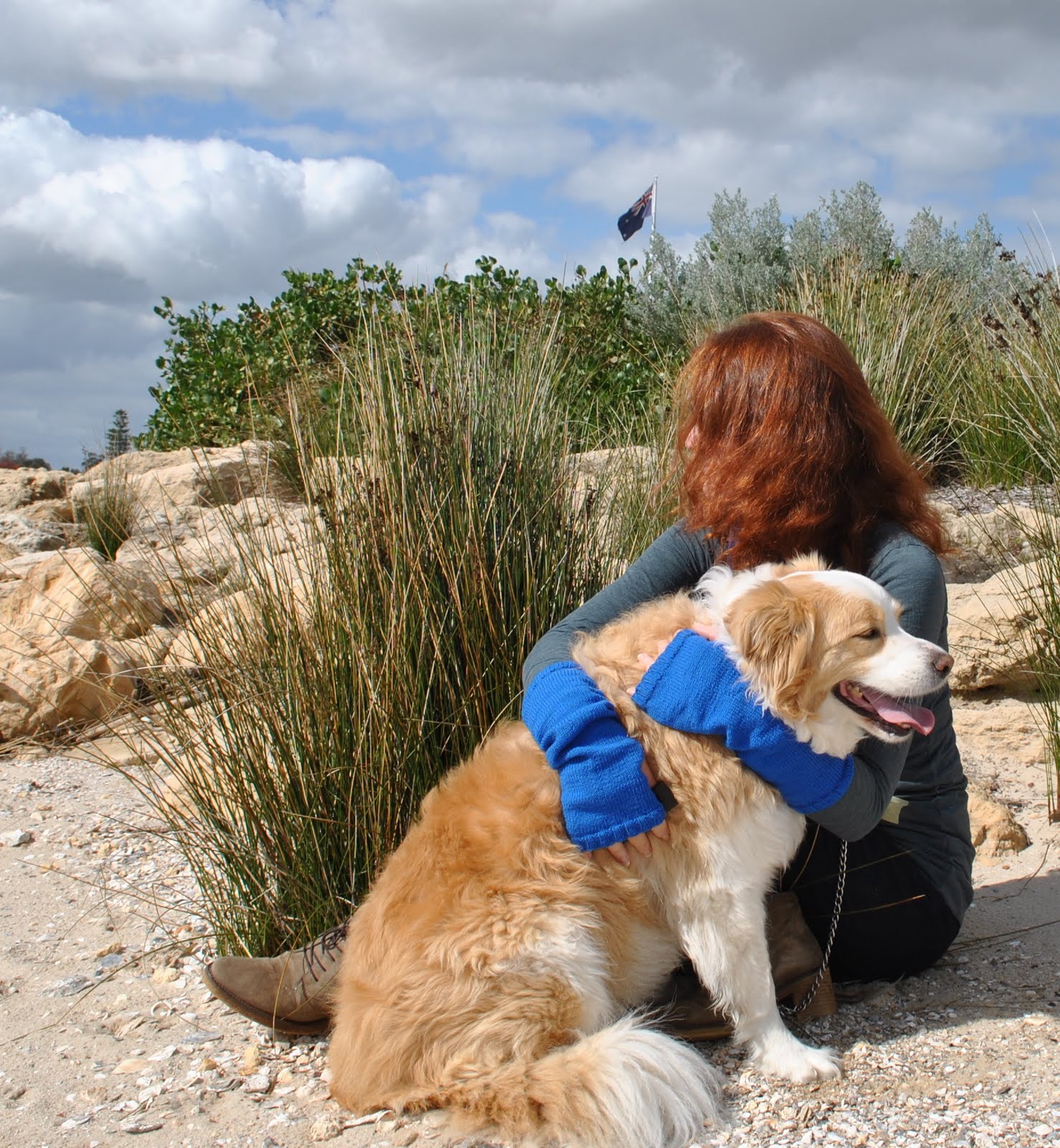
Socks, handknit by me, details here
Shoes; Francesco Morichetti, from Zomp shoes

Dressmaking details; if you want to know…
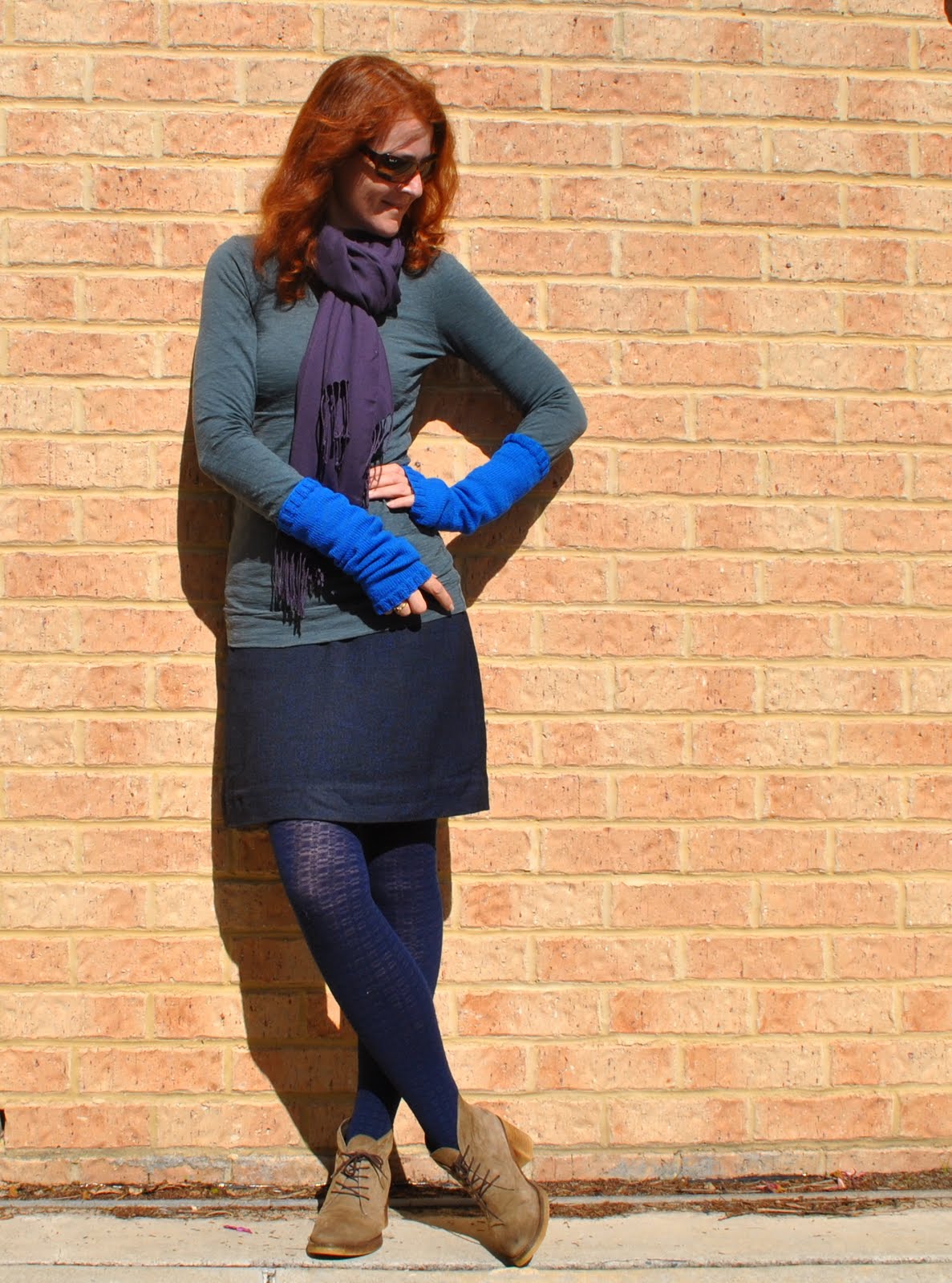
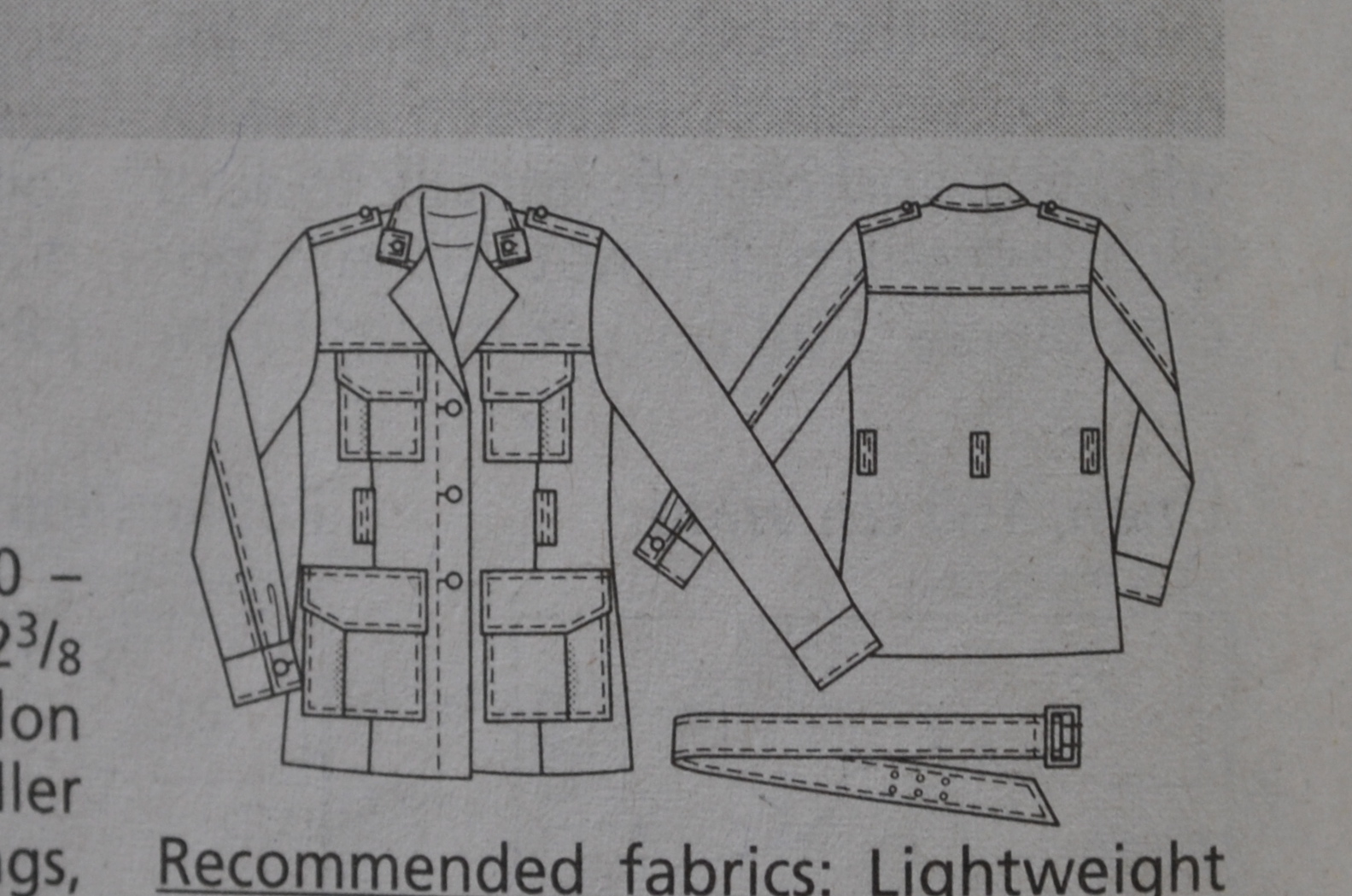
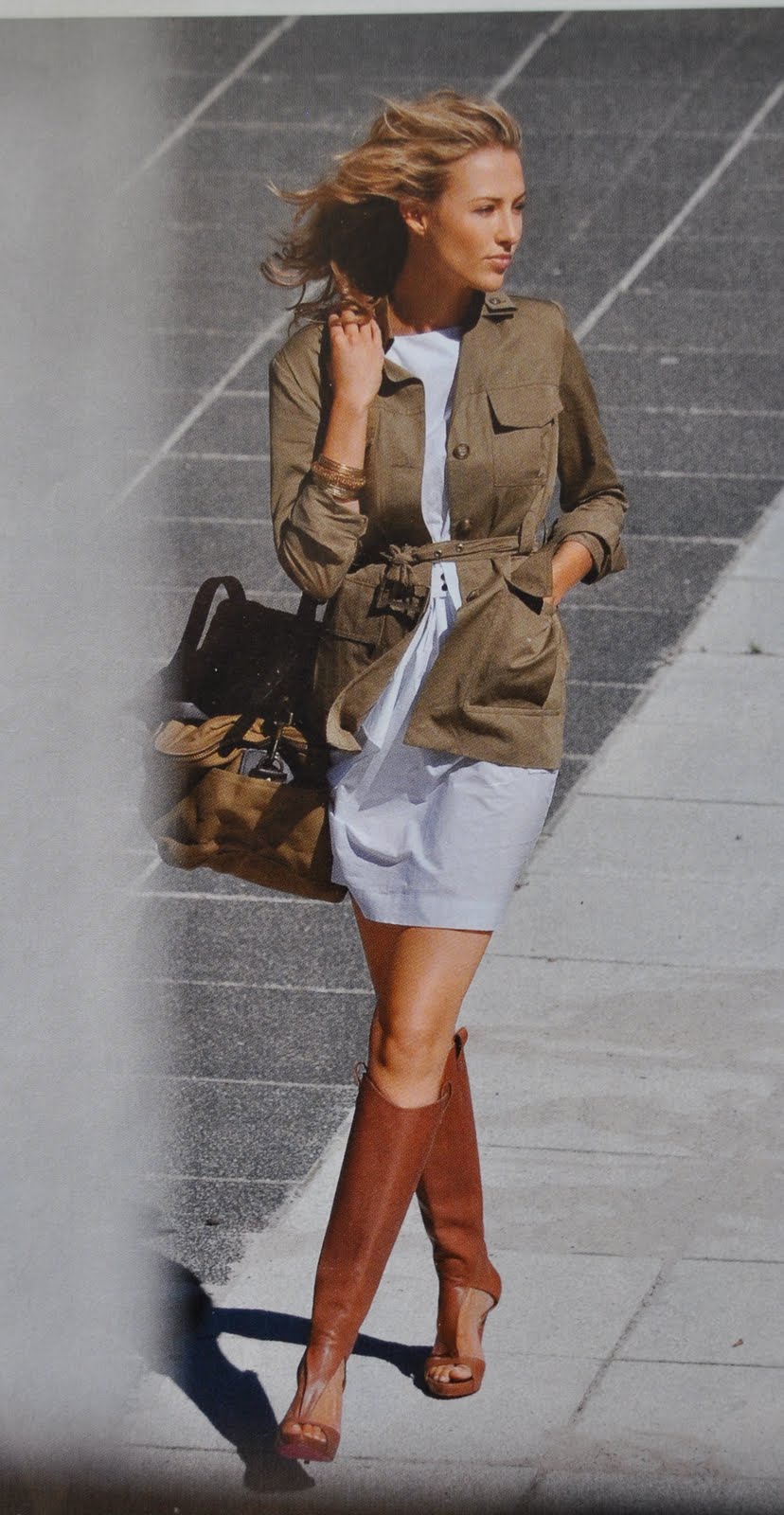
I used Burdastyle 05/2010, pattern 127 as a starting point, and as usual made a few modifications to get the army-style I envisioned, but as the bones of the jacket are essentially the same I think I can dare to write a review for this pattern??  I used ripstop cotton in khaki, a wonderful fabric both tough and hardwearing and so so so perfect for an army style jacket!  I have also made this and this from the exact same fabric, so I guess it is obvious I love it…!  I’d better not buy any more, hmmm?  The lining is a pale grey marle fleece, and the faux fur is… well, faux fur.  I think from memory, it was labelled silver fox.  All the materials are from Spotlight.
The modifications I made:
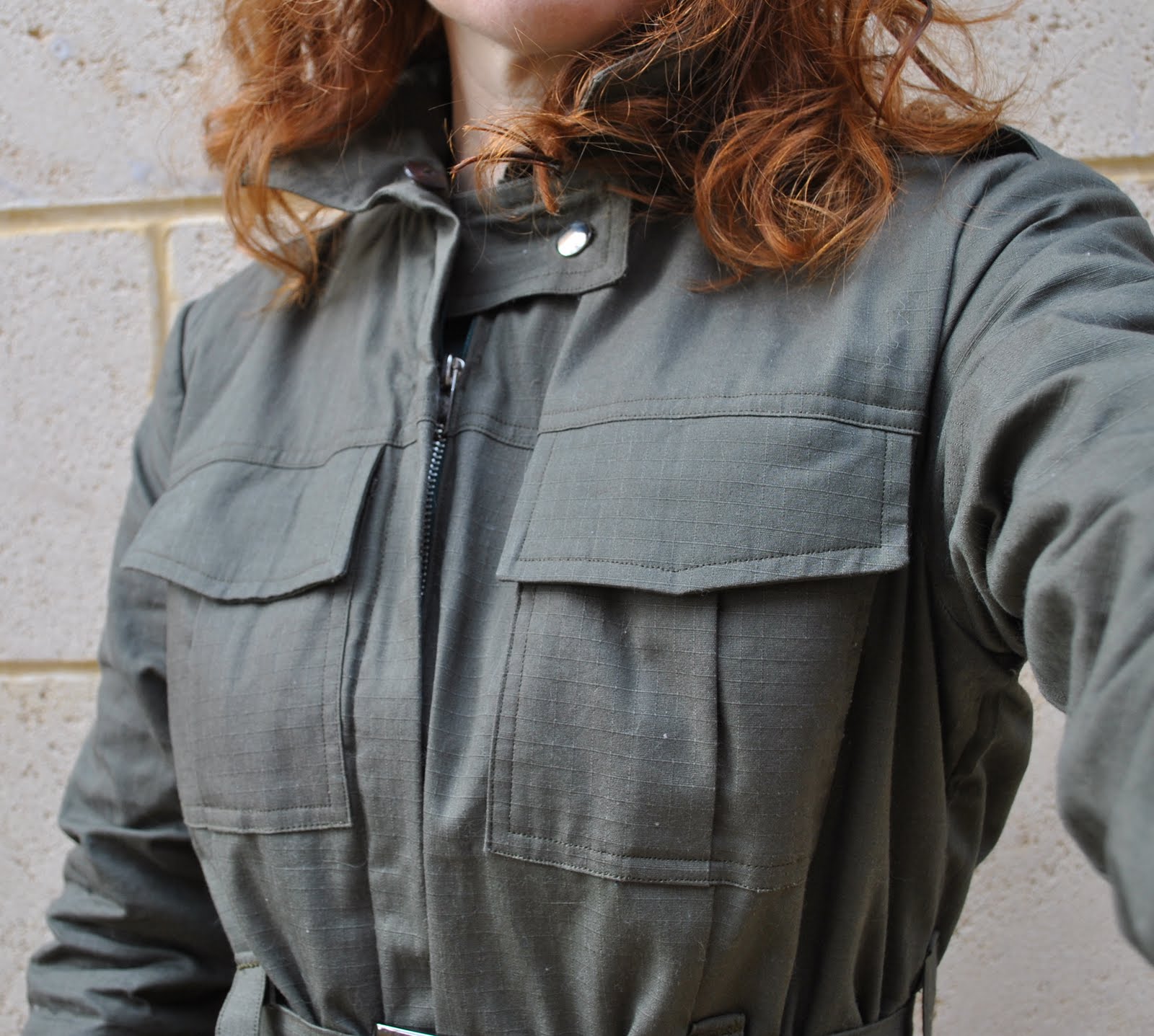
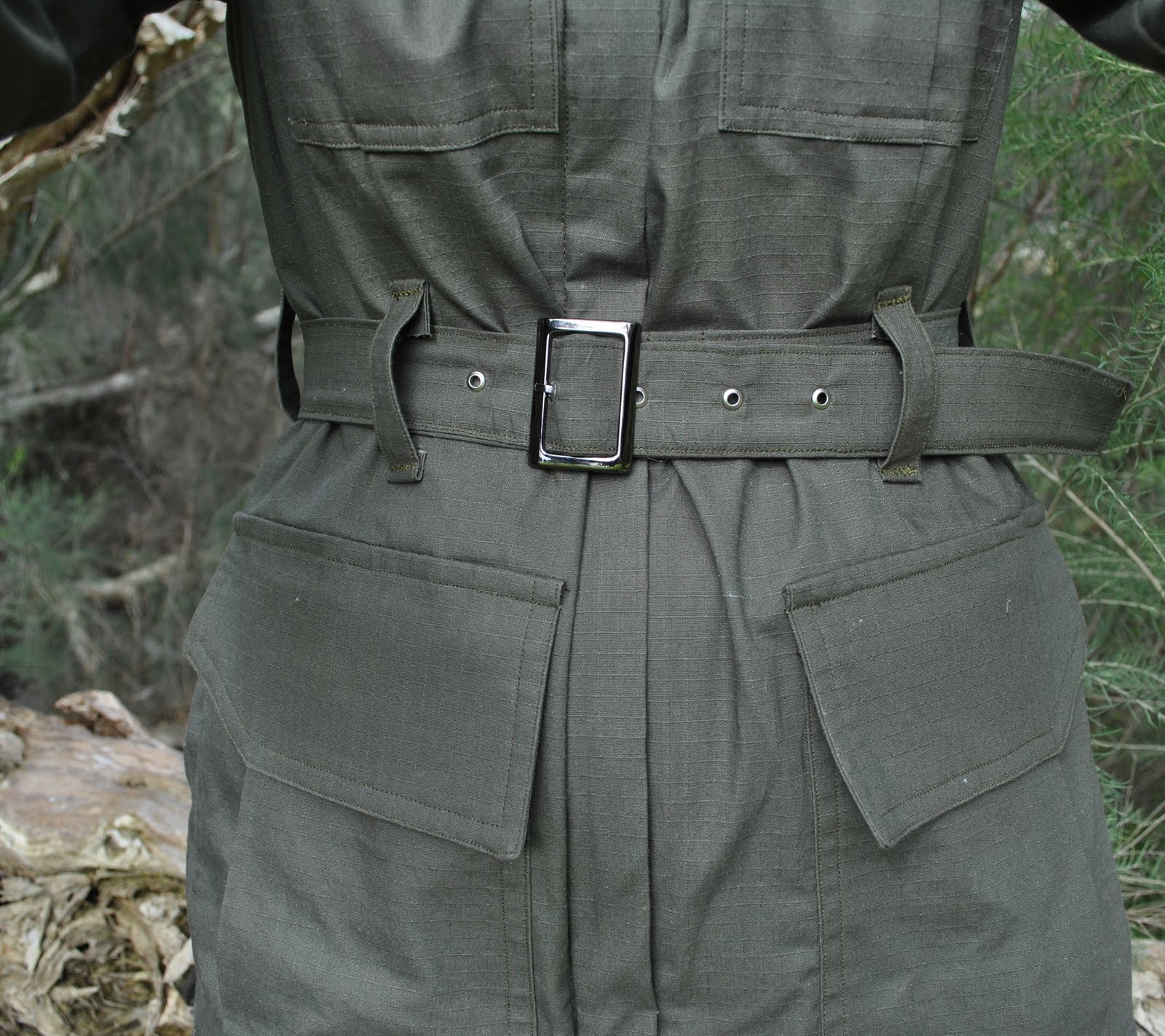
Lengthened the jacket by oooh, roughly 7cm? and also slightly enlarged (length-wise) and slightly lowered the lower front pockets.  I chose to enlarge these because I thought the original smaller ones would not have the right proportions on the lengthened jacket…
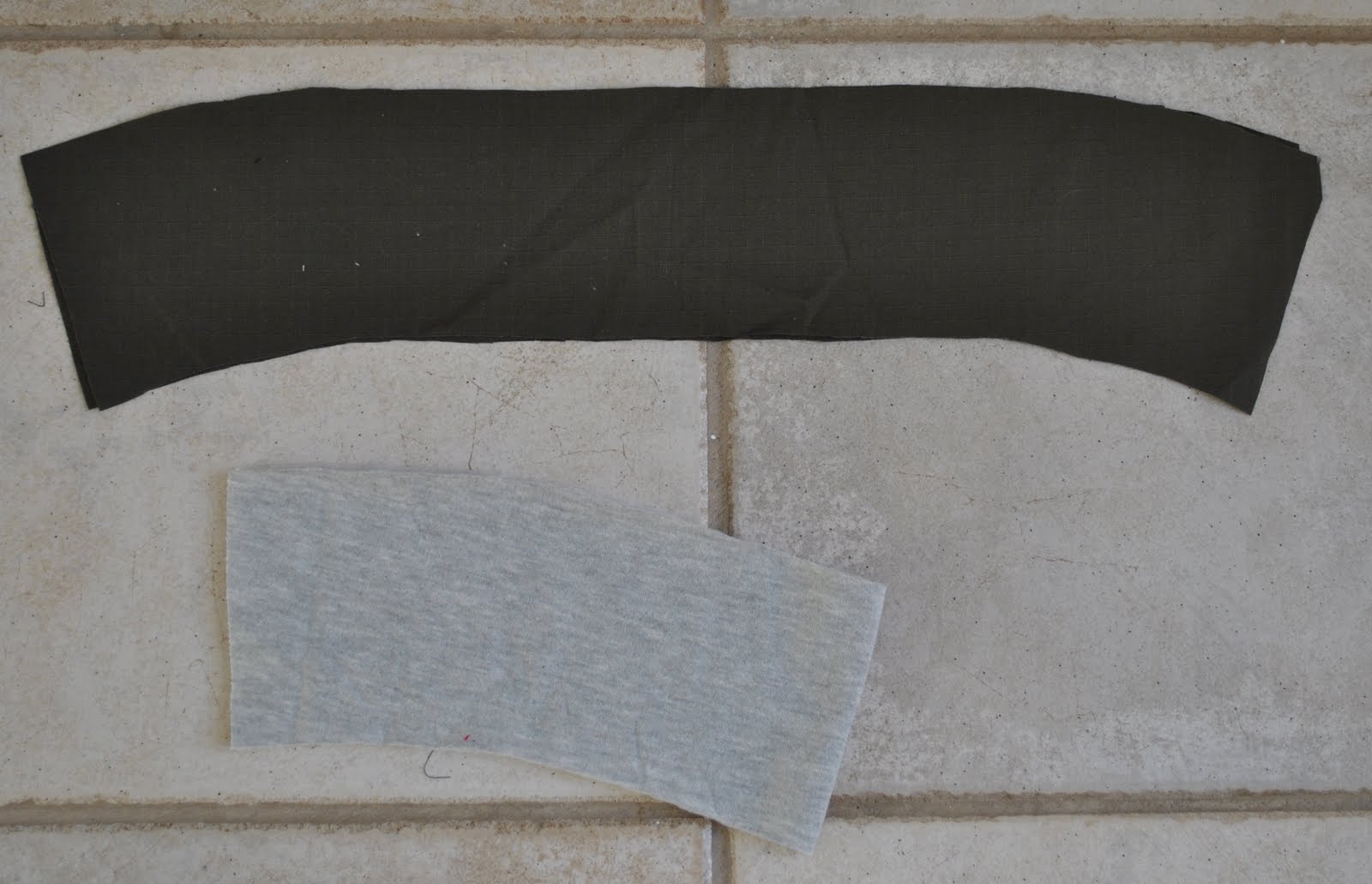
I drafted a completely different collar, a sorta slightly curved rectangle, because I wanted more of a wide standup collar than the little fold-down one in the pattern…

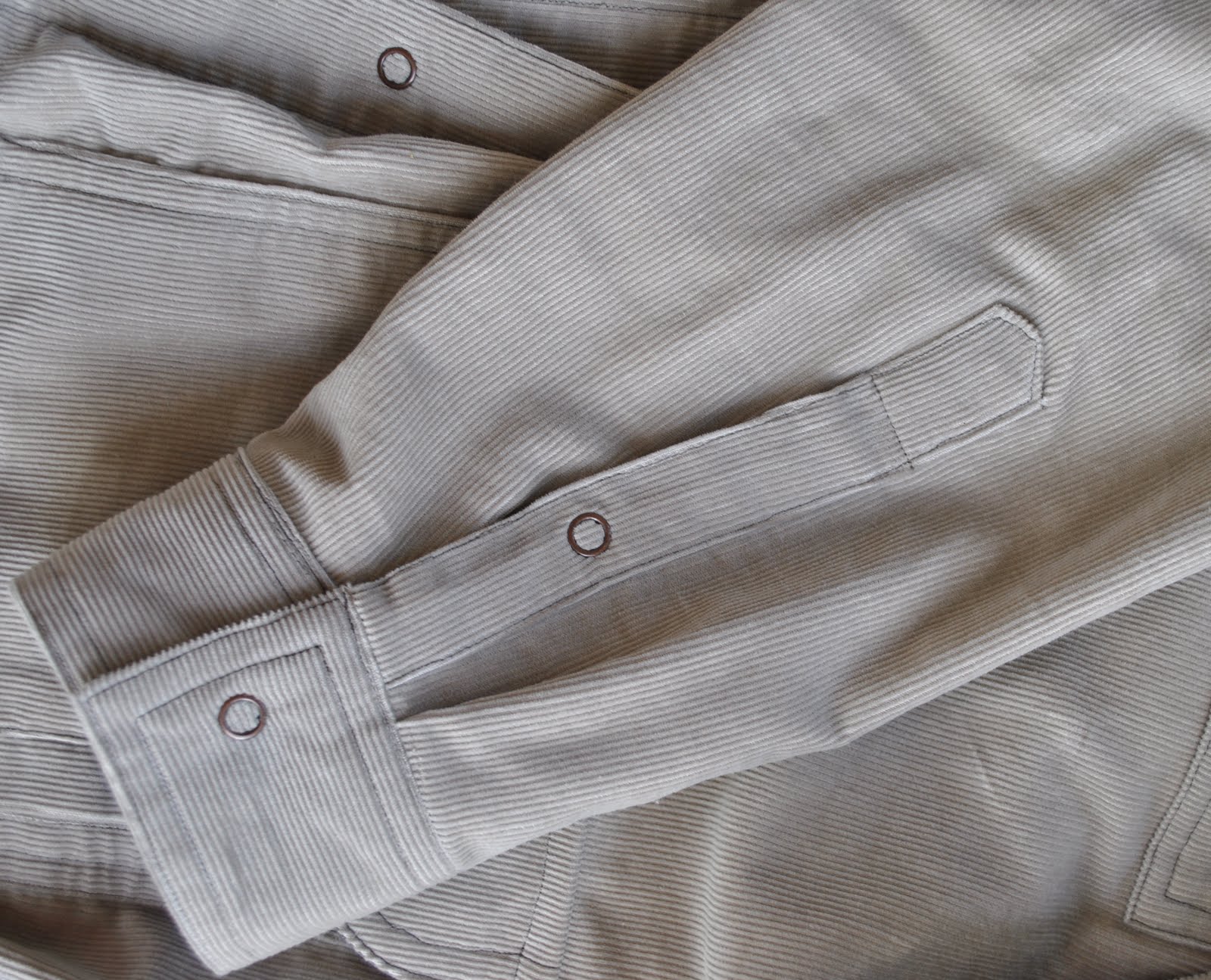
My sleeves are not vented or cuffed, and have a tab with snap closure, for more of a military-looking effect.
I did not incorporate buttons and buttonholes at the front as stipulated in the pattern, but instead inserted an open-ended zip, again inspired by the styling of army jackets I’ve seen around
My jacket is fully lined, with grey fleece (for warmth, and also to enhance that bulky look an army jacket is supposed to have)  as it turns out it is very warm!  I did not hem the lining, but enclosed the flat raw edges inside the sleeve and lower hems of the jacket.  The fleece was partly leftover from this project, I had to buy a bit more.

I added a tab at the lower edge, and another tab at the neck edge; both features I mentally noted from the army jackets I saw in Tokyo.  These both have snap closure.
The self-fabric belt is interfaced with the thickest, heaviest-duty iron-on interfacing I could find, and the buckle and eyelets were from Spotlight, like everything else.

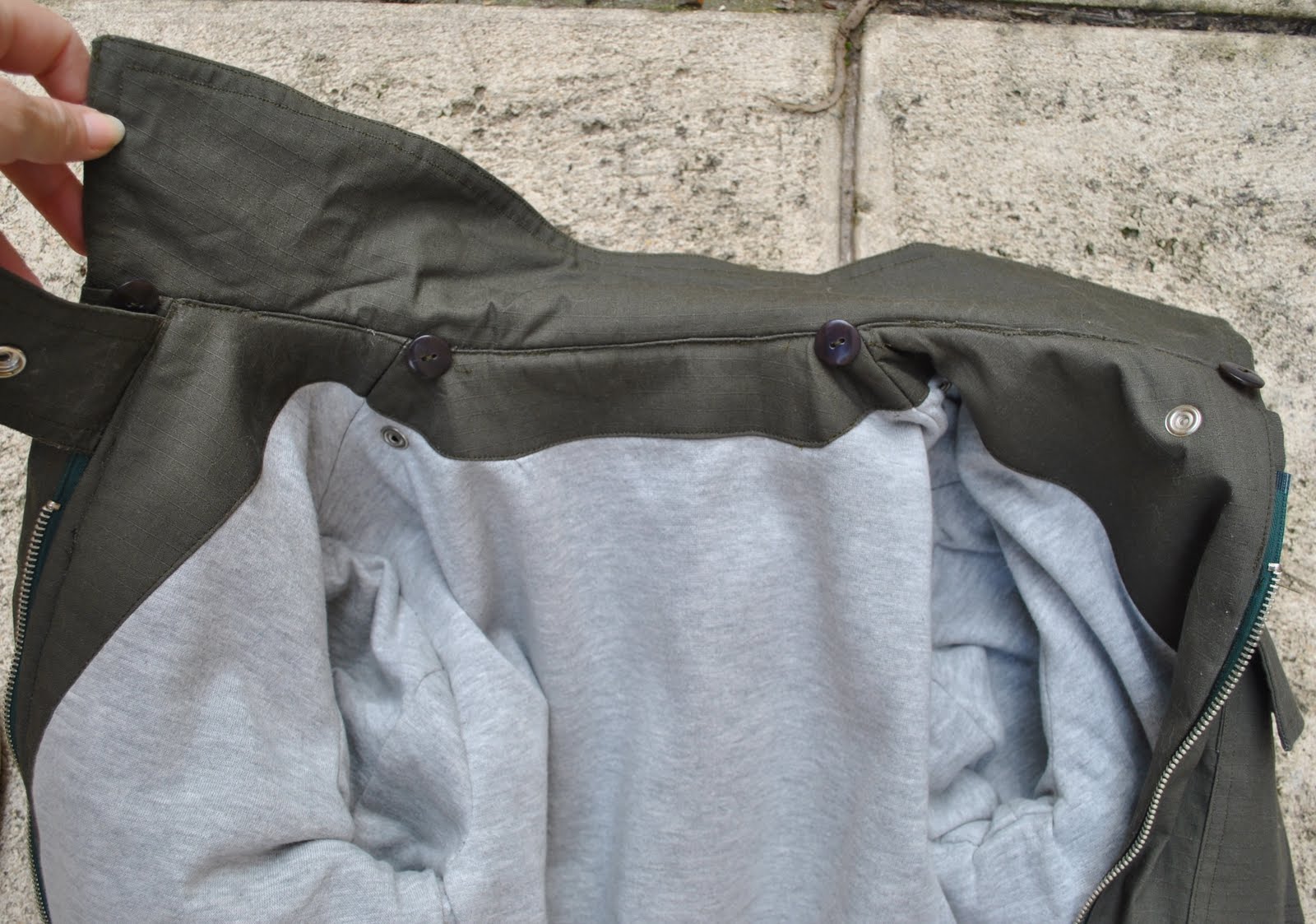
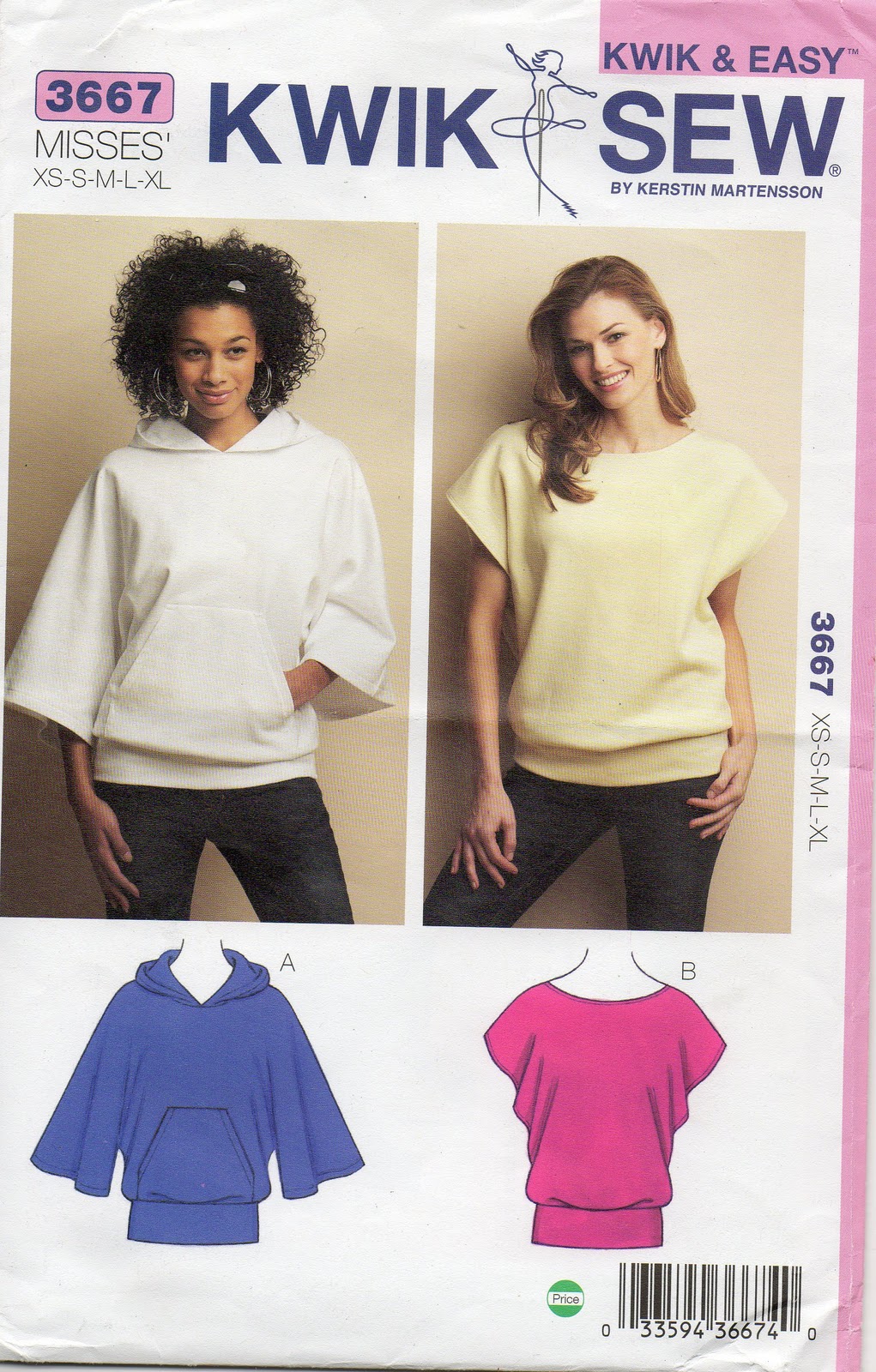
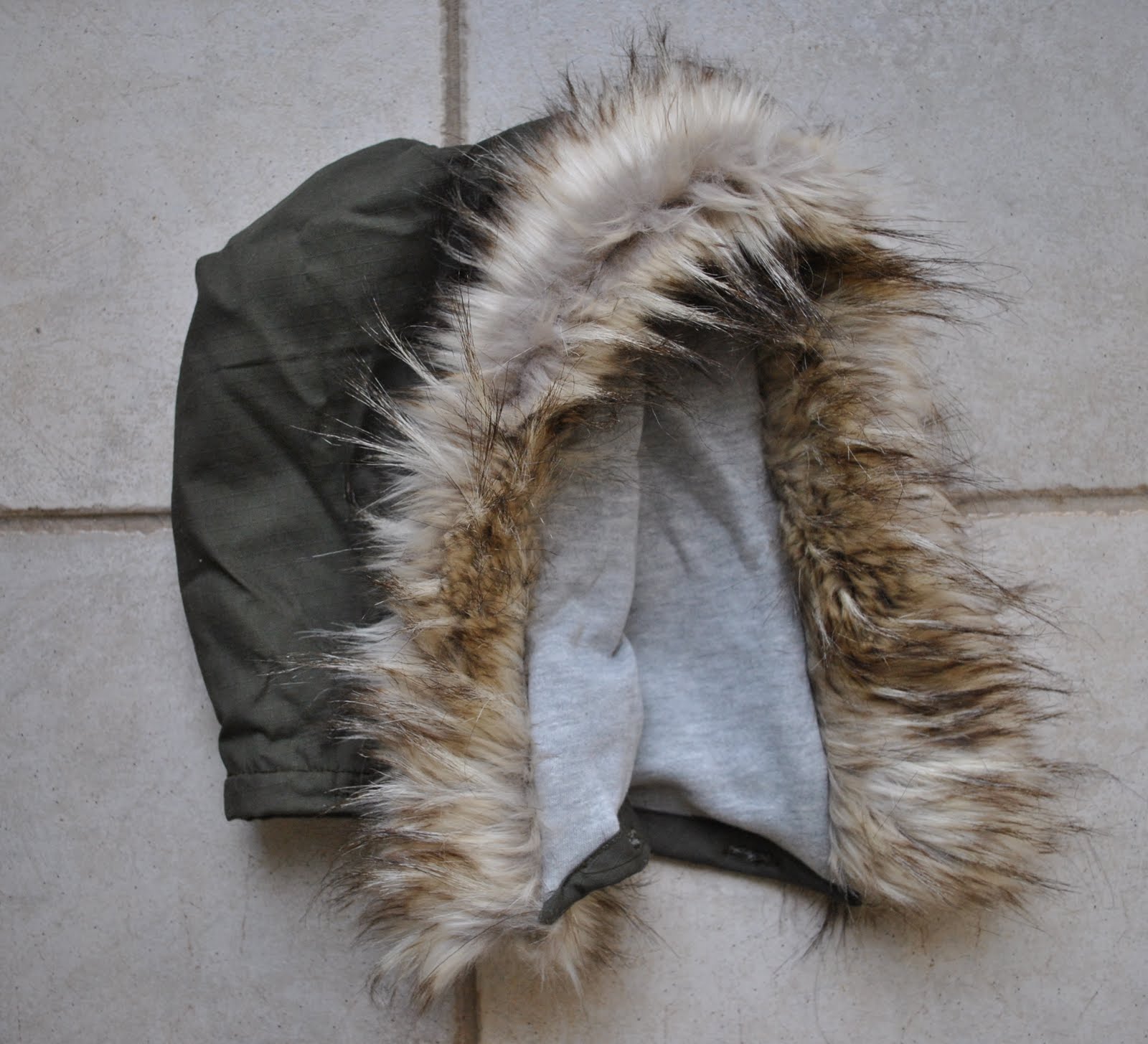
I made a detachable, (faux) fur-edged hood.  For this, I used a modified version of the hood from KwikSew 3667, with the lower edge cut flatter and a bit narrower to fit in with the neckline of my jacket.  It is also lined with fleece, and has buttonholes sewn in the bottom edge, which correspond with the buttons that I sewed inside the collar edge.  I realise the fur-edged hood is probably kinda silly in this climate, but I think it looks kinda cool, and it just may come in useful one day?

My review of this pattern, if you’re interested…

Pattern Description:
Unstructured long-sleeved jacket; with two piece sleeves with vents and buttoned cuffs, front buttons and buttonband, epaulettes, four flapped patch pockets at the front, belt loops at waist level for the self-fabric belt and a short, buttoned collar.
Pattern Sizing:
36-44.  I made a 38
Did it look like the photo/drawing on the pattern envelope once you had finished sewing it?
In essence, yes.  I made a few modifications.
Were the instructions easy to follow?
Yes.  I did some steps differently and in a different order, to accommodate my modifications…
What did you particularly like or dislike about the pattern?
I like everything about this pattern!  The basic bones of the pattern are great; being unstructured it is therefore very easy to fit, to put together and also easy to incorporate your own alterations.  The fun is in adding your own details.
Fabric Used:
Ripstop cotton, and fully lined with cotton/polyester fleece.  A strip of faux fur (silver fox) to edge the hood
Pattern alterations or any design changes you made:
Lengthened the jacket by about 7cm? and also slightly enlarged (length-wise) and slightly lowered the lower front pockets.  I chose to enlarge these not because I thought they were too small but because I thought the originals would not have the right proportions once I had lengthened the jacket…
Drafted a different, slightly curved rectangular collar, because I wanted a higher standup collar than the little fold down one in the pattern
Inserted tabs with snap closure in the top and bottom of the front edges
Instead of the front buttonband and buttons, extended the front opening edges slightly so I could insert an open-ended zip
Fully lined the jacket in a polyester cotton fleece
Added a hood, also fully lined with fleece, and edged in faux fur.  This has 4 buttonholes on the lower edge, and attaches to 4 buttons sewn around the neckline, inside of the collar
Left off the sleeve vent and cuffs, instead inserted tabs with snap closure inside the lower end of the sleeve seam, sewed the sleeves closed to the end and hemmed over the raw edges of the lining.  The lower hem of the jacket also encloses the raw edge of the jacket lining inside
Would you sew it again? Would you recommend it to others?
I would definitely recommend this to others!  I might sew it again, if I need another jacket like this.
Conclusion:
This pattern was one of the first to catch my eye in this magazine, and I always had a mind to make it.  After visiting Tokyo, and being totally inspired by the cool cool army/military style jackets I saw worn over there, I realised this was the perfect pattern I could adapt quite easily to get that style of jacket.  And I’m totally happy with how it turned out; even if the hood is not super appropriate for our climate I still love it, and am very pleased with the smart styling and warmth of the jacket even sans hood.  The waist belt is a nice finishing touch, although I am very glad I lengthened the jacket as I think the belt would have looked a bit funny on the shorter length.

pinterestmail

Tim’s shirt/jacket

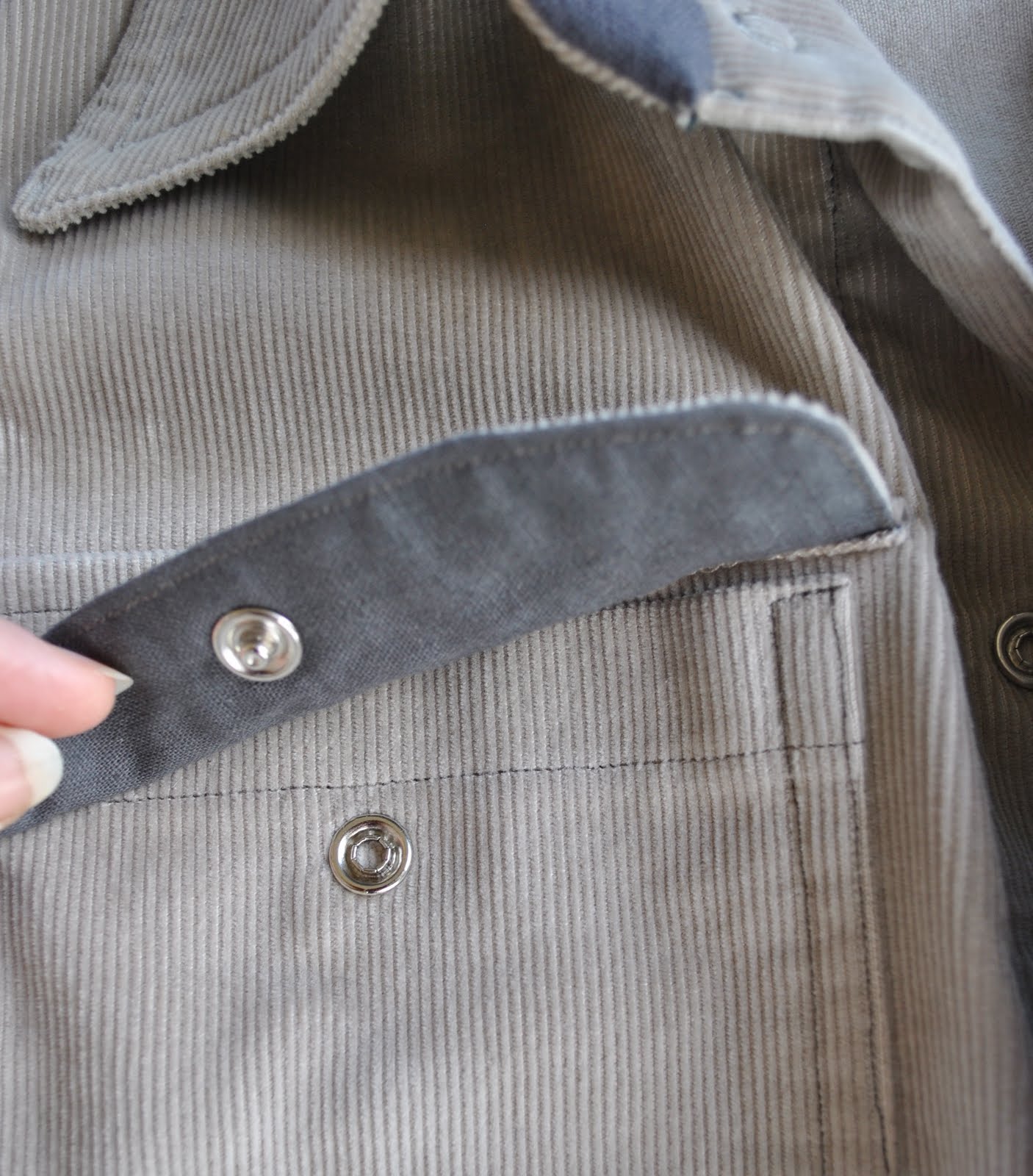
Here is the shirt/jacket thingy that I made for Tim for a birthday gift… it is very similar to Sam’s here, but using a grey/beige, thin but warm, corduroy and a (leftover) contrasting dark blue/grey cotton linen for the lining of each of the collar stand, yoke, welt pockets and pocket flaps. 
I used the same ol’ Burda 7767 that is now my standby go-to men’s button-up shirt pattern, almost lost count of the number of times I’ve used it now  (just went back and checked… 14 times!)  Hehe, Myrna suggested I do an overview of different ways in which I’ve used the same pattern to get different garments, and I think this pattern might be a prime candidate, along with my all-time favourite Vogue 7303… but not until I’ve given this shirt/jacket thing its very own post here…
Variations to the pattern; 
well, apart from the obvious customised fitting to Tim’s measurements modifications I implemented the following:
1.  lengthened the fronts and back by about 6-7cm, to get a more coat or jacket like effect and curved the hemline up to each of the side seams to get that shirt-tail effect both front and back…
2. added two breast pockets with curved flaps
3. added two of those double pockets at hip height… pockets that are separately a welt pocket and are also a patch pocket (you can tell, I was pretty thrilled with how these turned out on Sam’s jacket and Tim thought they were tres cool as well, so I just had to put them on his too!)  my tutorial for doing these double pockets is here.
4. used snaps throughout in lieu of buttons.  
Little anecdote; I had nearly finished this jacket – bar putting the snaps in, and by this time Tim knew very well that I was making this for him (well, I do make them something for each of their birthdays…. he was expecting it) and he wanted to wear it out to a friend’s place that night.  Of course the snaps seems like the easy quick bit and I’m like, oh hang on, shouldn’t take more than twenty minutes.  Like, well over an hour later….  hehe, SO putting in snaps does take a fair bit of time, if you are trying to be careful about placement that is and not just flying along recklessly… but he did get to wear it out, even if he was (fashionably) late!
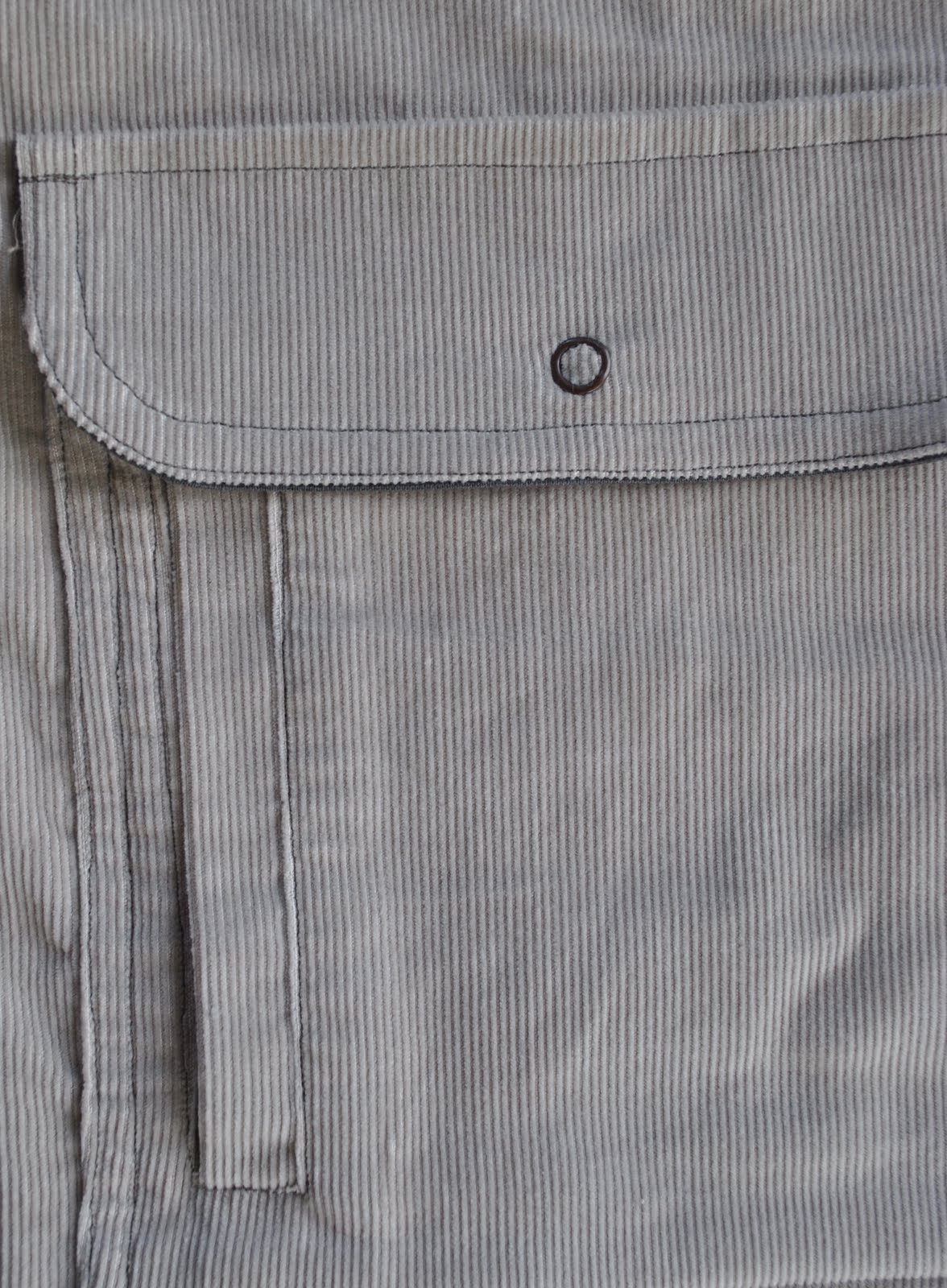
In an unthinking moment, I selected contrasting thread to topstitch, that matched the tobacco brown snaps exactly.  Bad idea!  I adore corduroy and have used it countless times, but looking back I have always selected matching topstitching thread.  In hindsight I can see the wisdom of that (even though it was ignorant wisdom…); corduroy by its very nature does not take super well to military-precisioned topstitching, all those furry velvety little ridges, bless them, are an enemy to the topstitching perfectionist.  Moral of the story; always, but always go with matching topstitching thread on corduroy, unless uneven lines are not going to send you spare.  The good news is that Tim, being an easy-going bloke, is OK with it.  It is just something to bother me whenever I have occasion to, say, hang it up on the line and get to see those slightly-darker-therefore-blindinglyobvious wonky lines all over again (grrr…)
At left; contrasting lining: at right; the double welt/patch pockets at hip level, complete with hideous topstitching

Because of the intensity that was me-made June, it may appear I haven’t done much sewing in the last month… actually I have still been sewing and have produced some new things.  For some reason I felt I didn’t want to do postings of any new stuff during that month, so I have kept some things back.  Well, OK I did reveal some new things, a little grey top, and the new scarf… oh, OK then.  There was a smattering of minor-league new stuff, hehe.  And some old stuff that was discovered in my winter sort-out.  But, back to the subject, I do have some new creations to reveal.  Just have to muster some enthusiasm to get back in front of the camera again… you understand.

pinterestmail

Sam’s shirt/jacket

So I finished off the pockets on Sam’s birthday shirt/jacket last night, and did take those few snaps of the pockets to show here because I was so happy at how they turned out, but the light was not great for taking a photo of Sam modelling the whole thing.  So now it is, and I have.
It is made out of thin navy blue non-stretchy corduroy, using the old favourite Burda 7767 with a few modifications… the addition of two breast pockets with arrow head flaps, and the double welt/patch pockets I showed you yesterday.  And a curved hemline.  And I used brown snaps instead of buttons.  The collar facing, yoke facing, flap facings and welt pocket lining are all in a contrasting cotton, woven in a tiny plaid design of beige and black.
So here’s the thing…  I don’t know if it qualifies as a shirt or a jacket, or both.
It is made using a shirt pattern, and can be happily worn buttoned (snapped?) up and on its own… thus earning itself a “shirt” label.  
But also; being made of sturdy corduroy fabric, and also wearable unbuttoned and open over other shirts with his hands shoved in the pockets, it comes off as kinda jacket-style… thus attaining “jacket” status.
A hybrid.  
There must be a name to properly describe garments like this without having to resort to the hyphenated.

my tutorial for doing those combination welt/patch pockets just below
pinterestmail

Cassie’s quilt

“Now here’s one I made earlier”… I think this is might be the next thing in my chronological documentation of my creations.  And luckily another one that is still used and loved on a daily basis.  I’ll have to admit to a bit of necessary repair work before it was anywhere suitable for its photo shoot today!  The second time in its life this quilt has had a major repair and maintenance session.  I’m just glad she obviously loves it so much…
This was made, according to my hand-embroidered signature and date in the corner, in 1993.  Like Tim’s quilt before it, it is just based on a very simple design; just same-sized square patches, and is machine pieced and hand-quilted.  Unlike Tim’s however, I had learnt at least a teensy bit about quilts by this time and the border treatment is a little better.  This time, I folded the outer border over the edge and under, and slipstitched it in place over the backing, then quilted in the ditch on the back, making a little quilted border of about 2cm width all around on the top side.  Still not the proper or recommended method of finishing quilts, mind you, but since when have I ever cared about properly following recommended methods, anyway?  Yah, I’m such a sewing rebel…
The backing is simply a single sized bed sheet, and yes that rather garish blue colour is far from a perfect choice for the very soft, antique shades of blue, pink and ivory of the topside fabrics, but meh.  The back wasn’t very important in my back-then eyes, and sheeting fabric is tough and cheap, also priorities to my back-then self.  Since the back is, unlike the topside, in absolute perfect condition, I guess it turned out to be a good choice.
The part I was most pleased with was the border quilting design (which I designed myself); a little arrangement of quilted hearts and nesting hearts, joined with garland-like rows of quilting stitch.  And I did quite a good job, if I say so myself.  I’m glad I still have things like this around to remind myself of how patient I used to be with regard to my sewing projects.  Seriously, I don’t know if I could ever do something like this ever again.

above; all these are the original fabrics…
above; fabrics added later over two major repair sessions (“major” = “now covering nearly a third of the quilt”)
below; border quilting design and (retrospective “what-was-I-thinking” moment) backing fabric
pinterestmail
Switch to mobile version
↓