When making my shearing jacket I came up to the important matter of buttonholes… what to have? I’d googled and pinned a few shearling jackets when planning the details and features that I wanted to have in my new jacket, but it’s not always easy to make out the finer construction details of the nitty gritty like buttonholes in far-away, full-length pictures on the net. As usual, it came down to knuckling down and working out how to do it myself.
I trialled several different types of buttonholes but am only sharing here the details of my two “finalists”, the two types I eventually decided upon using for my jacket.
Sewing details: I’m using a faux shearling, but this technique would be fine for real shearling too, as well as for thick leather or other thick and bulky, non-frayable fabrics. For real leathers which can be very thick and tough, use a leather needle and sturdy threads like upholstery or topstitching thread.
The first buttonhole, pictured above; is designed to look well-finished and to look identical from both sides of the fabric, meaning, both the suede outside and the woolly inside of the shearling fabric. I used this technique for down the front opening edges of my jacket and on the buttoned wrist bands. It is like the shearling version of a bound buttonhole, if you like.

Mark the buttonholes on the suede right side to be the same length as the buttons; in this case 2.5cm (1″), and cut two rectangular, self-fabric “bindings” per buttonhole, each the same width as the buttonhole – 2.5cm (1″) wide, and 2cm (6/8″) long. Trim away the shearling from the wrong side of the bindings as closely as possible, and cut the buttonhole slit in the fabric between the marking pins. I used a rotary cutter for the middle bit, for straightness and for a clean cut, then clipped into the ends with small sharp scissors.

Trim away the wool from around the buttonhole slit on the wrong side out to a width of 1cm (3/8″) each side
Wrap the bindings around the buttonhole edges and align edges top and underneath as neatly and as evenly as possible; pin. Stitch carefully along the long edge just inside the cut edges. Also, stitch-in-the-ditch along the short edges of the buttonhole also, to strengthen the slit and help prevent it from ripping out. Truth be told, I wouldn’t think ripping is all that likely in a tough fabric like shearling, but not impossible of course, so I reckoned it was better to be safe rather than sorry!


It’s more important for the stitching to be perfectly neat and even on the right side of the jacket than the wrong side, obviously. If the inside shows uneven edges, they can be trimmed off with small, sharp scissors.

And that’s it! pretty simple really. Apart from the fact that it looks almost smart and sorta polished as much as a raw-edged rustic technique can look, the beauty of this buttonhole is also that it looks identical from both right and wrong side of the fabric.. also I think the suede wrapped edges looks quite attractive against the woolly insides too!

The second type of buttonhole I devised is an easier, more workmanlike, “invisible” buttonhole, which is situated on the lapels and collars of my jacket. I wanted this one to be less obtrusive; to still look acceptably nice if seen from the outside of the coat, but more importantly to be as invisible as possible on the wrong, woolly side of the fabric. Reason; I wanted to have the option to wear the coat sometimes with the lapels and collar fully buttoned up, and also sometimes unbuttoned; and when unbuttoned I didn’t want them to show at all.

This one is like a letterbox-on-a-door, with an outside facing to reinforce and strengthen it on the right side. Cut a rectangle of shearling, 4cm (1 1/2″) wide and 1.5cm(5/8″) long, for each buttonhole, and trim away most of the wool from the wrong side. You can trim away the wool as completely as possible if desired, or if you want a frame of wool to fluff out around the edges, leave a slim border untrimmed around the edge. I decided a lightly woolly frame looks pretty cute, and couldn’t resist having it for my buttonholes.
fluffy edges are cute!!!


Pin the trimmed rectangle to the right side of the fabric where the buttonhole will be, and stitch just inside each edge. Remember to use white or ivory thread in the bobbin! Cut the buttonhole through both layers, using a rotary cutter for the middle bit, and snipping out to the edges with small sharp embroidery scissors.

I think it looks nice from the outside, but the best bit is that it is almost completely invisible on the wrong side!
For the button inside the collar, I needed something matching the woolly interior; and found the perfect, ivory tweed, covered button, originally from my grandmother’s stash and, knowing my grandmother, I expect it was salvaged from off of an old coat or skirt or something. Waste not want not! and I’m glad she did because it has finally found the perfect home 🙂

I hope my tutorial proves useful to someone… as always if it is helpful then please do leave a comment saying so. Thank you!


 Hello!
 That’s it, really!


 And also, don’t you just hate it when people boast smugly about their perfect pattern matching?


 Well I reckon it’s the attention to the whimsical detail that becomes the most fun thing about making your own clothes!
 Patterns; both knickers are the Watson briefs and the bra is my favourite pattern, MakeBra 2610. This is hands down the most wearable of the bra patterns in my collection.


 I’ve made a little black-and-white striped skirt…
  another Vogue 1247. How many is this by now? Okaaaay, just counted and this is version number seven, and that’s not even counting the ones that I made leaving the pockets off. Counting those ones too, this is version number fourteen. Wowza! what a great pattern this has been!


 Hello there. I’m Sally 🙂
 So, my Mum took me to to Calico and Ivy for my belated birthday present; and we chose this book The Making of a Rag Doll, by Jess Brown, and a little stack of fat quarters. I know, right? I’m so lucky: FABULOUS birthday present! This was on Thursday and I finished this lot last night, so obviously I just could not wait to immediately get stuck into making my doll.


 Quickie review:

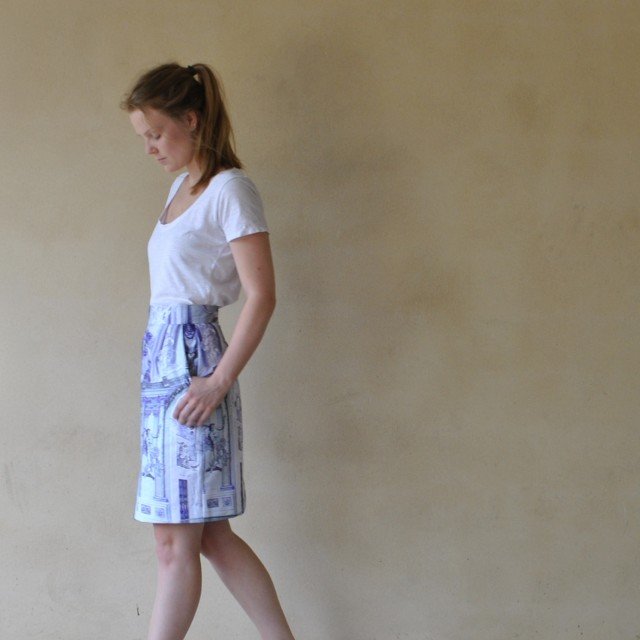
 That townhouse print though; it did cause me a wee bit of angst… how on earth to make it into something that was going to look cute and fun and funky and stylish? You know with some prints the subject material is absolutely perfect for a person, but the print itself is kinda messy and busy and so has the potential to be disastrous? It’s one of those prima donna prints, I felt it would look overpowering in a dress with a sleeve, also I knew it would not play nicely with many other colours/prints; likewise any design details like draping or … well anything at all, was OUT. At first I thought about making a very simple plain sleeveless shift, but still worried that it would look a little naf.
 Once the raglan lightbulb had popped up it was all super easy from there… I used my own raglan sleeve Tshirtpattern, that I’d worked out years ago from laying down and drawing around an old Tshirt … in a time when patterns for raglan sleeve Tshirt were non-existent! Yes, it’s hard to believe now there are tonnes of patterns available everywhere, but for a long time and until quite recently some design features were very difficult to get hold of. We had to hunt for them, and be creative and innovative and sometimes very devious in order to get what we wanted. The elusive Raglan Sleeve tee was one such rare beastie. I think it was often assumed that patterns for basics were something you either had already, or could work it out yourself with no pattern by cutting up an old one.
 Collar band, simple folded band

 It’s taken a while but I’ve finally taken pictures of Cassie wearing the dress I made for her for Christmas!
 btw, it’s faaaaaaar harder to hide Christmas sewing from Cassie than it is the boys! who pay precisely zero attention to whatever I’m mucking about with in the laundry… Cassie is a high probability to go snooping around the stash to periodically pet the fabrics and select stuff for herself. I had to be SUPER devious to get this made without her twigging as to what was going on… and she was completely surprised! Yay!!!


 Although it looks short on the model in the magazine, it didn’t look that short when made up so I removed about 9cm off the bottom to get the same look. Sleeves are about 2cm shorter.