Tag Archives: Pattern Review

A tale of a purple dress

Once upon a time, an avid seamstress took a trip far far away to Melbourne.  There she visited the fabled Tessuti’s and spenteth up big on fabric.  Including a piece of slippery dippery shot rayon-y stuff in a wonderful plummy-chocolate-y sort of a colour.  The rich and gorgeous colour of a ripe eggplant.  The fabric was borne home, lovingly folded and put carefully away and just taken out every now and again for speculative draping over the seamstress’ faithful dummy Bessie, before being re-folded and tucked away again, awaiting the Perfect Project.
The months marched by.
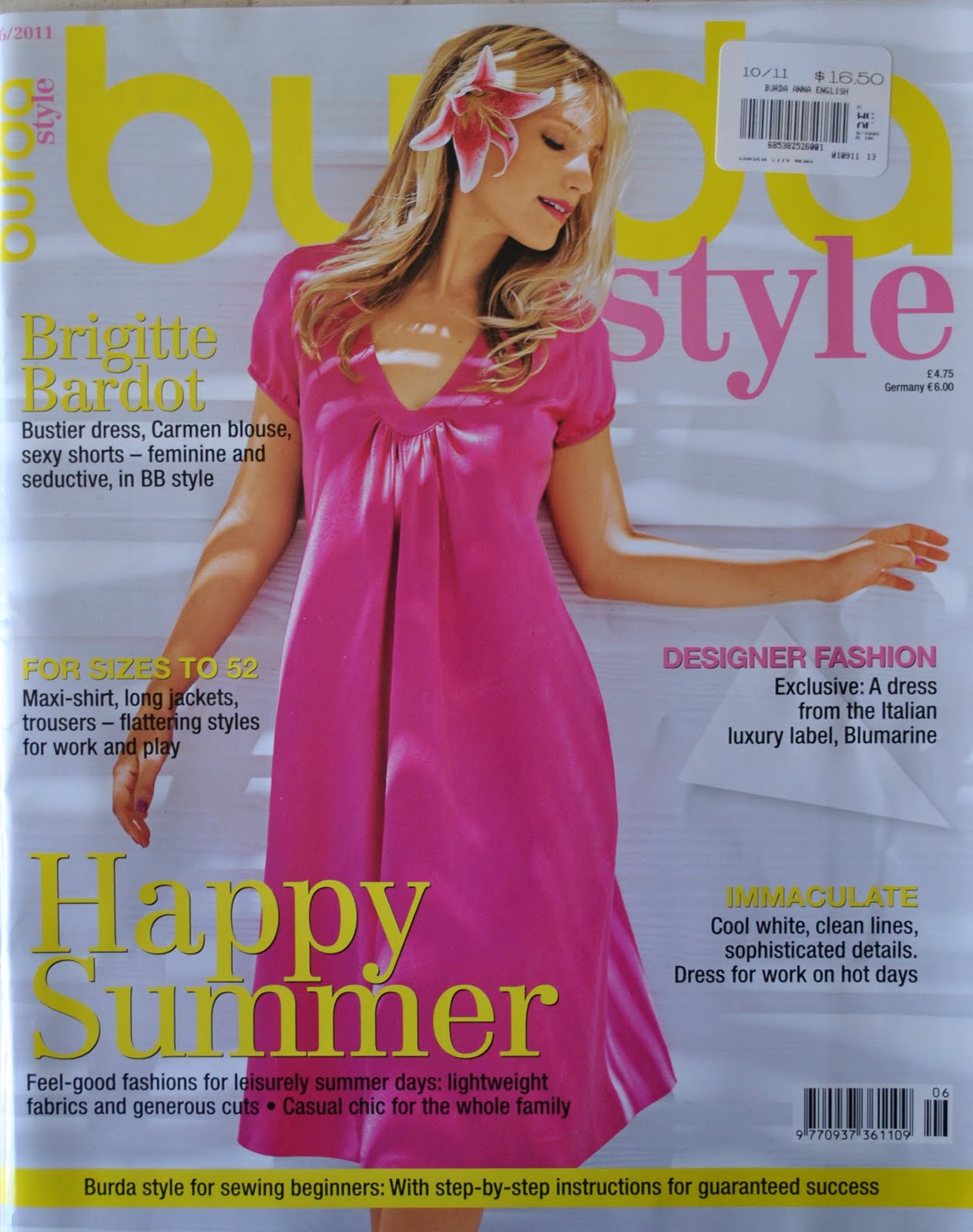
The lovely fabric was still sitting there, taunting the seamstress, Perfect Project-less, and fast becoming that dreaded stuff; Fabric That is Too Good To Sew Up.  The seamstress realized this and took it out again, determined to make something utterly fabulous with it.  She cast about, more seriously this time, for the Perfect Project.  The beguiling dress 102 on the cover of 06/2011 Burdastyle magazine caught her eye, again… actually the very reason she bought this magazine.  It was a promising looking number for summer; loose and elegant, and just the thing for flowy slippery dippery sort of fabrics.  The seamstress did all her prep, and then bravely sliced into the precious fabric.  She made up her dress, pinned up the hem, and hung it up for the requisite couple of days (being an old hand, she knew all the rules regarding bias-cut)  Then she put it on.  Lo, and the mirror reflected back to her a frump.  A complete and utter frump.
The seamstress realized that her delicious and expensive fabric the colour of an eggplant had magical powers and had transformed her into one… just like when Cinderella was transformed into a pumpkin (oh OK OK, that was the coach not Cinders… but you getteth the idea)
Bitterly disappointed, she took it off and hung it out of sight for a few days; busied herself with easier projects, like making Pattern Magic stuff out of scraps.  Then took out the Eggplant costume again (for this is how she now thought of it)  Studied it.  Had a brainwave, and chopped off 14cm.  Pinned the hem, hung it up for the next few days again, blah blah.  Tried it on.  Lo, and the shorter length had worked wonders!  Gone was the bulbous look!  The seamstress felt victorious.  Hand-stitched a narrow hem.  And wore the dress out.  And catching sight of herself in a shop window, noticed in a certain light a sheerness to the dress, the shadow of underwear showing through, that had not previously been apparent in the bathroom mirror…  
Doh! 
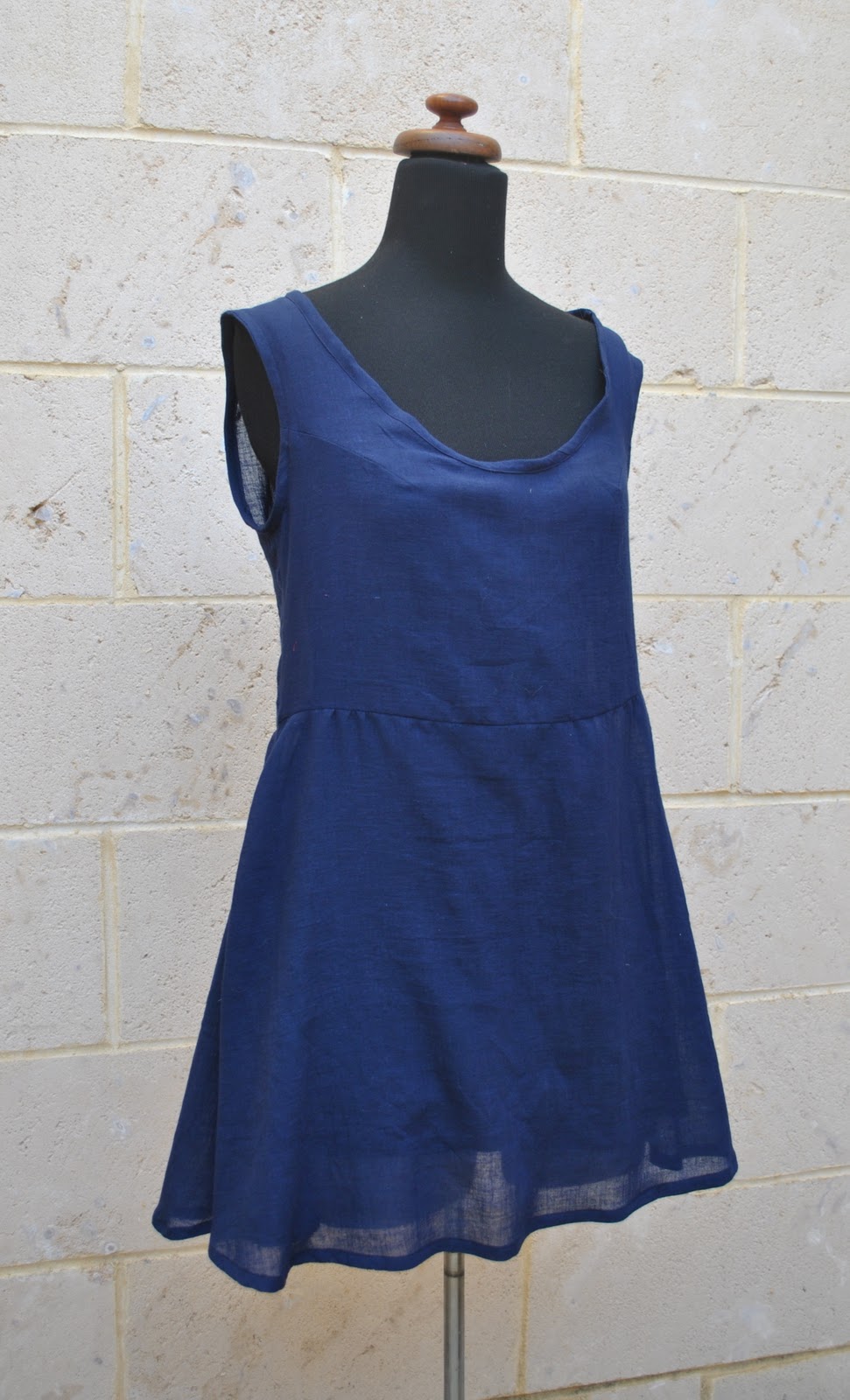
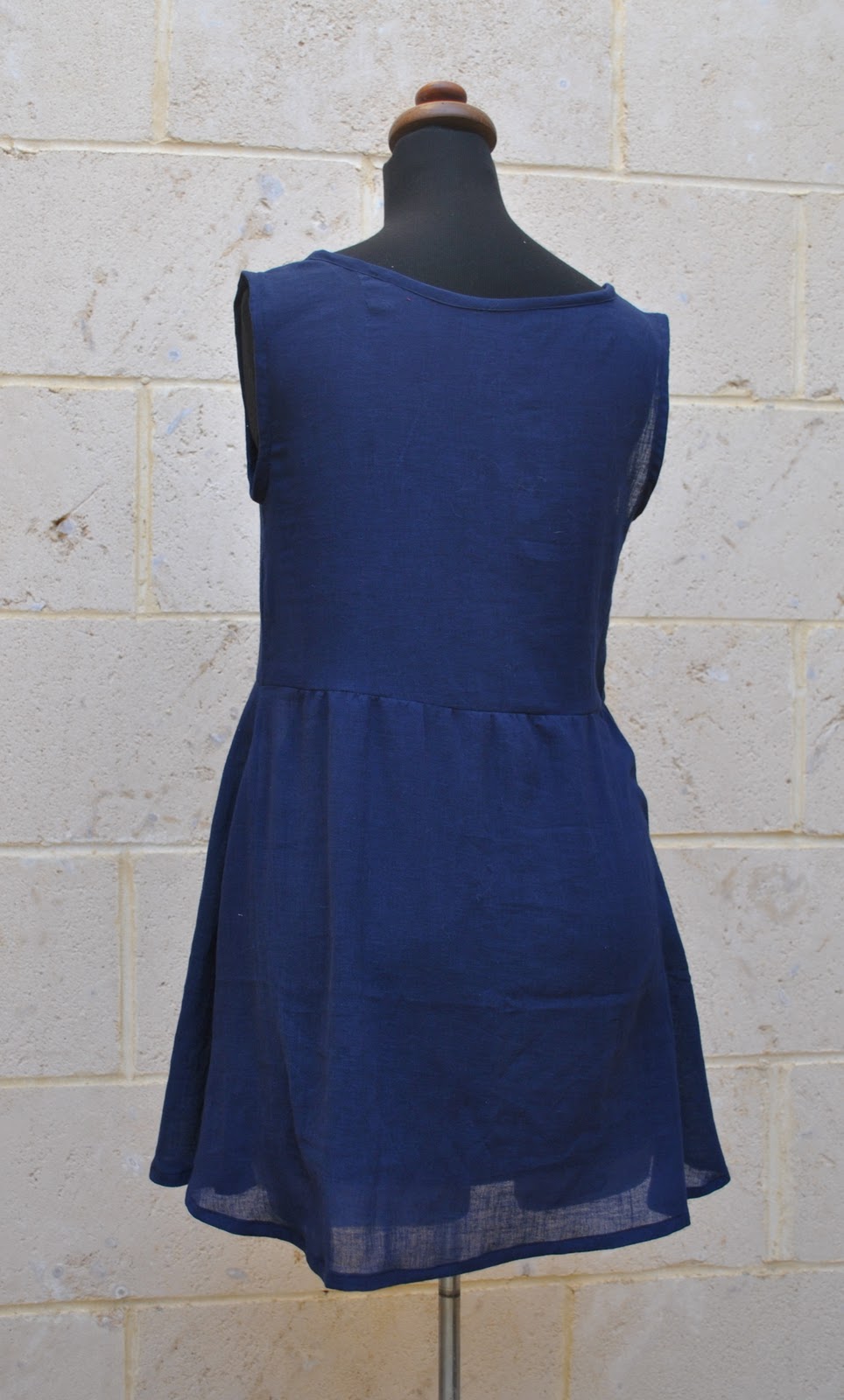
She despaired, but briefly; rallied and then quickly made a little slip-on petticoat.  It was thrown together somewhat, but finally the gods were smiling on the seamstress because the petticoat was perfect. 
And they all lived happily ever after.
Details:
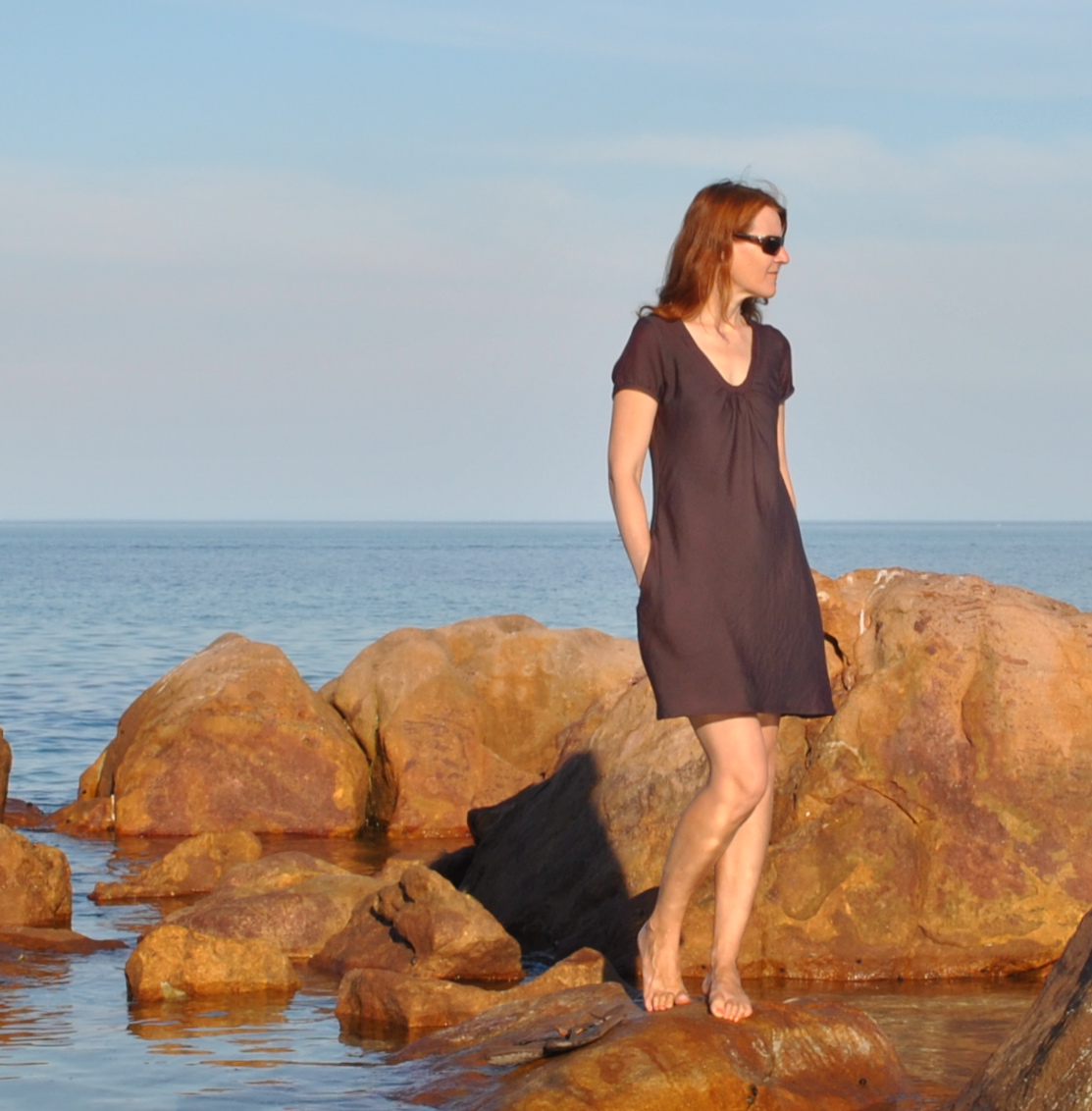
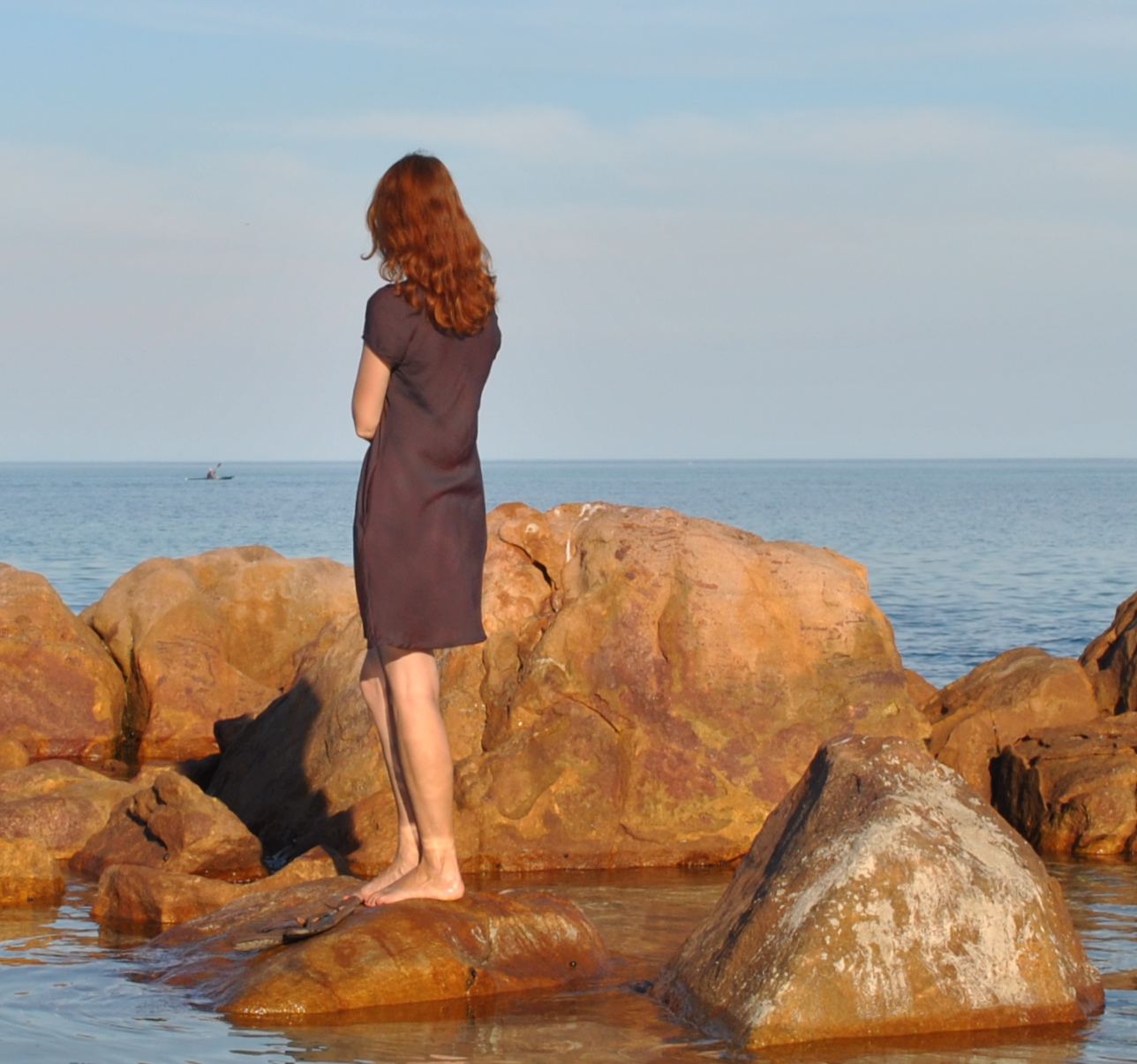
Dress; Burdastyle magazine 06/2011, dress 102, purple shot rayon
Petticoat; self-drafted, from lightweight navy blue polycotton (the last leftover bit after making this)

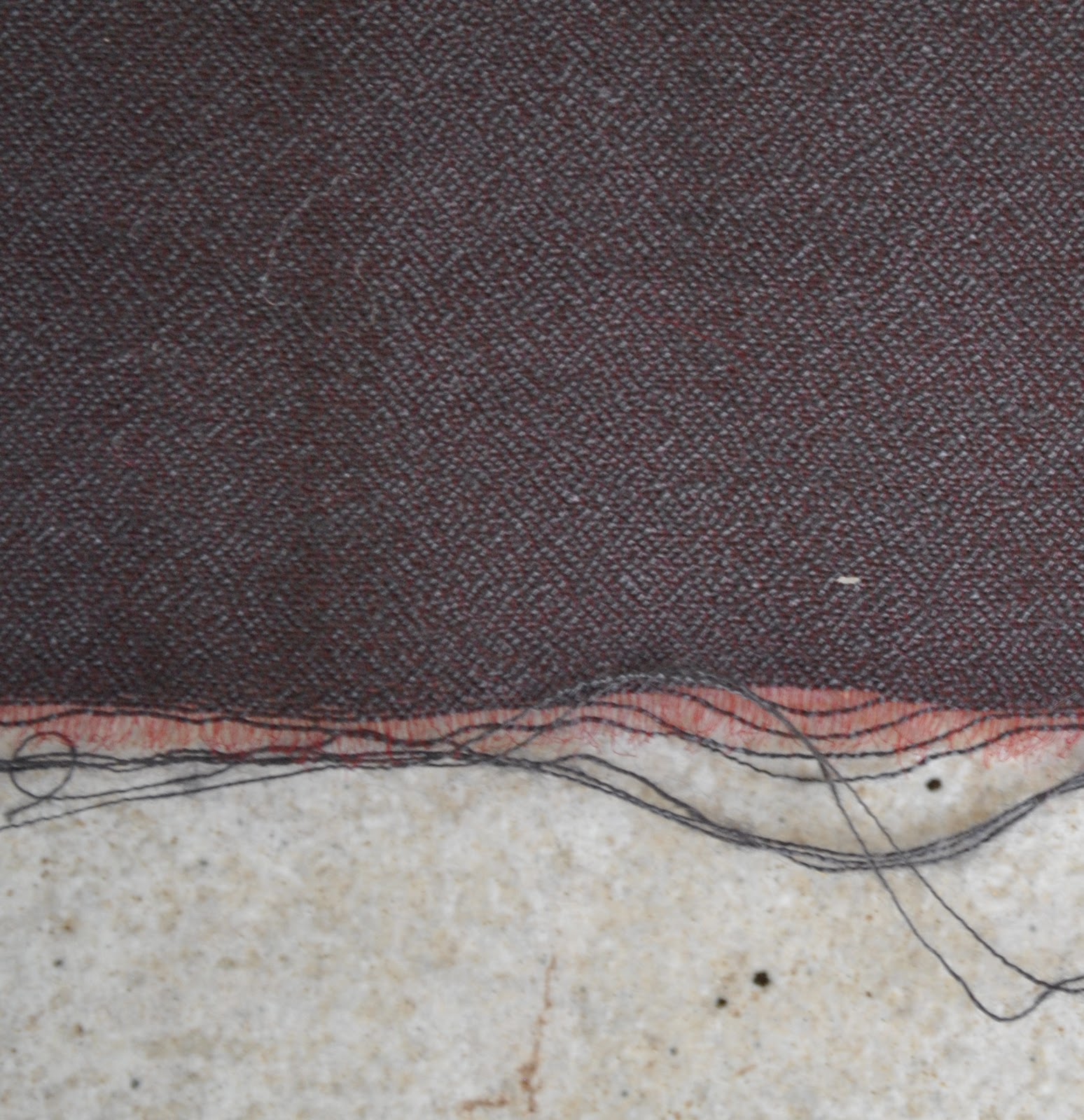
The fabric is shot rayon; with a red warp and a dark blue/grey weft, giving it an overall browny-purple hue.  Craig took this last candid photo which illustrates quite well how the fabric takes on different colours in the light (a hallmark of shot fabrics)
Pattern Description:
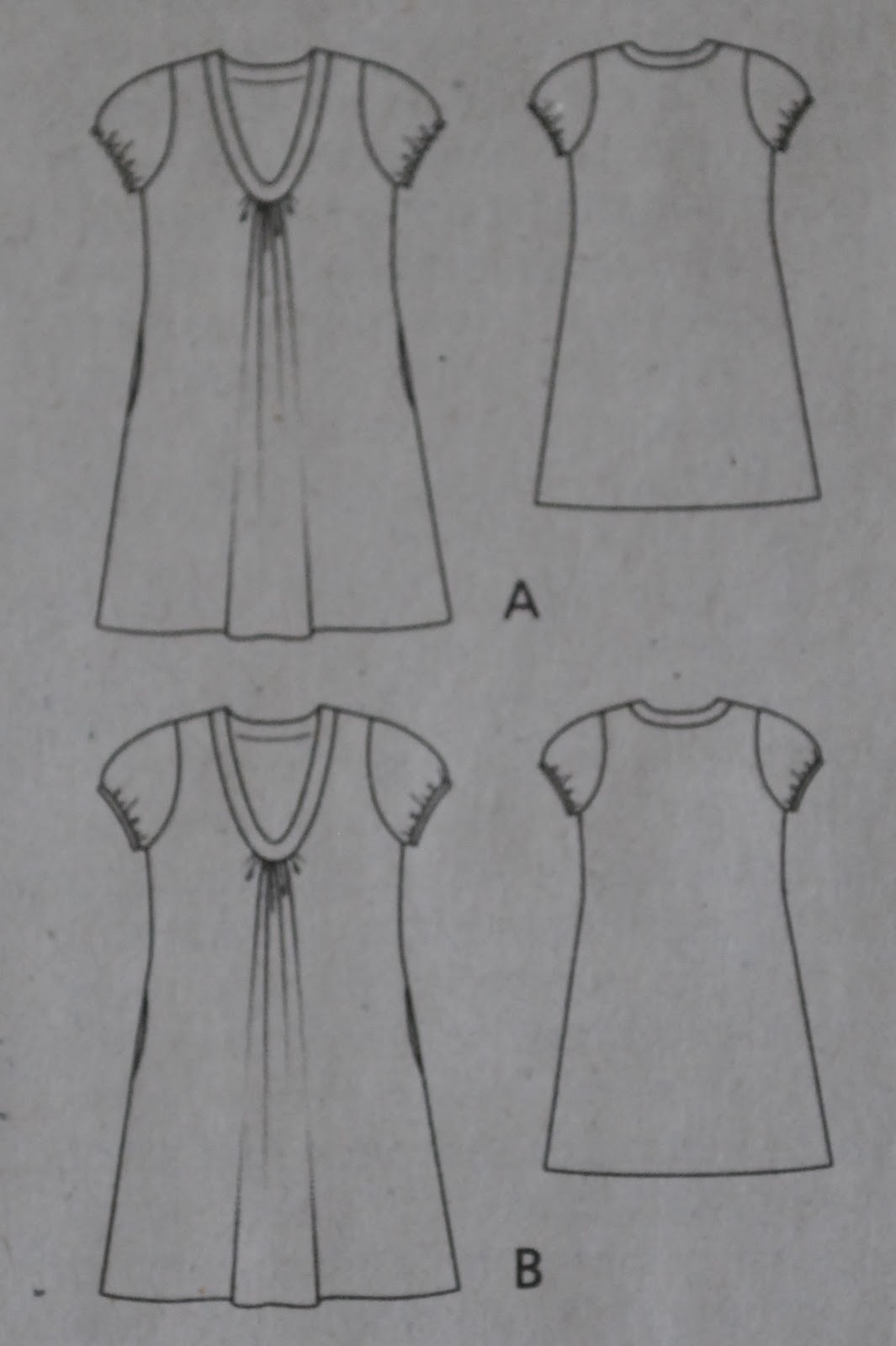
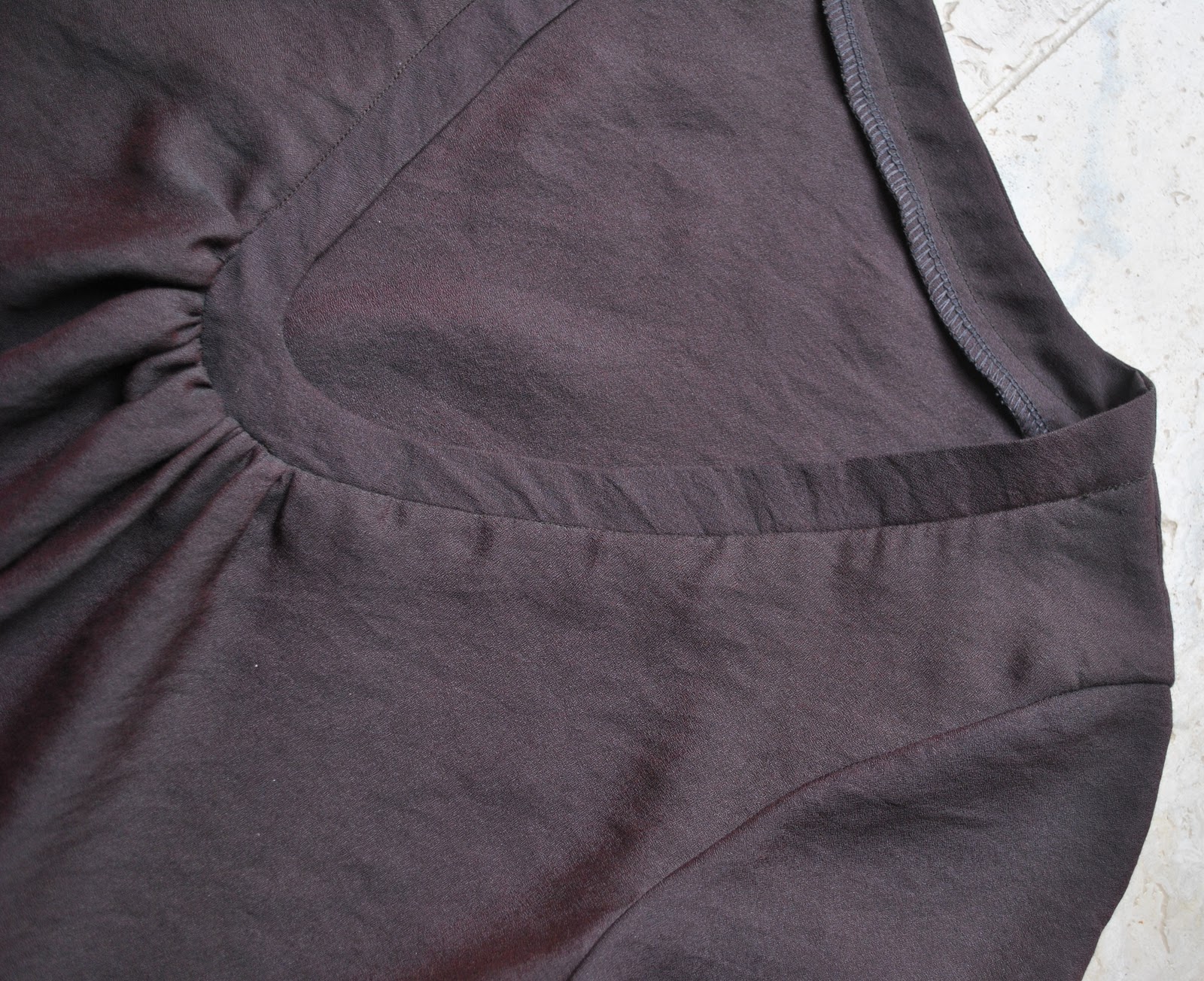
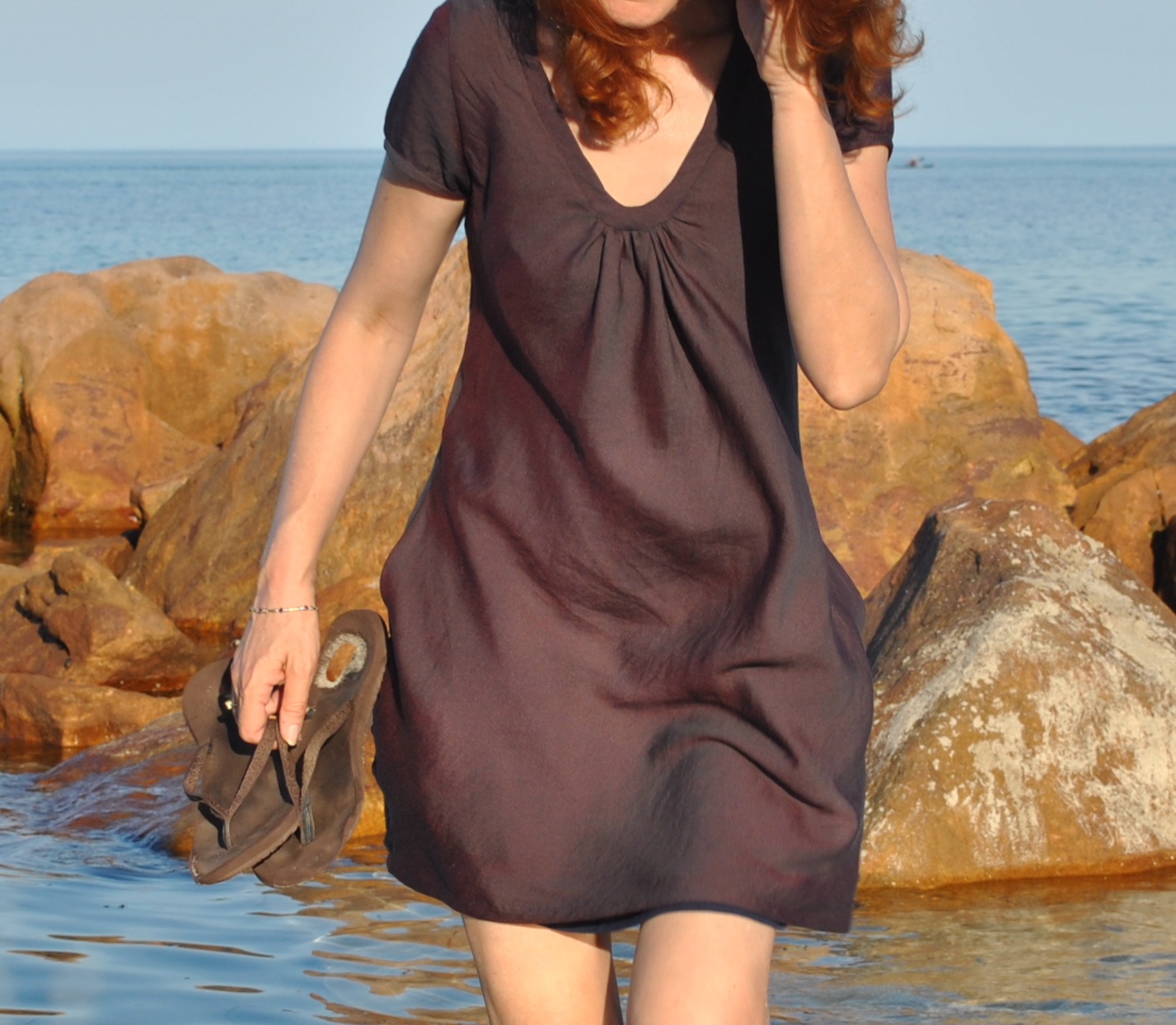
Flared bias-cut dress with an oval neckline which according to the magazine description “accents an alluring décolleté “ (hehehe)  Small gathered cap sleeves, inseam side pockets, no closure necessary.
Pattern Sizing:
European 36-44; I made the size 38
Did it look like the photo/drawing on the pattern envelope once you had finished sewing it?
Yes, except that mine is 14cm shorter.
Were the instructions easy to follow?
Not too convoluted, by Burdastyle standards.
What did you particularly like or dislike about the pattern?
I really love the neckline of this dress, the cute overall shape of the bodice part of the dress and the fact it will be wonderfully cool and comfortable this summer.
Unfortunately the pattern is a little… odd-looking in its finished form  :S  I think this might well be due to the bias cut, which when combined with that gathered neckline; well I should have foreseen how huge this would make the front of the dress look. I am not fond of the maternity look, been there done that and at my age I’m well past all that!!  However, looking closely at the dress I thought the baby bump effect was created partly by the length of the dress, and that the weight of the fabric caused the front to curve back inwards towards your body, in a sort of “bulbous” effect.  I took 14cm off the length and I think this drastically improved the shape of the dress.  The removal of this extra weight of fabric allowed the hemline to sit up and flip out more fully, giving more of an A-line rather than an eggplant silhouette.
Fabric Used:
Lightweight shot rayon, with a very slippery silky feel to it
Pattern alterations or any design changes you made:
Contrary to the instructions I sewed the pocket pieces to the dress before sewing up the side seams.  Why would you sew up the side seams before attaching the pockets anyway?  That doesn’t make sense to me at all.
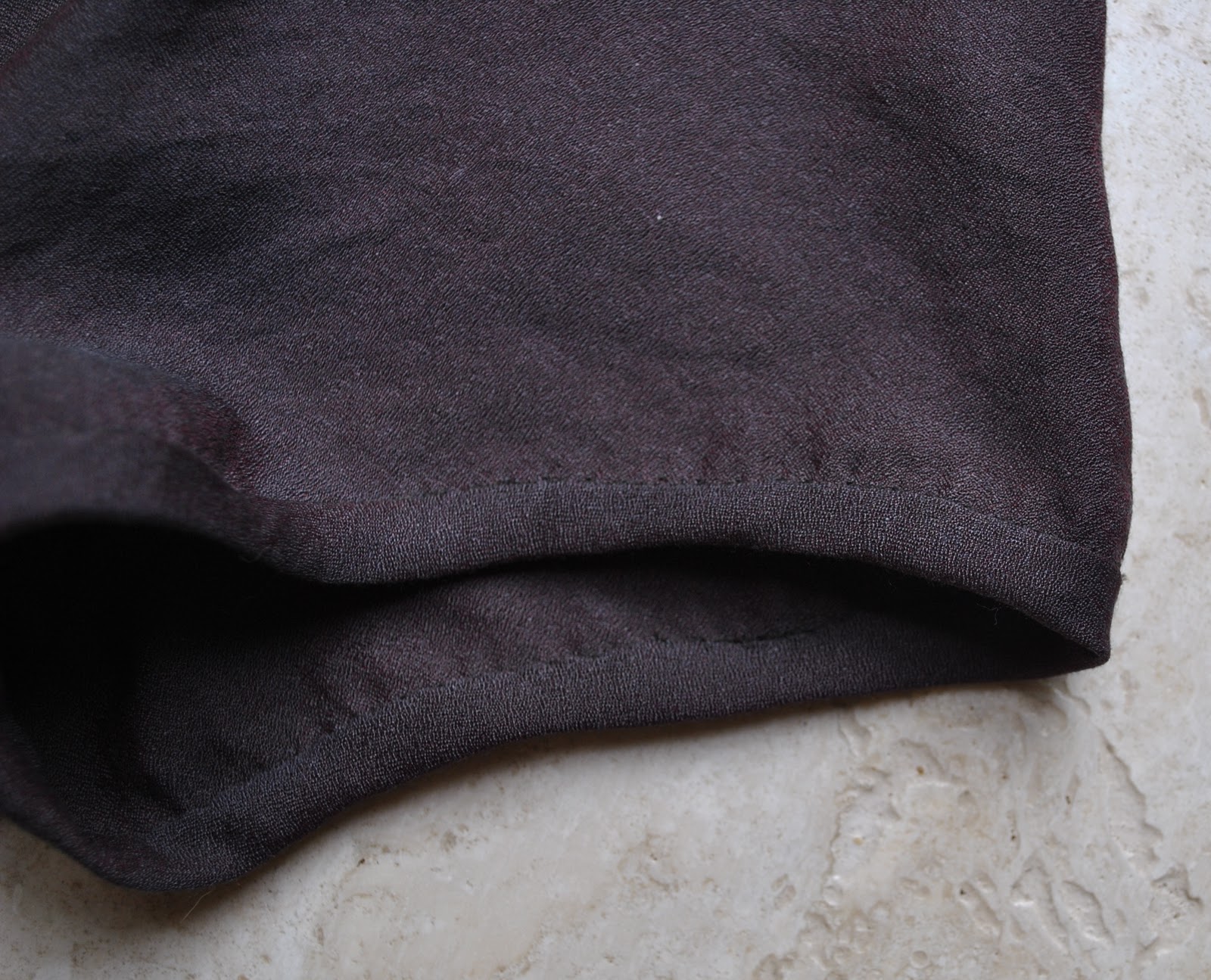
The instructions tell you to attach the sleeve binding before sewing up the side sleeve seams… I sewed the side seams of the dress, then sleeve seams and then set in the sleeves; then I attached the binding to the lower edge of the sleeves and slipstitched it over by hand.  Just a personal preference…
The “bigness” of the dress combined with a quite long length added up to an unfortunate overall frumpiness… so I ended up taking 14cm off the length and this improved the silhouette of the dress enormously, imo.
Would you sew it again? Would you recommend it to others?
I’m curious as to whether this would look better in a straight-cut; and I might just try this out sometime…  Otherwise it might be worth reducing the width of the neckline (and thus some of the excess fabric from out of the front of the dress) to see if this reduces the unfortunate “baby bump” effect.
Would I recommend this to others? well, this would definitely make a fabulous maternity dress!
 Conclusion:
My first reaction to the unhemmed dress at the longer length was disappointment, but taking off that crucial 14cm in length and I am happy!  I really like this at the shorter length.  But I wouldn’t make this again, at least without trying a few adjustments, like taking away at least a bit of that excess fabric around the middle…
This might work better in a lightweight cotton or something else not as slippery and slithery as the fabric I chose.  Bias cut rayon is not much fun to work with.
pinterestmail

Aquarama

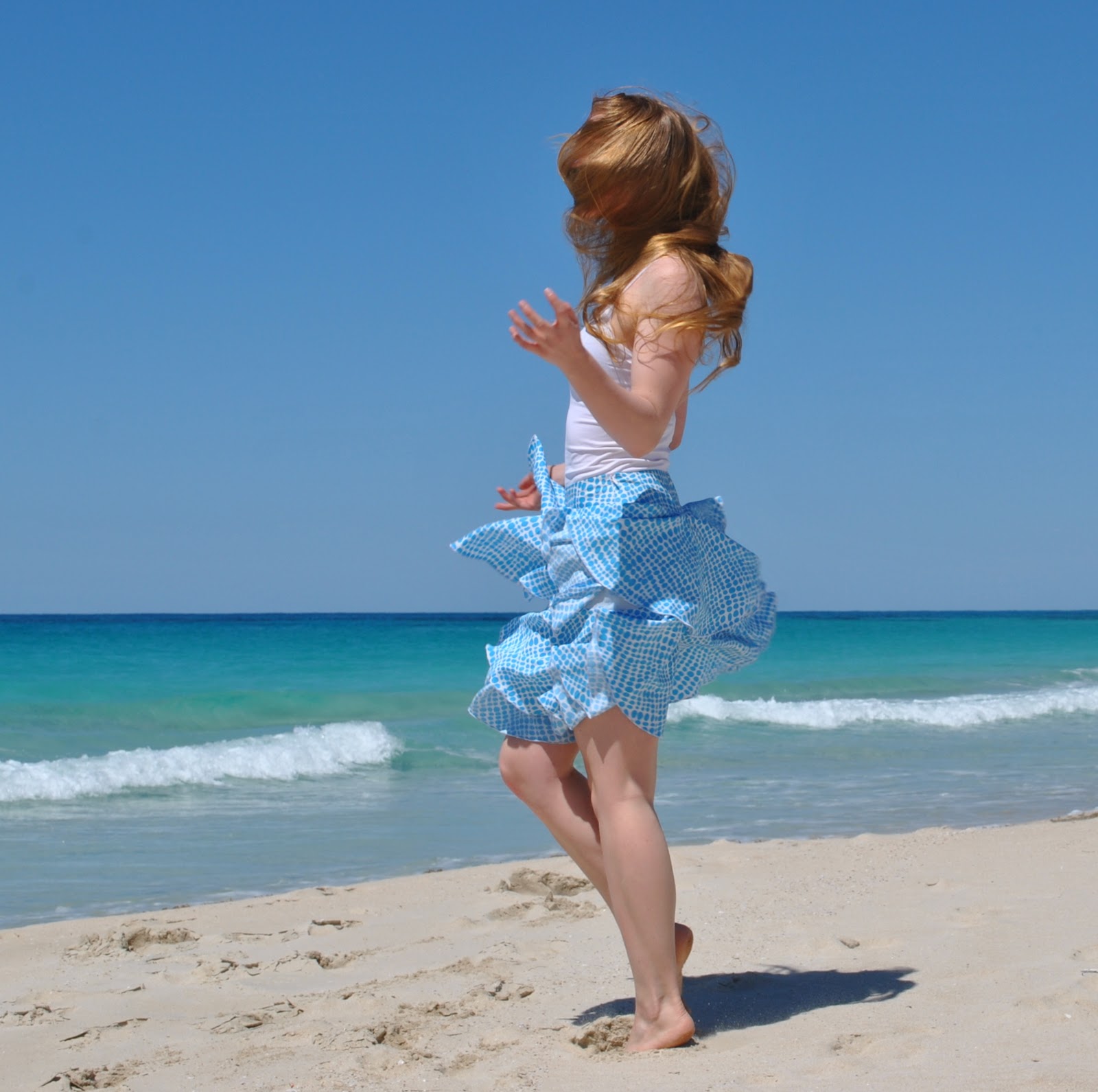
I made a skirt for my daughter…
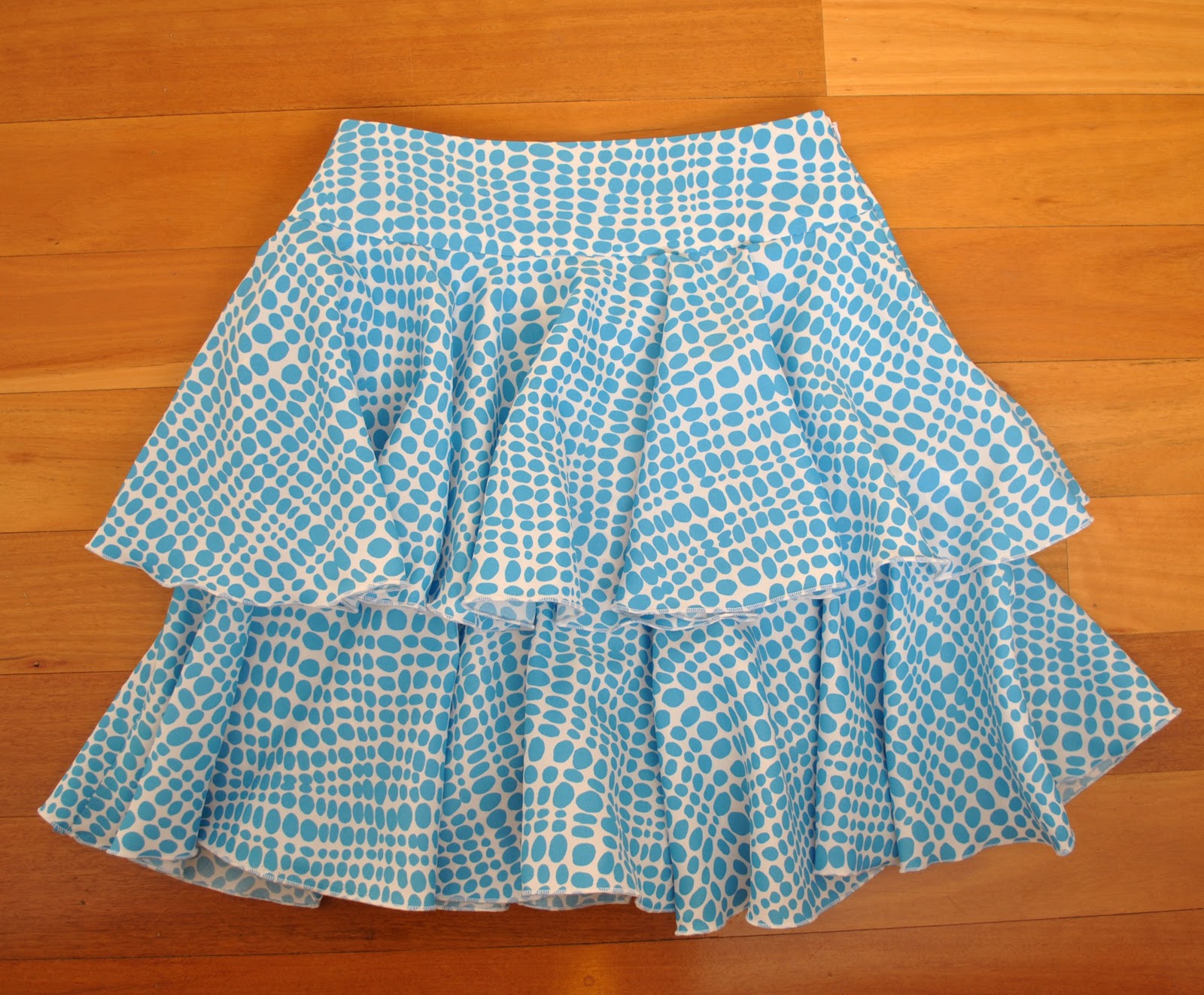
I used another piece from the bundle of fabric given to me by my friend C, from her late mother’s stash.  Going by certain clues (only 90cm in width, a stapled-on tag from a long-gone local store with imperial measurements penciled on it) this piece must be at least 35 years old, and probably the loveliest piece of the lot; densely woven, light/medium weight and slightly crisp with a matte crepe-y texture.  It cut like butter and sewed together beautifully.  I don’t know if it was expensive, but it feels like it could have been quite expensive… and I even started to wonder if it could be silk so I did a burn test on a scrap.  Well, it shriveled up faster than you can say “omg, where has my skirt gone?!”  
SO, a fairly important modesty as well as a safety tip there for Cassie….
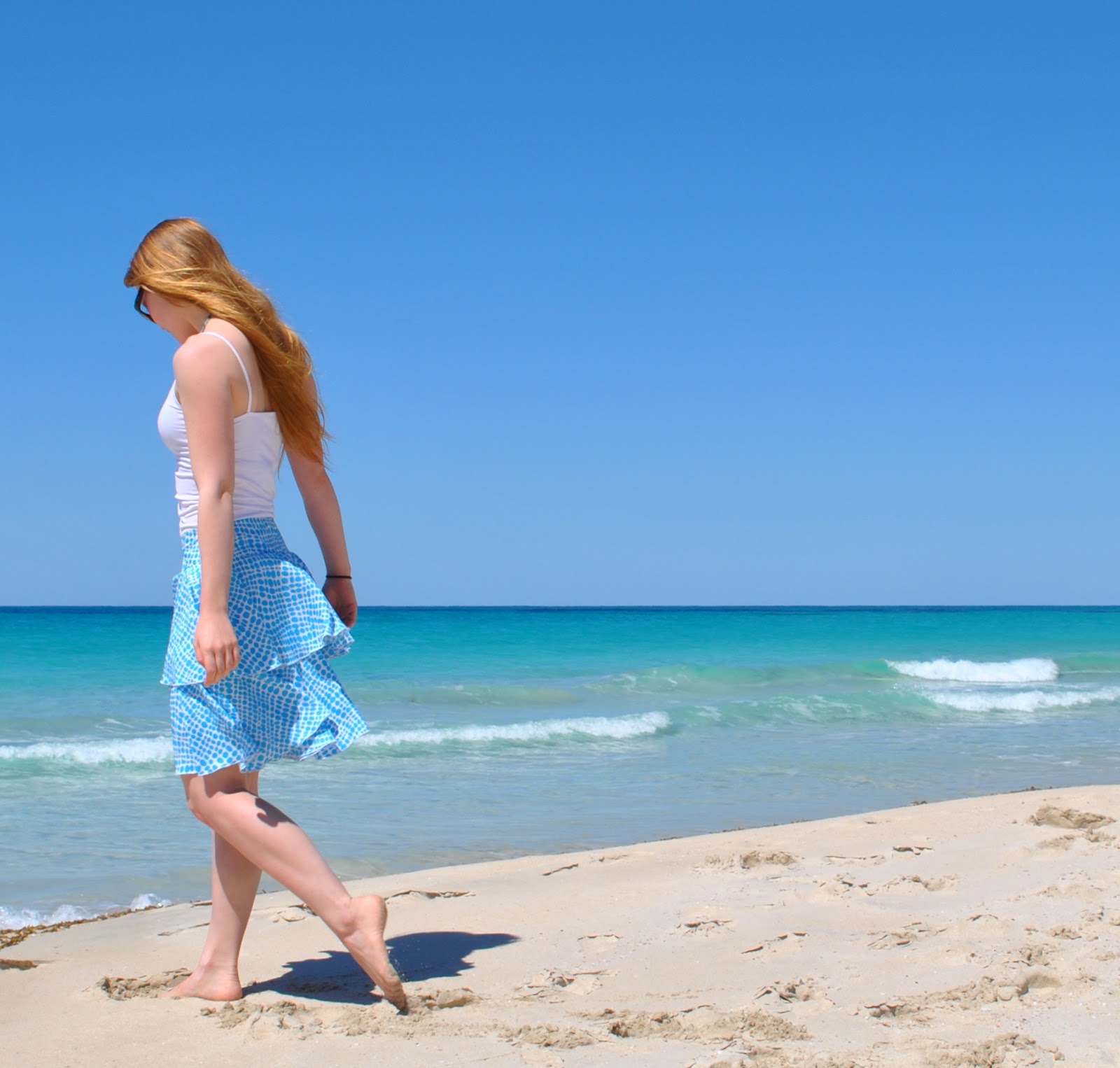
The print, of random wave-y rows of organic turquoise blobs on a snowy white ground is pretty cool… don’t you think?  Lava lamp-ish, sorta.  Optimistic and space-age-y both, just like the 60’s and 70’s were.  So a bubbly kinda print for a bubbly kinda skirt, y’know.  I think it works well, stylistically. And she likes it!
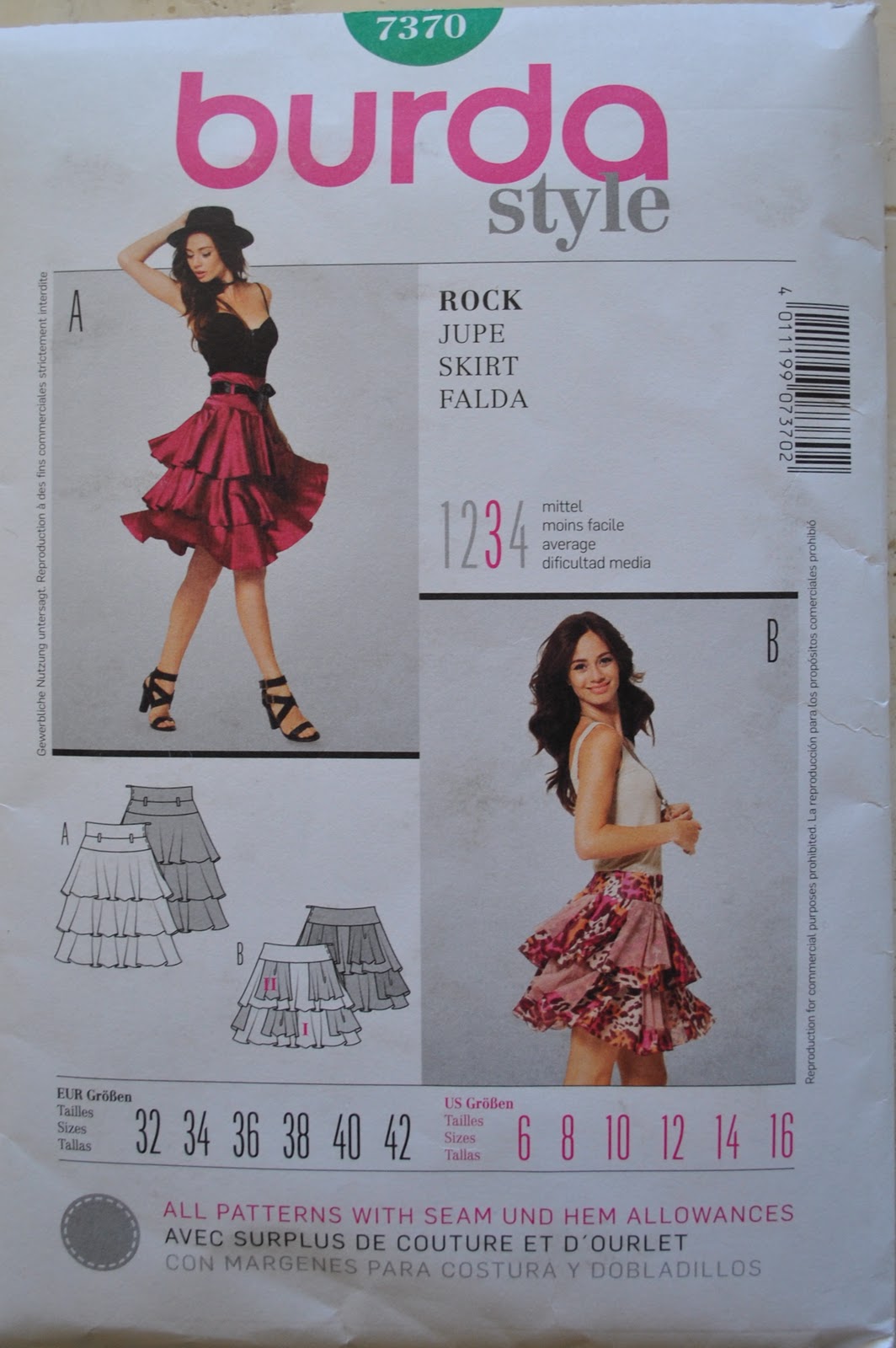
I used Burda 7370, the 2-layered skirt in view B but without the extra insert bits.  I knew she liked this shape, since it is a pattern we bought together for her recently and she has made one up for herself already in a denim-blue burnt-out jersey.  Having Cassie’s perfectly custom-fitted version for comparison made this second version an easier job for me….  Incidentally, I think it is interesting that Cassie has exactly the same fitting issues as me; taking in several centimetres off the waist is a given in any skirt pattern.
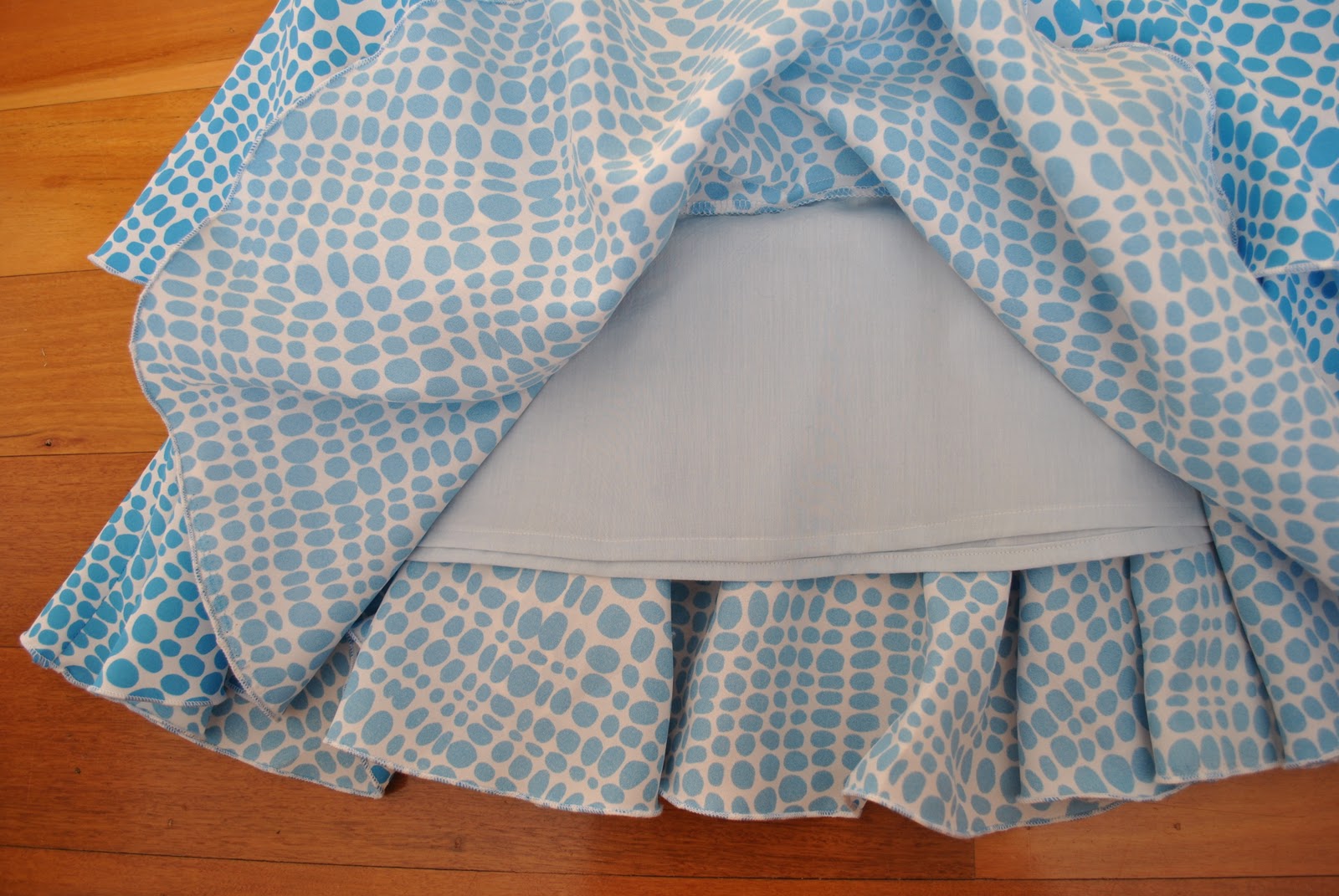
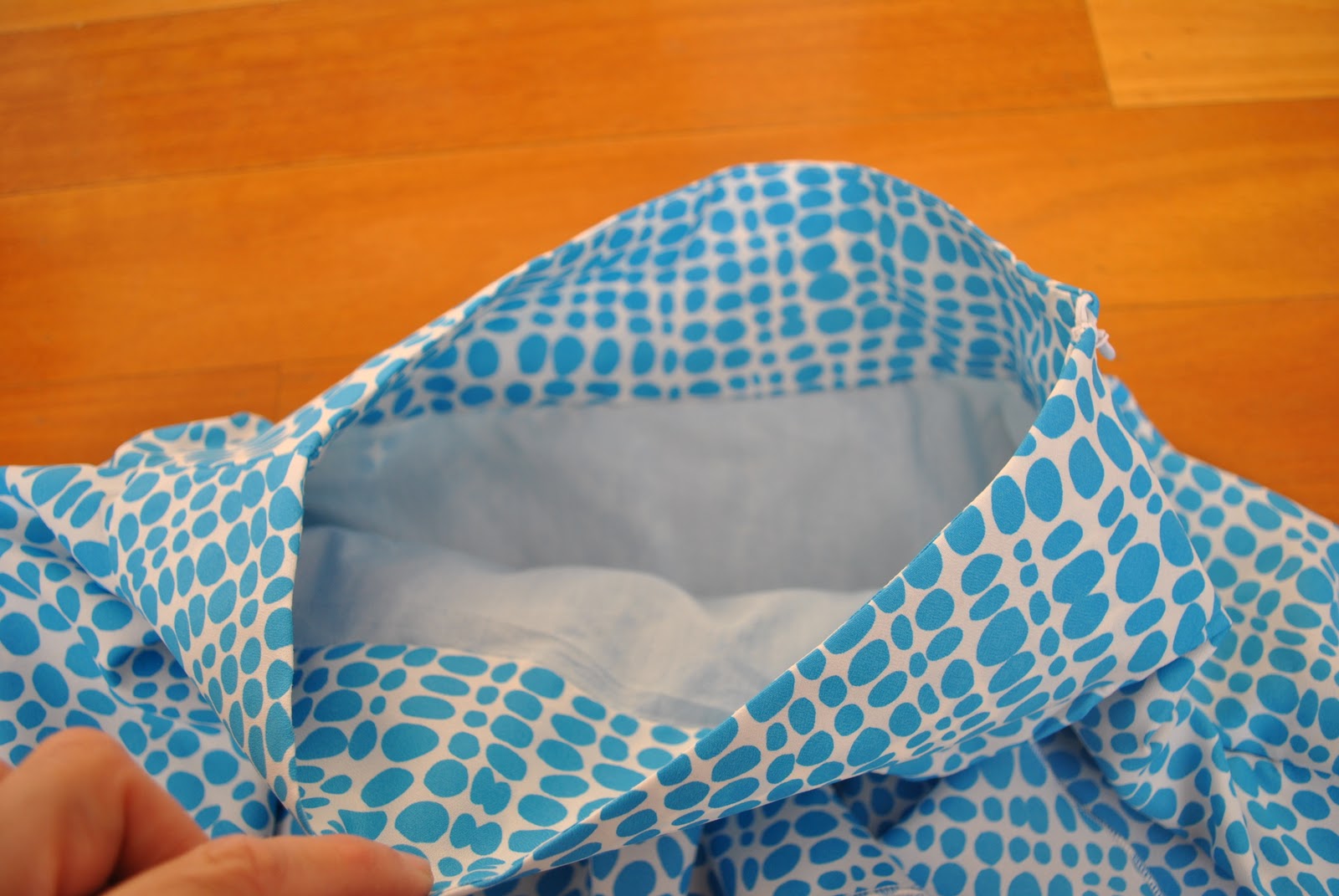
The skirt lining is of pale blue shot cotton in Ice, hemmed by folding in twice and machine stitching.  All the raw edges inside the skirt are overlocked to finish, and the hems on both layers finished with the rolled hem on my overlocker.
Details:
Skirt; Burda 7370 view B, turquoise and white print synthetic crepe, at least 35 years old
Camisole; Country Road
In twirl mode…
Pattern Description:
Flared skirt, either two or three layers, two yoke variations and side zip
Pattern Sizing:
European 32 (US 6) to European 42 (US 16).  I made the size 8.
Did it look like the photo/drawing on the pattern envelope once you were done sewing with it?
Yes, except that I left off the extra inserts.
Were the instructions easy to follow?
very easy
What did you particularly like or dislike about the pattern?
Love the cute flippiness of this skirt, a perfect dancing skirt for a girl who loves to dance like my daughter.  It looks adorable when on, swishes about gloriously and accentuates her waist beautifully.
I’m not thrilled that it requires such a lot of fabric, but that is just stinginess talking…  The first time she made up this pattern and we were buying the (not particularly cheap) fabric that she had chosen, I really had to bite my tongue at how much it was costing!  However she did a superb job of making it up.  And she’s worn them a lot.  This version pictured here is the second skirt using this same pattern.
Fabric Used:
Light/medium-weight synthetic crepe
Pattern alterations or any design changes you made:
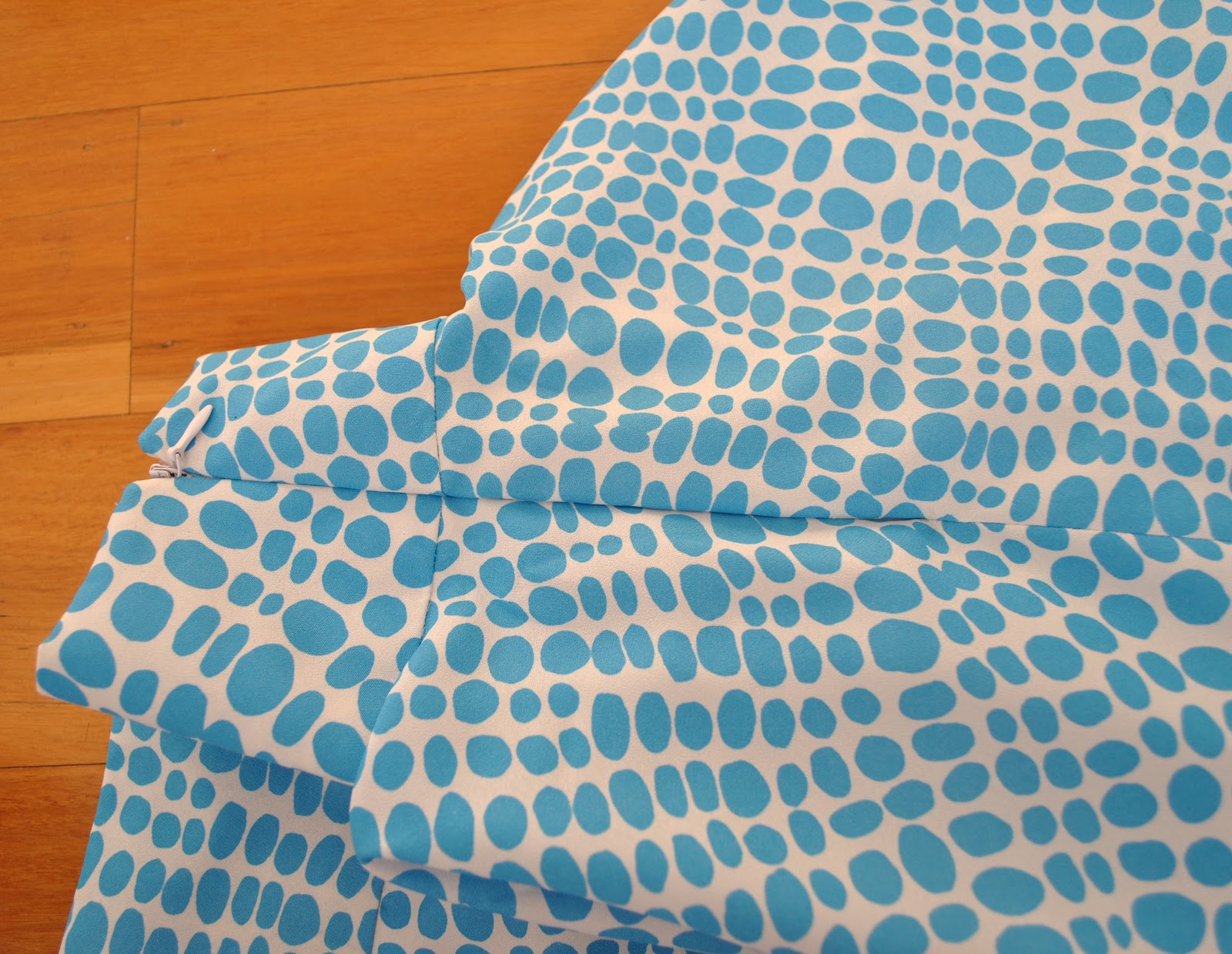
The pattern is gorgeous just the way it is.  The only alteration to the instructions I would suggest is my usual one; when inserting an invisible zip I get a much better and smoother result by sewing in the zip BEFORE sewing up the rest of the seam allowance below the zip.  This requires some careful measurement to get the lining and skirt seams lined up and sewn up perfectly, but is worth it for the superior finish. 
I finished the lower hem using the rolled hem stitch on my overlocker.
Other than that, the only adjustments I made were just custom-fitting issues, taking in a few centimeters off the waist.
Would you sew it again? Would you recommend it to others?
Probably will sew this again for my daughter.
If you love to dance and twirl about then do I highly recommend this one!!  My daughter cannot resist sashaying about, just by putting this skirt on! 
Conclusion:
Uses a lot of fabric, but is so cute and feminine and so darn flippy that it is well worth going there.  My daughter went out dancing with her friends, was the only one in her crowd not wearing a miniature mini dress, and the only one who didn’t have to worry about constantly pulling down said miniature mini dress whilst on the dance floor.  She enjoyed that freedom, and said that she got lots of compliments… win!  Apparently she got offered lots of free drinks too… hmmm
pinterestmail

A sleeveless top, con latte

I’ve made a new top!
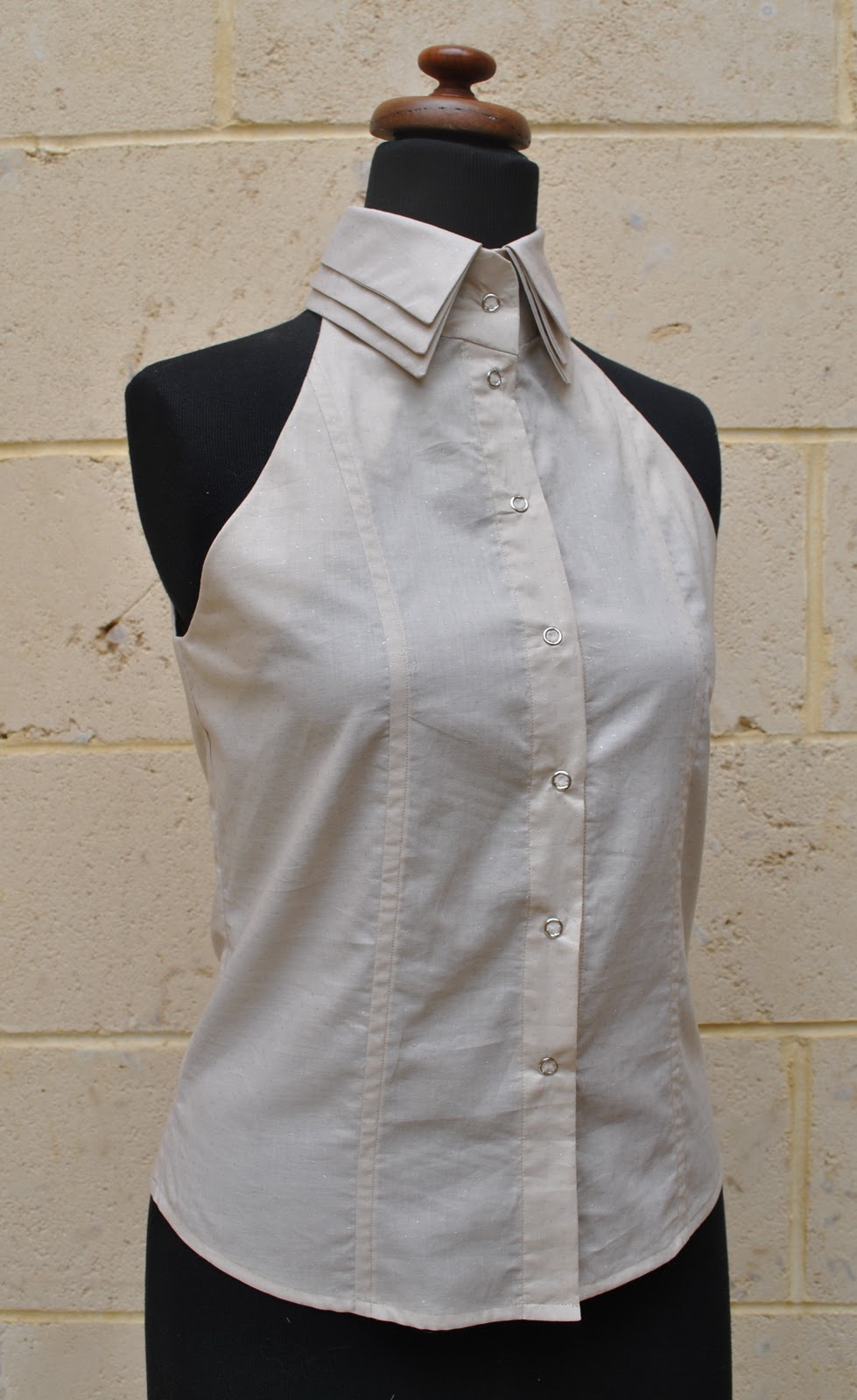
This is the little top from Vogue 1248, made of a light cotton voile the colour of pale milky coffee, and with miniature metallic silver polka-dots dotted sweetly all over like a starry starry sky…
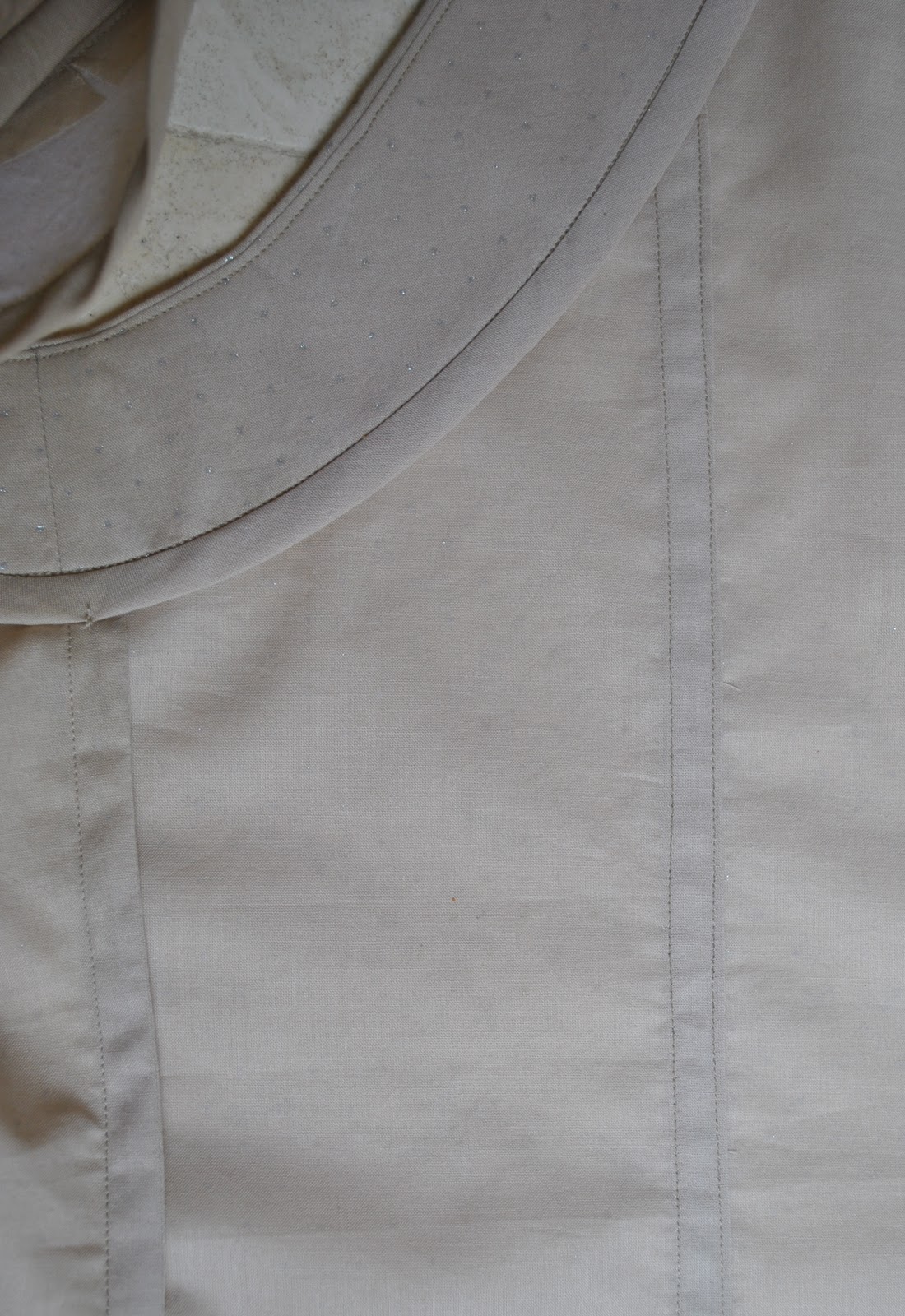
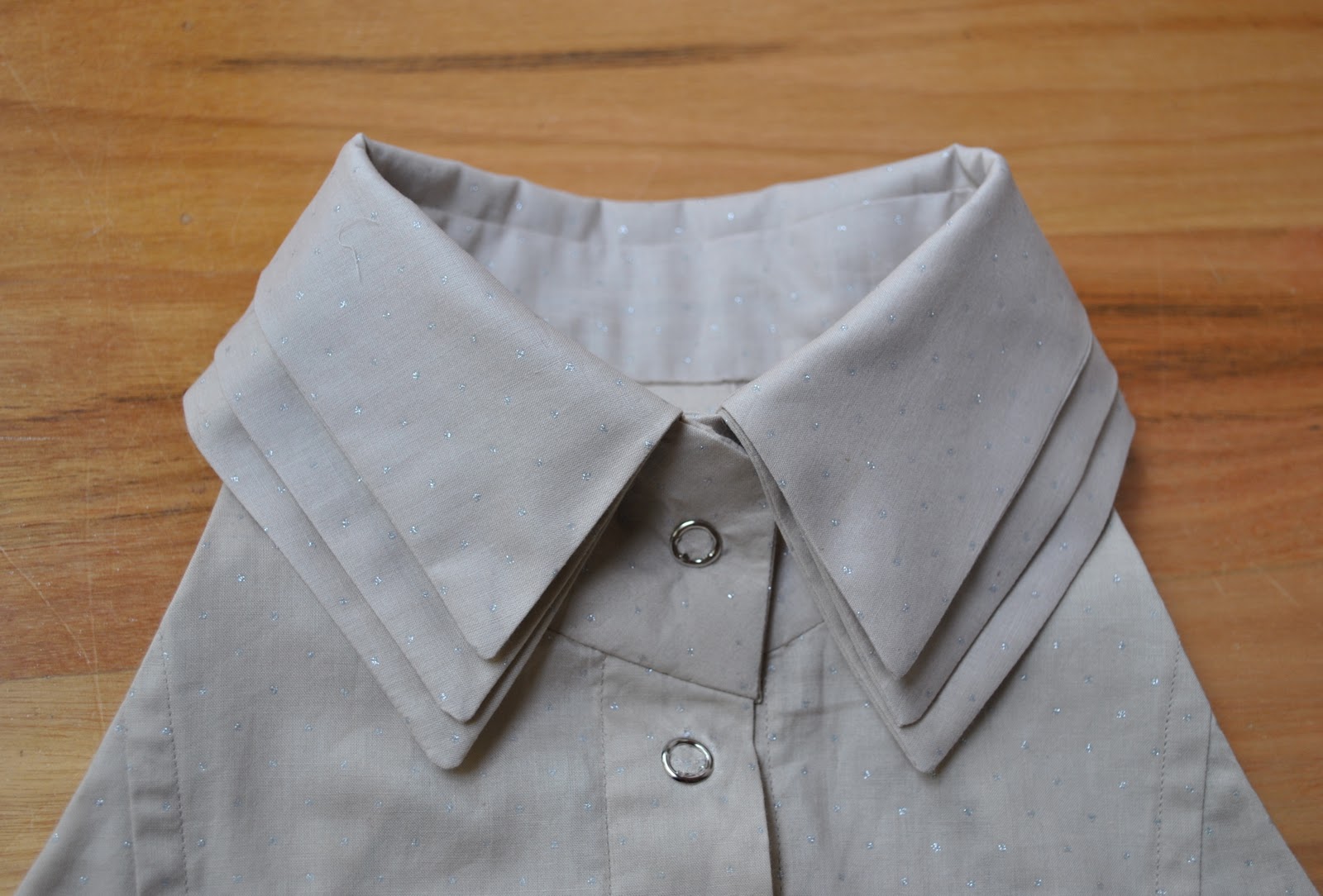
the most interesting feature of this top is that it has a triple collar.  This, I love.  How cool and easy is this idea? so simple and so cute and yet you don’t see multiple collars very often, if at all.  When I was planning the top, I thought how wonderful it would be to make the collars in different colours to really show off this feature but couldn’t find matching weight fabrics in colours I liked, and I vetoed as being too wasteful the idea of dyeing tiny little collar-sized pieces of fabric.  So in the end I took the easy route of just using all one fabric.  Next time… and yup, I am already plotting a next time, mwahaha (watch this space!)
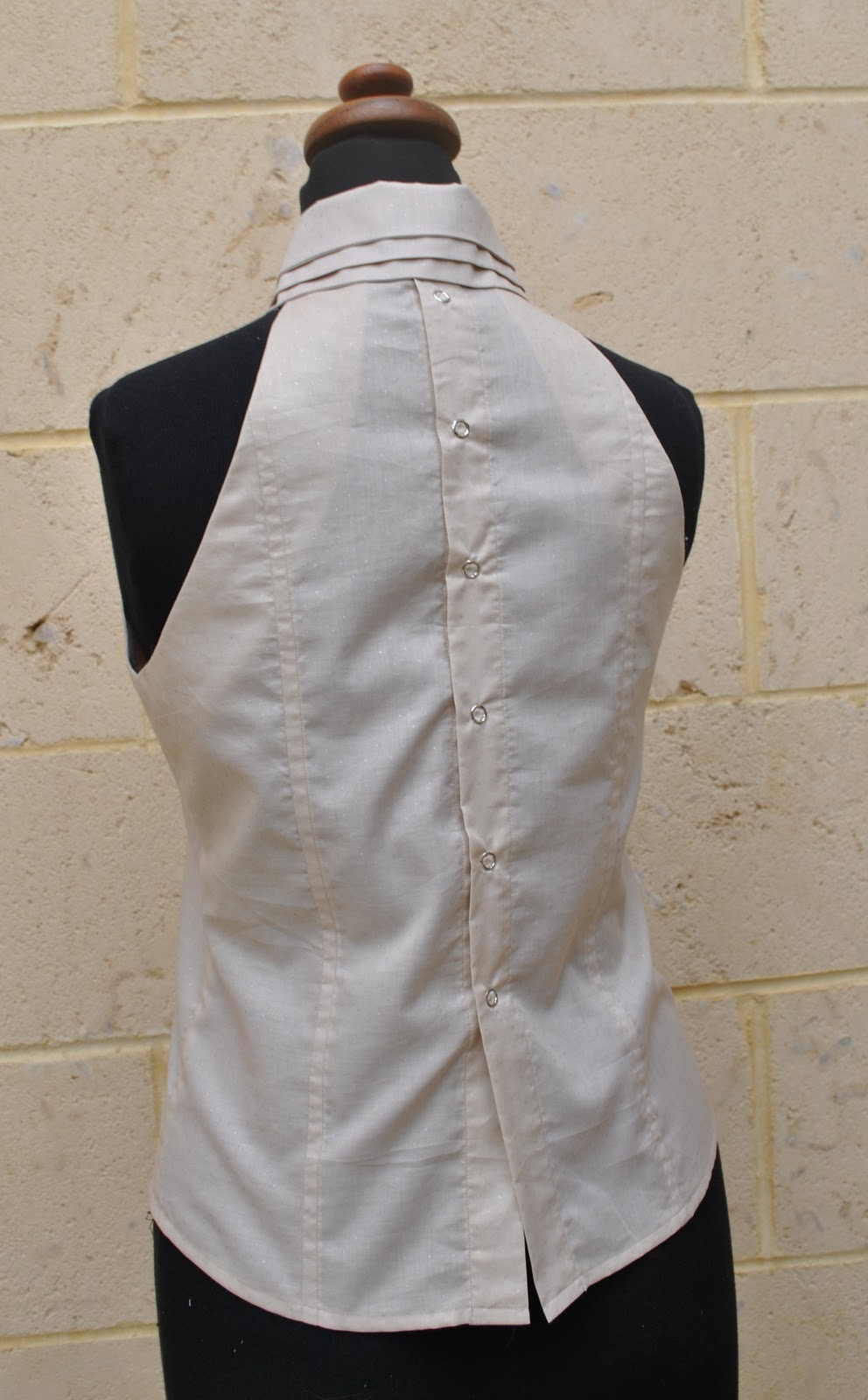
The top also has snap-opening plackets both front and back, and I chose silver snaps to match the tiny silver dots on the fabric.
I’m not thrilled with the snaps… because my fabric is very very light and just may be too fragile for snaps, yikes!  Undoing the snaps I am veeery carefully and slowly prising them apart, absolutely terrified of ripping the fabric.  But this is completely my fault for not putting in heavy-duty enough interfacing to stabilise the plackets enough, something to bear in mind.
Another unusual feature about this little top; the two fronts and the two backs just go into the collar; with no shoulder joining seams, or any shoulder at all, for that matter!  So really my calling it a sleeveless top is not going far enough; it is more specifically a shoulderless as well as a sleeveless top.  I just went with “sleeveless” because; well, “sleeveless and shoulderless top” up in the blog post title is not super-succinct but is a bit of a mouthful and would have just befuddled and confused and had y’all going, “wha’?? no sleeves and no shoulders, well how can there be any top even left?”…. but yeah, one’s shoulders are bare too.  This will a good feature for summer in a hot hot climate like ours; just as long as one remembers to slather on that suncream before heading out.
Following the “finishing off as well as I can” policy; the princess seams are flat-felled, the side seams are French seams, and the armhole facings are edged with self-fabric HongKong seaming but with the fabric reversed so as to have the silver dots hidden inside.
(left; inside the top and clockwise; HongKong seaming around the facing, flat-felled princess seaming, French side seaming: at right; that interesting triple collar)

Details:
Top; Vogue 1248, pale coffee cotton batiste with tiny silver polka-dots
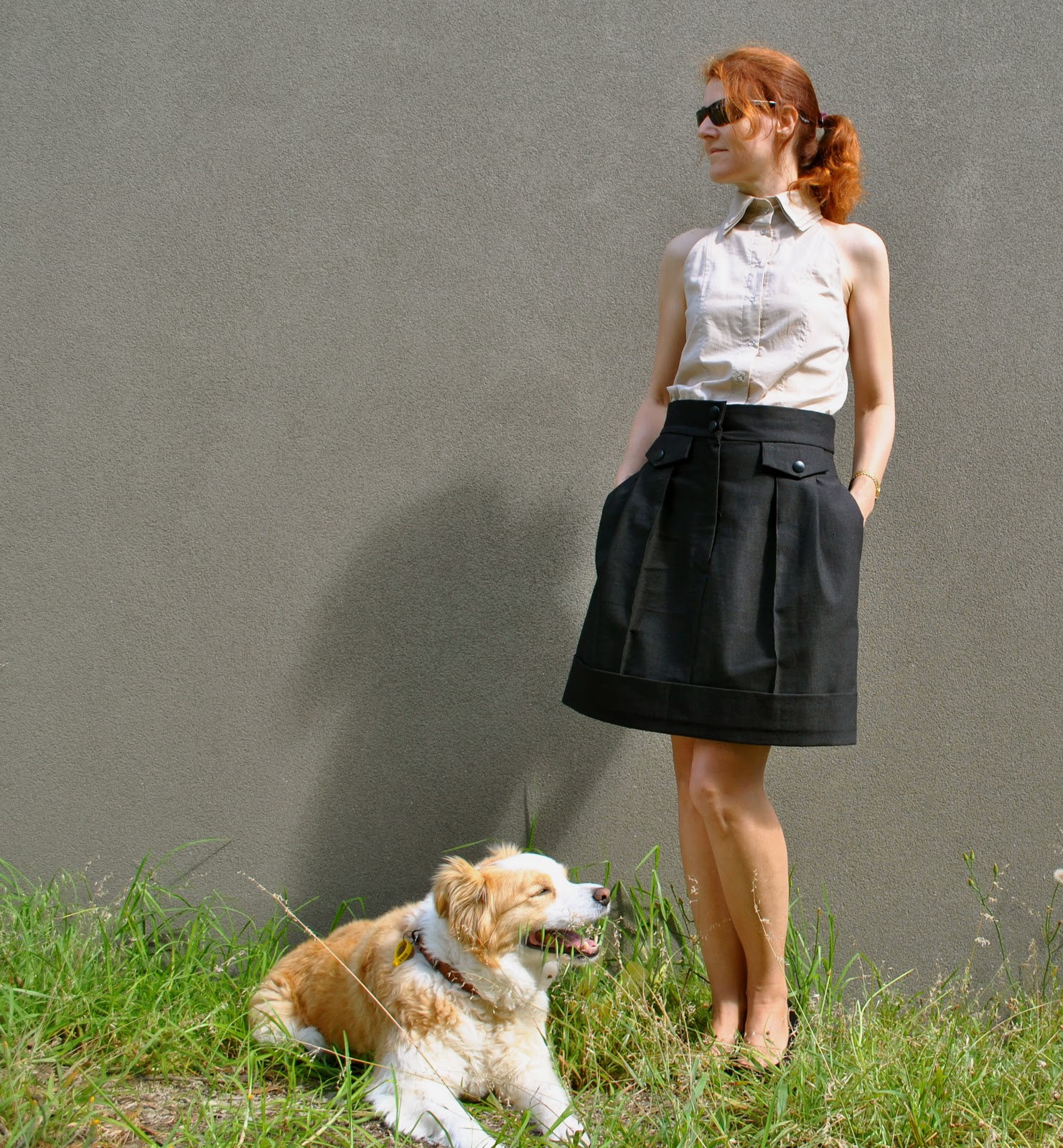
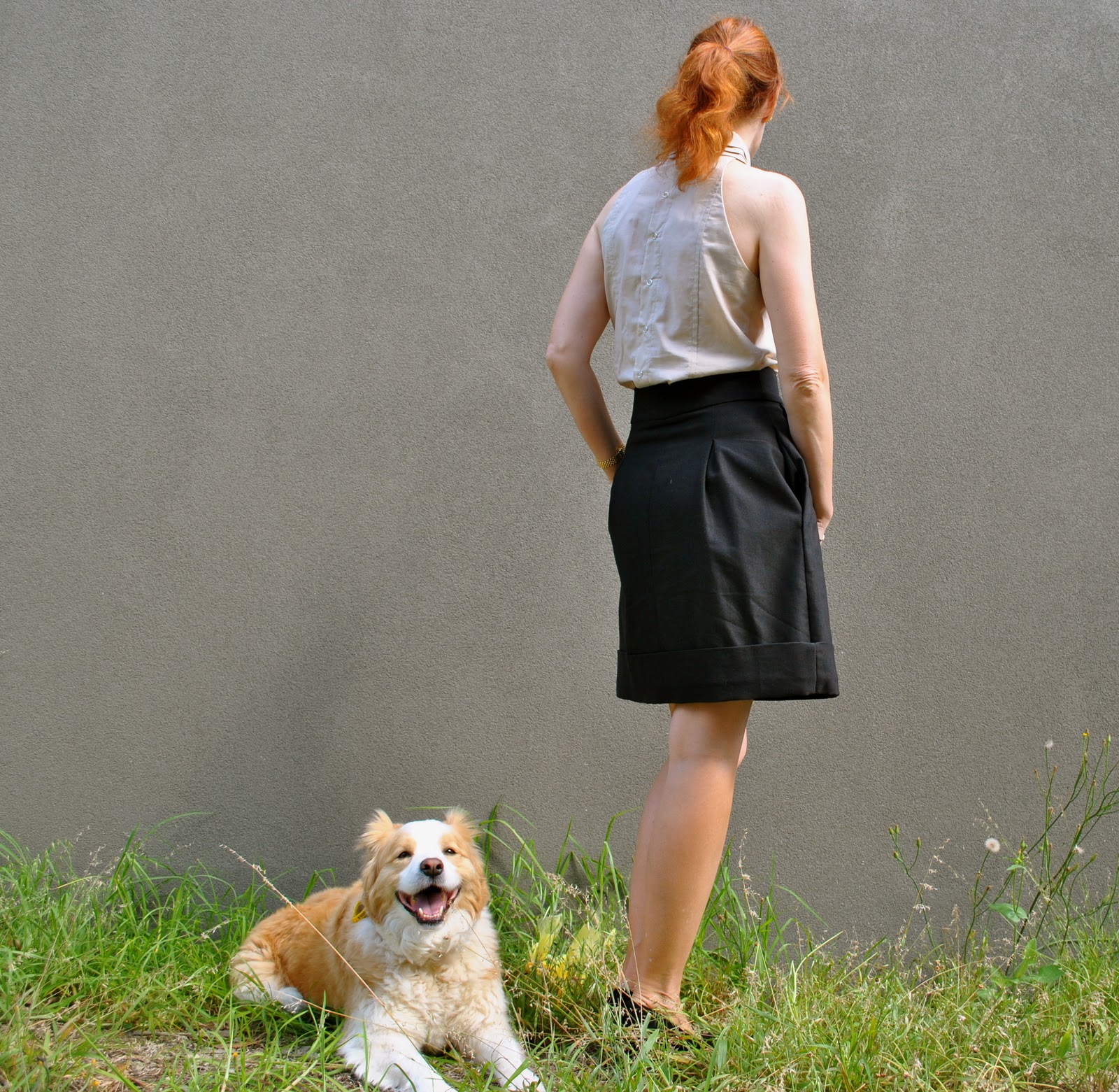
Skirt; Burdastyle 10/2010, 136, made of black suiting, details and my pattern review here
Shoes; Misano, bought from Labels boutique

Pattern Description:
Top: fitted front and back snap closing
Pattern Sizing:
4-10 in this envelope, I made a straight size 10
Did it look like the photo/drawing on the pattern envelope once you had finished sewing it?
yes
Were the instructions easy to follow?
yes
What did you particularly like or dislike about the pattern?
I totally adore the triple collar feature!!  Sooo cute!  Will be doing this one again for sure, and using different coloured fabrics to highlight the three collars next time…
The length is a nice one which allows the top to look equally good out loose as well as tucked in.
Fabric Used:
very lightweight cotton batiste
Pattern alterations or any design changes you made:
I didn’t make any pattern alterations, but I did flat-felled seams on the princess seams, French seams at the side seams, and applied self-fabric HongKong seaming on the armhole facing edges.
Would you sew it again? Would you recommend it to others?
Yes, I am already planning my next version in multiple fabrics, to show off that adorable triple-collared feature…!  I do recommend this cute and slightly unusual little top pattern to others too.
Conclusion:
Initially I was a little skeptical about this top pattern, as I tend to shy away from clothes which require special undergarments, but well, logically if you own a halter neck bra then you should wear it at least once in a while, no?  And I do love this cute little top, I think the shape is flattering, feminine and quite unusual.  My husband likes my shoulders on show like this, and I think the high neckline still gives the top a modest flavour and doesn’t make me feel too exposed so it is a win all round!

pinterestmail

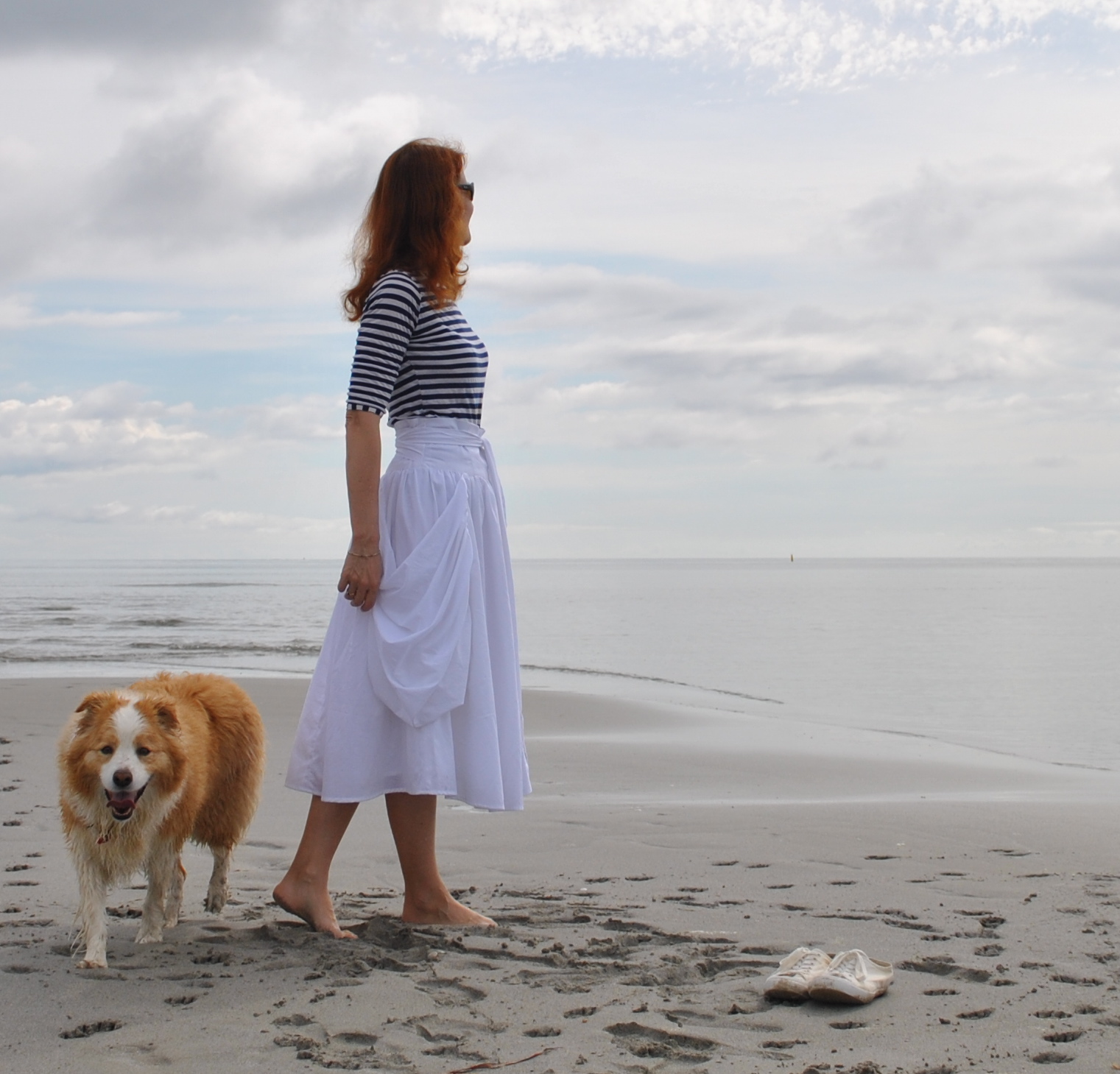
Do you like big pockets…?

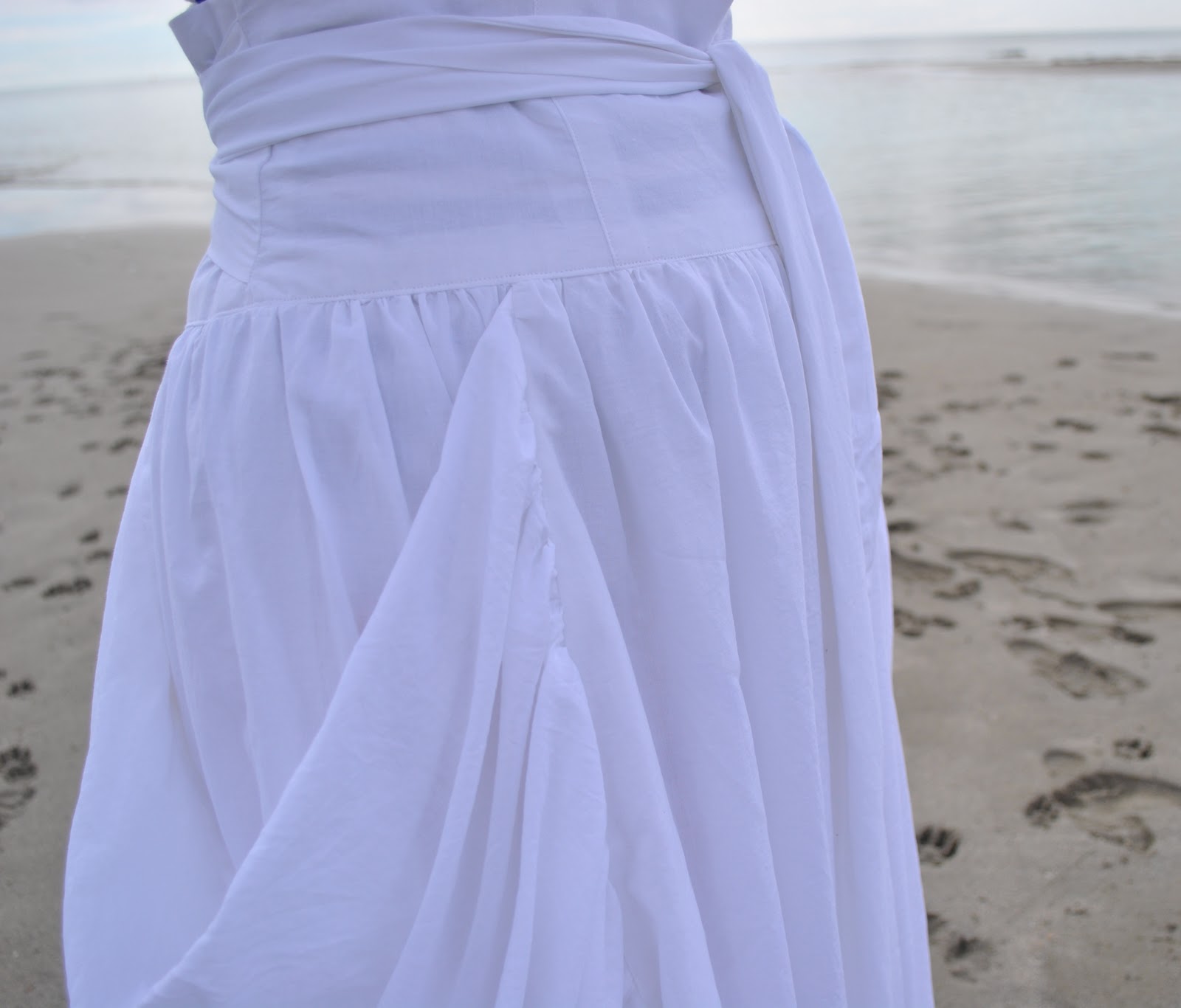
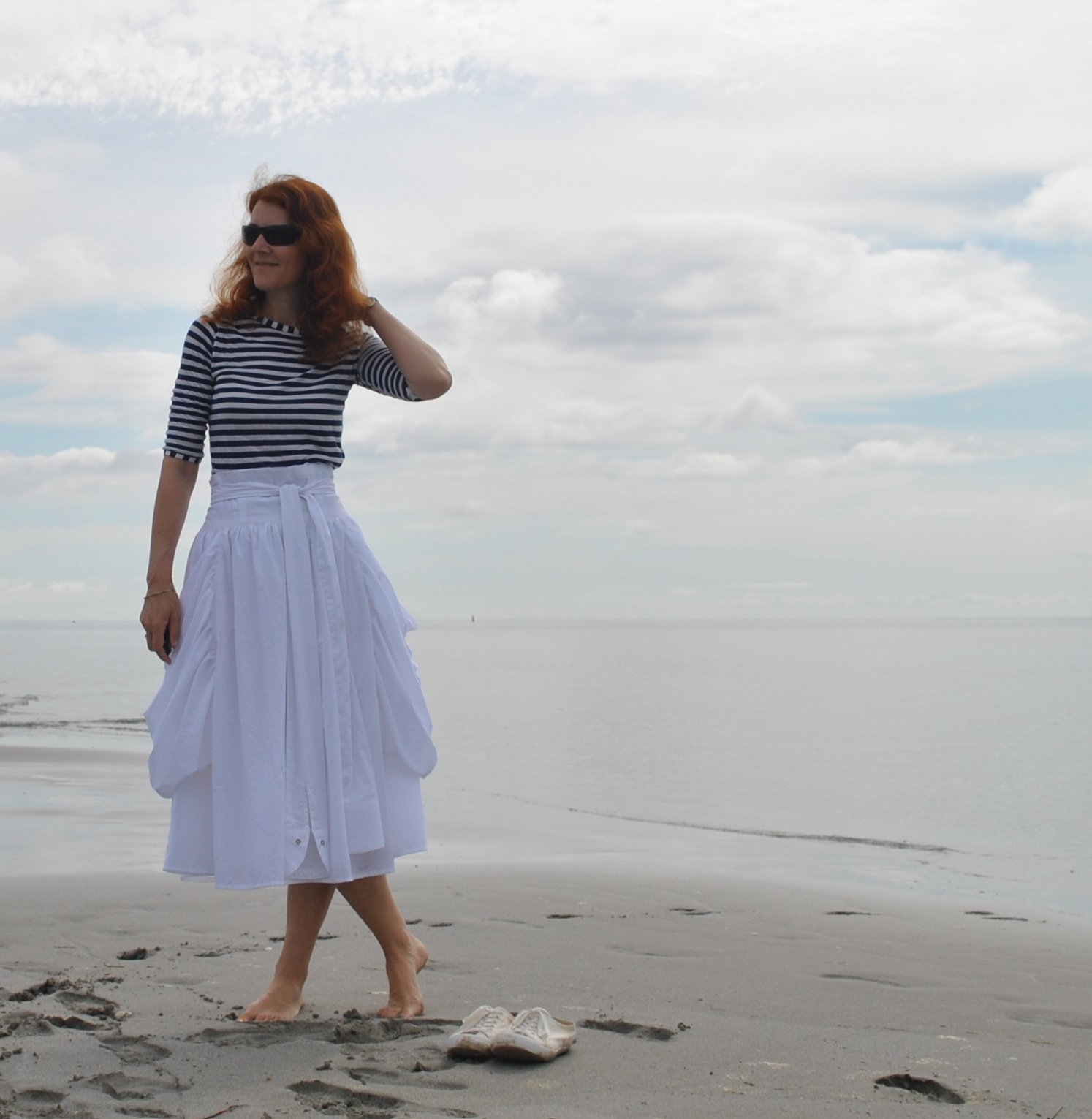
… if so then this is the skirt for you!  I have never seen pockets to rival these, ever.  I knew (intellectually) the pockets were big by the picture on the pattern envelope, but the (realistic) first sight of the pocket pattern piece was still a bit of a shock.  Seriously about as big as the skirt pieces, and the skirt pieces are big.  Lol!!
But of course, the pockets are not mere pockets at all, but a clever design feature to enhance the pouffiness, the floatiness, and the gathered, over-the-top loveliness that is the hallmark of this beautifully feminine skirt pattern.  Side note; my husband commented spontaneously that he loved me in big floaty skirts like this; double WIN! since I love it too.
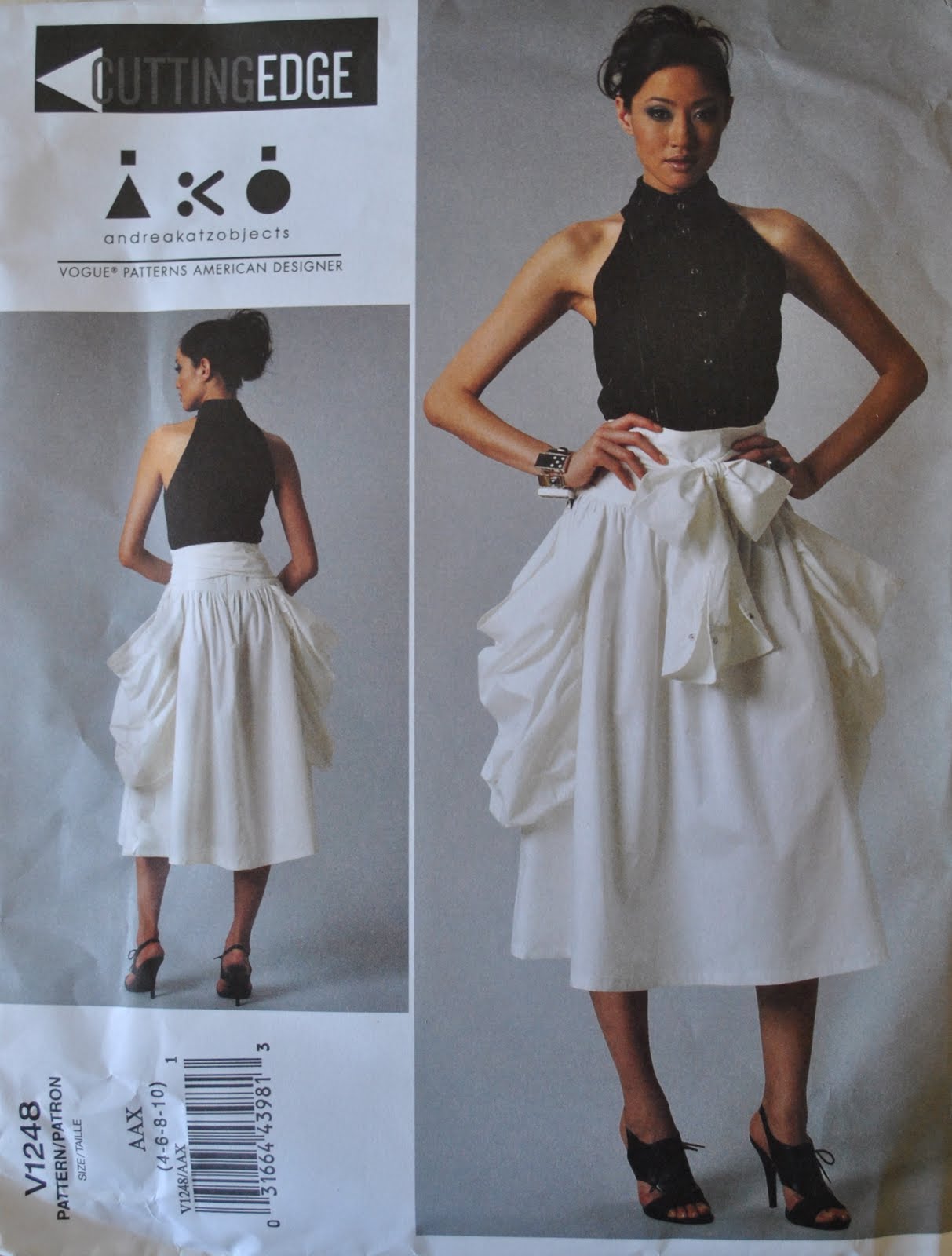
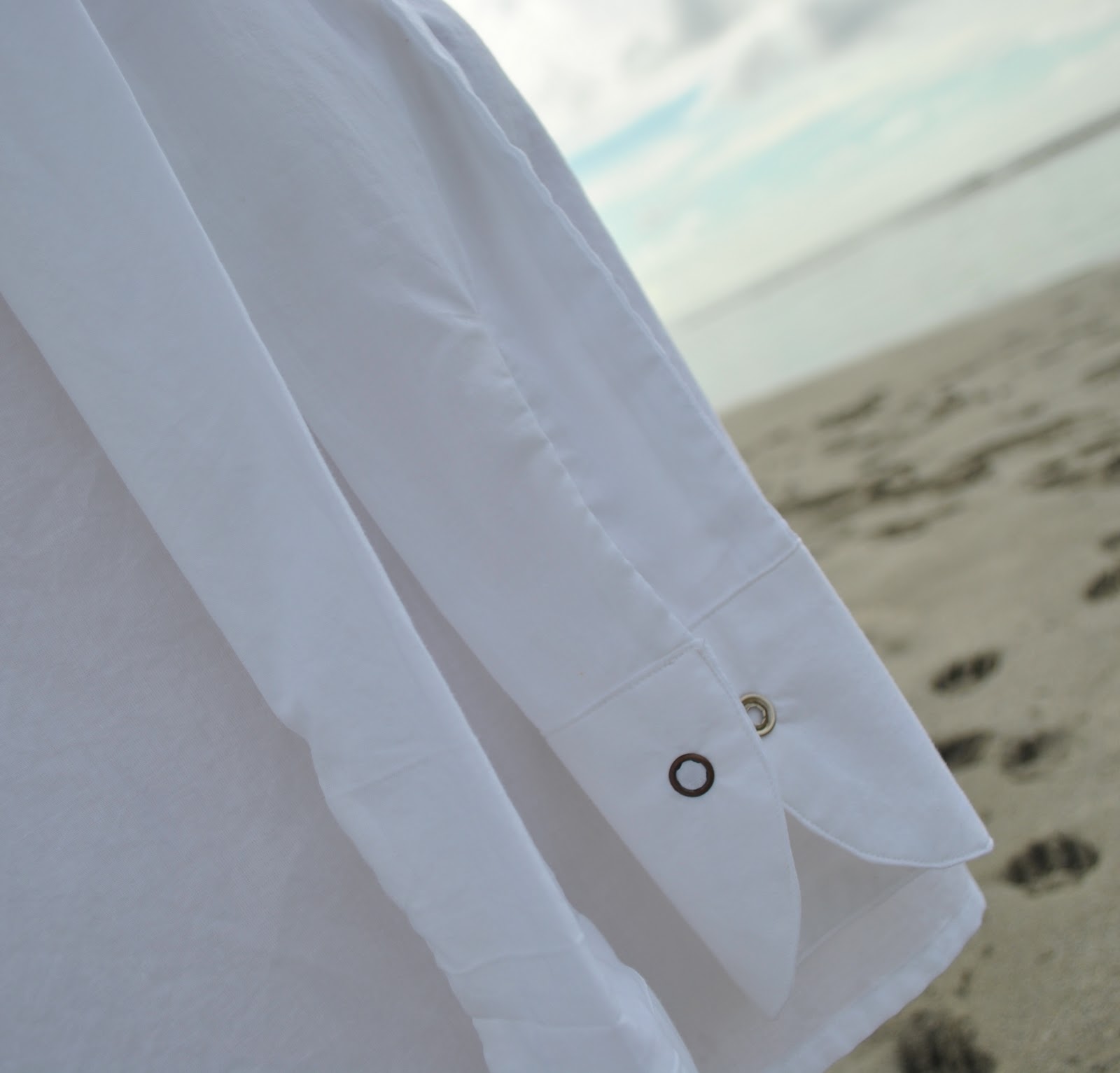
Funny little anecdote about the pattern… I first saw this on shams’s blog and knew I just had to have it.  Those shirt sleeve cuffs on the ends of the sashes; so adorable!!  (salivating) must have… 
I immediately visited Fabulous Fabrics and asked for the pattern… no, they didn’t have it.  I was actually hoping against hope that it was miraculously hidden in the back of the pattern drawer since I had already looked through the Vogue catalogue and noticed it wasn’t there (eek!)  I assumed its time had come and gone.  I then started trawling ebay, looking for somebody getting rid of their old copy… no dice, although I did fall victim to must-have-itis for a maxi-dress pattern… the product of which has also recently exited my sewing room and been welcomed into the wardrobe… But I digress…   
So, in a masterstroke of going to every extreme to get that pattern by hook or by crook, I did some more detective work and eventually discovered and joined BMV where I was amazed to see I could get it for a price that was an incredibly delightful surprise; $3.99.  This is about a fifth of the usual price of Vogue patterns in Australia… no, I am not kidding nor exaggerating!!)  The cheap price just reinforced my belief that it must be an old pattern and I was lucky to have found it…  My pattern arrived and I was supremely happy.  Then, get this, the last time I was in Fabulous Fabrics (er, yesterday, hehe… yup I am a regular, on a first name basis with staff) I had a quick flick through the new spring Vogue catalogue, and you guessed it, there was the pattern.  It is actually new season, like this season!  To us southern hemispheries, that is…  thus all finally became clear to this very behind-the-times seamstress why I hadn’t been able to get it before… doh!
I used a very light cotton voile, which I sometimes use as a lining fabric, and the same fabric for both the skirt main and for the lining.  I completely love the long long sashes with shirt cuffs on the end, a fun and quirky touch that drew me to the pattern in the first place.  Because of this little feature, to my mind the skirt just had to made of white cotton.  Nothing else would do…  Those shirt cuffs just wouldn’t have the same witty flair unless the style directly referenced the Classic White Shirt.  Plus I just adore big white floaty skirts for summer.
And those pockets…? well, they are graaaand, in every sense of the word.  I don’t think I could actually really put anything in those pockets, really.  Stuff could get lost forever in there…
I have some more fabric to make up the little top as well, but for now, below is my review of the skirt pattern…

Details:
Skirt; Vogue 1248, white cotton voile
Shirt; self-drafted, navy and white stripe cotton jersey, details here
Shoes; Country Road

Pattern Description:
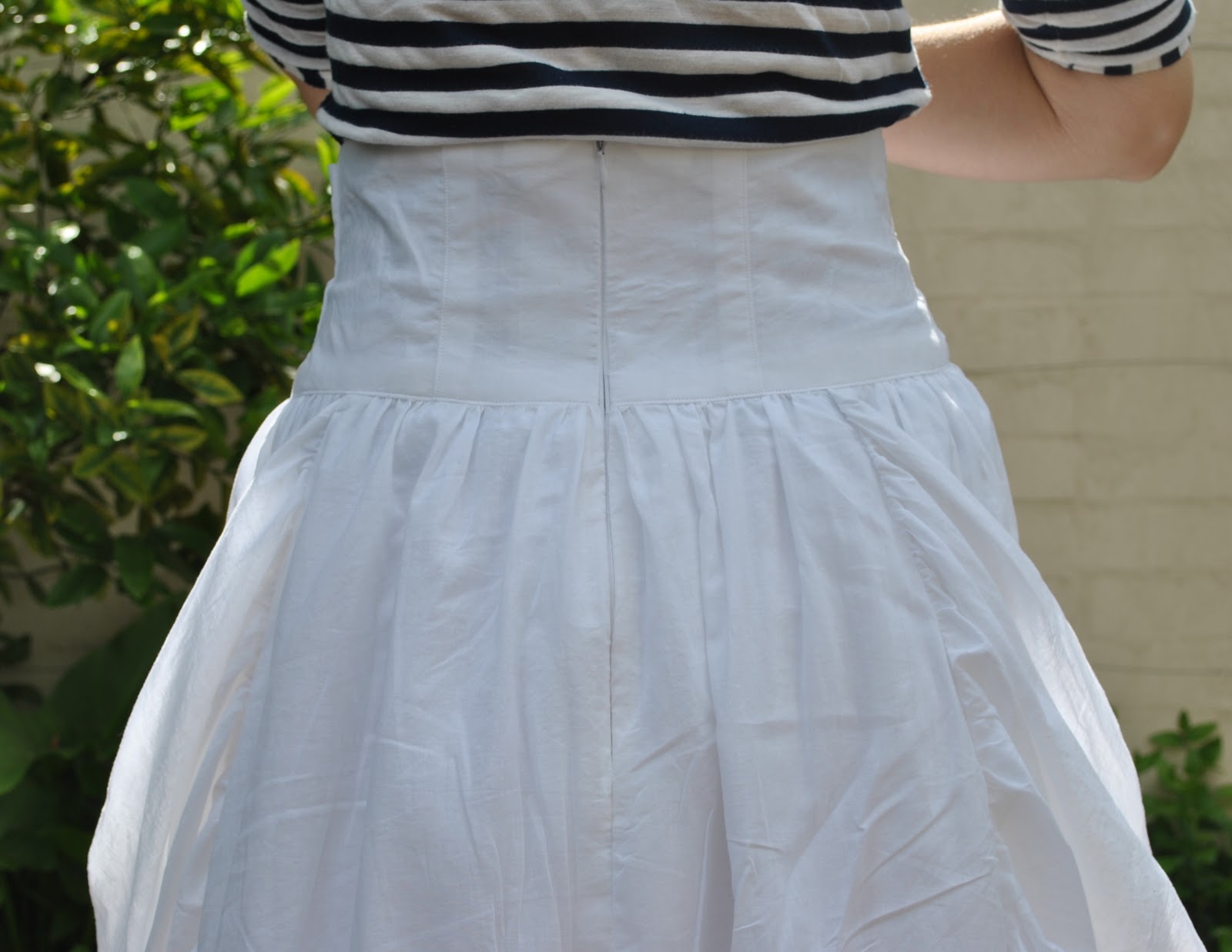
Skirt, gathered, flared and lined, with fitted contoured waistband, centre back zip closure and long attached side sashes with shirt cuff features.  HUGE gathered pockets.
Pattern sizing; 
I bought the AA 8-12, and cut a size 10.
Did it look like the photo/drawing on the pattern envelope once you had finished sewing it?
Just about exactly, since I used white fabric too!
Were the instructions easy to follow?
yes
What did you particularly like or dislike about the pattern?
The pattern is great.  Vogue patterns are always accompanied by clear instructions and detailed illustrations. The pattern pieces went together beautifully.
There is one small thing I would change… the instructions stipulate to gather each skirt piece individually, before joining them together along the side seams.  I find I get a much better and smoother gathering result when the whole skirt is gathered as a whole; that is, you join up the skirt pieces at the side seams, THEN run the gathering stitch around the skirt top in one long go.  This is because I find that the first and last few centimetres of gathering do not gather as evenly or as ideally as if they were part of one long continuous line of stitching and if the skirt is broken up into several sections you have several of these gathering stitch stop/starts.  I would recommend to gather the skirt as a whole.  And also to gather the lining skirt as a whole, too.
Fabric Used:
very lightweight cotton voile
Pattern alterations or any design changes you made:
I took about 5cm (2″) overall off the waist band pieces.  Also I gathered the skirt as a whole, as discussed above.
Would you sew it again? Would you recommend it to others?
Yes, I think I might sew this again, I love it!  I highly recommend this skirt pattern to others.  Just bear in mind it needs very lightweight drapey fabric, because of all that gathering.  I have some fabric to sew the little top, so I will review that separately.
Conclusion:
I just love this skirt!  Firstly, the silhouette is delightfully feminine, and the floatiness and frothiness of all those light gathered swathes of fabric floating about you is highly satisfying.  I feel just so darn feminine in a skirt like this!!
Secondly, the shirt cuffs on the ends of those sashes are completely adorable and what drew me to this pattern in the first place.  Such a witty and unique little detail, that really makes the skirt stand head and shoulders above your average everyday gathered skirt.  Not to mention those pockets, which must be the biggest in known history!  Another fun and interesting feature…
I’m going to love wearing this skirt over this summer!

pinterestmail

Ivory blouse

I finished a new blouse.
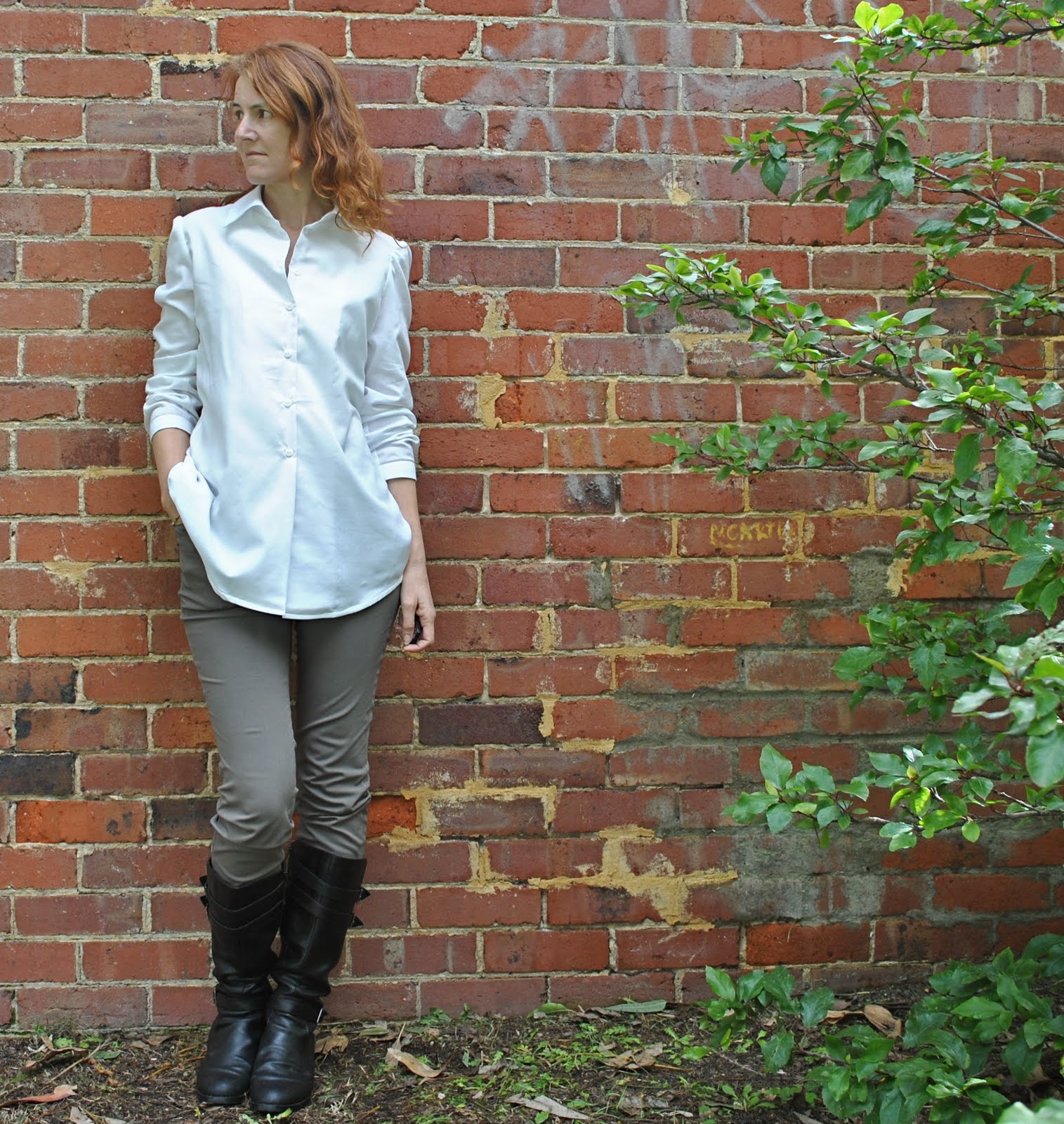
This is a project that took me far longer than it should have, actually.  Been working on it for a few weeks! and that is not like me…  I had it nearly finished, and then toddled off to get buttons.  Got completely distracted by a sale on at Spotlight and the dye selection and, you guessed it, came home with a heap of new dyes and some other odds and sods, as you do, but no buttons… then it was a while before I could get back to the fabric store, blah blah blah.  Then I went off it for a bit, thinking it was awfully boring and uninspiring, and it came thisclose to getting dip-dyed on the weekend, but then I came to my senses.  I think I will be glad I kept it snowy white.  Everyone could use an ivory shirt in their collection, right?  And now my husband’s white linen shirt will finally be safe from my clutches…
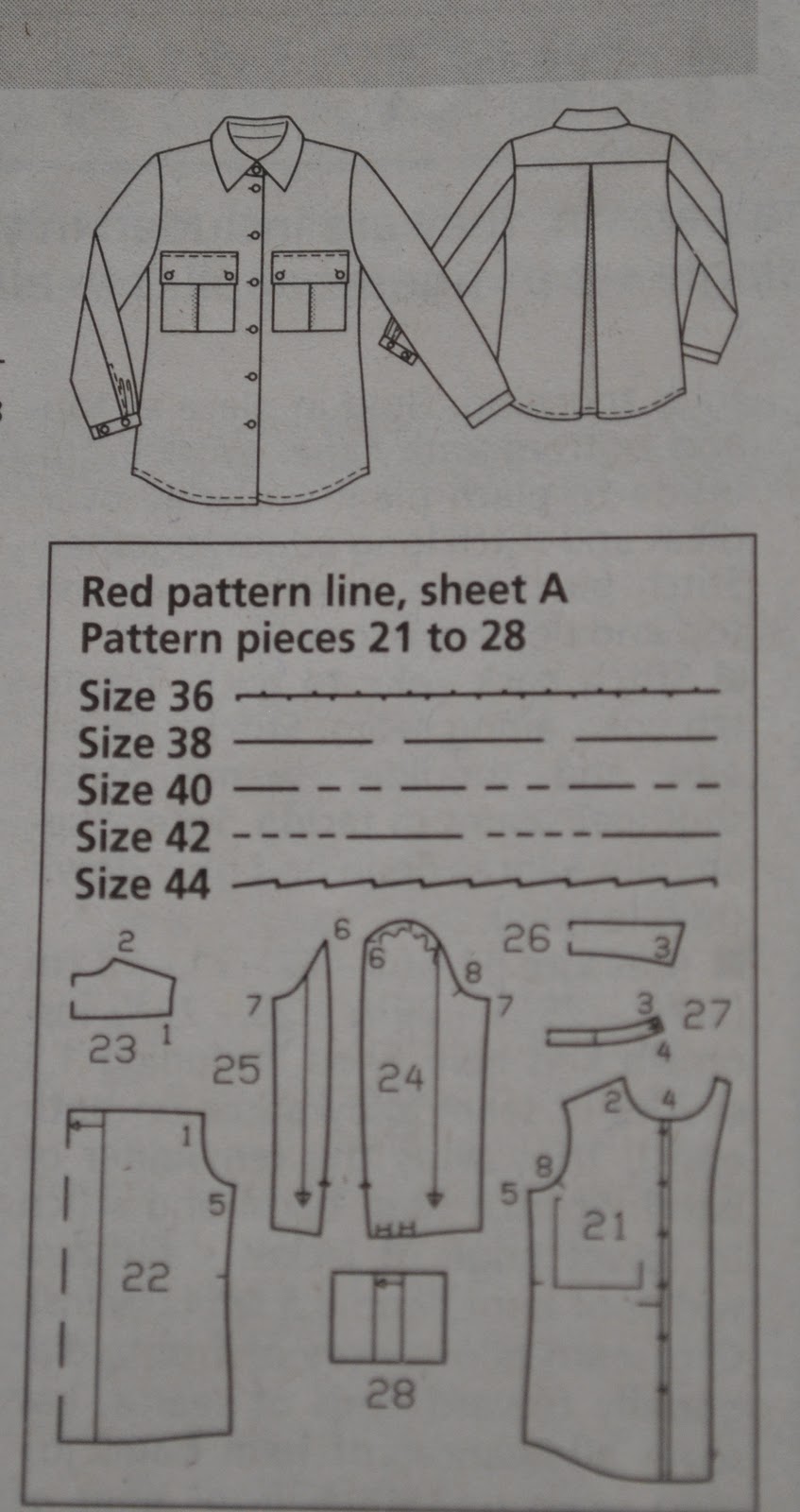
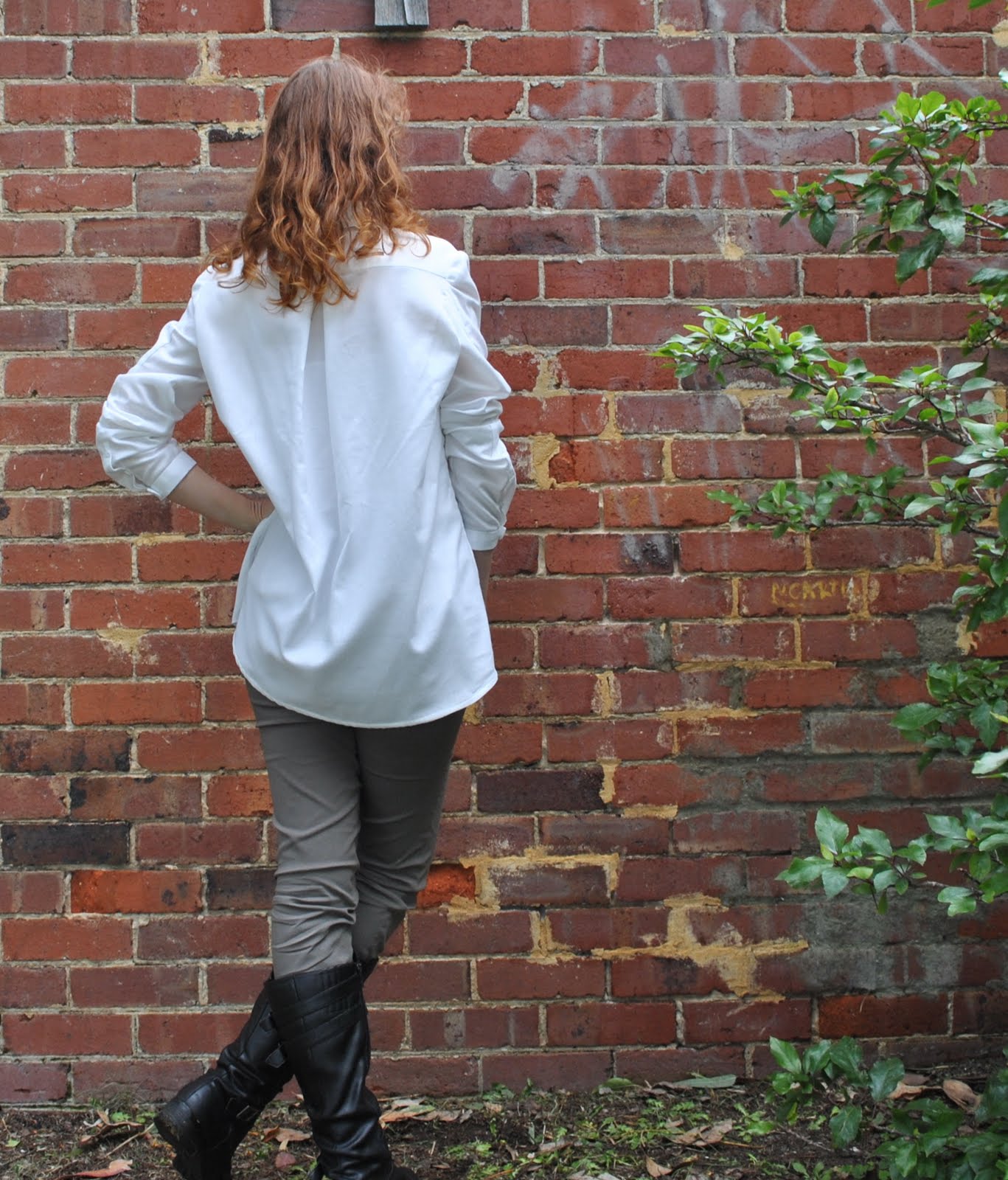
The fabric is a light slightly fluffy brushed cotton, and I used pattern 102 from Burdastyle magazine 10/2010.  I have used this pattern partially before to make my black blouse, so I know it to be quite nice; billowy but still slightly mannish.  I do like that in a ladies’ shirt.
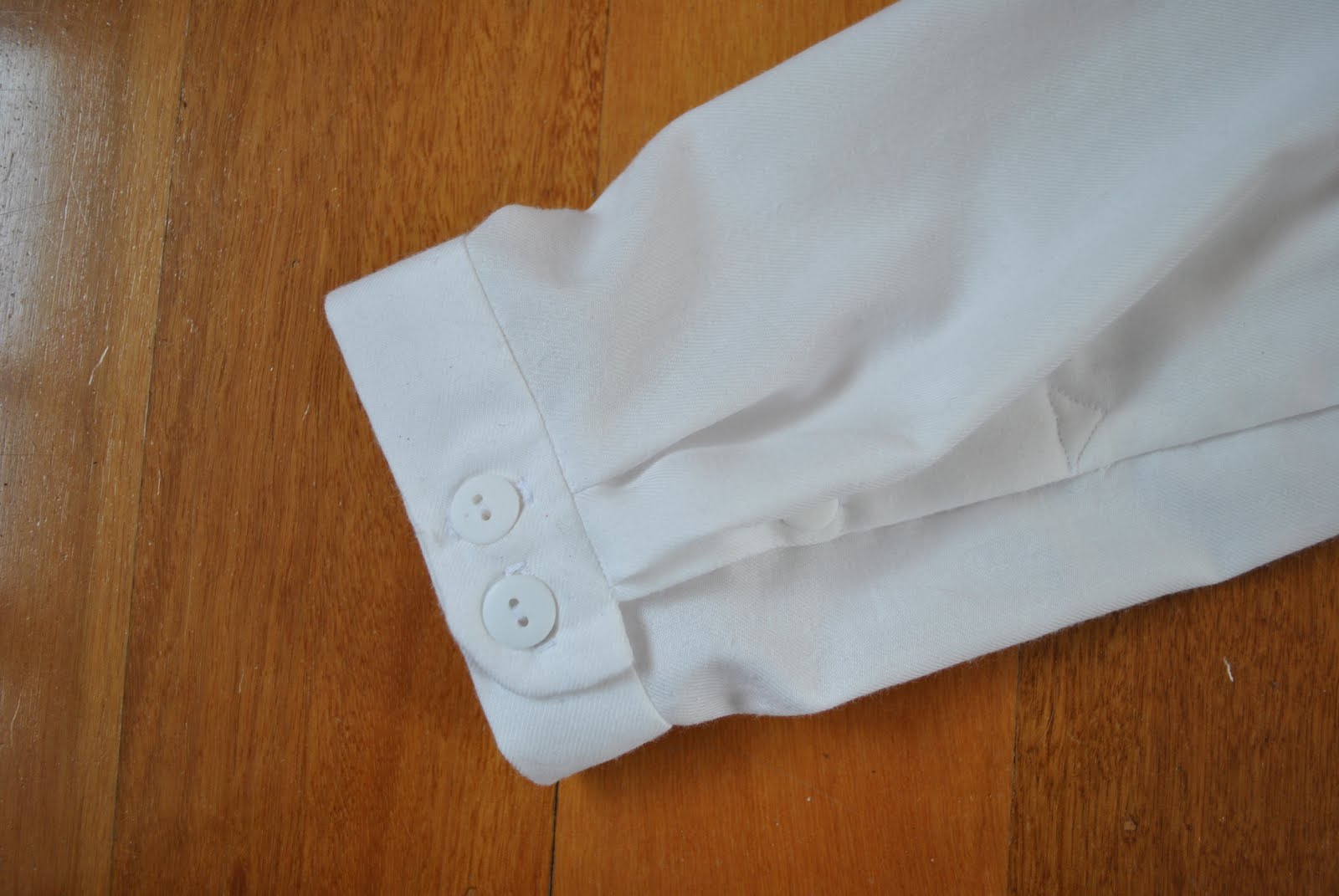
Because the fabric is slightly sheer I finished all the seams with French seaming, except for the armholes which were just overlocked.  I curved the top edge of the sleeve cuff and put on two buttons and buttonholes, one perpendicular to the other for a little touch of something interesting.  I did this because the sleeve cuff dimensions provided by the pattern are overly generous and I found them to be too long.  So rather than clipping them off to the right length I just kept them long and put in this double offset buttonhole feature for fun.

Details:
Blouse; Burdastyle magazine 10/2010, 102, ivory brushed cotton
Jeans; Burda 7863, khaki stretch gabardine, details here
Boots; Andrea and Joen, from Uggies in Dunsborough

Pattern Description:
Loose-fitting button-up blouse with two piece sleeves, cuffs, collar stand and collar
Pattern Sizing:
36-44, I made a straight 38
Did it look like the photo/drawing on the pattern envelope once you had finished sewing it?
I left off the breast pockets, but otherwise yes
Were the instructions easy to follow?
If you have made up a tailored shirt before, then yes.  For a beginner I would recommend getting a pattern with step by step illustrations, like one of the big 4 for example, for a first go at a tailored shirt.
What did you particularly like or dislike about the pattern?
I love the big blouse-y shape of this blouse!  If I was making it up again, I don’t know if I would bother with the two piece sleeves but instead go with a one piece sleeve with a slit and a separate placket piece for the vent, a procedure I am more familiar with.  And these sleeves are so loose-fitting that it doesn’t seem worth the effort of that little bit of shaping you get with having the two pieces.
Fabric Used:
lightweight, slightly fluffy, brushed cotton blend
Pattern alterations or any design changes you made:
I left off the breast pockets.
The method for putting together the front facing and collar stand was inefficient in my opinion, so I did it instead by turning the facing to the outside around the collar stand and sewing it in one seam, then turning the facing to the inside.  This not only means less fiddling about with slipstitching the collar stand seam allowance under, but also means the collar stand seam allowances are down inside the facing and not up inside the collar stand itself, meaning less bulk.  The usual issue of all those bulky seam allowances inside the collar stand are a slight pet peeve of mine, and I thought having a front self facing that branches up into the shoulder seam is a great solution to this small problem…
I also altered the button placement.
The pattern stipulates one yoke piece; I cut two and enclosed the seam allowances of the back piece and shoulder edges of the front pieces between the two yoke pieces.  A double thickness yoke is more stable too.
The cuff dimensions are generous and I found them to be too long; but I kept the extra length, curved off the top edge and just had two buttonholes and two buttons, for an interesting little feature.
Would you sew it again? Would you recommend it to others?
Probably I will sew this again sometime, and yes, I do recommend this to others!
Conclusion:
Nicely blouse-y and feminine, but still with a slightly tailored and mannish air about it, so I am pretty happy with the look of this lovely and flattering pattern.  I think I will get a tonne of wear out of this!

pinterestmail

Rusty red wool/silk skirt

I’ve made a new skirt…
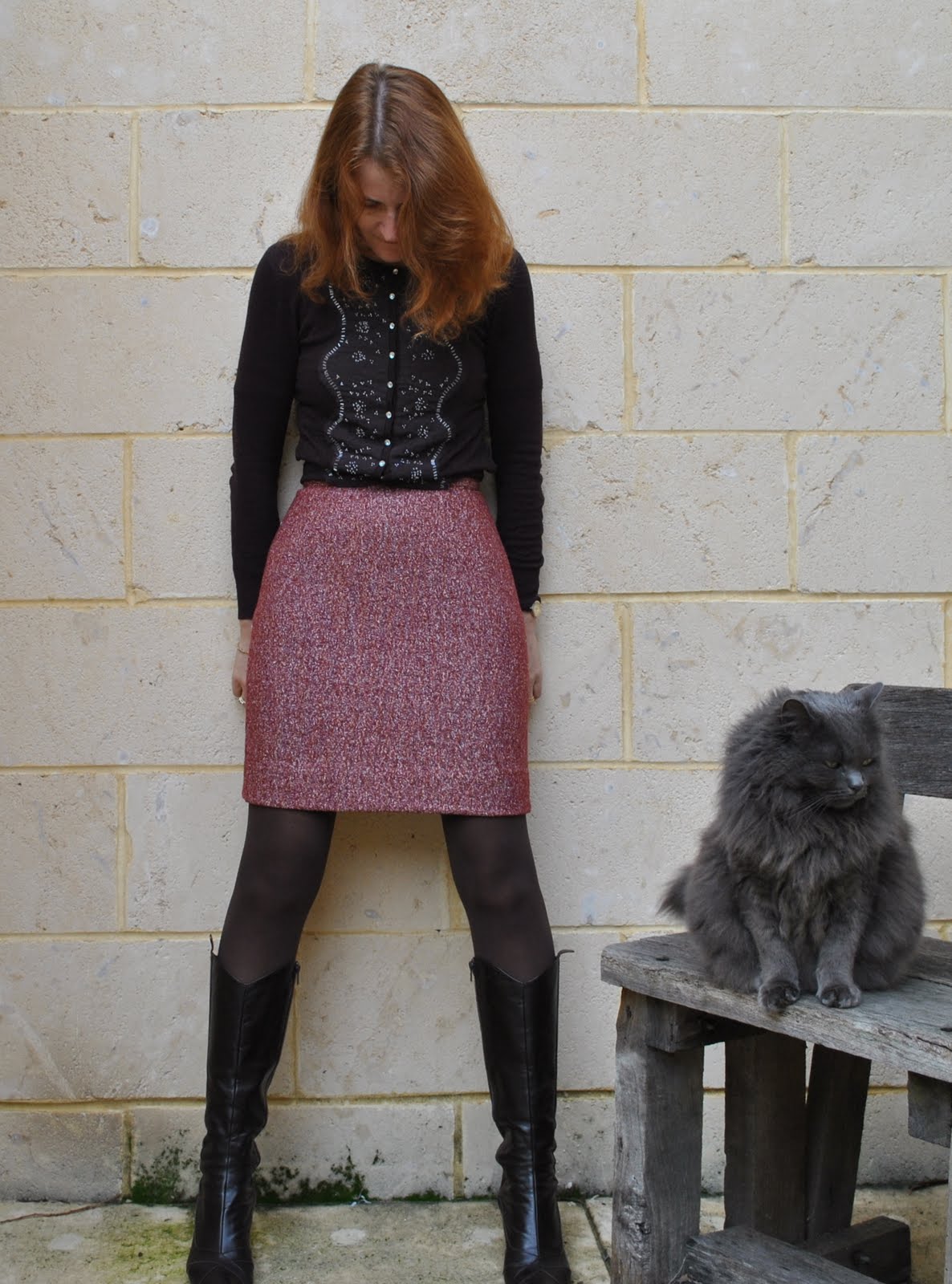
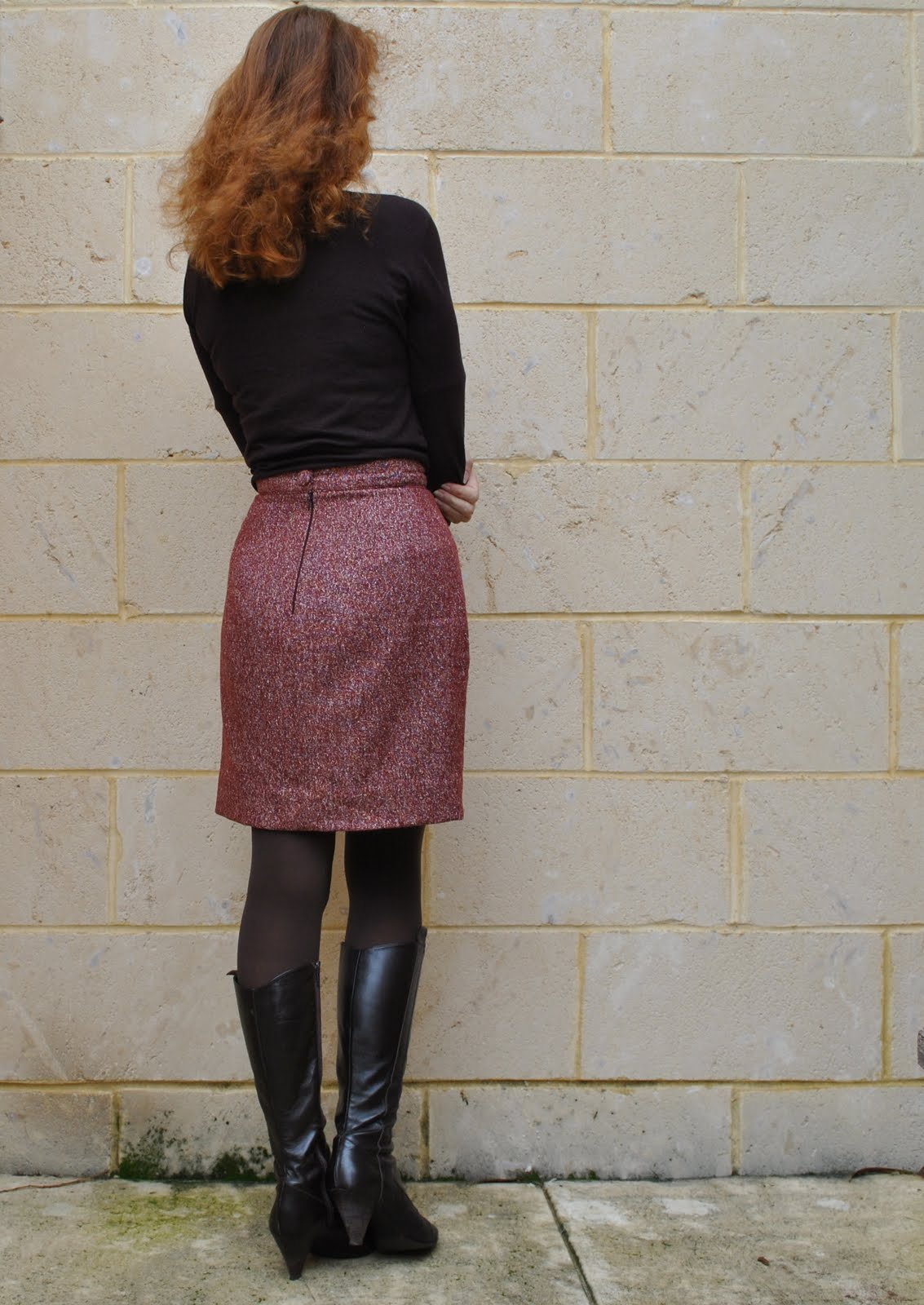
I found this yummily coloured, beautifully textured wool/silk mix fabric in a remnant bin in Tokyo, the day of our shopping trip with Yoshimi and Novita.  At the time I just picked it up instinctively, with only a quick check to see it was enough for a little skirt.  When I got home and actually laid it out however I could see there was quite a lot of fabric, too much for just one little skirt.
Oh well, maybe I could make a longer, almost-ankle-length skirt…?
I had originally intended to go for my ol’ favourite Vogue 7303, but here’s the thing; two years ago I bought another plainish skirt pattern Vogue 8363, and have rudely ignored it because of my steadfast and loyal allegiance to Vogue 7303; the poor thing has languished uncut in its packet.  I decided it was high time to try out a different skirt pattern, gave myself a strict talking to and bravely took out the new pattern.  And set to making a three-quarter length skirt (actually view C, lengthened)…. but by the time I had reached the point of hemming I knew that a longer skirt was not the right choice for this fabric.  It is such a heavily textured fabric, and is so visually impactful that the big unbroken expanse of it in a longer skirt was just too overpowering… so I ended up cutting a big chunk off to finish up with the very same little skirt that was my original vision for this fabric.  Full circle!
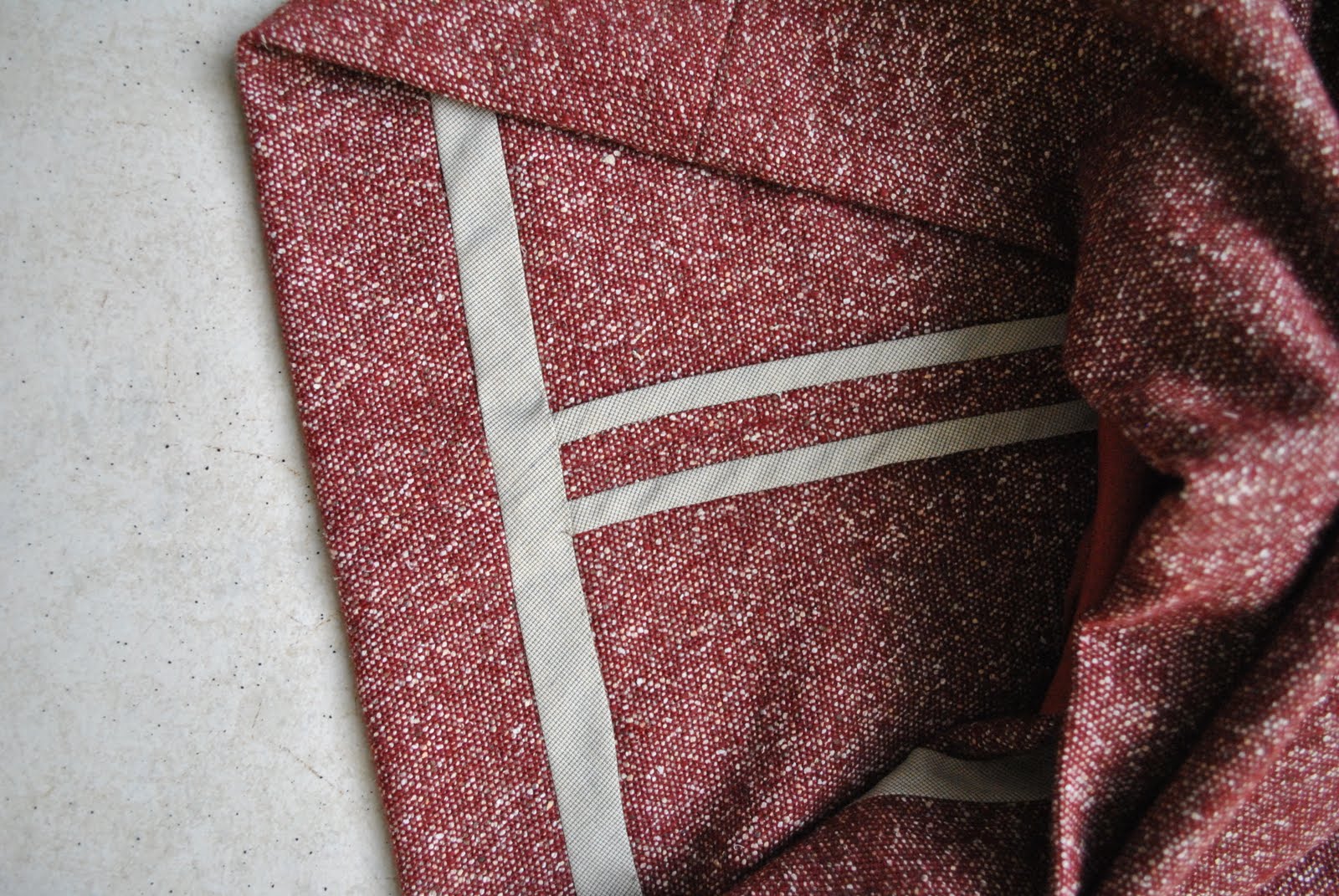
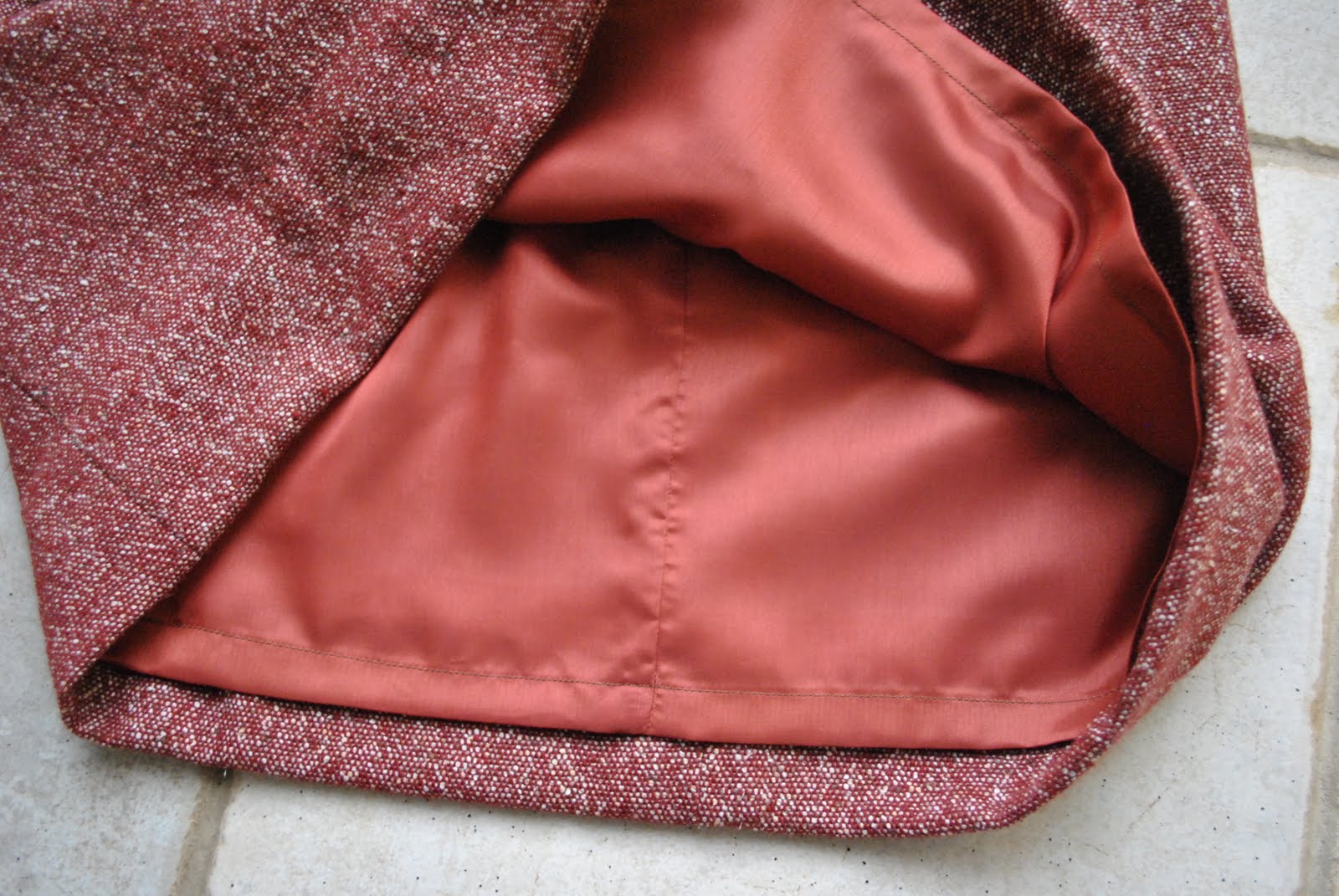
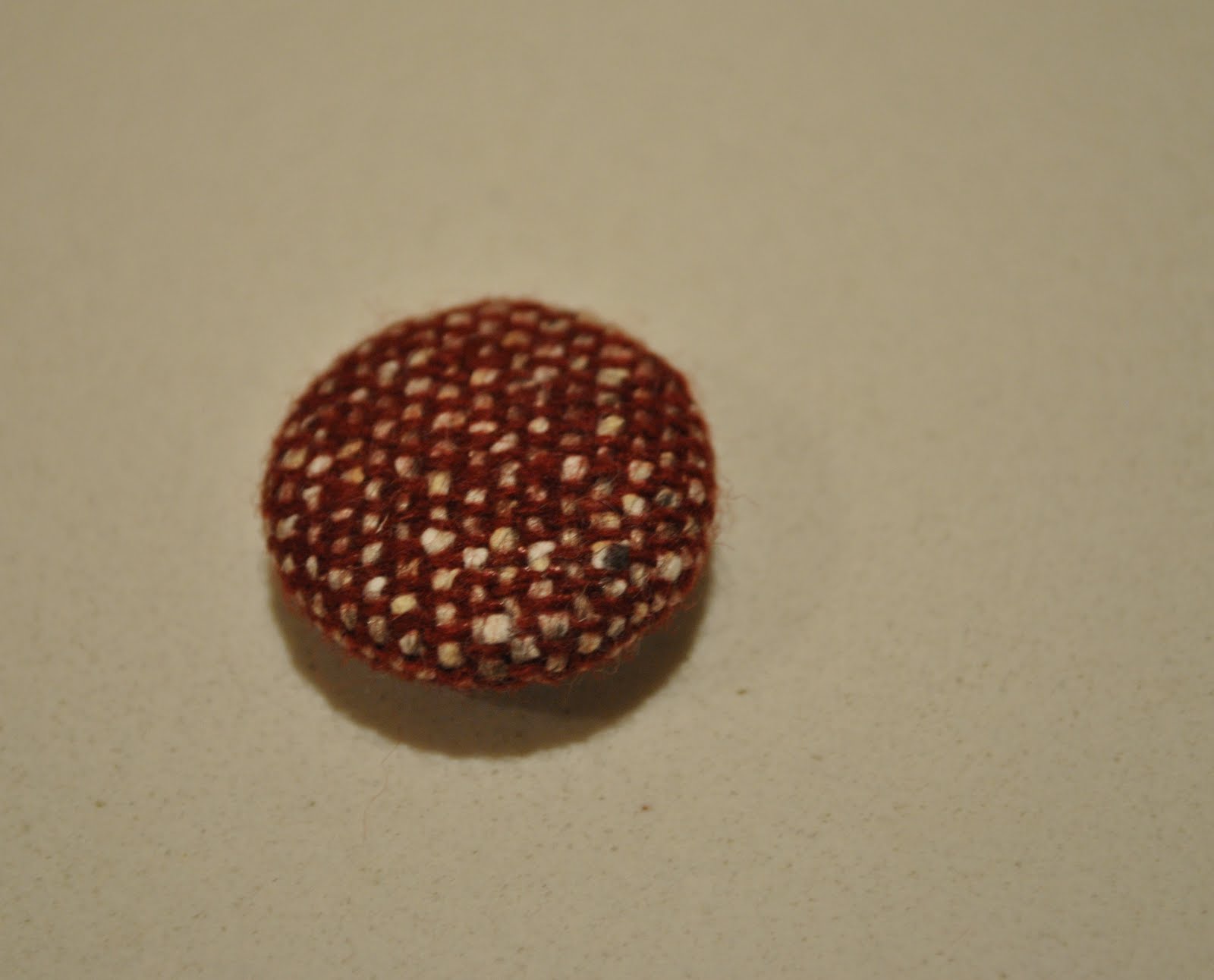
Because this fabric is quite special to me, a memento of our Japanese trip, I went all out to fit and finish the skirt as well as I am capable.  The skirt is lined with raspberry acetate lining fabric, the inner raw edges are finished with HongKong seaming and the lower edge is hemmed with bias tape.  I searched and searched for a suitable button and failed dismally.  So I tried out something new to me; covering a button with my own fabric, using one of those kits you see in the haberdashery section.  Super easy, and the perfect finishing touch!  I don’t know why I’ve never even had a go at this before!
I do have one teeny tiny regret… I have read somewhere about how iron-on interfacing is never used in couture construction, so I decided to go for sew-in interfacing in the waistband.  This was basted in and the waistband was finished, but I could feel the interfacing was waffling loosely about on the inside of it, so I decided to topstitch the waistband to hold everything firmly in place.  That worked, but now I kinda regret doing this, I think this style of fabric and skirt together suits a much more clean finish without any topstitching, and the loosely woven fabric is not the sort to take kindly to unpicking… I’m more afraid of damaging the fabric in the unpicking stage than I am of the look of that topstitching, so it stays.  This does not diminish my love for the skirt; buuuut… should have stuck with the iron-on interfacing!
And no need to worry about that cut-off leftover fabric, it has been put to good use already too!  Results to appear here soon…

Details:
Skirt; Vogue 8363 with modifications, rusty-red wool/silk mix bought in Tokyo
Top (not seen); Metalicus
Cardigan; Alannah Hill (bought damaged, and repaired)
Tights; Kolotex
Boots; di Sempre, from Zomp shoes

My review of this pattern…
Pattern Description:
Skirts A, B, C, F have front and back darts and back zip.  A; ruffle.  B; lace overlay and back vent.  C; side buttonhole closure.  Skirts D, E have front pockets and front and back darts.  E; purchased trim and snap closure.  F; front stitched pleats and back vent.  Skirt length is 5cm below mid-knee.
Pattern Sizing:
6-20 overall, I bought the AA (6-12) and custom-fit to myself during construction, as usual
Did it look like the photo/drawing on the pattern envelope once you had finished sewing it?
Essentially yes, except that my version is a simple short skirt incorporating none of the variations pictured…!
Were the instructions easy to follow?
very easy!
What did you particularly like or dislike about the pattern?
I like everything about this pattern.  Super easy, stylish, a basic wardrobe builder.  It might even be my new favourite skirt pattern!  Without a doubt I will use it and use it over again.
Fabric Used:
Wool/silk tweed, polyacetate lining
Pattern alterations or any design changes you made:
This version pictured is a short version of view C, without the button/button band at the bottom, the only other adjustments were fitting alterations.  Also my skirt pictured is fully lined, provisions for which are not supplied in the pattern but is an easy alteration.
Would you sew it again? Would you recommend it to others?
Definitely yes, to both!
Conclusion:
Very easy, very basic, therefore a very useful pattern.  It has no standout or trendy features, so it will never go out of style.  This pattern is a winner that I will hang on to forever…!
(below; going for a fashion magazine pose…)

pinterestmail

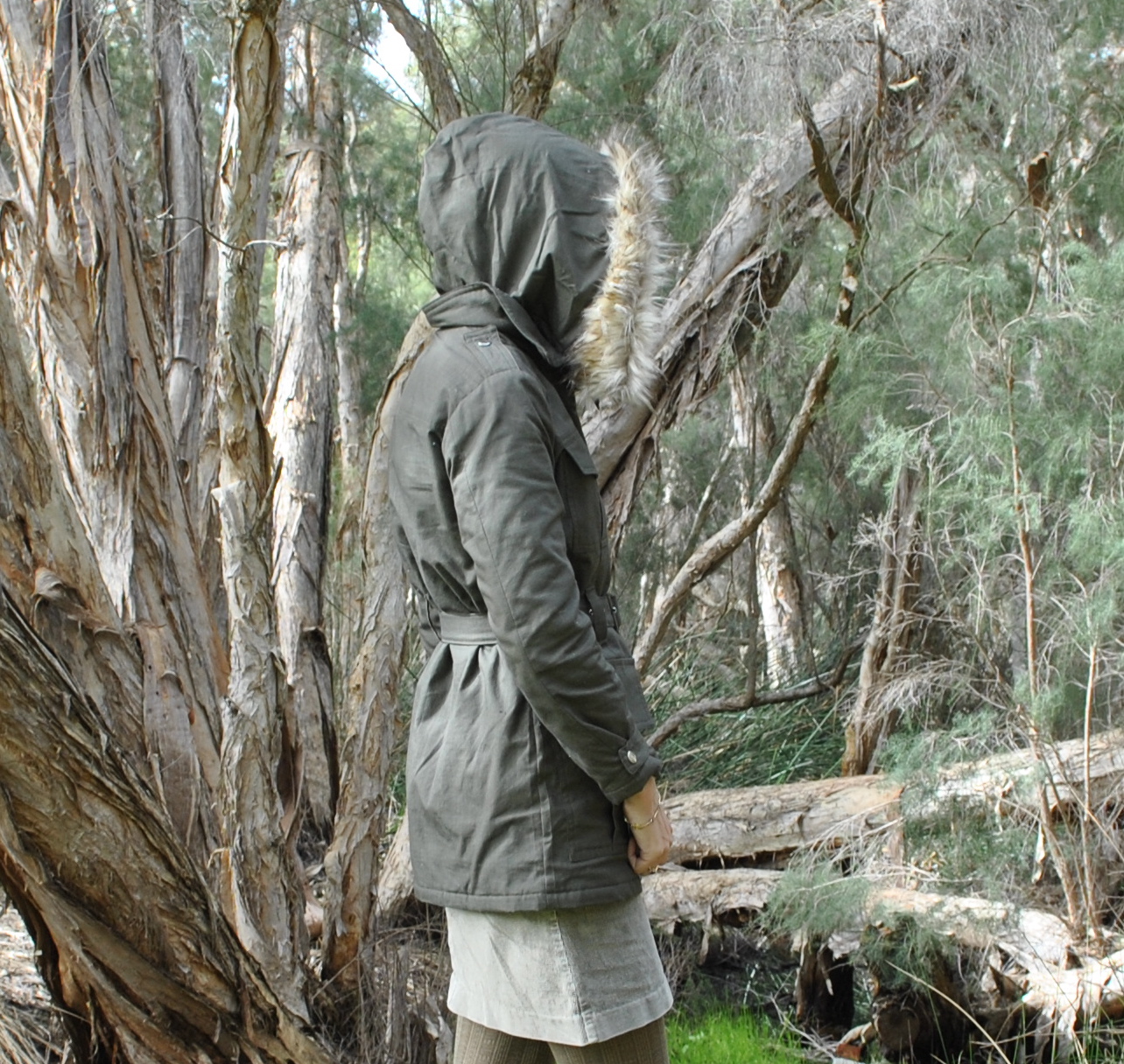
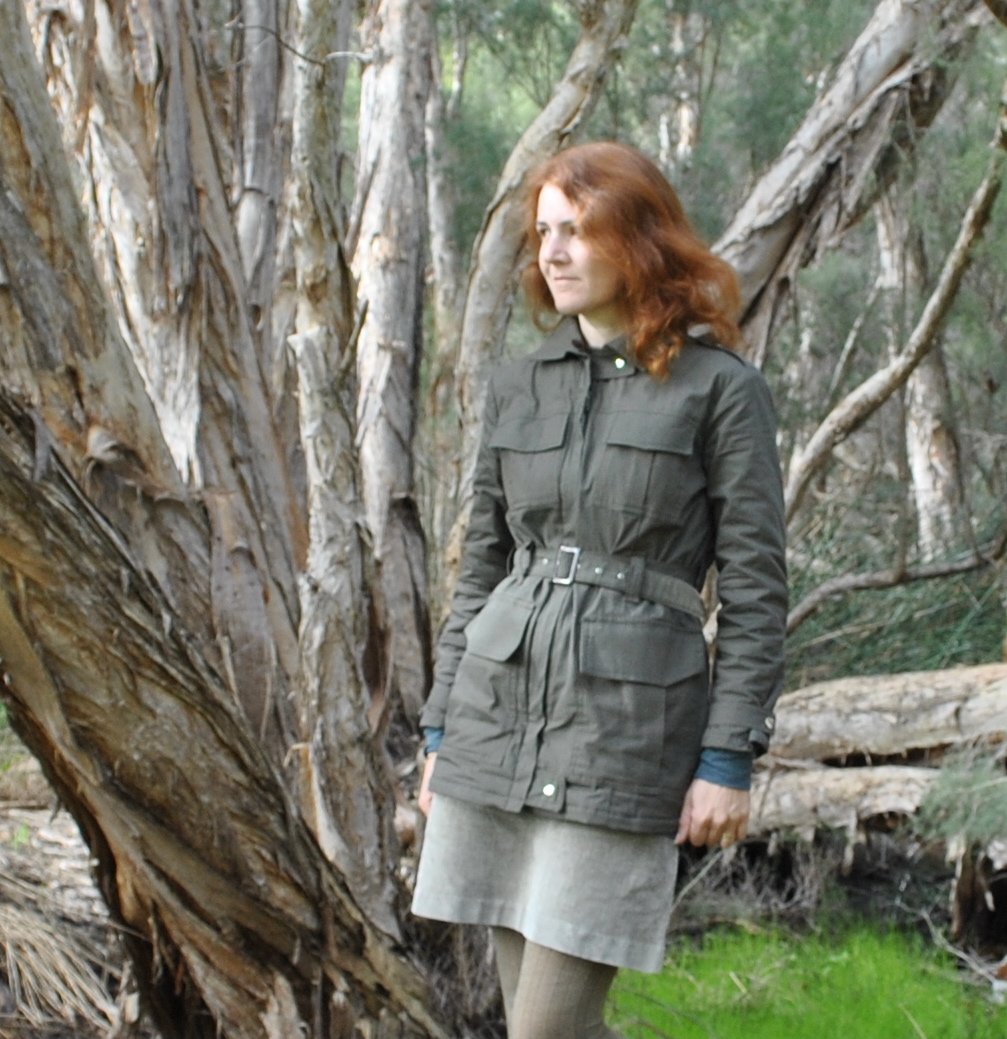
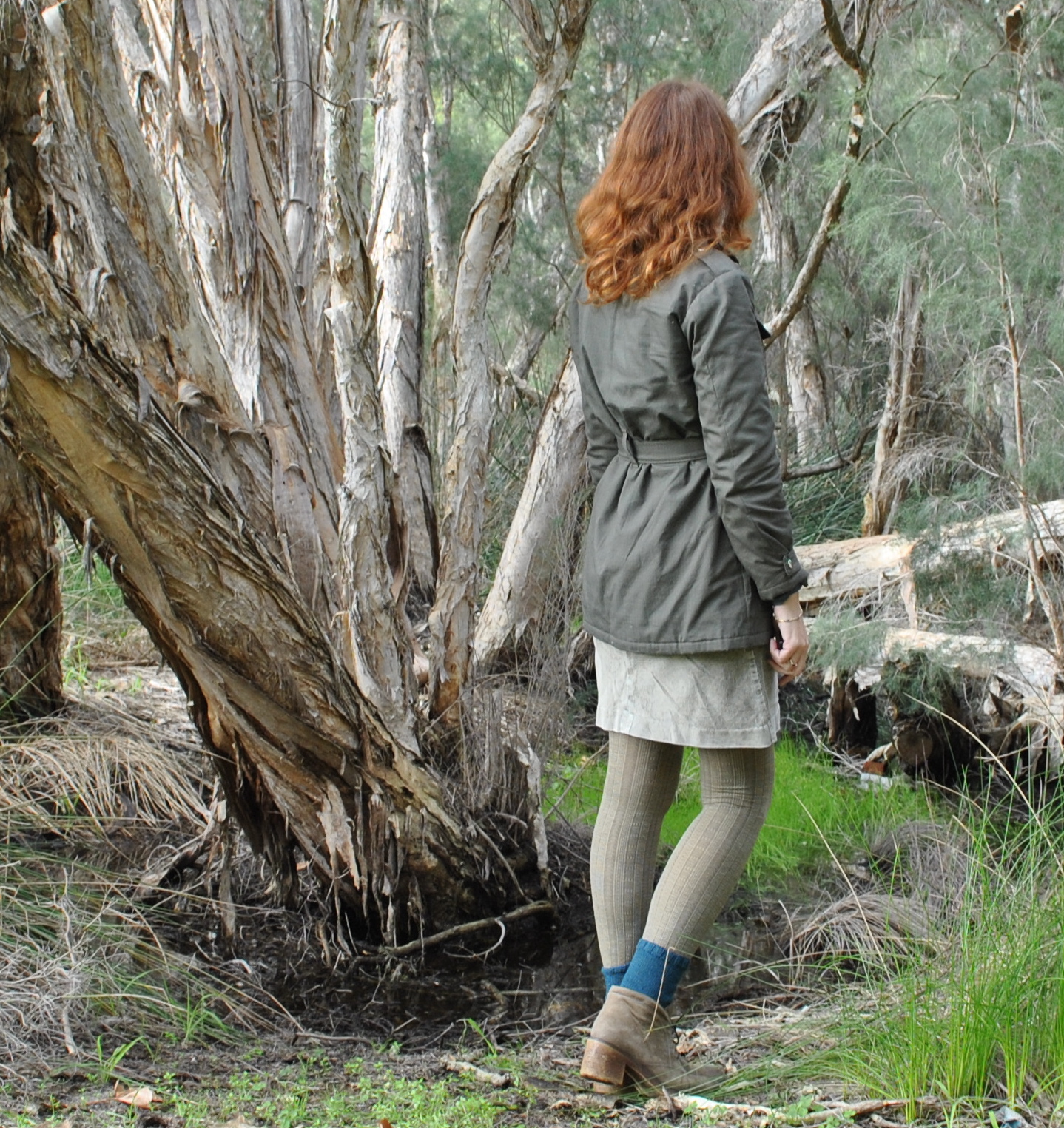
Army style jacket, with detachable (faux) fur-lined hood

I mentioned some time ago my new army/military style jacket; finished way back in March, well, here it is!
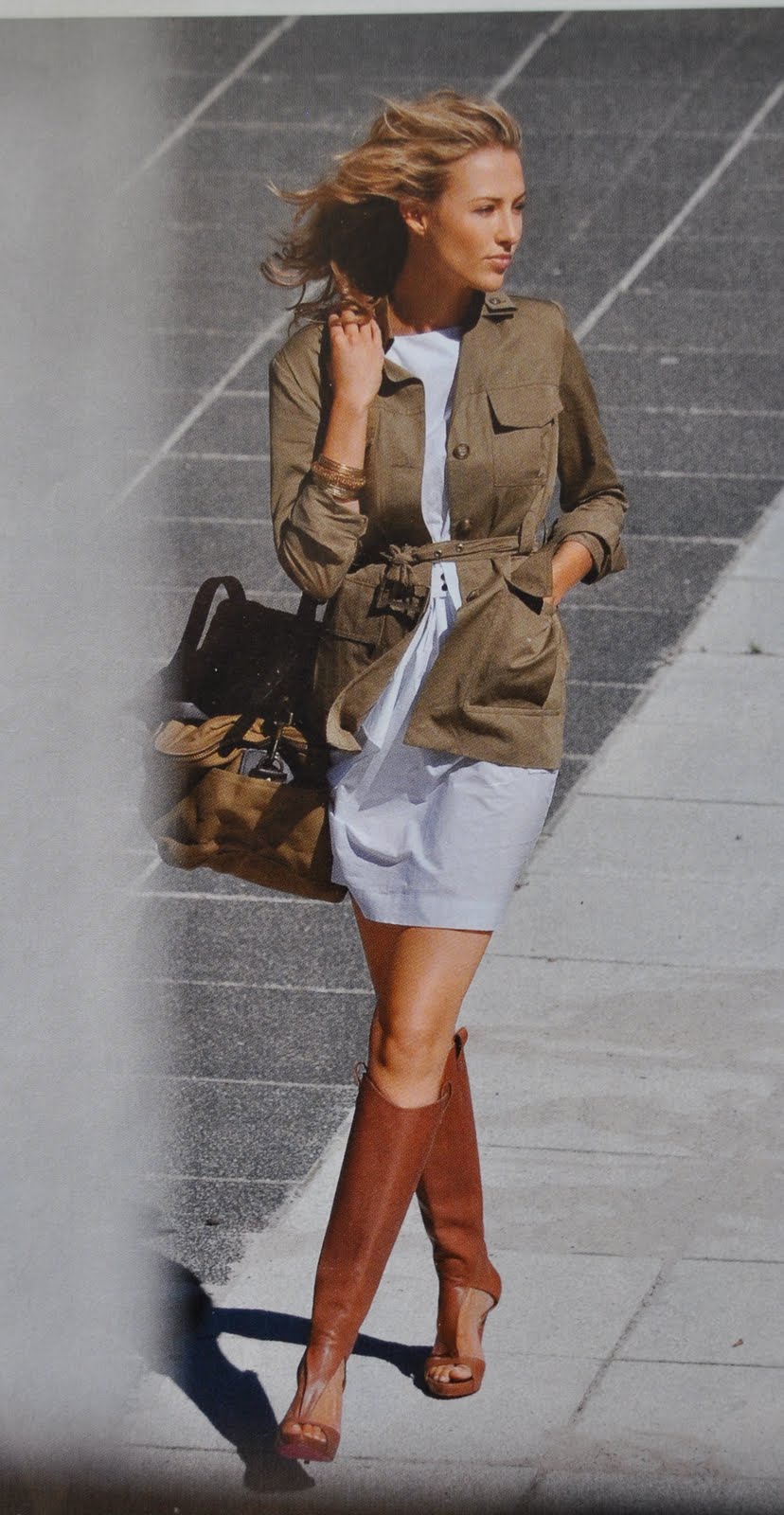
When we were in Tokyo I saw all ages and both sexes, everywhere, sporting big khaki army type jackets.  All with military details, lots of pockets, cinched in waist belts and sometimes with fur-lined hoods, and I just fell in love with them and decided I just had to have my own.  They just looked so big and comfy and cosy looking, and the girls (and boys) wearing them looked so warm not to mention so so so too-cooool-for-school; casually and bulkily stylish…  I’m sure a lot of the ones I saw were real army jackets, possibly from army disposal stores or secondhand stores, but naturally with my DIY aesthetic I was always going to try to make my own… 😀
Of course what I wasn’t taking into account was that it doesn’t really get all that cold here and especially for the hoodie part of it!  I expect I will wear it without the hood for most of the time… but it was still fun to have a go at making a furry hood, and it just might come in handy for some mornings, and if we ever go down to the country.

Details:
Jacket; Burdastyle 05-2010-127 with my own modifications, khaki ripstop cotton and grey marle fleece lining
Skirt; Vogue 7303, olive green corduroy, to see this little skirt styled in 6 different ways go here
Top and tights; Metalicus
Socks, handknit by me, details here
Shoes; Francesco Morichetti, from Zomp shoes

Dressmaking details; if you want to know…
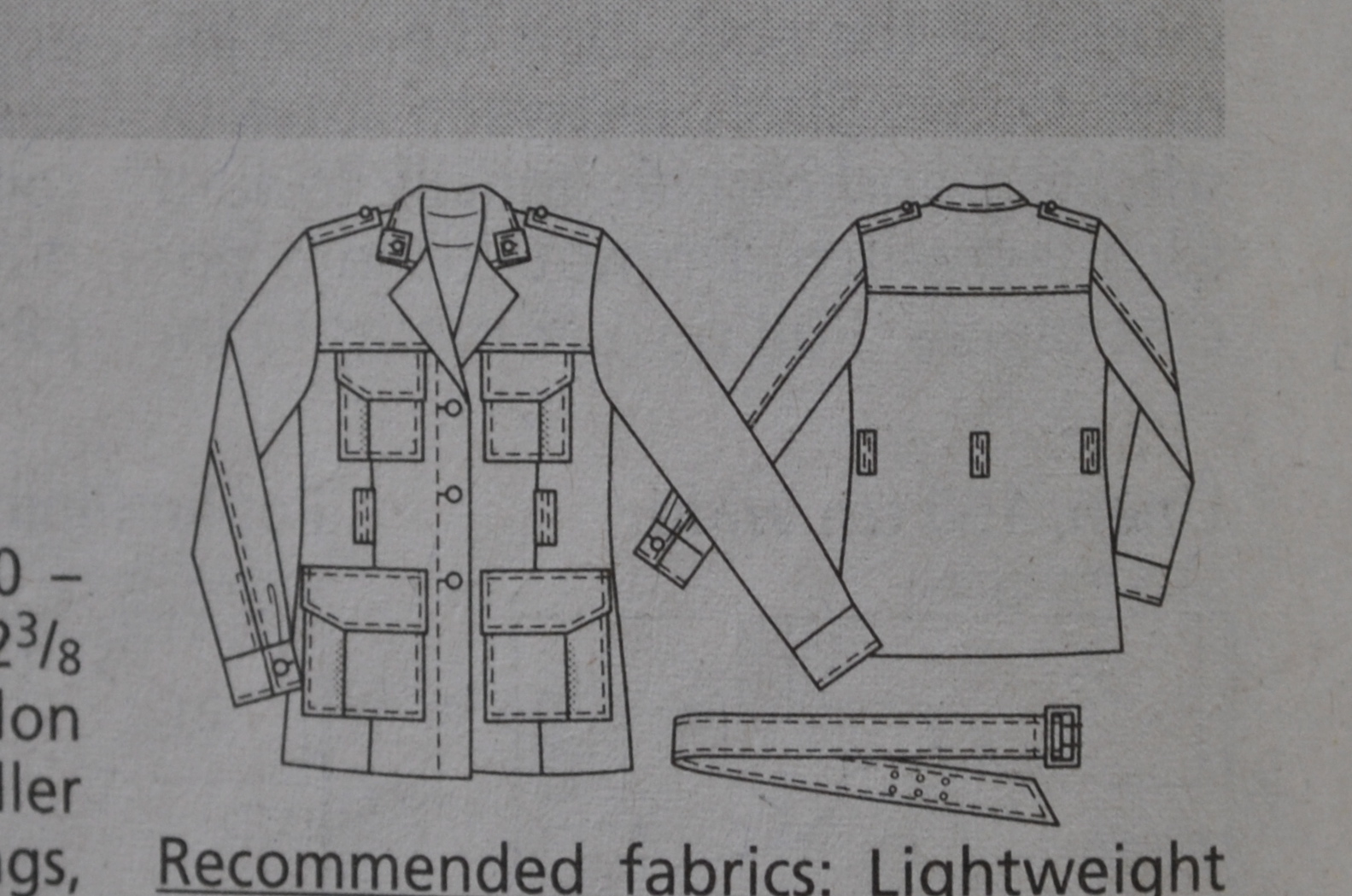
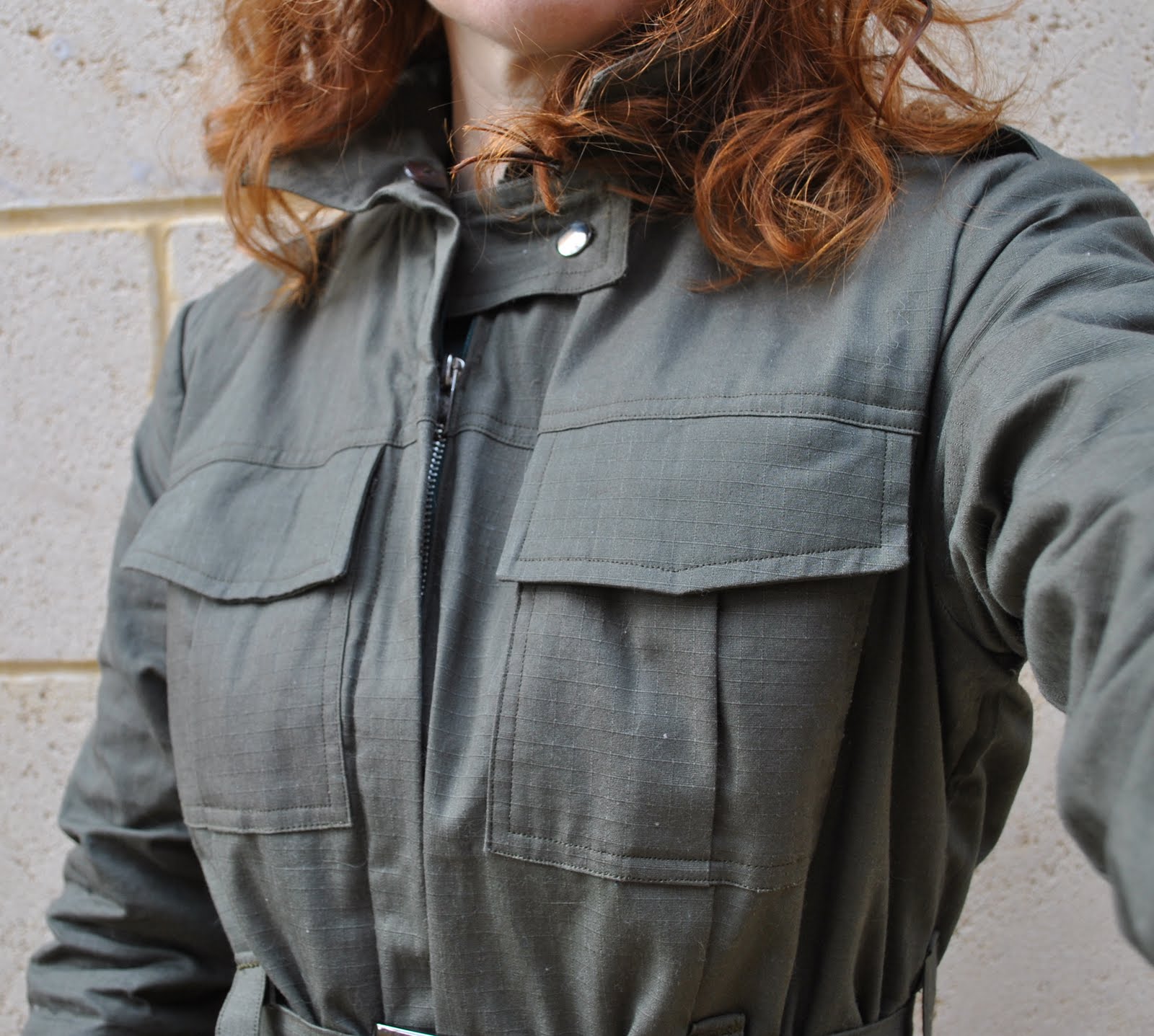
I used Burdastyle 05/2010, pattern 127 as a starting point, and as usual made a few modifications to get the army-style I envisioned, but as the bones of the jacket are essentially the same I think I can dare to write a review for this pattern??  I used ripstop cotton in khaki, a wonderful fabric both tough and hardwearing and so so so perfect for an army style jacket!  I have also made this and this from the exact same fabric, so I guess it is obvious I love it…!  I’d better not buy any more, hmmm?  The lining is a pale grey marle fleece, and the faux fur is… well, faux fur.  I think from memory, it was labelled silver fox.  All the materials are from Spotlight.
The modifications I made:
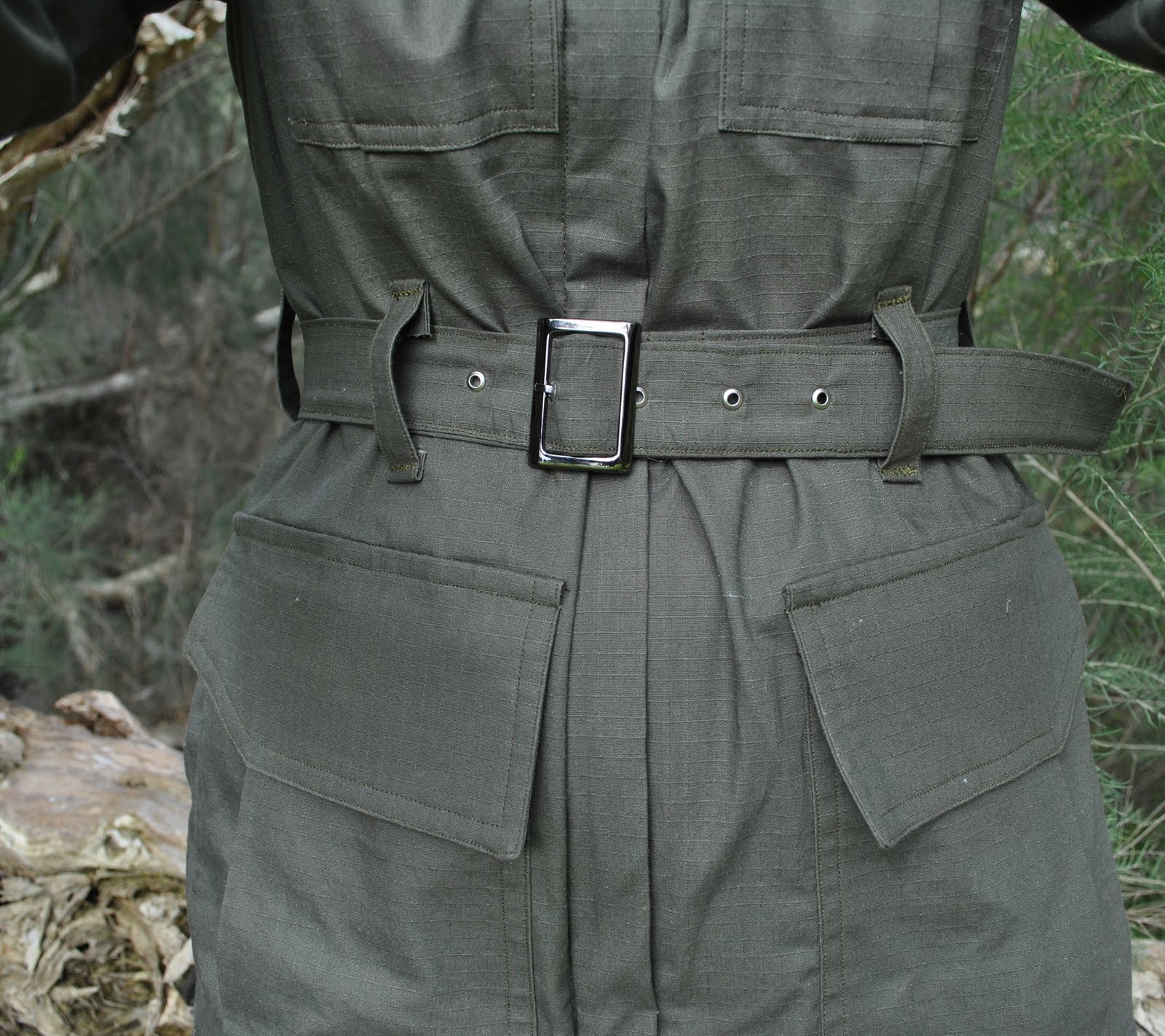
Lengthened the jacket by oooh, roughly 7cm? and also slightly enlarged (length-wise) and slightly lowered the lower front pockets.  I chose to enlarge these because I thought the original smaller ones would not have the right proportions on the lengthened jacket…
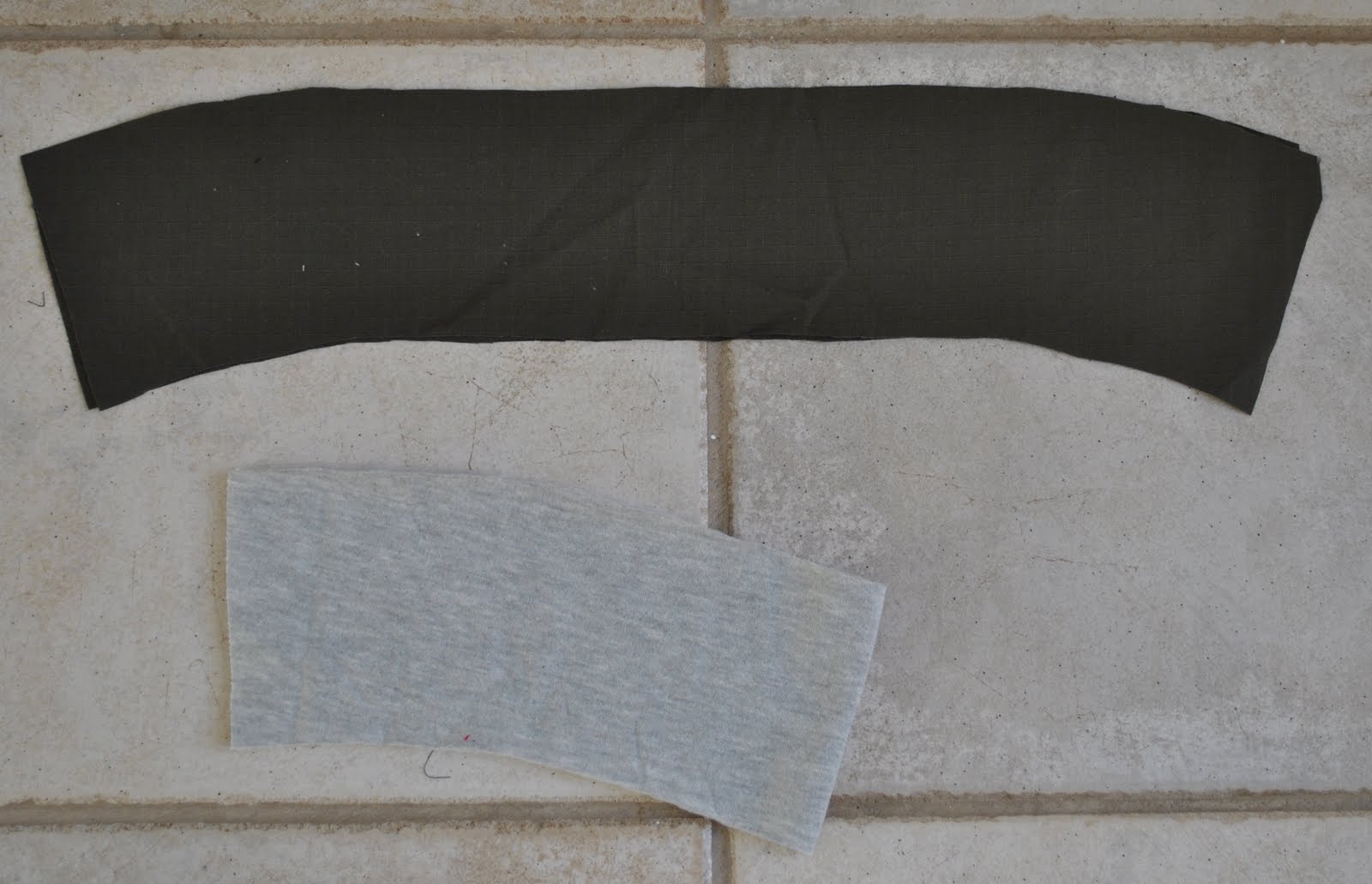
I drafted a completely different collar, a sorta slightly curved rectangle, because I wanted more of a wide standup collar than the little fold-down one in the pattern…

My sleeves are not vented or cuffed, and have a tab with snap closure, for more of a military-looking effect.
I did not incorporate buttons and buttonholes at the front as stipulated in the pattern, but instead inserted an open-ended zip, again inspired by the styling of army jackets I’ve seen around
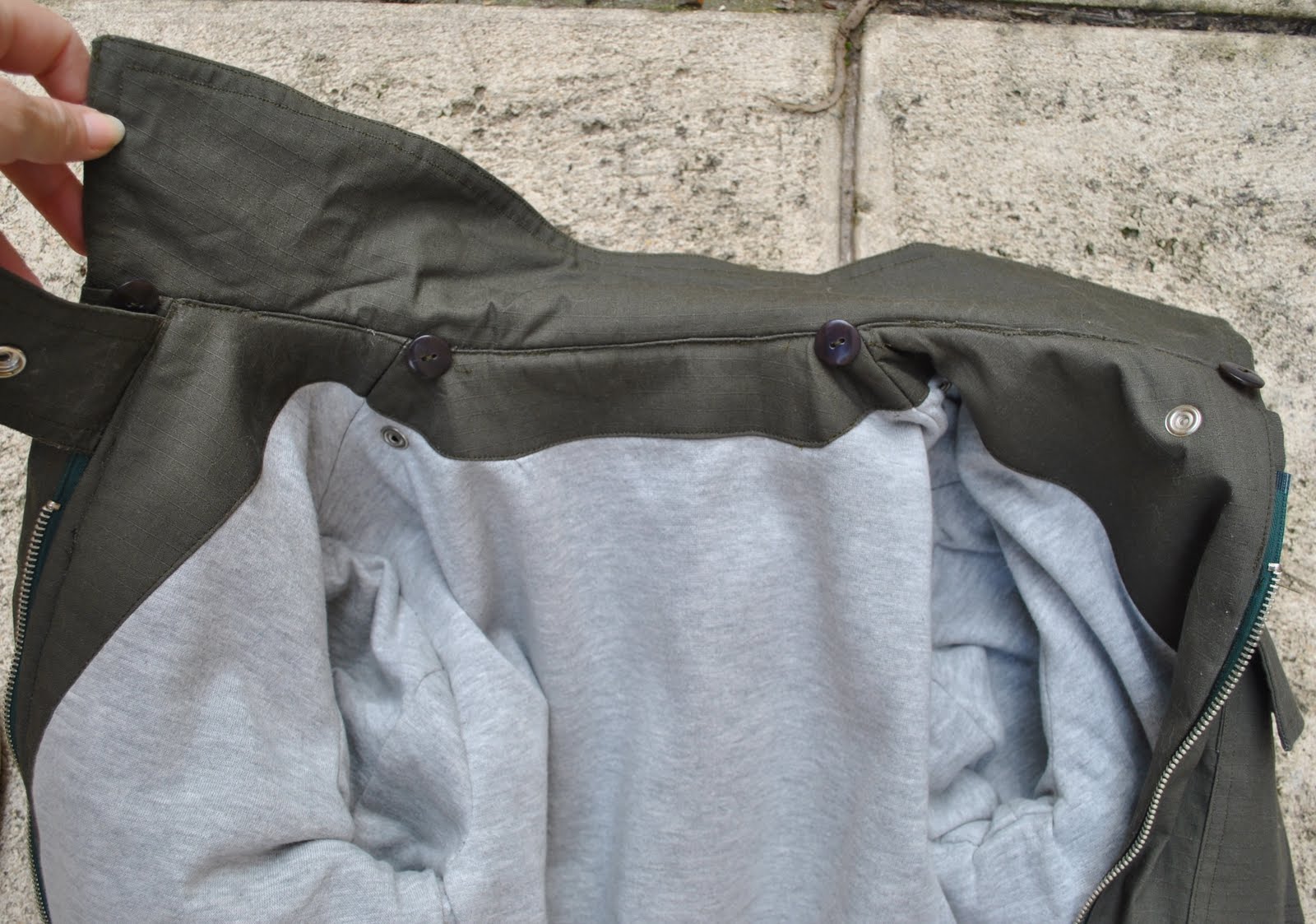
My jacket is fully lined, with grey fleece (for warmth, and also to enhance that bulky look an army jacket is supposed to have)  as it turns out it is very warm!  I did not hem the lining, but enclosed the flat raw edges inside the sleeve and lower hems of the jacket.  The fleece was partly leftover from this project, I had to buy a bit more.

I added a tab at the lower edge, and another tab at the neck edge; both features I mentally noted from the army jackets I saw in Tokyo.  These both have snap closure.
The self-fabric belt is interfaced with the thickest, heaviest-duty iron-on interfacing I could find, and the buckle and eyelets were from Spotlight, like everything else.

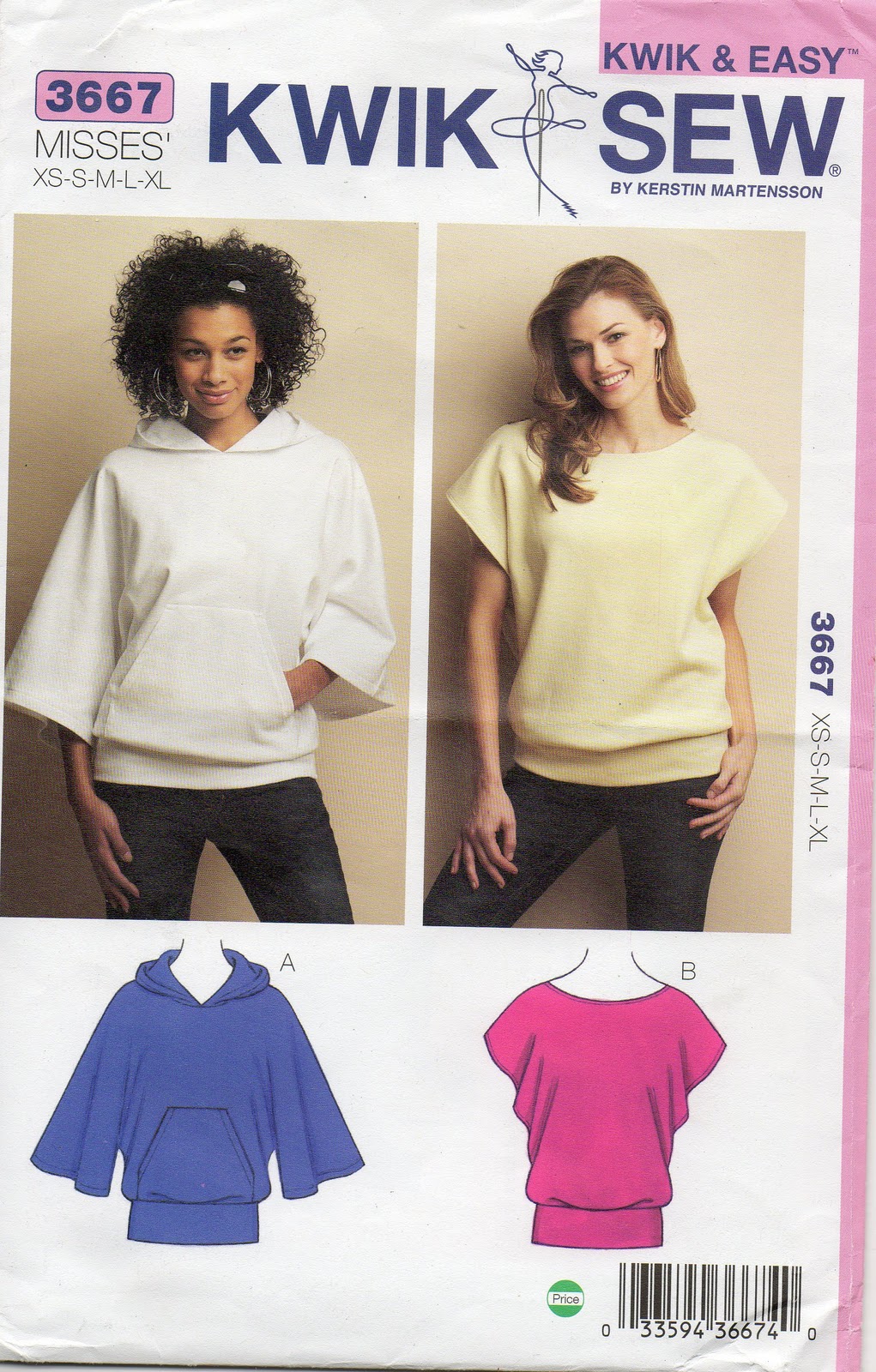
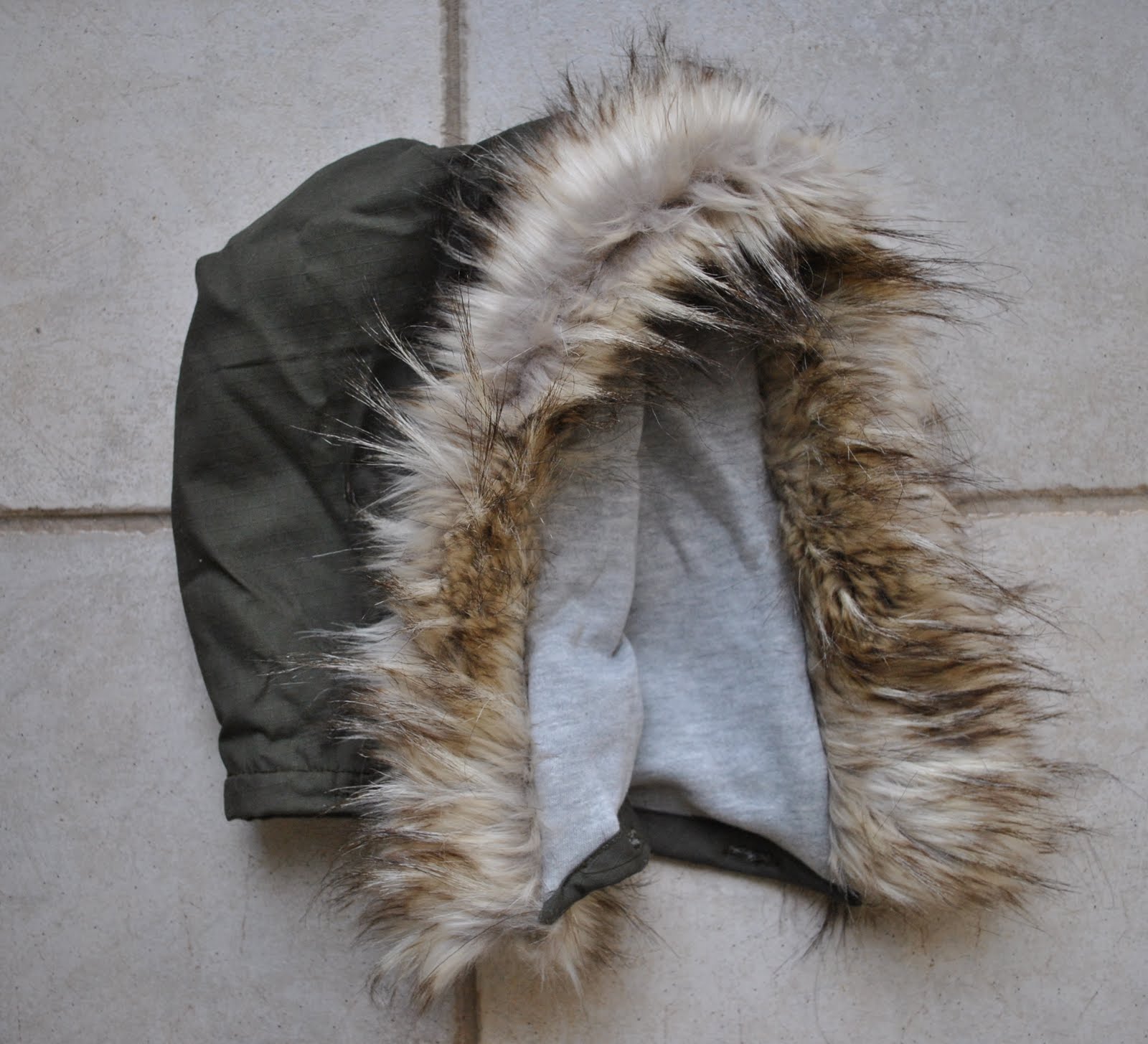
I made a detachable, (faux) fur-edged hood.  For this, I used a modified version of the hood from KwikSew 3667, with the lower edge cut flatter and a bit narrower to fit in with the neckline of my jacket.  It is also lined with fleece, and has buttonholes sewn in the bottom edge, which correspond with the buttons that I sewed inside the collar edge.  I realise the fur-edged hood is probably kinda silly in this climate, but I think it looks kinda cool, and it just may come in useful one day?

My review of this pattern, if you’re interested…

Pattern Description:
Unstructured long-sleeved jacket; with two piece sleeves with vents and buttoned cuffs, front buttons and buttonband, epaulettes, four flapped patch pockets at the front, belt loops at waist level for the self-fabric belt and a short, buttoned collar.
Pattern Sizing:
36-44.  I made a 38
Did it look like the photo/drawing on the pattern envelope once you had finished sewing it?
In essence, yes.  I made a few modifications.
Were the instructions easy to follow?
Yes.  I did some steps differently and in a different order, to accommodate my modifications…
What did you particularly like or dislike about the pattern?
I like everything about this pattern!  The basic bones of the pattern are great; being unstructured it is therefore very easy to fit, to put together and also easy to incorporate your own alterations.  The fun is in adding your own details.
Fabric Used:
Ripstop cotton, and fully lined with cotton/polyester fleece.  A strip of faux fur (silver fox) to edge the hood
Pattern alterations or any design changes you made:
Lengthened the jacket by about 7cm? and also slightly enlarged (length-wise) and slightly lowered the lower front pockets.  I chose to enlarge these not because I thought they were too small but because I thought the originals would not have the right proportions once I had lengthened the jacket…
Drafted a different, slightly curved rectangular collar, because I wanted a higher standup collar than the little fold down one in the pattern
Inserted tabs with snap closure in the top and bottom of the front edges
Instead of the front buttonband and buttons, extended the front opening edges slightly so I could insert an open-ended zip
Fully lined the jacket in a polyester cotton fleece
Added a hood, also fully lined with fleece, and edged in faux fur.  This has 4 buttonholes on the lower edge, and attaches to 4 buttons sewn around the neckline, inside of the collar
Left off the sleeve vent and cuffs, instead inserted tabs with snap closure inside the lower end of the sleeve seam, sewed the sleeves closed to the end and hemmed over the raw edges of the lining.  The lower hem of the jacket also encloses the raw edge of the jacket lining inside
Would you sew it again? Would you recommend it to others?
I would definitely recommend this to others!  I might sew it again, if I need another jacket like this.
Conclusion:
This pattern was one of the first to catch my eye in this magazine, and I always had a mind to make it.  After visiting Tokyo, and being totally inspired by the cool cool army/military style jackets I saw worn over there, I realised this was the perfect pattern I could adapt quite easily to get that style of jacket.  And I’m totally happy with how it turned out; even if the hood is not super appropriate for our climate I still love it, and am very pleased with the smart styling and warmth of the jacket even sans hood.  The waist belt is a nice finishing touch, although I am very glad I lengthened the jacket as I think the belt would have looked a bit funny on the shorter length.
pinterestmail

Oo la la

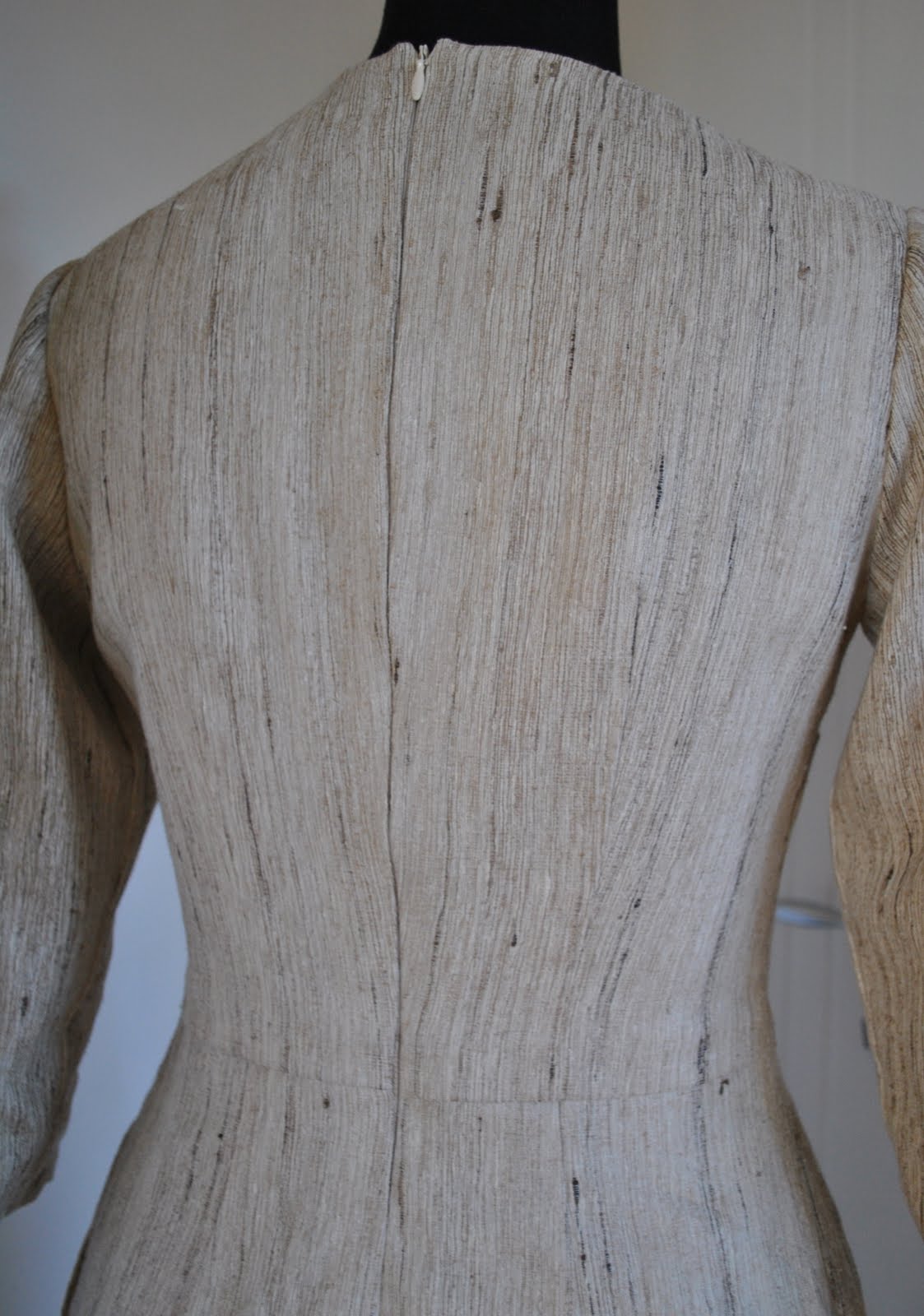
I’ve made a new dress for winter!
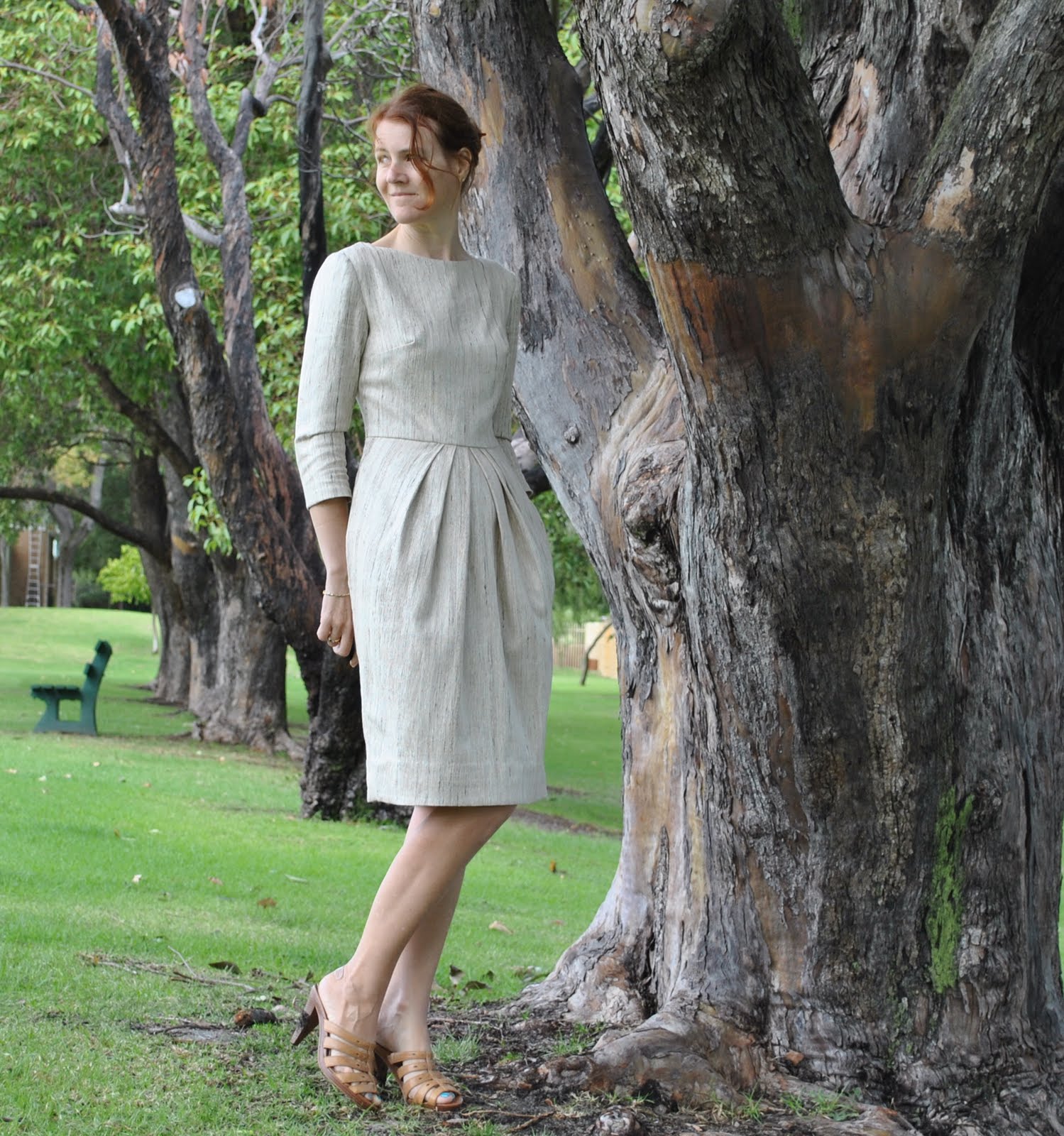
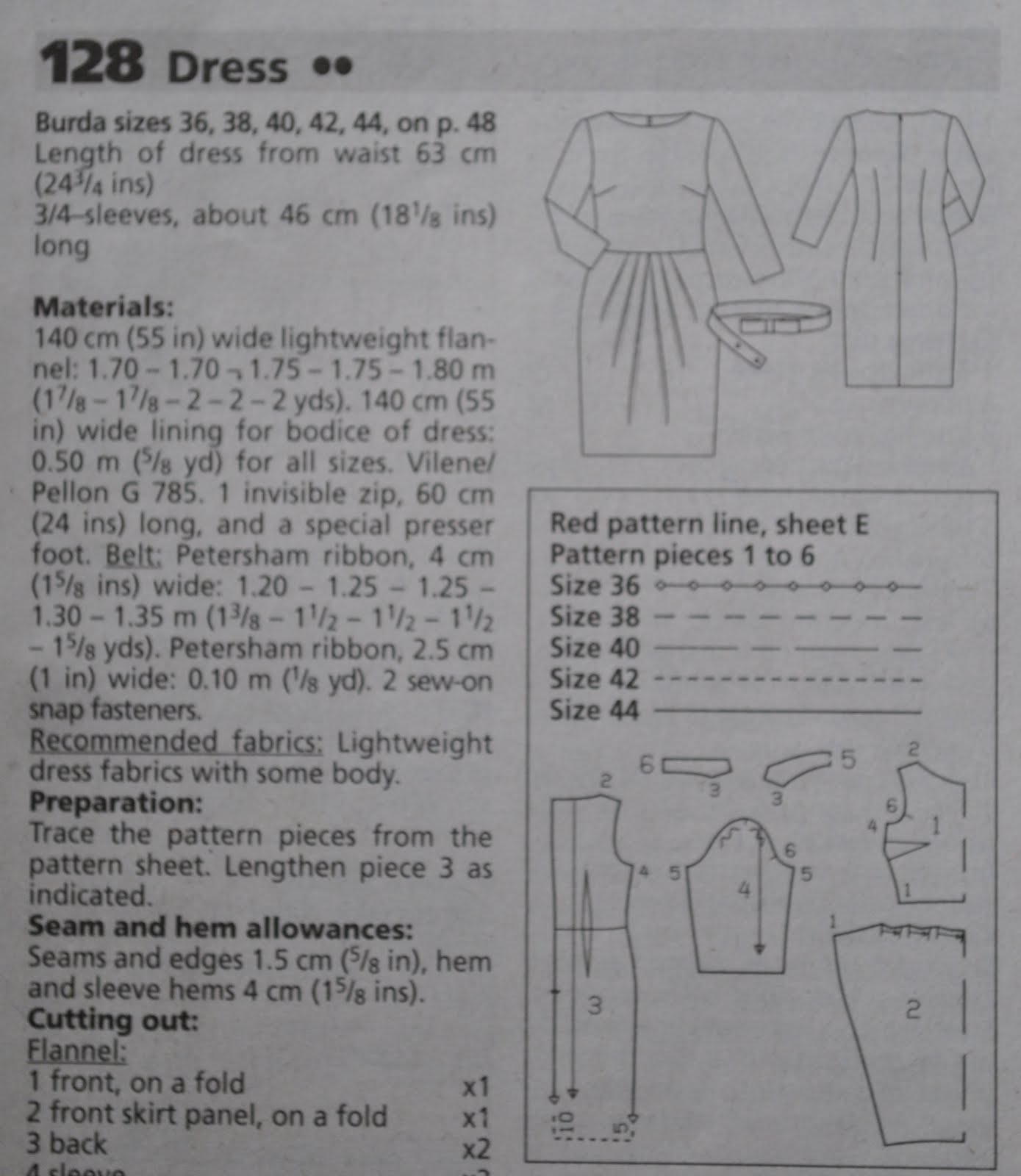
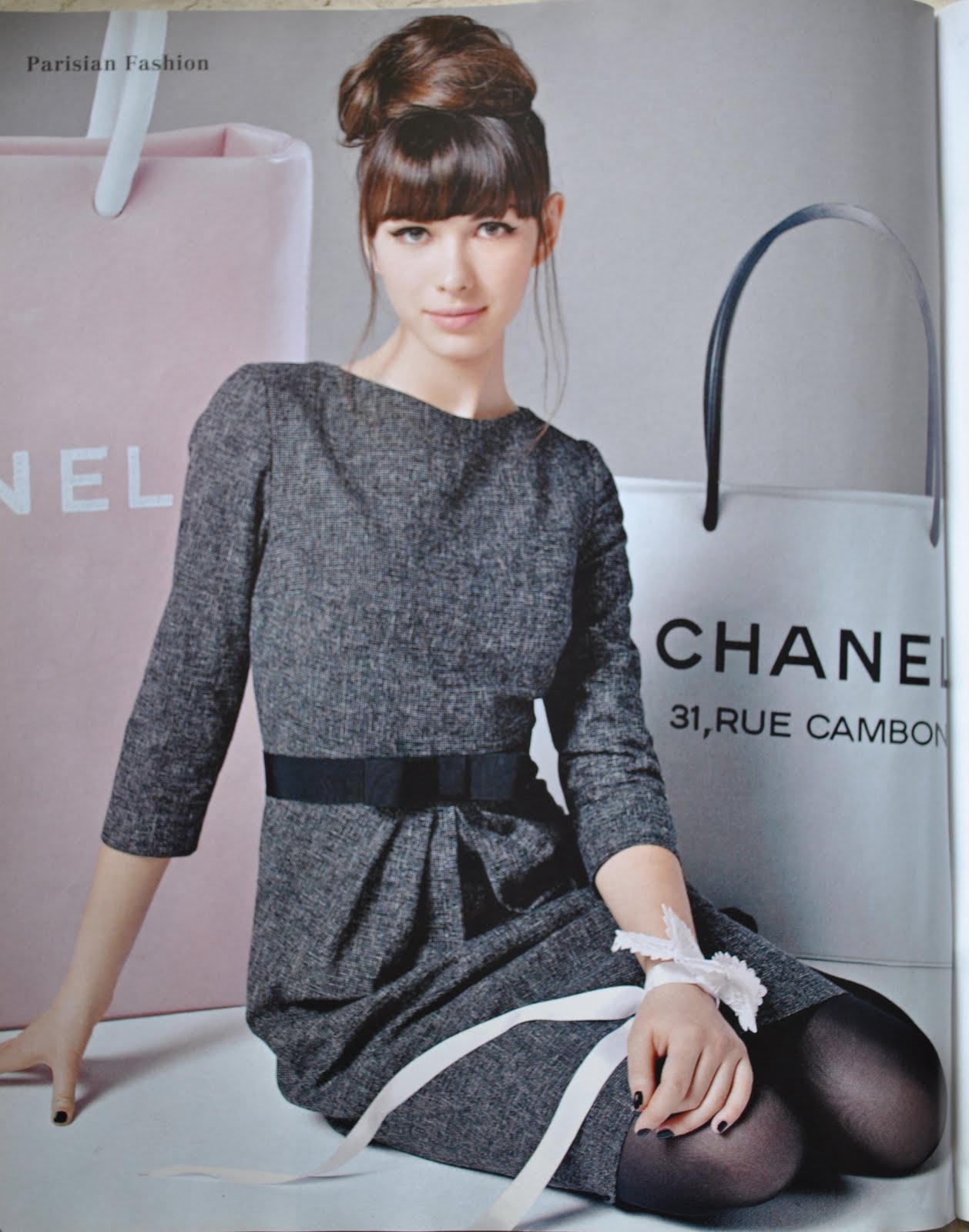
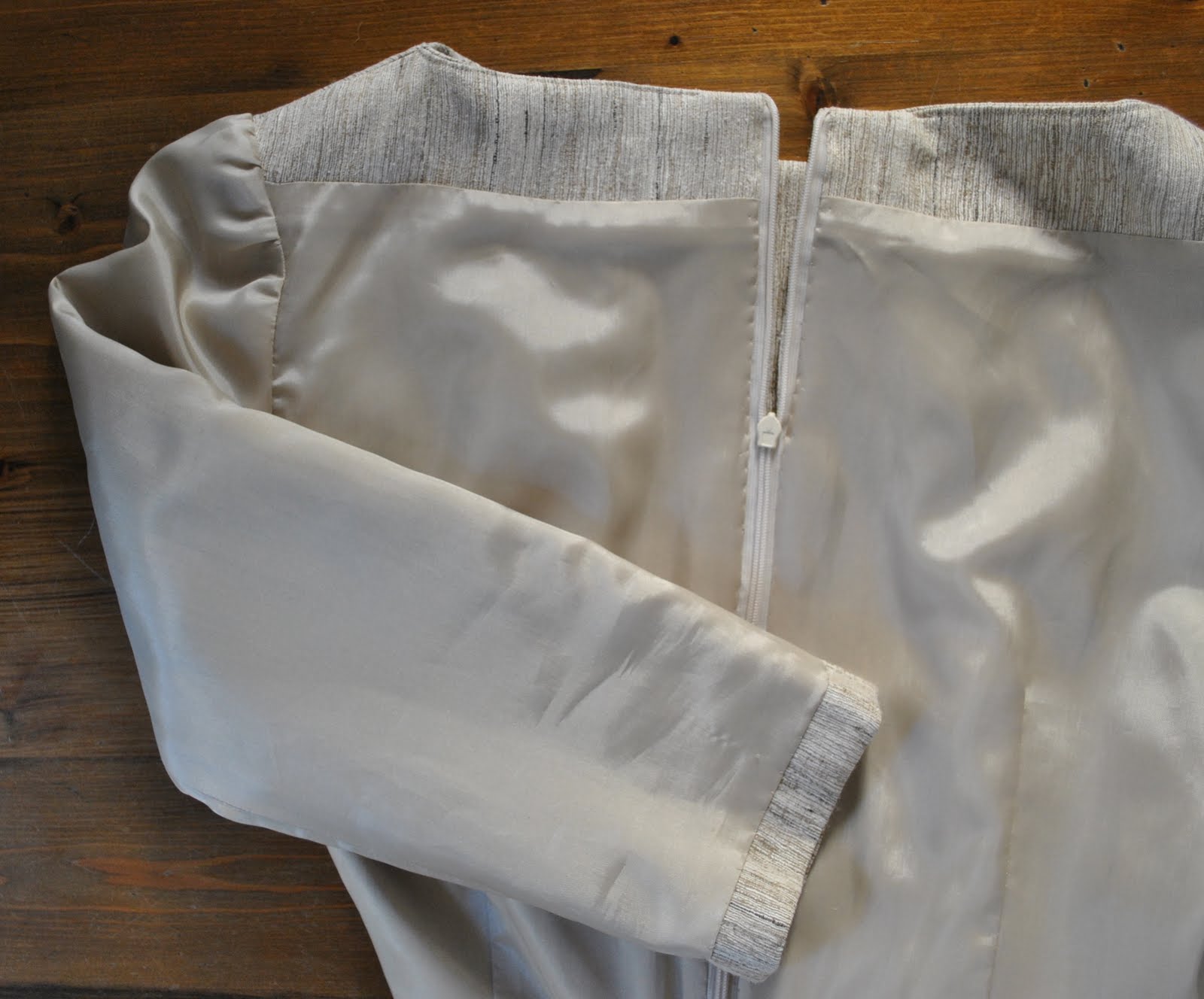
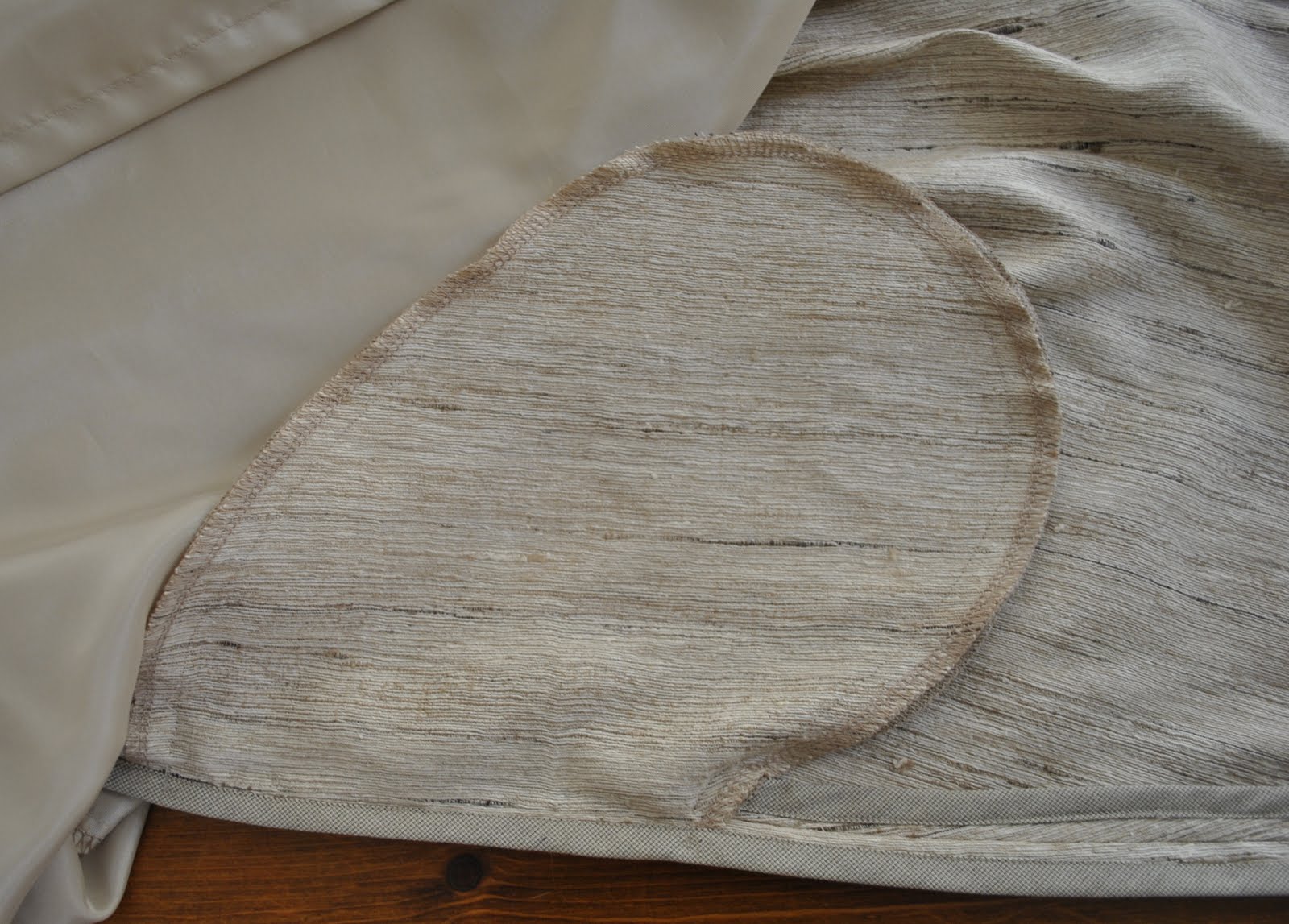
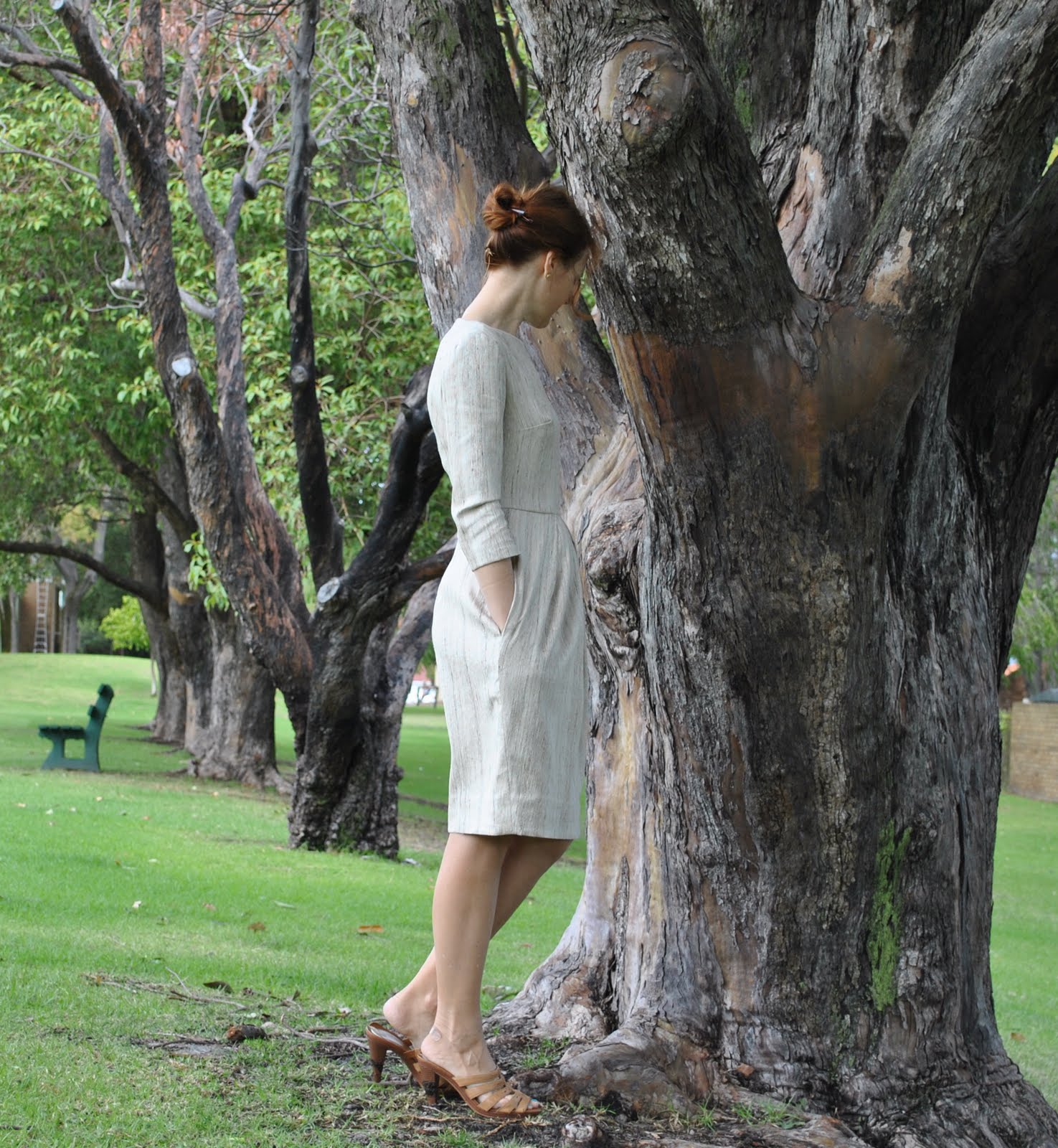
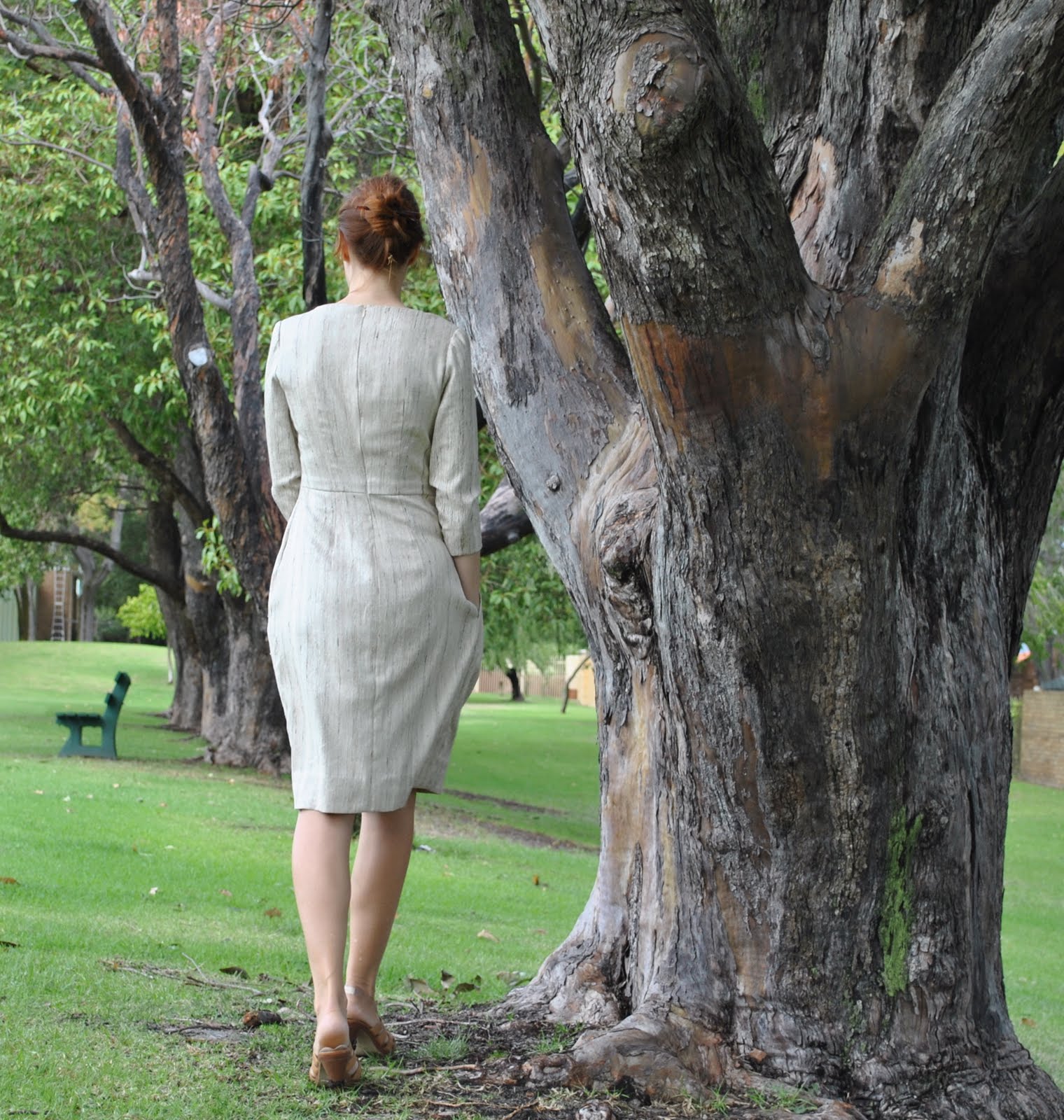
This fabric, a sort of very roughly spun and woven silk, with some very stiffish almost stick-like pieces woven into it, was one of my Christmas presents; that I bought so the children could have some things to give me; hehe, I know, so thoughtful of me…  I always wanted to make some sort of unadorned sheath dress with it, something that was plain-ish, yet still chic and polished, that could be dressed up or down to suit a multitude of “looks”.  And in an ideal world, pockets would be in there too somehow.  But how to incorporate pockets into a sheath dress?   It is almost impossible, without resorting to the ol’ patch pockets, which are not very chic and not a very polished look.  I wanted “polished”, in case if I so desired I just could wear my dress to semi-formal do-es.  Occasionally, I do so desire.  So when I saw this pattern, dress 128 from the 08/2009 Burdastyle magazine I realised that while the dress did appear quite fitted and sheath-like, the pleated fullness at the front of the skirt meant that inseam side pockets were a distinct possibility.  So I tried out putting some in, and they worked out pretty good, imo.  Yes! (self high five)  Is that a case of having my cake and eating it too, or what?!
Apart from the inseam pockets, I made a few other small modifications.  Firstly, I have a slight pet aversion to dresses that have a waist seam on the front and not on the back.  Just privately, it bothers my pernickety need for order and continuity… so I cut the back pieces to have a corresponding waist seam at the back, corresponding to fit with the front waist seam.  This also enabled me to make a slight sway back adjustment easily, a double win.
Also, my dress is fully lined with acetate lining fabric, unlike the pattern, which stipulates a bodice lining only.  Why would you have a lined bodice, and not go that small extra step to line the skirt section? Hmmm…  imo, a skirt lining is mandatory in a winter dress, so it doesn’t stick to your tights.  For my dress lining pieces, apart from the very top neckline and sleeve bits which are to the pattern, I used mostly the lower portion of an ol’ faithful Burda 8511.  So apart from the bust darts at the front, and long double ended body darts at the back, the lining is quite plain.
I also opted to line the sleeves, for extra warmth.  But here I made a small error of misjudgement, although I know that sleeve linings need wearing ease, at this stage I was happily whizzing ahead in my blissful little sewing trance, and didn’t incorporate enough into mine.  Agreed, I should know better by now… still, this is only a problem for that one moment in my day when I am trying to zip up the thing at the back, you know when you are twisted in that position with one arm up and one arm down behind your back, trying to hold that back centre seam in place with one hand and grab the zip pull with the other to pull it up?  I’m sure this is one of the main reasons yoga was invented.  I mean, the need to stay limber enough so we can get our back dress zips up by ourselves, naturally… 

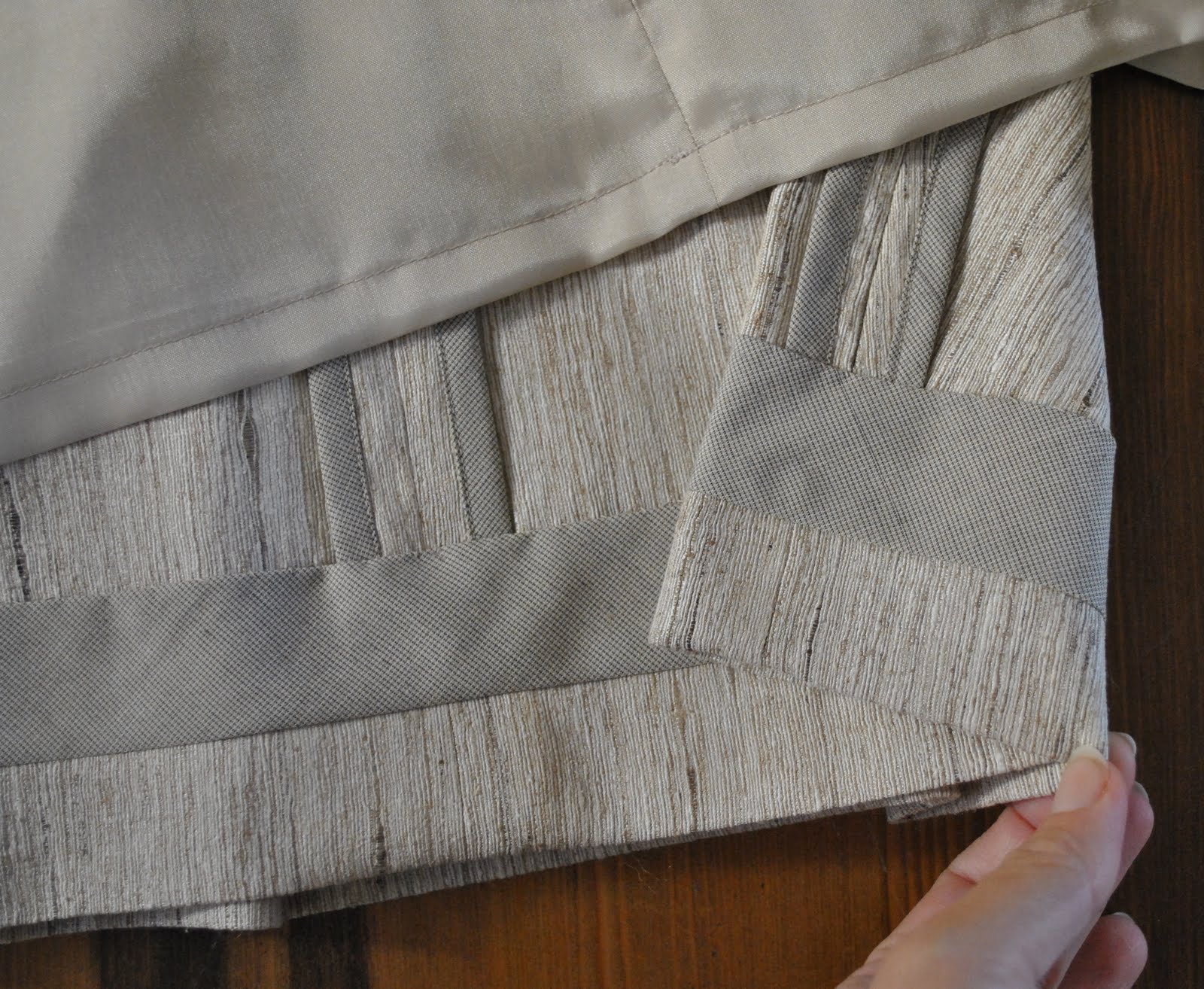
The fabric is that sort of silk that frays like a madman, fraying all by itself just seconds after it has been cut. So I edged all the straight raw edges in HongKong seaming, while some of the “hidden” ones up inside the bodice and in the sleeves were just overlocked to finish…  did someone just say “lazy?”  Who, moi?  On the bottom hem, I made a wide strip of bias binding to make a divinely wide hem…  just look at that hem width, and not a raw edge to be seen anywhere.  Couture heaven, no?!

Details:
Dress; pattern no 128 Burdastyle magazine 08/2009 with some modifications, silk
Sandals; akiel, from an op shop

Below is my pattern review, if you are interested…

Pattern Description:
This figure-following sheath dress constitutes a tribute to all Paris fashion designers; the bodice remains plain while little waist tucks lend the skirt a refined tulip look  (don’t you just love Burdastyle descriptions…!)
Pattern Sizing:
36-44, I sewed a 38, and  graduated the skirt pieces out to 40 from hip height down because I wanted to incorporate inseam side pockets.
Did it look like the photo/drawing on the pattern envelope once you had finished sewing it?
yes!
Were the instructions easy to follow?
very straightforward and easy
What did you particularly like or dislike about the pattern?
There’s nothing not to like about this pattern!  I made a few slight modifications to suit my personal taste.
Fabric Used:
A roughly spun and woven silk, with acetate lining
Pattern alterations or any design changes you made:
I incorporated inseam side pockets.  The slight flare at the front of the skirt provided by the waist pleats made this an obvious modification, and very easy to do.
I cut the dress back pieces to have a waist seam, corresponding to the waist seam at the front of the dress.  I prefer the continuity of this look, and it also enabled me to make a slight sway back adjustment.
I fully lined the dress, including the skirt and sleeves.  For the dress lining pieces, I used a plain shift dress pattern I already have; which does not have the shaping of the main dress pieces.  For the sleeve linings I used the pattern pieces, although, note to others who plan to do this, be sure allow some wearing ease here!
Would you sew it again? Would you recommend it to others?
I highly recommend this to others!
Conclusion:
This is an easy dress pattern with a lovely, flattering and classic shape.

below; side view, with pockets in action…

pinterestmail
Switch to mobile version
↓