Category Archives: Uncategorized

raspberry/navy Alabama Chanin tank top

I’ve finally finished my latest Alabama Chanin project…  
Below is how it appeared on this blog previously…? (shudder) well, that dress has undergone extensive renovation over the past five months and now at last, I am quite satisfied.

I received loads of fantastic suggestions, thank you so very much to everyone who gave me so much helpful and wonderfully thoughtful advice  đŸ™‚  I am very grateful  đŸ™‚ *mwah*
The pattern is the fitted top from Alabama Studio Sewing + Style, by Natalie Chanin, and I had modified it slightly by giving it a higher rise at the neckline at CB, which will help keep the straps firmly on my shoulders and not slip off, like they occasionally do in my previous, first version of this pattern.  The print is Abbie’s Flower design from the same book, enlarged by hand and printed as described here, and I employed the reverse appliquĂ© method from the book, stitching running stitch around all motifs using crimson Gutermann upholstery thread, and then cutting the printed motifs away to reveal the base layer of fabric underneath.

I really liked Ann’s suggestion to bring some navy into the equation.  I bought some royal blue cotton jersey from KnitWit.  This was but a starting point; the original blue was a nice colour, but flat and not quite as edgy as I would have liked against the warmth and liveliness of the raspberry.  Some dyeing fun was called for.  I made haste for the lair and dragged out ye olde dye-pot, mwahahahaha
A short stint in a half-strength bath of iDye in Brown later and it was darkened and deepened up very nicely; transformed it into a very satisfactory shade of mottled dirty-navy.

Hehe, I just re-read that description and had to laugh at how the exact opposite of attractive that colour sounds!  well, I do love me some ugly colours, hehe.
The seams are all hand stitched in running stitch, with the occasional backstitch to “stop” the seam, something I learnt to do in hand- stitching quilts; and the seams then felled using running stitch, as per the Alabama Chanin way.  

I cut the binding strips for the armholes and neckline from the same dyed navy jersey and hand stitched them down in herringbone stitch using navy blue Gutermann upholstery thread.

A new tip; in my previous Alabama Chanin embroidery forays, I pinned the fabric layers together for the embroidery stage, this time I thought of a better solution.  I pinned and basted around all raw edges, then simply ran rough basting lines of long stitches, about 4-5cm apart, right across the pieces using my sewing machine.  Quick and dirty, nicely stable, and the long stitches are very easy to pull out as the embroidery progressed.  And far better than having to worry if my pins were going to fall out, only to get discovered on the sofa and produced as hard evidence in the Case against Sewing Taking Over the House.  Please, take a moment to consider the danger to one’s beloved husband whose bottom came to rest right beside that tiny little pearl-headed pin! not to mention one’s innocent offspring and cute fluffy pets!  
Hehe, no need to add further fuel to that particular flame  đŸ™‚

 My next Alabama Chanin project? already in the works!  Fortunately I made my original dress double layered and so I still have quite a good quantity of the raspberry fabric left after cutting this out; and I also dyed enough of the navy so that now a matching, though not identically patterned, skirt is awaiting in the wings to be made, as we speak.  Type?  Read?  One day, someone is going to come with a satisfactory verb for this kind of interaction  đŸ˜‰
Anyway, I am super pleased with my new Alabama Chanin top, and the good thing about that satisfaction is the renewed enthusiasm it brings for me to get on with that skirt quick sticks, to have something else to wear it with.  Ever onwards!

Details:
Top; the fitted top from the Alabama Studio Sewing + Style book, hand-dyed, -printed, -embroidered and -stitched in two different colour fabrics
Jeans; the Closet Case patterns Ginger jeans, navy stretch cotton denim, details here

pinterestmail

watercolour silk dress

I’ve made a new dress  đŸ™‚
Every year, my friends give me a Fabulous Fabrics voucher for my birthday; aaaah! they know me so well…!  đŸ™‚
and last year I spent it on this gorgeous, water-colour-y silk charmeuse.  And have made it into dress 35 from Patrones 7; this magazine was itself a gift to me from Merche Martinez from a few years ago.  This is the second time I have used this same dress pattern, my first version is here.
So, I have worn it a scant handful of times so far; for dinners during our recent holiday, and I’m wearing it today as well to show it off to my gorgeous gal-pals who gave the voucher to me… and I have to say I’m quite besotted with my dress already.  Honestly, bias cut silk, there’s just nothing quite so lovely to wear.  It’s a beautiful gift from you to your skin.  Seriously, my skin is thanking me every single second I spend in this dress.  It’s pure and utter heaven.  *dreamy sigh*    
To go the whole nine yards silk-wise, I fully lined the dress with creamy-coloured silk habutai.  Pinky-purple lining seemed at first to be a better colour match; but upon checking how the fabrics looked when layered together I found any colour just very subtly dulled those large white-ish feathery-floral areas, whereas a lighter creamier-coloured backing really enhanced the colours of the charmeuse and gave them a beautiful inner glow that I preferred.   Something to bear in mind when choosing a lining for lightweight, patterned fabrics; hold lining underneath the fashion fabric to check how it affects the colours before making a final decision.  Sometimes an unexpected colour choice will look better.

The dress lines are quite simple and feminine, with a slight a-line curve, small cap sleeves and I lengthened the neck-tie to extend right around the length of and beyond the v-neckline, so it is both a tie and also a sort of “collar” that finishes the neckline.  The skirt is cut flatteringly on the bias and I gave careful thought to the colour placement over the body.  I wanted the darker, moodier colours to feature mostly and aimed for the splashes of those big abstract feathery flowers to appear over one shoulder and to bloom down the side and hem of the dress, front to back.  ie. not on my tummy or right boom on the derriere.  The dress closes with a burgundy invisible zip in the left bodice side seam, and I hand-rolled a narrow hem on the sleeves and lower hemline.  All seams in both dress and lining are French seamed.

I altered the bodice pattern piece substantially from my first version because ultimately I decided that that dress incorporated an excessive degree of blousiness for my particular shape, or lack thereof, ahem.  I pinned out about 3cm width from the lower edge and curved the lower edge up as marked in red, cutting out up to 5cm in height at CF, this removed a tonne of blousiness and so is only about a thousand times more flattering on me, rough estimate there.  In lieu of lightly gathering the bodice evenly along most of its width into the skirt, instead I folded the width into four little folds, evenly distributed just out from either side of CF, treating the lining as underlining and folding them together.  These folds can be seen more clearly from the inside of the dress.

I also added about 4cm in length to the skirt at the lower edge.  I’m slightly doubtful about this added length, I don’t hate it but also am not bowled over with love for the length right now either.  I may just live with it for a while but that extra 4cm may or may not just get lopped off at some point.  I’ll just have to see how I go; weighing up the pros, such as would it look more chic if it was a bit shorter? against the cons; the main one being that I would have to re-do that hand-rolled hem.  Hmmm…

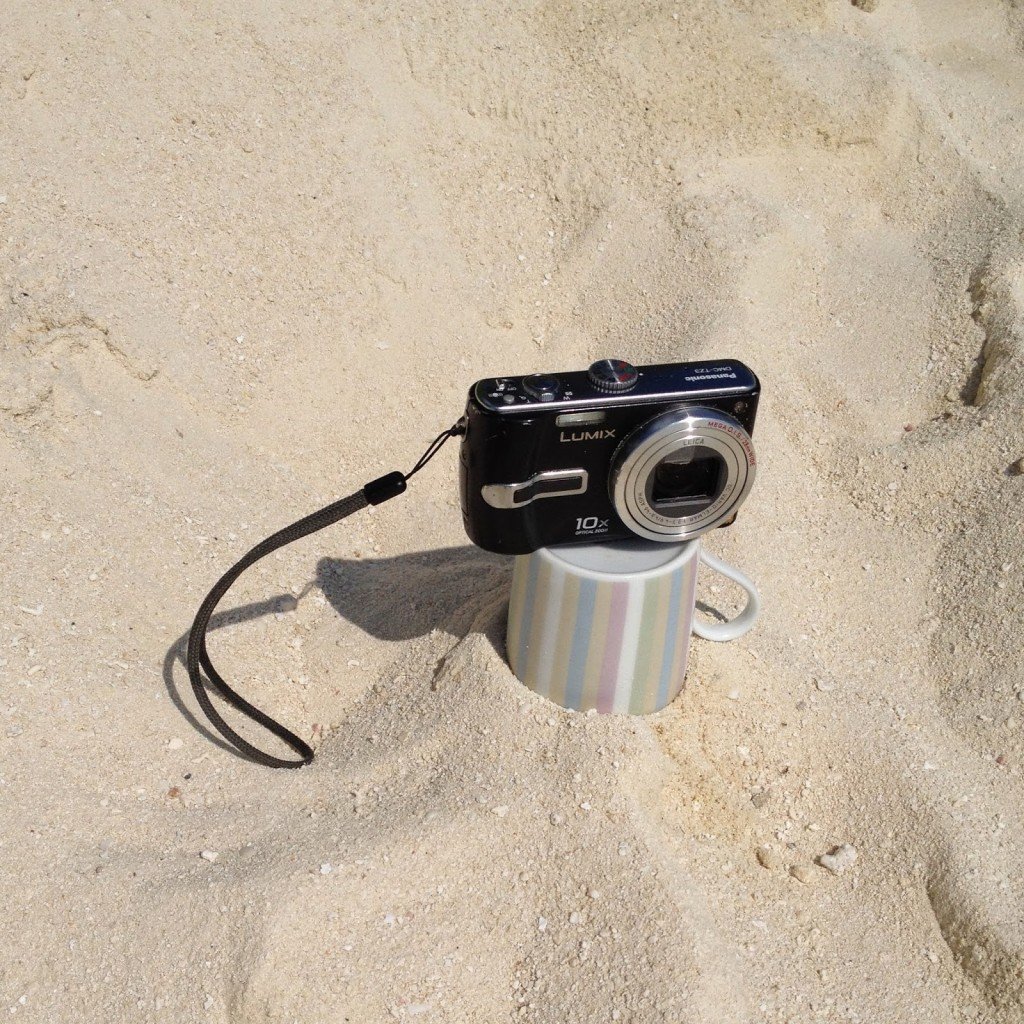
Now, on another note: anyone who follows me on IG would know already about our recent, most utterly paradisiacal holiday ever!  yep, I took my pictures on the beach during our holiday in the Maldives.  And I thought I would show one example of my set-up for taking my own pictures when away, an activity at which I now consider myself an expert!  I’m a big fan of packing as light as possible and saving myself any packing and carrying around bulky camera equipment.  Just cannot be bothered with all that.  Yeah, lazy, I know 🙂 
When travelling, I just take my small travel camera and nothing else.  And I look out for and take full advantage of any flat surface that I may come across, although if nothing presents itself I can at a pinch just sit the camera on its own little soft case.  This is not completely ideal, but it’s doable if no other handy flat surface is around.   Good flat surfaces include, but are not limited to: park benches, curbs, low walls, a level spot on a rise in a path.  Rocks sometimes too, though rocks can be tricky and it’s imperative to check carefully that the camera is sitting perfectly stable and isn’t going to topple over and smash.  
In the case of our last holiday, our cabin was on the beach and I used a flat-bottomed cup from our room.  My camera sat up, safe and clean, up off the sand as pictured.

Anyway, whatever flat surface is at hand; I just set the timer function on my camera, pop the camera up on said flat surface, push the button and then race out in front.  Voila.  Does the job, and requires no big bulky camera equipment.  Win!

Details:
Dress; Patrones 35-7 modified slightly, silk charmeuse
Location: Valessaru, the Maldives

pinterestmail

purple skirt, with “tulip” pockets

I’ve made a new skirt.  This new skirt is un-noteworthy except that I gave it some rather unusual little side pockets.  They sit down at the hem, inserted in off-set side seams.  They’re not very big pockets, just a nice size to hold my fitbit and maybe my phone at a stretch.  Really, I was playing; got the idea to put them in a skirt and went for it.
The pockets are based on those in this picture, which ?I think? is from a vintage design.  To accommodate them in this otherwise very plain little skirt I drafted for myself a 4-panelled skirt pattern using an old favourite Vogue 1247, a straight skirt with waistband, as a starting point.  I treated the pattern like a “block”, and spliced, cut and spread and sliced and rotated to eliminate darts etc to make a 4-panelled pattern with a narrow front and back and two, even narrower, waist-to-hem side panels which host the pockets.  
Fabrics; outer and lining fabrics are both from Fabulous Fabrics, a greyish purple silk hessian for the outer shell from the remnants table and burgundy polyacetate for the lining fabric.  I only had 60cm of the silk hessian, barely big enough for anything at all!  Extreme laying-out skillz were employed, hehe.

lining was cut using spliced-together Vogue 1247 straight, with the waist darts simply pleated into the waistband.
The grey cotton jersey edging on those pocket panels is harvested from off of an old Tshirt of Tim’s, and lack of fabric forced me to use it for the waistband facing too.
front view is kinda boring
So…  skirts.  I’ve been having some deep thoughts.  Well, about as deep as can be expected on the subject of skirts, which is approximately puddle-depth in the scheme of things … but still.
Keeping tabs of my wardrobe over the past few years has not been totally fluff n’ puff with no substance, believe it or not some actual useful conclusions have been reached.  *gasp!* 
Into Mind writes about finding your “uniform” and I find I tend to favour two quite distinct and different kinds of skirts; plain and straight “little” skirts like my new one here and then longer, three-quarter length ones that can be a bit more visually interesting, more pfouffy with layering and/or detailing. 
During winter, well I could happily and comfortably live in the former, plain, straight, little skirts, all winter long.  I like to wear jeans every now and then, but really, if I’m being honest, skirts are just far more “me”.  
It’s nice to have some skirt-and-top “outfits”, that go together so well they don’t need to go with anything else, ie. my Alabama Chanin ensemble; but obviously solid-coloured separates are the absolute best workhorses for mixing and matching the sometimes disparate elements of my wardrobe.  Colourwise, I have seasonal favourites and basics and neutrals, sure, and I also like to have some odd colours, “outliers” in my wardrobe to choose from too, to suit whatever changing mood I’m in.  And, I don’t know if it’s because I pluck them from my wardrobe more frequently, or because of their straight shape, or both; but all my “little” skirts always seem to bag out and die more quickly too.  
Sadness ensues.  Cue tiny violins.
Anyway, just some random thoughts.  Ergo, I’m stocking up on some little skirts in a few different colours.  So sensible!  It’s early to judge it yet, but I think this sludgy purply-grey colour might be a totally excellent one in my winter wardrobe.  It’s not obviously a neutral, nor a colour, but manages to be a bit of both, if that makes any sense at all.  We shall see, we shall see…  đŸ™‚
 back view, also kinda boring

Details:
Skirt; my own design, derived from Vogue 1247 as a “block”, deep purple silk hessian
Top; the loose drape top, modified, from drape drape by Hisako Sato, white cotton jersey, details here
Shoes; Zomp, from Zomp shoe boutique
pinterestmail

Cassie’s terracotta dress

I made this belated birthday present for Cassie; we recently went on a girly shopping expedition together for her birthday present and spent hours browsing, looking at pretty things, chatting, having hot chocolate and enjoying ourselves! we had lots of fun but she couldn’t decide on anything that she liked.  Finally I suggested, hesitantly, would she like to go to Fabulous Fabrics to get some fabric of her choice and I could make her a dress of her choosing? and she delighted me by immediately agreeing.  She’s so sweet  đŸ™‚  I say “hesitantly”, because while I love to sew things for my family I absolutely do not want to force the products of my sewing on them.  And I often worry that my love of sewing is influencing them to ask for me to make something for them, just to make me happy; if you know what I mean.
Anyway, happily she says she loves the new dress, and plans to wear to work at her office with her black ballet flats as well as sometimes on the weekend with sandals.  The pinky-brick/terracotta viscose from Fabulous Fabrics is a fabric Cassie has loved for “ages” and she chose the dress style based upon one we had seen in Morrison, with some minor design alterations to make it what she wanted in her birthday dress.

The result is quite plain, with its main feature being a wide front tuck emanating from the neckline and disappearing into the body of the dress.  I started out with my standby, plain sheath dress pattern Burda 8511, and rotated out all darts, cut it with an 8cm tuck allowance in the front panel, i.e. an extra 16cm width at the neckline tapering off to nothing by the hemline.  I scooped out and widened the neckline, added inseam side pockets, rouleau belt loops and a long self-fabric sash.  

The side and pocket seams are French seamed, with a hand stitched, narrow hem.

I’m extremely happy with how chic Cassie looks in the new dress  đŸ™‚

Details:
Dress; own design, using Burda 8511 as a starting point, terracotta viscose
Shoes; from Hobbs shoe boutique

pinterestmail

Inseam arrow welt pockets

My example shows a skirt pocket with a 16cm length opening edge bordered by 1cm width welts, although obviously all measurements can easily be altered to give any width of welt or pocket desired.

Apply a strip of iron-on interfacing to the wrong side of the garment, where welt pockets are to be situated.

Fold bias cut welt strips wrong sides together and press, pin to the stitching line of the garment edge; with folded edges to the outside.  Mark the upper and lower points of the long edge stitching line.  It is essential that the upper and lower markings on each welt be as square as possible and give exactly the same length on each side; in this example, the stitching lines are 14cm long.

Stitch, starting from exactly the upper marking on each welt and finishing exactly at the lower marking.  It is most important that your stitching be an even width from the outer folded edge of the welt, rather than the cut edges.

Snip the seam allowances of the garment from the raw edge in to the first and last stitches of the previous stitching, taking care to not cut into the welt.
Turn the seam allowances of the welt inside the garment and press.

Mark on the folded edge of the welt the upper and lower tips of the arrowhead, in this example 1cm out from each stitching line for a 16cm finished pocket opening.

Turn out the garment over the welt again, with the snipped seam allowance splayed over the welt and raw edges squared.  Pin through from the previous marking to determine where the short seam will end, secure seam allowance to welt with another pin.

Stitch from the snip point diagonally out to the marked top point.

Turn welt back out, press; stitch the remainder of the garment seam from the upper/lower points of the welt out; press open.

Pocket pieces; in this case I pieced the wider pocket piece with a strip of the self-fabric at the opening edge; this is the under pocket piece that will sit under my hand in situ.  

From inside; open out the welt again and pin the relevant pocket pieces right sides together to the seam allowances of the welts.  Stitch pocket pieces to the welt SA from underneath the welts ie. with interfacing uppermost.  This is to ensure that your stitching goes directly and exactly over the previous welt stitching line.

Stitch the pocket pieces together and finish edges.

From the right side of the garment, stitch in the ditch through all layers along the two short diagonal edges of the arrowhead.

And, ta da! finished!

pinterestmail

High-waisted apricot skirt

I’ve made a new skirt; a high-waisted, knee-length straight skirt, with a self-belt, long double belt loops and in-seam arrow welt pockets.  This is skirt 114 from the Solo in White collection from Burda style magazine 04/2014.  I’ve waxed lyrical about this collection previously just because of the dreamy colour palette, but a closer perusal of the design lines had me lost in admiration anew for the designs themselves.  This is now the third piece I’ve made from the collection; others here and here.  May not be the last either, because all pieces are quite lovely; classical but still with their own interesting little twist.  Honestly, it has to be said; Burda magazines are simply the hands down best value for money around.
The fabric is from the Fabric Store in Melbourne, bought during my last trip there with Mum and Cassie.  I think it’s a linen/something mix, woven of various thickness fibres, stiff-ish and almost like thin upholstery fabric.  I didn’t think it too thick for the slightly more complex sewing required of those arrow welt pockets, and think they turned out ok.  I got the skirt pieces cut out of my piece with the barest of scraps to spare.  Honestly, my wastage was less than a scrunched handful of fabric.  Win!!!  After cutting the pieces I overlocked all edges before doing a single other thing, because it frays like a madman.

Changes: I cut a size 40 at the hips grading into a size 38 at the waist.  In fitting to myself I ended up taking a little bit more off each edge at the waist.
I cut my pocket pieces to be substantially bigger than the pattern piece.  My one gripe with Burda patterns is that the pocket pieces are nearly always laughably small.  Or do I have giant flipper hands?  Ummm, probably the latter!
Another small gripe I have with this style of skirt is that the in-seam pockets are frequently situated too close to the CF for my liking, and so when you’ve got your hands in your pockets you end up feeling like you’ve got your hands sitting coyly and weirdly right over your crotch.  Hate that!  So I cut my skirt pieces so the front piece was 4cm wider at the CF, and folded 2cm down the centre of each side front piece.  This moved the seams 2cm further out to each side, which is just enough to make hands-in-pockets feel not so weird to me.

I fully lined the skirt with cream coloured polyacetate from Fabulous Fabrics, mostly because my fabric has some stiff and sharp fibres in it that I could imagine over time would become scratchy and super annoying against soft tummy skin.  Lining pieces are not provided with the pattern, but it’s easy enough to make a lining; by splicing the front pieces together along the seam lines, cutting from the facing allowance down; and folding the width difference in along the top as a pleat.  The back dart allowance can also be folded as a pleat in the lining.

I cut the facing and pocket pieces from pale yellow polycotton, and pieced the pocket with a strip of the self-fabric at the opening edge, so that is what shows if the insides are glimpsed during wear.

The instructions for the in-seam arrow welt pockets, contained in those for skirt 113, are quite difficult to follow; I was thinking vaguely of doing a little pictorial here to illustrate how they are done.  Maybe.
Anyway, that’s it!  It’s still too hot for this skirt yet, but I’m happy to tuck it away in the wardrobe, awaiting some lovely cool weather.  I bought some perfectly matching fabric to make a top to go with it too, so should get on to that thing next.  Ever onwards!

Details:
Skirt; Burda style 04/2014-114, apricot/cream linen/cotton woven
Top; adapted from the loose drape top from drape drape, by Hisako Sato, cream jersey knit, details here
Sandals; Zomp, from Zomp boutique

pinterestmail

Red dress; 6 different ways

It’s been a while since I did one of these!  I don’t really have deliberate dress-up sessions to test out my clothes’ versatility any more, but it’s still interesting for me to look back and get a general overview of just how well my self-made wardrobe mixes and matches and whether everything works together.  This red cotton dress has been an absolute beaut!  it’s been worn a tonne and proved itself to be quite a versatile year-rounder too.  I made it late 2013, using an adaption of dress pattern M from the Stylish Dress Book by Yoshiko Tsukiori.
I think its usefulness has lain in several factors: firstly the cheerful tomato-red colour is supposed to be one of “my” colours, as well as a shade equally at home in both hot and cold weather, and also the style of the dress is quite plain and simple, lending itself very well to mixing and matching with a bunch of other clothing pieces and stylistically not fighting with anything.
Some of the highlights in its life:
At left, its raison d’ĂȘtre was for me to have something for Wildcats games … I wore it to just about every single one and fitted in fine with everyone else!  At right, during a long hot summer it was fabulous to wear just all on its own, sans any adornment.

red1a

At left; the colour looked good with just about every colour cardigan and scarf that I own; and at right, I’m wearing it here inside out! for Fashion Revolution Day.  I chose it for that day mostly because it had patch pockets and not inseam bag pockets, making this the least weird-looking inside-out option in my wardrobe.   Hehe and yes, I was brought up that the insides of a piece should look presentable enough for them to be worn inside out without embarrassment, but not that I purposefully make things with the actual intention of wearing them that way very often!
Speaking of that; the mission statement of Fashion Revolution is a comfortable fit for those of us who sew… after all; the question is “Who made my clothes?”  If you can give an answer, and by that I don’t think they mean just “Brand x” then you are making a difference.  Albeit a small one, but still.  If your answer is “me”, then that can only be a very good thing!  I am planning to do the inside out challenge again this year on 24th April, please join me!

red2a

At left; on cooler days I liked wearing my red dress with my paprika tights because they were such a good colour match, note to self; having matching tights and dresses/skirts is actually an excellent wardrobe idea, I must plan for this more!  At right, I really liked this winter outfit a lot too.  I know summer dresses can be kind of a weird choice for winter, but if the style is loose enough to enable wearing with lots of layers under and over for warmth then I think it can be done very successfully.  I was perfectly warm in this wintery ensemble.  Wintery for Perth, that is.

red3a
Sadly, at its last wearing I decided that this red dress was now just a bit past its best *sob*.  It’s faded soooo much and has developed a noticeable seat in the bottom-al region so out it’s gone to the rag/”potential refashion” bag.  Leaving a giant red-dress-shaped hole in my wardrobe 🙁 but I’m hoping my recent red gingham dress is going to step in to fill that.
We shall see, we shall see….
Later edit; I just couldn’t do it! throw it out, I mean.   A stint in the refashioning bag, and when I next took it out for a look-see it didn’t look nearly as bad as I remembered.  I’ve re-instated it back into the wardrobe again…  🙂
pinterestmail

dress of plastic splattered linen

I’ve made a summery little dress for myself.
This is dress F from the Japanese pattern book Stylish Dress Book, by Yoshiko Tsukiori.   I’ve made this pattern up once before here, and that polka dot dress is still in my wardrobe and remains one of my perennial favourites.  I don’t know if this new one is going to topple its big sister from my favourites list, but anyway, it’ll still be a goodie and bound to get worn a lot in this long, loooong, very hot summer we’re having!
I made a couple of teeny changes, adding inseam side pockets and also leaving off the sleeve ties.  Instead the sleeve opening has a button sewn on to close.  Still looks quite cute and meant I didn’t have to try to sew and turn out those skinny-binny sleeve ties in this lovely but rather challenging fabric.
I know… it doesn’t look particularly challenging in my pictures; it appears from a distance to be a quite ordinary duck-egg blue, handkerchief linen.  Only closer inspection reveals random dots of what appears to be clear plastic, splattered all over it.  This has the happy side effect that in the sunlight it appears to sparkle like diamonds, *squeals, oooh pretty!* and the less than happy side effect that it was quite difficult to actually sew the splatters and they don’t fold well at all; also it, how shall I say this? presents an Ironing Challenge, to say the very least.

 See, obviously linen requires the hottest setting on your iron but the plastic splatters turn into soft and sticky, glue-y spots that stick to your iron and everything else when they’re subjected to heat.  I’ve pondered it for four years; four! since I bought this lovely stuff from the Fabric Store in Melbourne! wondering what I could make with it that would do it justice, finally hit upon this.  Also, reflected all over again upon how super silly it is to leave lovely fabric languishing in le stash when I bought it for the fun of making it up and wearing it, what the heck.
Happily, I think it did work out!  đŸ™‚

sleeves finished with buttons in lieu of the ties; and pockets
I finished the neckline with a bias-cut strip, but it was nearly impossible to attain neat looking top stitching over the splatters! so I ended up unpicking all attempts and just hand-stitched it down with invisible fell stitches along both fronts.  I kept the double row of machine stitching on the back neckline, where it miraculously turned out kinda neat-looking.

During construction I pressed either using my ironing cloth or on the wrong side of the fabric, and had to peel it off the cloth or the ironing board each time! and wondered if the splatter dot situation, while a cool concept and I visually I loved it! was in practice going to be a massive pain to iron.
Well I’ve washed and ironed it once now and fortunately I don’t think the dots are going to be a problem.  I ironed the dress inside out and even though it does stick together it’s no biggie to just peel the layers apart while turning it right side out again.  And the plastic does cool and dry hard again pretty quickly. Thank goodness.

The hem line has a tuck around the bottom.  This is actually a crafty fix of a cutting booboo.  You see, when I made my first dress F I had screenprinted my own fabric and I forgot to note that I had actually lengthened the pattern pieces to fit my print.  Actually I find it good practice to add by default like, at least 10cm in length to any dress from a Japanese pattern book.  Anyway, this time I carefreely cut out the pattern as is… result; scandalously short dress.  Darnit.
Fortunately I had enough fabric to cut extra lengthening bits and sewed them on to the bottom, hiding the joining seam up inside this tuck.  You can’t see the join on the inside because I turned up the hem long enough to enclose everything.  The hem is hand-stitched using invisible fell-stitching, and I caught the upper fold of the tuck in the same stitching to secure all the layers together.
Problem solved!
In fact, I have to say that this is a very simple dress which belies its unexpected difficulty-factors! but I am so pleased that it all came together quite happily and satisfactorily in the end.  đŸ™‚

Details:
Dress; dress F from the Stylish Dress book, by Yoshiko Tsukiori, plastic splattered linen
Hat; Vogue 8844, ivory corduroy, details and my review of this pattern here

pinterestmail
Switch to mobile version

↓