Tag Archives: Tip

ivory Ruby

Hello!
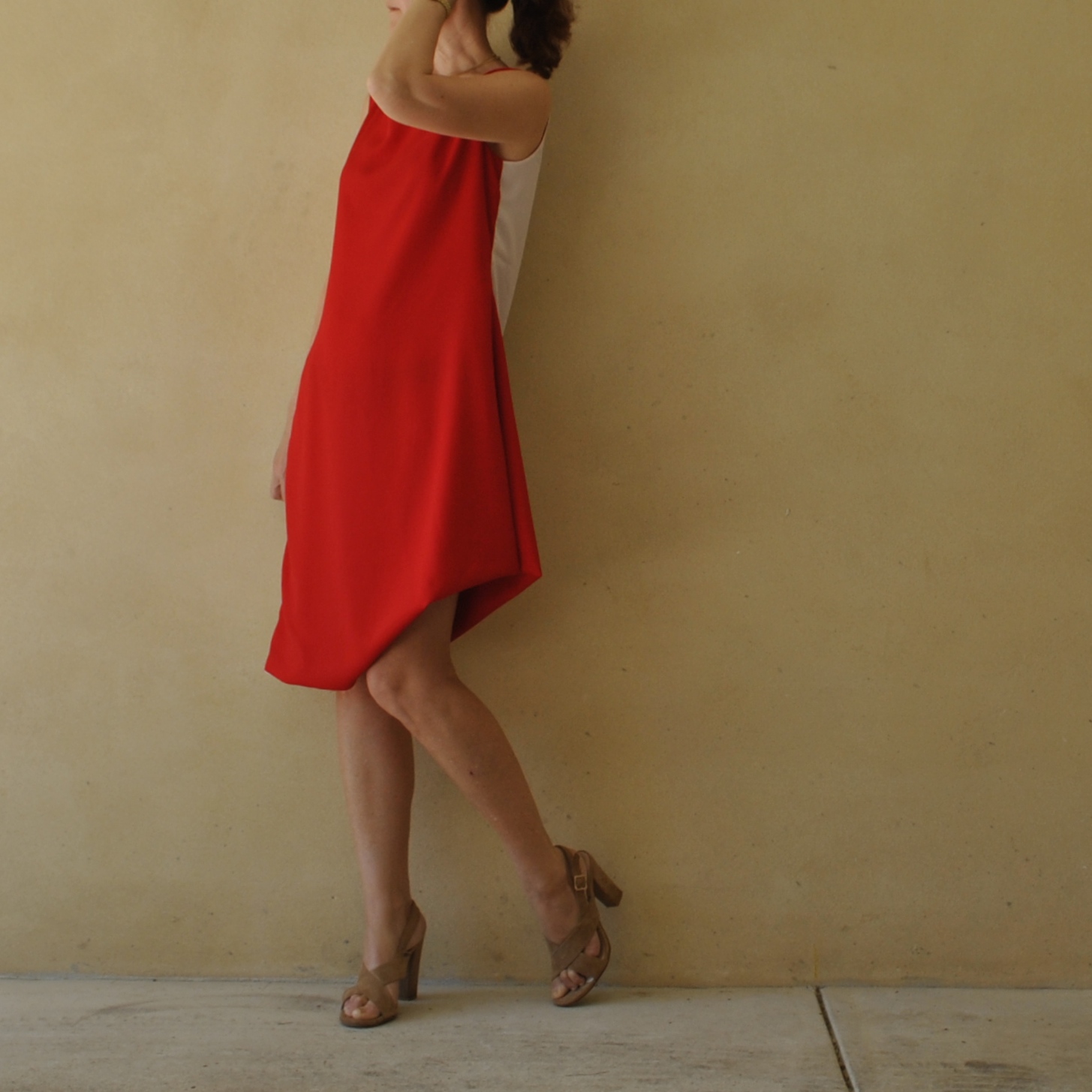
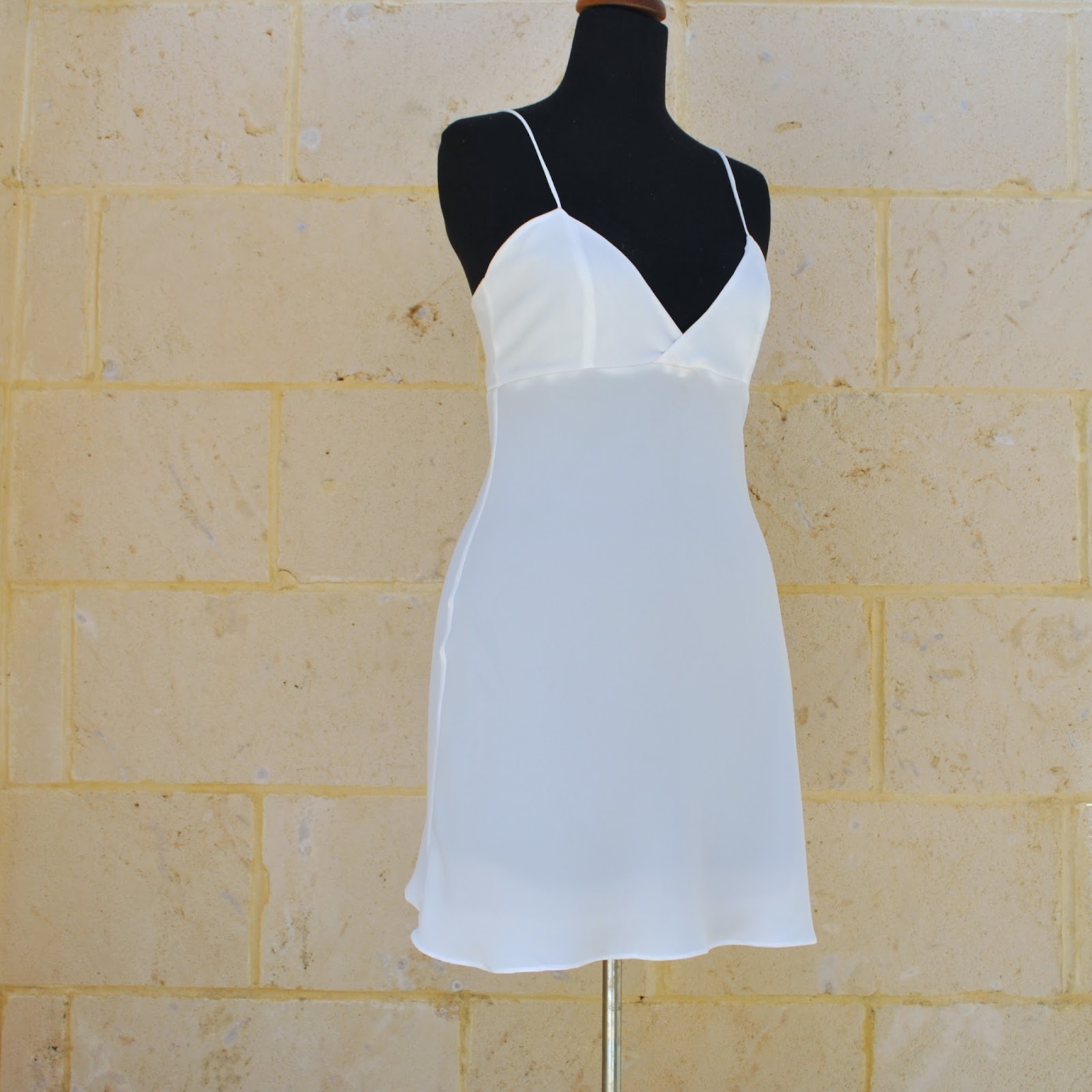
I’ve made a new slip; which looks superficially rather plain and boring, belying the hours of of care that has been lavished upon it, haha!  Bias hemlines!  aaaaugh! *insert Munchian scream here*
Pattern; the Ruby slip, designed by Sheryll of pattern scissors cloth.  I downloaded it years ago but this is the first time I’ve used it! I’ve wanted to, but actually felt a little shy of doing so since she made her blog private for quite a long time.  Anyhow, now she’s back … yay! and so I feel ok about using and linking to her pattern again.  Thank you so much for the wonderful pattern, Sherry!
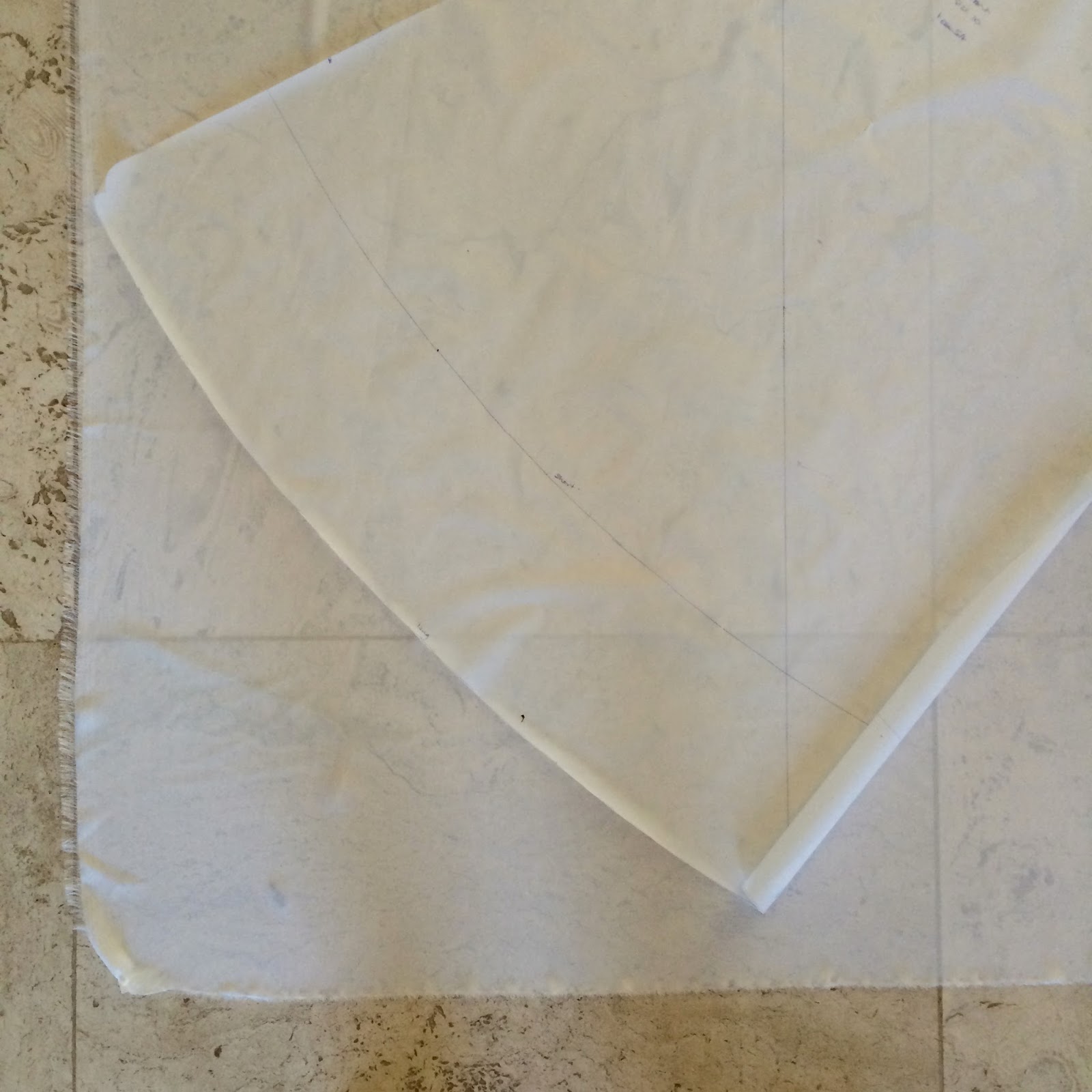
Fabric; a fine and slithery ivory crepe from FabulousFabrics.  The slip is cut on the bias, so hurrah for large-scale floor tiles! I can’t say how many times I’ve found them super useful for lining up grain lines, selvedges, bias lines etc etc when laying and cutting out my pattern pieces.  And especially when you’re dealing with a slippery slithery fabric like crepe, which is so dodgy it can deviate and deform at the slightest provocation.
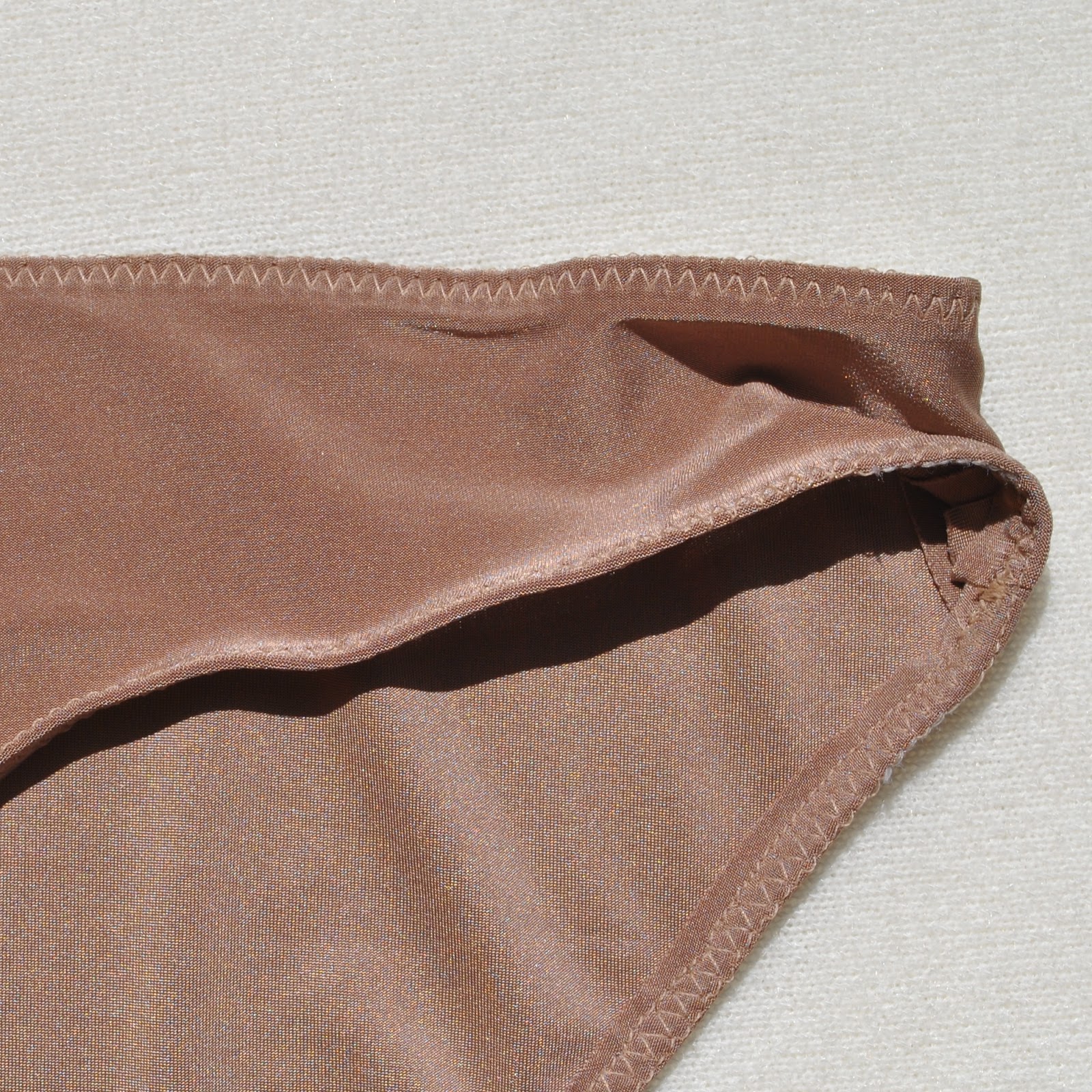
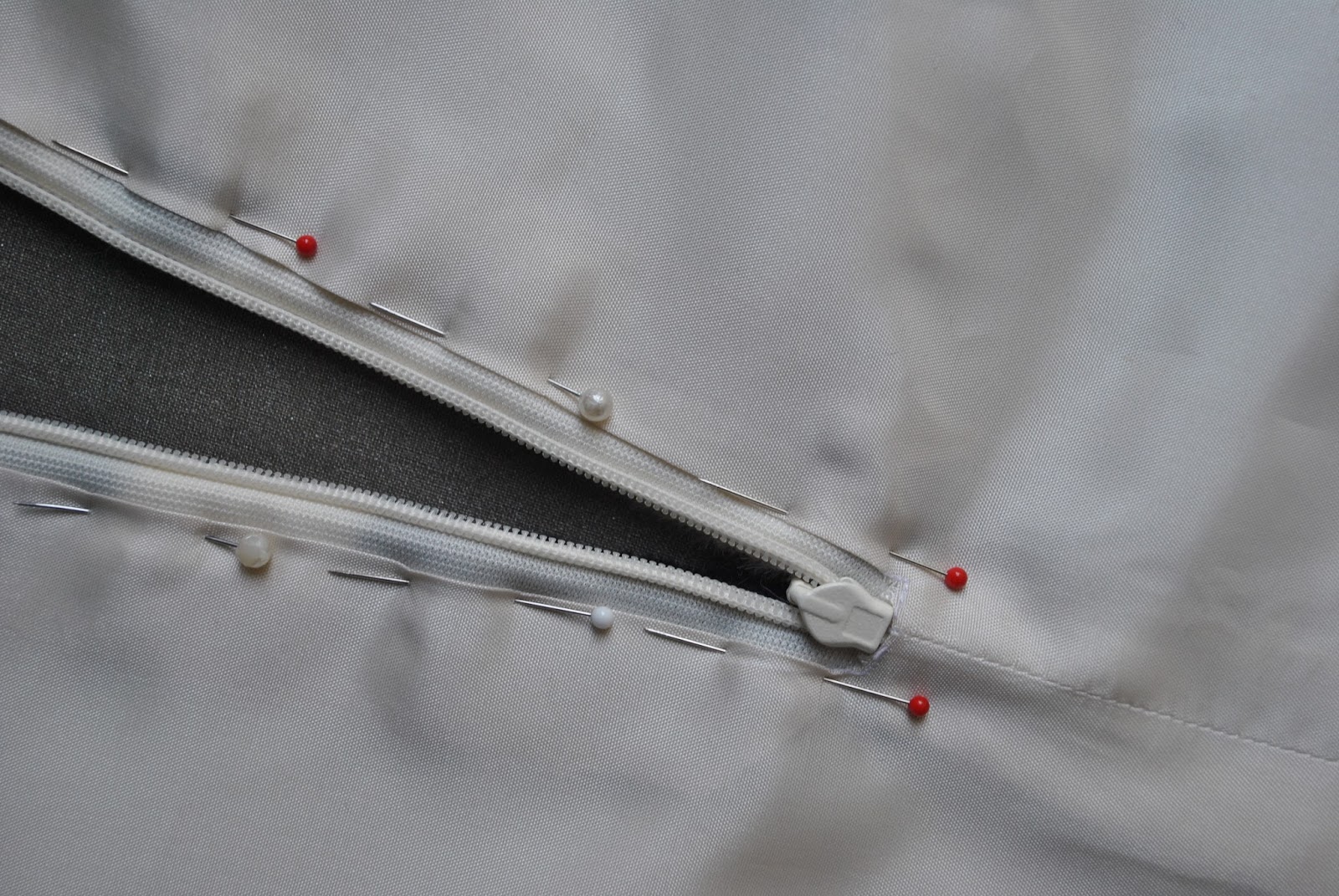
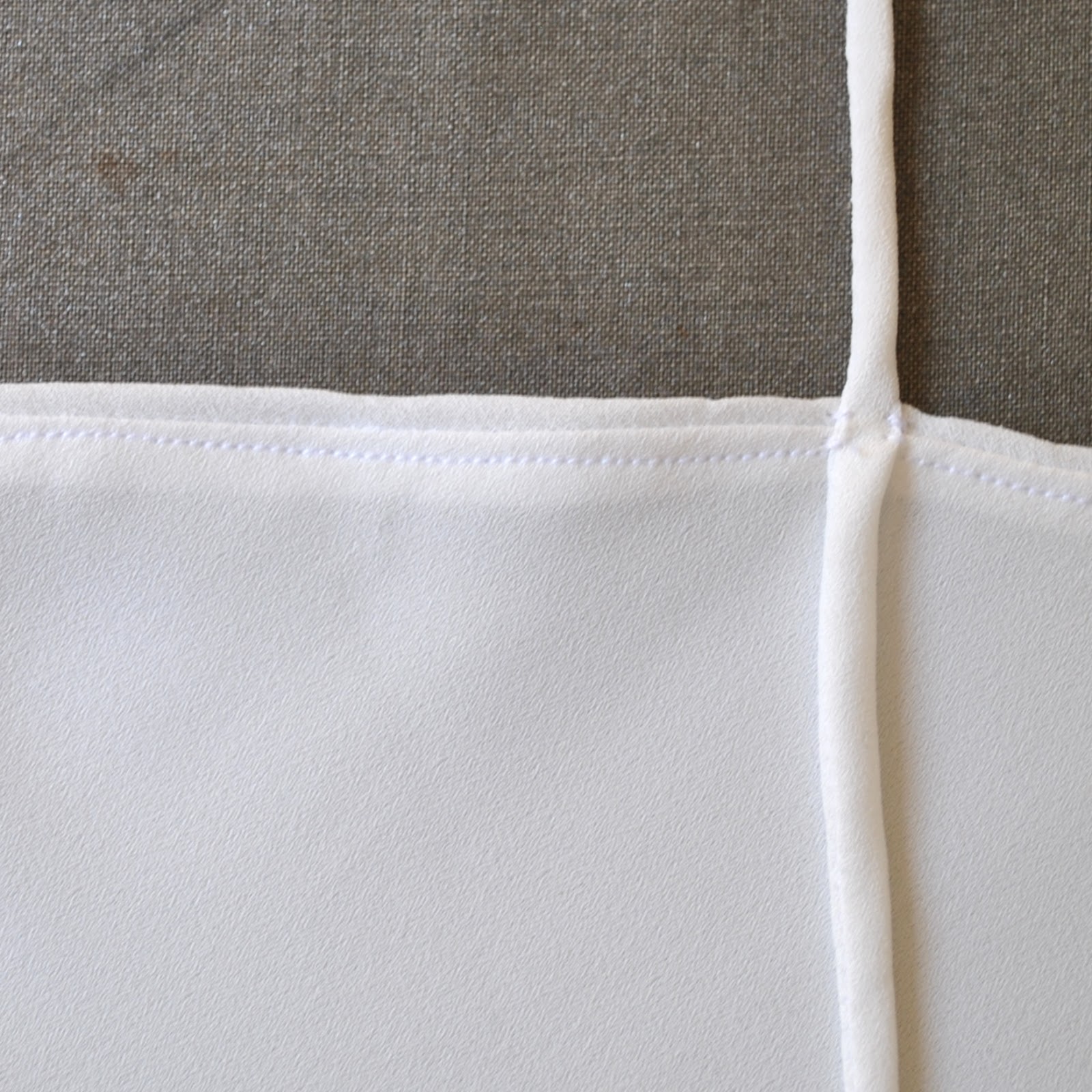
Sherry’s pattern is designed for a lace bodice but I cut my pieces all from the crepe, with a double layered bodice front and back.  The skinny skinny spaghetti straps are encased within the two layers on the front bodice, whereas at the back (pictured below) I hand-tacked them inside the bodice, not within the two layers, to enable easy unpicking/readjustment in the case of the straps stretching out over time.  The under stitching of the bodice lining is visible in this picture here too.
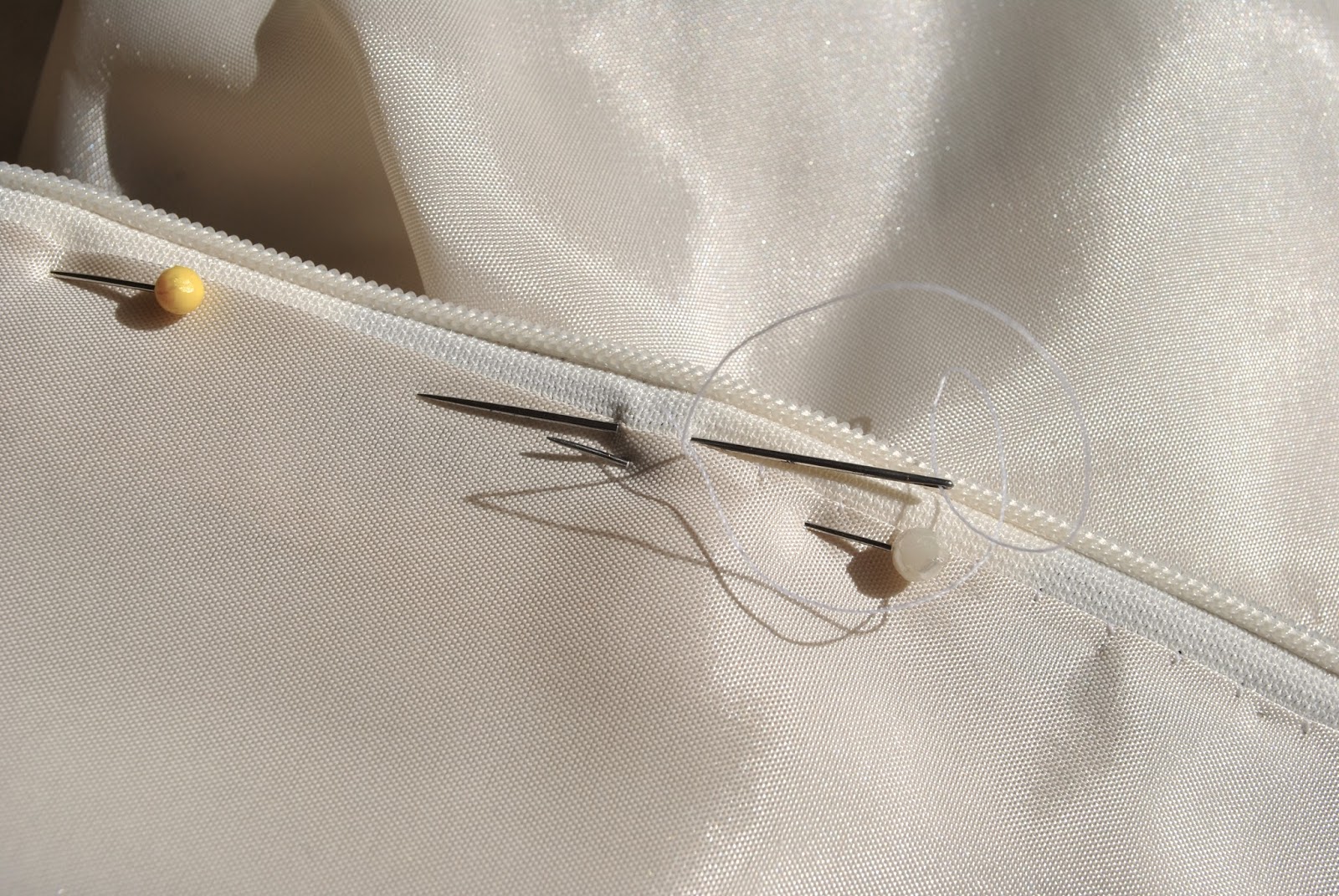
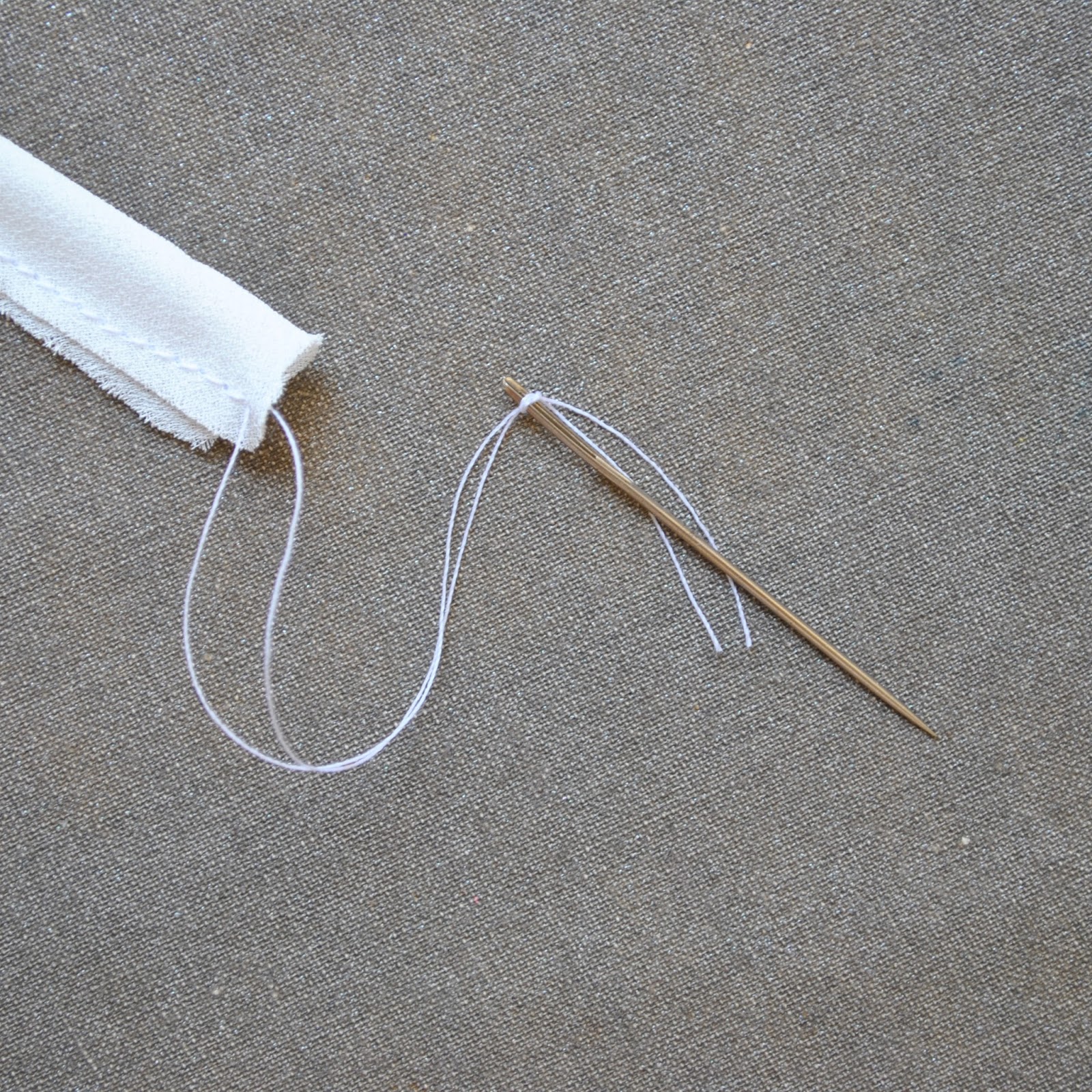
Those skinny straps, by the way; I know everyone probably has their own individual way of turning them; I tie the seam thread ends through the eye of a wool needle and let it drop/push it through through the tube, turning the tube out.  A wool needle is generally quite blunt enough to use for this purpose and unlikely to get stuck in your fabric on the way, but if you’re worried about the point being a little too sharp you can always put it through eye first.
Also; cut your straps a few centimetres longer than required, so you can trim off the ends that invariably turn out a little scrappy-looking after turning.
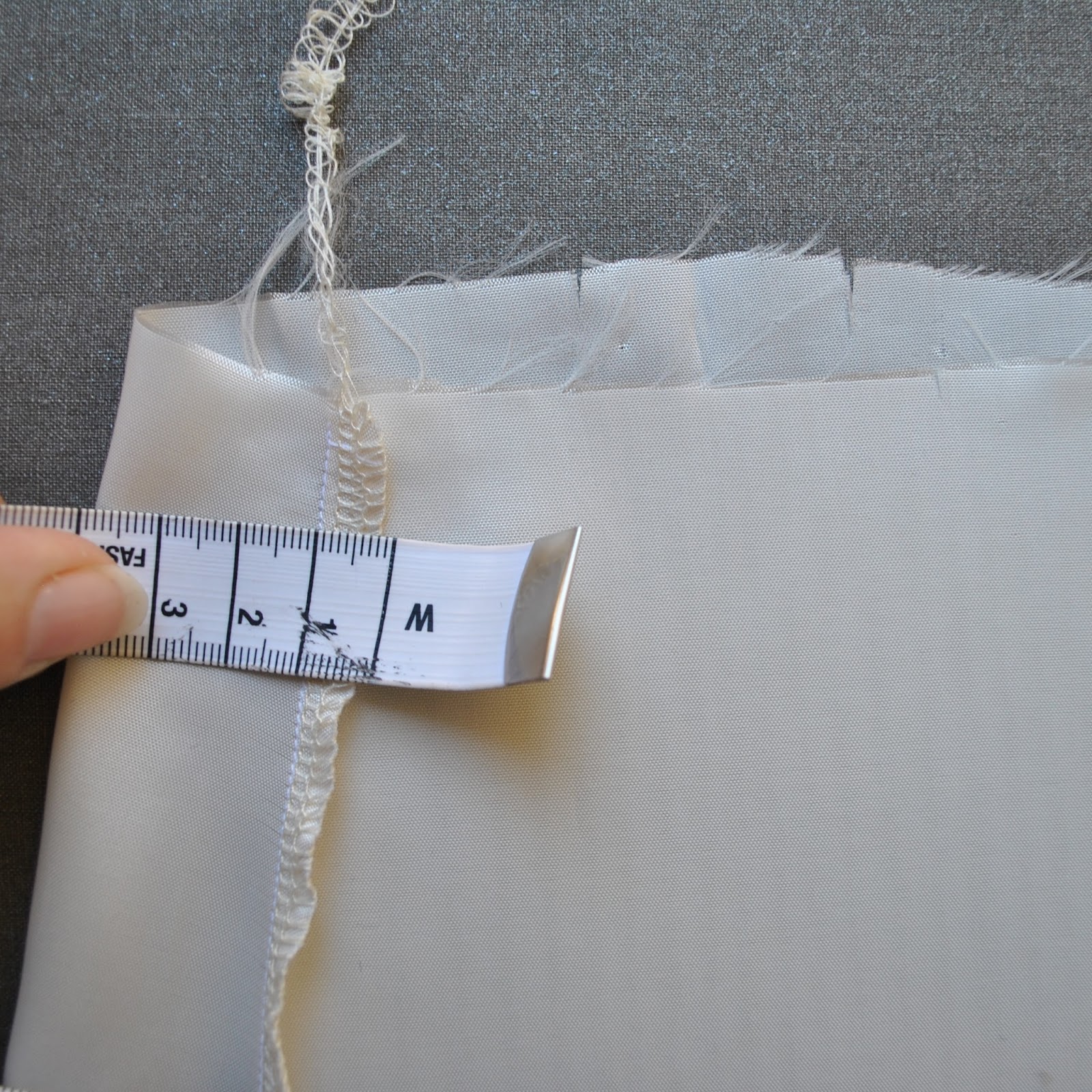
I sewed all seams as French seams but just overlocked the bodice-to-dress seam on the inside to finish it *blush*
Picking my battles here…!
The slip then spent a week hanging up on Bessie to let that bias drop out as much as possible. Then I spent aaaaaages measuring and measuring and re-measuring and double checking that hemline, first on both Bessie then myself to be absolutely sure it’s straight, before cutting it to length.
The length is determined by the fact that this slip is tailor-made to go under another dress I’m in the process of making right now, by the way; but I do hope to wear it with other things too, of course  🙂
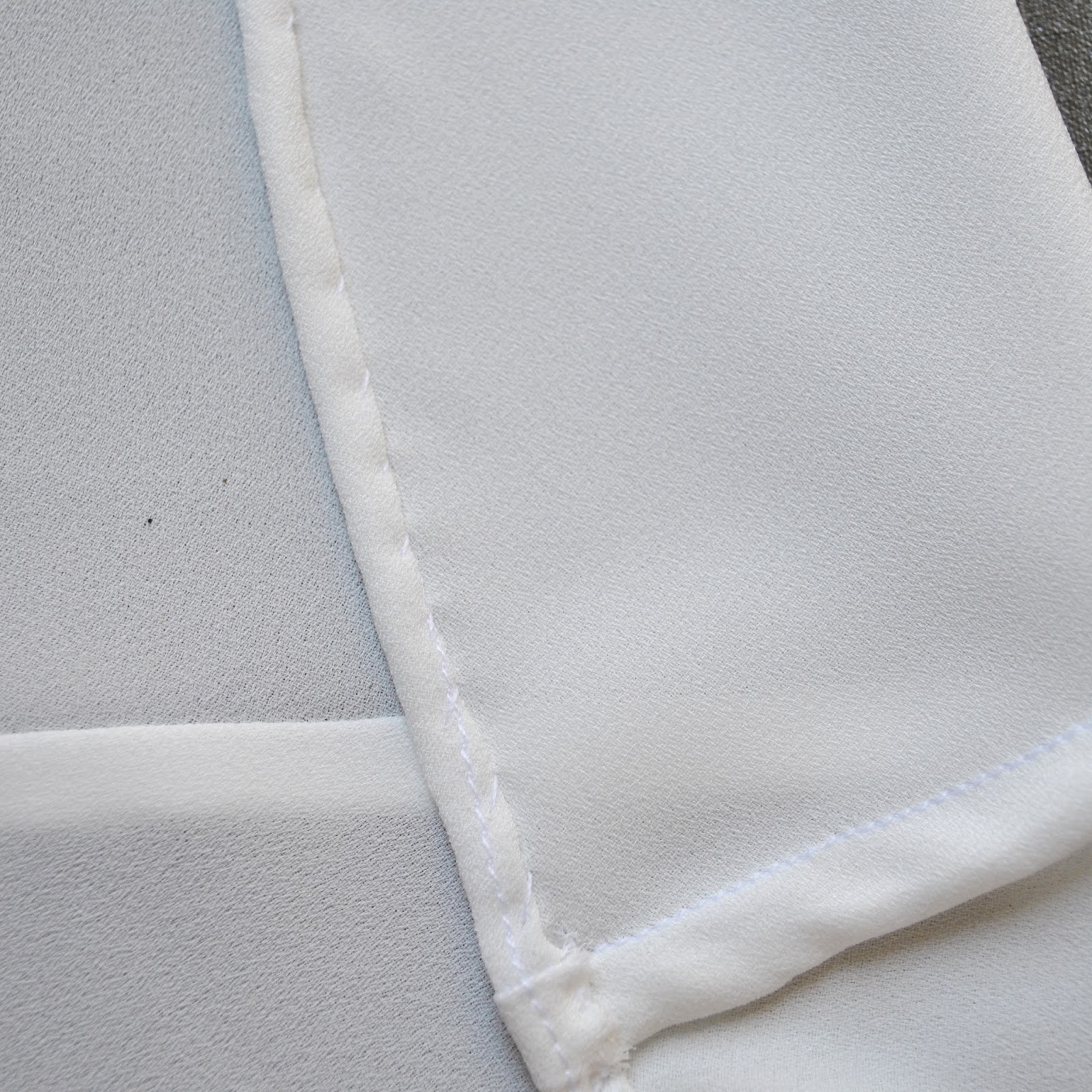
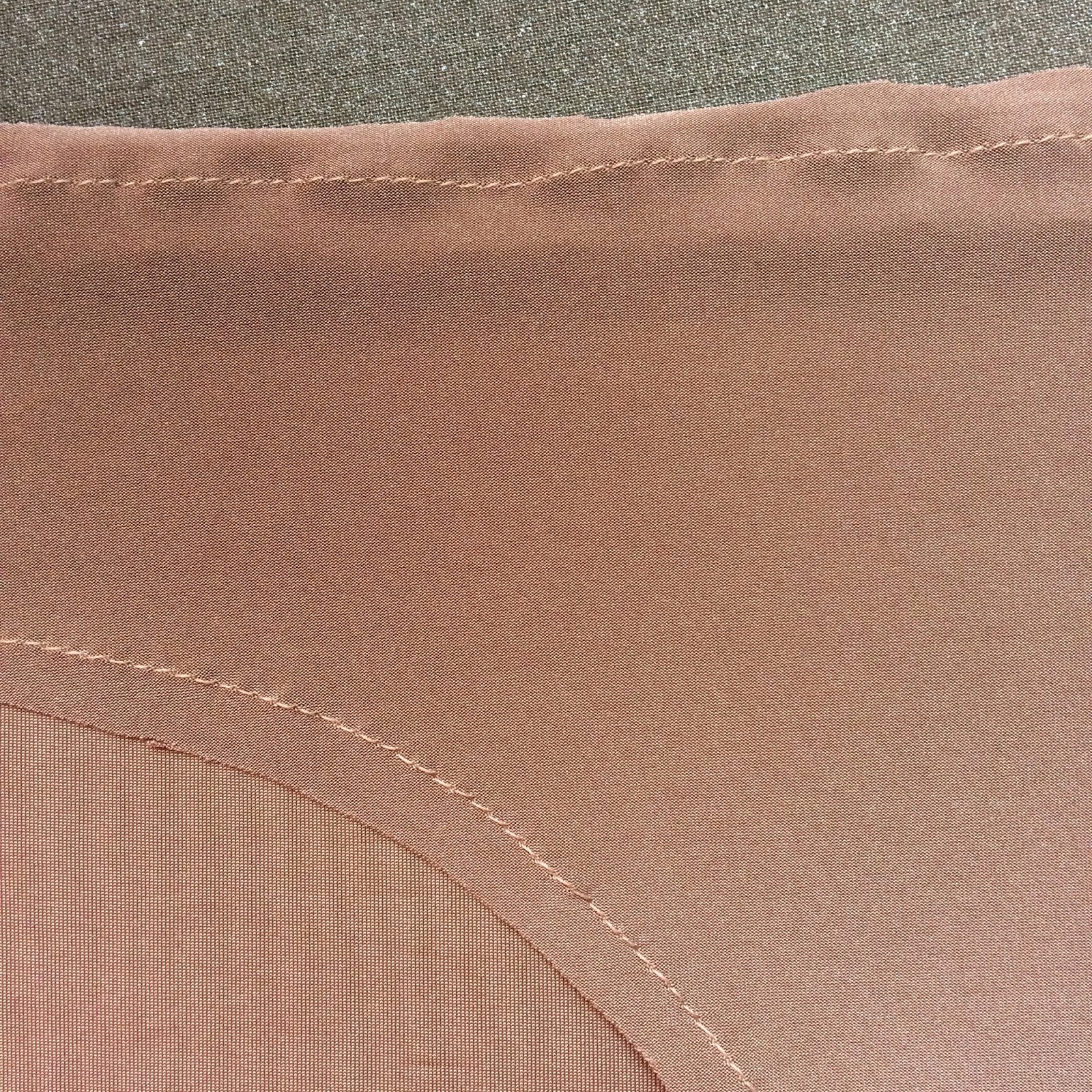
In the close-up above, at the very lower edge of the picture can be seen some white stay-stitching along that hem…  if the fabric is very light and slithery like this, I generally stay-stitch a stitching guideline, situated a few millimetres outside the measured lower edge of a bias-cut garment, on the machine.  Then I trim the seam allowance outside that, it gets rolled up and I stitch along and into that machine stitching when hemming.  The benefits of this stay-stitching are threefold: it not only makes it a heckuvva lot easier to stitch a hand-rolled hem, it stabilises the fabric substantially and prevents the bias from stretching out too much while you’re stitching, the dreaded lettuce leaf edge! AND also keeps your hem on the straight and narrow as it were, keeping it even and helps avoid any little dips, ducks and dives in the final product.  Even the best hand-roller is bound to roll a little bit more, a little bit less every now and again.  Nit-picky; I know, but every little bit helps I think, and after all that careful measuring to ensure the hemline is perfectly even, it makes sense to safeguard it and keep it as straight as is humanly possible for the stitching of it too, yes?
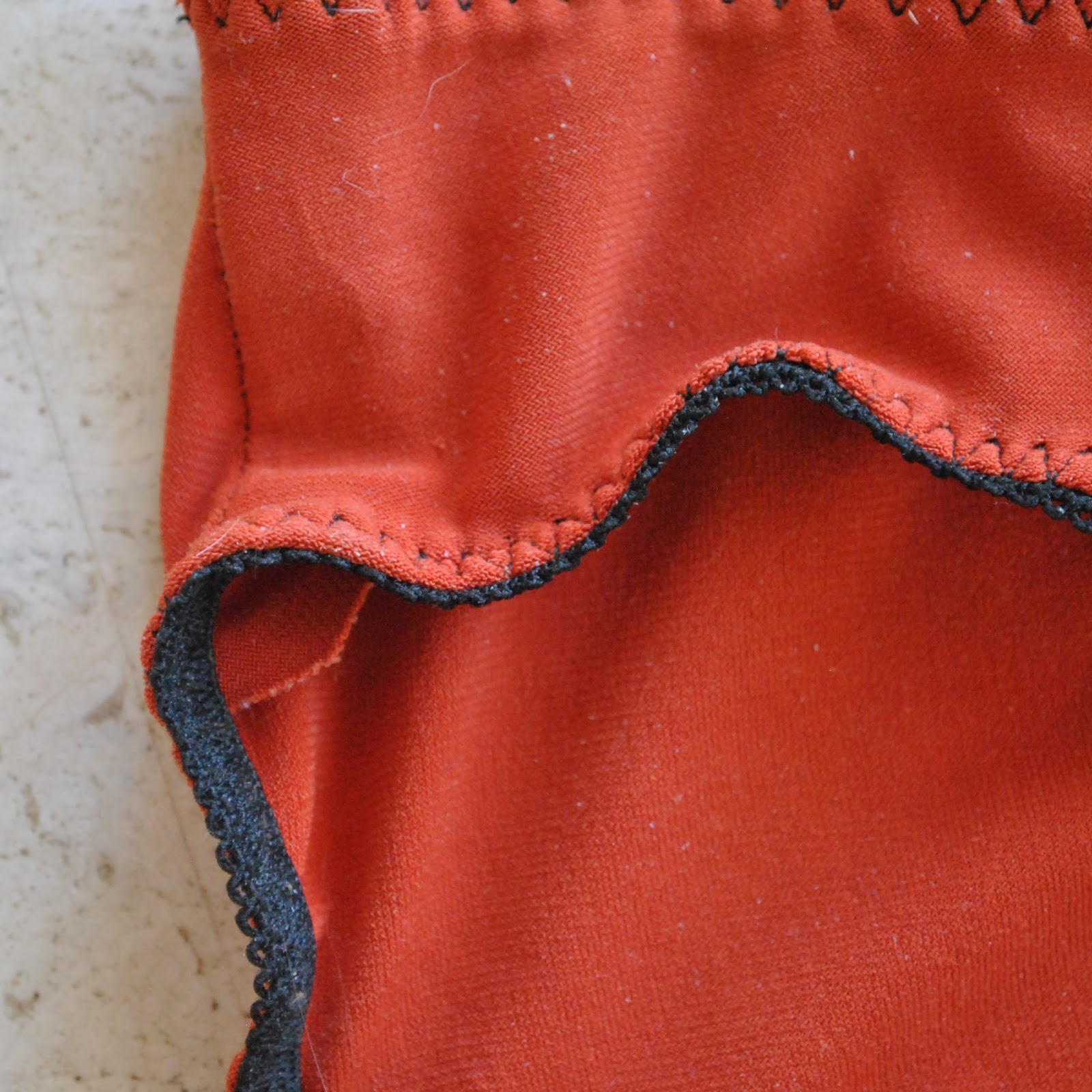
Also as seen in the picture; I often don’t “roll” the French-seamed side seam under twice at the hem either, but turn it up just the once for its short bit of hemline… why? frequently it’s too bulky and often creates a little dip or worse, a “flip-out” of the hem at that point if I’ve tried to force it.  Probably my bad sewing, but there it is, I get better results like this!

Later edit;
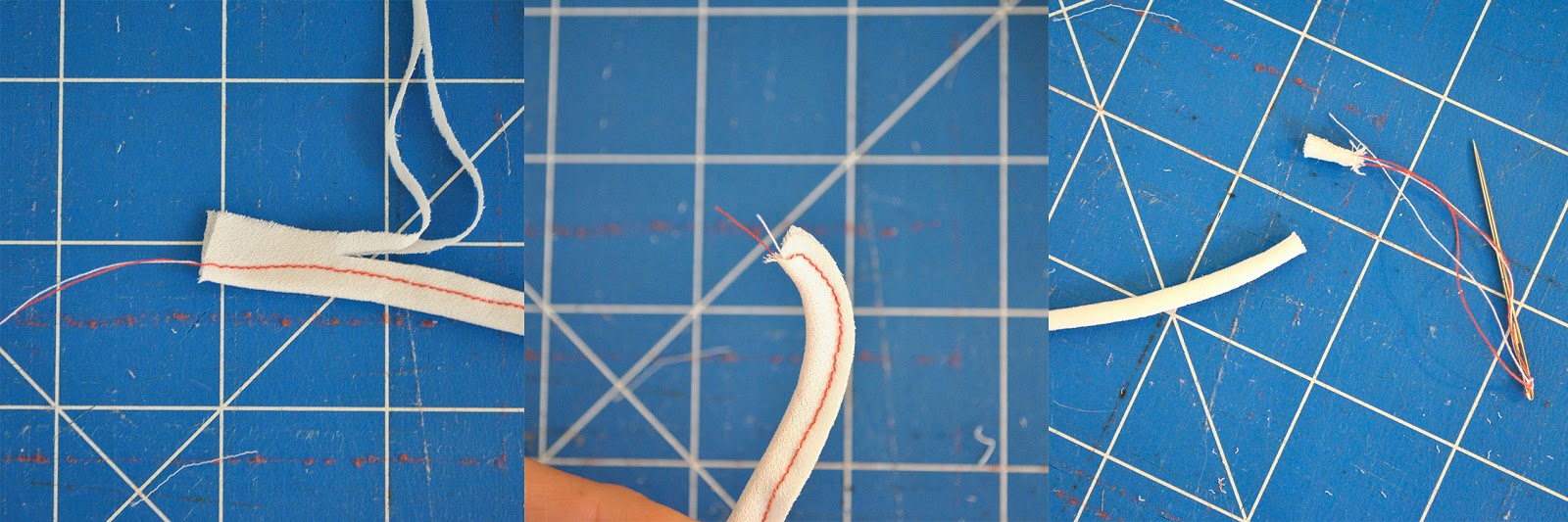
Jillian asked about turning spaghetti/rouleau straps; thank you Jillian!  Fabrics like this slippery crepe are rarely a problem but in some thicker and/or stiffer fabrics, turning out a strap can be a bear.  The less fluid the fabric the less easily it can be manipulated into turning inside out into a little tube… and yes that starting bit is always the most awkward bit!
Firstly; it’s important to trim the seam allowances so as to be of a much smaller width/lesser thickness than the final tube will be.
Also, never never allow the fabric to bunch up excessively, but keep teasing the tube along, a little bit at a time, slowly but surely  🙂
Another little trick I have used successfully is to sew the end centimetre or so of the tube seam tapering inwards into a slightly skinnier tube at the very end, as pictured above left.  The skinnier end does pull into and turn inside the wider “main” tube a little easier than if it was the same circumference.  The tapered end bit can be trimmed off after the strap is turned out successfully.

pinterestmail

some random tips for sewing lingerie

There are a bajillion great posts out there with good tips for sewing lingerie; hopefully this one is adding one or two new pieces of info into the pot…

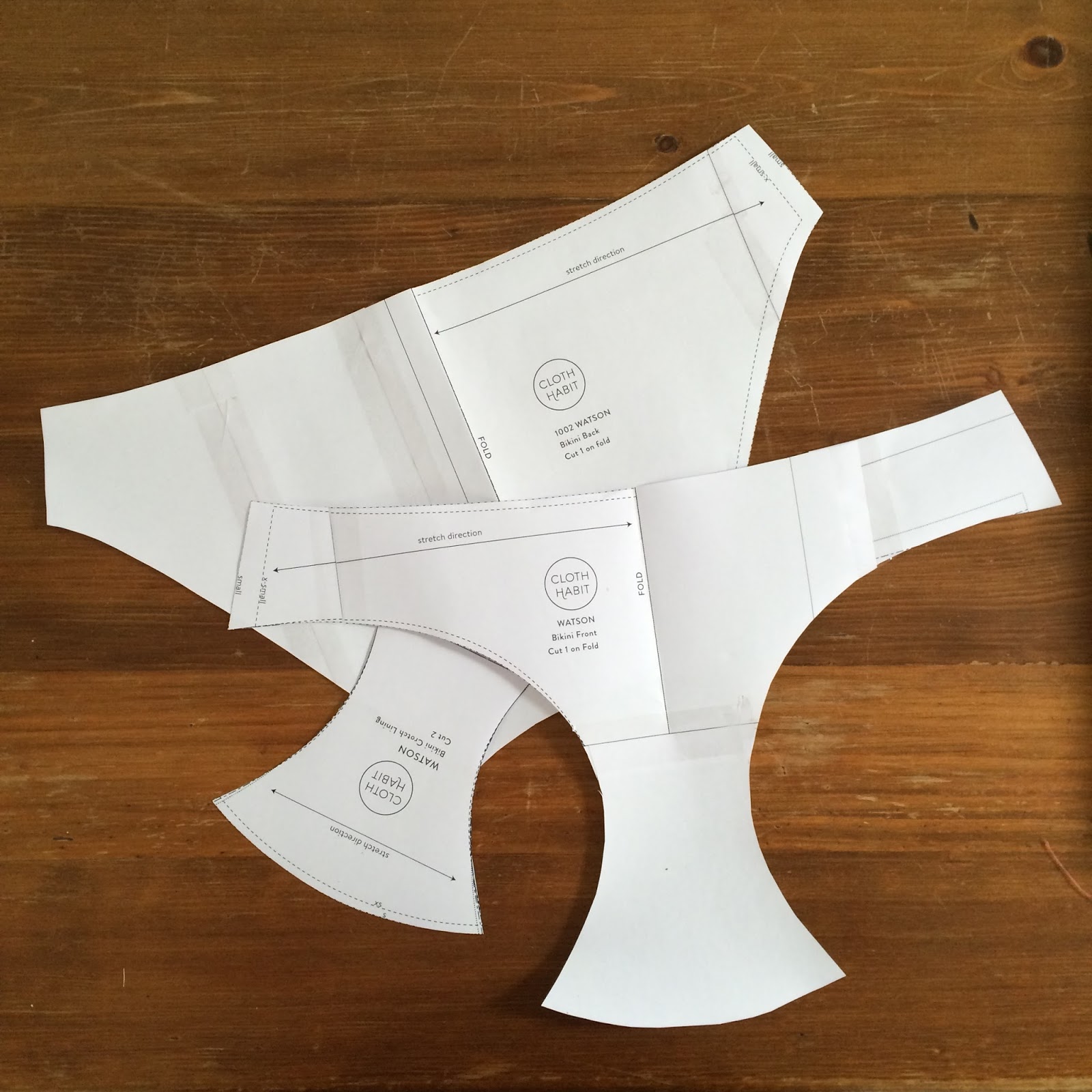
Pattern pieces: If your pattern pieces are half ones it’s well worth doubling them to make full pattern pieces, that do not need to be placed on a fold.  This is useful for many reasons; one is pattern placement when it comes to lining up lace motifs, another is getting the most economical layout on a small piece of possibly expensive lace.  Also if your pieces are to be cut on the bias… some knickers patterns are suitable for fine wovens like Liberty, and need to be cut on the bias and it’s only about 1000 times easier with a full pattern piece than folding the fabric accurately for a “cut on the fold”.  Mark the bias line on all new pattern pieces too.

I also prefer to splice together the knickers front piece and crotch piece of my Watson brief pattern (see above) so as to make them one piece and eliminate that horizontal front seam.  The crotch lining is sandwiched between the (new) knickers front and back pieces along the curved joining seam, and is stitched down with the leg elastic at the sides, but otherwise sits loose at the front.  I prefer this to having a front seam!

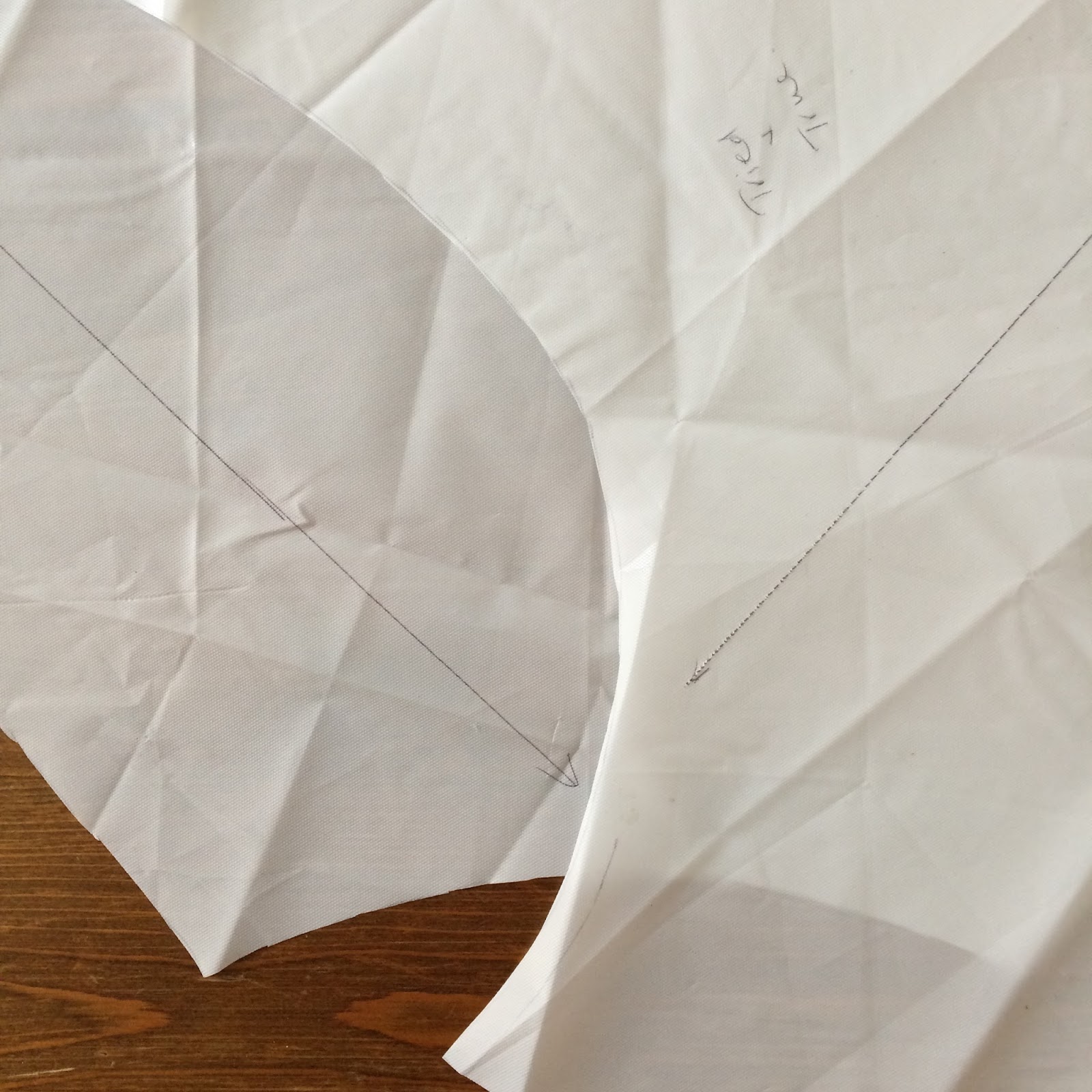
Usually I save paper by taping together scrap pieces or even newspaper to make the other half pieces; for frequently used patterns, or if the original is a fragile tissue paper pattern, the pieces can be traced as whole new ones on thin, sheer plastic which is more durable (above).  For this I use plastic table-clothing, sold in 30m rolls from the party section of Spotlight.

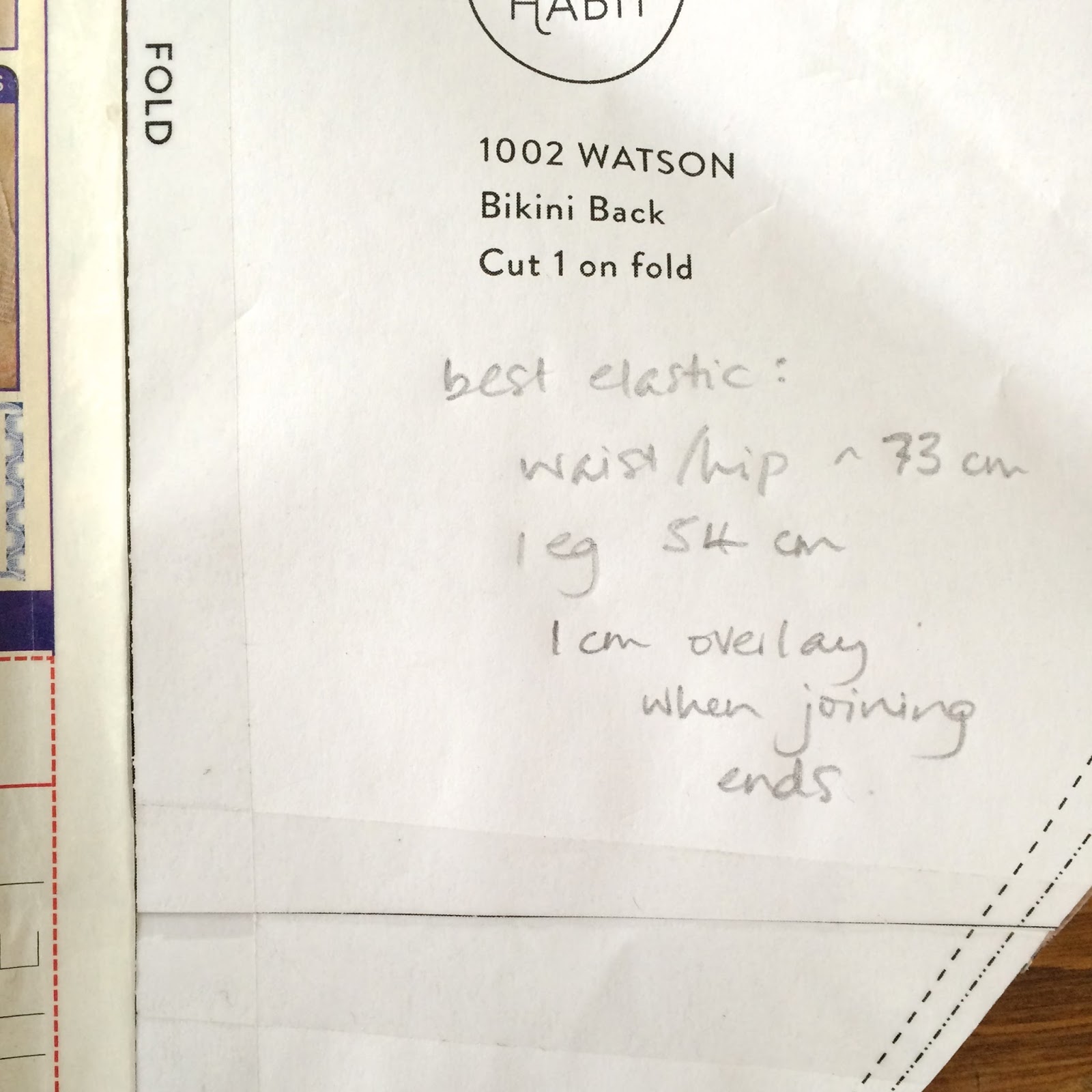
Also, I jot on the actual pattern pieces the lengths of elastic needed, to save re-measuring for each new project.

When sewing the ends of the rings and sliders; cut, pin and sew the pairs together and at the same time.  It’s hand down the best way to guarantee the two sides will be identical, if such things as symmetry are important to you.  Actually the same goes for anything there will be a “pair” of in the project.

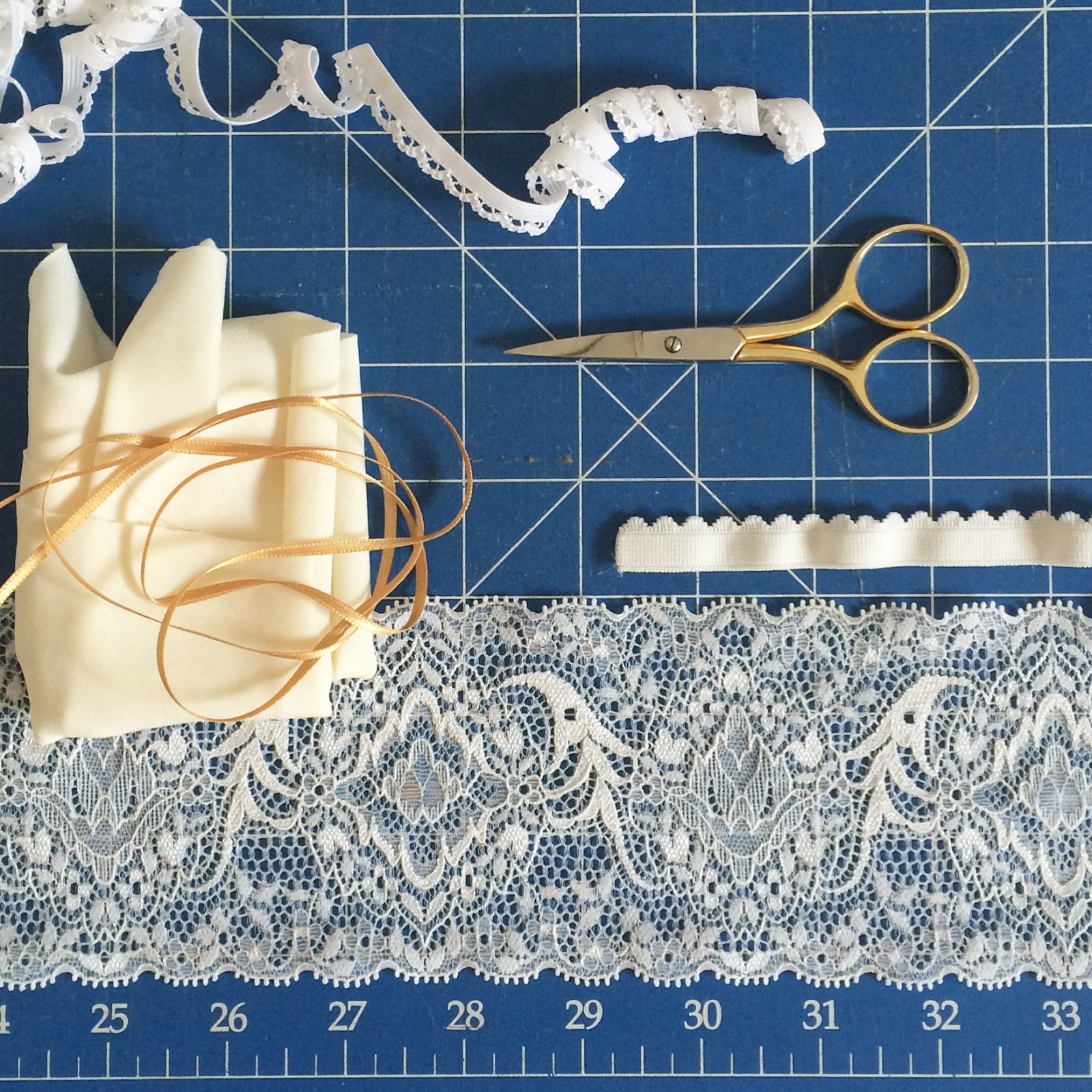
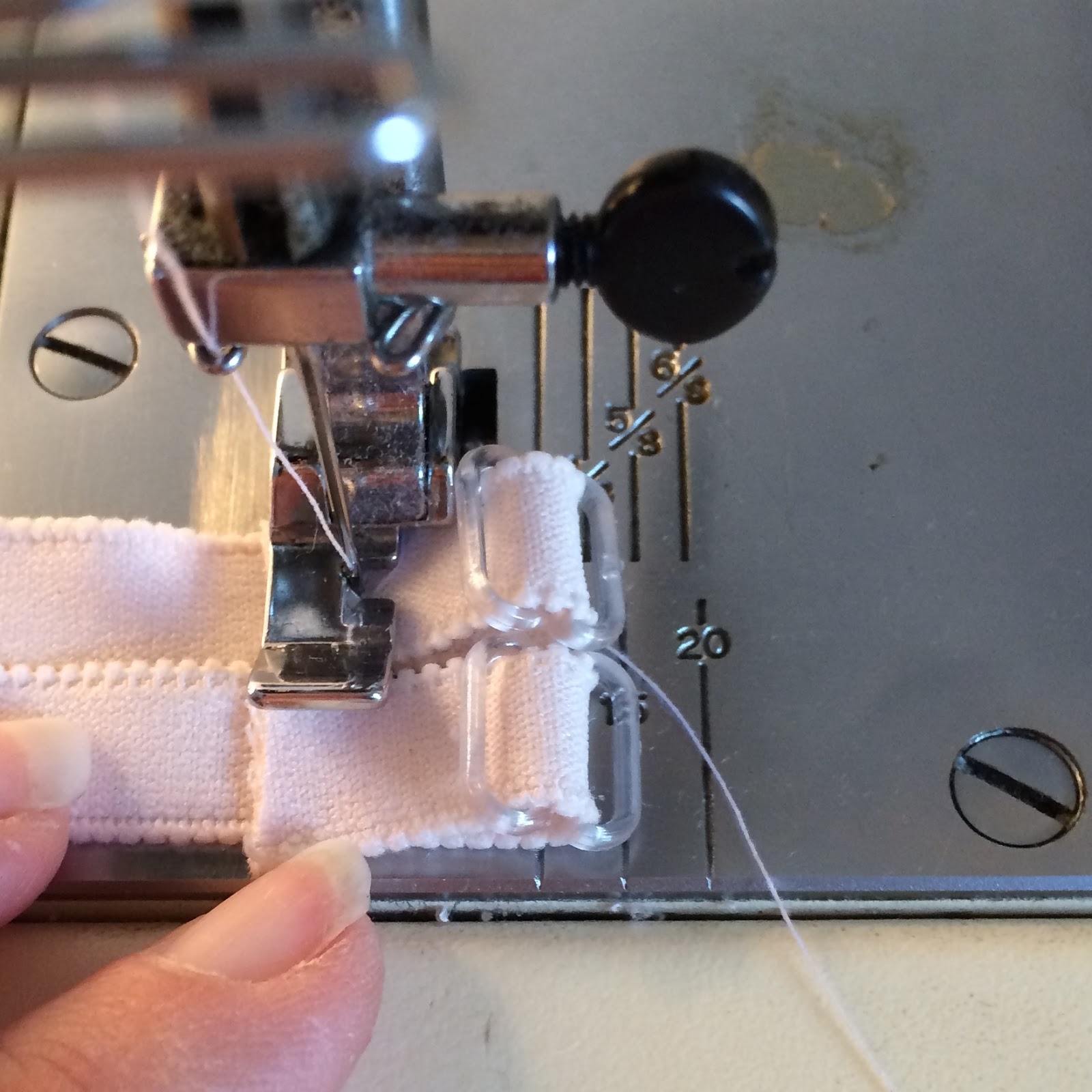
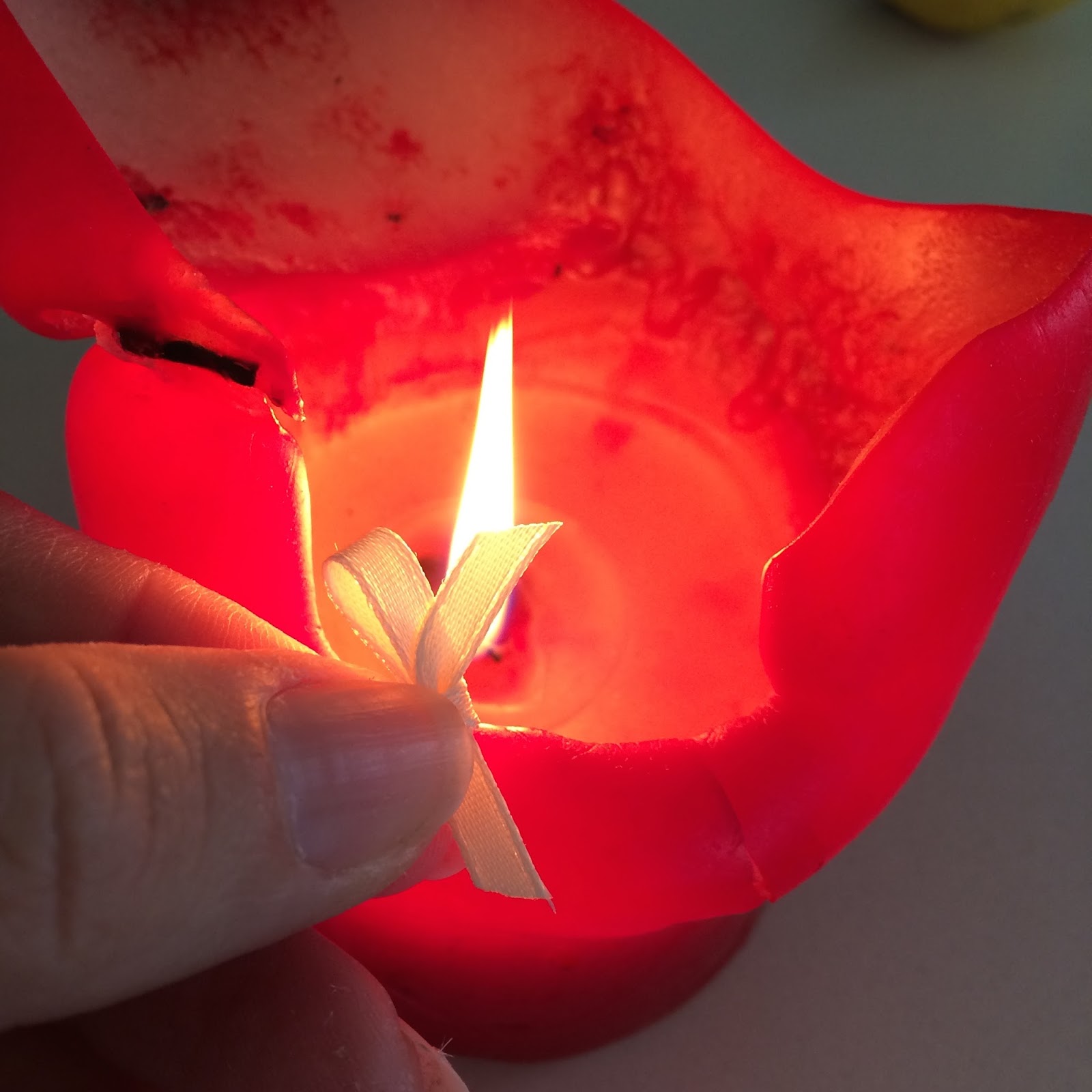
Satin ribbon trim; I always “heat seal” the cut ends of ribbon bows so they don’t fray during wear.  Just hold the cut end of the ribbon close to a candle flame and carefully watch it as you sloooowly move it closer; it gets to a point where it starts to melt away in the heat.  This happens pretty quickly so you need to keep a close eye on it and pull it away the very second you see it happening.

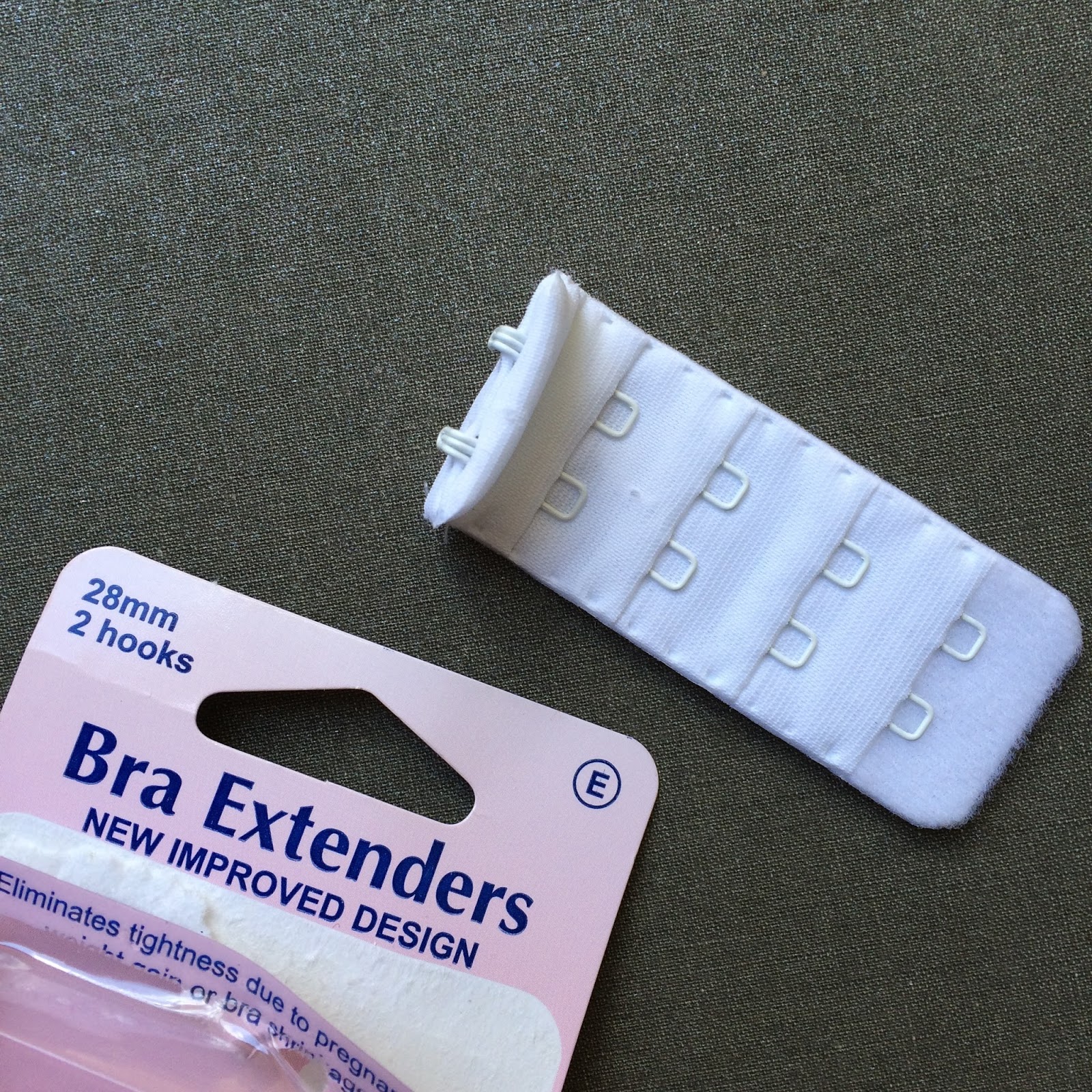
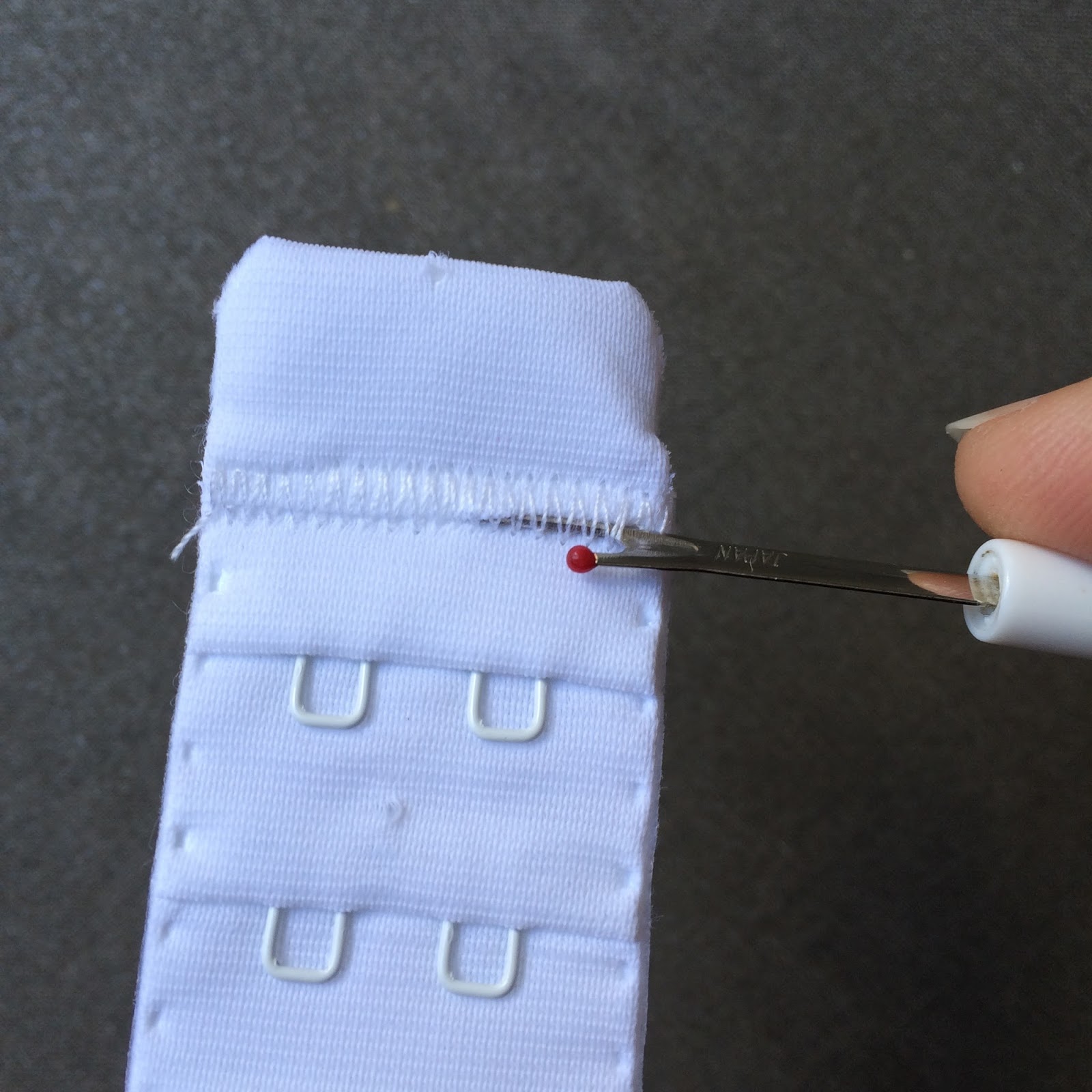
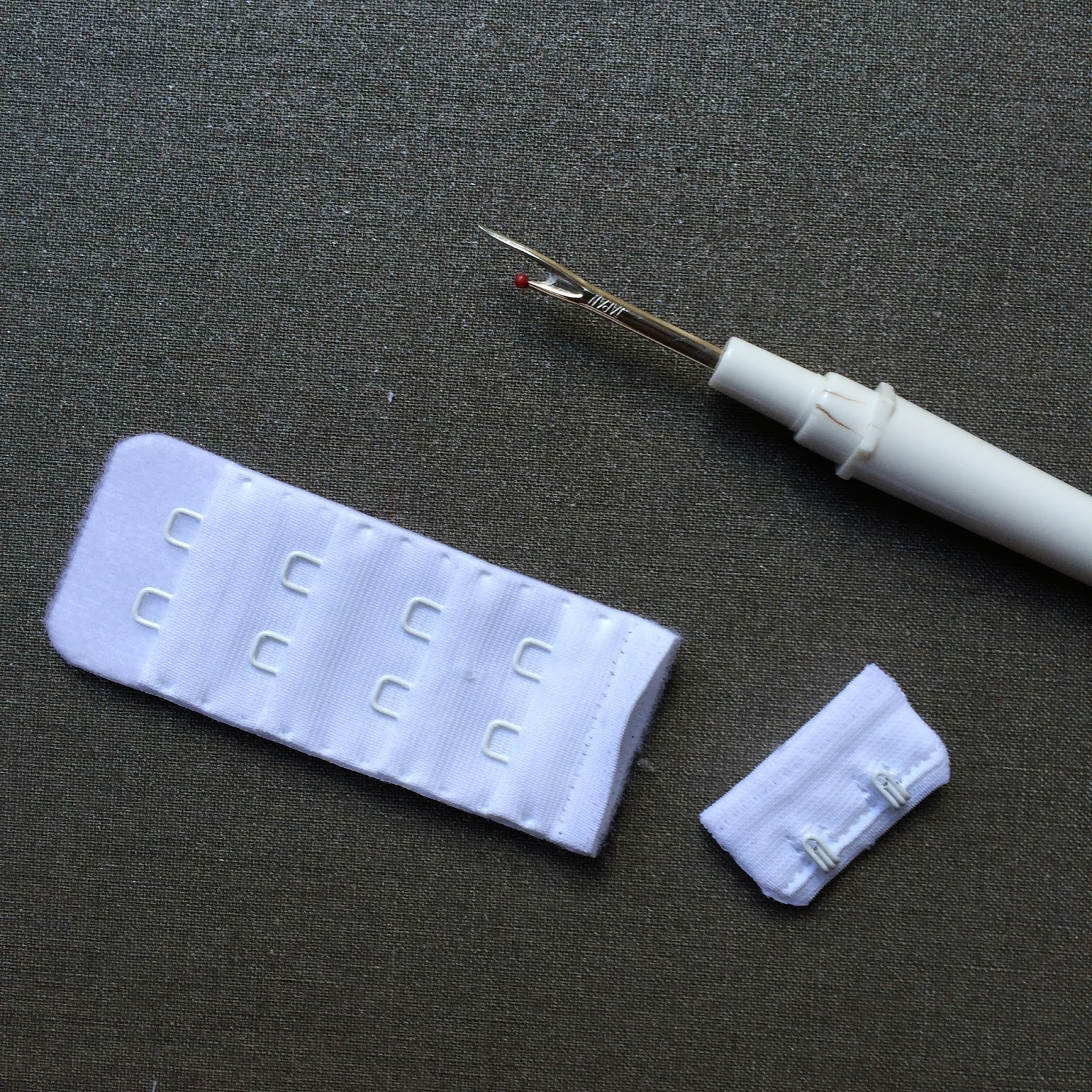
Hook and eye tape: I prefer to buy separate hook and eye tape if it’s available but my closest store sells only “bra extenders”.  I’ve found these to be an adequate substitute if I can’t find the proper arrangement;  the pieces can just be picked apart quite easily.  If the “hook” piece is too long the extra length can be cut away and the edge zig-zagged.  It’s not as neatly finished or as professional looking, but it’s perfectly fine in a pinch.
Sewing edging elastic onto lightweight and super-stretchy fabrics
Super stretchy fabrics are obviously perfect for underthingies but also obviously come with their own little challenges… and one of them is the dreaded “lettuce leaf” edge happening.

yes, this is my own work *hangs head in shame*

I’ve found it very helpful to sew a long basting or stay stitching 6mm (1/4″) from all edges before attaching any elastic.  I know, straight stitch on knits, *horrified gasp*   it’s a huge no-no and I could get blasted for this! but meh, it works out pretty good for me 🙂

I mean, everyone has their own, slightly unique way of attaching elastic, I’m of the school of thought that whatever works, works; and lots of different ways are going to work.
The lettuce leaf occurs when the elastic is overstretched while sewing it to the edge of the fabric, and it’s pretty easy to do this when sewing with a particularly stretchy fabric.  It’s better for the elastic to be sewn to the edge of the fabric “flat” that is, for the elastic to be stretched to the minimal amount and for the fabric to be stretched not at all, while sewing them together.   A stay stitching helps to prevent this, and after the elastic is attached and before the final zig-zag you can pull out those initial basting/stay-stitching threads, if you like; to keep things looking nice and neat and tidy.
pinterestmail

reversible infinity, or twist, dress

I love working out convoluted construction puzzles in the process of sewing something and this new dress ticked that box very nicely.
It looks kinda plain upon first glance, but it’s actually based upon a very unusual twisted design by Anita, of Studio Faro.  
And now I have to apologise right here because I’ve just searched forever for the design on Anita’s blog to link to it, and I find I did not even pin it… so I cannot. I’m sorry! but I’m pretty sure I saw the sketch for the pattern piece on either Anita’s blog, studio faro well-suited, or her Facebook page.


Later edit; thanks to Emily I found it, Anita’s original design is here.
Anyway.   In making it, I realised it was just like an infinity scarf, but in dress form.  Unique!

And, my dress is fully reversible! with all the seam allowances enclosed and tucked away neatly between the two layers of the dress.  The construction technique to make it reversible is one that I worked out myself and not something I’ve ever seen in any pattern or design before.  This was the part of it that kept me on my toes, brainstorming a way to make it happen.  I’m super chuffed that it did work out.  🙂
In my initial plans; it was not going to be a reversible design and I wanted to use double-sided fabric for my dress, but the only ones I could find were kinda expensive, and much as I craved the actualisation of that idea I just couldn’t justify the cost…  economy can often be the mother of invention, non?  Eventually I settled with a double layered dress using two lightweight fabrics, and then while I was fiddling about with the two layers I realised I could actually make it a completely reversible dress, meaning I could wear it inside out just as easily … and ta da!  this is the result!

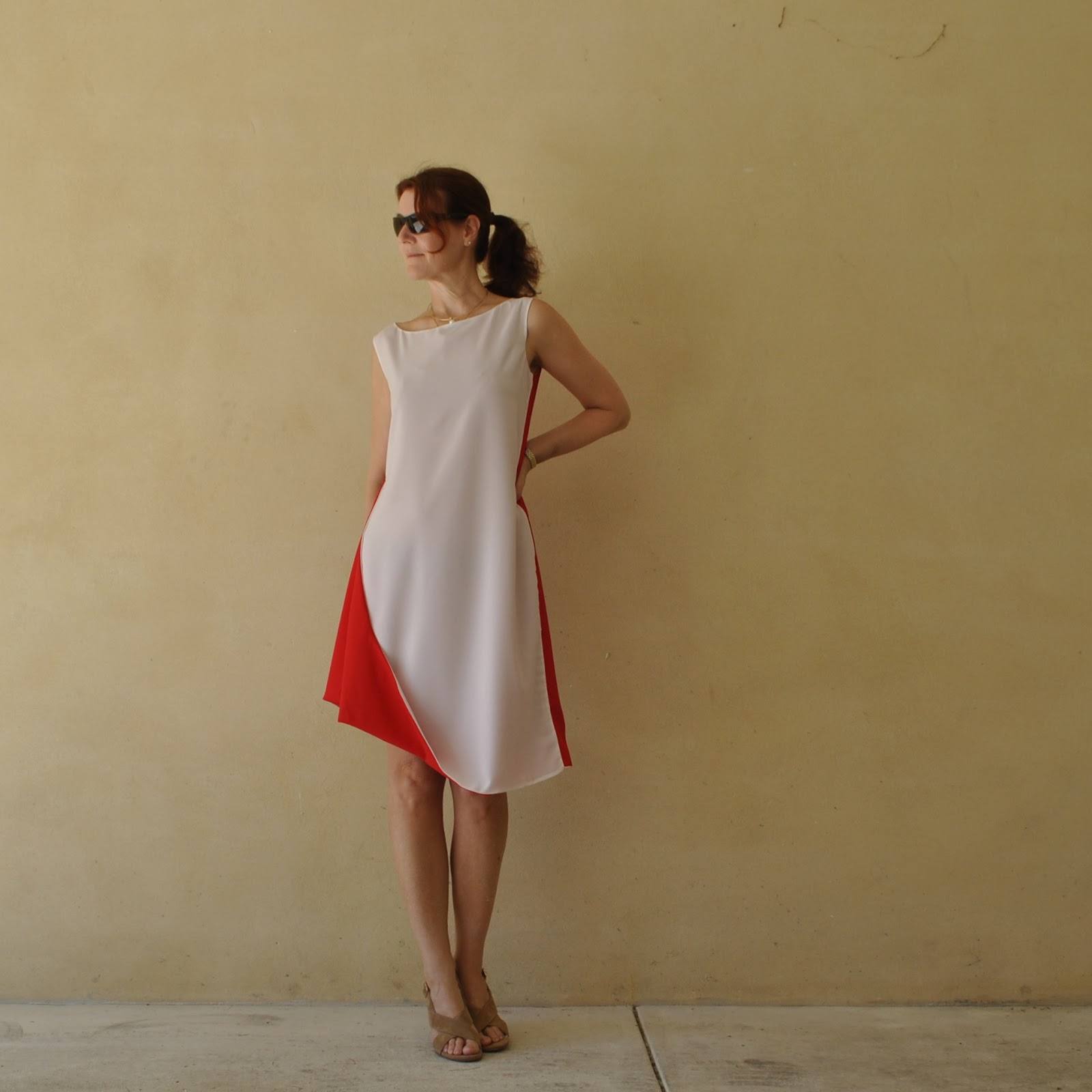
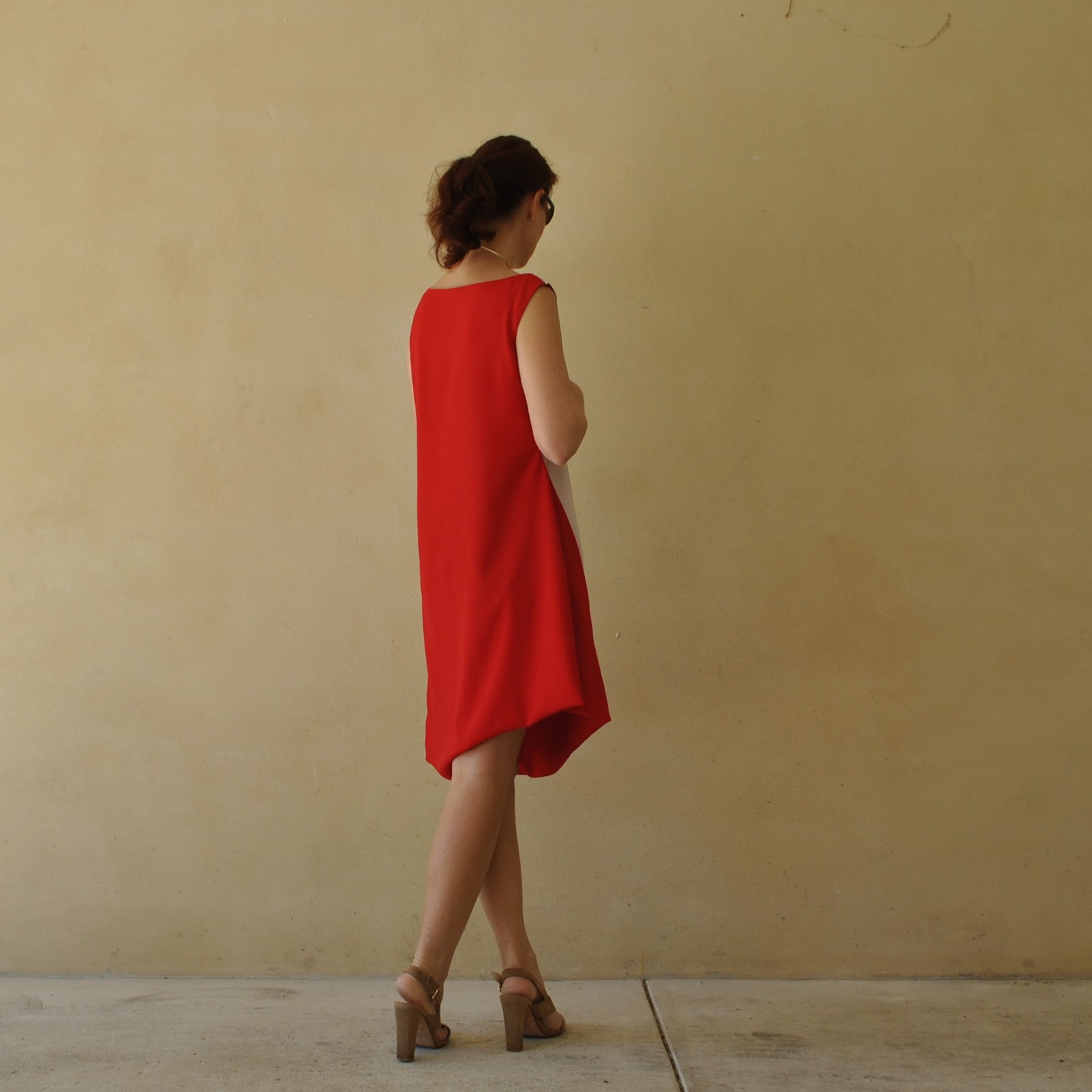
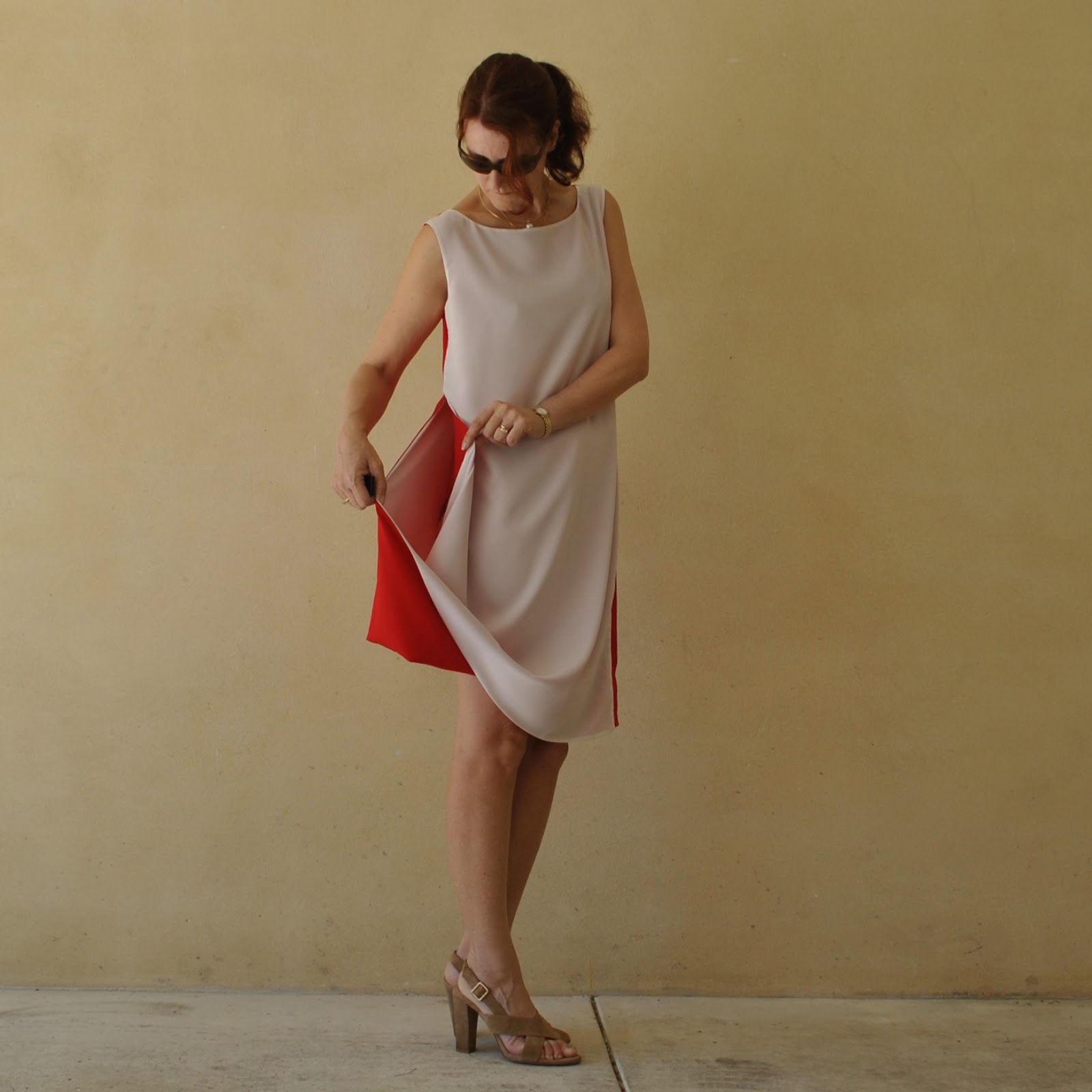
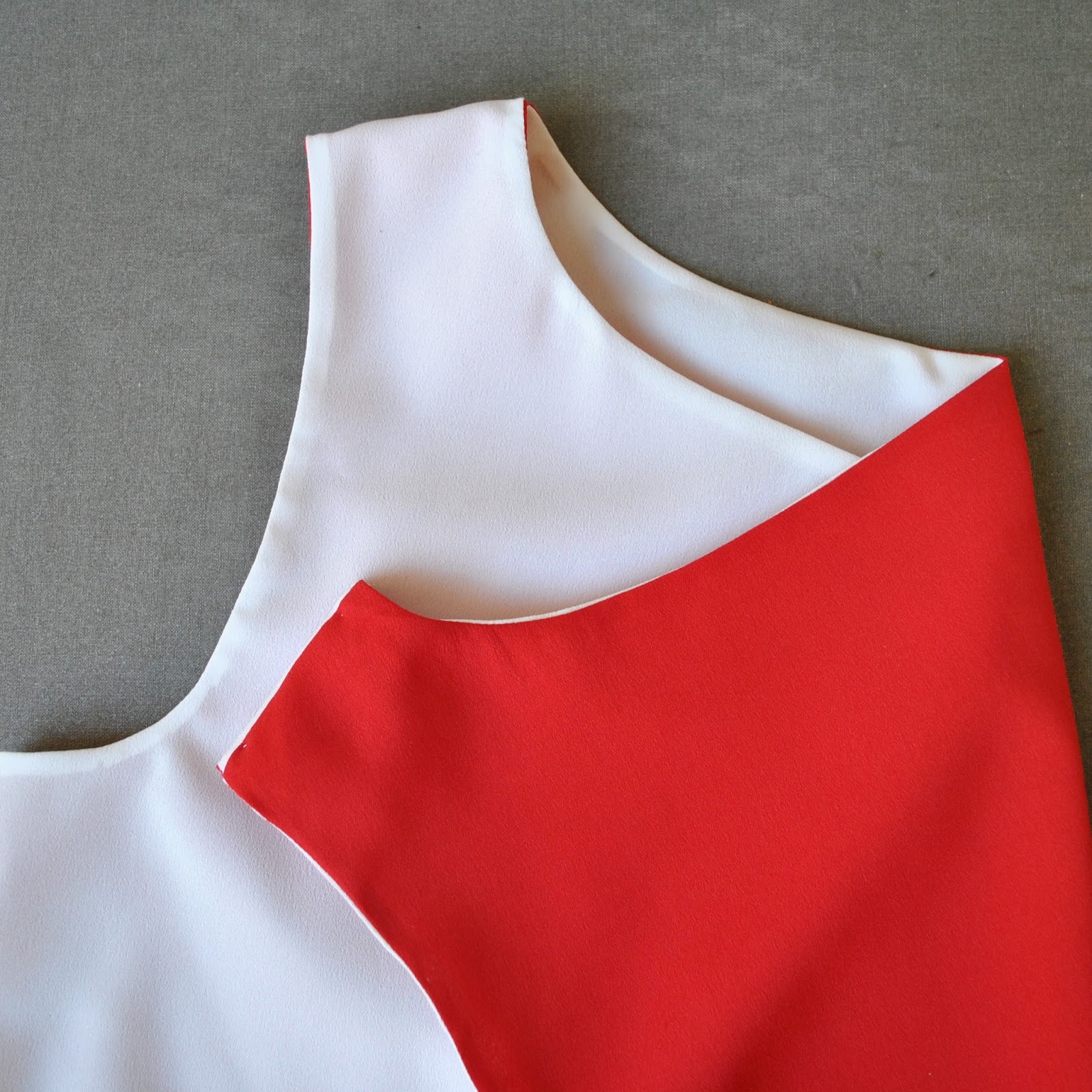
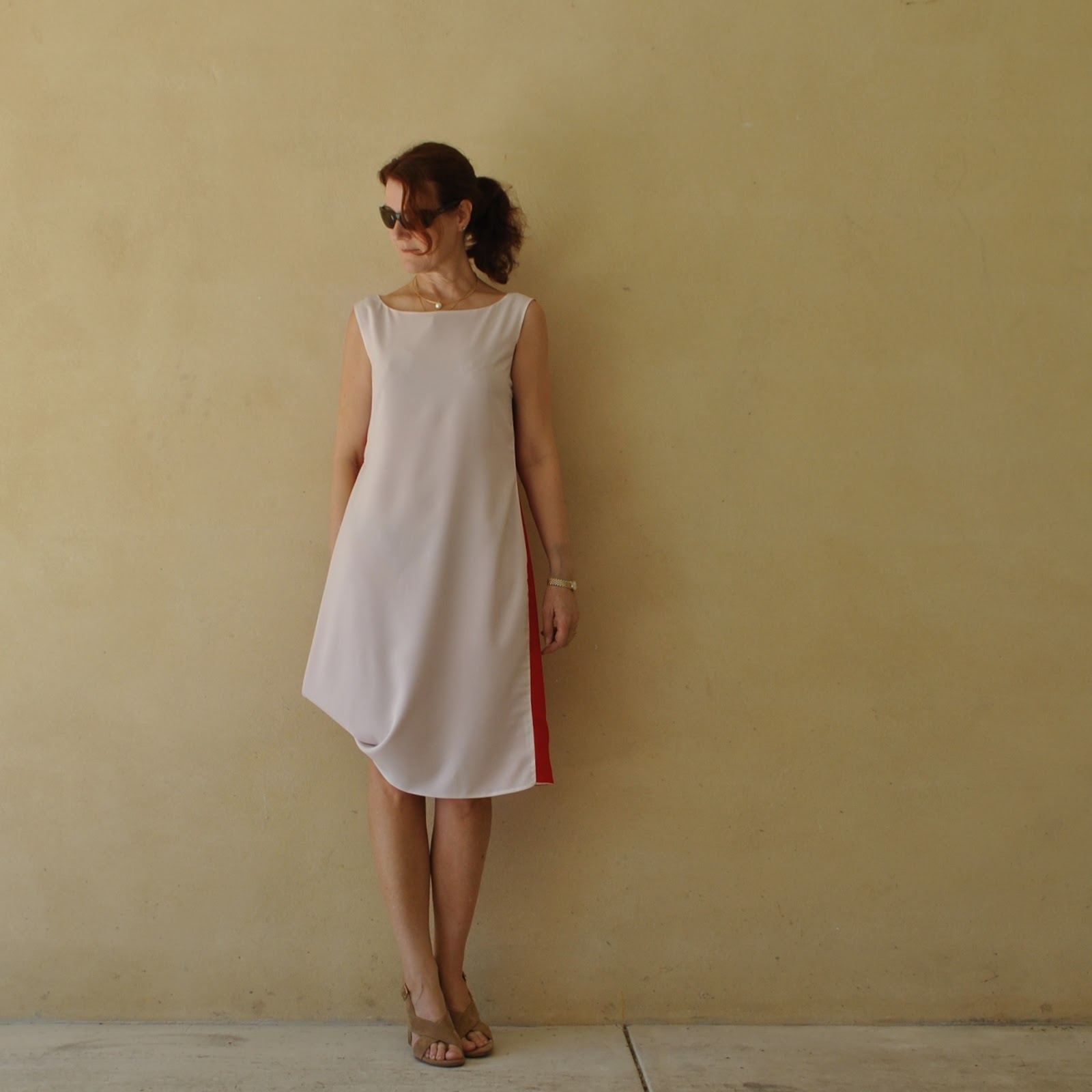
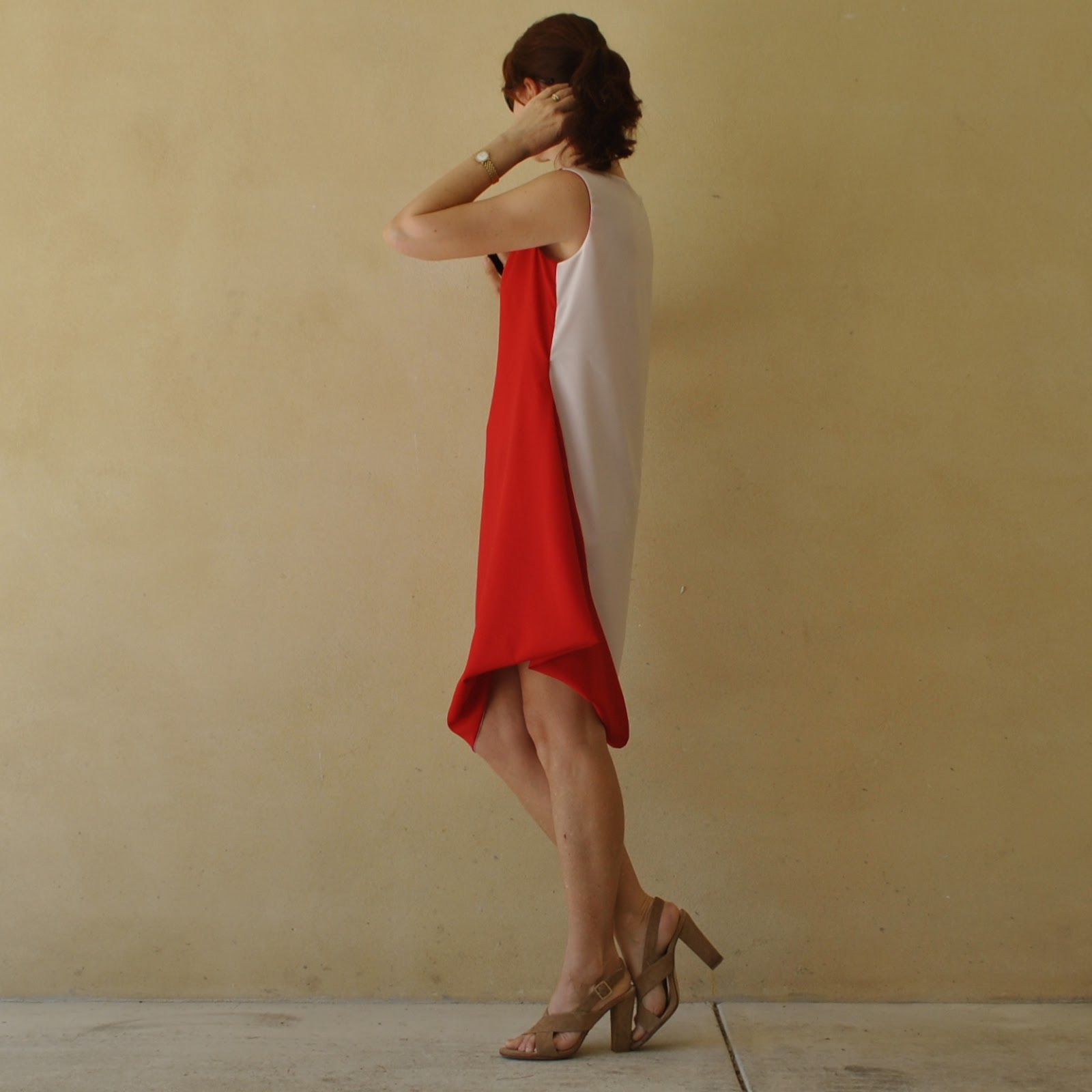
Right way out; I wanted the white at the front and red at the back.  The way the infinity twist goes; the dress is actually mostly open at the right side seam, but the way it crosses over there is a restriction in the drape of the hemline so that it sits with the opening closed quite securely; and there is absolutely no danger of the drape falling open and exposing your knickers at all.  I tried to move and sit in it a few times to see if I could possibly get humiliated from any hint of exposure in the dress and am happy to say I could not make it happen.

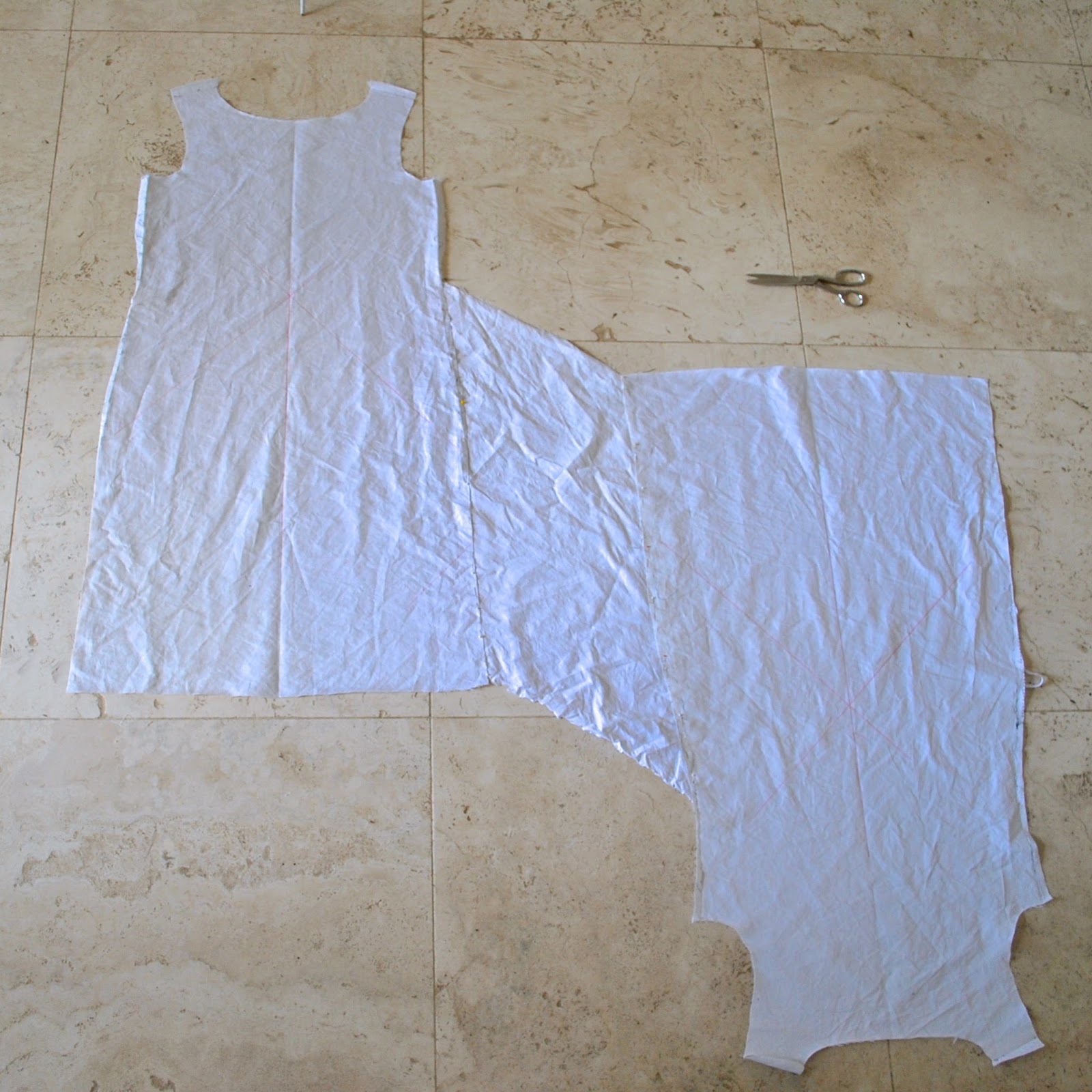
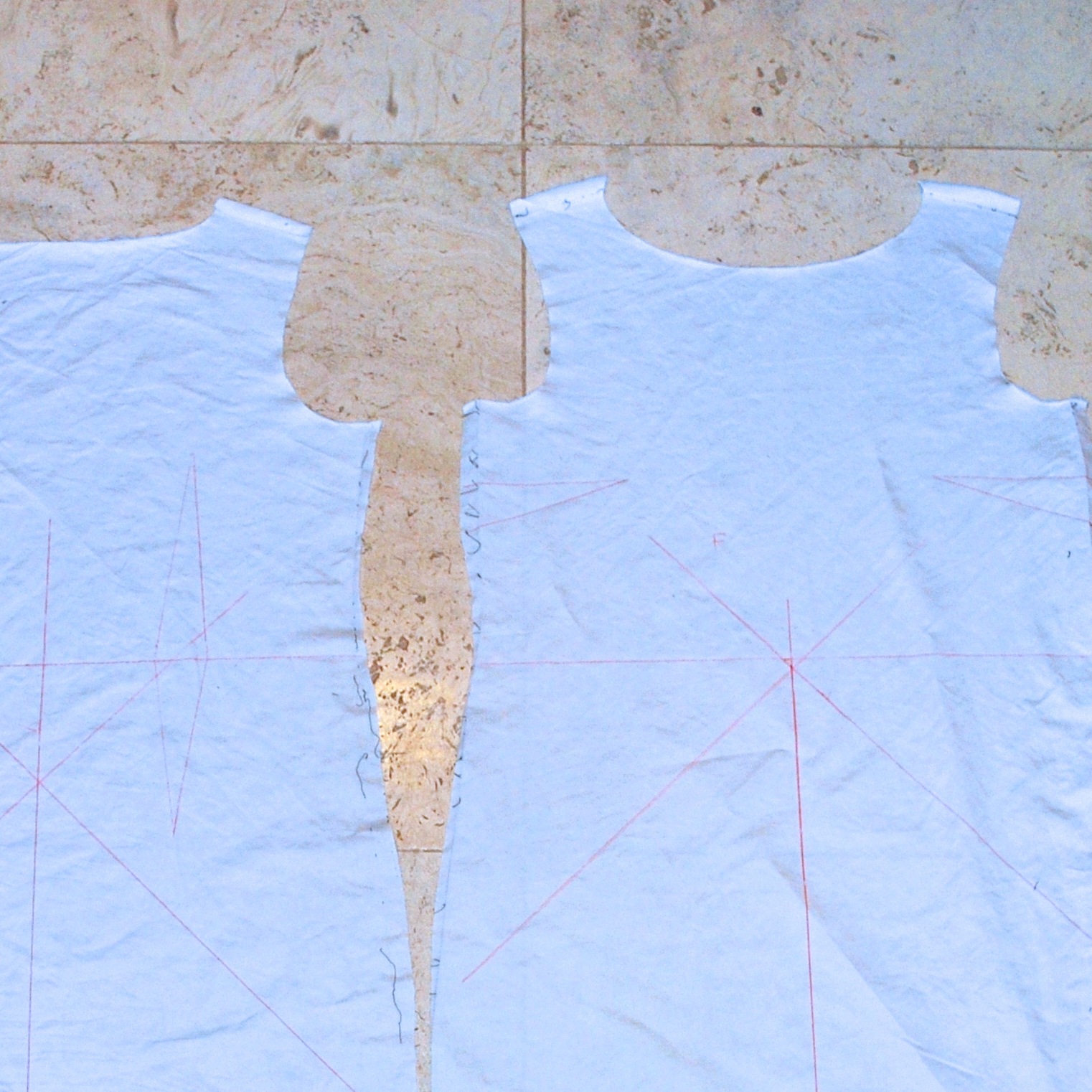
The one single pattern piece looks like this, and you rotate the “upside-down” part around clockwise and up, to lie over on the “right-side up” part.  This naturally forms an infinity-twisted drape at the side, and the wrong side of the fabric against the right side, front and back.
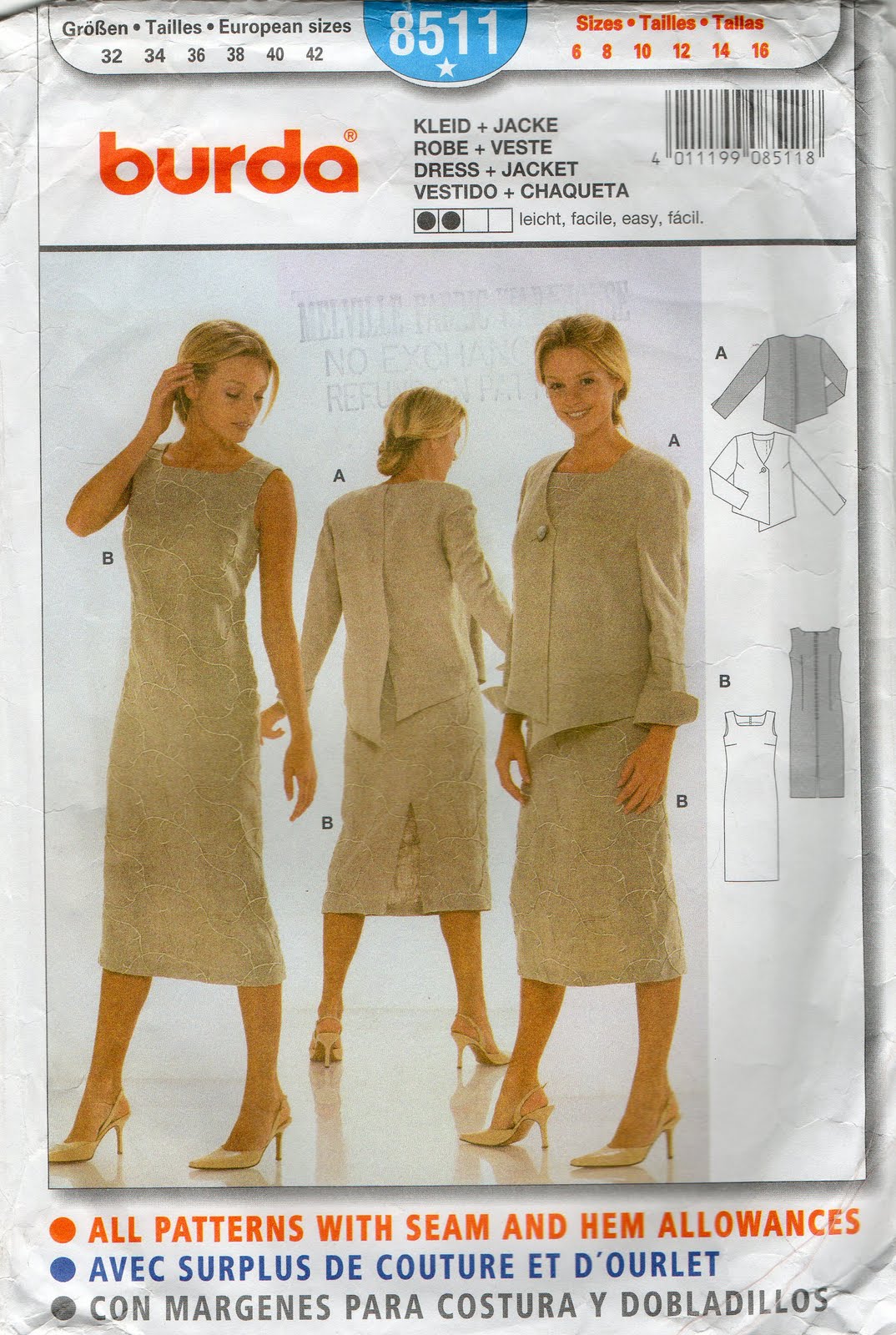
   Any straight or sheath dress design could be used to get this pattern piece;  I used my old standby Burda 8511 as my sheath dress sloper.  It’s one I’ve made enough times over the years to have tweaked and fiddled with it enough to have fine-tuned the fit to my pear-shaped self just about perfectly. 

By the way; if you’re at all interested in creating your own pattern manipulations like this one, and this goes for just about all the Pattern Magic designs too; my recommendation is make a sturdy, fabric sloper.  It’s a good idea to have one for a sheath dress, a bodice and possibly a skirt too.  You could use a well-fitting, tried and true pattern like this one, if you have one; in any case get a basic pattern and make up a few samples to fine-tune your fit.  Once you’ve fiddled and diddled enough to discover the perfect adjustments for you; get some strong fabric that’s not going to rip or fray easily, like an old sheet… these often have the most fabulously high thread count making them super-tough!  Then cut out your perfectly-fitting pattern pieces.  Using a clear, easy-to-see marking pen of some sort, mark on the sloper pieces the waist line, hipline, bust points, back dart points, the straight grainline and the bias grainlines going both ways.  I used bright red marking pen.  This sloper can be kept rolled up with your patterns for whenever you have new ideas and want to play about with making new designs for yourself  🙂
Why fabric, not paper? well obviously so you can baste it together and put it on!  wearing a paper version of a thing is absolutely nothing like the real fabric thing, we all know that!  Paper has zero drape, plus it rips all too easily  😀

The middle, joining piece goes from the waist to the hemline.  I left off all shaping darts, so the “dress” portion is a kinda shapeless sack, a base-point which I think is a good criteria for a double layered reversible design.  I also cut it so that I can just slip the dress over my head, eliminating the need for a zip.  Obviously that feature is essential in a reversible dress too!
I used a lovely rayon crepe from Fabulous Fabrics, in red and white, and needed 1.8m of 150cm wide fabric in each colour.  Having the nice wide fabric meant I could cut my pieces on-grain and with no joining seams in the pieces.
The white is quite sheer, and just about all seam finishes except for French looked absolutely dreadful underneath it; so after a bit of experimenting I went with seam allowances done like this:

Firstly I stitched the seam allowances with a regular 1.5cm(5/8″) seam allowance.  Pressed to set it, pressed open to get the crease set, then pressed back closed again.  Secondly stitched a second pass of stitching just inside the seam allowance.  Lastly, trimmed the seam allowance to an even narrow width.  This should be pretty secure and stable with the double stitching.  And the “ghost” of this seam allowance as it appears showing on the white outside looks quite nice, almost like a French seam.  

By the way, I did consider trying to do actual French seams in this dress for about a hot minute, before I got sensible and realised in that way insanity lies and I would be tearing my hair out and frothing at the mouth in no time at all….  in any case, the reversibility of my construction technique means that all my seam allowances are enclosed with the two layers of the dress, so there’s no danger of any seam allowance coming out on view anyway.  The ultimate in neat-looking insides, yay!

There are only three bits of almost invisible hand-stitching closing the layers: the two inside shoulder seams, and a short length on the inside hanging drape; through which I pulled the entire dress in the very last step before closing it up.

The drape can be adjusted to sit in different ways; like pulled completely through to the front as in the top picture.  I also like it pull it back through on itself a little bit, and have it sitting more balanced.  It does look nice like this, but it does eventually tend to slip naturally back into its default position, probably because my fabric is quite slithery and slippery.  If it were made up in linen, which is more “grabby”, it would probably hold a different position better.

The dress does have a front and a back, the only way to tell them apart is by holding it up at the shoulders so you can see the lower scoop of the front neckline.  However I can wear it with a red front and a white back if I like by pulling it inside out and wearing it with the lining side out… hello, reversibility for the win!  Below is the dress worn in reverse; i.e., with the “lining” on the outside.  It doesn’t look that different to if the dress was worn back to front, just in small details.  Unless you looked closely at the shoulders and saw that they were hand-stitched closed, you probably couldn’t tell this was the inside of the dress!

Although I really like how the dress looks, I’m not completely happy with some of my construction in this one…  I found to my cost that one majorly important aspect is to make sure that the two outer, left side-seam edges are exactly, and I mean exactly the same length!!  This is the boo boo I made; mine were out by a mere 1cm, which was enough to put my side seam out by a touch, so it hangs a weeny bit too wibbly-wobbly for my taste.  So I’m thinking of this one as a kind of prototype or wearable muslin, and want to make another “proper” one for myself, although I will wear this one a lot too.
Maybe if I make it again I’ll do a proper tute on how it all goes together, reversibly.  
Maybe.

Details:
Dress; a variation on Burda 8511 and based upon a design idea of Anita from studio faro; in red and white rayon crepe
Sandals; Zomp, from Zomp shoes

pinterestmail

making felt from fleece

Hello!
So furthering onward with my one year one outfit adventures, I thought I would put together a post on my other efforts so far… I have also been making my fabric for the other components of my outfit.  Yes, making freakin’ fabric!!!! transforming Western Australian sheep fleece into felt, with which I shall make…. something.    Still ruminating on exactly what...  
Along with my fellow one year one outfitters Sue, Nicki and Megan, I visited Bilby Yarns; a small but treasure-packed little shop in Willagee that supports local wool producers and enthusiasts and stocks supplies for anything and everything wool-related you could possibly think of! spinning, weaving, felting, needle felting, knitting and crochet and probably some other endeavours that I haven’t taken in yet, too.  It also stocks dyes, both natural and chemical and, most fabulously; yarn from Western Australian sheep, hand processed and hand spun by local ladies.  It’s a truly fantastic local resource! and I can see myself paying the shop many more visits in the future.  The lovely chatty June kindly demonstrated spinning and also felting to us; and we all came away with supplies of fleece, greatly enthused to make us some felt…

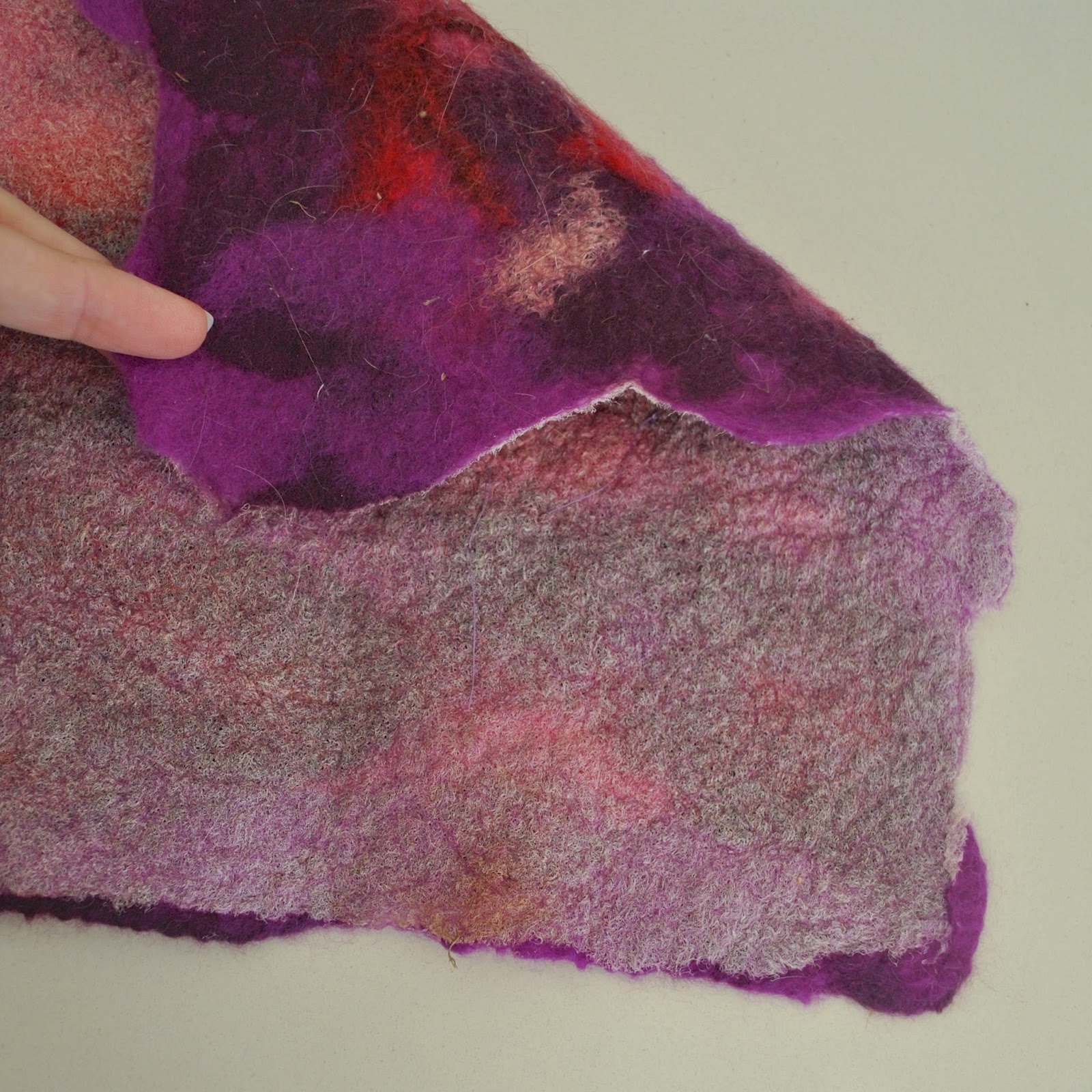
I have made some decorative felt panels a few times before, small and therefore easy things; blogged here and here and a couple of others that I’ve given away and never blogged.  However, this project would have to fit in with Nicki’s strict criteria; to be a TOTALLY home grown product.  Normally if I was considering making felt for a garment to wear; I would felt onto a piece of silk chiffon to give strength to the fabric. 

felt with silk chiffon backing

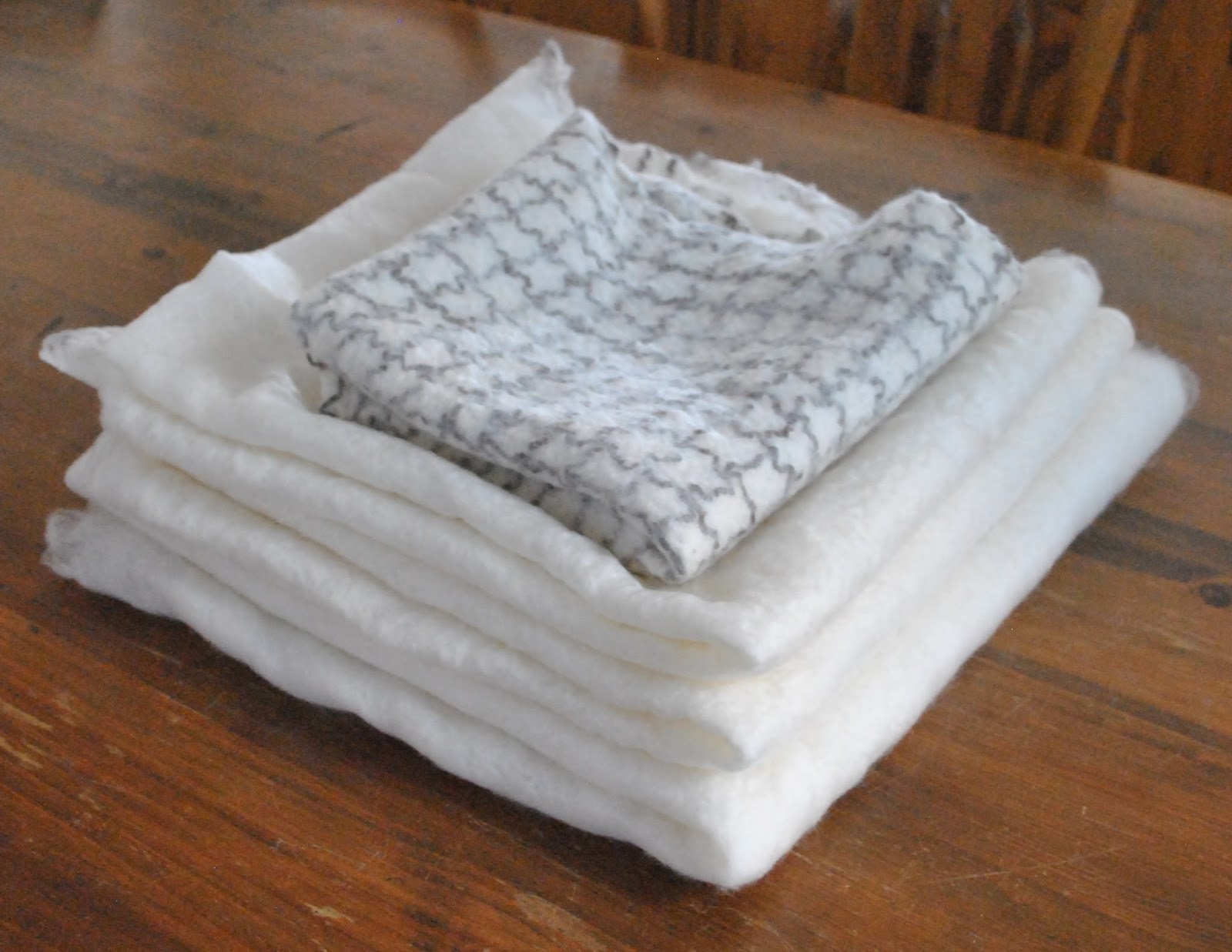
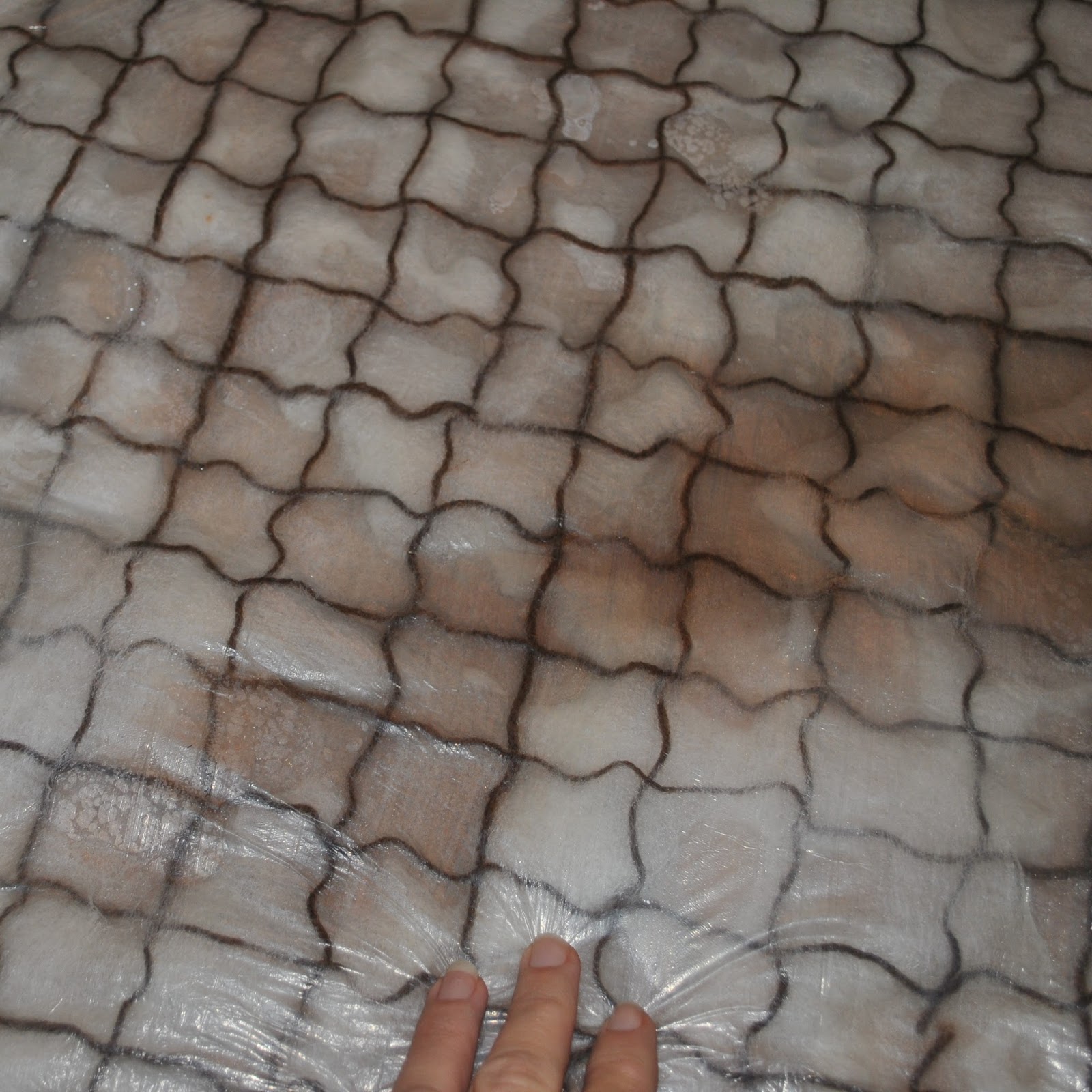
However; obviously silk chiffon is not a thing ever produced here in Western Australia! so in terms of our challenge it was a no-no.  I had to think of some other way of building some toughness into my felt…  I noticed a small sample in the shop with a yarn grid felted into it, and thought this would be a brilliant way of solving the strength problem.  I incorporated a yarn grid feature into one piece of my felt and I will be using another method of building strength into the remaining pieces.
I bought some washed and combed, naturally white Corriedale sheep fleece, and also two balls of locally hand-spun, West Australian wool yarn; one naturally black the other naturally white; and 3 large, thin, plastic, painting drop-sheets from Bunnings.

Modus Operandi:
First of all.. key words:  GENTLE!  EVEN!  Those two words were to be my mantra throughout this entire procedure.  OK.
Now: you need a fair amount of uninterrupted time, and for large pieces of felt big enough for an actual garment, a large table; preferably indoors in a wind-less, breeze-free environment.  I used my dining room table.  When laying out the fleece, bear in mind the fleece will shrink to roughly 75% of its former size in the process of becoming felt, so if you’re after a specific size you’ll need to allow at least an extra third in size dimensions each way.
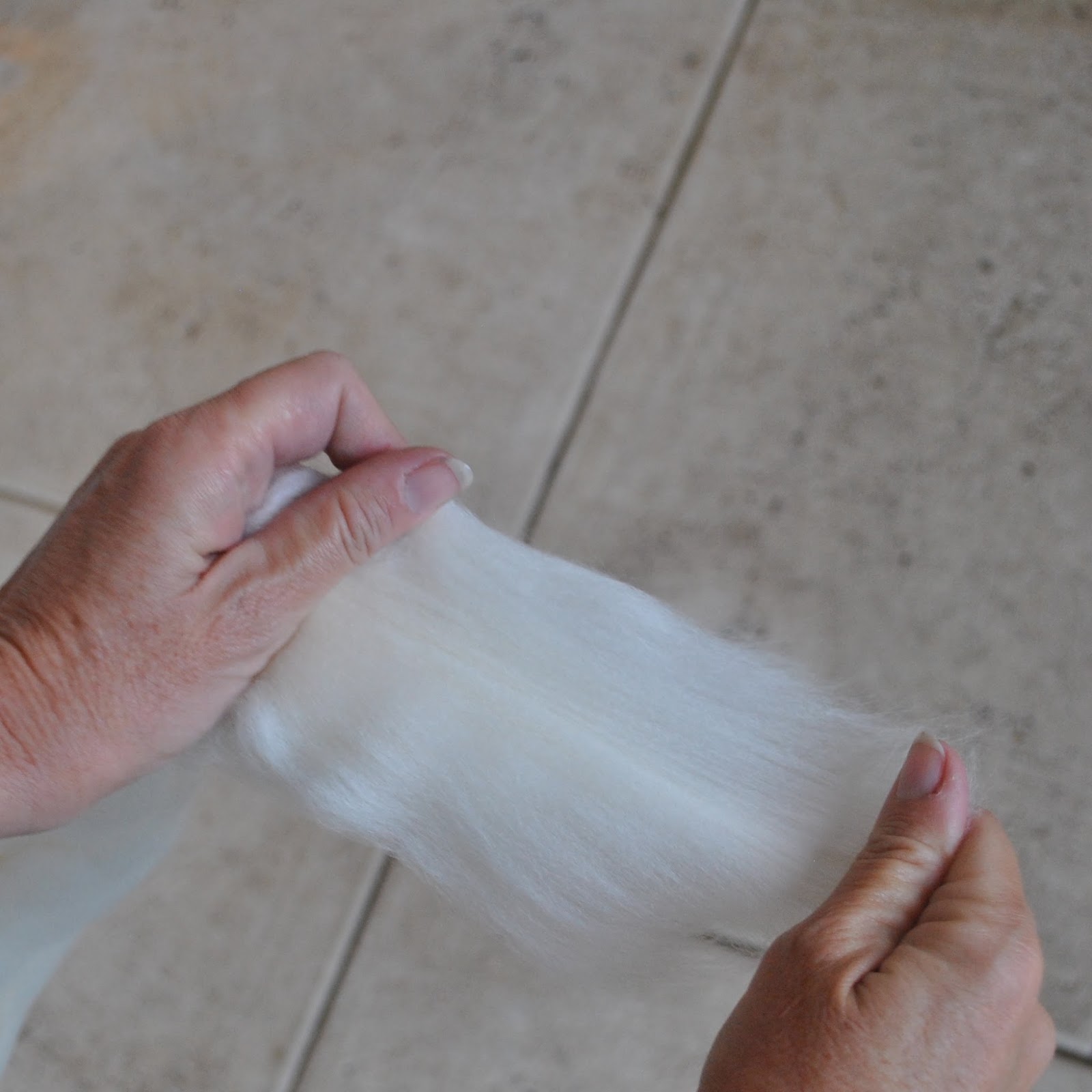
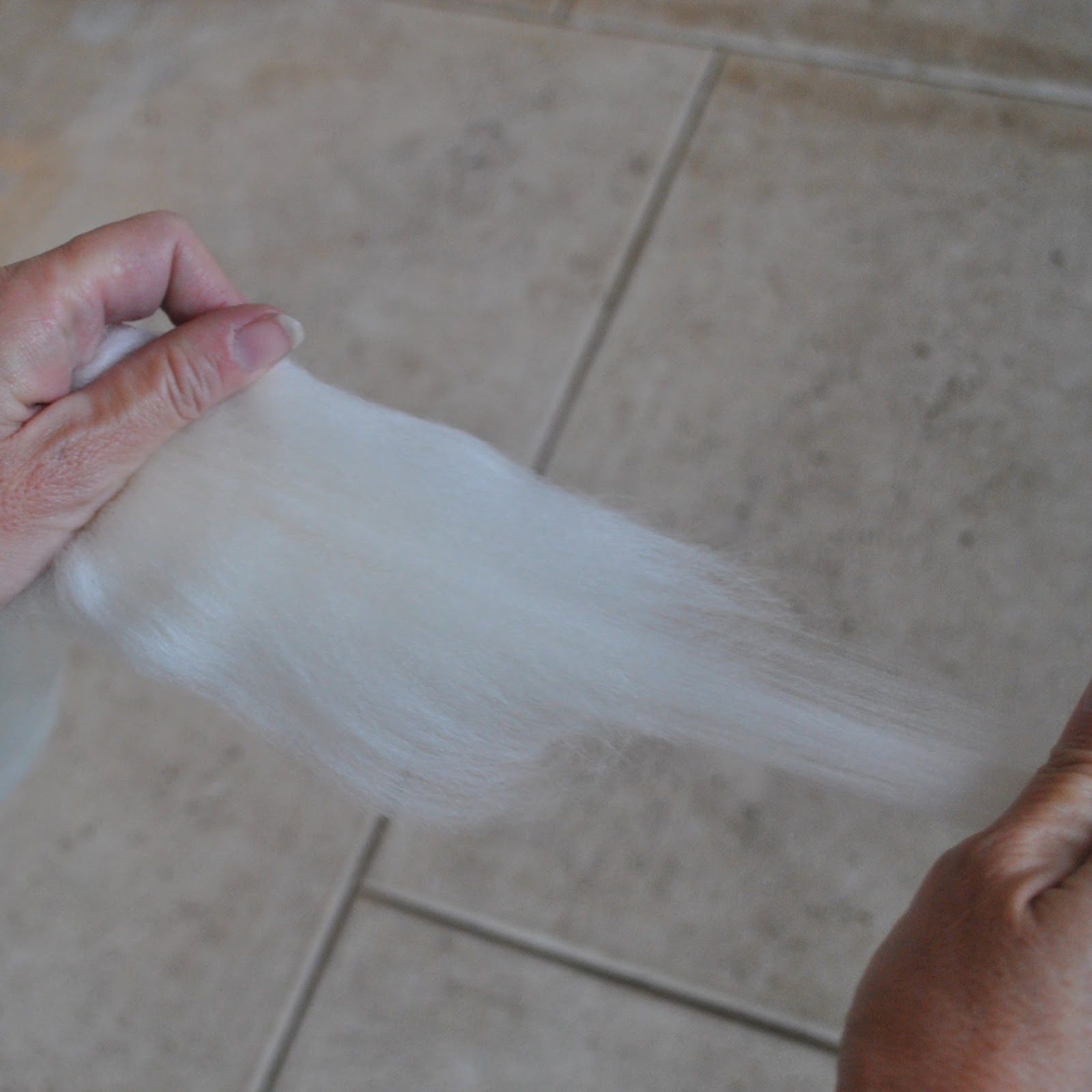
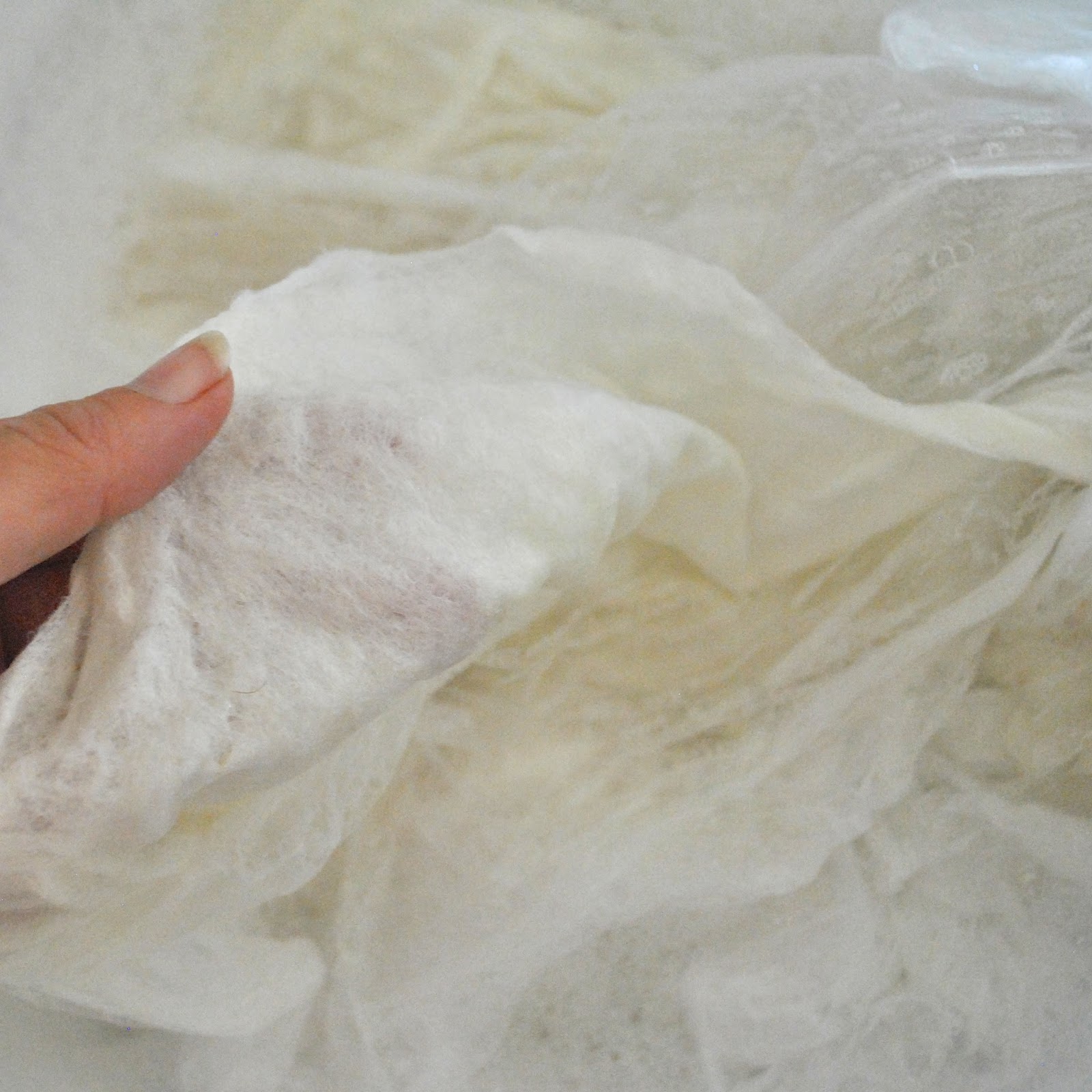
I laid my cut-to-fit plastic drop sheet on the table and start laying out small hanks of fleece onto it.  You hold the combed fleece loosely in your left hand, not too tight and not applying any pressure, and then with your right hand you grab and just pull away a small flat wodge.  Aim to keep the sections you’re pulling out of reasonably even spread and thickness; i.e., with no thick bits in the middle.  

Then, you’re simply laying them all in an even layer as possible, in one direction onto the plastic sheet.  I used my whole 2m x 1m table space.  This is why you need a good wedge of time, since your family’s not going to be able to eat dinner on the table during this process! and you can’t exactly pack it up out of the way since the wool fleece is so light and floaty that at all times it’s in danger of wafting about, blowing onto itself, or onto the floor if a door opens and a breeze comes through.  Plus in my three cat household there’s the very real danger that a curious little helper is suddenly going to jump up onto the table to check out what you’re doing and keep you company while you’re doing it.  Eeeeeeeek!  The potential for disaster is HUGE! 

The top end that you “grabbed” is a little thicker than the tail end, so overlap these by a little bit in each row.  Once you’ve covered the area, go over again, this time laying the hanks of fleece crosswise to the previous layer.
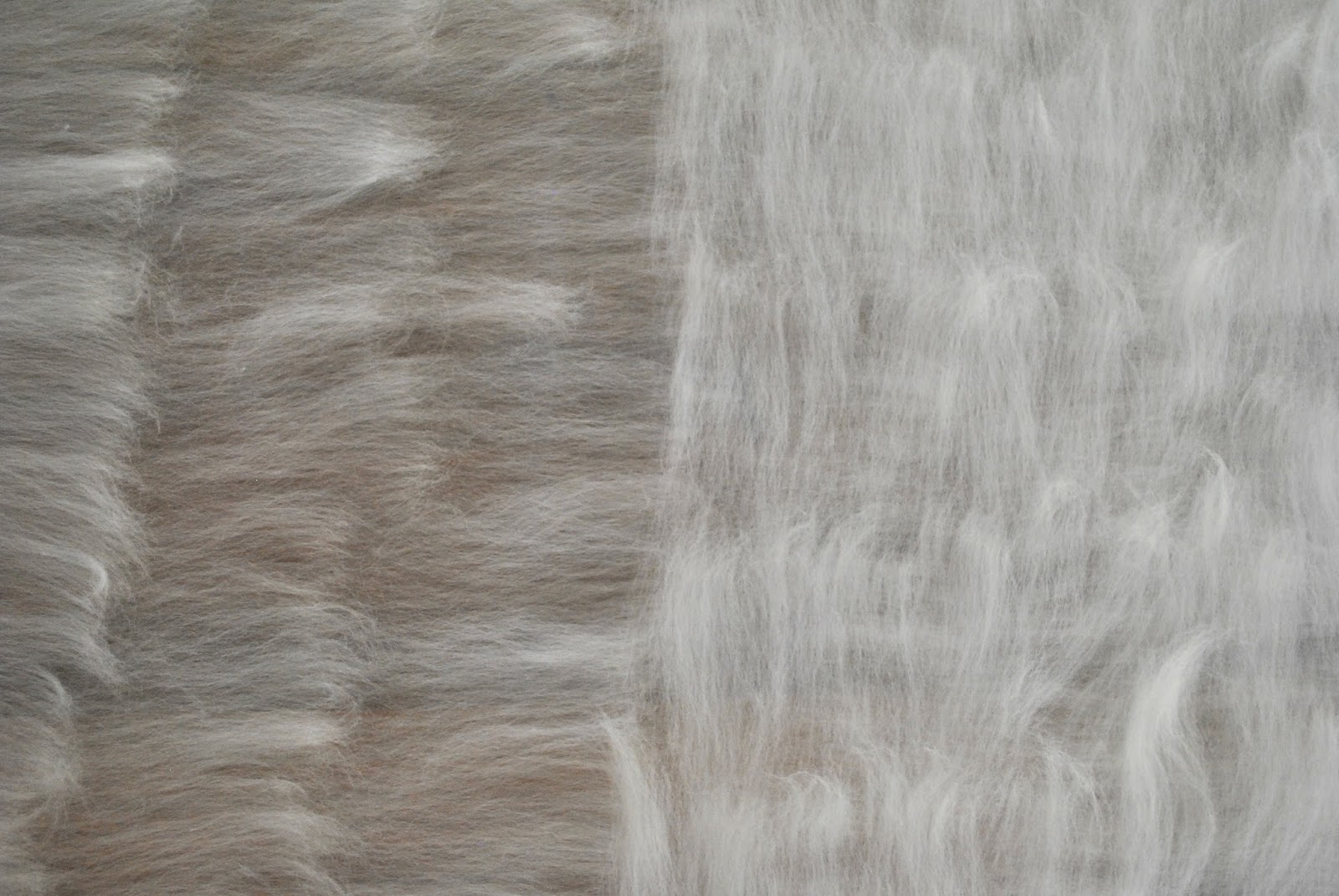
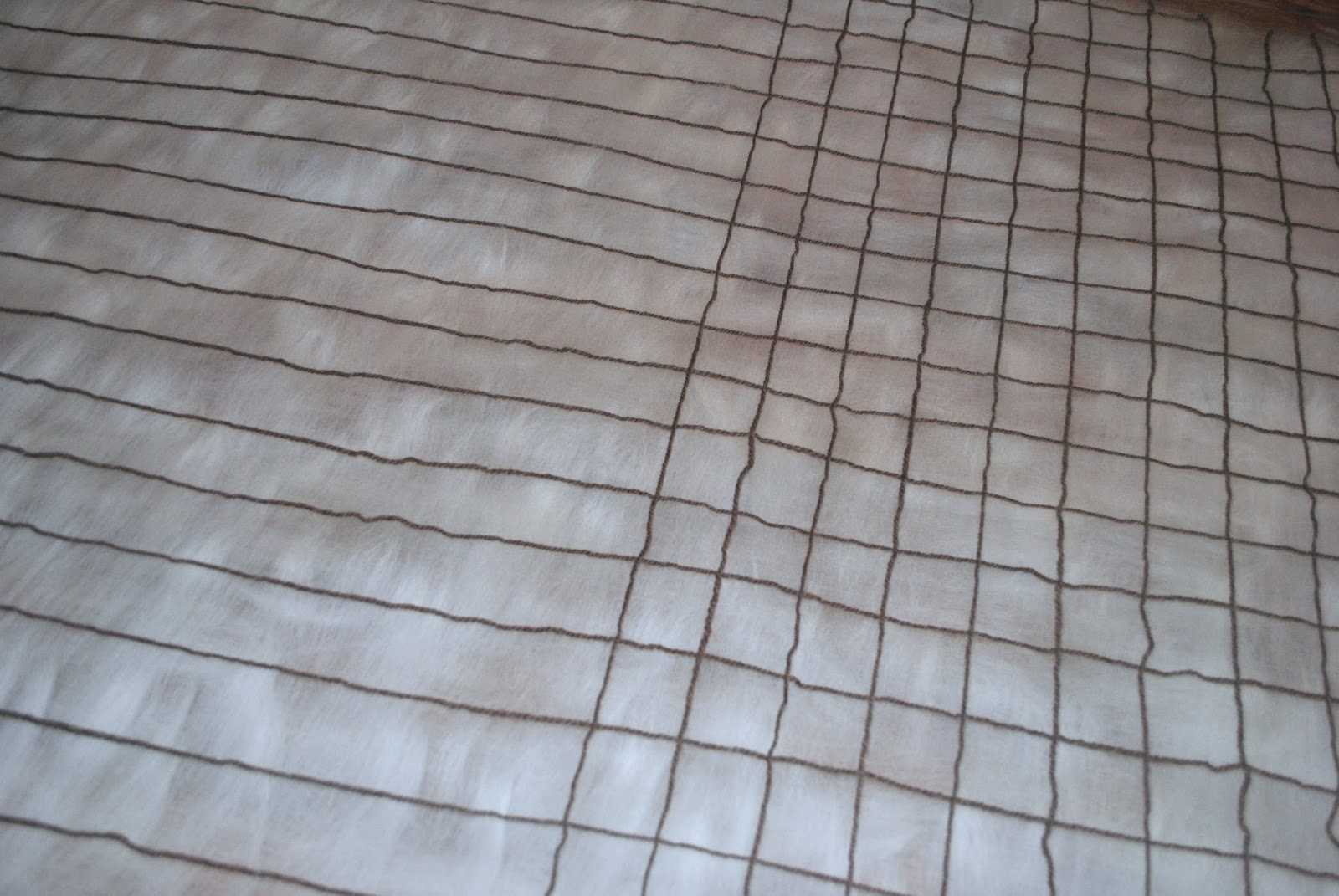
For my gridded felt I cut lengths of the homespun wool and laid it out over the fleece in an even grid.  Then I laid a very light and thin third layer of fleece over this one.  btw, some of the following pictures in this tutorial are of the grid felt and some are just the plain, un-gridded felt… because I was a little erratic in my picture taking; sorry!  But the felting process is just exactly the same in each case  🙂
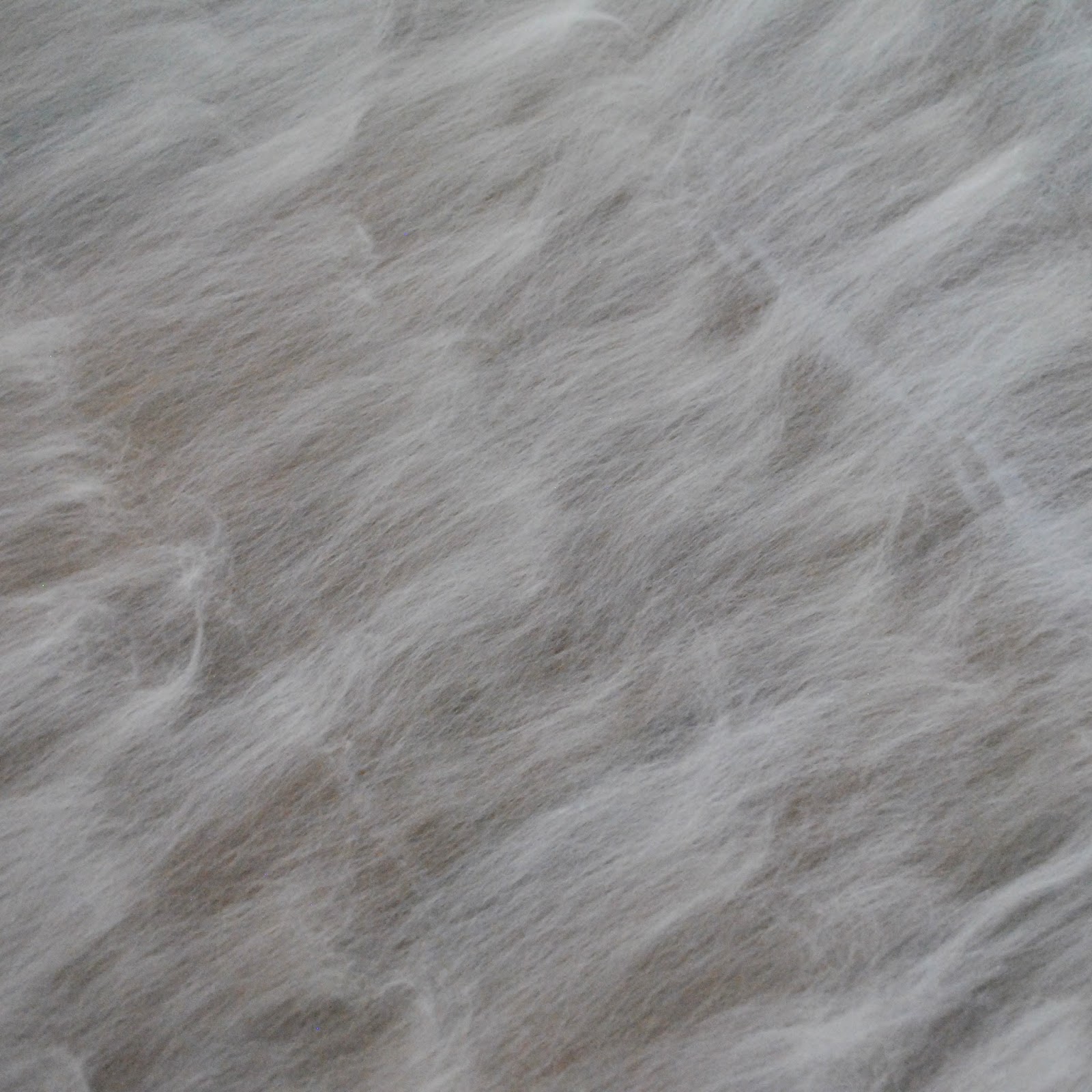
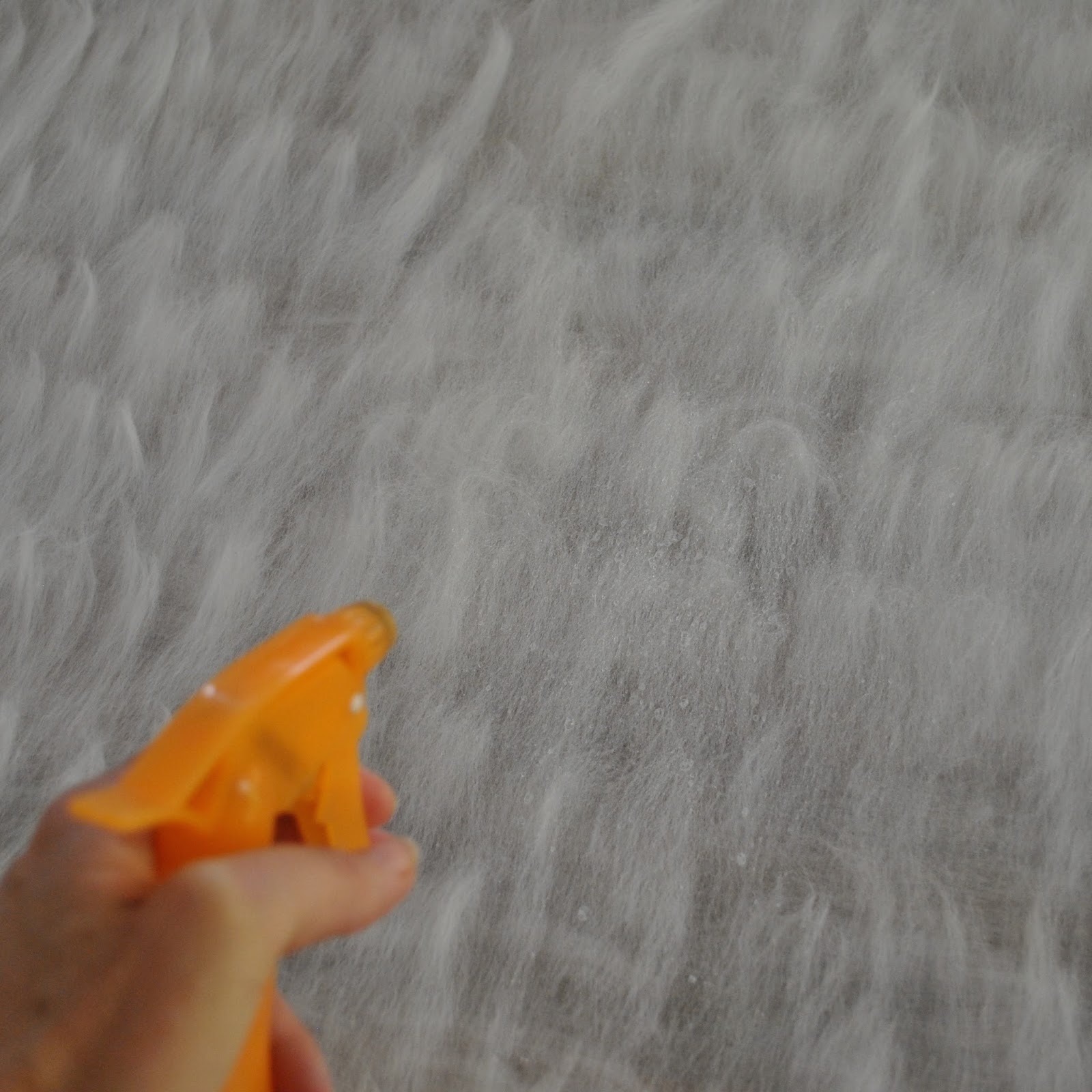
Fill a spray bottle with hot soapy* water and with the nozzle set to a fine mist lightly and carefully start spraying the fleece evenly all over.  Take great care to not blow the fleece about with an inadvertently strong spray or jet of water here! which could destroy all that carefully even laying-out… you’re aiming to very gently dampen down the fleece with a light misty spray.  Once the fleece has an allover layer of misty dew-like droplets all over, you can spray with slightly more vigour, pausing occasionally to gently flatten down the fleece with your hand, patting it down and allowing the water to seep through the layers of fleece.
*  Soap: the ladies in Bilby Yarns recommend the use of a gentle olive oil soap, and I agree this would be a wonderful option.  However, inadequate preparation and an impatience to just do it!!! meant that I just used a dash of regular dishwashing liquid for mine.  *horrified gasp*
Sorry to the purists out there!   I know, I’m a philistine  *hangs head in shame*  Please don’t boot me out of the felting club!
Eventually the fleece layers will be wet enough that they are no longer in danger of blowing about, and at this stage I allowed myself to add water just a bit more freely, but still lightly! sprinkling the fleece carefully using a small, plastic hand-watering can.

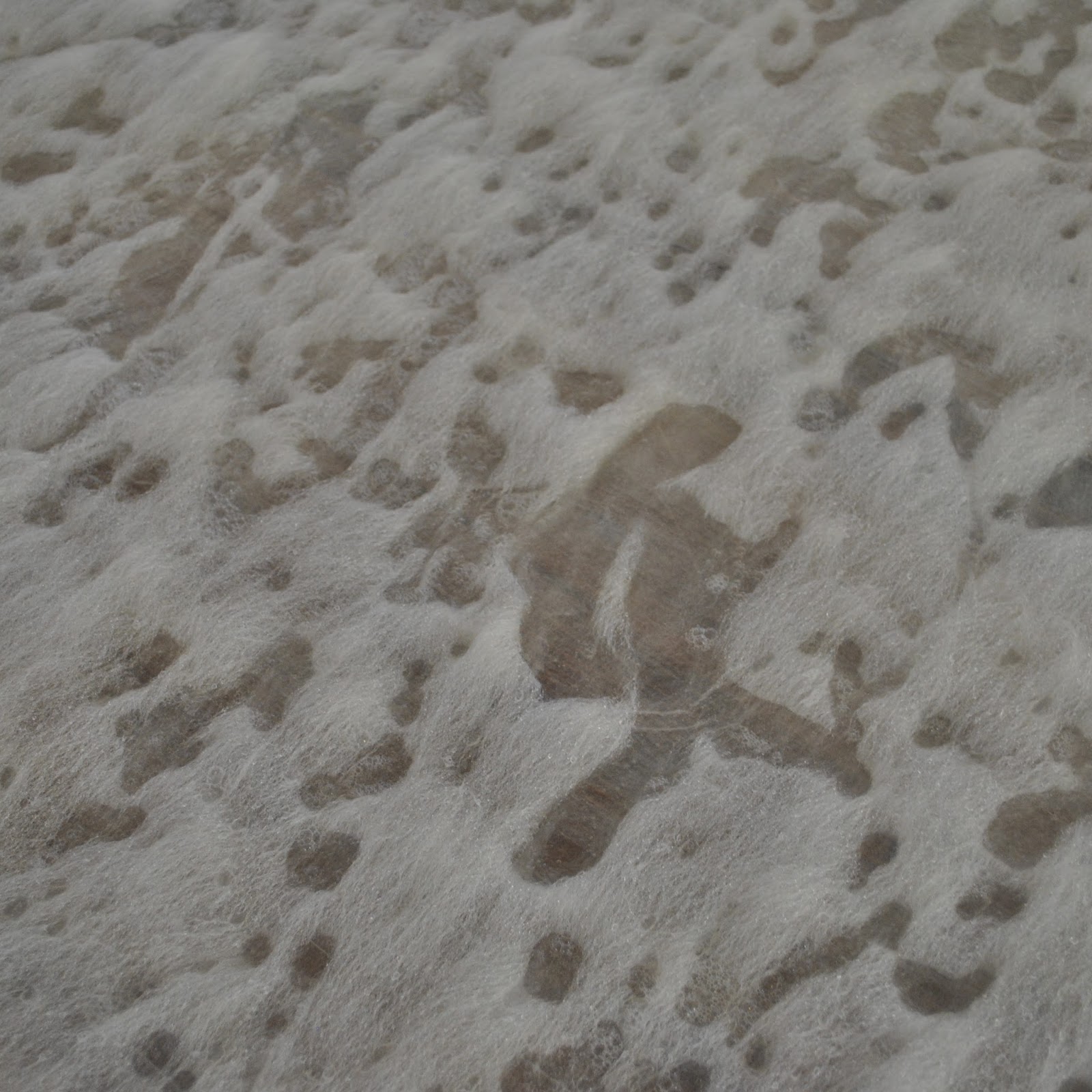
Check all over to make sure there are no dry bits; and once the fleece is wet through lay another cut-to-fit plastic dropsheet over the fleece, smoothing out any air bubbles, and start gently massaging to felt the fleece together.  Be light but firm, use small circular movements,  and cover the whole area evenly.  Every now and again peel back a corner to check that it’s felting together.

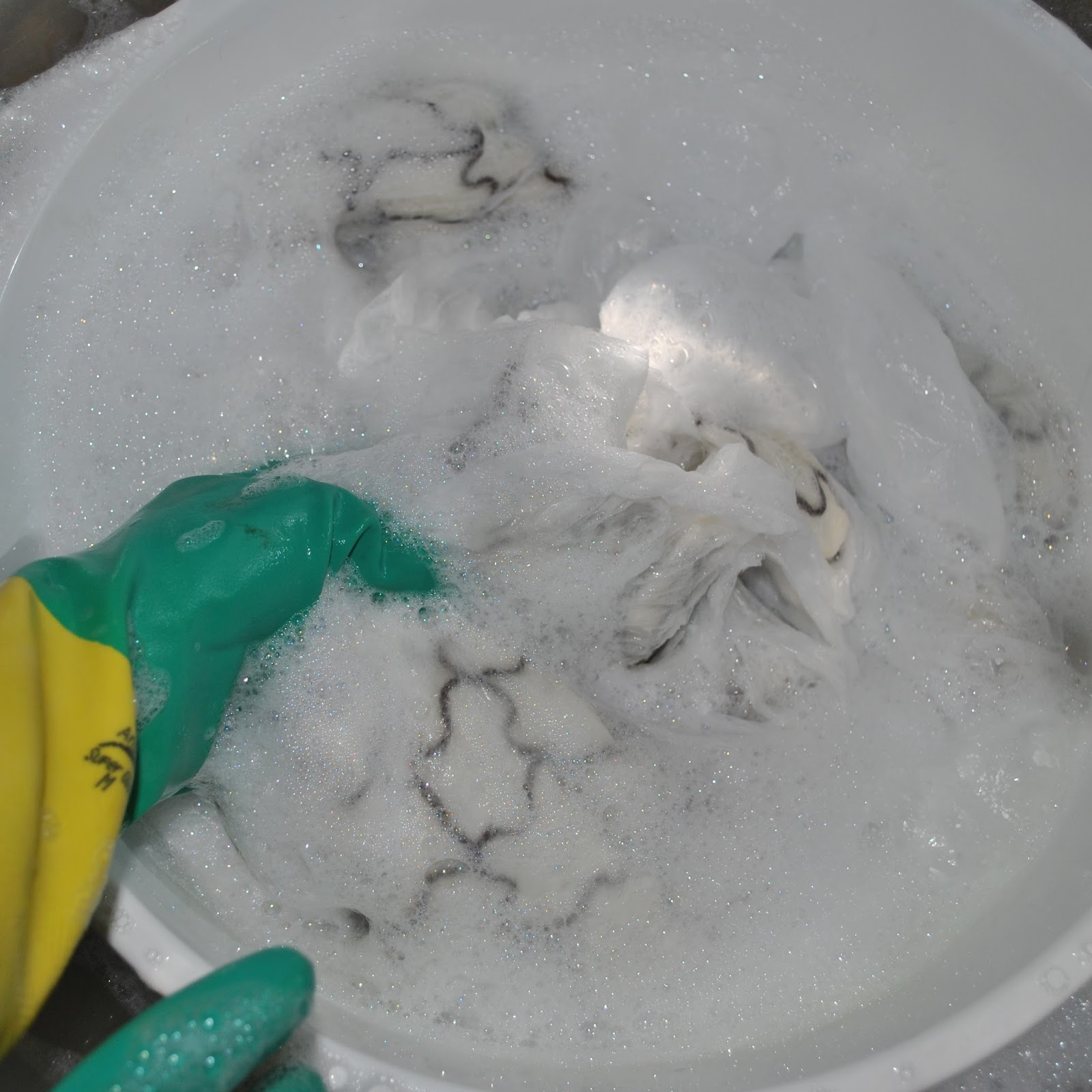
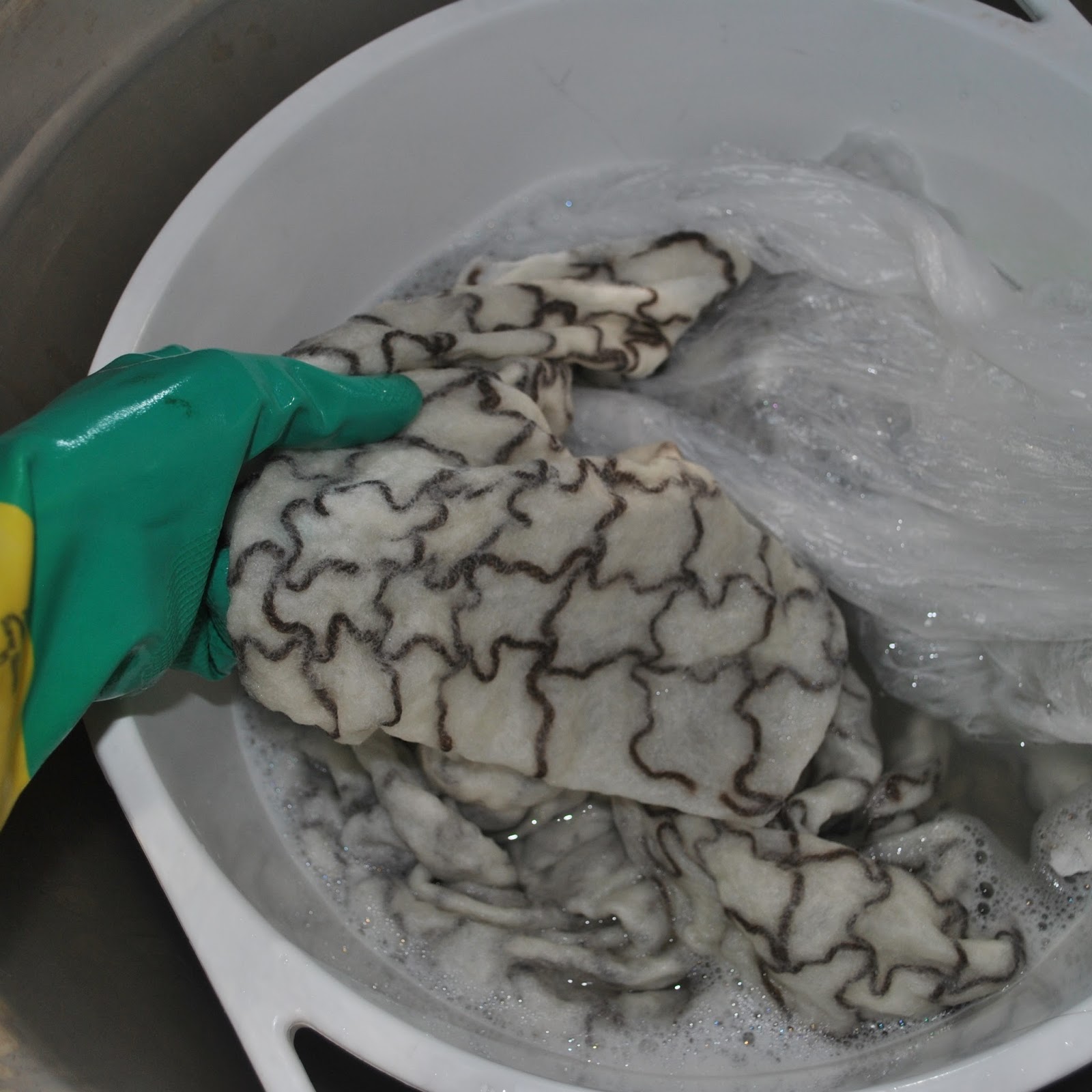
Once it seems to be melded and matted together enough that you can peel a corner away from the plastic and it seems to hold together in a sodden sheet of wool; replace that corner back between the plastic layers, and roll or fold the whole shebang up.  Fill a bucket with quite warm, but not hot! soapy water, plonk it in and start to gently agitate the plastic-wrapped fleece in the water.  Use the same sort of movements you would if you were hand-washing a precious cashmere jumper.  So, a bit of smooth slow swooshing, but no rubbing and nothing very vigorous.  Just some nice gentle easy swirling.

After a few minutes, say 5-10 minutes of this; check to see how the felting is going.  Once it has achieved a more stable, fabric-like texture you can peel away the plastic and remove that from the bucket.  
Gently rinse out all the soap, using cool water.  Still absolutely NO wringing or twisting the felt during this delicate procedure!!

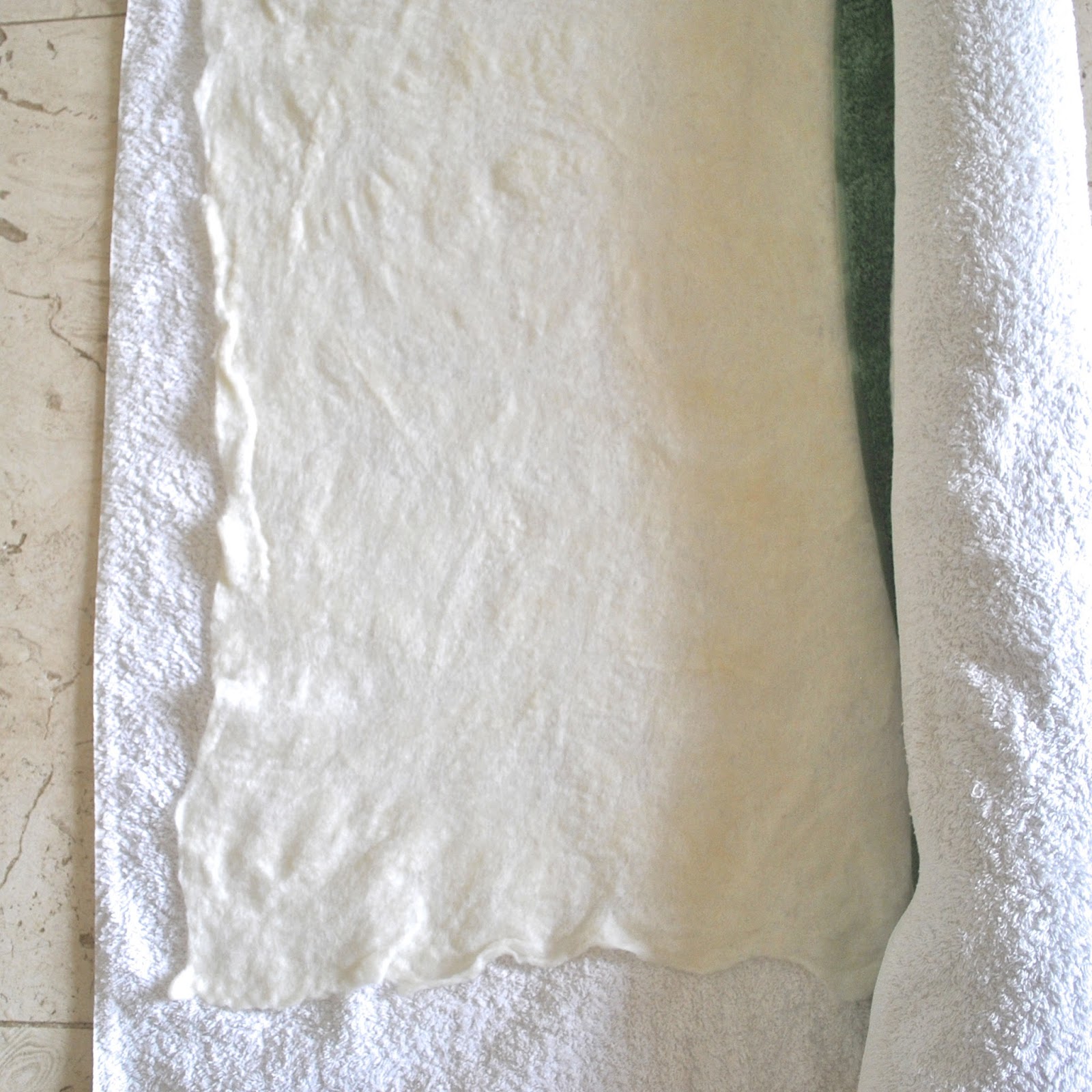
Just like you would that precious cashmere jumper; gently squeeze some excess water out, then lay the felt out on old towels and smooth it out as flat and smooth and even as possible.  Gently pull it into shape, tease out the crumply edges, smooth out any creases or little folds.  It will have shrunk somewhat during the felting process.  For the record; I initially laid out my fleece in a 90cm x 180cm rectangle.  After felting; my pieces had shrunk to roughly  67cm x 133cm; ie. approx. 75% of the previous size in both dimensions.  

When satisfied it is pulled flat and smooth and into a more or less rectangular  shape, roll it up in the towel, smoothing out any little creases that may form as you’re going along.  Squeeze excess water out by kneeling on and pressing down on the towel roll.  
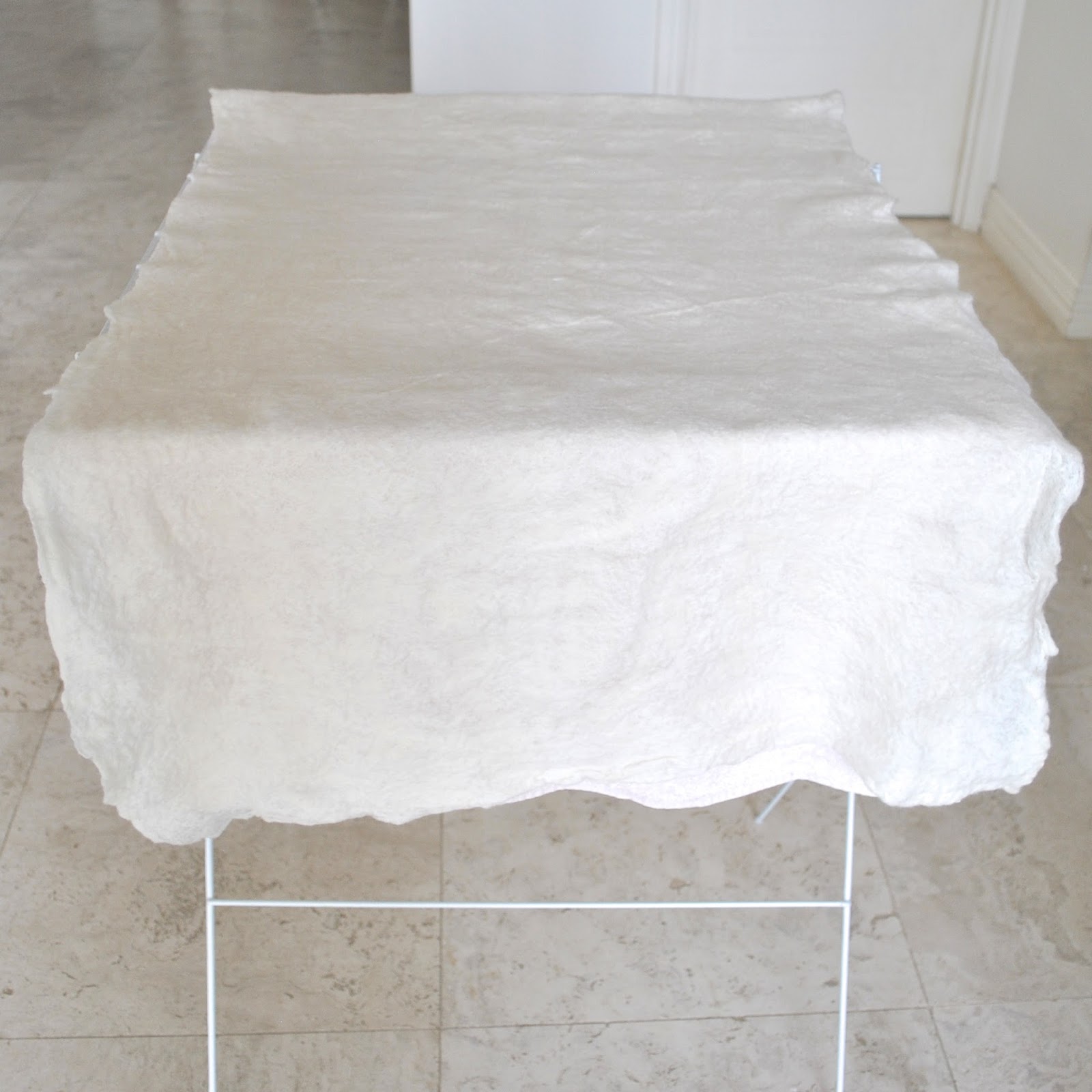
Unroll, lay the wet felt onto fresh dry towels, and let it dry flat.

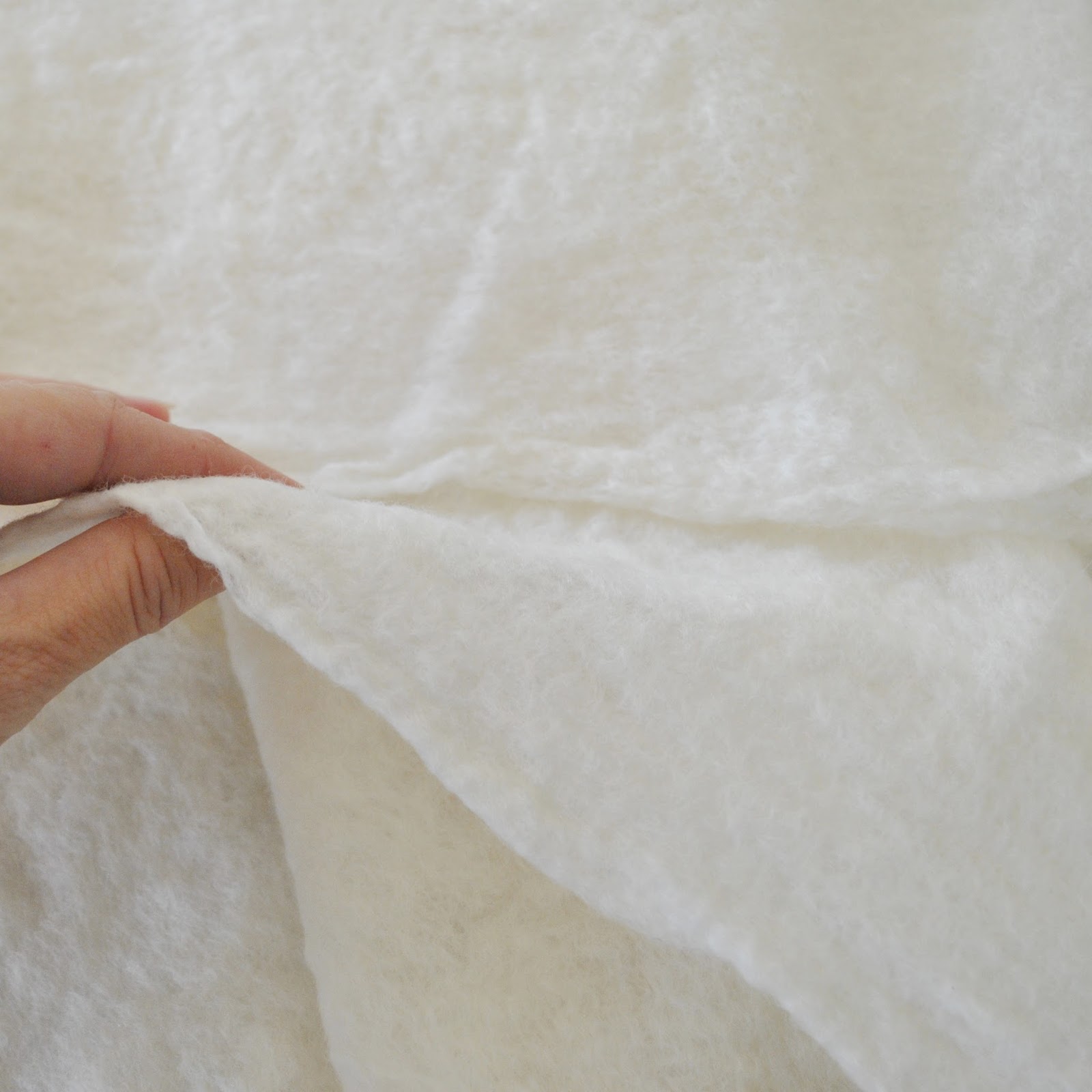
Et voila! felt!
The gridded felt is quite tough, sturdy enough to use on its own; and I plan to add extra strength to my plain cream pieces by adding some wool embroidery of some sort, which I am in the process of designing right now.
The most difficult part of all will be to cut into this precious stuff…  eeep!  must not ruin..!

pinterestmail

adding lining to a skirt; some tips

Plenty of skirt patterns do not come with separate pieces nor instructions for adding a lining to the skirt.  And often you want a lining; particularly in a winter skirt that you wish to wear with tights.
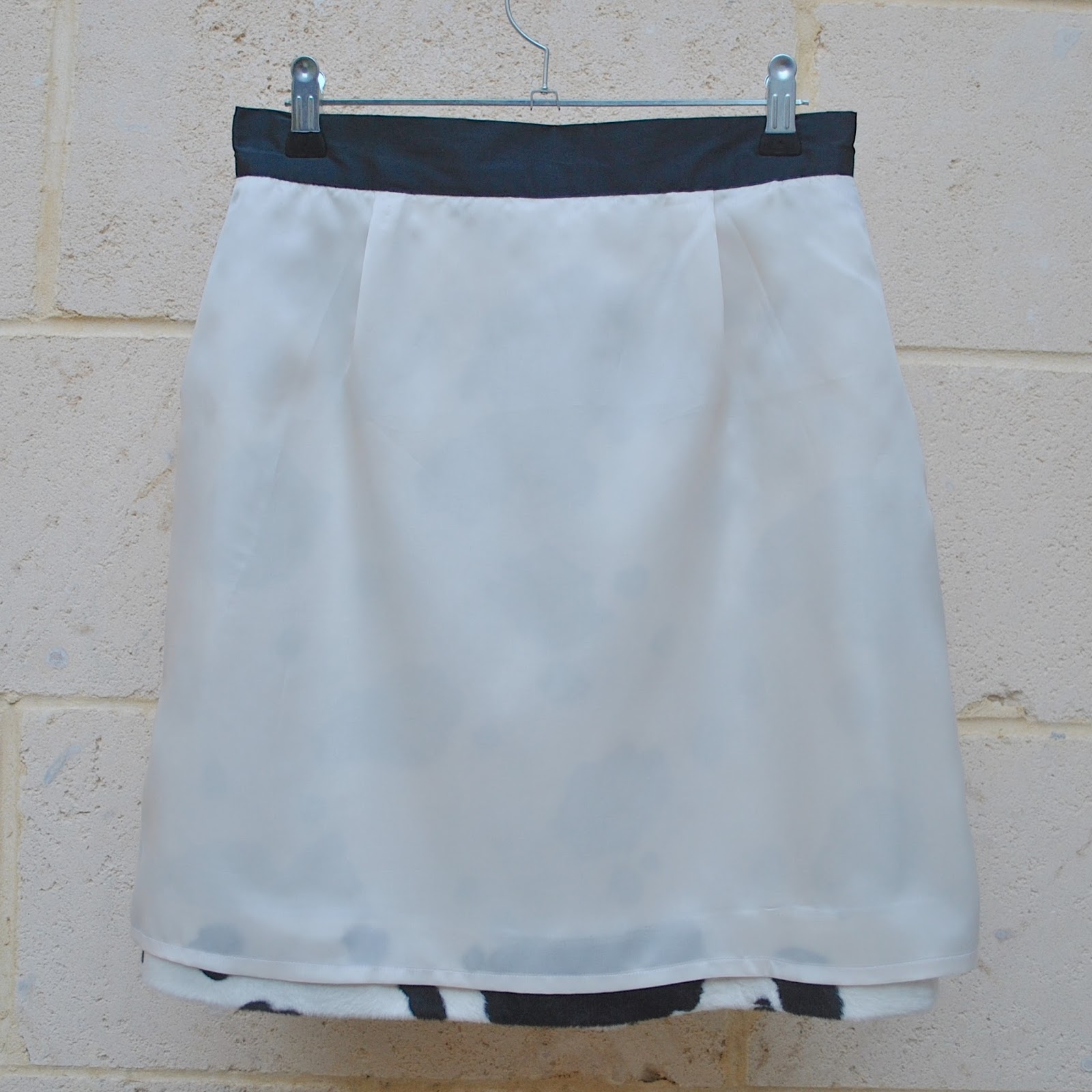
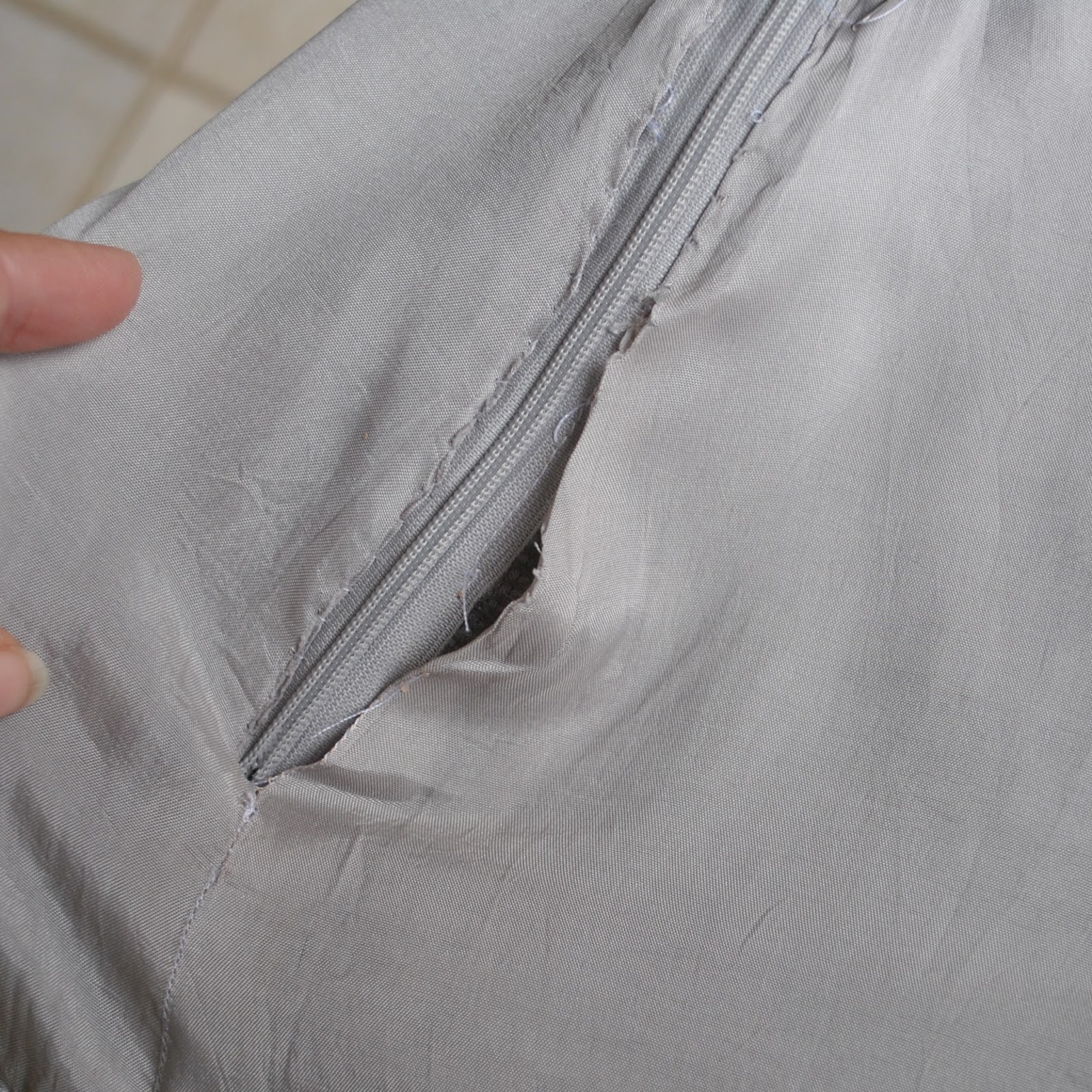
In a nutshell: my own method for adding this is now to generally to cut a skirt lining using the same pattern pieces as the skirt, and — critical difference — sew them together using narrower seams.  So your lining has a wider girth than the skirt itself, i.e. a nice dose of extra wearing ease… this is a small thing but makes a big difference for slimline or pencil skirts particularly!  Why? well, a few ripped linings later…! haha! I jest! but seriously; in my experience sometimes I would find that linings would habitually start to pull away from the zip tape right at hip level.  I re-stitch them back on, only for them to pull away yet again.  

old skirt

When I did start making my linings just a touch roomier than the skirt itself, this pesky little problem has not recurred!

I just sew the side seams using the narrowest possible seam allowance, around 6mm(1/4″).  For a plain skirt pattern with a standard 1.5cm (5/8″) seam allowance, this alone gives around 3.5cm (1 1/4″) extra wearing ease in there.
Another, equally viable option would be to cut the lining just one size bigger instead.  

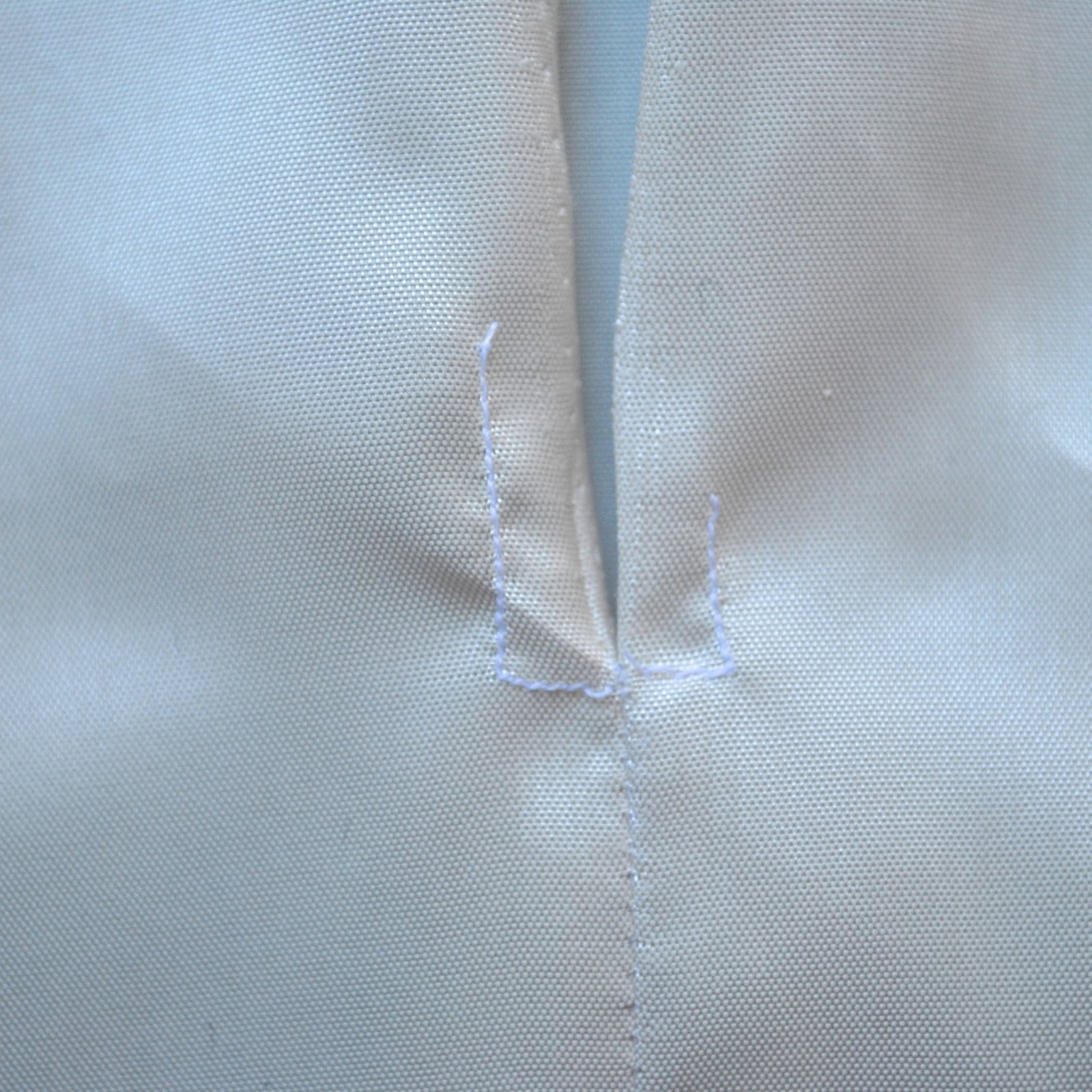
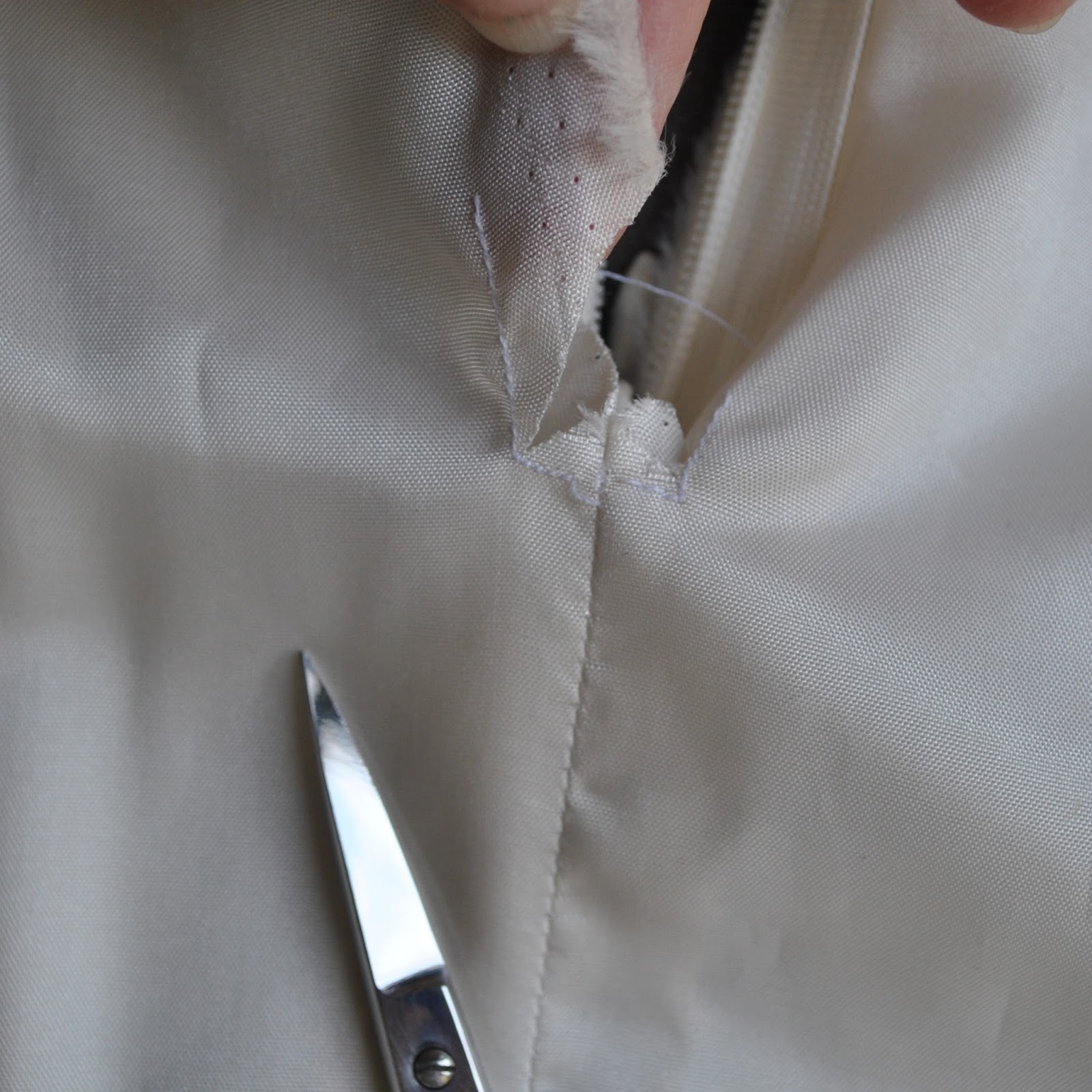
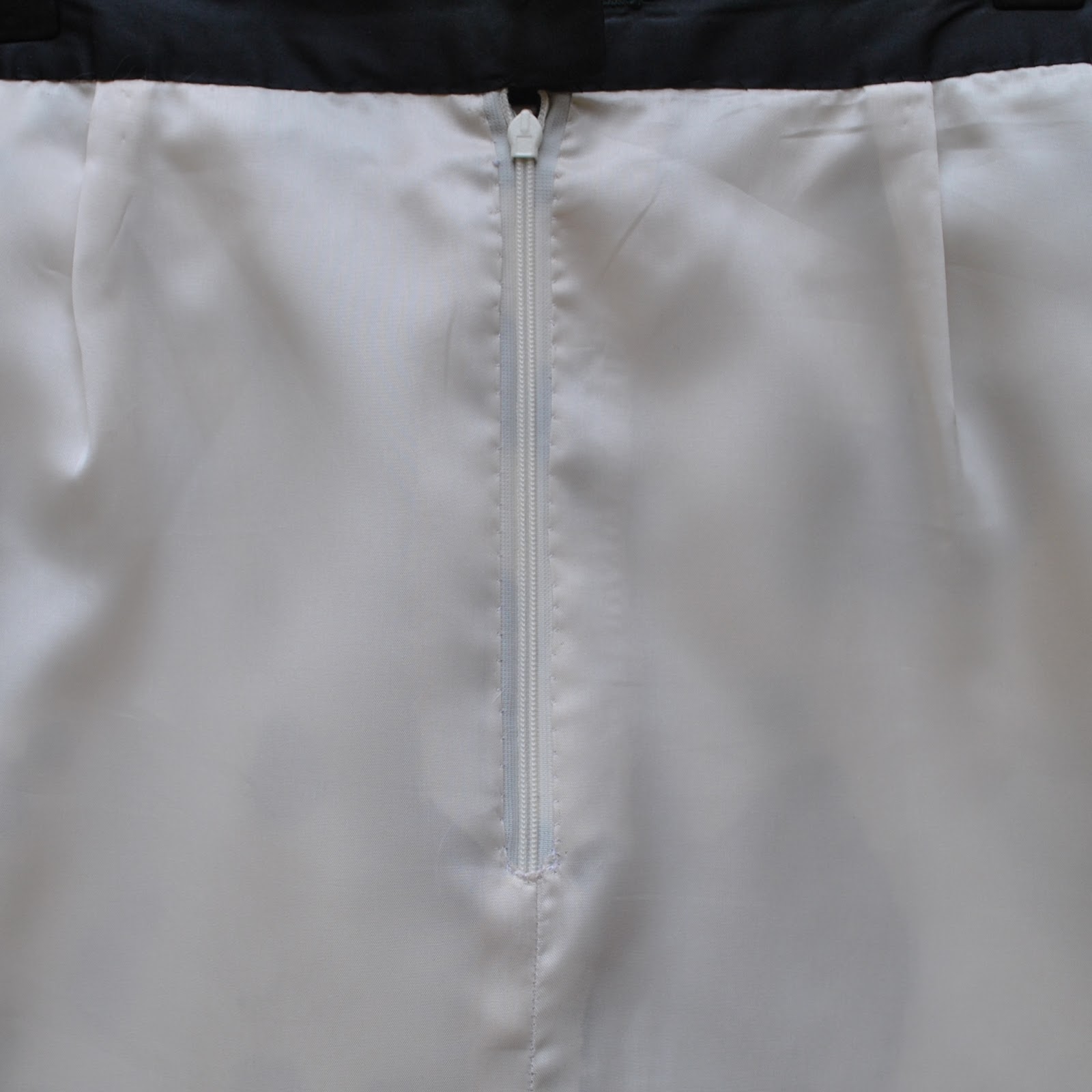
The CB seam of the lining; stitch with the regular 1.5cm (5/8″) seam allowance up to the bottom edge of the zip opening, then re-enforce the stitching line at the lower edge of the zip opening with stay stitching; stitching each side separately and keeping the seam allowance free of the stitching.  Snip into the corners, fold the seam allowances under and press.

With wrong sides together, pin the lining to the skirt at the side seams.  Pin the zip opening of the lining skirt to the zip tape of the skirt.

Also; do not stitch waist darts but merely fold the excess width of the lining at the waist dart point into a pleat and pin.  As expected, thanks to those narrower seams, these will be slightly deeper pleats than the skirt darts.  Pleating the wait darts rather than stitching them down also builds just a touch more ease into the lining.

Hand-stitch the skirt lining to the zip tape around the zip opening.

Attach the waistband as normal, and hem.  I generally hem a lining to 2.5cm (1″) shorter than the skirt, but this is a matter of personal taste.

pinterestmail

watercolour silk dress

I’ve made a new dress  🙂
Every year, my friends give me a Fabulous Fabrics voucher for my birthday; aaaah! they know me so well…!  🙂
and last year I spent it on this gorgeous, water-colour-y silk charmeuse.  And have made it into dress 35 from Patrones 7; this magazine was itself a gift to me from Merche Martinez from a few years ago.  This is the second time I have used this same dress pattern, my first version is here.
So, I have worn it a scant handful of times so far; for dinners during our recent holiday, and I’m wearing it today as well to show it off to my gorgeous gal-pals who gave the voucher to me… and I have to say I’m quite besotted with my dress already.  Honestly, bias cut silk, there’s just nothing quite so lovely to wear.  It’s a beautiful gift from you to your skin.  Seriously, my skin is thanking me every single second I spend in this dress.  It’s pure and utter heaven.  *dreamy sigh*    
To go the whole nine yards silk-wise, I fully lined the dress with creamy-coloured silk habutai.  Pinky-purple lining seemed at first to be a better colour match; but upon checking how the fabrics looked when layered together I found any colour just very subtly dulled those large white-ish feathery-floral areas, whereas a lighter creamier-coloured backing really enhanced the colours of the charmeuse and gave them a beautiful inner glow that I preferred.   Something to bear in mind when choosing a lining for lightweight, patterned fabrics; hold lining underneath the fashion fabric to check how it affects the colours before making a final decision.  Sometimes an unexpected colour choice will look better.

The dress lines are quite simple and feminine, with a slight a-line curve, small cap sleeves and I lengthened the neck-tie to extend right around the length of and beyond the v-neckline, so it is both a tie and also a sort of “collar” that finishes the neckline.  The skirt is cut flatteringly on the bias and I gave careful thought to the colour placement over the body.  I wanted the darker, moodier colours to feature mostly and aimed for the splashes of those big abstract feathery flowers to appear over one shoulder and to bloom down the side and hem of the dress, front to back.  ie. not on my tummy or right boom on the derriere.  The dress closes with a burgundy invisible zip in the left bodice side seam, and I hand-rolled a narrow hem on the sleeves and lower hemline.  All seams in both dress and lining are French seamed.

I altered the bodice pattern piece substantially from my first version because ultimately I decided that that dress incorporated an excessive degree of blousiness for my particular shape, or lack thereof, ahem.  I pinned out about 3cm width from the lower edge and curved the lower edge up as marked in red, cutting out up to 5cm in height at CF, this removed a tonne of blousiness and so is only about a thousand times more flattering on me, rough estimate there.  In lieu of lightly gathering the bodice evenly along most of its width into the skirt, instead I folded the width into four little folds, evenly distributed just out from either side of CF, treating the lining as underlining and folding them together.  These folds can be seen more clearly from the inside of the dress.

I also added about 4cm in length to the skirt at the lower edge.  I’m slightly doubtful about this added length, I don’t hate it but also am not bowled over with love for the length right now either.  I may just live with it for a while but that extra 4cm may or may not just get lopped off at some point.  I’ll just have to see how I go; weighing up the pros, such as would it look more chic if it was a bit shorter? against the cons; the main one being that I would have to re-do that hand-rolled hem.  Hmmm…

Now, on another note: anyone who follows me on IG would know already about our recent, most utterly paradisiacal holiday ever!  yep, I took my pictures on the beach during our holiday in the Maldives.  And I thought I would show one example of my set-up for taking my own pictures when away, an activity at which I now consider myself an expert!  I’m a big fan of packing as light as possible and saving myself any packing and carrying around bulky camera equipment.  Just cannot be bothered with all that.  Yeah, lazy, I know 🙂 
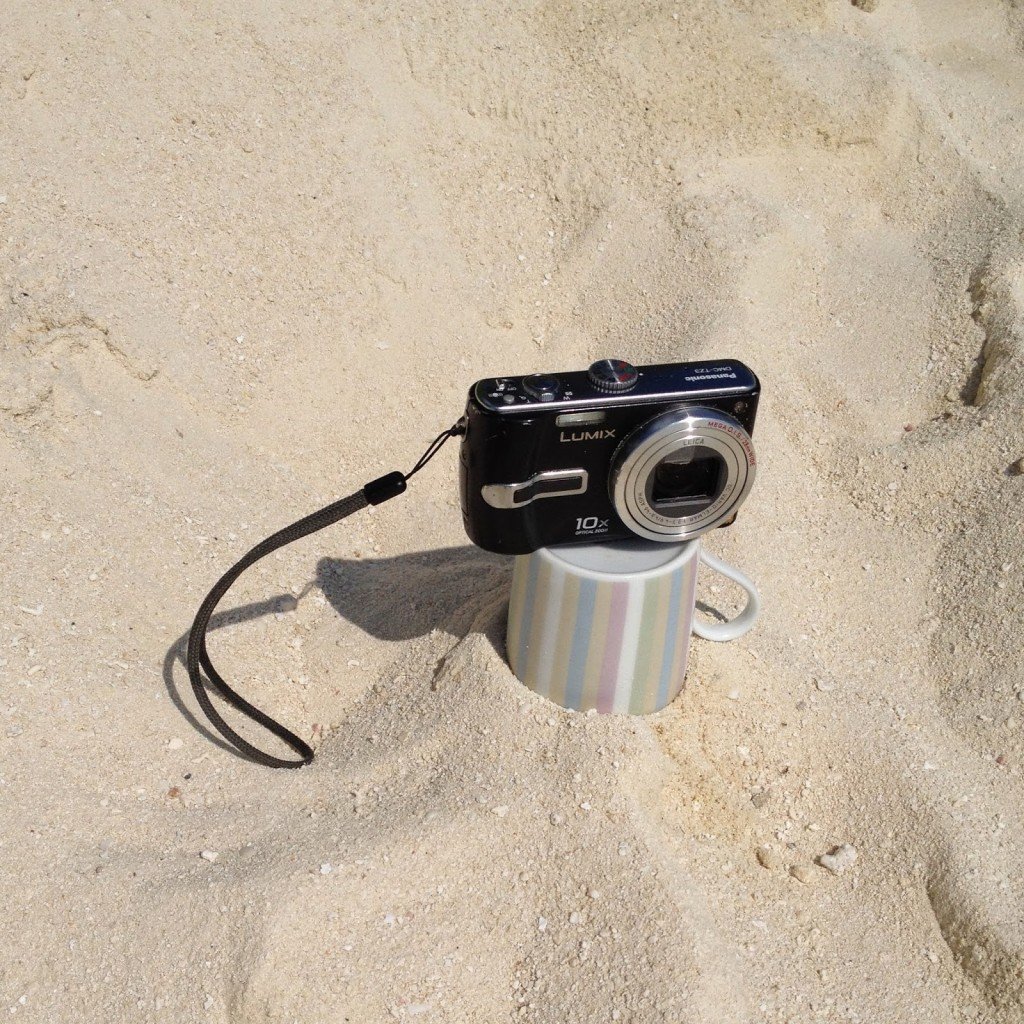
When travelling, I just take my small travel camera and nothing else.  And I look out for and take full advantage of any flat surface that I may come across, although if nothing presents itself I can at a pinch just sit the camera on its own little soft case.  This is not completely ideal, but it’s doable if no other handy flat surface is around.   Good flat surfaces include, but are not limited to: park benches, curbs, low walls, a level spot on a rise in a path.  Rocks sometimes too, though rocks can be tricky and it’s imperative to check carefully that the camera is sitting perfectly stable and isn’t going to topple over and smash.  
In the case of our last holiday, our cabin was on the beach and I used a flat-bottomed cup from our room.  My camera sat up, safe and clean, up off the sand as pictured.

Anyway, whatever flat surface is at hand; I just set the timer function on my camera, pop the camera up on said flat surface, push the button and then race out in front.  Voila.  Does the job, and requires no big bulky camera equipment.  Win!

Details:
Dress; Patrones 35-7 modified slightly, silk charmeuse
Location: Valessaru, the Maldives

pinterestmail

Caramel suede cardigan/jacket

o hello  🙂
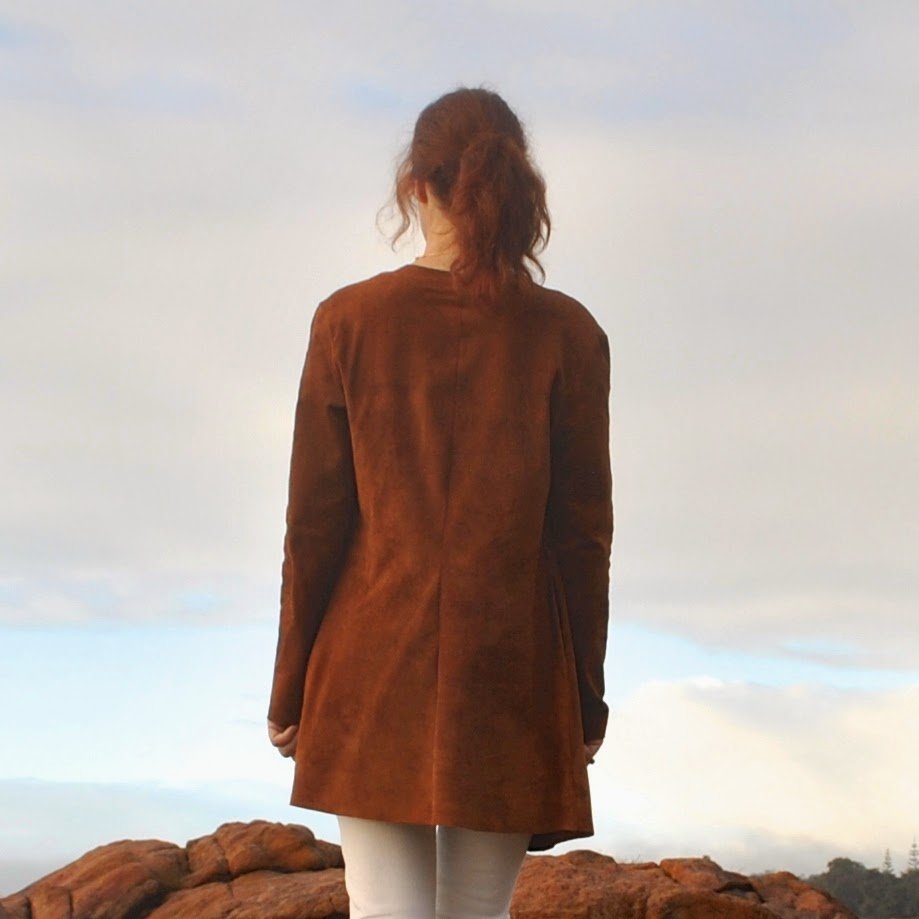
I’ve made a suede cardigan for myself, or is it a jacket?  The pattern says “jacket” but I tend to think of jackets as being kinda involved, time-consuming things to make, with lining and so forth.  While cardigans are unstructured, unlined things one can whizz up in a blink of an eye.  Which actually describes this thing pretty well.
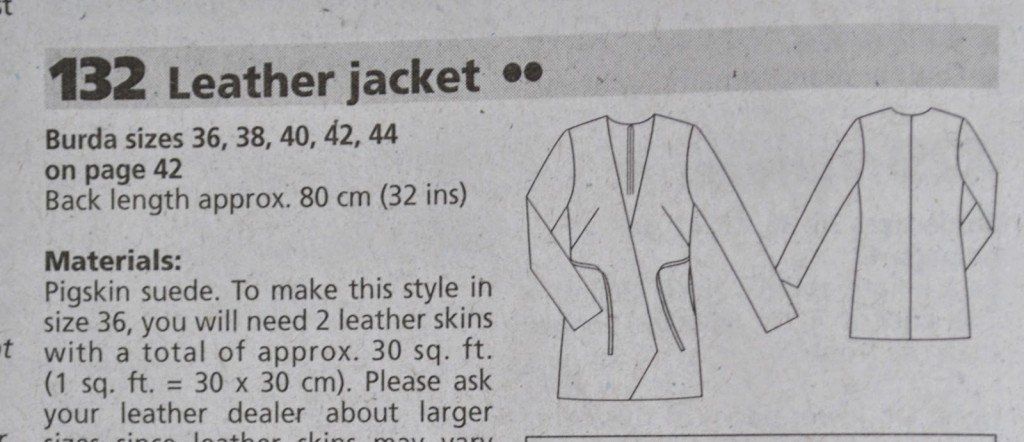
The pattern is jacket 132 from Burda style magazine 11/2012, which Philippa sent to me in a giveaway, thank you so much Philippa!  I lurve Burda magazines, the designs are usually both interesting and stylish, the cost per pattern is very very low, and still not bad even if you do only make a few things in an issue.  I reckon they deserve to be a heckuvva lot more popular than they are.  You don’t need every issue but I generally get maybe one magazine in a year and manage to make several things in each one.  This design caught my eye straight away, and was firmly in my mind when I bought my leather.  I actually made a muslin for it, which is only worth mentioning because it’s such a rare thing for me to do.  Well my leather was kinda precious and I did not want to stuff it up!  I did a minor sway back adjustment and shortened the bust darts by a few inches.
I used my two pieces of caramel brown pigskin, bought in Copenhagen on our trip.  I liked both sides; the smoother, leather-y side has some interesting brand marks, but the suede side has the most glorious, rich caramel colour.  Colour trumped brand marks.

The cardigan is quite long in the body with wide-ish front flaps so it took some layout wizardry to get the pattern pieces out!  I re-laid the pieces down over and over and over again, trying to fit them all in and cut it with the skinniest little 5mm seam allowances.  I did have to do just one little fill-in piecing on the left back back, but I managed to position this at the very top, centre back, so it’s as un-noticeable as I think it could possibly be!

The pattern has pockets; which I cut to be nice and huge, to accommodate my nice huge hands, hehe.  Burda magazine patterns have the teeniest tiniest child-sized pockets of all, I swear.  Very cute, but seriously?!  Maybe it’s just me; I like to plunge my hands right down deep into my pockets  🙂  I used chocolate brown silk charmeuse, which I fortuitously just happened to have in my stash already,  hanging around, in the perfect colour, you know, as you do  😉  Hopefully cutting those pockets out of it won’t mean I now don’t have enough for it to fulfil its original destiny.

below left; I have no idea why the colour is so off in this picture here, but… pocket! 

The pattern called for a waist tie, to be sewn in the side seams.  I preferred the idea of a separate belt that I could wear or not wear, whichever I wanted, however whim and whimsy struck, and not to have the ties dangling uselessly and annoyingly at my sides whenever I was wearing the cardigan loose.  So I put little belt loops in the side seams, seen at top left in the picture above, and made a very long skinny belt as a separate thing.  This has tonnes of mad bias-cut piecing  all along it, as I was dealing with mere scraps of leather by the time I had cut out the main pieces of the jacket.  But I don’t think that matters much, you can barely see all the joins when it’s on. This is simply folded in two lengthwise and topstitched.

I think worn loose, as at top, it looks quite modern, and with the waist tied up it looks a little bit boho 70’s, yes?

I am very happy with, and am very much going to enjoy wearing my Copenhagen souvenir!

Later edit: some technical details on sewing with leather, and thank you so much to Erica for asking  🙂
 This is the first leather thing I have made so I learned a few things… I used a denim needle and regular polyester all-purpose thread, and used paper clips to hold edges together in lieu of pins. Lots of experimenting to get the tension right, I ended up with a medium-loose tension and a long stitch. The leather didn’t move through my machine very easily, so I used strips of tissue paper while stitching the seams, which helped a lot. Fortunately, this jacket had few seams! I used tissue paper both top and bottom, and did this by folding a wide, single strip and wrapping it closely around the edges before clipping it all together with paper clips, then sewed the seam; which was easier to hold in place than I imagine two separate strips would be, and also made it easier to follow an even seam allowance while stitching too.  
For short seams, like piecing the belt pieces together; I started stitching from halfway along and ended at the edge, then turned the piece over and stitched the other half of the seam from the same halfway point to the other edge, because my machine didn’t like “starting” on an edge, and behaved badly on these. If I was to do more sewing with leather I think it would probably be very well worth getting a teflon foot for my machine, which will enable the leather to glide through more smoothly.

 Details:
Cardigan; Burdastyle magazine 11/2012-132, caramel pigskin suede
Jeans, Burda 7863, white denim, details here and my review of this pattern here
Tshirt; self-drafted, white cotton jersey, details here
Socks; hand-knitted by me, details here
Shoes; Francesco Morichetti, from Zomp shoes

pinterestmail

More on sewing knit bands

eleynagomez asked how I made the thumbhole bands on my Nettie bodysuit, thank you so much for asking!
I didn’t take any pictures while I was making the real thing but I sat down this weekend and ran up a little mock-up band … basically it is the exact same procedure as if you are adding a neckline or armhole band to a Tshirt but just on a much smaller scale!

Firstly, when you cut your Tshirt or bodysuit pieces cut the sleeves long enough that they will cover over your hands, as above.  Make the Tshirt.
Try on and mark with a pin where you want the thumbholes to sit on the sleeves.
Now, measure around the base of your thumb and cut 4cm wide bands to fit, adding 0.5cm seam allowance onto each short end.

Sew the band in a ring, press the seam allowance open.

Fold in half, long edges together.  Cut an on-grain slit in the sleeve at where the thumbhole is marked; make it just a bit shorter than the length of the folded band.  It is best to make it a bit short, you will stretch the hole to fit the band as you are sewing.  If the hole turns out to be too small to stretch out sufficiently to fit the band; you can always nick the end of the slit a little bit longer while sewing.  But if you make it too long to start with then the thumb-band might stretch out and be too loose around your thumbs.  

And no one wants *horrified gasp* floppy thumb-holes!
Pin from the band side, since stitching is to be done with the band side up.  

Also… important: whenever you do sew a ring or a tube of fabric like this, be sure to always sew from inside the tube rather than the outside; to avoid sewing down the opposite or underside by mistake!

Because it is such a tiny weeny little band; just go slow, keeping an even distance from the folded edge of the band at the left of the needle, and checking constantly to make sure the slit edge is being caught underneath into the seam.  Stretch out each end of the slit to fit the band as you go.

If desired, the seam allowance can be neatened by overlocker.

Also, I mentioned previously about sewing the joining seam in a band on the bias… I did say I would write a how-to, but this really only qualifies as a “tip”, I think!

When sewing a jersey band onto the neckline or armhole or any aperture really! of a knit garment, I’ve generally gone for a straight seam just because it’s easy.
But because there are almost double the number layers of fabric sitting at that joining seam point compared to elsewhere along the band this area is can sometimes be a bit bulky and you sometimes end up with a slight bump no matter how carefully you guide that seam through the machine.  Seriously, getting a nice smooth and even-width band all the way around is often the hardest part about making a Tshirt!
So lately I’ve been cutting and sewing the join on the diagonal, reducing the number of layers at the joining seam, and I think it’s been an improvement with almost no bumpy bit at all!!
It is a particularly good idea for bands like a cardigan button band, on which slight bumps and irregularities in thickness and width are particularly noticeable.

You do have to be careful while sewing that joining seam, since the fabric is on the bias along that edge you have to watch out that you’re not stretching the fabric at all while you’re sewing that short seam.  If you’re in any doubt as to whether the fabric will distort during stitching it would help to pin and sew to a backing piece of tissue paper, which can be ripped away after it is sewn.
Later edit in response to an email question; just to be clear, the band is NOT a bias-cut band, it is still cut cross-grain just like you normally would and it is just the short joining ends that are being cut on the diagonal  🙂

And yes, the thumbhole bands I described above are so tiny it was really too tricky to mess about with bias joining seams and I just cut those on the straight.  Choose your battles!

pinterestmail
Switch to mobile version
↓