Tag Archives: Seams

Kelly’s wedding dress

photo by Shoshana Kruger Photography

Kelly’s hair by Higley’s Hairdressing

location; the Melbourne Hotel in Perth

dress and veil; made by me!

SO; Tim and Kelly became engaged to be married in January of last year…

and shortly afterwards Kelly asked me to make her dress for her.  Of course I was honoured to be asked!  Kelly had checked out a few dresses online and pinned a few she liked, and had also tried on a few irl; narrowing down the style and shape that suited her the best.  She eventually settled upon having a dress with an ivory crepe skirt and a “nude” illusion style bodice overlaid with random beaded and sequinned lace; the bodice to be very fitting, sleeveless and with a scooped neckline so as to show off the necklace Tim had given to her; and the skirt to skim her body to the hips, then flare out below that into a graceful, gently mermaid-style hemline.  And a train!

The bodice was to be lace in an organic, “growing vines” look to it, and the lace would extend down onto the skirt and around to the back.  The train was to have lace too, and with have a cut-away insert section so you could see the floor underneath the lace.  The border of the skirt was to be edged with lace.  In addition, there were to be self-fabric covered buttons down the entire centre back seam of the dress.  Okay!!

First things first; we swooped upon Fabulous Fabrics during their yearly sale, perused and selected patterns, and spent ages picking out laces, various silks, nets and crepes, and draping and layering everything over each other, and Kelly.  The very definition of girly fun!!!


What did we pick??  In the end, we settled upon two patterns for the dress; Vogue 9239 as a starting point for the bodice, and Vogue 1032 as a starting point for the skirt.  I made a first muslin using grey sheets, put it on Kelly and got pinning and drawing lines on the muslin for fit.

Oh my gosh, fit!  there was quite a lot of fit customisation.   Kelly has a classic hourglass shape; busty with a small waist and flat stomach, and looks absolutely wonderful in her chosen silhouette, imo.  We wanted a perfectly fitted bodice, and for the skirt to skim her hips without being tight, nor for there to be any folds about her body from being even little bit loose.  Kelly bought a corset, I made measurements and issued strict instructions for her to neither lose, nor gain weight!  The pattern I used for the bodice, V9239, is actually brilliant for having different pieces for different cup sizes, which made for a much easier starting point; although my final pieces of course look very different from the starting point!  As it is drafted, the pattern is not actually very fitted at all.  I also altered the pattern pieces so as to have a straight waistline seam, which Kelly was firm about.  The skirt of Vogue 1032 is absolutely lovely; but at the centre back the three seams curve to join up in the middle in a sort of pointed arch-shape; which we all agreed is um, decidedly unattractive.  I fixed it so as to have more regular seams, and cut up the grey muslin to use as my pattern for the second muslin…

Made up the second muslin in white sheets, and the fit and style were given a big thumbs up… perfect!  I cut this one up to use as my pattern for the actual dress…

I then got brave and started cutting out the REAL fabric!

early bodice…

Bodice; for the illusion bodice, we’d chosen light coffee coloured silk habotai, overlaid with a beige/pink soft netting… this was for two reasons, firstly because the coffee-coloured silk was quite yellow in tone, too yellow; and the beige/pink net toned it down to be a better colour for Kelly’s skin.  Secondly, having a net bodice made a nice background to the lace we’d chosen for the appliquéd bodice, because it had a net background too, obviously; so having net as the default background for the bodice meant that everything blended in nicely together and looked more seamless.  So essentially, the bodice was pink/beige net/ underlined with coffee silk habotai, and I made the lining in the coffee silk habotai too.  Everything was hand-basted together and double checked for fit before machine-stitching…

skirt fabric…

lining and underlining fabric, doubled up…

The skirt is ivory crepe, underlined with ivory lining fabric, and with the separate lining of ivory lining fabric too.  I cut out the skirt and underlining and laid the pieces together, and then hand-basted all together around all edges.  MAN!!  This alone took me DAYS; literally .

Little story:  Craig absolutely insisted that we go down to Eagle Bay one long weekend, grrrr, even though he knew I was flat-chat working on the dress, so I’d bundled all the skirt pieces together and into a bag, and taken them down with me.  I spent the entire long weekend standing up at the kitchen counter in our cottage, hand basting the skirt/underlining pieces together, and to each other.  Then they were bundled back into a bag to bring home again at the end of the it.  Obviously everything was quite crinkled after such treatment and needed pressing again.  And pressing them took me over an hour too.  NEVER AGAIN!  After that, I kept all pieces laid out flat on our spare bed, and once the skirt, and then dress was pieced together, hanging up from a high curtain rod; and absolutely nothing was rolled up in a bag, ever again.

I found a length of turquoise ribbon in my stash, which I snipped in half and then stitched securely to each side seam at the waist through all layers, so as to hang it up and keep everything smooth and wrinkle free.

Also… something blue!

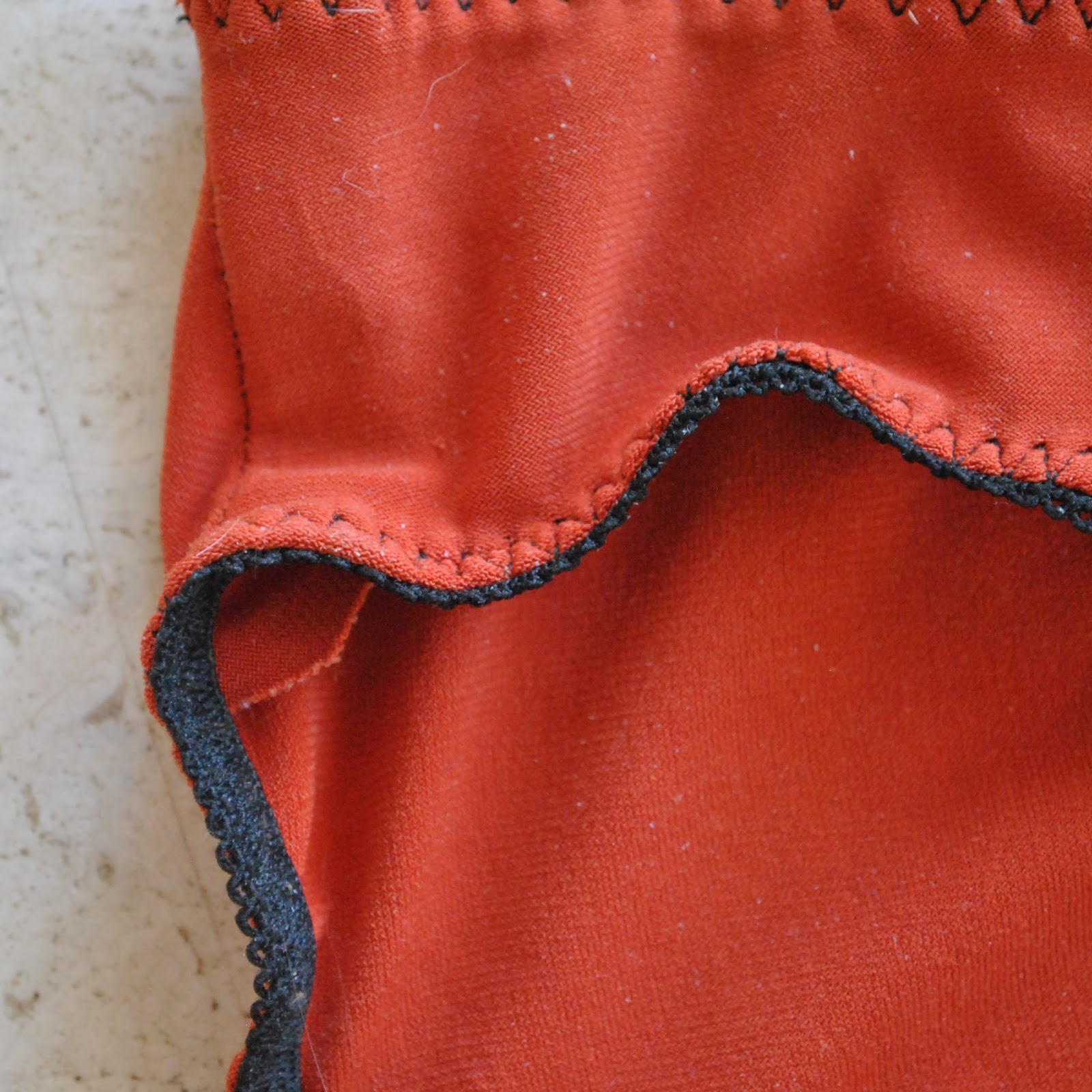
Technical edge finishing bizzo inside the skirt:  To lessen seam bulk, because let’s just consider for a minute that there are SIX layers of fabric at each seamline on that skirt, that need to sit as nice and as unobtrusively flat as possible; I treated the edges in the following ways; the skirt edges are pinked, the underlining edges are overlocked, and the seams pressed open.  For the skirt lining, I overlocked both seam allowances together, quite close to the stitching.  In the bodice, I didn’t actually finish the raw edges at all (gasp) because all that appliqué keeps things pretty secure I think and also obviously a bodice doesn’t face the fraying risks like the skirts.

below: edge finishing deets: pinked skirt and overlocked underlining edging, basting stitches can also be seen here, separate lining seen at top right with the edges overlocked together close to seam stitching

zip and waist stay: so I pride myself on getting seamlines and zip tops and bottoms lining up perfectly on everything I make, and I obviously wanted to achieve that here too…

We also wanted for the waistline to fit Kelly to a tee.  At this point, I’m going to mention again that the 3-layered, fairly massive skirt is HEAVY, and that little flimsy bodice is constructed purely of very lightweight silk habotai and net… so I realised there needed to be some fairly substantial internal engineering required.  I made a waist stay from grosgrain ribbon and stitched it firmly to the waist seam allowances, in between the outer dress and lining dress.  Then, I stitched buttonholes in the lining dress, about 12cm away from the centre back, through which the ribbon could emerge.

At Kelly’s exact waist measurement, I stitched on a metal hook and eye; so this is a “belt” that basically holds up the skirt and prevents too much strain on that lightweight bodice.  The last thing I wanted was ripping shoulder seams, or anything like that!  Getting the zip inserted at this exact spot, to match the belt, and of course, Kelly’s waist measurement, felt HUGE to me!  Its this sort of precision work that no one will ever see, but that is hugely satisfying to get right, that makes projects like this such a rush!  I was so proud of myself to get this bit exactly right!


Then for the arguably pretty and frivolous bit; appliquéing the lace.  Haha.
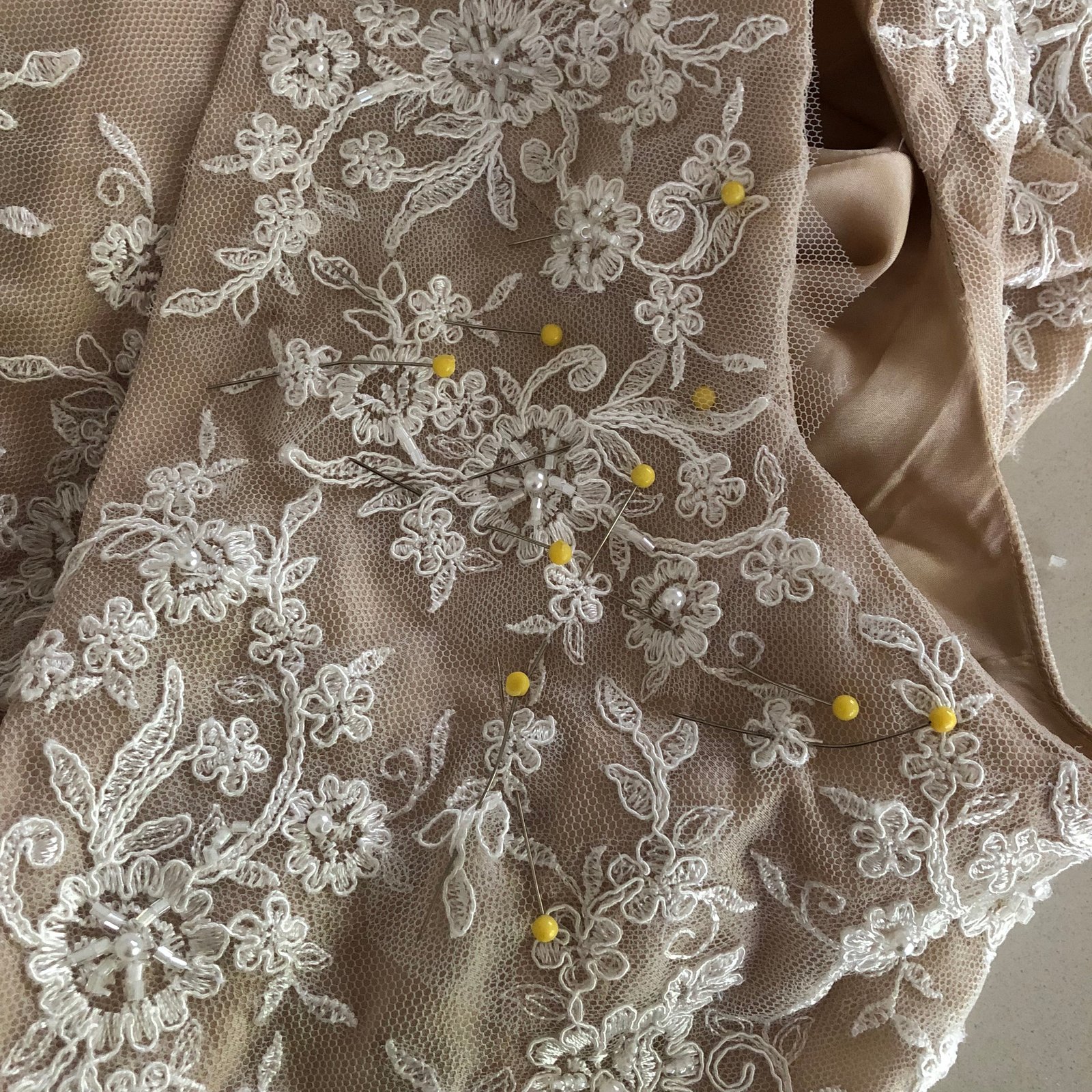
So, to digress for a minute: I realise the order here sounds counter-intuitive, I mean, wouldn’t it be better to appliqué the lace onto that little bodice before attaching it to that huge skirt with its like 20-odd metres of fabric, give or take?  And yes, I concede this might have been a good plan, for ease of stitching.  However, because the lace extended over both the bodice and the skirt, covering the join, and because the appliqué was very much going to be a 3D thing going all around Kelly’s curves, well I am actually glad I did it this way.  I started with the lace at the waistline, so as to place it over the waist seam “just right” and then started cutting motifs and laying them so as to achieve the “organically growing” look we wanted, moving up and over each shoulder.

This is the lace as bought:

snipped down into smaller motifs…

… fitted together like a jigsaw puzzle…
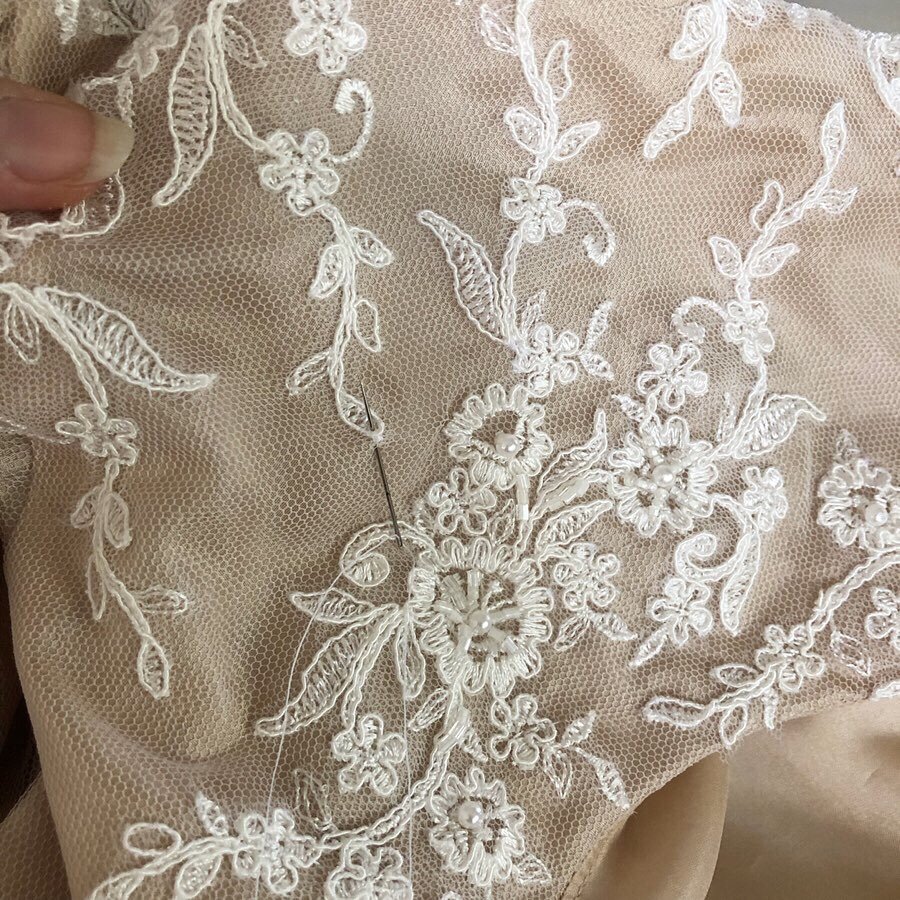
Motifs were cut down to size to fit holes and gaps; and I arranged so as to achieve an even and fully covered look with no overlapping.  Kelly also wanted for the motifs to reach the very edges of the bodice but very definitely NOT go over the edge, she hates that look! but at the same time we didn’t want any flowers or leaves to be cut in half, so there was much careful planning and placing going on…. Far from being fluffy and frivolous this part of the process was hands-down of course the most time-consuming part of the whole project.

During our trip to Japan, Yoshimi had given to me the most wonderful pair of magnifying spectacles (Hizumi), which helped enormously to stitch the tiniest, most invisible hand-stitches of lace to bodice I could achieve, and also the white-on-white appliqué on the skirt!

Because of course there is appliqué on the upper part of the skirt.  The train is fully covered with lace motifs too, although here I allowed for the motifs to be not so crowded on each other, and for there to be more “skirt” around each one.

All the motifs on the skirt are stitched to the skirt shell only, with the underlining kept free, and all the motifs on the bodice are stitched to the net and habotai shell, and the lining is kept free.  The only part where this proved difficult was when I was stitching motifs to the shoulder areas of the bodice… because Kelly wanted the motifs to be placed so as to kiss the edges of the bodice without sticking out and also I didn’t want motifs to be caught in the edges either, I stitched the bodice lining on before adding any motifs, and finished the under stitching etc, fully.  So appliquéing on these motifs required sliding my hand up carefully inside and ensuring the needle did not go through the lining layer underneath!  A little tricky, but doable, and I really love how the motifs turned out here.  The dress lining was hand-stitched to the zip tape inside after I’d finished all the appliqué.

Sorta funny story… so it was near the end and I’d basically finished the dress, and Kelly was trying it on; Cassie was there and she ever so casually pointed out a slightly bald spot, only about a few cm too big, near the back of one shoulder.  Moment of pure shock!!  Kelly said she didn’t even notice it, but for me … well obviously I just could NOT unsee again!  I just sighed, mentally girded my loins and cut out a new motif, stitched it on.  I honestly don’t think anyone would ever have noticed, but I just had to fix it.  Also did a ultra careful inspection to see if there were any more bald spots… there were not!

weeks and weeks… that’s all…

Shout out to my wonderful Mum who responded to my stressed-out vibes through the phone, came up for a weekend and spent two days working on lace appliqué while I worked on Georgia’s dress… thank you Mum!!  and I’m sorry I was such an exacting taskmaster!!

The lace border to the skirt… this is also a cautionary tale … initially I’d stitched the border onto both the skirt and underlining together.  BIG mistake!  Because the skirt is crepe, which has a heavy-fish drape to it, and the underlining is polyacetate lining fabric, which has less drape to it; the skirt just “hung” over the border lace, just ever so slightly, in several places, in a most unattractive way.  It was subtle, but noticeable.  I could not believe my eyes when I hung the dress up on its curtain rod, and noticed it.  Moment of utter deep depression; I was going to have to unpick that border lace and re-attach it to just the shell this time.  I mean, let’s just speculate for a minute on the length of that skirt border.  I reckon it is, oh I dunno; 6m? or more?? I couldn’t bring myself to actually measure… and what’s more, I’d done a really good job sewing on that lace border; nice solid zig-zag stitch, by machine, around each and every in-and-out bit.  This was a real low-point for me, where I actually wanted to cry.  However I just got out that old seam-ripper, immediately; and like a robot just got straight onto it; otherwise I knew I might actually break down.  The border hung perfectly after I’d re-attached it to just the top layer, thank goodness for that.

The lace insert for the train was another moment of “how the heck am I going to do this??”  In the end, I made a tissue-paper pattern of the train, in the size and shape that we wanted the lace insert to be, and simply arranged lace motifs in as artistic and “interesting” way as I could.  I’d used lots of the lace we’d bought on the bodice by this time and was running low on the bigger pieces, but managed to make it work!  Then I stitched them together onto the pattern, ripped the tissue-paper away, and firmly zig-zag stitched the whole thing around its edge to the; as yet still intact, train.

I left cutting away the crepe from underneath until quite late in the whole saga, simply because I was so nervous about this part!  The point of no return!  What if we didn’t like it?!   In the end it was fine and I needn’t have stressed about this.  I also cut away the underlining a bit bigger, and carefully overlocked the edges.  To keep the underlining in place underneath the skirt and not fold in on itself, or flip underneath the lace insert and show underneath; I joined shell and underlining together all around the lower edge with hand-stitched “tethers” about 1″ long, at about 6″ intervals.  This worked really well!

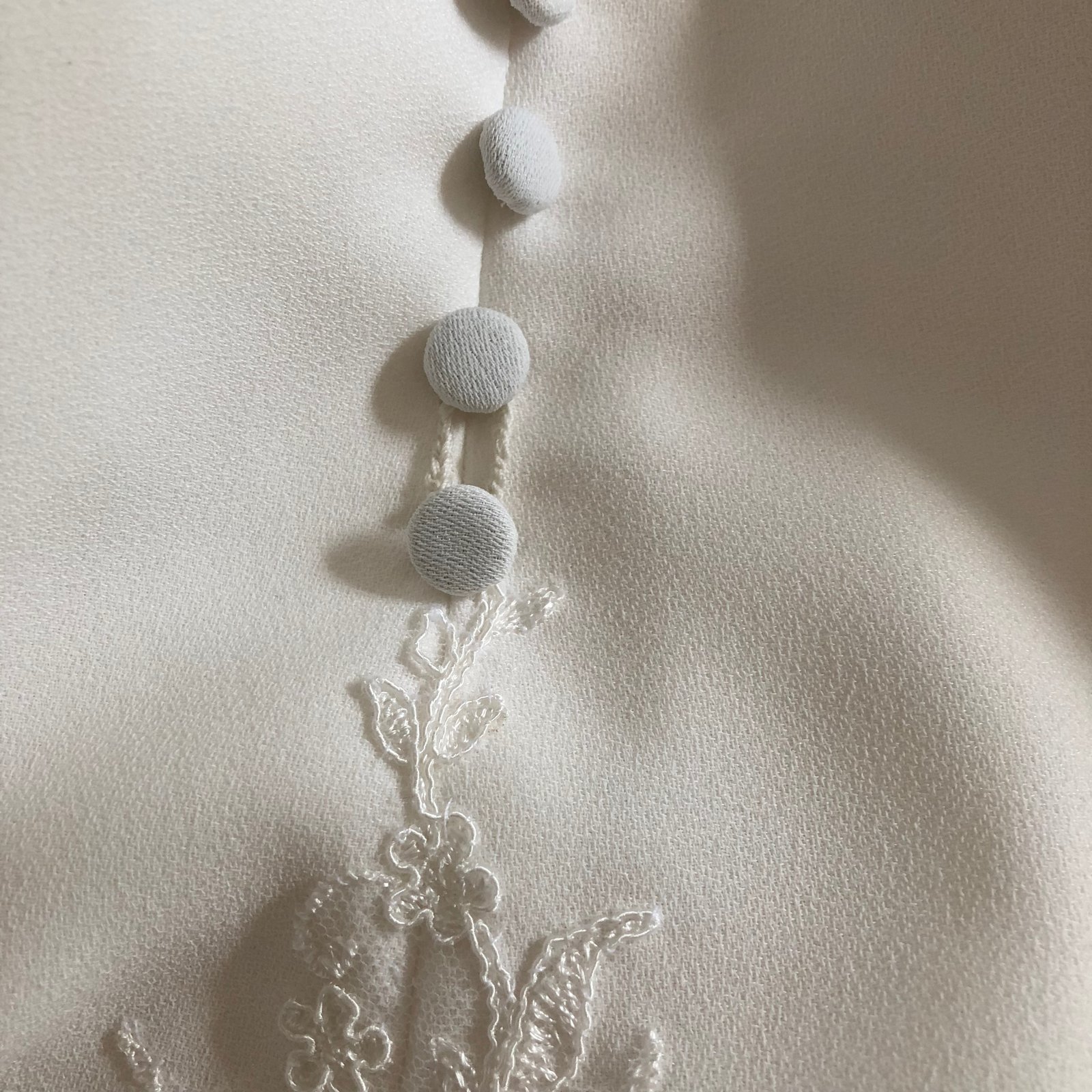
The buttons…  So I spent some time investigating and sourcing possible candidates for the self-fabric covered buttons.  The ones you get at Spotlight are absolute CRAP, by the way.  DO NOT BUY.  You can order custom-made self-covered buttons done at Buttonmania in Melbourne, for a price.  In the end though, I bought a 100 pack of 11mm self-cover buttons from this etsy store, and was very happy with both the product and the delivery time.  Have I written before about the experience of covering them?  If so, I am about to repeat myself, because this story illustrates quite clearly how very mad and insanely attention-detail-y I can be, ahem…  so the metal buttons are naturally silver, and I covered a few experimentally and for Kelly to see.  Both she and I could see that the silver of the buttons was showing through the crepe a little, and making them look noticeably grey in comparison to the dress.  Also, being metal and slippery, it was quite difficult to hold the little circle of fabric in place evenly while trying to push the edges in between button and shank-piece.  So eventually; I got the remainder of the 100 buttons and lined them up along bamboo skewers that had been set up like train tracks, and spray-painted them all with ivory spray paint, leftover from when I made my Queen Rutela cosplay…  the painted surface not only provided a nice “grippy” surface making them a lot easier to cover, but they were also noticeably less grey.

Finicky? yes, but a definite win and worth it in the end. I stitched the buttons down the back seam of the dress at 2.3cm intervals.

This length chosen because it was visually pleasing, and worked out to be a perfect division of the seam length from the top point down to the bustle point and to the bustle loop point; where I stitched the upper of the train lace motifs.

At the aforementioned bustle points; I stitched plain buttons inside – blue ones, something else blue!!  – beneath the outer, decorative ones, stitching them together to the seam allowance through shell and underlining skirt layers.

For the bustle loop, I took 4 strands of Gutermann’s upholstery thread, for strength, and crotched a 4.6cm length to fit perfectly around the button above and back, so the button spacing would be perfectly even even with the bustle done up.   The thread ends of the crochet loop passed through the skirt and through the holes of the button underneath, and were then fastened off with multiple, very firm tight knots.  The loop is not itself stitched to the skirt, because I worried about the possibility of the skirt ripping if there was any strain placed on it, instead all the strain is placed on the button on the inside.  You know what? that train is HEAVY.  As it is, in a lot of pictures where the train is bustled up I see, or think I can see, at least, how the weight of it is pulling the back of the dress down quite substantially.  I don’t think there’s any way around this, it’s just how it is; but I’m glad I made that crochet loop industrial strength!  It held up beautifully.  When the train was not bustled up, the loop sat unobtrusively and fairly invisibly looped around the button above, nicely tucked out of the way.
the veil:

the funny thing is that at first Kelly didn’t even want a veil; but we’d visited a bridal boutique where the girl dressing her just popped one on her head, without being asked.  It looked so lovely against her dark hair and Kelly just froze, I could immediately see that a veil had suddenly become a very firm “yes” in her head.  The veil was very simple and plain, one soft waterfall of unadorned net, with a comb and one single lace motif.  So we bought a metre of net in the right shade of ivory, too.

Now is the time to mention; Kelly also had a piece of her grandmother’s wedding dress that we wanted to incorporate into her dress somehow… it is peach satin; completely lovely, however a very different colour and texture to any of the other fabrics that Kelly had chosen for her dress.

I’d put a lot of thought into how we could use some of it in her dress, eventually I had the idea of using some to make the padded base for her veil on which to sew the lace motif she wanted…  I cut a short piece of batting and hand-covered it with a piece of the peach satin, then stitched this to the metal comb Kelly gave me… the first double pass of stitching I used regular all-purpose thread, then for the second pass of stitching I used ivory Gutermann’s upholstery thread.

I snipped a motif from the wedding dress lace down to a good size/arrangement, but it was quite floppy on its own so I boiled up a solution of cornflour/water to make a homemade starch to stiffen it.  A short soak in the starch, then left it to dry overnight… I had intended to use more starch if the lace wasn’t stiff enough however my very helpful husband threw out the starch and washed the saucepan, thinking it was just dirty water!!  Fortunately, just one soak in the starch was enough to stiffen it perfectly fine  🙂

I’d lightly tacked the wedding netting on the comb already, and then just stitched the stiffened lace motif to the top… voila!!  All I had to do was trim the veil to the right length… I laid it out on the table, measured, measured again, measured a third time!!  Then in one clean go, cut a nice even swoop off at the length we’d decided.

I think it looks so understated and beautiful, and perfect for Kelly’s style.

the garter; Kelly had planned to make the garter herself, but with less than a week to go and she was still super busy she emergency-asked if I could please make a garter too?  fortunately this is super easy.  I used another piece of the precious scrap from her grandmother’s wedding dress, and whipped one up.  Along with a tiny lace motif stitched on the join.

The very last touch?!  As a secret surprise for Kelly, I embroidered another piece of her grandmother’s wedding satin with Tim and Kelly’s names, and the date of the wedding.  I used a water-soluble pen to handwrite as neatly as I could, my own hand-writing; and hand embroidered using embroidery floss.  Something else blue!!  I stitched this precious patch inside the dress as a final touch. and she did not see this until the very moment she put on the dress on the day of their wedding!

I’m just going to write a story of transportation of the dress to the hotel on the day; because we spent some time worrying how to get it there, perfectly clean and safe from rain, street dirt, or anything like that… the solution; a mattress protector!  Yep, Tim went to Bunnings, picked up a single size mattress protector, which is basically a huge plastic bag.  I pulled it up over the dress and taped it shut at the top, over the hanger.  Hehe, funny story; he initially bought a Queen sized mattress protector, which made for some outraged jokes from Kelly along the lines of “just how big do you think I am, TIM?!!!”  Lol!

One other little story; the buttons on Tim’s waistcoat were coming loose so he’d asked me to stitch them on again, so I did.  I also took the opportunity to stitch a tiny, subtle little good luck message to the inside.  I wondered if he’d even notice it? and he did!  The lovely photographer Shosh made sure …  🙂

I just had to include this picture… look at our handsome boy!!!

photograph by Shoshana Kruger Photography;  genes by us  😉


So that is that!  Easily the biggest and most emotional thing I have ever made so far in my sewing life; I’ve been living and breathing this for like six months and have actually done very little else during that time.  However? also one of the most wonderful and rewarding things I have ever done!  I am so grateful for the experience, and for the trust placed in me and my abilities by Kelly, entrusting me with the task of making her dream dress.  This will forever be one of my most special projects.

And of course she looked absolutely beautiful!! glowing with love, lending her beauty to the dress, making it look amazing!!  She was an absolute dream to sew for, not only committed to her original ideas, but also ultra-enthusiastic and infectiously excited about every single step.; it was really wonderful to be buoyed along by such joy and interest in how I was getting along with it every time she came over… also, let it be said, that she had such a very firm vision of how her dress was to be, which certainly made my life happily so much easier when it came to the creative process.  She never ever backtracked on her earliest decisions or her vision of the dress, not one little bit, which thank goodness for that! I mean, this is my first experience making a wedding dress, and I can now fully appreciate now how very hard it could be if you had a bride constantly second-guessing or changing their mind half way.

I love this picture of Tim twirling Kelly about…

photograph by Shoshana Kruger Photography

Also of course most importantly of all to mention is that Kelly and I forged even more lovely solid bond of friendship during the process of bringing her special dress to life, which I hope continues to strengthen and grow in the years to come…  🙂

jarrah wedding arch made by Tim himself

flowers by Green Vase Flowers, Perth

 photograph by Shoshana Kruger Photography

Kelly’s hair by Higley’s Hairdressing

pinterestmail

Christmas pressies; a sewing marathon

Tim and Kelly…

As usual, I made Christmas presents for my family… I started late October, so I was giving myself plenty of time, or so you’d think!  I’m a fairly efficient seamster, and I still only just finished a few days before Christmas!  it’s been a little intense and stressful, actually; every year I underestimate how busy the lead-up to Christmas is and how I just don’t get as much time to devote to sewing presents as I thought.  Plus, I’m a lot more finicky and particular – maybe excessively so?! about my sewing now too.  I think this is a good thing, but I have to accept that I’m taking longer to make things, and should start sooner!  Or maybe make less?

Anyway, it got done!  *phew

Listing everyting in the order I made it…

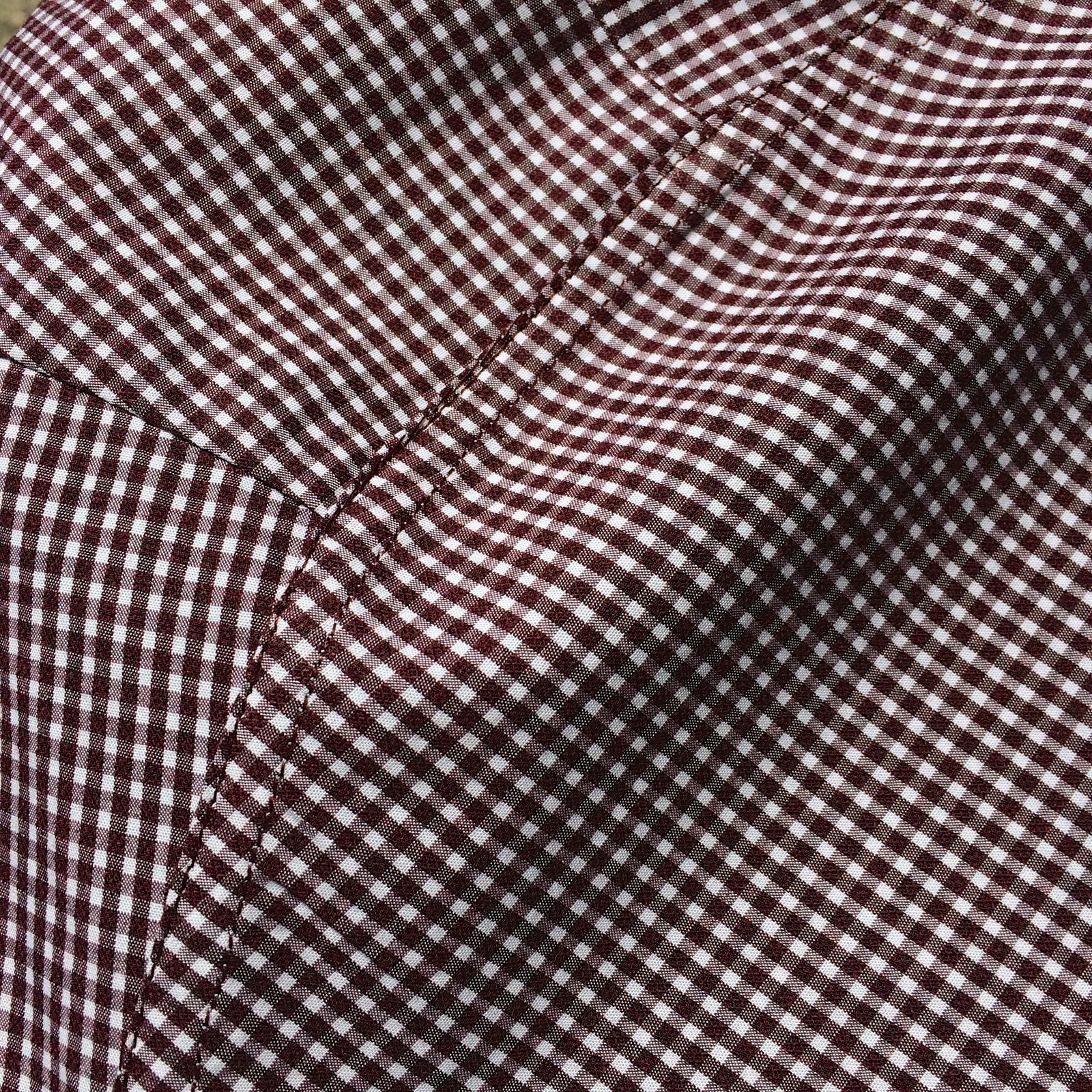
First thing to get made was a shirt for Tim… He has a job now where he has to look smart, so I decided to make a business shirt… I bought the really lovely deep maroon, mini-scale gingham cotton shirting from Tessuti’s in Melbourne, and used Burda 6874, my kinda go-to shirt pattern since I semi-retired Burda 7767.  d’you know I made that pattern 37 times… can you believe it?!  that tissue paper was wearing pretty thin in some places and in some other places I’d trimmed off the cutting lines altogether, woopsies!!

what sleeve placket…? of course I busted a gut matching those teeny little checks everywhere, took me two days before I could see straight again…

I made the buttondown version… see how the collar up there buttons down onto the shirt?  This is what qualifies it as a buttondown, folks!  I don’t wanna get all grumpy and pedantic here, being Christmas and all, but the number of times I’m reading about someone’s very lovely, but NOT A BUTTONDOWN shirt erroneously labeled as such and have to hold myself back, because we all hate a little lecture, right? I’m gonna stop right now otherwise I’m going to become that painful lecture-r.

this is the inside of the shirt… I’m pretty proud of my flat-felled seams… and I use the burrito method for the yoke so that’s all nicely enclosed too

All seams are flat-felled, using my own tutorials here and also this one here… yes you can flat-fell every single seam in a shirt! and it’s so much better and nicer… although I’m starting to realise that this is probably why what used to take me maybe two days to make a shirt…  now takes me double that time at the least! but anyway.  My guys appreciate the tailoring, so I’m happy that they’re happy.

Sam’s shirt…

I’m just SUPER happy with how my buttondown collars are looking nowadays!  It’s pretty hard to get that sitting just right and perfectly symmetrical; and I think after all the shirts I’ve made I’ve finally got it down…

Next up; I made a matching top for Kelly.  I’ve previously made matching tops for the two of them and noticed that they wear them together a lot! yes, it’s super cute…  I did a little bit of subtle inquiring as to whether matching clothes were still something they liked before I went there and got a positive response.  Alright then!

I had to be far less subtle about fitting it though!  I’d previously taken Kelly’s measurements for when I made a Kelly anorak for her… it’s impossible to do this without it being obvious! and made a block for her, using my Pattern Magic book to help me.  Yes, this is a pretty involved thing to do, requiring protractors and algebra and such-like! but honestly I’ve always found it to be a hugely worthwhile exercise when drafting new patterns.  Then I mocked up a quick plain bodice, and got her to try it on, and made the necessary changes.  In Kelly’s case, the block fitted but the armhole/bust dart had to modified considerably… the famous full-bust adjustment.  I regret now that I didn’t take any pictures of the mock-up bodice and the changes I made because it was a new learning curve for me that I wish I’d documented!

For Kelly’s top, I’d chosen the asymmetrical cowl top from Pattern Magic 2; the shape of the cowl is dictated by the shape of the facing.  It’s always a bit of a challenge to draft your own patterns, but well I love a challenge! and I knew the shape of this top would be super flattering for Kelly and suit her beautifully…  I cut the pieces on the bias and inserted a maroon invisible zip in the left side seam, so it zips down undone… however Kelly says she can squeeze into it without having to undo the zip which is cool.  I think the bias-cut is what gives it that little bit of stretch.

Next up! a business shirt for Sam! He has also started a new job which requires business dress everyday… I’d noticed a lot of young men wearing gingham shirts while we were in Melbourne… a good sign that gingham is super on-trend! so hot right now! which is basically why I bought gingham for both my boys in the first place.  It’s a bugger to pattern match though, even worse than stripes! gnnnnnnn  but oh well…

Again I used Burda 6874, flat felled seams throughout, same links as for Tim’s above… aaaaand so not much else to add.  Both Sam and Tim have been working out some lately, so I think I’m going to have to make some small adjustments to their shirts in the future.

Next up!  I made some little things for Cassie, she needs more work clothes so this was another practical gift really.  I made three things for her…. I just want to say here; it might seem unfair that I made one top plus TWO skirts for her, when compared to just one shirt for each of the boys, but it really does even out because the TIME I spent making these three little separates is actually the same as the time I spent on EACH of the boys’  shirts.  I know, crazy right?!  it’s all that tailoring bizzo that takes so much time…

Likewise, Kelly’s top needing a block made, plus the fitting muslin, plus drafting a pattern, also took about the same amount of time as making three tried and true things for Cassie!

Anyway; Cassie had already chosen this lovely crackle-y hand-painted cotton from the Fabric store in Melbourne while we were there, and I secretly bought the mustard gingham printed silk from Tessuti’s while she was looking elsewhere.  So the little top was a surprise!  The crackle print really is gorgeous, it is hand painted in Zambia and has that handmade naturalness to it…  LOVE this but pattern matching those hand-painted stripes was never going to happen!  of course they are all different widths and thicknesses which just adds to the charm of course.  I just shut down my inner-obsessive for a little while and did my best… at least I got the centre back seam to match!

The other little skirt is a cityscape print, maybe New York City by the looks of that Lady Liberty in there!  We’d seen the fabric in the upholstery section of Spotlight, so she’d known this one was coming too…

for both skirts I bound the lower hem seams using some leftover purple pin-striped linen, the leftovers from when I made this shirt for Craig a few Christmas’s ago.

I have also taken to binding the bottom edge of the zip and stitching it down to the seam allowances… often the bottom edge of a zip has a slightly scratchy bit which can be extreeeeeemely irritating when you’re wearing it… so I’ve taken to doing this whenever I made an unlined skirt with an invisible zip.  Such a small thing that greatly increases the comfort factor when wearing the skirt!!!


Oh! patterns!  I used the Inari tee pattern for the little top and Vogue 8363 for both of the skirts, and since I’ve made both of these patterns for her several times already they were super quick and easy to run up. For both skirts I added belt loops so she can cinch in the waistline a bit; in self-fabric for the Zambia striped one, and in black denim for the cityscape one.

Next up! a short-sleeved white shirt for Craig! also using Burda 6874 and a white cotton broadcloth from Spotlight, this was intended originally to be the same as this little shirt that I made for him a few years ago and which happens to be his most worn shirt … then just before making this I’d whipped up my little yellow/black&white lingerie set and had the gingham ribbon sitting out, and suddenly had this brainwave as to how I could use a bit more of it! I stitched the gingham ribbon carefully down the button line of the button placket, and used a little bit to trim the pocket.

To match this gingham detail, I lined both the collar and collar stand with some cotton gingham that I’ve had for aaaaages, and used black buttons to finish the shirt.  Note; IT’S A BUTTONDOWN SHIRT!  Also, of course it’s nowhere near a clone of the other white shirt any more but I still think he’ll wear it a lot…

Next up! a pullover/sweatshirt for Craig!  truth now… I was running out of time, and steam! and this fair near killed me!

Craig with a much much smaller Sam and Tim…

So, once upon a time, nearly twenty years ago, we went on a summertime camping trip down south and it was blooming’ freezing, our tent nearly blew away, we got rained on, hailed on and fair near froze to death!  In pure survival mode, Craig drove to the nearest town bought a red sweatshirt that he has since LOVED and worn about a million times, almost to bits since it’s getting reeeeeeally worn and threadbare now.  At some point he asked me to make a clone of the famous sweatshirt…

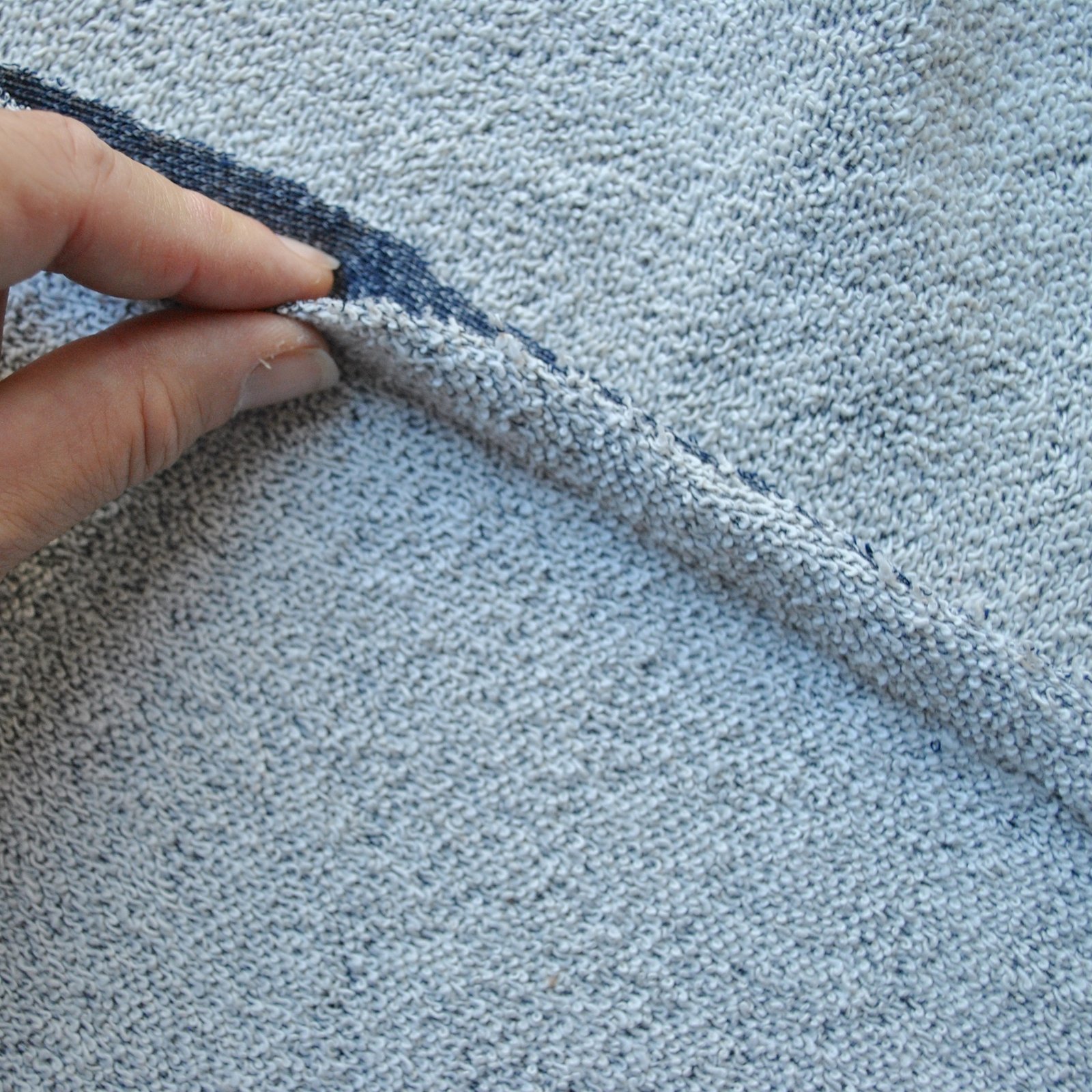
Of course it’s easy to clone a sweatshirt, but the challenge is in finding suitable fabric! I found this blue marled French terry in Spotlight, and while the colour is a teeny bit blah and the texture is not as nice as his original sweatshirt, it’s going to make a reasonable stop-gap until winter rolls around, the winter fabrics come into the shops, and hopefully I can find something nicer.  I busted a gut finishing off all the seam allowances off beautifully inside though… imitating the exceptionally beautiful finishes that were in the original.  For the pockets and bias binding I used some of the leftover navy/white gingham that I used for Sam’s shirt, above.  The pockets are French-seamed and the rest of the seams have an interesting amalgamation of HongKong bound AND flat-felled seams… not sure if my method is the same as in the original but I worked out a way to do it and took a few pictures along the way.

First, stitch the seams, then figure out which way you want the seams to be stitched down and apply bias binding to the topside of the seam allowance… ie. to stitch along the same stitching as previously you will be pinning/stitching along the UNDERNEATH,

OR alternatively you can save yourself a step here and stitch the bias binding on at the same time as you’re stitching the seam; your choice.

Press the garment seam allowances open, then press them to the side where they will be felled, with the bias binding on top.  From the other, right side, of the garment, pin through all layers.

With the right side facing up, topstitch the garment to the seam allowances plus binding, through all layers, just to the side of the garment seam…

view on the inside…

Keeping the bias binding free and clean, trim and grade the garment seam allowances…

Turn under and press the raw edge of the bias binding down so as to encase the seam allowances of the garment, pin in place.

With the bias binding facing up, and following the previous stitching as a stitching guide, topstitch the pressed edge of the bias binding down.  Since you’re using the previous stitching as a guide, the width of your double-topstitching will be nice and even from the outside.

Voila!  Such a nice neat finish!  at first I thought it might be overkill, but it is rather classy, if I say so myself; looks pretty good both inside and outside.  I will definitely be using this one again!

As seen above, I also applied bias binding all around the zip tape and stitched it down with double top-stitching the same way to match… this really does make a nice, neatly finished look when the zip is down.  Which it will be, most of the time.

And, last but not least!  I also made a few more little hardback notebooks… just fun little things, however I do know that the recipients do actually use notebooks regularly so I know they will be useful too!  I used mostly a mixture of leftover and old papers; from old scrapbooks, some with the children’s scribbles still on them!  I’m sentimental that way  😉 , various papers, musical paper, some pale coloured wrapping paper, writing stationery; just lots of different stuff.

The notebooks are covered variously with linen, velvet, printed cotton.  The one I made for Mum is covered with raw silk hessian.

So! Yes, it was quite a lot of stuff to make and I was working on it all like billy-o from touching down after Melbourne right up until I finished right on the wire only two days before Christmas…  I’ve been thinking about this… why am I taking longer to achieve less nowadays?  and I think it’s because I used to be happy and content with a slightly more unfinished approach… slapdash is maybe too strong a word? whereas now I am far more, possibly excessively? finicky and particular about perfect finishes on the insides.  I think I’m ok with this…  I feel like well-finished clothing is what I’m into right now.

However, to avoid the Christmas stress maybe I need to start making Christmas presents a LOT sooner!  Each year I start way ahead of time and think by doing so will relieve the stress, each year I get super stressed out and have at least one “I CANNOT DO THIIIIIIS!!” moment.  But I did.  And now for a break from deadlines!!

SaveSave

SaveSave

SaveSaveSaveSaveSaveSaveSaveSaveSaveSave

SaveSave

SaveSaveSaveSaveSaveSave

pinterestmail

Sydney jacket

have you guys seen COLOSSAL… ?

Bet you can’t guess where I am here…   Yeah, I know, it’s a tough one.   Some locations are just so obscure and far off the beaten track, but I do like to seek out these especially quiet and sleepy, tucked-away little spots to highlight here on ye olde blog…  GO me.

Yeah, so I’ve made a Sydney jacket… I bought the pattern from Tessuti’s in Melbourne back during my March trip away there with Mum, Cassie and my niece Tiffany; and have finally got around to giving it a whirl…  I think I first saw this design on Sue, at one of our meet ups and was instantly interested.  It’s a pretty nice design with a true shawl collar and not just your usual body with two set in sleeves.  This is like my wearable muslin, if you like.

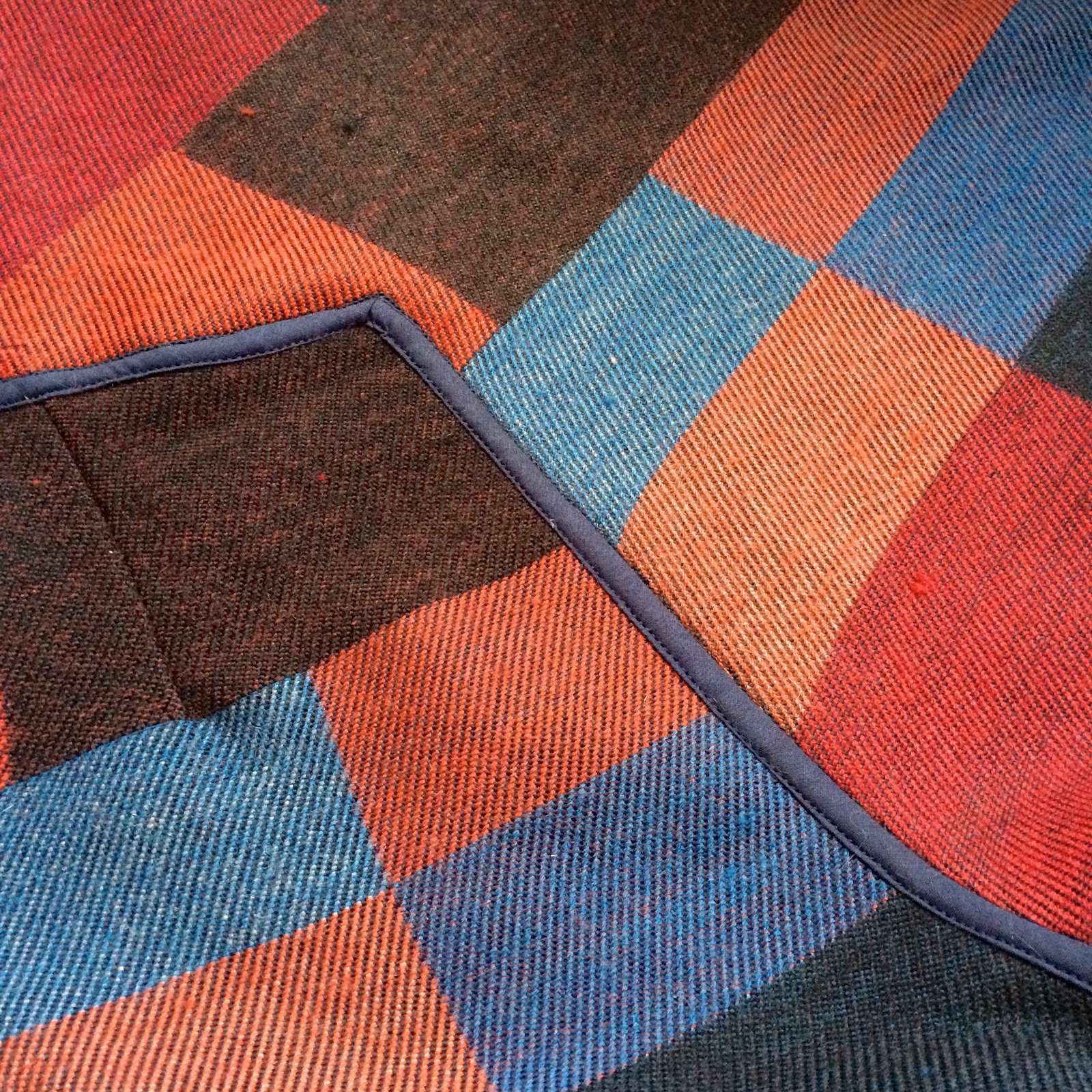
I used a very blankety-like wool-mix from Spotlight, which I think is definitely a lot more “mix” than “wool”, haha! but that’s fine by me!  I tossed it in the machine when I got home and it washed up beautifully, absolutely zero shrinkage and just a bit of light “fluffing”, which was equally ok with me; in fact any and all fluffing is totally welcome in all my winter clothing, thanks.

I agonised for ages over which side to use; one side was more vibrant but “flatter” with a more pronounced twill to its appearance; the other side is fluffier, and with more muted colours.  I loved both sides equally! and couldn’t decide… finally I asked Craig and Cassie to choose for me.  They both voted vibrant OUT, fluffy IN.  Hurdle number one; cleared!

It’s a lovely fabric really, warm and cosy and with that richly colourful blocky weave, the perfect drape;  and I loved the idea it for this particular jacket pattern… however! the Sydney instructions have a big bolded announcement on the first page… IMPORTANT: Not suitable for woven fabrics that fray when cut  What is my chosen fabric? only like the most fray-able of fraying fabrics ever invented by mankind. Typical of me, so stubborn.  I’m like… Oh, I’m not supposed to use a fray able fabric?  JUST WATCH ME THEN mwahahahaha.

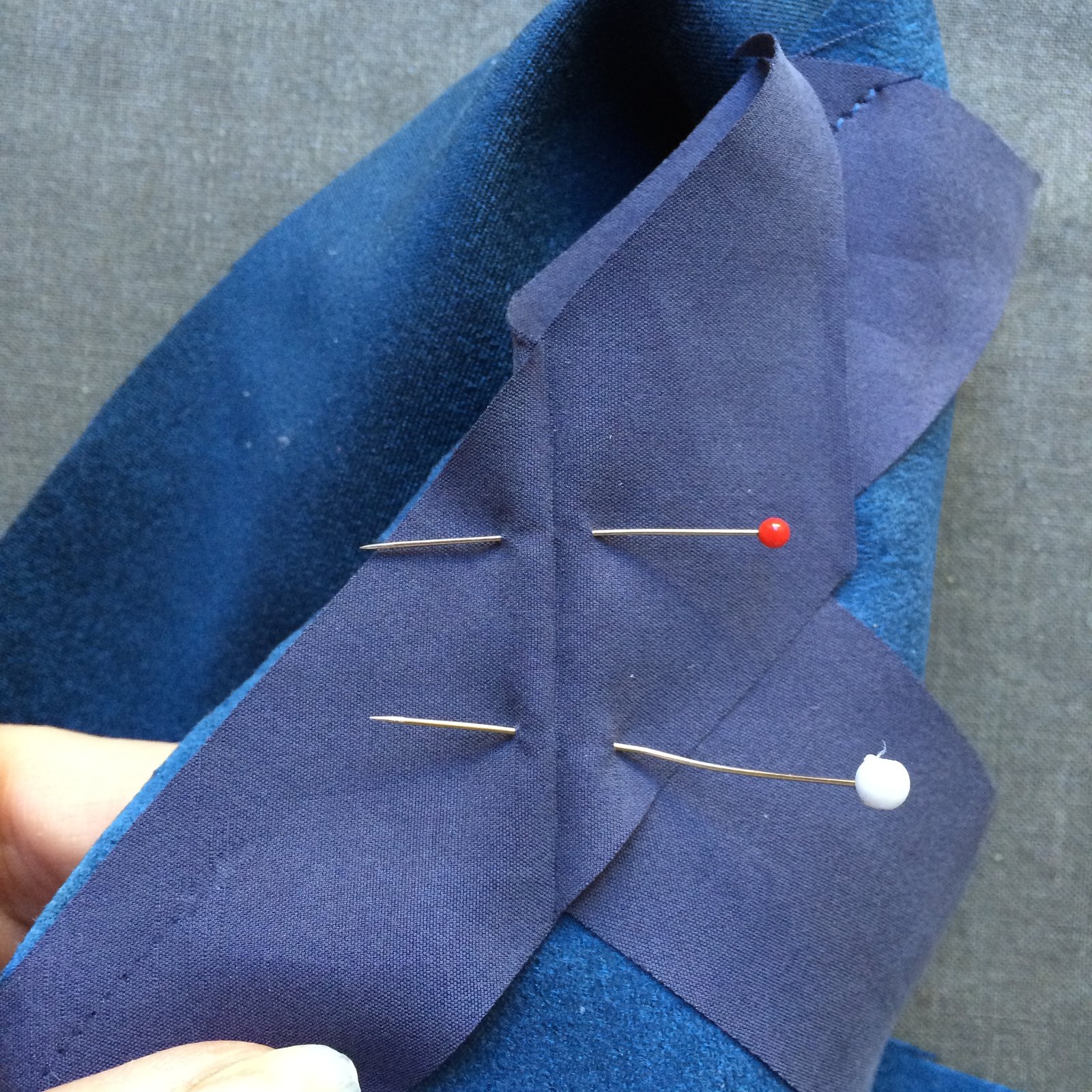
Solution; I edged the visible raw edges with bias binding… oh I’d bought a mid blue poplin for my bias binding, but it was a bit bright.. so I sludged * it up nicely with a bit of iDye in Brown, to make a nice deeper dirty blue; a much better colour for my fabric.  I think it turned out a rather nice match!

Hurdles two and three; cleared!

new colour, with scrap of the original colour on top…

*”sludged” as a verb. along with the associated adjective “sludgy”, are technical terms used a lot around here… where Brown dye is employed liberally and frequently to tone down the overly bright colours beloved by commercial fabric designers and that form about 99.99% of commercially available fabric, so they better suit those of us who look hideous in said brights.

What else is there to say?  I lengthened the sleeves to bracelet length… I really like them at this length, and even though I wasn’t very serious about it at first I absolutely love my jacket now it’s finished.  It’s rather Lagenlook, yes?  I’ve worn it two days in a row since I finished it… and that’s just about unheard of for me! who pretty much has to mix it up some every day… There’s just something about this rather simple yet inherently dramatic style that prompts the adoption of random flamboyant poses.  My enthusiasm for photoshop going only so far, you’ll just have to imagine the appropriate backdrop in each case…

exhibit A, supersleuthy spy… the scene: nighttime; the main gallery of the Louvre in Paris, a dim light glistening off the polished parquet floorboards, while painted masterpieces look on silently

exhibit B: busy woman-about-town hailing a taxi on the streets of some mega-metropolis no, not in her garage, oh no not at all) the scene; outside the New York stock exchange, close of business, important business-y types milling about on peak- hour sidewalks

exhibit C: Victoria’s Secret model strutting down the runway.. except she forgot her wings and is instead clad in rather unsexy but warm, warm winter woollies in lieu of the cute little bejewelled bikini.  Or alternatively; Rio de Janeiro’s Jesus… or a tightrope walker…

Because the wrong side/underneath of the fabric shows around the neckline I applied the bias binding on the inside of this centre back seam here instead… it’s not super visible, under my hair and all, but you know… I made a little hanging loop too…

So that’s it!… oh wait, one last thing to add; and that’s my method for dealing with a frayable fabric in a pattern that calls for un-frayable fabric.  In this pattern the seaming is the simplest method possible; seams are formed by overlapping the raw edges and simply topstitching in place… and using my method you first bind the upper raw edges with bias tape, so you end up with all the seams thus highlighted throughout.

First step; overlock the raw edges of the underneath edge…  the bias binding will be applied to the upper edge only.

Cut bias binding strips 2.6mm (1″) wide… this allows for a seam overlap of 1cm (3/8″) For patterns calling for a wider overlap, the same method applies, just cut the bias binding strips correspondingly wider i.e., for a 1.5cm (5/8″) overlap, cut bias binding strips to be 3mm (1 1/4″) wide.. etc.

Stitch bias binding to the upper side raw edge in a 6mm (1/4″) wide seam.

Press over and around to enclose the raw edge.

Position the upper side edge over the underside raw edge, with the overlocked edge even with the bias binding edge.  This corresponds to a 1cm (3/8″) overlap, as required by the pattern.

Topstitch the two pieces together by stitching in the ditch, or if preferred, just inside the bias edge.

Topstitch a second time, with a second pass of stitching a scant 3mm (1/8″) just inside the folded bias edge of the upperside.

For the opening edges, lower edge and sleeve edges; I simply applied the same bias binding and slip-stitched it down inside just like a regular bias-bound edge…

Voila!  Jacket made the same way you’re supposed to, and using the forbidden fabric to boot!  Ha!

Details:

Jacket; the Sydney jacket by tessuti patterns, wool-mix blanket fabric from Spotlight
Top; twist top from Pattern Magic by Tomoko Nakamichi, green stretch, details here
Skirt; Jade skirt by Paprika patterns, in red stretch knit, details here
Tights; self-drafted, details here and my tutorial for making your own custom-fit tights pattern here
Boots; Roberto del Carlo, from Zomp shoes

SaveSave

SaveSave

SaveSave

SaveSave

SaveSave

SaveSave

SaveSave

SaveSave

SaveSave

pinterestmail

white Issey Miyake shirt

Self-explanatory, really.  #endblogpost  😉
Pattern; Vogue 1384.  It’s a vintage pattern, hailing from 1984, sorry. Yeah, it’s annoying when people make things in vintage patterns that you can’t get a hold of anymore.  But I’m sure this is not particularly aspirational actually, it’s a little weird in that 80’s way.  That high, slightly floppy collar combined with a billowing pirate-y blousiness is giving me serious Duran Duran vibes.  That’s sort of a good thing btw HUGE Duran Duran fan, once upon a time… only you know, dating myself here  #woops  On a side note; watching that clip again, wow I think I’ve suddenly identified the genesis of my lifelong white shirt obsession…   Also, haha, I totally dance just exactly like that, to this day still, lol.

I’d actually vaguely planned to make this shirt for quite a while, then Anna of blogless Anna proposed an IG #sewjapaneseinjanuary sewing challenge; prompting a jump to the top of my queue… sewing challenges are such fun!

I’ve previously made the skirt from this pattern too; here.  That now resides in Cassie’s wardrobe.  Thing is; the pretty floaty pink-ness, while lovely, I’ve decided is just not really ME.  Not to mention that she put it on one day and obviously it looked only like about 999999 times better on her than it ever did me (sob)   I’ve got to stop giving her my clothes to try on!!   Just kidding; I wore it a few times but tired of it quite quickly and I don’t miss it, not one little bit.  Though I do still really like that design and am thinking of making it up again, just in a more me-friendly fabric and colour.

Fabric; a thin, sparsely-dotted swiss cotton voile with ever so faint and equally sparse paisley embroidery on it in bits.  Very very subtle.  I bought it in Potters Textiles a few years ago, when it was in its other location.

The top looks at its best when it’s either tucked in or belted-n-blousy, and while I have a small collection of self-made belts… like, four maybe?  none of them looked very right with this sheer-ish white top, so I quickly whipped up a thin white one in the same fabric to wear with it.  Kt-chaaaaaaa!! *whip-crack sound effect*  Sorry, I simply cannot read “whipped something up” with regards to sewing without hearing a crack o’ the whip sound in my head.  Craaa-aack that whip!  *  (Devo, and a warning, do not click that link unless you WANT to be subjected to some really random and classic 80’s, madness.  Yep, I was a fan of that too, *blush*)

The belt is basically just a waistband really.  A poor, bereft and lonely little waistband, with no skirt to call home…  *sad violins*  It’s exactly the same deal as the one I made for my tartan dress.  Just two buttonholes, and one button, and you wear it so the button is on the inside.

Also, interesting pocket tab/flap detail.  You can’t really see it on the outside, which defeats the purpose a bit really, but oh well.  It’s kinda cute when you notice it!

I flat-felled all seams throughout, as usual.  Btw, you CAN flat-fell all sleeve and armscye seams too… my tutorial for flat felling the armscye seam is here… and the sleeve seam itself can be flat felled by starting from the middle of the seam and stitching OUT.  Be sure to have the sleeve RIGHT SIDE OUT, so that you are sewing inside the sleeve… this will ensure that you are in no danger of stitching down the other side of the sleeve underneath…

In the case of this shirt; I stitched the sleeves to the shirt, and flat-felled that armscye seam before stitching up the sleeve and side seams…
First, stitch the sleeve and side seams in one fell swoop.  Press seam open and trim one side.  If you are flat-felling the seam towards the back of the garment, trim the back edge of the seam.

Press the front edge back over the back edge, turn under the raw edge, and press in a neat even width.

Turn sleeve RIGHT SIDE OUT  (v. important) and from the wrist end of the sleeve; bundle the tube of the sleeve up to locate a point roughly midway up the sleeve.  Position the bundled up sleeve tube behind your machine and pull the wrist end of the tube through until this midway point is under the needle.  Take it nice and slow, and stitch the flat-felled seam from here out to the wrist.

To complete the seam; just repeat the same process as above only bundling up the sleeve from the armscye side… locate that same midway point of the sleeve, and stitch the seam from there, to the underarm, and keep going in one long continuous seam down the side seams to the bottom hem of the shirt.

Done!

Details:

Blouse; Vogue 1384, white swiss voile
Skirt; Vogue 1247, striped stuff, details here and my original review of this pattern here
Sandals (above): my own design, made by me, all details here


Denim shoes (below); my own design, made by me, all details here
location at top: Preston St overpass, Como, Western Australia

Replicating the 80’s pattern envelope pose,  just because…. the 80’s.

pinterestmail

finishing an edge with bias binding

Now, I promised to write this tutorial to show my Mum how I applied this finish to her top… and others expressed an interest too; thank you so much to everyone else who did… I finally did it, yay  😉

Mostly I would use this finish for a neckline that is wide enough to need no zip or button opening, as pictured above. Another example of its use is for a hemline such as the skirt demonstrated here.  I’m making this in a totally inflexible fabric with about zero give, PLUS the design has such a sharp curvature around the bottom edge a regular turned-up-twice hem is quite difficult to execute neatly.  The bias binding finish is a good solution for this 🙂   It results in a clean, banded finish on the inside of the garment, with one row of 1cm (3/8″) topstitching visible on the outside of the garment.

This method is just one of several ways of doing this kind of finish, I prefer this way because I find it the quickest and easiest, results in minimal fabric bulk, and minimal mucking around.

Firstly, make a strip of 2.5cm (1″) wide bias cut fabric long enough to fit the opening to be finished, plus at least 20cm (8″) extra.  Best fabrics to use are something woven that is very thin, fine and lightweight, like cotton voile, silk or handkerchief linen; in an unobtrusive colour toning in with the fabric.  For Mum’s cotton top above I used the self-fabric because it is quite light; for the blue suedette skirt I used a scrap of leftover silk-like microfibre.

Right sides together, pin around the edge to be finished, and stitch in a 6mm (1/4″) seam, leaving a gap between start and finish of around 15cm (6″) and ideally tails of at least 20cm (8″) 

Fold and press the strips to meet together on the bias.  I find it best to leave a very tiny gap, like 1-2mm or so, between the pressed edges.  Don’t have any explanation for this, just that it works better when it can stretch into it just a touch.  Keeping everything straight and right sides together, pin along the folds, stitch, and trim.  Press seam open.

Stitch up the gap to complete the bias strip attachment to the edge.  Press the bias strip, bias strip seam allowance, and garment seam allowance away from the garment.  Understitch these three layers together close to the seam line, keeping just the garment layer free.

Turn the garment wrong side up and press the bias strip back onto the garment, keeping the seam line just inside the pressed edge.

Turn under a 6mm (1/4″) seam allowance on the bias strip, press and pin in place.  Topstitch 1cm (3/8″) in from the garment edge.  Done! and the nice thing is that you won’t ever be able to see where the strip starts and ends  🙂

pinterestmail

some random tips for sewing lingerie

There are a bajillion great posts out there with good tips for sewing lingerie; hopefully this one is adding one or two new pieces of info into the pot…

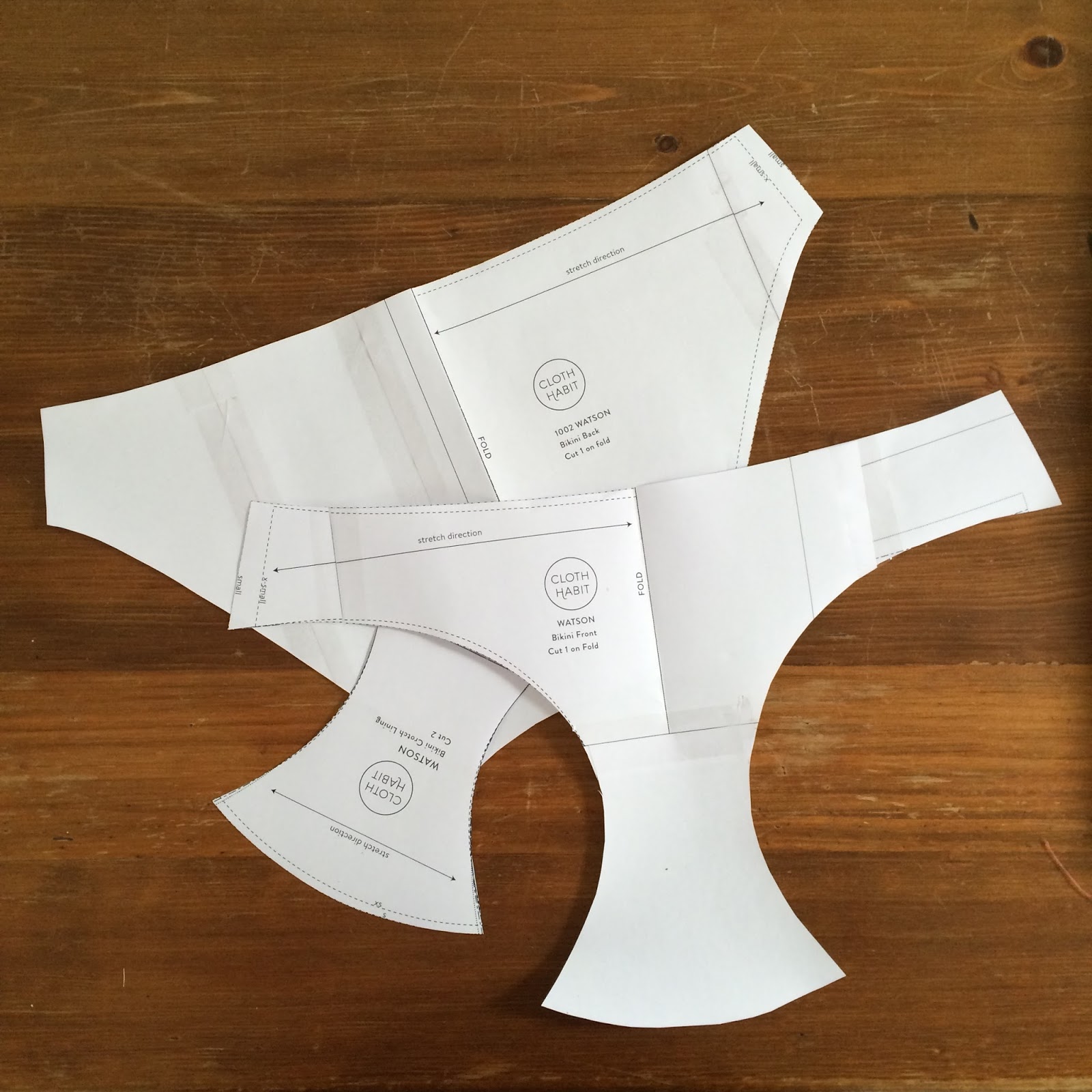
Pattern pieces: If your pattern pieces are half ones it’s well worth doubling them to make full pattern pieces, that do not need to be placed on a fold.  This is useful for many reasons; one is pattern placement when it comes to lining up lace motifs, another is getting the most economical layout on a small piece of possibly expensive lace.  Also if your pieces are to be cut on the bias… some knickers patterns are suitable for fine wovens like Liberty, and need to be cut on the bias and it’s only about 1000 times easier with a full pattern piece than folding the fabric accurately for a “cut on the fold”.  Mark the bias line on all new pattern pieces too.

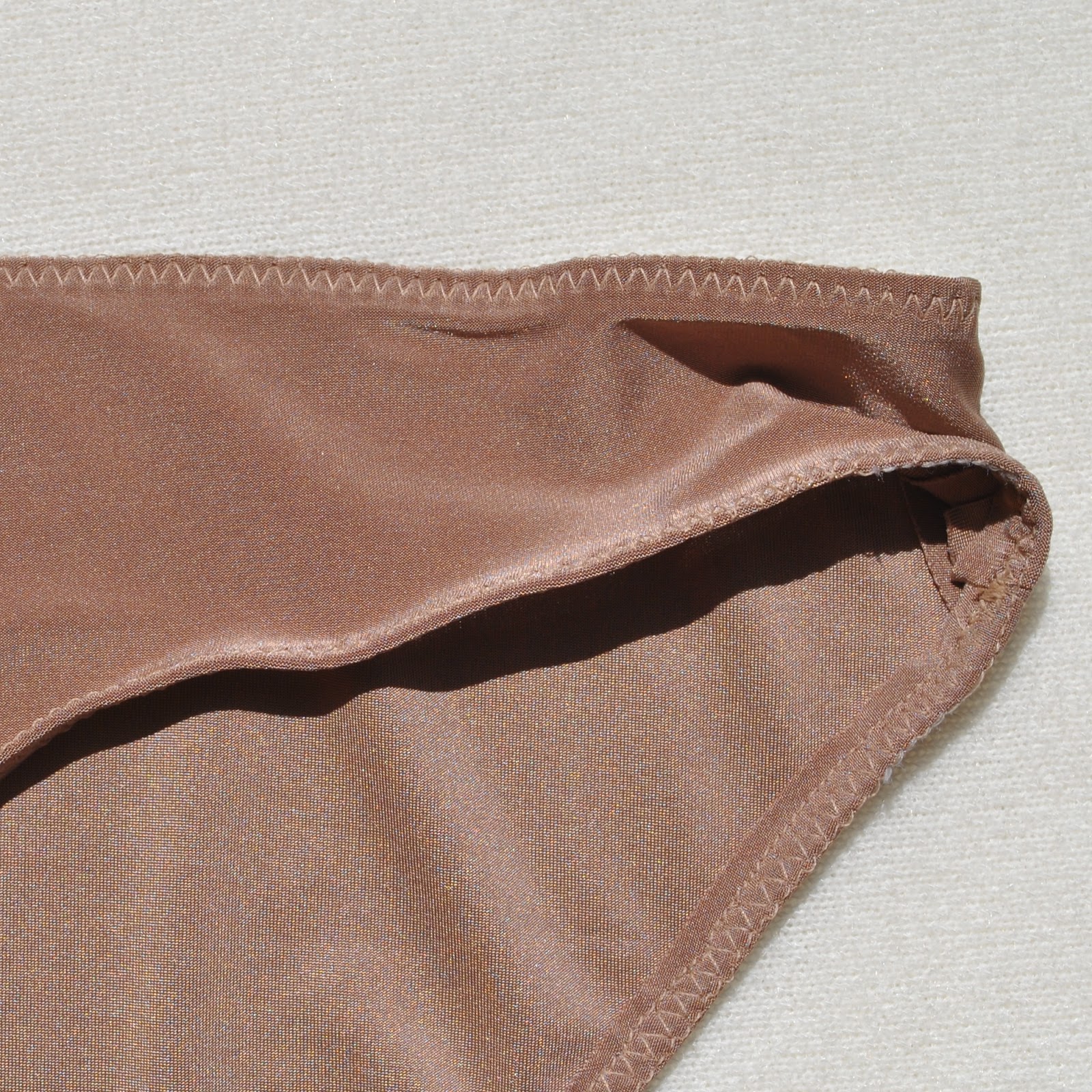
I also prefer to splice together the knickers front piece and crotch piece of my Watson brief pattern (see above) so as to make them one piece and eliminate that horizontal front seam.  The crotch lining is sandwiched between the (new) knickers front and back pieces along the curved joining seam, and is stitched down with the leg elastic at the sides, but otherwise sits loose at the front.  I prefer this to having a front seam!

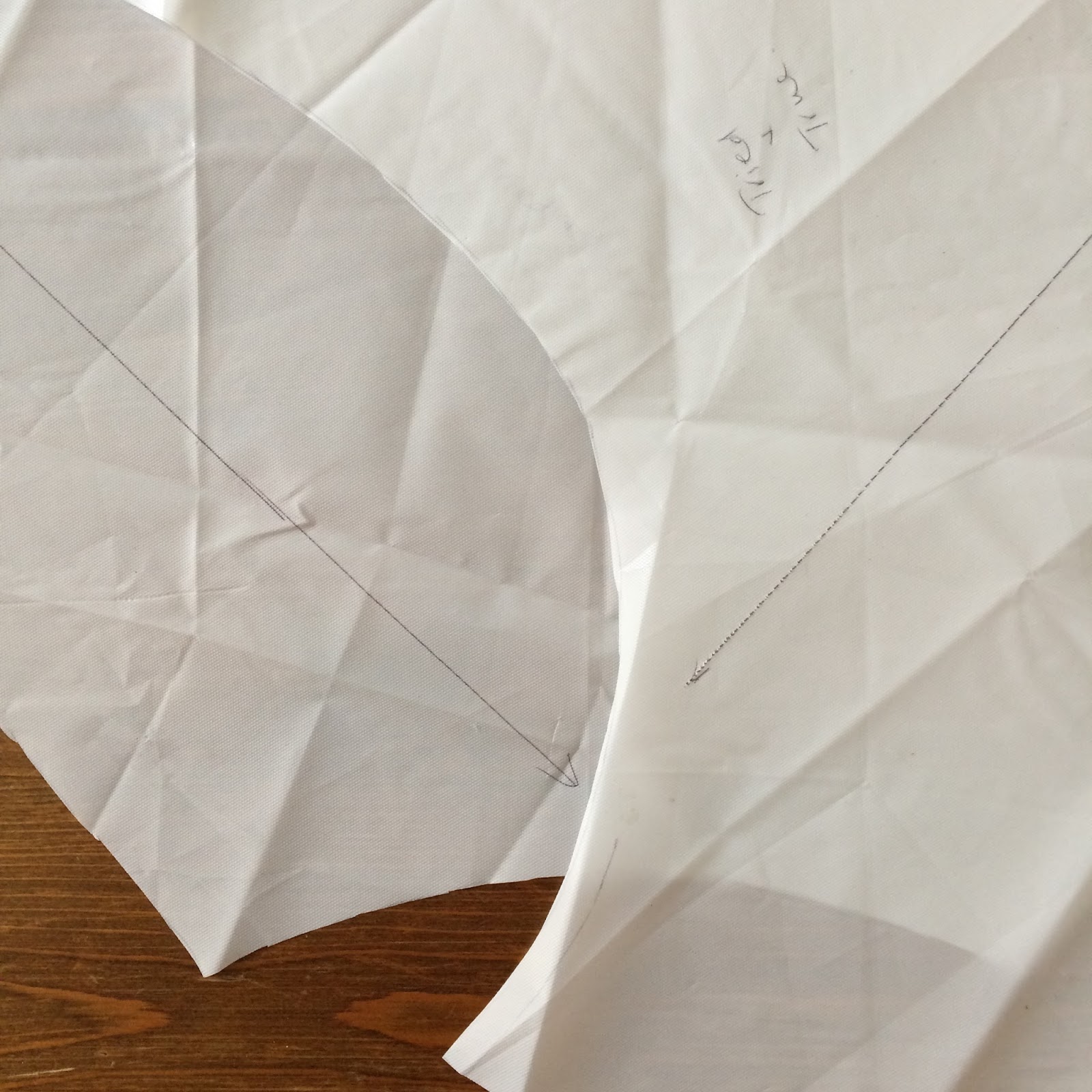
Usually I save paper by taping together scrap pieces or even newspaper to make the other half pieces; for frequently used patterns, or if the original is a fragile tissue paper pattern, the pieces can be traced as whole new ones on thin, sheer plastic which is more durable (above).  For this I use plastic table-clothing, sold in 30m rolls from the party section of Spotlight.

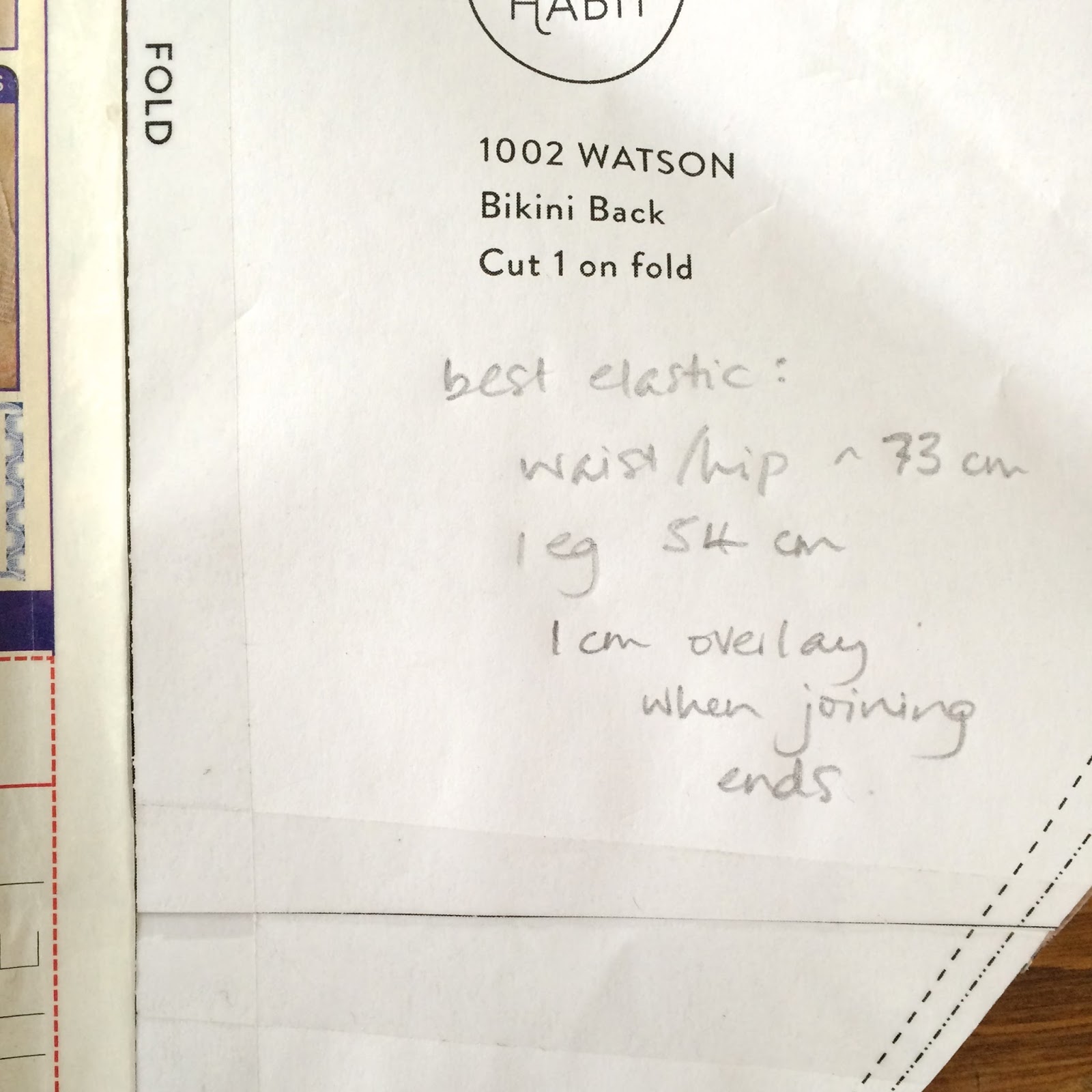
Also, I jot on the actual pattern pieces the lengths of elastic needed, to save re-measuring for each new project.

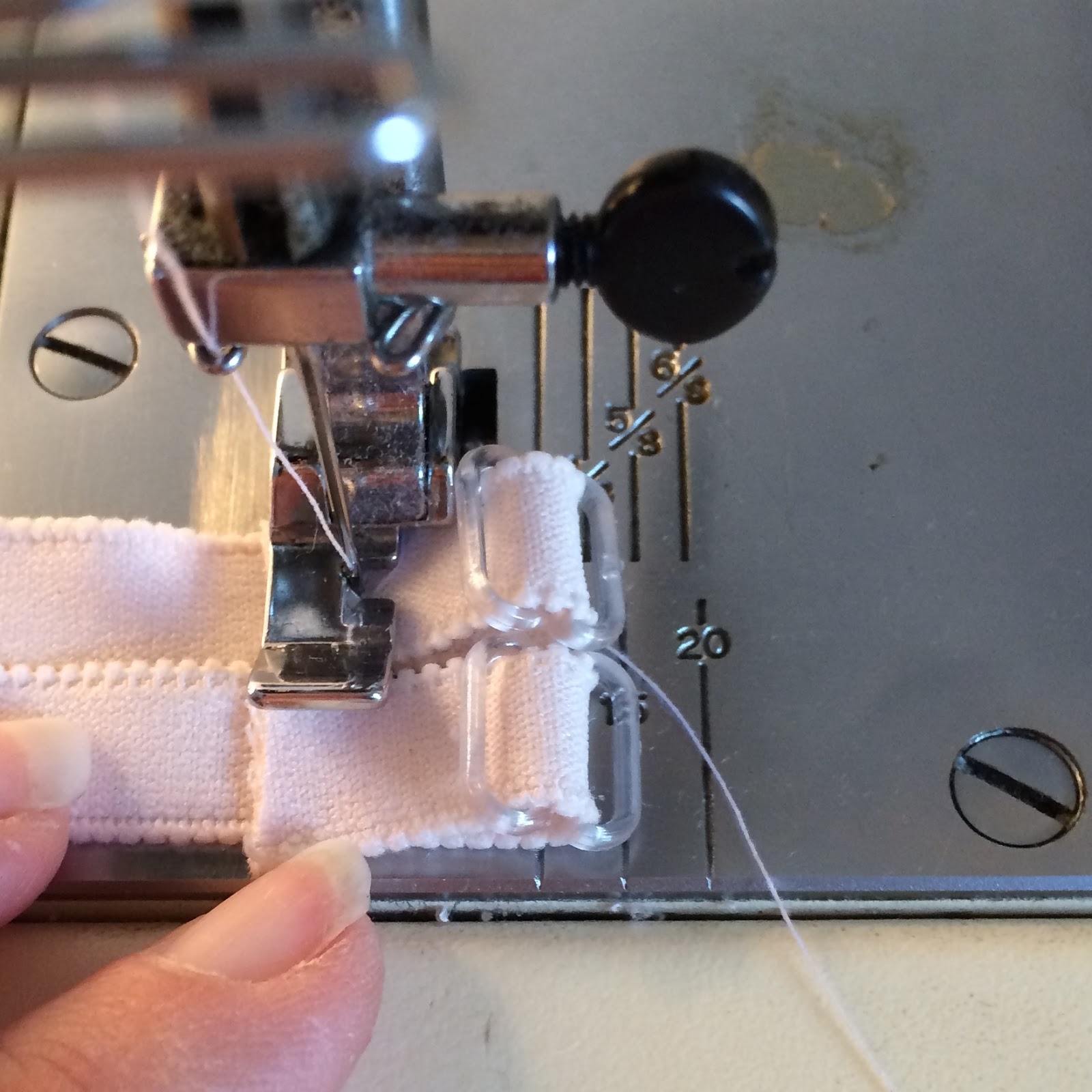
When sewing the ends of the rings and sliders; cut, pin and sew the pairs together and at the same time.  It’s hand down the best way to guarantee the two sides will be identical, if such things as symmetry are important to you.  Actually the same goes for anything there will be a “pair” of in the project.

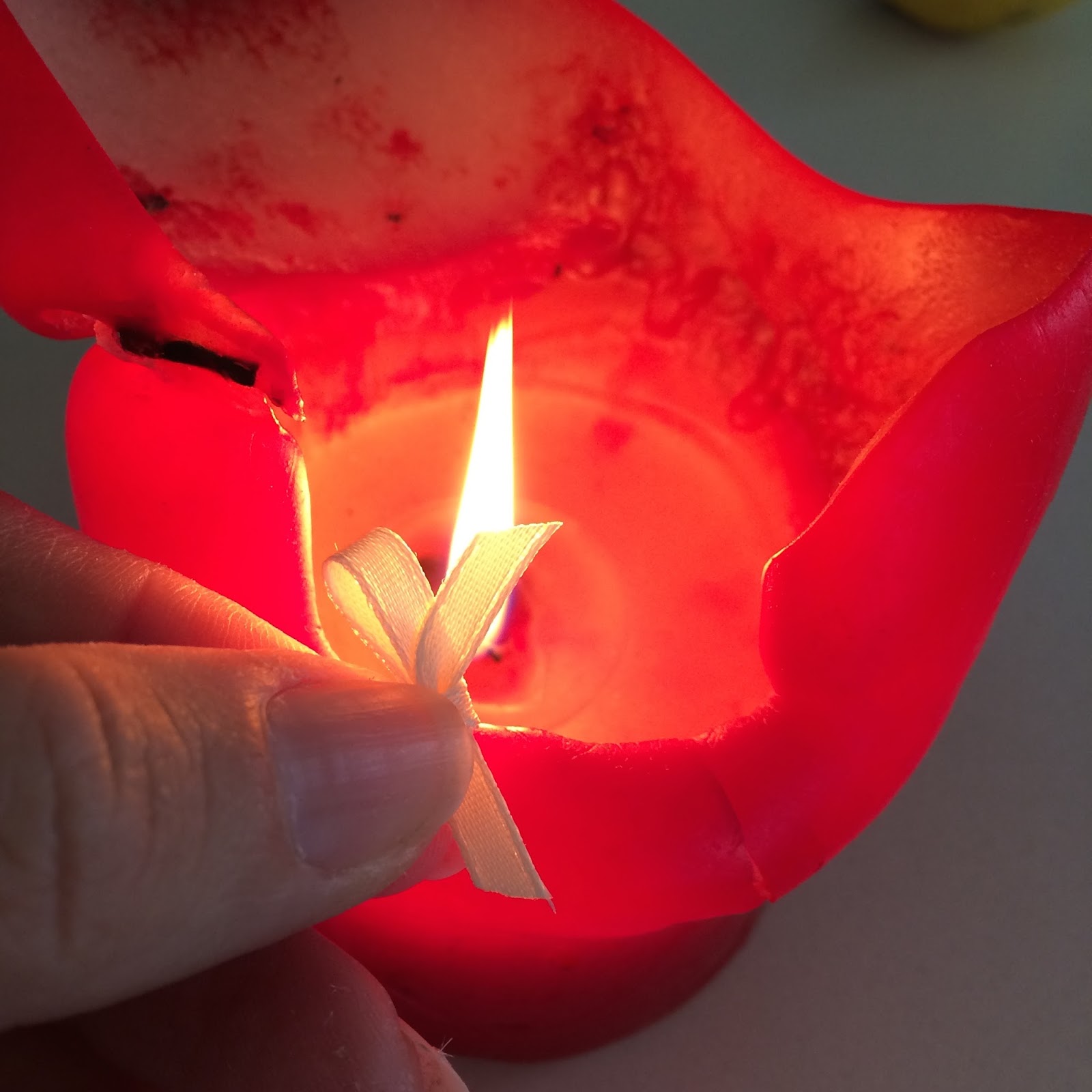
Satin ribbon trim; I always “heat seal” the cut ends of ribbon bows so they don’t fray during wear.  Just hold the cut end of the ribbon close to a candle flame and carefully watch it as you sloooowly move it closer; it gets to a point where it starts to melt away in the heat.  This happens pretty quickly so you need to keep a close eye on it and pull it away the very second you see it happening.

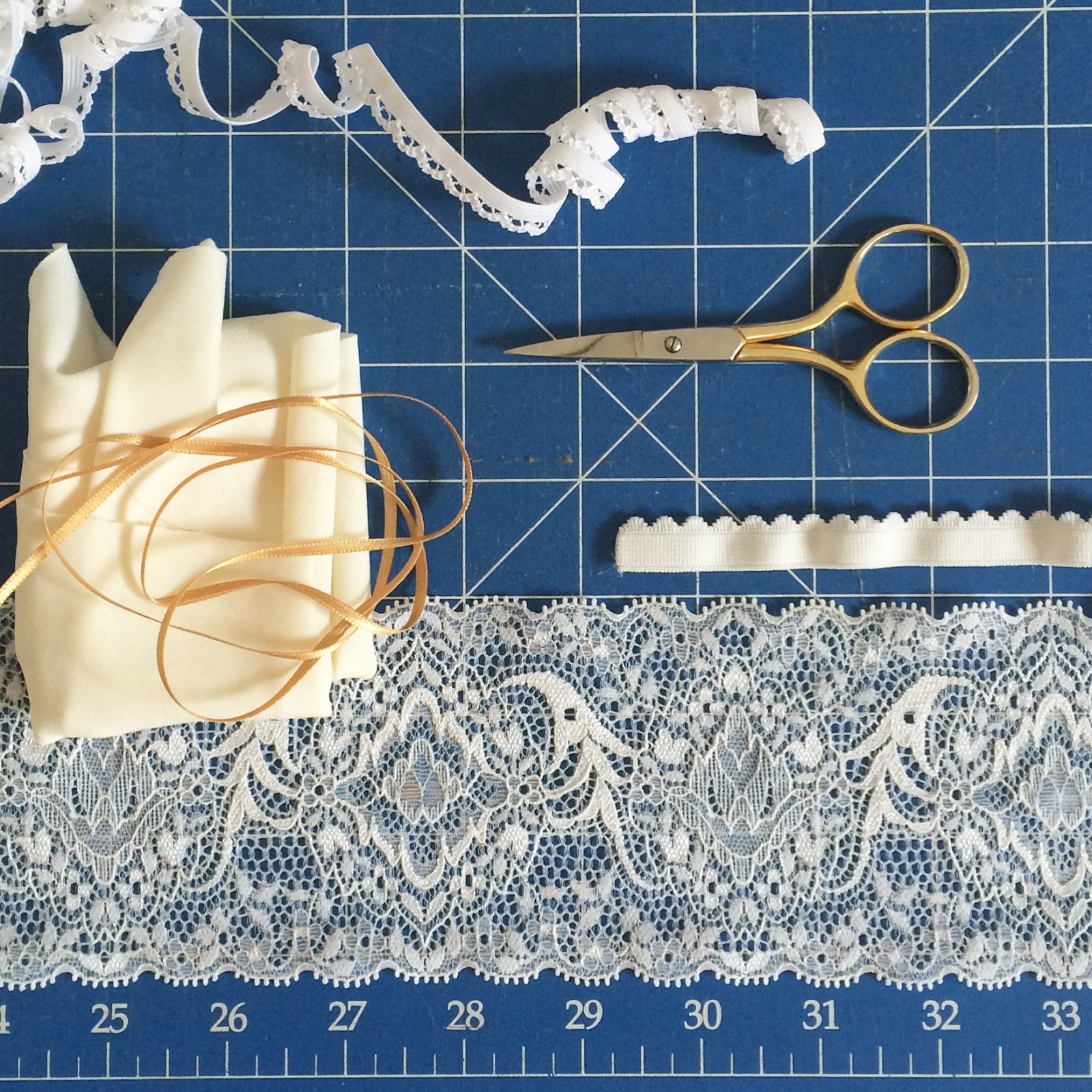
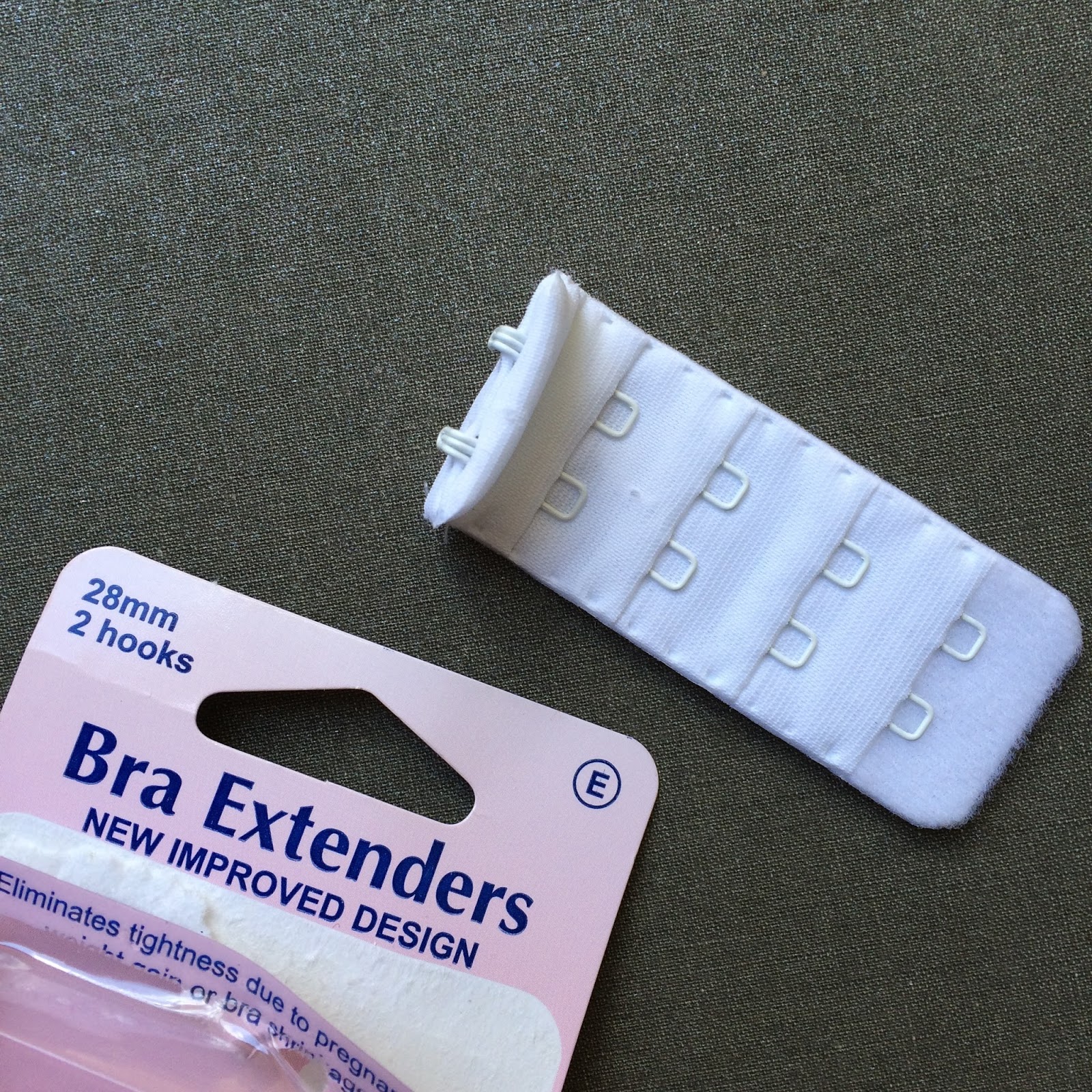
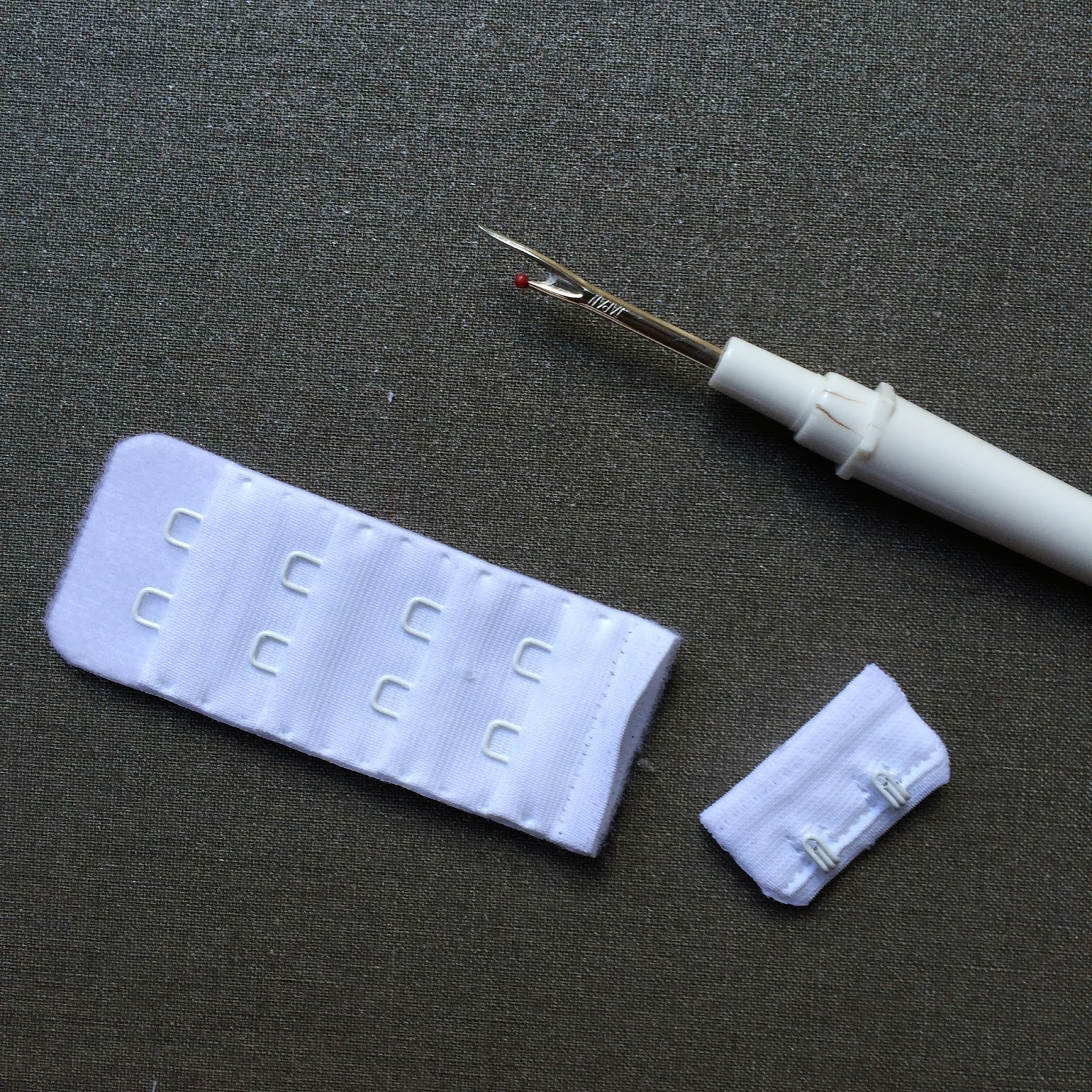
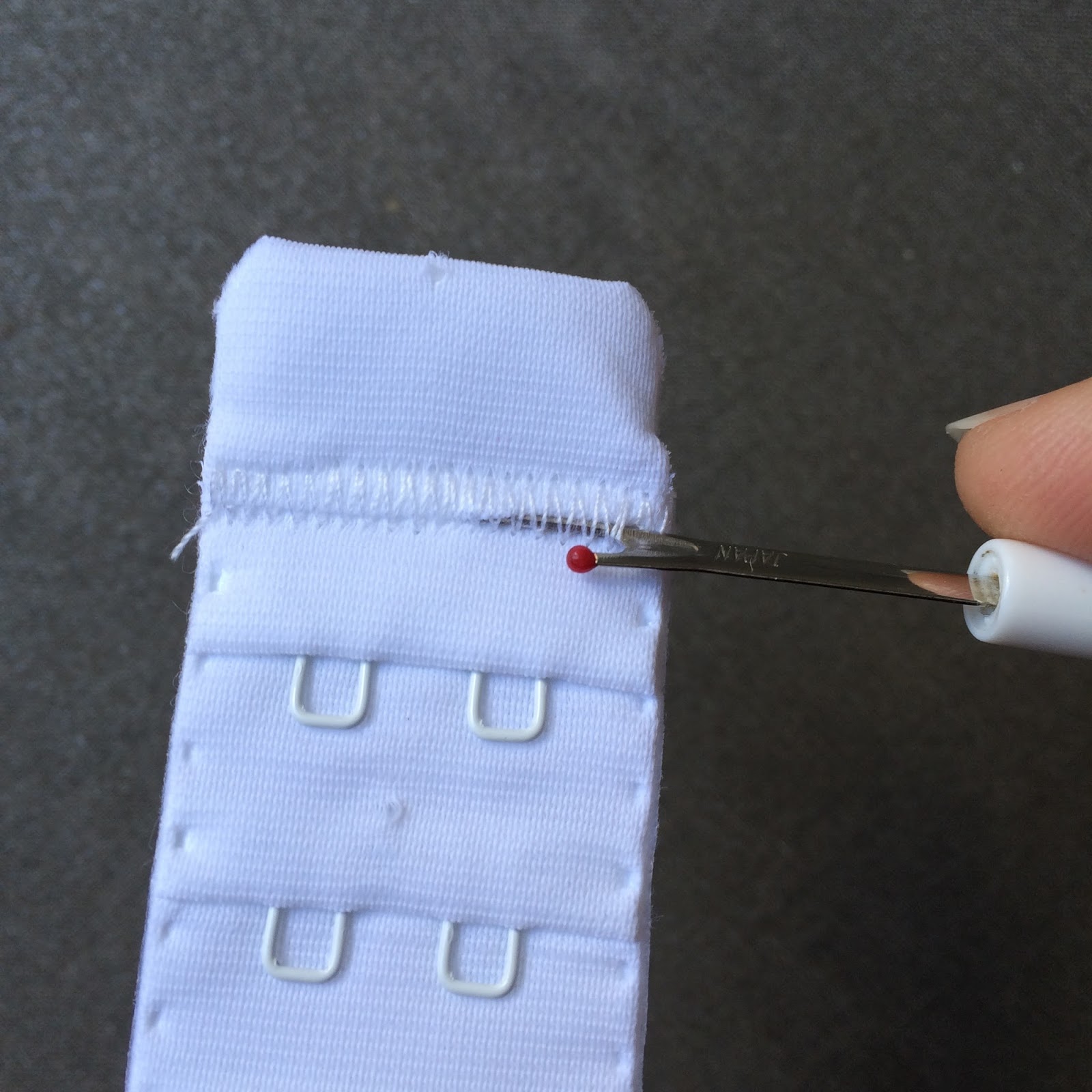
Hook and eye tape: I prefer to buy separate hook and eye tape if it’s available but my closest store sells only “bra extenders”.  I’ve found these to be an adequate substitute if I can’t find the proper arrangement;  the pieces can just be picked apart quite easily.  If the “hook” piece is too long the extra length can be cut away and the edge zig-zagged.  It’s not as neatly finished or as professional looking, but it’s perfectly fine in a pinch.

Sewing edging elastic onto lightweight and super-stretchy fabrics
Super stretchy fabrics are obviously perfect for underthingies but also obviously come with their own little challenges… and one of them is the dreaded “lettuce leaf” edge happening.

yes, this is my own work *hangs head in shame*

I’ve found it very helpful to sew a long basting or stay stitching 6mm (1/4″) from all edges before attaching any elastic.  I know, straight stitch on knits, *horrified gasp*   it’s a huge no-no and I could get blasted for this! but meh, it works out pretty good for me 🙂

I mean, everyone has their own, slightly unique way of attaching elastic, I’m of the school of thought that whatever works, works; and lots of different ways are going to work.
The lettuce leaf occurs when the elastic is overstretched while sewing it to the edge of the fabric, and it’s pretty easy to do this when sewing with a particularly stretchy fabric.  It’s better for the elastic to be sewn to the edge of the fabric “flat” that is, for the elastic to be stretched to the minimal amount and for the fabric to be stretched not at all, while sewing them together.   A stay stitching helps to prevent this, and after the elastic is attached and before the final zig-zag you can pull out those initial basting/stay-stitching threads, if you like; to keep things looking nice and neat and tidy.

pinterestmail

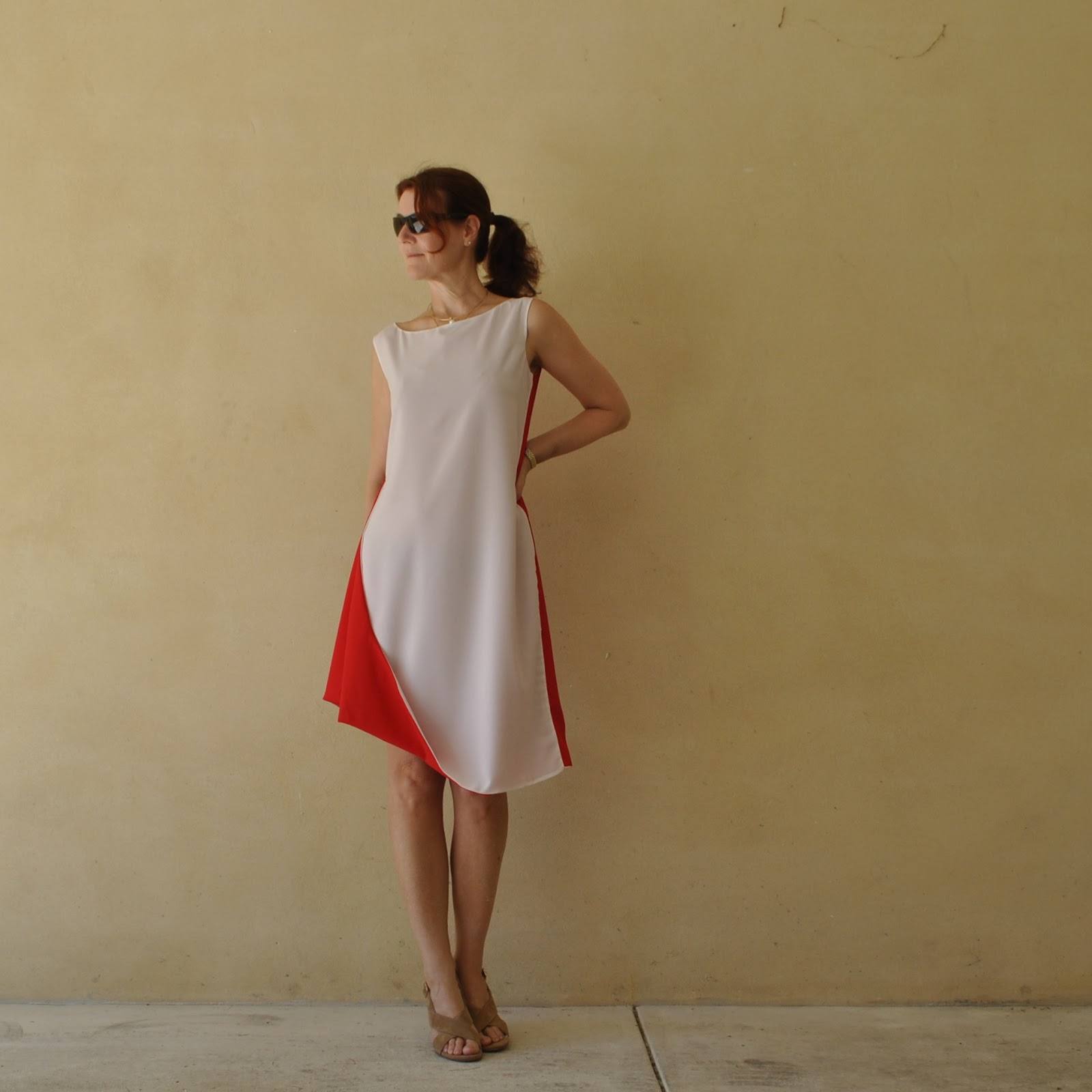
reversible infinity, or twist, dress

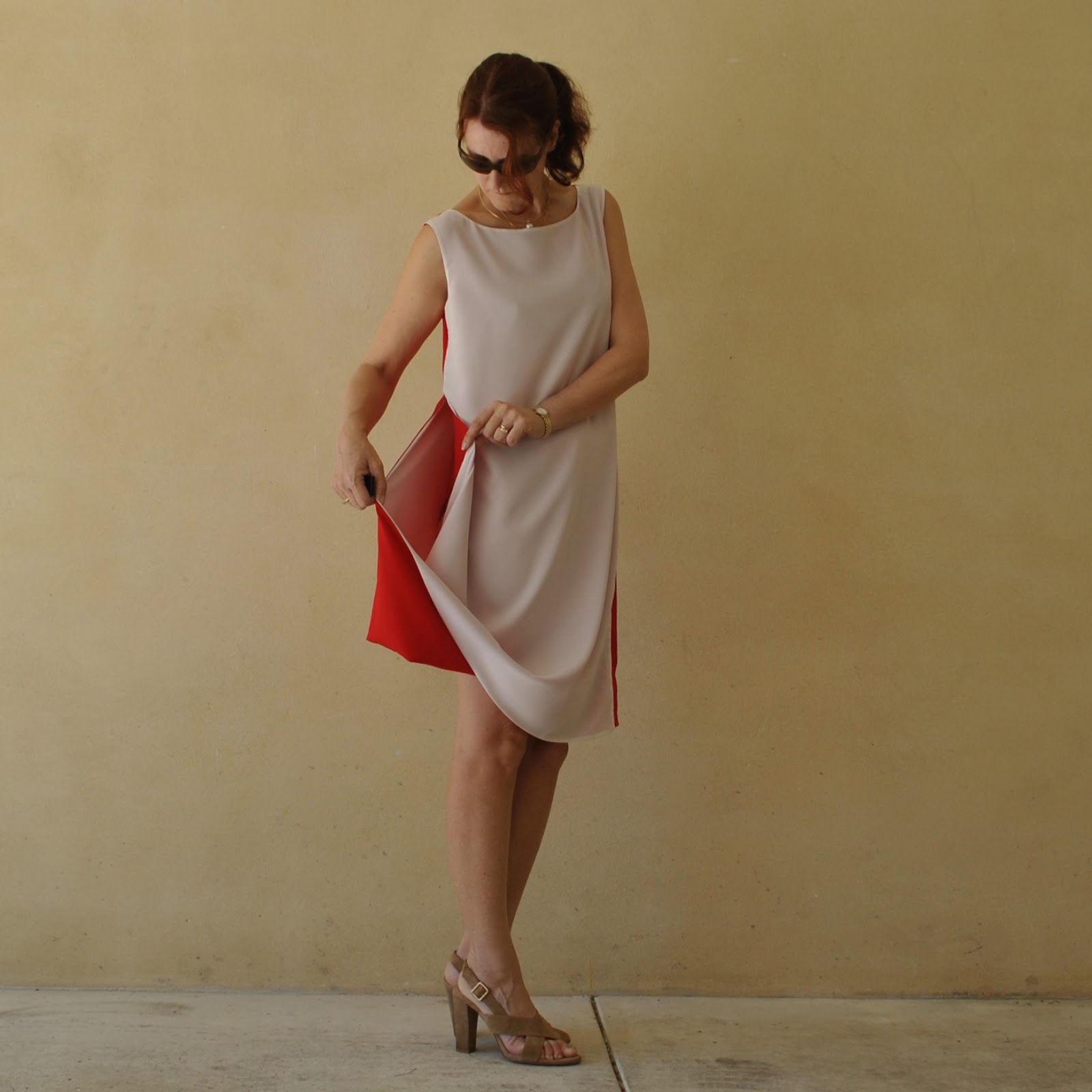
I love working out convoluted construction puzzles in the process of sewing something and this new dress ticked that box very nicely.
It looks kinda plain upon first glance, but it’s actually based upon a very unusual twisted design by Anita, of Studio Faro.  
And now I have to apologise right here because I’ve just searched forever for the design on Anita’s blog to link to it, and I find I did not even pin it… so I cannot. I’m sorry! but I’m pretty sure I saw the sketch for the pattern piece on either Anita’s blog, studio faro well-suited, or her Facebook page.


Later edit; thanks to Emily I found it, Anita’s original design is here.
Anyway.   In making it, I realised it was just like an infinity scarf, but in dress form.  Unique!

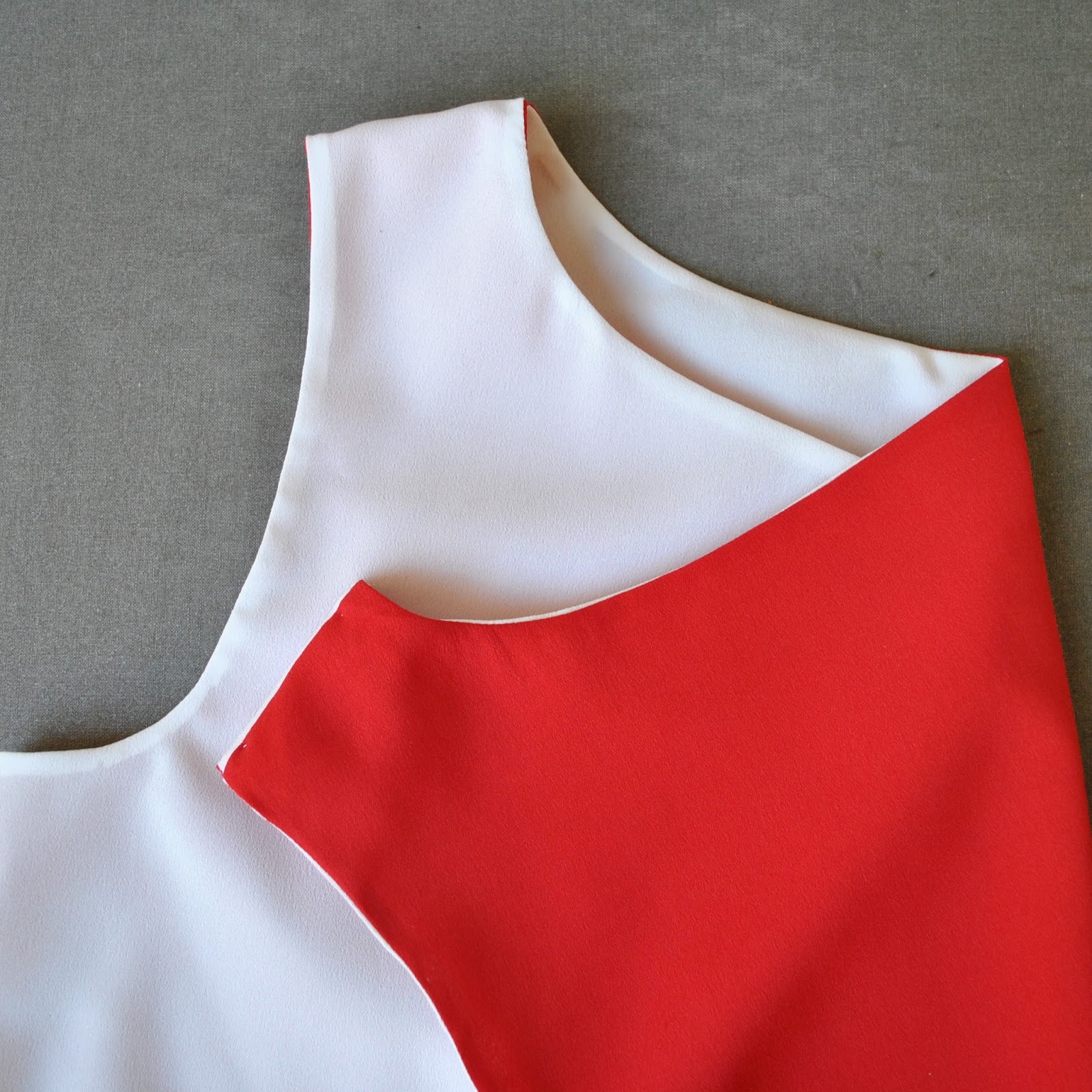
And, my dress is fully reversible! with all the seam allowances enclosed and tucked away neatly between the two layers of the dress.  The construction technique to make it reversible is one that I worked out myself and not something I’ve ever seen in any pattern or design before.  This was the part of it that kept me on my toes, brainstorming a way to make it happen.  I’m super chuffed that it did work out.  🙂
In my initial plans; it was not going to be a reversible design and I wanted to use double-sided fabric for my dress, but the only ones I could find were kinda expensive, and much as I craved the actualisation of that idea I just couldn’t justify the cost…  economy can often be the mother of invention, non?  Eventually I settled with a double layered dress using two lightweight fabrics, and then while I was fiddling about with the two layers I realised I could actually make it a completely reversible dress, meaning I could wear it inside out just as easily … and ta da!  this is the result!

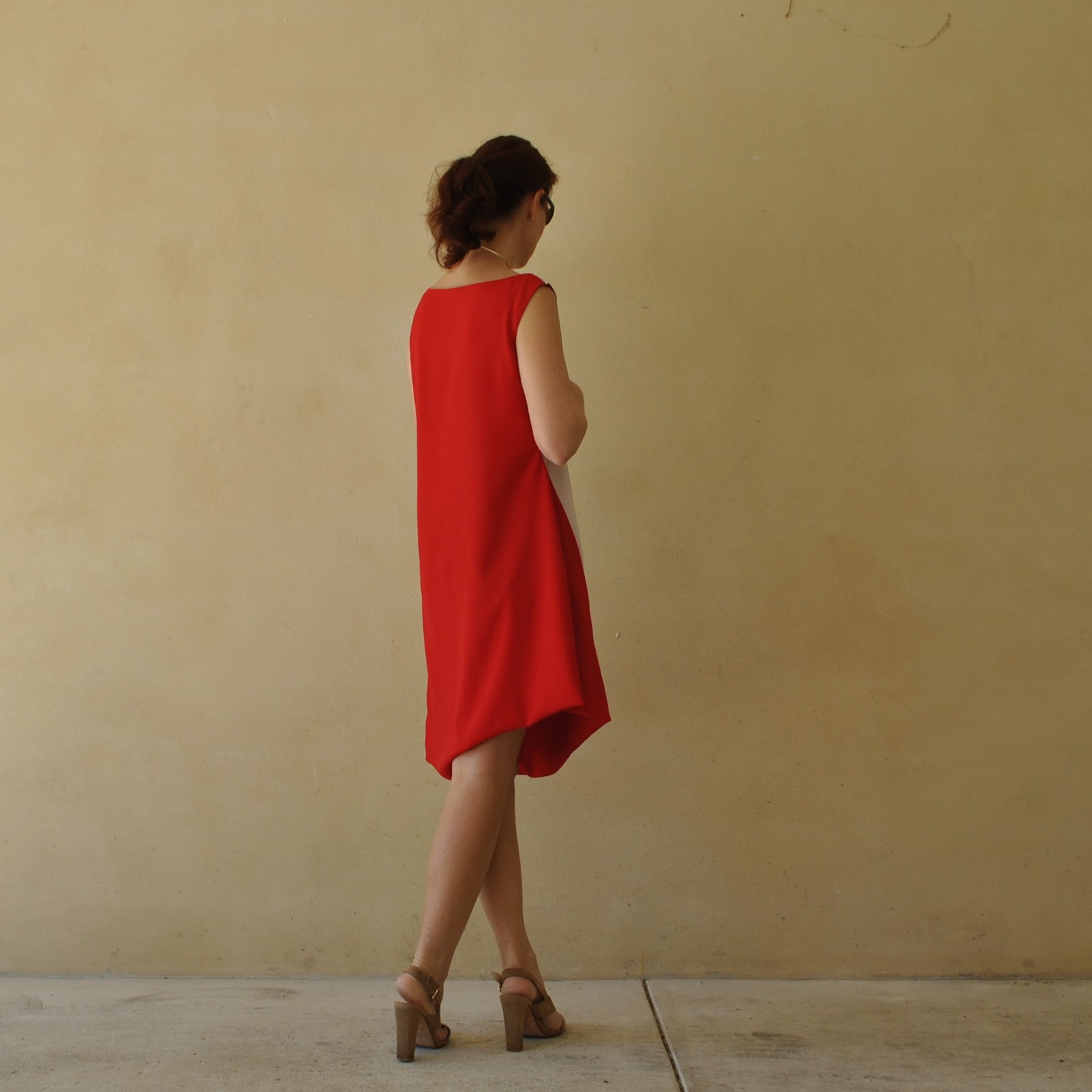
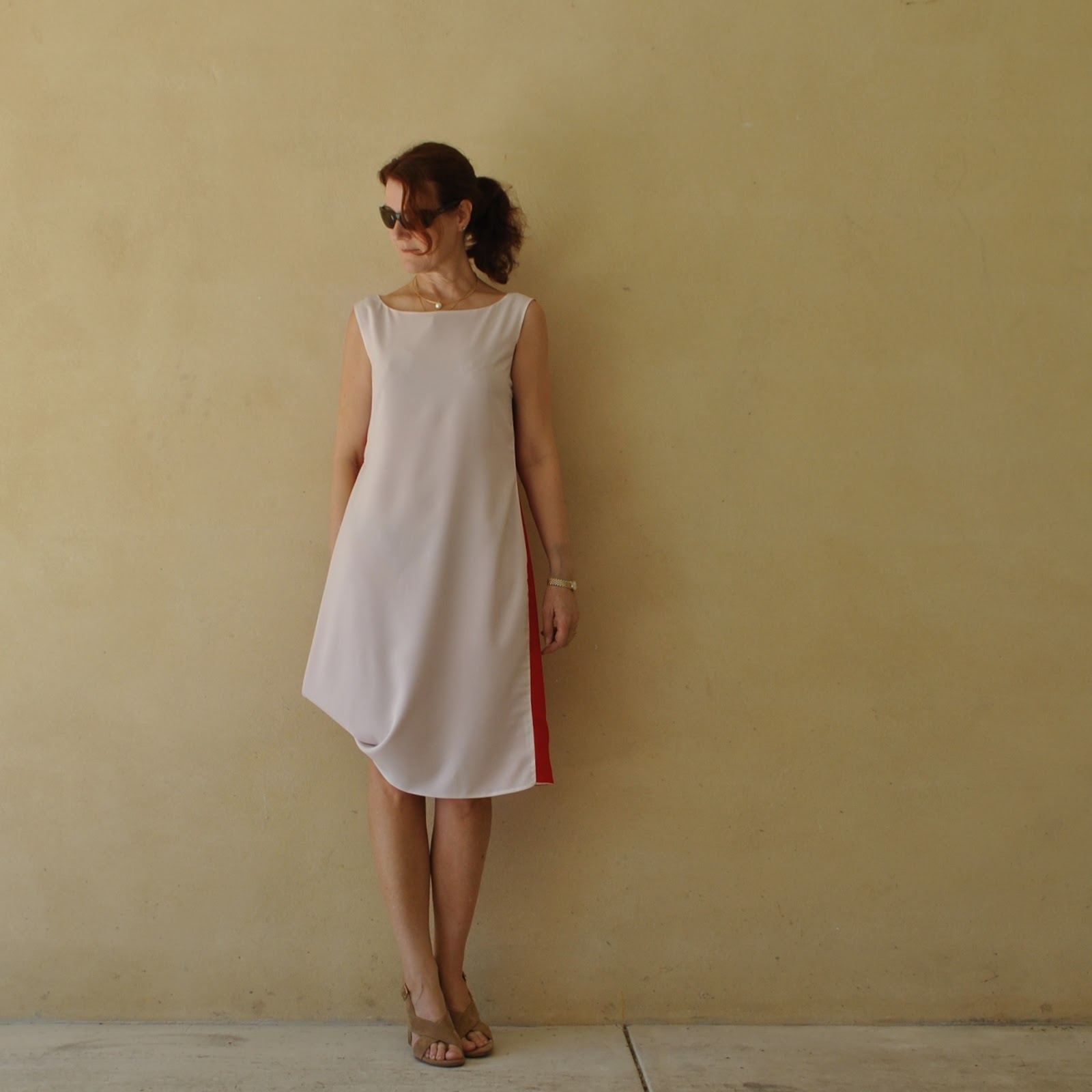
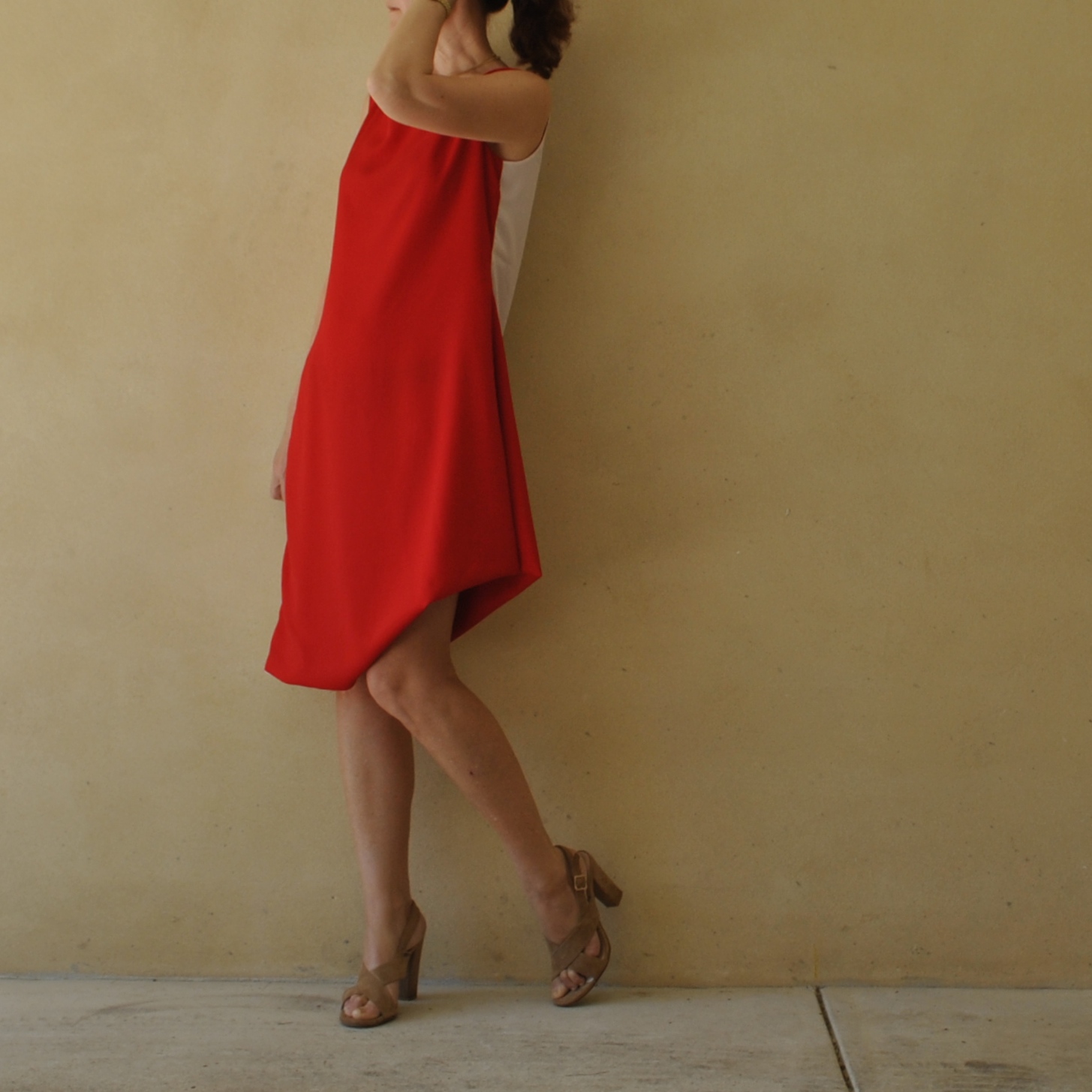
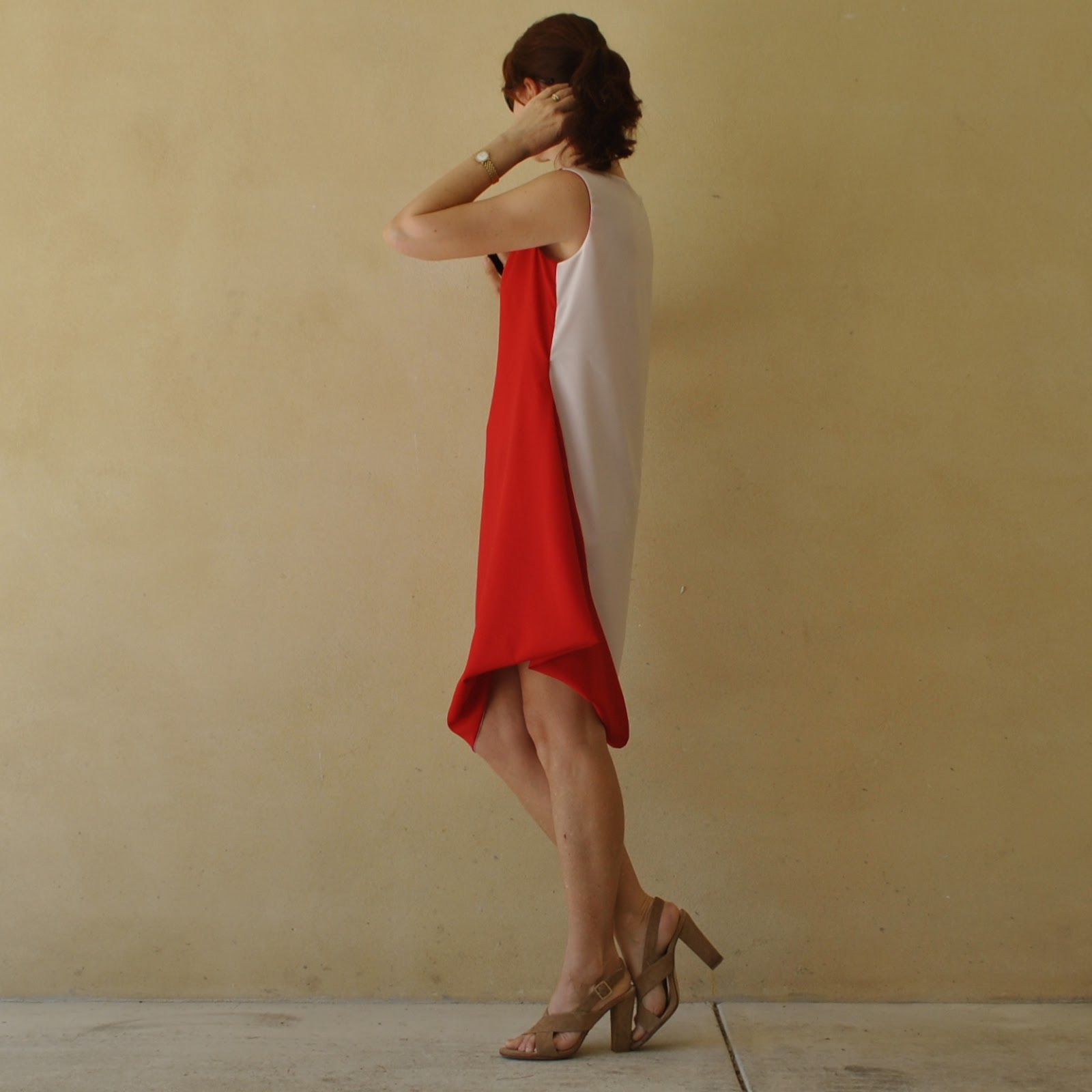
Right way out; I wanted the white at the front and red at the back.  The way the infinity twist goes; the dress is actually mostly open at the right side seam, but the way it crosses over there is a restriction in the drape of the hemline so that it sits with the opening closed quite securely; and there is absolutely no danger of the drape falling open and exposing your knickers at all.  I tried to move and sit in it a few times to see if I could possibly get humiliated from any hint of exposure in the dress and am happy to say I could not make it happen.

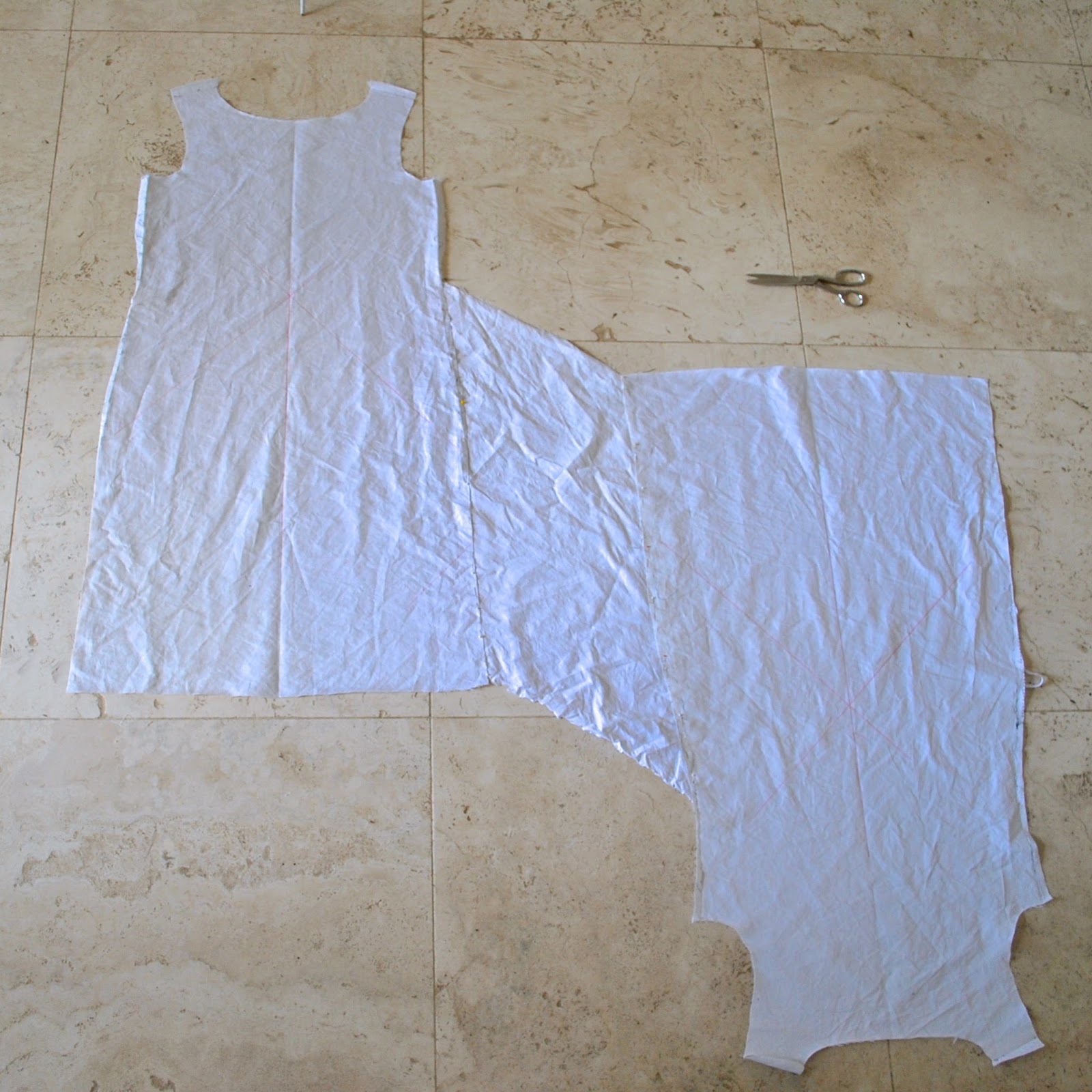
The one single pattern piece looks like this, and you rotate the “upside-down” part around clockwise and up, to lie over on the “right-side up” part.  This naturally forms an infinity-twisted drape at the side, and the wrong side of the fabric against the right side, front and back.
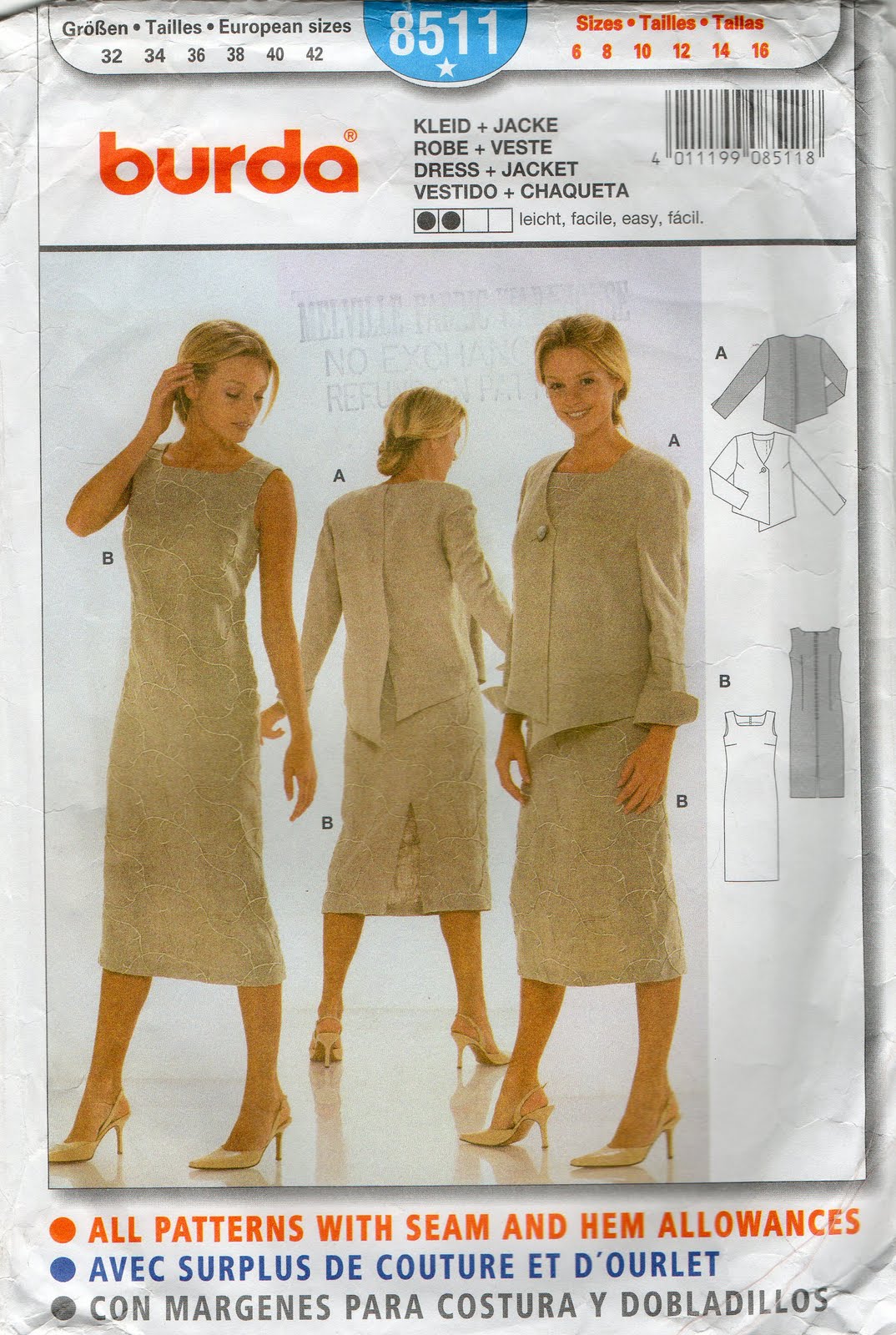
   Any straight or sheath dress design could be used to get this pattern piece;  I used my old standby Burda 8511 as my sheath dress sloper.  It’s one I’ve made enough times over the years to have tweaked and fiddled with it enough to have fine-tuned the fit to my pear-shaped self just about perfectly. 
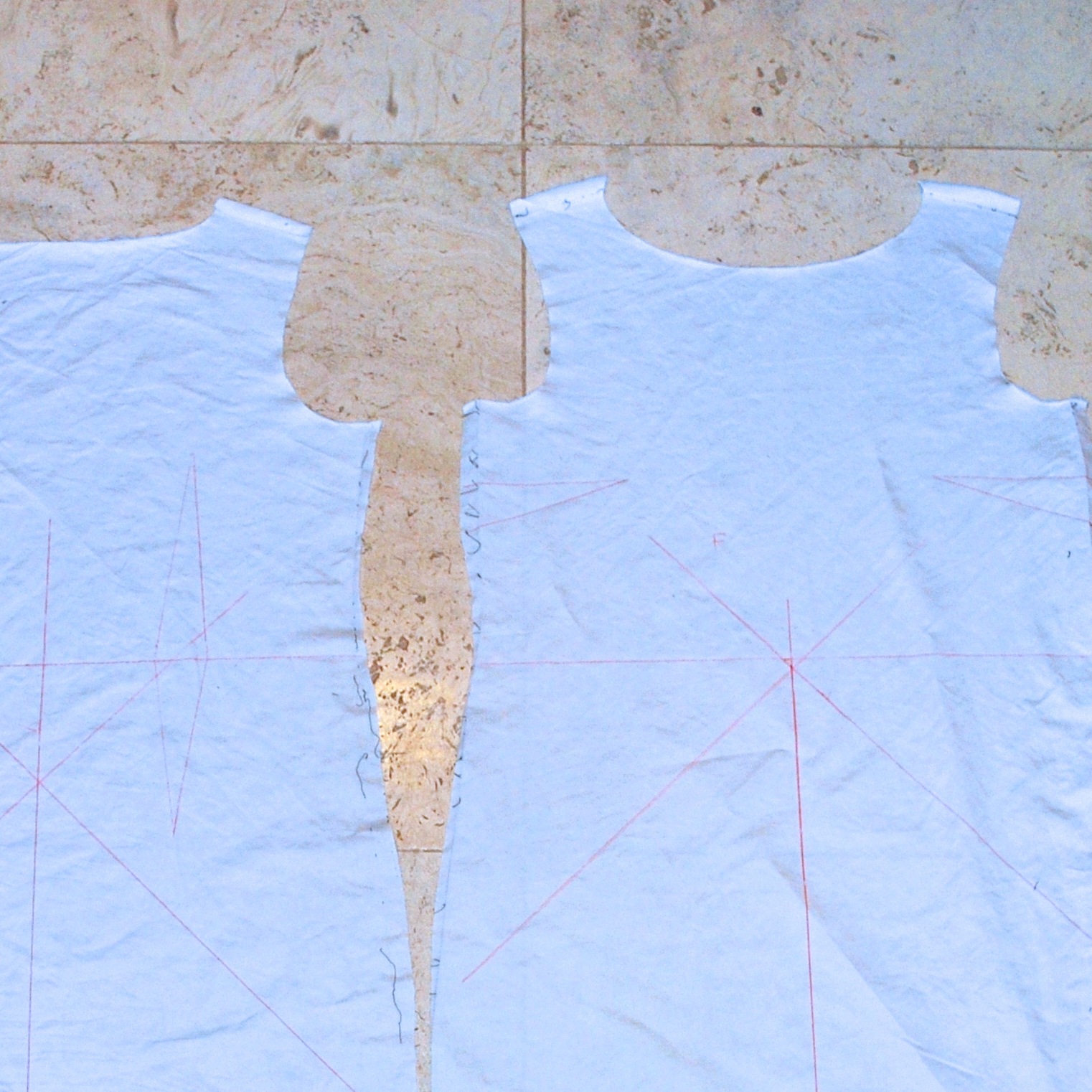
By the way; if you’re at all interested in creating your own pattern manipulations like this one, and this goes for just about all the Pattern Magic designs too; my recommendation is make a sturdy, fabric sloper.  It’s a good idea to have one for a sheath dress, a bodice and possibly a skirt too.  You could use a well-fitting, tried and true pattern like this one, if you have one; in any case get a basic pattern and make up a few samples to fine-tune your fit.  Once you’ve fiddled and diddled enough to discover the perfect adjustments for you; get some strong fabric that’s not going to rip or fray easily, like an old sheet… these often have the most fabulously high thread count making them super-tough!  Then cut out your perfectly-fitting pattern pieces.  Using a clear, easy-to-see marking pen of some sort, mark on the sloper pieces the waist line, hipline, bust points, back dart points, the straight grainline and the bias grainlines going both ways.  I used bright red marking pen.  This sloper can be kept rolled up with your patterns for whenever you have new ideas and want to play about with making new designs for yourself  🙂
Why fabric, not paper? well obviously so you can baste it together and put it on!  wearing a paper version of a thing is absolutely nothing like the real fabric thing, we all know that!  Paper has zero drape, plus it rips all too easily  😀

The middle, joining piece goes from the waist to the hemline.  I left off all shaping darts, so the “dress” portion is a kinda shapeless sack, a base-point which I think is a good criteria for a double layered reversible design.  I also cut it so that I can just slip the dress over my head, eliminating the need for a zip.  Obviously that feature is essential in a reversible dress too!
I used a lovely rayon crepe from Fabulous Fabrics, in red and white, and needed 1.8m of 150cm wide fabric in each colour.  Having the nice wide fabric meant I could cut my pieces on-grain and with no joining seams in the pieces.
The white is quite sheer, and just about all seam finishes except for French looked absolutely dreadful underneath it; so after a bit of experimenting I went with seam allowances done like this:

Firstly I stitched the seam allowances with a regular 1.5cm(5/8″) seam allowance.  Pressed to set it, pressed open to get the crease set, then pressed back closed again.  Secondly stitched a second pass of stitching just inside the seam allowance.  Lastly, trimmed the seam allowance to an even narrow width.  This should be pretty secure and stable with the double stitching.  And the “ghost” of this seam allowance as it appears showing on the white outside looks quite nice, almost like a French seam.  

By the way, I did consider trying to do actual French seams in this dress for about a hot minute, before I got sensible and realised in that way insanity lies and I would be tearing my hair out and frothing at the mouth in no time at all….  in any case, the reversibility of my construction technique means that all my seam allowances are enclosed with the two layers of the dress, so there’s no danger of any seam allowance coming out on view anyway.  The ultimate in neat-looking insides, yay!
There are only three bits of almost invisible hand-stitching closing the layers: the two inside shoulder seams, and a short length on the inside hanging drape; through which I pulled the entire dress in the very last step before closing it up.

The drape can be adjusted to sit in different ways; like pulled completely through to the front as in the top picture.  I also like it pull it back through on itself a little bit, and have it sitting more balanced.  It does look nice like this, but it does eventually tend to slip naturally back into its default position, probably because my fabric is quite slithery and slippery.  If it were made up in linen, which is more “grabby”, it would probably hold a different position better.

The dress does have a front and a back, the only way to tell them apart is by holding it up at the shoulders so you can see the lower scoop of the front neckline.  However I can wear it with a red front and a white back if I like by pulling it inside out and wearing it with the lining side out… hello, reversibility for the win!  Below is the dress worn in reverse; i.e., with the “lining” on the outside.  It doesn’t look that different to if the dress was worn back to front, just in small details.  Unless you looked closely at the shoulders and saw that they were hand-stitched closed, you probably couldn’t tell this was the inside of the dress!

Although I really like how the dress looks, I’m not completely happy with some of my construction in this one…  I found to my cost that one majorly important aspect is to make sure that the two outer, left side-seam edges are exactly, and I mean exactly the same length!!  This is the boo boo I made; mine were out by a mere 1cm, which was enough to put my side seam out by a touch, so it hangs a weeny bit too wibbly-wobbly for my taste.  So I’m thinking of this one as a kind of prototype or wearable muslin, and want to make another “proper” one for myself, although I will wear this one a lot too.
Maybe if I make it again I’ll do a proper tute on how it all goes together, reversibly.  
Maybe.

Details:
Dress; a variation on Burda 8511 and based upon a design idea of Anita from studio faro; in red and white rayon crepe
Sandals; Zomp, from Zomp shoes

pinterestmail

Setting an invisible zip in a French seam

… as promised, and thank you to everyone who showed an interest  🙂
And, just saying; I am a believer that there is no necessarily right or wrong way to do anything in sewing, but whatever works and is neat and tidy is pretty much going to be a “right” way, no matter how you got there!  This is merely just showing a way that I chose to do it 🙂
Step 1; sew the zip into the open seam.  Also, when inserting a zip into a very lightweight sheer fabric like this I always stabilise the seam with strips of the selvedge as described here, the ends of these can be seen at right protruding out either side from underneath the seam.  I used the selvedge of the thicker lining fabric here.
On the inside, pinch the seam allowances together, aligning the raw edges, right sides together. Snip 6mm (2/8″) into the seam allowances, underneath the zip tape, about 1cm away from the stitching.

Turn raw edges to the outside, wrong sides together, align and pin.  Stitch a narrow 6mm (2/8″) seam starting from the “snip” and continuing down to the bottom edge of the seam.  Note, this seam is on the outside of the garment.

Press the stitching.  Open the seam and press open.  

Close it again and press closed.
Trim the seam allowance to half its width.

Open the newly skinny seam and press open.
Turn to the inside, folding as accurately as possible along the line of stitching with wrong sides together.  Press the fold firmly in place.

Underneath the zip, pin the stabilising selvedge strips in place over the seam. 
Baste a 6mm (2/8″) seam, commencing a few inches below the lower end of the zip and going up to as close to the zip stitching as possible.   Turn it out and check for straightness and neatness. 
Note; this is the most difficult part of the whole thing! below at right is pictured my first, not particularly straight, line of basting stitches 😛
If it isn’t neat, unpick and re-baste.  When you’re satisfied with it, stitch over the basting stitches.

Stitch the remainder of the French seam, from the previous stitching down to the bottom edge of the seam in a 6mm (2/8″) seam allowance.
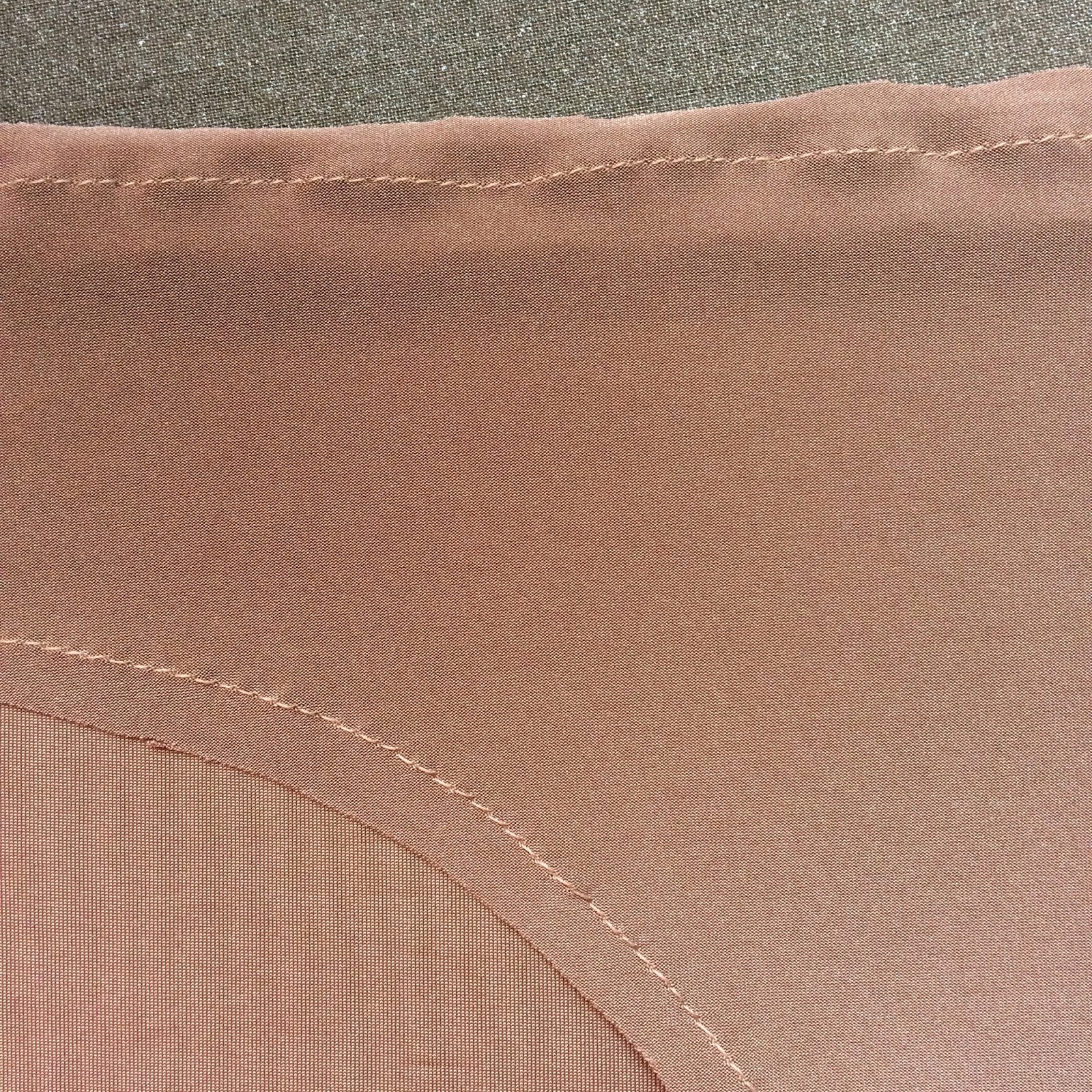
Press the French seam to one side, and catch the lower ends of the zip tape by hand to secure it.

And that’s it!  I also lined this skirt, and in a sheer fabric like this it’s best to French seam the lining too.  I trimmed the zip opening seam allowances of the lining skirt before turing under and hand-stitching them invisibly to the zip tape.

pinterestmail
Switch to mobile version
↓